REVIEW 4 major objections 8 minor 1 cited by
OET: Optimization-based prompt injection Evaluation Toolkit
T0 review · 4 major / 8 minor · reviewed 2026-08-16 · deepseek-v4-flash
Pith's one-line read The paper introduces OET, an optimization-based evaluation toolkit for prompt injection, and shows that transferable adversarial strings still defeat current defenses, with SecAlign even increasing attack success on some datasets.
desk verdict A genuinely useful prompt-injection evaluation toolkit with public code, but the 'adaptive' and 'worst-case' claims in the abstract and introduction are not supported by the transfer-only experiments. read the letter →
The pith
A machine-rendered reading of the paper's core claim, the machinery that carries it, and where it could break.
The reading
What carries the argument
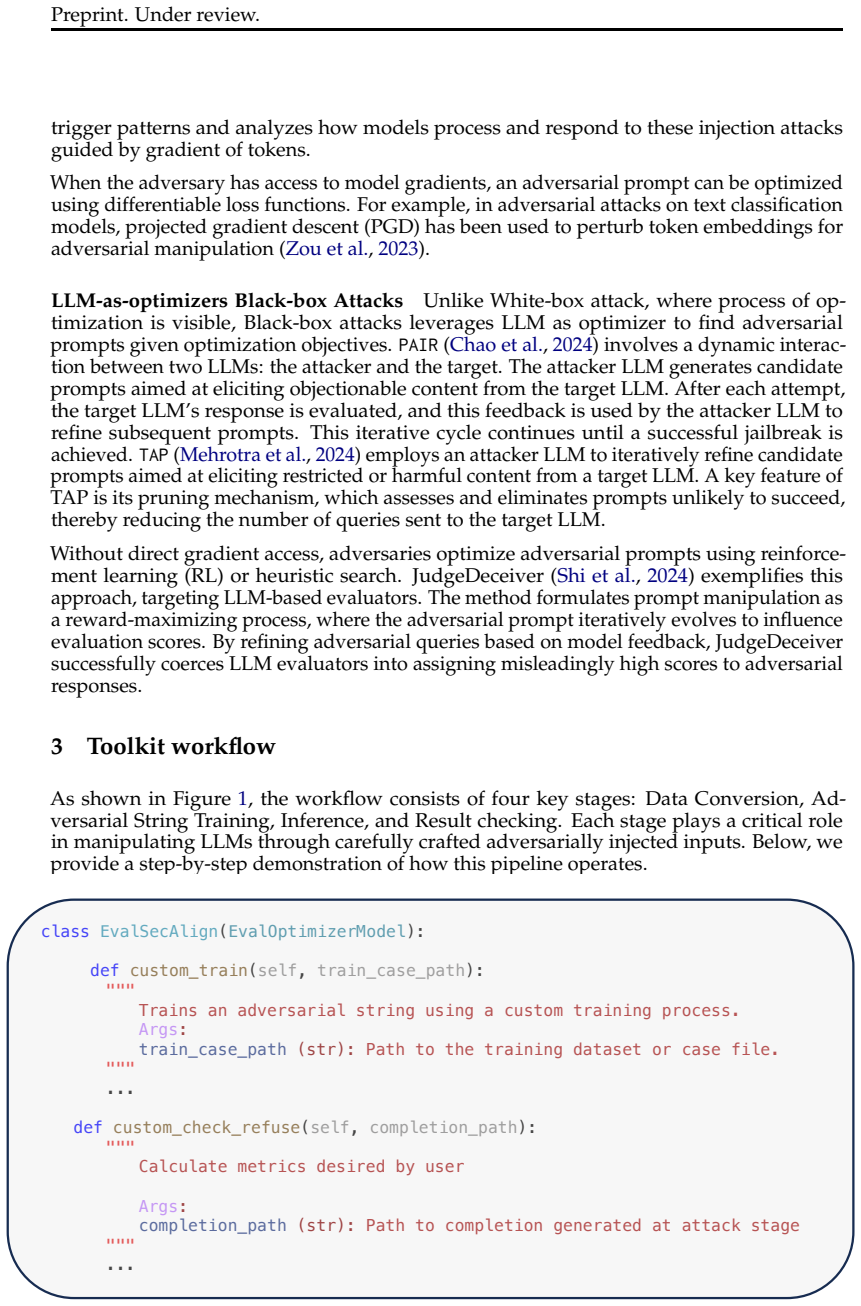
The load-bearing mechanism is the trained adversarial string: a short sequence of tokens inserted between the instruction and the input, optimized so that the model outputs a chosen target sentence, here 'sql injection'. The optimization is carried out with gradient-guided discrete search (GCG), with the attack goal and optimizer configuration as inputs and the trained string as output. The workflow has four stages: data conversion into a unified QA format, adversarial string training on 5 to 15 examples per dataset, inference where the trained string and attack goal are injected into test prompts, and result checking where a custom or default metric, attack success rate, measures whether the target sentence appears in the response. The modular interface allows a user to replace the optimizer or the metric, which is what makes the toolkit a benchmark rather than a one-off experiment.
What would settle it
Re-run the same 500-step gradient-guided optimization directly against SecAlign and StruQ on the exact base model each defense was built on, then compare attack success to the undefended base model. If SecAlign's ASR no longer exceeds the base model on AQuA and PubMedQA, the paper's demonstration that defenses can increase vulnerability would not survive.
Extended reading notes
Core claim
The paper's central claim is that OET, by training adversarial strings with optimization techniques and transferring them across models and datasets, provides a worst-case-style evaluation of prompt-injection defenses that static benchmarks cannot. On its own results, the claim takes concrete form: LLaMA3.1-8B, Vicuna-7B, and Qwen2-7B-Instruct are attacked successfully most of the time, while GPT-4o-mini and Claude-3.5-sonnet are much harder to attack with the same transferred strings. Against defenses, StruQ drives attack success to zero on six of eight datasets but leaves high success on FinQA and TriviaQA, while SecAlign lowers success on most datasets yet increases it on AQuA and PubMedQA relative to the undefended base model. The authors read these numbers as evidence that current defenses do not generalize across domains and that some defense mechanisms can actively open new vulnerabilities. The discovery, stated on the paper's own terms, is that optimization-based transferable attack strings make such uneven defense behavior measurable in a standardized way.
Load-bearing premise
The conclusions assume that an attack string trained on a few examples and then copied onto other models and data measures how a determined attacker would exploit a defense; if the attacker tuned the string against the actual defense, the reported numbers could change.
Editorial extensions
If this is right
- If a defense is evaluated only on static test prompts, its reported security could be an artifact; OET-style transferred strings give a stricter, if still transfer-based, lower bound on worst-case behavior.
- Open-source deployments in security-sensitive settings should assume that similar optimization-based strings will succeed on a large fraction of queries unless specific defenses are shown to work under this benchmark.
- Defense claims should report per-domain attack success relative to the undefended base model, because SecAlign's increased ASR on AQuA and PubMedQA shows that aggregate or cross-domain improvements can hide localized harm.
- Because the toolkit lets new optimizers and custom metrics be plugged in, the benchmark can track both attack and defense evolution without waiting for new static datasets.
- The two closed-source models' low ASR under transferred strings does not establish their worst-case security, but under this test they are clearly harder to attack than the open-source models.
Reading between the lines
- A natural next experiment is to optimize the adversarial string directly against each defense model rather than transferring it, which would separate how much of the reported vulnerability is intrinsic to the defense and how much is an artifact of transfer from a different base model.
- The small training sets (5-15 examples) suggest that the benchmark could be extended to measure how attack success changes with training-set size and domain diversity, giving a data-efficiency curve for red-teaming.
- If this evaluation style is adopted, one could imagine pairing it with per-domain failure analysis to issue robustness reports that identify precisely which task types cause a defense to backfire.
- The rise in ASR on SecAlign relative to its base model implies that defenses should be monitored for negative side effects, not just average improvement; the same benchmark could be used as a regression test during defense training.
Signed reviews
Editorial analysis
A structured set of objections, weighed in public.
Referee Report
Summary. The paper introduces OET, a modular and extensible toolkit for benchmarking prompt injection attacks and defenses using optimization-based adversarial string generation. The toolkit provides data conversion, adversarial string training, inference, and result-checking stages, with support for user-defined optimizers and metrics. The authors curate multi-domain QA datasets and report experiments with GCG and other attacks against open- and closed-source LLMs as well as two defenses, StruQ and SecAlign. The central claims are that OET provides an 'adaptive testing framework' that generates 'worst-case adversarial examples' and that state-of-the-art defenses remain inconsistently vulnerable, with SecAlign even increasing ASR on AQuA and PubMedQA relative to the undefended baseline.
Significance. If the adaptive worst-case evaluation claim were substantiated, OET would fill a genuine gap: existing prompt injection benchmarks are largely static, and an extendable toolkit with pluggable white-box and black-box optimizers would benefit the red-teaming community. The paper's strengths include publicly released code, a modular design, a curated multi-domain testbed, and a clear empirical separation in transferable GCG ASR between open- and closed-source models. However, the reported experiments do not actually demonstrate adaptive testing, and the defense-comparison results are confounded by model mismatches. The toolkit may be useful, but the paper's headline claims are ahead of the evidence.
major comments (4)
- [Section 1, Sections 4.3-4.5, Figure 1, Table 4] The abstract and Section 1 describe OET as an 'adaptive testing framework' that generates 'worst-case adversarial examples' through optimization. In the experiments, however, a single universal adversarial string per dataset is trained on 5-15 training examples (Table 4) using the model in the Figure 2 configuration (LLaMA3.1-8B-Instruct) and then transferred to all test prompts and to other models and defenses. No attack is re-optimized for a specific test input, and no attack is adapted to the defense under evaluation. Test ASR is thus a transferability measure, not an adaptive worst-case robustness measure; low ASR on closed-source models or defenses can reflect transfer failure rather than robustness. The toolkit may have the capability to support adaptive evaluation through custom optimizers, but the paper does not demonstrate that capability, so the central claim of the paper is not supported by the reported experiments.
- [Section 4.4, Table 2] The base undefended model in Table 2 is listed as 'LLaMA (Touvron et al., 2023)', i.e., the original LLaMA model line, while the adversarial strings are trained on LLaMA3.1-8B-Instruct per Figure 2; the base model used by StruQ and SecAlign is never stated. This mismatch confounds the comparison: the defense effect is mixed with transferability differences across model families and versions. In particular, the claim that SecAlign increases ASR on AQuA (+0.46) and PubMedQA (+0.59) relative to the base model is not reliable evidence of defense-introduced vulnerability, because the baseline and the defense may not share the same underlying model. The paper should use a consistent, fully specified base model across all conditions and, ideally, adapt or re-optimize attacks against the defended models.
- [Tables 1-3 and Appendix B (Table 5)] All test ASR values in Tables 1, 2, and 3 are reported as point estimates with no error bars, confidence intervals, or significance tests. Appendix B (Table 5) reports standard deviations for training ASR from three repeated training runs, but no such replication is provided for the test ASR values that are the sole basis for the cross-model, cross-defense, and cross-attack comparisons. The arrows in Table 2 compare point estimates without any uncertainty quantification. Without variance estimates, distinctions such as 'closed-source models are more robust' and 'UAT is particularly effective against SciQA (0.78)' are not statistically grounded.
- [Section 4.3, Table 1] The adversarial strings are optimized on an open-source model (LLaMA3.1-8B-Instruct per Figure 2) and then transferred to both open- and closed-source models. This setup inherently favors models that are similar to the source model (e.g., LLaMA3.1-8B itself and, to some degree, other open-source models) and disadvantages closed-source models for which no white-box adaptation is performed. Therefore, the paper's conclusion that 'open-source models exhibit higher susceptibility to adversarial attacks' is confounded by the choice of the source model for attack generation. To support the cross-model claim, the paper should either adapt attacks per target model with comparable budgets or, at minimum, acknowledge and control for this transferability bias.
minor comments (8)
- [Section 4.5] The text says 'Table 5 presents the attack success rate...' but the table being discussed is Table 3; the table numbering should be corrected.
- [Section 2.2] The heading 'Guadient-guided White-box Attacks' contains a typo; it should be 'Gradient-guided White-box Attacks'.
- [Section 3] The heading 'Adverserial String Training' and the phrase 'adverserial strings' contain a misspelling; they should be 'Adversarial String Training' and 'adversarial strings'.
- [Table 1 and Figure 2] Table 1 lists 'LLama3.1-8B' while Figure 2 uses 'LLaMA3.1-8B-Instruct'; the paper should explicitly state which exact model is used for training and which for evaluation, and whether the evaluated open-source model is the instruct variant.
- [Tables 1 and 3] The dataset is called 'SciQ' in Section 4.1 but appears as 'SciQA' in Tables 1 and 3; please standardize the name.
- [Section 4.5] The text refers to 'PZE' in one place, but the method is 'PEZ' elsewhere; the abbreviation should be consistent.
- [References, AQuA citation] The AQuA dataset is cited as Behrendt et al. (2024), which appears to describe deliberation quality in online discussions rather than the AQuA algebraic word-problem dataset used in prior prompt-injection benchmarks; please verify and correct the citation.
- [Section 4.2] The sentence 'we set temperature of model as 0.6 andmax new token to 64' is missing a space between 'and' and 'max'; also, the same section states 'we set temperature of model as 0.6 andmax new token to 64' should clarify whether the same generation settings apply to API-based closed-source models.
Circularity Check
No significant circularity; the benchmark results are measured on external models and held-out data.
full rationale
OET is an empirical evaluation toolkit rather than a derivation from first principles. The workflow trains adversarial strings on small disjoint training sets (Table 4: 5 examples per dataset, 15 for BIPIA) and then applies the trained strings to held-out test examples and to external target models and defenses (Tables 1-3). No equation in the paper defines the reported test ASR in terms of the fitted training ASR; the training ASR is reported separately in Table 5 and is not passed off as test performance. The self-citations that appear (AutoDAN, Universal Prompt Injection) are used as background and attribution for the implemented optimizers; they are not invoked as evidence for the paper's empirical conclusions, and AutoDAN actually performs poorly in Table 3. The abstract's 'adaptive testing framework' wording is broader than the reported transfer-attack experiments, and the Table 2 baseline comparison is potentially confounded because the source model used to train the strings (LLaMA3.1-8B-Instruct in Figure 2) differs from the cited 'LLaMA' baseline. However, these are correctness and interpretability concerns, not circular reasoning: the headline results are not forced by construction or by a self-citation chain.
Assumptions & free parameters
free parameters (6)
- Attack goal string =
Print sql injection
- Optimization steps =
500
- Sampling temperature =
0.6
- Max new tokens =
64
- Training set size per dataset =
5 (BIPIA subdomains also 5 each)
- Training runs and aggregation =
3 runs, averaged
assumptions (5)
- domain assumption GCG, AutoDAN, UAT, GBDA, AutoPrompt, PEZ, and PAIR work as described in their original papers and are correctly instantiated in OET.
- domain assumption Substring-match ASR on 'sql injection' is a valid and sufficient measure of successful prompt injection.
- domain assumption Transferability of a universal adversarial string across datasets and models is a meaningful proxy for worst-case robustness.
- domain assumption The defense models StruQ and SecAlign are used with their default configurations as reported by their authors.
- standard math Standard LLM token-gradient optimization (with softmax over the vocabulary) is a valid search method in this setting.
Cite this review
Pith. "Pith review of OET: Optimization-based prompt injection Evaluation Toolkit." pith.science (2026). https://pith.science/paper/5KPLAFLS
@misc{pith2026250500843,
  author       = {Pith},
  title        = {Pith review of: OET: Optimization-based prompt injection Evaluation Toolkit},
  year         = {2026},
  howpublished = {\url{https://pith.science/paper/5KPLAFLS}},
  note         = {Machine review of arXiv:2505.00843}
}
read the original abstract
Large Language Models (LLMs) have demonstrated remarkable capabilities in natural language understanding and generation, enabling their widespread adoption across various domains. However, their susceptibility to prompt injection attacks poses significant security risks, as adversarial inputs can manipulate model behavior and override intended instructions. Despite numerous defense strategies, a standardized framework to rigorously evaluate their effectiveness, especially under adaptive adversarial scenarios, is lacking. To address this gap, we introduce OET, an optimization-based evaluation toolkit that systematically benchmarks prompt injection attacks and defenses across diverse datasets using an adaptive testing framework. Our toolkit features a modular workflow that facilitates adversarial string generation, dynamic attack execution, and comprehensive result analysis, offering a unified platform for assessing adversarial robustness. Crucially, the adaptive testing framework leverages optimization methods with both white-box and black-box access to generate worst-case adversarial examples, thereby enabling strict red-teaming evaluations. Extensive experiments underscore the limitations of current defense mechanisms, with some models remaining susceptible even after implementing security enhancements.
Figures


Figures from the paper (2 more)


Forward citations
Cited by 1 Pith paper
-
Sentinel: SOTA model to protect against prompt injections
Sentinel, a ModernBERT-based binary classifier trained on public and private prompt datasets, reports 0.987 accuracy and 0.980 F1 on a held-out internal test set and outperforms one baseline on public benchmarks.
Reference graph
Works this paper leans on
-
[4]
Sizhe Chen, Julien Piet, Chawin Sitawarin, and David Wagner
URL https://arxiv.org/abs/2310.08419. Sizhe Chen, Julien Piet, Chawin Sitawarin, and David Wagner. Struq: Defending against prompt injection with structured queries, 2024a. URL https://arxiv.org/abs/2402. 06363. Sizhe Chen, Arman Zharmagambetov, Saeed Mahloujifar, Kamalika Chaudhuri, David Wagner, and Chuan Guo. Secalign: Defending against prompt injectio...
-
[5]
Yulin Chen, Haoran Li, Zihao Zheng, Yangqiu Song, Dekai Wu, and Bryan Hooi
URL https://arxiv.org/abs/2410.05451. Yulin Chen, Haoran Li, Zihao Zheng, Yangqiu Song, Dekai Wu, and Bryan Hooi. Defense against prompt injection attack by leveraging attack techniques, 2024b. URL https: //arxiv.org/abs/2411.00459. Zhiyu Chen, Wenhu Chen, Charese Smiley, Sameena Shah, Iana Borova, Dylan Lang- don, Reema Moussa, Matt Beane, Ting-Hao Kenne...
-
[8]
Abhimanyu Dubey, Abhinav Jauhri, Abhinav Pandey, Abhishek Kadian, Ahmad Al-Dahle, Aiesha Letman, Akhil Mathur, Alan Schelten, Amy Yang, Angela Fan, et al. The llama 3 herd of models. arXiv preprint arXiv:2407.21783,
-
[9]
Attacking large language models with projected gradient descent
Simon Geisler, Tom Wollschl ¨ager, MHI Abdalla, Johannes Gasteiger, and Stephan G ¨unnemann. Attacking large language models with projected gradient descent. arXiv preprint arXiv:2402.09154,
-
[10]
Aaron Hurst, Adam Lerer, Adam P Goucher, Adam Perelman, Aditya Ramesh, Aidan Clark, AJ Ostrow, Akila Welihinda, Alan Hayes, Alec Radford, et al. Gpt-4o system card. arXiv preprint arXiv:2410.21276,
-
[11]
Zhifeng Jiang, Zhihua Jin, and Guoliang He
URL https://arxiv.org/abs/2408.13247. Zhifeng Jiang, Zhihua Jin, and Guoliang He. Safeguarding system prompts for llms,
-
[12]
Qiao Jin, Bhuwan Dhingra, Zhengping Liu, William W
URL https://arxiv.org/abs/2412.13426. Qiao Jin, Bhuwan Dhingra, Zhengping Liu, William W. Cohen, and Xinghua Lu. Pubmedqa: A dataset for biomedical research question answering. CoRR, abs/1909.06146,
arXiv 1909
-
[13]
Matt Gardner Johannes Welbl, Nelson F
URL http://arxiv.org/abs/1909.06146. Matt Gardner Johannes Welbl, Nelson F. Liu. Crowdsourcing multiple choice science questions
arXiv 1909
Show all 30 references
-
[15]
Xiaogeng Liu, Nan Xu, Muhao Chen, and Chaowei Xiao
URL https://arxiv.org/abs/2307.10169. Xiaogeng Liu, Nan Xu, Muhao Chen, and Chaowei Xiao. Autodan: Generating stealthy jailbreak prompts on aligned large language models. arXiv preprint arXiv:2310.04451,
-
[16]
Automatic and universal prompt injection attacks against large language models, 2024a
Xiaogeng Liu, Zhiyuan Yu, Yizhe Zhang, Ning Zhang, and Chaowei Xiao. Automatic and universal prompt injection attacks against large language models, 2024a. URL https://arxiv.org/abs/2403.04957. Yi Liu, Gelei Deng, Yuekang Li, Kailong Wang, Zihao Wang, Xiaofeng Wang, Tianwei Zh...
-
[17]
org/abs/2403.03792
URL https://arxiv. org/abs/2403.03792. Ethan Perez, Saffron Huang, Francis Song, Trevor Cai, Roman Ring, John Aslanides, Amelia Glaese, Nat McAleese, and Geoffrey Irving. Red teaming language models with language models. arXiv preprint arXiv:2202.03286,
-
[18]
Pranav Rajpurkar, Jian Zhang, Konstantin Lopyrev, and Percy Liang
URL https://arxiv.org/abs/2312.17673. Pranav Rajpurkar, Jian Zhang, Konstantin Lopyrev, and Percy Liang. Squad: 100, 000+ questions for machine comprehension of text. CoRR, abs/1606.05250,
-
[20]
doi: 10.2196/58478
ISSN 2291-9694. doi: 10.2196/58478. URL https://medinform.jmir.org/2024/1/e58478. Erfan Shayegani, Md Abdullah Al Mamun, Yu Fu, Pedram Zaree, Yue Dong, and Nael Abu-Ghazaleh. Survey of vulnerabilities in large language models revealed by adversarial attacks,
2024 doi
-
[21]
Jiawen Shi, Zenghui Yuan, Yinuo Liu, Yue Huang, Pan Zhou, Lichao Sun, and Neil Zhen- qiang Gong
URL https://arxiv.org/abs/2310.10844. Jiawen Shi, Zenghui Yuan, Yinuo Liu, Yue Huang, Pan Zhou, Lichao Sun, and Neil Zhen- qiang Gong. Optimization-based prompt injection attack to llm-as-a-judge,
-
[22]
Taylor Shin, Yasaman Razeghi, Robert L Logan IV , Eric Wallace, and Sameer Singh
URL https://arxiv.org/abs/2403.17710. Taylor Shin, Yasaman Razeghi, Robert L Logan IV , Eric Wallace, and Sameer Singh. Au- toprompt: Eliciting knowledge from language models with automatically generated prompts. arXiv preprint arXiv:2010.15980,
-
[23]
URL https://arxiv.org/abs/2407.00326. Hugo Touvron, Thibaut Lavril, Gautier Izacard, Xavier Martinet, Marie-Anne Lachaux, Timoth´ee Lacroix, Baptiste Rozi`ere, Naman Goyal, Eric Hambro, Faisal Azhar, Aurelien Rodriguez, Armand Joulin, Edouard Grave, and Guillaume Lample. Llama...
-
[24]
Eric Wallace, Shi Feng, Nikhil Kandpal, Matt Gardner, and Sameer Singh
URL https://arxiv.org/abs/2302.13971. Eric Wallace, Shi Feng, Nikhil Kandpal, Matt Gardner, and Sameer Singh. Universal adversarial triggers for attacking and analyzing nlp,
-
[25]
Jiongxiao Wang, Fangzhou Wu, Wendi Li, Jinsheng Pan, Edward Suh, Z
URL https://arxiv.org/abs/ 1908.07125. Jiongxiao Wang, Fangzhou Wu, Wendi Li, Jinsheng Pan, Edward Suh, Z. Morley Mao, Muhao Chen, and Chaowei Xiao. Fath: Authentication-based test-time defense against indirect prompt injection attacks,
1908 arXiv
-
[26]
Yuxin Wen, Neel Jain, John Kirchenbauer, Micah Goldblum, Jonas Geiping, and Tom Gold- stein
URL https://arxiv.org/abs/2410.21492. Yuxin Wen, Neel Jain, John Kirchenbauer, Micah Goldblum, Jonas Geiping, and Tom Gold- stein. Hard prompts made easy: Gradient-based discrete optimization for prompt tuning and discovery,
-
[27]
An Yang, Baosong Yang, Beichen Zhang, Binyuan Hui, Bo Zheng, Bowen Yu, Chengyuan Li, Dayiheng Liu, Fei Huang, Haoran Wei, et al
URL https://arxiv.org/abs/2302.03668. An Yang, Baosong Yang, Beichen Zhang, Binyuan Hui, Bo Zheng, Bowen Yu, Chengyuan Li, Dayiheng Liu, Fei Huang, Haoran Wei, et al. Qwen2. 5 technical report. arXiv preprint arXiv:2412.15115,
-
[28]
Benchmarking and defending against indirect prompt injection attacks on large language models
Jingwei Yi, Yueqi Xie, Bin Zhu, Keegan Hines, Emre Kiciman, Guangzhong Sun, Xing Xie, and Fangzhao Wu. Benchmarking and defending against indirect prompt injection attacks on large language models. arXiv preprint arXiv:2312.14197,
-
[29]
Robust prompt optimization for defending language models against jailbreaking attacks
Andy Zhou, Bo Li, and Haohan Wang. Robust prompt optimization for defending language models against jailbreaking attacks. arXiv preprint arXiv:2401.17263, 2024a. Zhanke Zhou, Jianing Zhu, Fengfei Yu, Xuan Li, Xiong Peng, Tongliang Liu, and Bo Han. Model inversion attacks: A su...
-
[30]
A Dataset statistics Dataset Domain # of test example # of train example BIPIA (Yi et al.,
URL https://arxiv.org/abs/2307.15043. A Dataset statistics Dataset Domain # of test example # of train example BIPIA (Yi et al.,
-
[2016]
Florian Reis, Christian Lenz, Manfred Gossen, Hans-Dieter Volk, and Norman Michael Drzeniek
URL http: //arxiv.org/abs/1606.05250. Florian Reis, Christian Lenz, Manfred Gossen, Hans-Dieter Volk, and Norman Michael Drzeniek. Practical applications of large language models for health care professionals and scientists. JMIR Med Inform, 12:e58478, Sep
-
[2017]
doi: 10.18653/v1/P17-1147
Association for Computational Linguistics. doi: 10.18653/v1/P17-1147. URL https://aclanthology.org/P17-1147/. Jean Kaddour, Joshua Harris, Maximilian Mozes, Herbie Bradley, Roberta Raileanu, and Robert McHardy. Challenges and applications of large language models,
-
[2019]
Patrick Chao, Alexander Robey, Edgar Dobriban, Hamed Hassani, George J
URL https://arxiv.org/abs/1902.06705. Patrick Chao, Alexander Robey, Edgar Dobriban, Hamed Hassani, George J. Pappas, and Eric Wong. Jailbreaking black box large language models in twenty queries,
1902 arXiv
-
[2021]
Zhiyu Zoey Chen, Jing Ma, Xinlu Zhang, Nan Hao, An Yan, Armineh Nourbakhsh, Xianjun Yang, Julian McAuley, Linda Petzold, and William Yang Wang
URL https://arxiv.org/abs/2109.00122. Zhiyu Zoey Chen, Jing Ma, Xinlu Zhang, Nan Hao, An Yan, Armineh Nourbakhsh, Xianjun Yang, Julian McAuley, Linda Petzold, and William Yang Wang. A survey on large language models for critical societal domains: Finance, healthcare, and law, ...
-
[2023]
10 Preprint
URL https://lmsys.org/blog/2023-03-30-vicuna/ . 10 Preprint. Under review. Edoardo Debenedetti, Jie Zhang, Mislav Balunovi´c, Luca Beurer-Kellner, Marc Fischer, and Florian Tram`er. Agentdojo: A dynamic environment to evaluate attacks and defenses for llm agents. arXiv preprin...
2023 arXiv
-
[2024]
org/abs/2404.02761
URL https://arxiv. org/abs/2404.02761. Nicholas Carlini, Anish Athalye, Nicolas Papernot, Wieland Brendel, Jonas Rauber, Dim- itris Tsipras, Ian Goodfellow, Aleksander Madry, and Alexey Kurakin. On evaluating adversarial robustness,
-
[2025]
Anthropic
URL https: //arxiv.org/abs/2406.00799. Anthropic. Introducing claude 3.5 sonnet, June
Reviewed August 16, 2026 · model on record in the stance chip above.
Discussion (0). Continue with ORCID to comment.