REVIEW 3 major objections 5 minor 51 references
Hipandas: Hyperspectral Image Joint Denoising and Super-Resolution by Image Fusion with the Panchromatic Image
T0 review · 3 major / 5 minor · reviewed 2026-08-11 · deepseek-v4-flash
Pith's one-line read A single network jointly denoises and super-resolves hyperspectral images, outperforming sequential pipelines by over 2 dB.
desk verdict A genuinely new joint task with a zero-shot method that beats sequential baselines on simulated data; the self-supervised losses lack an identifiability guarantee, but the empirical comparison largely holds up. read the letter →
The pith
A machine-rendered reading of the paper's core claim, the machinery that carries it, and where it could break.
The reading
What carries the argument
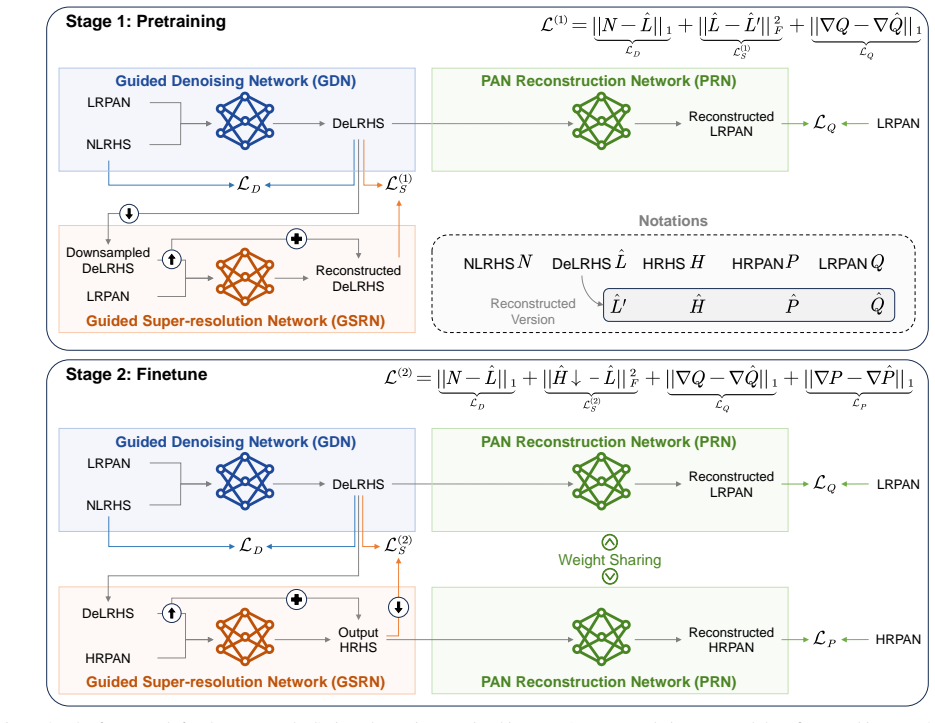
The load-bearing object is the detail-oriented low-rank prior: for an HRHS image $H$ with downsampled LRHS $L$, the clean detail map $D = H - L\uparrow$ has a steep singular-value energy curve, meaning it is strongly low-rank, while noise flattens that curve. The networks GDN and GSRN are built as guided low-rank matrix factorization networks whose output is the product of $r$ base images and spectral coefficients, with $r \ll b$ enforcing low rank; GSRN injects details as $\hat{H} = \hat{L}\uparrow + f(\hat{L}\uparrow, P)$, where $f$ is the predicted detail map. The PRN, a stack of five convolutions, reconstructs the PAN image from the HSI to keep the restored image spectrally consistent with the observed PAN. Training uses an $\ell^1$ reconstruction of the noisy input through the low-rank bottleneck, the downsampling consistency loss $\|\hat{H}\downarrow - \hat{L}\|_F^2$, and Sobel-gradient losses that preserve PAN high frequencies.
What would settle it
On a simulated dataset with known ground truth $H$, construct a scene where one spectral band contains high-frequency spatial detail that is invisible in the PAN image, such as a sharp pattern that cancels under downsampling, and check whether ZSHipandas restores it; if the output matches $\hat{L}$ and $P$ but fails to reproduce $H$, the self-supervised losses are insufficient to determine the true image.
Extended reading notes
Core claim
The central discovery is that a clean, high-resolution hyperspectral image can be reconstructed from a noisy low-resolution HSI and a high-resolution PAN image by a single zero-shot network, and that the detail map—defined as the difference between the high-resolution image and the upsampled low-resolution image—is itself approximately low-rank. The paper builds the guided denoising and super-resolution networks as low-rank matrix factorizations whose output is $\hat{L} = V \times_3 U$, with a PAN-fusion branch generating the base images $V$ and a spectral coefficient branch generating $U$, while a separate PAN reconstruction network enforces that the restored HSI can reproduce the observed PAN image. A two-stage training procedure, pretraining at low resolution and finetuning at high resolution, prevents the super-resolution network from learning a bias toward noise. The result is a method that beats the best sequential combination of state-of-the-art denoisers and pansharpening networks by over 2 dB in PSNR on simulated data and produces visually cleaner, less spectrally distorted images on real PRISMA data.
Load-bearing premise
The self-supervised losses—reconstructing the noisy input through a low-rank bottleneck and matching the downsampled output to the denoised low-resolution image—are assumed to be enough to recover the true clean high-resolution image, so that no signal is lost while noise is removed and the added high-frequency detail is genuine rather than hallucinated.
Editorial extensions
If this is right
- Treating denoising and super-resolution jointly avoids the error accumulation seen when the two tasks are applied sequentially, so the framework is more directly suited to real satellite acquisition chains.
- Because the method is zero-shot, a noisy low-resolution HSI and its PAN image are sufficient for restoration, removing the need for large paired training sets of clean high-resolution hyperspectral images.
- Ablation results indicate that the two-stage training strategy is critical: removing pretraining drops PSNR from 40.61 to 35.94 dB under i.i.d. Gaussian noise with σ = 10.
- The low-rank modeling of the detail map contributes about 3.6 dB over a plain CNN architecture, and removing PAN fusion costs about 6.8 dB, showing both priors are load-bearing.
- Joint training improves denoising itself: ZSHipandas achieves 41.68 dB on the denoised LRHS image versus 40.67 dB for a network trained only for denoising, demonstrating synergy between the two tasks.
Reading between the lines
- The detail-oriented low-rank prior could transfer to other guided fusion problems, such as multispectral-plus-panchromatic sharpening or RGB-guided depth super-resolution, where the residual detail map may also exhibit strong low-rank structure.
- Because training is zero-shot and uses only a single image pair, the same framework might adapt to video or multi-frame fusion with a guide image, though temporal consistency would require additional constraints.
- One implicit risk is that the PAN reconstruction loss could encourage the restored HSI to reproduce the PAN's spatial structure exactly, potentially eroding spectral details that have no counterpart in the PAN image; testing on scenes with such details would delineate the method's limits.
- The reported 1 dB improvement of joint training over denoising alone suggests the super-resolution guidance regularizes denoising; ablating the capacity of the detail branch could quantify how much of this synergy depends specifically on the low-rank detail prior.
Editorial analysis
A structured set of objections, weighed in public.
Referee Report
Summary. The paper proposes Hipandas, a zero-shot framework for joint denoising and super-resolution of noisy low-resolution hyperspectral images (LRHS) using a high-resolution panchromatic (PAN) image as guidance. The method comprises three interconnected networks: a guided denoising network (GDN), a guided super-resolution network (GSRN), and a PAN reconstruction network (PRN), trained with self-supervised losses in a two-stage procedure. The key novelty is a detail-oriented low-rank prior enforced through a low-rank factorization in the GSRN's detail branch. Experiments on simulated data (Gaussian and mixture noise) report consistent improvements over sequential baselines, e.g., PSNR 40.61 dB vs. 38.34 dB for the best baseline under i.i.d. Gaussian noise σ=10 (Table 2), plus a qualitative result on a real PRISMA scene.
Significance. If the central claim holds, the paper makes a practical contribution by addressing a more realistic imaging scenario (simultaneous noise and low resolution) in a zero-shot manner, and the reported gains over sequential pipelines are substantial (1–3 dB across noise levels). The detail low-rank prior is a novel architectural idea, and the ablation study shows that removing it degrades performance by 3.6 dB. However, the self-supervised objective lacks an identifiability guarantee: the losses in Sec. 3.3 do not by themselves single out the true clean HRHS image, and the real-data evaluation is only qualitative. The paper's strengths are its clear problem formulation, the two-stage training strategy with supporting ablations, and reproducible simulated experiments; its main weakness is the absence of a theoretical or empirical analysis of the ambiguity in the super-resolution loss.
major comments (3)
- [Sec. 3.3, Eq. (8)] The super-resolution loss L_S^(2) = ||Hhat↓ − Lhat||_F^2 constrains only the downsampled output. Any high-frequency detail δ with δ↓ = 0 yields exactly the same loss, and the only constraints on δ are the rank-12 low-rank bottleneck of the detail branch (Sec. 3.4) and the PAN gradient losses (Eqs. 5 and 9), which match edges rather than absolute values. The manuscript provides no identifiability argument showing that the true H is uniquely determined by these losses, so the zero-shot claim that the method recovers the clean HRHS image (rather than a visually pleasing but inaccurate sharpened version) is not established. Please add an analysis of the null space of the downsampling operator and how the rank constraint and PAN losses resolve it, or temper the claim and discuss this limitation explicitly.
- [Sec. 3.4] The claim that the clean detail map D = H − L↑ is inherently low-rank is supported only by qualitative energy curves in Fig. 3. There is no quantitative measure (e.g., effective rank, singular-value decay rate) or comparison with alternative priors, and the rank r=12 for the GSRN is chosen without a sensitivity analysis. This is load-bearing because the detail branch is the only high-frequency constraint beyond the PAN gradient terms, so the validity of the detail low-rank prior directly affects the plausibility of the recovered H. Please provide quantitative evidence for the low-rankness of D and an ablation over r.
- [Sec. 4.2] The real-world experiment on the PRISMA Kanpur scene is evaluated only with the no-reference PIQE metric and visual inspection. Since the paper's central claim is that the method yields 'more accurate' HRHS images, this evidence does not confirm accuracy on real data, where no ground truth is available and the identifiability concern from Eq. (8) is most acute. Please either provide a quantitative accuracy assessment on real data (e.g., using a scene with known reference targets or cross-sensor validation) or clearly state that the real-data results are qualitative and that accuracy is only validated on simulated data.
minor comments (5)
- [Sec. 4.1] The text contains 'Fig. Fig. 6' which should be 'Fig. 6'.
- [Sec. 4.4] The sentence 'employing only the GRN component' should read 'GDN component' to match the notation.
- [Sec. 4.2] The phrase 'Restored images by still preserve the unpleasant color' is ungrammatical and should be rewritten.
- [Sec. 3.2] The PRN is described as '5 stacked Conv units' without specifying kernel sizes, strides, or activation details; please provide a complete architectural description or refer to a supplementary document.
- [Sec. 3.3, Eq. (6)] In stage 1, Lhat is used as pseudo ground truth to train the GSRN on downsampled versions of itself; the manuscript should clarify why this self-referential training does not simply drive the GSRN toward the identity mapping.
Circularity Check
No circularity found: the central comparative claim rests on external ground-truth evaluation, and the self-supervised losses are not fitted inputs renamed as predictions.
full rationale
The paper's claimed derivation chain reconstructs a clean HRHS image H from noisy LRHS N and HRPAN P using GDN, GSRN, and PRN with losses in Eqs. (4), (5), (8), and (9). The central claim that ZSHipandas outperforms sequential baselines is evaluated against known ground truth H on simulated data (Tables 2–3), and on a real PRISMA patch via a no-reference metric; no ground-truth value or fitted parameter is renamed as a prediction. Stage 1 uses the denoised output Lhat as pseudo ground truth for super-resolution pretraining (Eq. 6), and Stage 2 enforces only downsampling consistency (Eq. 8); this is a self-supervised identifiability assumption, not a circular reduction, because H is never observed during training and the evaluation is external. The detail low-rank prior is an empirical observation from Fig. 3 rather than a consequence of the objective, and it is built into the architecture rather than fitted to the test output. Self-citations ([26], [32], [44], [45]) appear in related work and as compared baselines, but they do not carry the central argument; the low-rank HSI prior is also supported by external citations. The concern that any Hhat = Lhat↑ + δ with δ↓ = 0 satisfies Eq. (8) is a robustness/identifiability limitation of the self-supervised losses, not a case where the prediction reduces to its inputs by construction. Overall, no load-bearing circular step is present.
Assumptions & free parameters
free parameters (3)
- GDN rank r =
3
- GSRN rank r =
12
- Number of channels in networks =
128
assumptions (5)
- domain assumption The observed noisy low-resolution HSI is modeled as N = H down + epsilon, where H is the clean HRHS and epsilon is noise.
- domain assumption PAN and HS images share similar spatial textures, so PAN can guide denoising and super-resolution.
- ad hoc to paper The detail map D = H - L up is inherently low-rank for natural HSI data.
- ad hoc to paper The self-supervised losses (reconstruction of noisy input, downsampling consistency, PAN reconstruction) are sufficient to train the networks to recover the true clean HRHS image.
- domain assumption A learned PRN network can adequately model the spectral relationship between PAN and HS images.
Cite this review
Pith. "Pith review of Hipandas: Hyperspectral Image Joint Denoising and Super-Resolution by Image Fusion with the Panchromatic Image." pith.science (2026). https://pith.science/paper/5MFQME4T
@misc{pith2026241204201,
  author       = {Pith},
  title        = {Pith review of: Hipandas: Hyperspectral Image Joint Denoising and Super-Resolution by Image Fusion with the Panchromatic Image},
  year         = {2026},
  howpublished = {\url{https://pith.science/paper/5MFQME4T}},
  note         = {Machine review of arXiv:2412.04201}
}
read the original abstract
Hyperspectral images (HSIs) are frequently noisy and of low resolution due to the constraints of imaging devices. Recently launched satellites can concurrently acquire HSIs and panchromatic (PAN) images, enabling the restoration of HSIs to generate clean and high-resolution imagery through fusing PAN images for denoising and super-resolution. However, previous studies treated these two tasks as independent processes, resulting in accumulated errors. This paper introduces \textbf{H}yperspectral \textbf{I}mage Joint \textbf{Pand}enoising \textbf{a}nd Pan\textbf{s}harpening (Hipandas), a novel learning paradigm that reconstructs HRHS images from noisy low-resolution HSIs (LRHS) and high-resolution PAN images. The proposed zero-shot Hipandas framework consists of a guided denoising network, a guided super-resolution network, and a PAN reconstruction network, utilizing an HSI low-rank prior and a newly introduced detail-oriented low-rank prior. The interconnection of these networks complicates the training process, necessitating a two-stage training strategy to ensure effective training. Experimental results on both simulated and real-world datasets indicate that the proposed method surpasses state-of-the-art algorithms, yielding more accurate and visually pleasing HRHS images.
Figures


Figures from the paper (4 more)


Reference graph
Works this paper leans on
-
[1]
Naveed Akhtar, Faisal Shafait, and Ajmal S. Mian. Bayesian sparse representation for hyperspectral image super resolu- tion. In CVPR, pages 3631–3640, 2015. 2
work page 2015
-
[2]
Naveed Akhtar, Faisal Shafait, and Ajmal S. Mian. Hier- archical beta process with gaussian process prior for hyper- spectral image super resolution. In ECCV, pages 103–120,
-
[3]
Deep spatial-spectral global reasoning network for hyper- spectral image denoising
Xiangyong Cao, Xueyang Fu, Chen Xu, and Deyu Meng. Deep spatial-spectral global reasoning network for hyper- spectral image denoising. IEEE TGRS, 60:1–14, 2022. 2
work page 2022
-
[4]
Zero-shot hy- perspectral sharpening
Renwei Dian, Anjing Guo, and Shutao Li. Zero-shot hy- perspectral sharpening. IEEE TPAMI, 45(10):12650–12666,
-
[5]
Spec- tral super-resolution via model-guided cross-fusion network
Renwei Dian, Tianci Shan, Wei He, and Haibo Liu. Spec- tral super-resolution via model-guided cross-fusion network. IEEE TNNLS, 35(7):10059–10070, 2024. 1
work page 2024
-
[6]
Learning a deep convolutional network for image super-resolution
Chao Dong, Chen Change Loy, Kaiming He, and Xiaoou Tang. Learning a deep convolutional network for image super-resolution. In ECCV, pages 184–199, 2014. 2
work page 2014
-
[7]
Wenqian Dong, Yufei Yang, Jiahui Qu, Weiying Xie, and Yunsong Li. Fusion of hyperspectral and panchromatic im- ages using generative adversarial network and image seg- mentation. IEEE TGRS, 60:5508413, 2022. 2
work page 2022
-
[8]
Jian Fang, Jingxiang Yang, Abdolraheem Khader, and Liang Xiao. MIMO-SST: multi-input multi-output spatial-spectral transformer for hyperspectral and multispectral image fu- sion. IEEE TGRS, 62:5510020, 2024. 1
work page 2024
Show all 51 references
-
[9]
Atkinson, and Jon Atli Benediktsson
Pedram Ghamisi, Behnood Rasti, Naoto Yokoya, Qunming Wang, Bernhard Hofle, Lorenzo Bruzzone, Francesca Bo- volo, Mingmin Chi, Katharina Anders, Richard Gloaguen, Peter M. Atkinson, and Jon Atli Benediktsson. Multisource and multitemporal data fusion in remote sensing: A compre...
2019
-
[10]
Band-wise hyperspectral image pansharp- ening using CNN model propagation
Giuseppe Guarino, Matteo Ciotola, Gemine Vivone, and Giuseppe Scarpa. Band-wise hyperspectral image pansharp- ening using CNN model propagation. IEEE TGRS , 62: 5500518, 2024. 2, 7
2024
-
[11]
Spectral response function-guided deep optimization-driven network for spectral super-resolution
Jiang He, Jie Li, Qiangqiang Yuan, Huanfeng Shen, and Liangpei Zhang. Spectral response function-guided deep optimization-driven network for spectral super-resolution. IEEE TNNLS, 33(9):4213–4227, 2022. 6
2022
-
[12]
Two spectral-spatial implicit neural representations for arbitrary-resolution hyperspectral pansharpening
Lin He, Zhou Fang, Jun Li, Jocelyn Chanussot, and Antonio Plaza. Two spectral-spatial implicit neural representations for arbitrary-resolution hyperspectral pansharpening. IEEE TGRS, 62:5513621, 2024. 1
2024
-
[13]
Non-local meets global: An iterative paradigm for hyperspectral image restoration
Wei He, Quanming Yao, Chao Li, Naoto Yokoya, Qibin Zhao, Hongyan Zhang, and Liangpei Zhang. Non-local meets global: An iterative paradigm for hyperspectral image restoration. IEEE TPAMI, 44(4):2089–2107, 2022. 2
2022
-
[14]
Hyperspectral image super-resolution via intrafusion network
Jing Hu, Xiuping Jia, Yunsong Li, Gang He, and Minghua Zhao. Hyperspectral image super-resolution via intrafusion network. IEEE TGRS, 58(10):7459–7471, 2020. 2
2020
-
[15]
Learn- ing spatial-spectral prior for super-resolution of hyperspec- tral imagery
Junjun Jiang, He Sun, Xianming Liu, and Jiayi Ma. Learn- ing spatial-spectral prior for super-resolution of hyperspec- tral imagery. IEEE TCI, 6:1082–1096, 2020. 2
2020
-
[16]
Spatial-spectral transformer for hyperspectral image denoising
Miaoyu Li, Ying Fu, and Yulun Zhang. Spatial-spectral transformer for hyperspectral image denoising. In AAAI, pages 1368–1376, 2023. 2
2023
-
[17]
Spectral enhanced rectangle transformer for hyperspectral image denoising
Miaoyu Li, Ji Liu, Ying Fu, Yulun Zhang, and Dejing Dou. Spectral enhanced rectangle transformer for hyperspectral image denoising. In CVPR, pages 5805–5814, 2023. 2
2023
-
[18]
Exploring the rela- tionship between 2d/3d convolution for hyperspectral image super-resolution
Qiang Li, Qi Wang, and Xuelong Li. Exploring the rela- tionship between 2d/3d convolution for hyperspectral image super-resolution. IEEE TGRS, 59(10):8693–8703, 2021. 2
2021
-
[19]
Hyperspectral and panchromatic images fusion based on the dual condi- tional diffusion models
Shuangliang Li, Siwei Li, and Lihao Zhang. Hyperspectral and panchromatic images fusion based on the dual condi- tional diffusion models. IEEE TGRS, 61:5526315, 2023. 2
2023
-
[20]
Hyperspectral image super-resolution using deep convo- lutional neural network
Yunsong Li, Jing Hu, Xi Zhao, Weiying Xie, and Jiaojiao Li. Hyperspectral image super-resolution using deep convo- lutional neural network. Neurocomputing, 266:29–41, 2017. 2
2017
-
[21]
Swinir: Image restora- tion using swin transformer
Jingyun Liang, Jiezhang Cao, Guolei Sun, Kai Zhang, Luc Van Gool, and Radu Timofte. Swinir: Image restora- tion using swin transformer. In ICCVW, pages 1833–1844,
-
[22]
Cascaded convolutional neural network- based hyperspectral image resolution enhancement via an auxiliary panchromatic image
Xiaochen Lu, Junping Zhang, Dezheng Yang, Longting Xu, and Fengde Jia. Cascaded convolutional neural network- based hyperspectral image resolution enhancement via an auxiliary panchromatic image. IEEE TIP , 30:6815–6828,
-
[23]
Hyperspectral image spatial super-resolution via 3d full convolutional neural network
Shaohui Mei, Xin Yuan, Jingyu Ji, Yifan Zhang, Shuai Wan, and Qian Du. Hyperspectral image spatial super-resolution via 3d full convolutional neural network. Remote. Sens., 9 (11):1139, 2017. 2
2017
-
[24]
DDS2M: self-supervised denoising diffusion spatio- spectral model for hyperspectral image restoration
Yuchun Miao, Lefei Zhang, Liangpei Zhang, and Dacheng Tao. DDS2M: self-supervised denoising diffusion spatio- spectral model for hyperspectral image restoration. In ICCV, pages 12052–12062, 2023. 2
2023
-
[25]
Trq3dnet: A 3d quasi-recurrent and transformer based network for hyper- spectral image denoising
Li Pang, Weizhen Gu, and Xiangyong Cao. Trq3dnet: A 3d quasi-recurrent and transformer based network for hyper- spectral image denoising. Remote. Sens., 14(18):4598, 2022. 2
2022
-
[26]
Hir-diff: Unsupervised hyper- spectral image restoration via improved diffusion models
Li Pang, Xiangyu Rui, Long Cui, Hongzhong Wang, Deyu Meng, and Xiangyong Cao. Hir-diff: Unsupervised hyper- spectral image restoration via improved diffusion models. In CVPR, pages 3005–3014, 2024. 2, 7
2024
-
[27]
Patel and Manjunath V
Rakesh C. Patel and Manjunath V . Joshi. Super-resolution of hyperspectral images: Use of optimum wavelet filter coeffi- cients and sparsity regularization. IEEE TGRS, 53(4):1728– 1736, 2015. 2
2015
-
[28]
Enhanced 3dtv regularization and its ap- plications on HSI denoising and compressed sensing
Jiangjun Peng, Qi Xie, Qian Zhao, Yao Wang, Yee Leung, and Deyu Meng. Enhanced 3dtv regularization and its ap- plications on HSI denoising and compressed sensing. IEEE TIP, 29:7889–7903, 2020. 2
2020
-
[29]
Low-rank and sparse 9 representation for hyperspectral image processing: A review
Jiangtao Peng, Weiwei Sun, Heng-Chao Li, Wei Li, Xi- angchao Meng, Chiru Ge, and Qian Du. Low-rank and sparse 9 representation for hyperspectral image processing: A review. IEEE Geoscience and Remote Sensing Magazine , 10(1):10– 43, 2022. 1
2022
-
[30]
Exact decomposition of joint low rankness and local smoothness plus sparse matrices
Jiangjun Peng, Yao Wang, Hong-Ying Zhang, Jianjun Wang, and Deyu Meng. Exact decomposition of joint low rankness and local smoothness plus sparse matrices. IEEE TPAMI, 45 (5):5766–5781, 2023. 2
2023
-
[31]
MSSL: hyperspectral and panchro- matic images fusion via multiresolution spatial-spectral fea- ture learning networks
Jiahui Qu, Yanzi Shi, Weiying Xie, Yunsong Li, Xianyun Wu, and Qian Du. MSSL: hyperspectral and panchro- matic images fusion via multiresolution spatial-spectral fea- ture learning networks. IEEE TGRS, 60:5504113, 2022. 2
2022
-
[32]
Unsupervised hyperspectral pansharpening via low-rank diffusion model
Xiangyu Rui, Xiangyong Cao, Li Pang, Zeyu Zhu, Zong- sheng Yue, and Deyu Meng. Unsupervised hyperspectral pansharpening via low-rank diffusion model. Inf. Fusion , 107:102325, 2024. 2, 7
2024
-
[33]
MFT-GAN: A multiscale feature-guided transformer net- work for unsupervised hyperspectral pansharpening
Yanli Shang, Jianjun Liu, Jingyi Zhang, and Zebin Wu. MFT-GAN: A multiscale feature-guided transformer net- work for unsupervised hyperspectral pansharpening. IEEE TRGS, 62:5518516, 2024. 1
2024
-
[34]
Hyperfusion: A computational approach for hy- perspectral, multispectral, and panchromatic image fusion
Xin Tian, Wei Zhang, Yuerong Chen, Zhongyuan Wang, and Jiayi Ma. Hyperfusion: A computational approach for hy- perspectral, multispectral, and panchromatic image fusion. IEEE TGRS, 60:1–16, 2022. 2
2022
-
[35]
Guaranteed tensor recovery fused low-rankness and smoothness
Hailin Wang, Jiangjun Peng, Wenjin Qin, Jianjun Wang, and Deyu Meng. Guaranteed tensor recovery fused low-rankness and smoothness. IEEE TPAMI, 45(9):10990–11007, 2023. 2
2023
-
[36]
A general paradigm with detail-preserving conditional in- vertible network for image fusion
Wu Wang, Liang-Jian Deng, Ran Ran, and Gemine Vivone. A general paradigm with detail-preserving conditional in- vertible network for image fusion. IJCV, 132(4):1029–1054,
-
[37]
Hyperspectral im- age super-resolution via recurrent feedback embedding and spatial-spectral consistency regularization
Xinya Wang, Jiayi Ma, and Junjun Jiang. Hyperspectral im- age super-resolution via recurrent feedback embedding and spatial-spectral consistency regularization. IEEE TGRS, 60: 1–13, 2022. 2
2022
-
[38]
Hyperspectral image restoration via total variation regularized low-rank tensor decomposition
Yao Wang, Jiangjun Peng, Qian Zhao, Yee Leung, Xi-Le Zhao, and Deyu Meng. Hyperspectral image restoration via total variation regularized low-rank tensor decomposition. IEEE JSTARS, 11(4):1227–1243, 2018. 2
2018
-
[39]
Enhancing hyperspectral images via dif- fusion model and group-autoencoder super-resolution net- work
Zhaoyang Wang, Dongyang Li, Mingyang Zhang, Hao Luo, and Maoguo Gong. Enhancing hyperspectral images via dif- fusion model and group-autoencoder super-resolution net- work. In AAAI, pages 5794–5804, 2024. 2
2024
-
[40]
3-d quasi-recurrent neural network for hyperspectral image denoising
Kaixuan Wei, Ying Fu, and Hua Huang. 3-d quasi-recurrent neural network for hyperspectral image denoising. IEEE TNNLS, 32(1):363–375, 2021. 2
2021
-
[41]
Hsr-diff: Hyperspectral image super- resolution via conditional diffusion models
Chanyue Wu, Dong Wang, Yunpeng Bai, Hanyu Mao, Ying Li, and Qiang Shen. Hsr-diff: Hyperspectral image super- resolution via conditional diffusion models. In ICCV, pages 7060–7070, 2023. 2
2023
-
[42]
Ediffsr: An efficient diffusion prob- abilistic model for remote sensing image super-resolution
Yi Xiao, Qiangqiang Yuan, Kui Jiang, Jiang He, Xianyu Jin, and Liangpei Zhang. Ediffsr: An efficient diffusion prob- abilistic model for remote sensing image super-resolution. IEEE TGRS, 62:5601514, 2024. 2
2024
-
[43]
Multitask sparse representation model-inspired network for hyperspectral image denoising
Fengchao Xiong, Jiantao Zhou, Jun Zhou, Jianfeng Lu, and Yuntao Qian. Multitask sparse representation model-inspired network for hyperspectral image denoising. IEEE TGRS, 61: 5518515, 2023. 2
2023
-
[44]
Deep gradient projection networks for pan-sharpening
Shuang Xu, Jiangshe Zhang, Zixiang Zhao, Kai Sun, Junmin Liu, and Chunxia Zhang. Deep gradient projection networks for pan-sharpening. In CVPR, pages 1366–1375, 2021. 6
2021
-
[45]
Pan-denoising: Guided hyperspectral image denoising via weighted represent coefficient total variation
Shuang Xu, Qiao Ke, Jiangjun Peng, Xiangyong Cao, and Zixiang Zhao. Pan-denoising: Guided hyperspectral image denoising via weighted represent coefficient total variation. IEEE TGRS, 62:5528714, 2024. 3, 7
2024
-
[46]
Overview frequency principle/spectral bias in deep learning
Zhi-Qin John Xu, Yaoyu Zhang, and Tao Luo. Overview frequency principle/spectral bias in deep learning. arXiv, 2201.07395, 2022. 3
2022 arXiv
-
[47]
Hyperspectral image denoising employ- ing a spatial-spectral deep residual convolutional neural net- work
Qiangqiang Yuan, Qiang Zhang, Jie Li, Huanfeng Shen, and Liangpei Zhang. Hyperspectral image denoising employ- ing a spatial-spectral deep residual convolutional neural net- work. IEEE TGRS, 57(2):1205–1218, 2019. 2
2019
-
[48]
Unmixing diffusion for self-supervised hyperspectral image denoising
Haijin Zeng, Jiezhang Cao, Kai Zhang, Yongyong Chen, Hiep Luong, and Wilfried Philips. Unmixing diffusion for self-supervised hyperspectral image denoising. In CVPR, pages 27820–27830, 2024. 2
2024
-
[49]
Hyperspectral image restoration using low-rank matrix recovery
Hongyan Zhang, Wei He, Liangpei Zhang, Huanfeng Shen, and Qiangqiang Yuan. Hyperspectral image restoration using low-rank matrix recovery. IEEE TGRS , 52(8):4729–4743,
-
[50]
Three- dimension spatial-spectral attention transformer for hyper- spectral image denoising
Qiang Zhang, Yushuai Dong, Yaming Zheng, Haoyang Yu, Meiping Song, Lifu Zhang, and Qiangqiang Yuan. Three- dimension spatial-spectral attention transformer for hyper- spectral image denoising. IEEE TGRS , 62:5531213, 2024. 1
2024
-
[51]
Hyperspectral image de- noising: From model-driven, data-driven, to model-data- driven
Qiang Zhang, Yaming Zheng, Qiangqiang Yuan, Meiping Song, Haoyang Yu, and Yi Xiao. Hyperspectral image de- noising: From model-driven, data-driven, to model-data- driven. IEEE TNNLS, 35(10):13143–13163, 2024. 1 10
2024
Reviewed August 11, 2026 · model on record in the stance chip above.
Discussion (0). Continue with ORCID to comment.