Locating the Production Sites of High-Energy Neutrinos in Blazar Jets
Pith reviewed 2026-06-28 13:25 UTC · model grok-4.3
The pith
Neutrino production in blazar jets requires the emitting region to be physically separated from the main electromagnetic emission zone.
A machine-rendered reading of the paper's core claim, the machinery that carries it, and where it could break.
Core claim
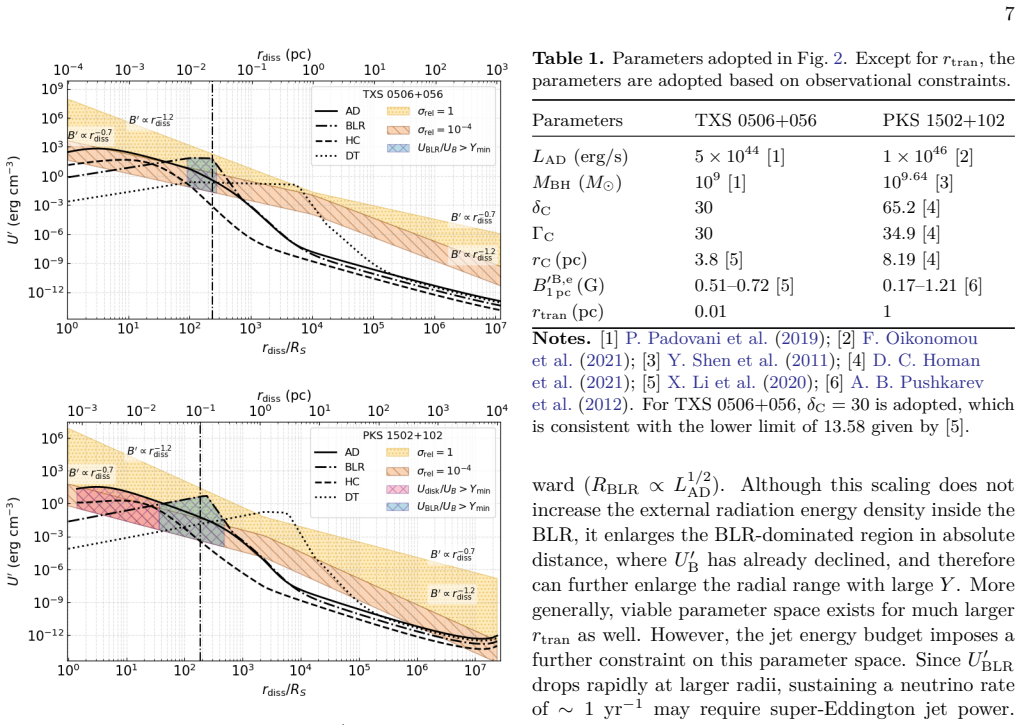
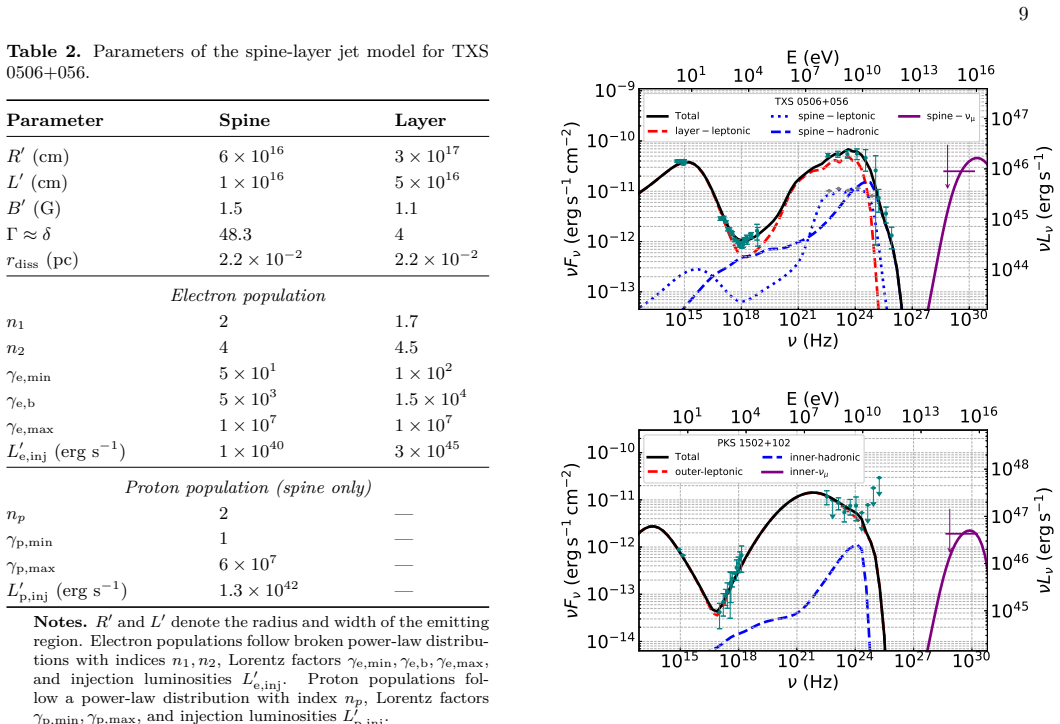
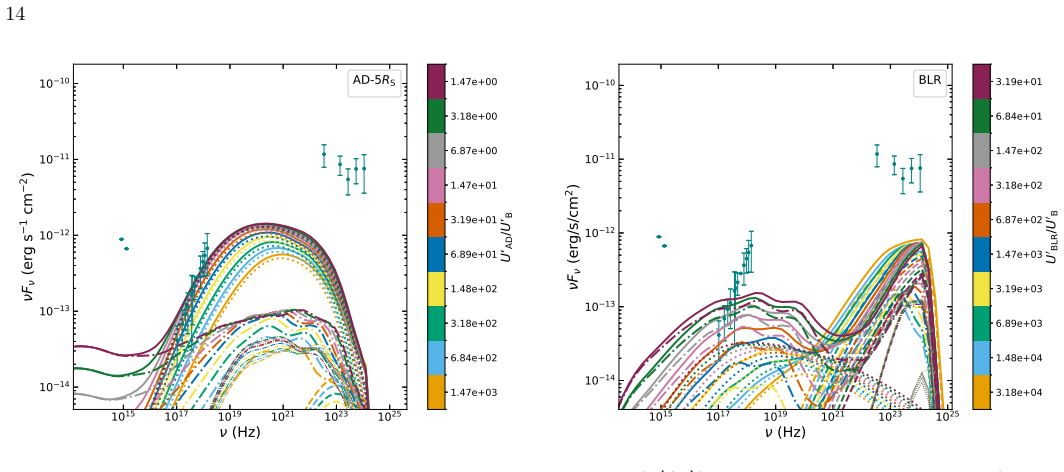
Efficient neutrino production requires an external radiation field stronger than the magnetic field in the jet frame. This environment enhances the efficiency of photohadronic interactions but also suppresses synchrotron radiation from secondary pairs, thereby avoiding overshooting the hard X-ray data. Such conditions can be achieved in regions near or within the broad-line region. However, assuming a single emission zone, these conditions are generally inconsistent with the double-bump flux ratio of the observed broadband emission. This implies that the neutrino-emitting region should be physically separated from the dominant electromagnetic emission zone. Such a scenario can be realized ei
What carries the argument
The ratio of external radiation field energy density to magnetic field energy density in the jet frame, which controls the efficiency of photohadronic neutrino production versus unwanted secondary synchrotron emission.
If this is right
- Efficient neutrino production occurs near or within the broad-line region.
- Single-zone models cannot simultaneously match both efficient neutrino production and the observed double-bump flux ratios.
- The neutrino-emitting region must be physically separated from the dominant electromagnetic emission zone.
- Separation is possible if the jet completes acceleration within sub-parsec scales or possesses a large intrinsic bulk Lorentz factor.
- These uncommon jet properties explain the observed rarity of blazar-neutrino associations.
Where Pith is reading between the lines
- Multi-zone modeling is required to locate neutrino production sites consistently with electromagnetic data.
- High-resolution radio observations of jet structure on sub-parsec scales could identify which blazars are likely neutrino sources.
- The same separation logic may constrain production sites for other high-energy particles or radiation components in jets.
Load-bearing premise
Single-zone emission modeling of the observed double-bump flux ratio provides a reliable test of consistency with the conditions required for neutrino production.
What would settle it
Detection of high-energy neutrinos from a blazar whose broadband spectrum is well described by a single-zone model that simultaneously satisfies the neutrino-production conditions without requiring physical separation of the sites.
Figures



read the original abstract
The production sites of high-energy neutrinos in blazar jets remain poorly constrained. In this work, we investigate the physical conditions required for efficient neutrino production by combining radio-constrained jet properties with multi-zone emission modeling. We show that efficient neutrino production requires an external radiation field stronger than the magnetic field in the jet frame. This environment not only enhances the efficiency of photohadronic interactions but also suppresses synchrotron radiation from secondary pairs, thereby avoiding overshooting the hard X-ray data. Such conditions can be achieved in regions near or within the broad-line region. However, assuming a single emission zone, these conditions are generally inconsistent with the double-bump flux ratio of the observed broadband emission. This implies that the neutrino-emitting region should be physically separated from the dominant electromagnetic emission zone. We further show that such a scenario can be realized either if the jet completes its acceleration within sub-parsec scales or if the bulk Lorentz factor is intrinsically large, both of which appear uncommon based on current observations. These results provide a natural explanation for the rarity of blazar-neutrino associations and highlight the importance of constraining jet structure at small scales to identify promising neutrino-emitting blazars.
Editorial analysis
A structured set of objections, weighed in public.
Referee Report
Summary. The paper claims that efficient high-energy neutrino production in blazar jets requires an external radiation field stronger than the magnetic field (in the jet frame) to enhance photohadronic interactions while suppressing secondary-pair synchrotron emission below hard X-ray limits. Such conditions can occur near or within the broad-line region but are generally inconsistent with observed double-bump flux ratios under single-zone assumptions, implying physically separated neutrino and electromagnetic emission zones. The required conditions are realized only if the jet completes acceleration within sub-parsec scales or has intrinsically large bulk Lorentz factor, both uncommon per current observations; this explains the rarity of blazar-neutrino associations.
Significance. If the central claims hold, the work offers a physically motivated explanation for the scarcity of neutrino-blazar associations and underscores the value of small-scale jet structure constraints. The integration of radio-constrained jet properties with multi-zone emission modeling is a constructive approach that ties observable radio scales to neutrino production physics.
major comments (1)
- [Sections applying radio-derived jet parameters to the neutrino-emitting region and the rarity assessment] The assessment that required neutrino-production conditions are uncommon rests on radio-constrained values of B, Gamma, and opening angle applied to sub-pc scales. Because radio emission originates at parsec scales, the lack of explicit radial-evolution modeling for the decline in B or continued acceleration between these scales and the neutrino zone introduces an unpropagated systematic uncertainty into the rarity conclusion and the multi-zone SED consistency test.
minor comments (2)
- Clarify the precise definition and normalization of the external radiation energy density u_ext relative to the magnetic energy density in the jet frame when stating the u_ext > B condition.
- The abstract would benefit from naming the specific sources or sample size used for the broadband SED modeling.
Simulated Author's Rebuttal
We thank the referee for the constructive feedback. We address the single major comment below and will revise the manuscript accordingly.
read point-by-point responses
-
Referee: [Sections applying radio-derived jet parameters to the neutrino-emitting region and the rarity assessment] The assessment that required neutrino-production conditions are uncommon rests on radio-constrained values of B, Gamma, and opening angle applied to sub-pc scales. Because radio emission originates at parsec scales, the lack of explicit radial-evolution modeling for the decline in B or continued acceleration between these scales and the neutrino zone introduces an unpropagated systematic uncertainty into the rarity conclusion and the multi-zone SED consistency test.
Authors: We agree that applying parsec-scale radio constraints directly to sub-parsec neutrino zones without explicit radial modeling of B(r) or Gamma(r) introduces a systematic uncertainty. Radio observations typically probe larger scales where the jet has already expanded, so B is lower and Gamma may be higher than at the neutrino site. In our analysis these values were used as representative benchmarks drawn from the literature on blazar jets; however, we acknowledge that a full propagation of the radial evolution would strengthen the quantitative rarity assessment. In revision we will add a dedicated paragraph discussing the expected scalings (B ∝ r^-1 or steeper, possible continued acceleration) and their effect on the B < u_ext condition and the double-bump inconsistency, noting that the conclusions remain qualitatively robust but that the precise fraction of jets satisfying the criteria carries this caveat. We will also clarify that detailed MHD jet simulations are beyond the present scope. revision: yes
Circularity Check
No circularity: derivation uses external radio constraints and standard photohadronic physics without self-referential reduction
full rationale
The paper derives the u_ext > B requirement from photohadronic interaction efficiency and secondary-pair synchrotron suppression, then compares the resulting conditions against observed double-bump ratios under single-zone assumptions. Radio-constrained jet parameters (B, Gamma, opening angle) serve as external inputs rather than quantities fitted to the neutrino or X-ray data within the same model. No equations reduce a prediction to a fitted parameter by construction, no self-citation chain bears the central claim, and the rarity conclusion rests on independent observational statistics. The derivation chain therefore remains self-contained against external benchmarks.
Axiom & Free-Parameter Ledger
Reference graph
Works this paper leans on
-
[1]
Physical Review Letters , archivePrefix = "arXiv", eprint =
Aartsen, M. G., Abbasi, R., Abdou, Y., et al. 2013, PhRvL, 111, 021103, doi: 10.1103/PhysRevLett.111.021103
-
[2]
G., Ackermann, M., Adams, J., et al
Aartsen, M. G., Ackermann, M., Adams, J., et al. 2014, PhRvL, 113, 101101, doi: 10.1103/PhysRevLett.113.101101
-
[3]
G., Ackermann, M., Adams, J., et al
Aartsen, M. G., Ackermann, M., Adams, J., et al. 2017a, ApJ, 849, 67, doi: 10.3847/1538-4357/aa8dfb
-
[4]
The Contribution of Fermi-2LAC Blazars to Diffuse TeV-PeV Neutrino Flux
Aartsen, M. G., Abraham, K., Ackermann, M., et al. 2017b, ApJ, 835, 45, doi: 10.3847/1538-4357/835/1/45
-
[5]
G., Ackermann, M., Adams, J., et al
Aartsen, M. G., Ackermann, M., Adams, J., et al. 2020, PhRvL, 124, 051103, doi: 10.1103/PhysRevLett.124.051103
-
[6]
2022, ApJ, 938, 38, doi: 10.3847/1538-4357/ac8de4
Abbasi, R., Ackermann, M., Adams, J., et al. 2022, ApJ, 938, 38, doi: 10.3847/1538-4357/ac8de4
-
[7]
2023, ApJS, 269, 25, doi: 10.3847/1538-4365/acfa95
Abbasi, R., Ackermann, M., Adams, J., et al. 2023, ApJS, 269, 25, doi: 10.3847/1538-4365/acfa95
-
[8]
2024, ApJ, 973, 97, doi: 10.3847/1538-4357/ad643d
Abbasi, R., Ackermann, M., Adams, J., et al. 2024, ApJ, 973, 97, doi: 10.3847/1538-4357/ad643d
-
[9]
2025, arXiv e-prints, arXiv:2507.03989, doi: 10.48550/arXiv.2507.03989
Abbasi, R., Ackermann, M., Adams, J., et al. 2025, arXiv e-prints, arXiv:2507.03989, doi: 10.48550/arXiv.2507.03989
-
[10]
The Spectral Energy Distribution of Fermi Bright Blazars.Astrophys
Abdo, A. A., Ackermann, M., Agudo, I., et al. 2010, ApJ, 716, 30, doi: 10.1088/0004-637X/716/1/30
-
[11]
2015, ApJS, 218, 23, doi: 10.1088/0067-0049/218/2/23
Acero, F., Ackermann, M., Ajello, M., et al. 2015, ApJS, 218, 23, doi: 10.1088/0067-0049/218/2/23
-
[12]
A., Atoian, A
Aharonian, F. A., Atoian, A. M., & Nagapetian, A. M. 1983, Astrofizika, 19, 323
1983
-
[13]
Ansoldi, S., Antonelli, L. A., Arcaro, C., et al. 2018, ApJL, 863, L10, doi: 10.3847/2041-8213/aad083
-
[14]
2012, ApJL, 745, L28, doi: 10.1088/2041-8205/745/2/L28 Astropy Collaboration, Robitaille, T
Asada, K., & Nakamura, M. 2012, ApJL, 745, L28, doi: 10.1088/2041-8205/745/2/L28 Astropy Collaboration, Robitaille, T. P., Tollerud, E. J., et al. 2013, A&A, 558, A33, doi: 10.1051/0004-6361/201322068 Astropy Collaboration, Price-Whelan, A. M., Sipőcz, B. M., et al. 2018, AJ, 156, 123, doi: 10.3847/1538-3881/aabc4f Astropy Collaboration, Price-Whelan, A. ...
-
[15]
2025, A&A, 700, A228, doi: 10.1051/0004-6361/202451328
Azzollini, A., Buson, S., Coleiro, A., et al. 2025, A&A, 700, A228, doi: 10.1051/0004-6361/202451328
-
[16]
Bennett, C. L., Larson, D., Weiland, J. L., & Hinshaw, G. 2014, ApJ, 794, 135, doi: 10.1088/0004-637X/794/2/135
-
[17]
The Low-Luminosity End of the Radius-Luminosity Relationship for Active Galactic Nuclei
Bentz, M. C., Denney, K. D., Grier, C. J., et al. 2013, ApJ, 767, 149, doi: 10.1088/0004-637X/767/2/149
work page internal anchor Pith review doi:10.1088/0004-637x/767/2/149 2013
-
[18]
J., Groves, B., Kauffmann, G., et al.\ 2006, , 372, 961, doi:10.1111/j.1365-2966.2006.10859.x
Beskin, V. S., & Nokhrina, E. E. 2006, MNRAS, 367, 375, doi: 10.1111/j.1365-2966.2006.09957.x 18
-
[19]
Blandford, R. D., & Znajek, R. L. 1977, MNRAS, 179, 433, doi: 10.1093/mnras/179.3.433 Böttcher, M., Reimer, A., Sweeney, K., & Prakash, A. 2013, ApJ, 768, 54, doi: 10.1088/0004-637X/768/1/54
-
[20]
Leptohadronic single-zone models for the electromagnetic and neutrino emission of TXS 0506+056.Mon
Cerruti, M., Zech, A., Boisson, C., et al. 2019, MNRAS, 483, L12, doi: 10.1093/mnrasl/sly210 De Young, D. S. 2010, ApJ, 710, 743, doi: 10.1088/0004-637X/710/1/743
-
[21]
Dermer, C. D., Murase, K., & Inoue, Y. 2014, Journal of High Energy Astrophysics, 3, 29, doi: 10.1016/j.jheap.2014.09.001 Domínguez, A., Primack, J. R., Rosario, D. J., et al. 2011, MNRAS, 410, 2556, doi: 10.1111/j.1365-2966.2010.17631.x
-
[22]
Drury, L. O. 1983, Reports on Progress in Physics, 46, 973, doi: 10.1088/0034-4885/46/8/002
-
[23]
2026, A&A, 708, A326, doi: 10.1051/0004-6361/202558593
Eppel, F., Kadler, M., Ros, E., et al. 2026, A&A, 708, A326, doi: 10.1051/0004-6361/202558593
-
[24]
Fang, K., Gallagher, J. S., & Halzen, F. 2024, Nature Astronomy, 8, 241, doi: 10.1038/s41550-023-02128-0
-
[25]
2006, A&A, 450, 77, doi: 10.1051/0004-6361:20064804
Foschini, L., Pian, E., Maraschi, L., et al. 2006, A&A, 450, 77, doi: 10.1051/0004-6361:20064804
-
[26]
2020, ApJ, 893, 162, doi: 10.3847/1538-4357/ab8307
Franckowiak, A., Garrappa, S., Paliya, V., et al. 2020, ApJ, 893, 162, doi: 10.3847/1538-4357/ab8307
-
[27]
2017, Galaxies, 5, 11, doi: 10.3390/galaxies5010011
Gabuzda, D. 2017, Galaxies, 5, 11, doi: 10.3390/galaxies5010011
-
[28]
2019, Nature Astronomy, 3, 88, doi: 10.1038/s41550-018-0610-1
Gao, S., Fedynitch, A., Winter, W., & Pohl, M. 2019, Nature Astronomy, 3, 88, doi: 10.1038/s41550-018-0610-1
-
[29]
2004, ApJ, 611, 1005, doi: 10.1086/422091
Gehrels, N., Chincarini, G., Giommi, P., et al. 2004, ApJ, 611, 1005, doi: 10.1086/422091
-
[30]
Monthly Notices of the Royal Astronomical Society , volume =
Ghisellini, G., & Madau, P. 1996, MNRAS, 280, 67, doi: 10.1093/mnras/280.1.67
-
[31]
Ghisellini, G., & Tavecchio, F. 2008, MNRAS, 387, 1669, doi: 10.1111/j.1365-2966.2008.13360.x
-
[32]
2010, MNRAS, 401, 2343, doi: 10.1111/j.1365-2966.2009.15859.x
Ghisellini, G., & Tavecchio, F. 2009, MNRAS, 397, 985, doi: 10.1111/j.1365-2966.2009.15007.x
-
[33]
2005, A&A, 432, 401, doi: 10.1051/0004-6361:20041404
Ghisellini, G., Tavecchio, F., & Chiaberge, M. 2005, A&A, 432, 401, doi: 10.1051/0004-6361:20041404
-
[34]
Giannios, D., & Uzdensky, D. A. 2019, MNRAS, 484, 1378, doi: 10.1093/mnras/stz082
-
[35]
A simplified view of blazars: Theγ-ray case.Mon
Giommi, P., Padovani, P., & Polenta, G. 2013, MNRAS, 431, 1914, doi: 10.1093/mnras/stt305
-
[36]
Harris, C. R., Millman, K. J., van der Walt, S. J., et al. 2020, Nature, 585, 357, doi: 10.1038/s41586-020-2649-2
-
[37]
Harvey, A. L. W., Georganopoulos, M., & Meyer, E. T. 2020, Nature Communications, 11, 5475, doi: 10.1038/s41467-020-19296-6 HI4PI Collaboration, Ben Bekhti, N., Flöer, L., et al. 2016, A&A, 594, A116, doi: 10.1051/0004-6361/201629178
-
[38]
2005, ApJ, 619, 73, doi: 10.1086/426497
Hirotani, K. 2005, ApJ, 619, 73, doi: 10.1086/426497
-
[39]
Homan, D. C., Lister, M. L., Kovalev, Y. Y., et al. 2015, ApJ, 798, 134, doi: 10.1088/0004-637X/798/2/134
-
[40]
Homan, D. C., Cohen, M. H., Hovatta, T., et al. 2021, ApJ, 923, 67, doi: 10.3847/1538-4357/ac27af
-
[41]
Hovatta, T., Lindfors, E., Kiehlmann, S., et al. 2021, A&A, 650, A83, doi: 10.1051/0004-6361/202039481
-
[42]
2019, in International Cosmic Ray Conference, Vol
Huber, M. 2019, in International Cosmic Ray Conference, Vol. 36, 36th International Cosmic Ray Conference (ICRC2019), 916, doi: 10.22323/1.358.0916 IceCube Collaboration. 2013, Science, 342, 1242856, doi: 10.1126/science.1242856 IceCube Collaboration, Aartsen, M. G., Ackermann, M., et al. 2018a, Science, 361, eaat1378, doi: 10.1126/science.aat1378 IceCube...
-
[43]
2018, ApJ, 869, 114, doi: 10.3847/1538-4357/aaeb95
Inoue, Y., & Doi, A. 2018, ApJ, 869, 114, doi: 10.3847/1538-4357/aaeb95
-
[44]
2023, MNRAS, 526, 661, doi: 10.1093/mnras/stad2724
Karl, M., Padovani, P., & Giommi, P. 2023, MNRAS, 526, 661, doi: 10.1093/mnras/stad2724
-
[45]
2018, ApJ, 864, 84, doi: 10.3847/1538-4357/aad59a
Keivani, A., Murase, K., Petropoulou, M., et al. 2018, ApJ, 864, 84, doi: 10.3847/1538-4357/aad59a
-
[46]
Kelner, S. R., & Aharonian, F. A. 2008, PhRvD, 78, 034013, doi: 10.1103/PhysRevD.78.034013
-
[47]
Kishimoto, M., Hönig, S. F., Antonucci, R., et al. 2011, A&A, 536, A78, doi: 10.1051/0004-6361/201117367
-
[48]
Kovalev, Y. Y., Pushkarev, A. B., Nokhrina, E. E., et al. 2020, MNRAS, 495, 3576, doi: 10.1093/mnras/staa1121
-
[49]
2018, MNRAS, 480, 1247, doi:10.1093/mnras/sty1890
Kubota, A., & Done, C. 2018, MNRAS, 480, 1247, doi: 10.1093/mnras/sty1890
-
[50]
2026, arXiv e-prints, arXiv:2605.24107
Li, W.-J., Xue, R., Wang, Z.-R., & Xiong, D. 2026, arXiv e-prints, arXiv:2605.24107. https://arxiv.org/abs/2605.24107
Pith/arXiv arXiv 2026
-
[51]
Li, X., An, T., Mohan, P., & Giroletti, M. 2020, ApJ, 896, 63, doi: 10.3847/1538-4357/ab8f9f
-
[52]
2018, ApJ, 866, 137, doi: 10.3847/1538-4357/aae2b7
Liodakis, I., Hovatta, T., Huppenkothen, D., et al. 2018, ApJ, 866, 137, doi: 10.3847/1538-4357/aae2b7
-
[53]
Hadronuclear interpretation of a high-energy neutrino event coincident with a blazar flare.Phys
Liu, R.-Y., Wang, K., Xue, R., et al. 2019, PhRvD, 99, 063008, doi: 10.1103/PhysRevD.99.063008
-
[54]
Lobanov, A. P. 1998, A&A, 330, 79, doi: 10.48550/arXiv.astro-ph/9712132
work page internal anchor Pith review Pith/arXiv arXiv doi:10.48550/arxiv.astro-ph/9712132 1998
-
[55]
2010, A&A, 512, A34, doi: 10.1051/0004-6361/200913298
Lusso, E., Comastri, A., Vignali, C., et al. 2010, A&A, 512, A34, doi: 10.1051/0004-6361/200913298
-
[56]
Marscher, A. P., Jorstad, S. G., D’Arcangelo, F. D., et al. 2008, Nature, 452, 966, doi: 10.1038/nature06895
-
[57]
McKinney, J. C. 2006, MNRAS, 368, 1561, doi: 10.1111/j.1365-2966.2006.10256.x
-
[58]
2010, MNRAS, 401, 2343, doi: 10.1111/j.1365-2966.2009.15859.x
Mullin, L. M., & Hardcastle, M. J. 2009, MNRAS, 398, 1989, doi: 10.1111/j.1365-2966.2009.15232.x 19
-
[59]
Murase, K., Inoue, Y., & Dermer, C. D. 2014, PhRvD, 90, 023007, doi: 10.1103/PhysRevD.90.023007
-
[60]
2013, ApJ, 775, 118, doi: 10.1088/0004-637X/775/2/118
Nakamura, M., & Asada, K. 2013, ApJ, 775, 118, doi: 10.1088/0004-637X/775/2/118
-
[61]
2021, JCAP, 2021, 082, doi: 10.1088/1475-7516/2021/10/082 O’Sullivan, S
Oikonomou, F., Petropoulou, M., Murase, K., et al. 2021, JCAP, 2021, 082, doi: 10.1088/1475-7516/2021/10/082 O’Sullivan, S. P., & Gabuzda, D. C. 2009, MNRAS, 400, 26, doi: 10.1111/j.1365-2966.2009.15428.x
-
[62]
TXS 0506+056, the first cosmic neutrino source, is not a BL Lac.Mon
Padovani, P., Oikonomou, F., Petropoulou, M., Giommi, P., & Resconi, E. 2019, MNRAS, 484, L104, doi: 10.1093/mnrasl/slz011
-
[63]
2022, MNRAS, 510, 2671, doi: 10.1093/mnras/stab3630
Padovani, P., Giommi, P., Falomo, R., et al. 2022, MNRAS, 510, 2671, doi: 10.1093/mnras/stab3630
-
[64]
2023, MNRAS, 521, 2270, doi: 10.1093/mnras/stad573
Paiano, S., Falomo, R., Treves, A., et al. 2023, MNRAS, 521, 2270, doi: 10.1093/mnras/stad573
-
[65]
2026, ApJL, 996, L22, doi: 10.3847/2041-8213/ae1ffe
Park, J., Takahashi, K., Toma, K., et al. 2026, ApJL, 996, L22, doi: 10.3847/2041-8213/ae1ffe
-
[66]
Plavin, A., Kovalev, Y. Y., Kovalev, Y. A., & Troitsky, S. 2020, ApJ, 894, 101, doi: 10.3847/1538-4357/ab86bd
-
[67]
Plavin, A. V., Burenin, R. A., Kovalev, Y. Y., et al. 2024, JCAP, 2024, 133, doi: 10.1088/1475-7516/2024/05/133
-
[68]
Plavin, A. V., Kovalev, Y. Y., Kovalev, Y. A., & Troitsky, S. V. 2021, ApJ, 908, 157, doi: 10.3847/1538-4357/abceb8
-
[69]
Plavin, A. V., Kovalev, Y. Y., Kovalev, Y. A., & Troitsky, S. V. 2023, MNRAS, 523, 1799, doi: 10.1093/mnras/stad1467
-
[70]
Plavin, A. V., Kovalev, Y. Y., & Troitsky, S. V. 2025, ApJ, 991, 33, doi: 10.3847/1538-4357/adf54f
-
[71]
Potter, W. J., & Cotter, G. 2013, MNRAS, 429, 1189, doi: 10.1093/mnras/sts407
-
[72]
Pushkarev, A. B., Hovatta, T., Kovalev, Y. Y., et al. 2012, A&A, 545, A113, doi: 10.1051/0004-6361/201219173
-
[73]
Readhead, A. C. S. 1994, ApJ, 426, 51, doi: 10.1086/174038
-
[74]
Ricci, C., Ho, L. C., Fabian, A. C., et al. 2018, MNRAS, 480, 1819, doi: 10.1093/mnras/sty1879
-
[75]
2019, MNRAS, 484, 2067, doi: 10.1093/mnras/sty3072
Righi, C., Tavecchio, F., & Pacciani, L. 2019, MNRAS, 484, 2067, doi: 10.1093/mnras/sty3072
-
[76]
Ro, H., Kino, M., Sohn, B. W., et al. 2023, A&A, 673, A159, doi: 10.1051/0004-6361/202142988
-
[77]
2024, A&A, 689, A147, doi: 10.1051/0004-6361/202450592
Rodrigues, X., Karl, M., Padovani, P., et al. 2024, A&A, 689, A147, doi: 10.1051/0004-6361/202450592
-
[78]
2026, A&A, 706, A351, doi: 10.1051/0004-6361/202556986
Rodrigues, X., Rieger, F., Bohdan, A., & Padovani, P. 2026, A&A, 706, A351, doi: 10.1051/0004-6361/202556986
-
[79]
Ros, E., Kadler, M., Perucho, M., et al. 2020, A&A, 633, L1, doi: 10.1051/0004-6361/201937206
-
[80]
2010, New Journal of Physics, 12, 033044, doi: 10.1088/1367-2630/12/3/033044
Schlickeiser, R., & Ruppel, J. 2010, New Journal of Physics, 12, 033044, doi: 10.1088/1367-2630/12/3/033044
discussion (0)
Sign in with ORCID, Apple, or X to comment. Anyone can read and Pith papers without signing in.