REVIEW 3 major objections 7 minor 144 references
Foundation Models for Autonomous Driving Perception: A Survey Through Core Capabilities
T0 review · 3 major / 7 minor · reviewed 2026-08-04 · deepseek-v4-flash
Pith's one-line read The paper argues that self-driving perception foundation models should be organized around four core capabilities—generalized knowledge, spatial understanding, multi-sensor robustness, and temporal understanding—and that no current system i
desk verdict A useful capability-organized survey of foundation models for AD perception whose central 'novel taxonomy' claim is contradicted by its own Table 1 — worth a referee after cleanup, but not the field-defining framing it bills itself as. read the letter →
The pith
A machine-rendered reading of the paper's core claim, the machinery that carries it, and where it could break.
The reading
What carries the argument
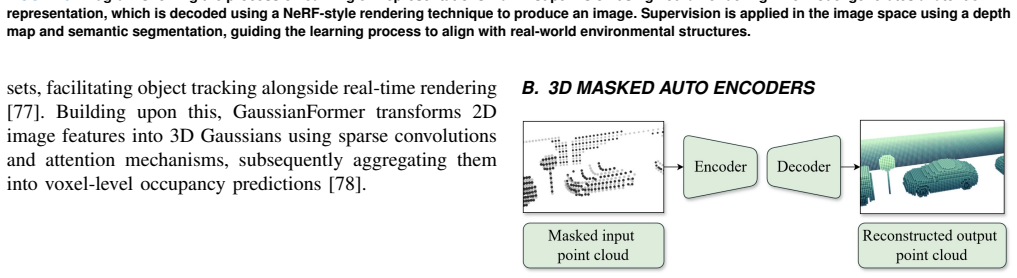
The load-bearing object is the four-capability taxonomy itself, plus the coverage matrix (Table 10) that assigns each surveyed method an X for each capability it provides. The taxonomy does the work of partitioning the literature: each of the four sections maps one capability to a family of techniques, such as knowledge distillation and pseudo-labeling for generalized knowledge; NeRF/3D Gaussian Splatting and masked autoencoders for spatial understanding; contrastive learning, distillation, multi-view consistency, and diffusion for multi-sensor robustness; and 4D forecasting and temporal contrastive learning for temporal understanding. The matrix then serves as the survey's evidence that cap
What would settle it
A concrete falsifier would be a deployed or benchmarked perception system that demonstrably operates in real time while satisfying all four capabilities on a held-out distribution-shift suite; observing such a system would falsify the paper's claim that no existing system integrates all four. Alternatively, a controlled study showing that improving temporal understanding necessarily changes multi-sensor robustness would falsify the taxonomy's separability assumption.
Extended reading notes
Core claim
The paper's central claim is that a capability-based taxonomy—generalized knowledge, spatial understanding, multi-sensor robustness, temporal understanding—captures what a perception foundation model must master to handle dynamic, long-tail driving, and that this taxonomy should steer research better than task- or method-based surveys do. To support this, the survey classifies recent methods into capability-oriented clusters: VFM/VLM/LLM adaptation mechanisms for generalized knowledge; volumetric models, NeRF/3D Gaussian Splatting rendering, and 3D masked autoencoders for spatial understanding; cross-modality contrastive learning, distillation, multi-view consistency, multi-modal masked auto
Load-bearing premise
The taxonomy assumes the four capabilities—generalized knowledge, spatial understanding, multi-sensor robustness, and temporal understanding—are a complete and cleanly separable decomposition of autonomous-driving perception, so every method can be placed in distinct boxes.
Editorial extensions
If this is right
- Researchers can use the four capabilities as a checklist when designing a perception foundation model, choosing whichever pillar is weakest for their deployment target.
- The integration claim implies that hybrid systems—foundation models handling high-level reasoning at a reduced rate plus a conventional real-time pipeline—are an interim solution, not the end state.
- Benchmarks should be built to isolate and stress each capability—for example, corruption benchmarks for multi-sensor robustness and accident-focused scenarios for generalized knowledge—rather than reporting only average-case mAP or IoU.
- If no current system combines all four capabilities, progress depends on closing integration gaps: latency, calibration, synchronization, and the representation mismatch between dense spatial outputs and object-centric planning.
Reading between the lines
- The taxonomy's exhaustive-and-separable assumption is the part most worth testing: temporal understanding and multi-sensor robustness both lean on spatial alignment, so a capability overlap, rather than four independent axes, may be the real structure.
- A quantitative analogue of Table 10—scoring degree of capability instead of binary X marks—would turn the survey's qualitative claim into a testable rubric and could reveal whether the four categories are actually independent.
- The survey's benchmark table suggests a natural extension: build a benchmark suite that perturbs one capability axis at a time—sensor dropout, occlusion, unseen categories, temporal discontinuity—so capability-level comparisons can be made fairly across models.
- The integration bottleneck also implies an opportunity: a model that does combine all four, even at modest performance, would be more informative for the field than another state-of-the-art result on a single task.
Editorial analysis
A structured set of objections, weighed in public.
Referee Report
Summary. This manuscript surveys foundation models for autonomous-driving perception and organizes the literature around a proposed taxonomy of four core capabilities: generalized knowledge, spatial understanding, multi-sensor robustness, and temporal understanding. Each capability is motivated, illustrated with representative methods (e.g., VFM/VLM/LLM distillation, occupancy networks, neural rendering, cross-modal contrastive learning, temporal contrastive learning), and accompanied by challenges. The paper further claims that this capability-based taxonomy is novel and that no existing system integrates all four capabilities into a real-time framework. The final sections discuss benchmark limitations, real-time latency, data bias, regulatory issues, and hallucination risks.
Significance. If the taxonomy is accepted, the survey provides a useful organizational frame for a rapidly growing literature and a practical checklist for model development. Its strengths are the breadth of recent work covered, the structured tables (Tables 3, 6, 7, 9, 10), and the attention to deployment issues such as latency, benchmarks, and hallucination. No new quantitative results or code are presented, so the appropriate standard of assessment is internal consistency and accurate characterization of prior work. Measured against that standard, the paper needs revision: the central novelty claim is internally contradicted by Table 1, and the binary capability assignments in Table 10 are not fully aligned with the text.
major comments (3)
- [Section I and Table 1] The abstract and Section I claim a 'novel taxonomy' and state that existing surveys 'frequently overlook' multi-sensor robustness and spatial awareness. However, Table 1 lists survey [6] as covering all four capabilities, including exactly those two. This is a direct internal contradiction: either [6] already organizes around these capabilities, which undermines the novelty claim, or Table 1 mischaracterizes [6], which undermines the reliability of the comparison matrix. The paper provides no section-level comparison or criterion for what counts as 'coverage.' Please revise the claim or provide a precise distinction between method-based and capability-based coverage and show that [6] fails the latter.
- [Section VII.A and Table 10] The claim that no existing system integrates all four capabilities into a real-time framework rests on Table 10, but the row assignments are not reliable. For example, the text describes SEAL as combining generalized knowledge with multi-sensor robustness and temporal understanding, yet the Table 10 row 'SLidR [43] / SEAL [44]' appears to mark only two capabilities. The text and table must be aligned, and the coding rules for assigning X marks should be stated explicitly.
- [Section I and Table 10] The four capabilities are treated as cleanly separable binary attributes, but they are interdependent: cross-modal fusion requires spatial alignment, temporal modeling often depends on multi-view geometric consistency, and generalized knowledge is used to resolve ambiguities in 3D reconstruction. The paper does not define what 'covers a capability' means or how overlap is adjudicated. Since the 'no seamless integration' conclusion is the survey's central claim, I ask for a short scope definition for each capability and a reproducible coding rubric for Table 10.
minor comments (7)
- [Abstract vs. Section VI] The abstract uses 'temporal reasoning' while Section VI and the conclusion use 'temporal understanding.' Please use one term consistently.
- [Figure 4 caption] Typo: 'supervise a encoder' should be 'supervise an encoder.'
- [Section IV.A and V.E] Typos: 'V olumetric' should be 'Volumetric' in Section IV.A; 'defusion' should be 'diffusion' in Section V.E.
- [Section II.E] Capitalization: 'Therefore, They become foundational components' should be 'therefore, they become...'
- [Section II.B] The distillation loss equations are set with inline expressions for the softened probabilities, which is hard to read. Please display these as numbered equations.
- [Table 10] Rows that group multiple methods under one mark, e.g., 'SLidR [43] / SEAL [44]', obscure differences in capability coverage. Use separate rows or per-method marks.
- [Section VII] The survey does not state its own limitations, including the literature selection protocol and the coverage cutoff date. Adding a short limitations paragraph would improve reproducibility.
Circularity Check
No circularity: the survey's taxonomy is an interpretive frame; there are no fitted inputs, derived predictions, or load-bearing self-citations.
full rationale
This paper is a survey whose contribution is an organizing taxonomy (generalized knowledge, spatial understanding, multi-sensor robustness, temporal understanding), not a derivation of empirical predictions from first principles. There are no fitted parameters, no equations used to derive results, no predictions from fitted inputs, and no load-bearing self-citations: the authors do not cite their own prior work, and all cited systems are external published methods described by the survey. The four capabilities are introduced by definition in Section I and then used to structure the review; Table 10's X-marks are the authors' qualitative literature judgments, not quantities derived from data. Consequently, there is no chain by which an output reduces to an input by construction. The skeptical concern that Table 1 lists reference [6] as covering all four capabilities, conflicting with the Introduction's claim that prior surveys overlook multi-sensor robustness and spatial awareness, is an internal-consistency/novelty-support issue, not a circularity: resolving it requires checking [6]'s actual scope, not exhibiting an equation-level or citation-level loop. Likewise, the subjective coverage judgments in Table 10 are potential evidence-quality concerns but do not constitute circular reasoning. Thus no circularity is found.
Assumptions & free parameters
assumptions (3)
- domain assumption The cited primary papers are accurately summarized, and each is a legitimate instance of the assigned capability.
- ad hoc to paper The four capabilities are jointly exhaustive and largely orthogonal for AD perception.
- domain assumption Foundation-model pretraining on diverse data transfers to AD perception.
invented entities (1)
-
Four-capability taxonomy
Cite this review
Pith. "Pith review of Foundation Models for Autonomous Driving Perception: A Survey Through Core Capabilities." pith.science (2026). https://pith.science/paper/5OLQUSI2
@misc{pith2026250908302,
  author       = {Pith},
  title        = {Pith review of: Foundation Models for Autonomous Driving Perception: A Survey Through Core Capabilities},
  year         = {2026},
  howpublished = {\url{https://pith.science/paper/5OLQUSI2}},
  note         = {Machine review of arXiv:2509.08302}
}
read the original abstract
Foundation models are revolutionizing autonomous driving perception, transitioning the field from narrow, task-specific deep learning models to versatile, general-purpose architectures trained on vast, diverse datasets. This survey examines how these models address critical challenges in autonomous perception, including limitations in generalization, scalability, and robustness to distributional shifts. The survey introduces a novel taxonomy structured around four essential capabilities for robust performance in dynamic driving environments: generalized knowledge, spatial understanding, multi-sensor robustness, and temporal reasoning. For each capability, the survey elucidates its significance and comprehensively reviews cutting-edge approaches. Diverging from traditional method-centric surveys, our unique framework prioritizes conceptual design principles, providing a capability-driven guide for model development and clearer insights into foundational aspects. We conclude by discussing key challenges, particularly those associated with the integration of these capabilities into real-time, scalable systems, and broader deployment challenges related to computational demands and ensuring model reliability against issues like hallucinations and out-of-distribution failures. The survey also outlines crucial future research directions to enable the safe and effective deployment of foundation models in autonomous driving systems.
Figures


Figures from the paper (9 more)




Reference graph
Works this paper leans on
-
[6]
X. Yan, H. Zhang, Y . Cai, J. Guo, W. Qiu, B. Gao, K. Zhou, Y . Zhao, H. Jin, J. Gaoet al., “Forging vision foundation models for autonomous driving: Challenges, methodologies, and opportunities,”arXiv preprint arXiv:2401.08045, 2024
arXiv 2024
-
[43]
Image-to-lidar self-supervised distilla- tion for autonomous driving data,
C. Sautier, G. Puy, S. Gidaris, A. Boulch, A. Bursuc, and R. Marlet, “Image-to-lidar self-supervised distilla- tion for autonomous driving data,” inProceedings of the IEEE/CVF Conference on Computer Vision and Pattern Recognition, 2022, pp. 9891–9901
2022
-
[44]
Segment any point cloud sequences by distilling vision foundation models,
Y . Liu, L. Kong, J. Cen, R. Chen, W. Zhang, L. Pan, K. Chen, and Z. Liu, “Segment any point cloud sequences by distilling vision foundation models,” Advances in Neural Information Processing Systems, vol. 36, pp. 37 193–37 229, 2023
2023
-
[1]
3d object detection for autonomous driving: A survey,
R. Qian, X. Lai, and X. Li, “3d object detection for autonomous driving: A survey,”Pattern Recognition, vol. 130, p. 108796, 2022
2022
-
[2]
Vision-based semantic segmentation in scene understanding for autonomous driving: Recent achievements, challenges, and out- looks,
K. Muhammad, T. Hussain, H. Ullah, J. Del Ser, M. Rezaei, N. Kumar, M. Hijji, P. Bellavista, and V . H. C. de Albuquerque, “Vision-based semantic segmentation in scene understanding for autonomous driving: Recent achievements, challenges, and out- looks,”IEEE Transactions on Intelligent Transporta- tion Systems, vol. 23, no. 12, pp. 22 694–22 715, 2022
2022
-
[3]
A review of deep learning-based visual multi-object tracking algorithms for autonomous driving,
S. Guo, S. Wang, Z. Yang, L. Wang, H. Zhang, P. Guo, Y . Gao, and J. Guo, “A review of deep learning-based visual multi-object tracking algorithms for autonomous driving,”Applied Sciences, vol. 12, no. 21, p. 10741, 2022
2022
-
[4]
Towards long-tailed 3d detection,
N. Peri, A. Dave, D. Ramanan, and S. Kong, “Towards long-tailed 3d detection,” inConference on Robot Learning. PMLR, 2023, pp. 1904–1915
2023
-
[5]
On the opportuni- ties and risks of foundation models,
R. Bommasani, D. A. Hudson, E. Adeli, R. Altman, S. Arora, S. von Arx, M. S. Bernstein, J. Bohg, A. Bosselut, E. Brunskillet al., “On the opportuni- ties and risks of foundation models,”arXiv preprint arXiv:2108.07258, 2021
arXiv 2021
Show all 144 references
-
[7]
Applications of large scale foundation models for autonomous driving,
Y . Huang, Y . Chen, and Z. Li, “Applications of large scale foundation models for autonomous driving,” arXiv preprint arXiv:2311.12144, 2023
2023 arXiv
-
[8]
A survey for foundation models in au- tonomous driving,
H. Gao, Z. Wang, Y . Li, K. Long, M. Yang, and Y . Shen, “A survey for foundation models in au- tonomous driving,”arXiv preprint arXiv:2402.01105, 2024
2024 arXiv
-
[9]
Prospective role of foundation models in advancing autonomous vehicles,
J. Wu, B. Gao, J. Gao, J. Yu, H. Chu, Q. Yu, X. Gong, Y . Chang, H. E. Tseng, H. Chenet al., “Prospective role of foundation models in advancing autonomous vehicles,”Research, vol. 7, p. 0399, 2024
2024
-
[10]
Llm4drive: A survey of large language models for autonomous driving,
Z. Yang, X. Jia, H. Li, and J. Yan, “Llm4drive: A survey of large language models for autonomous driving,”arXiv preprint arXiv:2311.01043, 2023
2023 arXiv
-
[11]
Vision language models in autonomous driving: A survey and outlook,
X. Zhou, M. Liu, E. Yurtsever, B. L. Zagar, W. Zim- mer, H. Cao, and A. C. Knoll, “Vision language models in autonomous driving: A survey and outlook,” IEEE Transactions on Intelligent Vehicles, 2024
2024
-
[12]
A simple framework for contrastive learning of vi- sual representations,
T. Chen, S. Kornblith, M. Norouzi, and G. Hinton, “A simple framework for contrastive learning of vi- sual representations,” inInternational conference on machine learning. PmLR, 2020, pp. 1597–1607. 26 VOLUME 00, 2024
2020
-
[13]
Momentum contrast for unsupervised visual repre- sentation learning,
K. He, H. Fan, Y . Wu, S. Xie, and R. Girshick, “Momentum contrast for unsupervised visual repre- sentation learning,” inProceedings of the IEEE/CVF conference on computer vision and pattern recogni- tion, 2020, pp. 9729–9738
2020
-
[14]
Improved baselines with momentum contrastive learning,
X. Chen, H. Fan, R. Girshick, and K. He, “Improved baselines with momentum contrastive learning,”arXiv preprint arXiv:2003.04297, 2020
2003 arXiv
-
[15]
Masked autoencoders are scalable vision learners,
K. He, X. Chen, S. Xie, Y . Li, P. Doll ´ar, and R. Girshick, “Masked autoencoders are scalable vision learners,” inProceedings of the IEEE/CVF conference on computer vision and pattern recognition, 2022, pp. 16 000–16 009
2022
-
[16]
An image is worth 16x16 words: Transformers for image recogni- tion at scale,
A. Dosovitskiy, L. Beyer, A. Kolesnikov, D. Weis- senborn, X. Zhai, T. Unterthiner, M. Dehghani, M. Minderer, G. Heigold, S. Gellyet al., “An image is worth 16x16 words: Transformers for image recogni- tion at scale,”arXiv preprint arXiv:2010.11929, 2020
2010 arXiv
-
[17]
Distilling the knowledge in a neural network,
G. Hinton, O. Vinyals, and J. Dean, “Distilling the knowledge in a neural network,”arXiv preprint arXiv:1503.02531, 2015
2015 arXiv
-
[18]
Knowledge distillation: A survey,
J. Gou, B. Yu, S. J. Maybank, and D. Tao, “Knowledge distillation: A survey,”International Journal of Com- puter Vision, vol. 129, no. 6, pp. 1789–1819, 2021
2021
-
[19]
Self- training with noisy student improves imagenet classi- fication,
Q. Xie, M.-T. Luong, E. Hovy, and Q. V . Le, “Self- training with noisy student improves imagenet classi- fication,” inProceedings of the IEEE/CVF conference on computer vision and pattern recognition, 2020, pp. 10 687–10 698
2020
-
[20]
Bootstrap your own latent-a new approach to self- supervised learning,
J.-B. Grill, F. Strub, F. Altch ´e, C. Tallec, P. Richemond, E. Buchatskaya, C. Doersch, B. Avila Pires, Z. Guo, M. Gheshlaghi Azaret al., “Bootstrap your own latent-a new approach to self- supervised learning,”Advances in neural information processing systems, vol. 33, pp. 21...
2020
-
[21]
Emerging properties in self-supervised vision transformers,
M. Caron, H. Touvron, I. Misra, H. J ´egou, J. Mairal, P. Bojanowski, and A. Joulin, “Emerging properties in self-supervised vision transformers,” inProceedings of the IEEE/CVF international conference on computer vision, 2021, pp. 9650–9660
2021
-
[22]
Structure-from- motion revisited,
J. L. Schonberger and J.-M. Frahm, “Structure-from- motion revisited,” inProceedings of the IEEE con- ference on computer vision and pattern recognition, 2016, pp. 4104–4113
2016
-
[23]
Multi-view stereo: A tutorial,
Y . Furukawa, C. Hern´andezet al., “Multi-view stereo: A tutorial,”Foundations and trends® in Computer Graphics and Vision, vol. 9, no. 1-2, pp. 1–148, 2015
2015
-
[24]
Past, present, and future of simultaneous localization and mapping: Toward the robust-perception age,
C. Cadena, L. Carlone, H. Carrillo, Y . Latif, D. Scara- muzza, J. Neira, I. Reid, and J. J. Leonard, “Past, present, and future of simultaneous localization and mapping: Toward the robust-perception age,”IEEE Transactions on robotics, vol. 32, no. 6, pp. 1309– 1332, 2016
2016
-
[25]
3d-r2n2: A unified approach for single and multi- view 3d object reconstruction,
C. B. Choy, D. Xu, J. Gwak, K. Chen, and S. Savarese, “3d-r2n2: A unified approach for single and multi- view 3d object reconstruction,” inComputer vision– ECCV 2016: 14th European conference, amsterdam, the netherlands, October 11-14, 2016, proceedings, part VIII 14. Springer...
2016
-
[26]
Predicting depth, surface normals and semantic labels with a common multi- scale convolutional architecture,
D. Eigen and R. Fergus, “Predicting depth, surface normals and semantic labels with a common multi- scale convolutional architecture,” inProceedings of the IEEE international conference on computer vision, 2015, pp. 2650–2658
2015
-
[27]
Nerf: Representing scenes as neural radiance fields for view synthesis,
B. Mildenhall, P. P. Srinivasan, M. Tancik, J. T. Bar- ron, R. Ramamoorthi, and R. Ng, “Nerf: Representing scenes as neural radiance fields for view synthesis,” Communications of the ACM, vol. 65, no. 1, pp. 99– 106, 2021
2021
-
[28]
3d gaussian splatting for real-time radiance field rendering
B. Kerbl, G. Kopanas, T. Leimk ¨uhler, and G. Dret- takis, “3d gaussian splatting for real-time radiance field rendering.”ACM Trans. Graph., vol. 42, no. 4, pp. 139–1, 2023
2023
-
[29]
Yolov3: An incremen- tal improvement,
J. Redmon and A. Farhadi, “Yolov3: An incremen- tal improvement,”arXiv preprint arXiv:1804.02767, 2018
2018 arXiv
-
[30]
Deep residual learning for image recognition,
K. He, X. Zhang, S. Ren, and J. Sun, “Deep residual learning for image recognition,” inProceedings of the IEEE conference on computer vision and pattern recognition, 2016, pp. 770–778
2016
-
[31]
Gpt-4 technical report,
J. Achiam, S. Adler, S. Agarwal, L. Ahmad, I. Akkaya, F. L. Aleman, D. Almeida, J. Altenschmidt, S. Altman, S. Anadkatet al., “Gpt-4 technical report,” arXiv preprint arXiv:2303.08774, 2023
2023 arXiv
-
[32]
Bert: Pre-training of deep bidirectional transformers for language understanding,
J. Devlin, M.-W. Chang, K. Lee, and K. Toutanova, “Bert: Pre-training of deep bidirectional transformers for language understanding,” inProceedings of the 2019 conference of the North American chapter of the association for computational linguistics: human language technologie...
2019
-
[33]
Segment anything,
A. Kirillov, E. Mintun, N. Ravi, H. Mao, C. Rolland, L. Gustafson, T. Xiao, S. Whitehead, A. C. Berg, W.- Y . Loet al., “Segment anything,” inProceedings of the IEEE/CVF international conference on computer vision, 2023, pp. 4015–4026
2023
-
[34]
Dinov2: Learning robust visual features without supervision,
M. Oquab, T. Darcet, T. Moutakanni, H. V o, M. Szafraniec, V . Khalidov, P. Fernandez, D. Haziza, F. Massa, A. El-Noubyet al., “Dinov2: Learning robust visual features without supervision,”arXiv preprint arXiv:2304.07193, 2023
2023 arXiv
-
[35]
Learning transferable visual models from natural language supervision,
A. Radford, J. W. Kim, C. Hallacy, A. Ramesh, G. Goh, S. Agarwal, G. Sastry, A. Askell, P. Mishkin, J. Clarket al., “Learning transferable visual models from natural language supervision,” inInternational conference on machine learning. PmLR, 2021, pp. 8748–8763
2021
-
[36]
Grounding dino: Marrying dino with grounded pre-training for VOLUME 00, 2024 27 Authoret al.: Preparation of Papers for IEEE OPEN JOURNALS open-set object detection,
S. Liu, Z. Zeng, T. Ren, F. Li, H. Zhang, J. Yang, Q. Jiang, C. Li, J. Yang, H. Suet al., “Grounding dino: Marrying dino with grounded pre-training for VOLUME 00, 2024 27 Authoret al.: Preparation of Papers for IEEE OPEN JOURNALS open-set object detection,” inEuropean Conferen...
2024
-
[37]
Denoising diffusion probabilistic models,
J. Ho, A. Jain, and P. Abbeel, “Denoising diffusion probabilistic models,”Advances in neural information processing systems, vol. 33, pp. 6840–6851, 2020
2020
-
[38]
High-resolution image synthesis with latent diffusion models,
R. Rombach, A. Blattmann, D. Lorenz, P. Esser, and B. Ommer, “High-resolution image synthesis with latent diffusion models,” inProceedings of the IEEE/CVF conference on computer vision and pattern recognition, 2022, pp. 10 684–10 695
2022
-
[39]
Video diffusion models,
J. Ho, T. Salimans, A. Gritsenko, W. Chan, M. Norouzi, and D. J. Fleet, “Video diffusion models,” Advances in Neural Information Processing Systems, vol. 35, pp. 8633–8646, 2022
2022
-
[40]
3d shape generation and completion through point-voxel diffusion,
L. Zhou, Y . Du, and J. Wu, “3d shape generation and completion through point-voxel diffusion,” inPro- ceedings of the IEEE/CVF international conference on computer vision, 2021, pp. 5826–5835
2021
-
[41]
Diffusion-based signed distance fields for 3d shape generation,
J. Shim, C. Kang, and K. Joo, “Diffusion-based signed distance fields for 3d shape generation,” inProceed- ings of the IEEE/CVF conference on computer vision and pattern recognition, 2023, pp. 20 887–20 897
2023
-
[42]
Language models are few-shot learners,
T. Brown, B. Mann, N. Ryder, M. Subbiah, J. D. Ka- plan, P. Dhariwal, A. Neelakantan, P. Shyam, G. Sas- try, A. Askellet al., “Language models are few-shot learners,”Advances in neural information processing systems, vol. 33, pp. 1877–1901, 2020
1901
-
[45]
Better call sal: Towards learning to segment anything in lidar,
A. O ˇsep, T. Meinhardt, F. Ferroni, N. Peri, D. Ra- manan, and L. Leal-Taix ´e, “Better call sal: Towards learning to segment anything in lidar,” inEuropean Conference on Computer Vision. Springer, 2024, pp. 71–90
2024
-
[46]
Sam4udass: When sam meets unsupervised domain adaptive semantic segmentation in intelligent ve- hicles,
W. Yan, Y . Qian, H. Zhuang, C. Wang, and M. Yang, “Sam4udass: When sam meets unsupervised domain adaptive semantic segmentation in intelligent ve- hicles,”IEEE Transactions on Intelligent Vehicles, vol. 9, no. 2, pp. 3396–3408, 2024
2024
-
[47]
Occnerf: Self-supervised multi- camera occupancy prediction with neural radiance fields,
C. Zhang, J. Yan, Y . Wei, J. Li, L. Liu, Y . Tang, Y . Duan, and J. Lu, “Occnerf: Self-supervised multi- camera occupancy prediction with neural radiance fields,”CoRR, 2023
2023
-
[48]
Open 3d world in autonomous driving,
X. Cheng and L. Li, “Open 3d world in autonomous driving,”arXiv preprint arXiv:2408.10880, 2024
2024 arXiv
-
[49]
Ovo: Open-vocabulary occupancy,
Z. Tan, Z. Dong, C. Zhang, W. Zhang, H. Ji, and H. Li, “Ovo: Open-vocabulary occupancy,”arXiv preprint arXiv:2305.16133, 2023
2023 arXiv
-
[50]
Clip2scene: Towards label-efficient 3d scene understanding by clip,
R. Chen, Y . Liu, L. Kong, X. Zhu, Y . Ma, Y . Li, Y . Hou, Y . Qiao, and W. Wang, “Clip2scene: Towards label-efficient 3d scene understanding by clip,” inPro- ceedings of the IEEE/CVF Conference on Computer Vision and Pattern Recognition, 2023, pp. 7020–7030
2023
-
[51]
Vlm2scene: Self- supervised image-text-lidar learning with foundation models for autonomous driving scene understanding,
G. Liao, J. Li, and X. Ye, “Vlm2scene: Self- supervised image-text-lidar learning with foundation models for autonomous driving scene understanding,” inProceedings of the AAAI Conference on Artificial Intelligence, vol. 38, no. 4, 2024, pp. 3351–3359
2024
-
[52]
Unsupervised 3d perception with 2d vision-language distillation for autonomous driv- ing,
M. Najibi, J. Ji, Y . Zhou, C. R. Qi, X. Yan, S. Ettinger, and D. Anguelov, “Unsupervised 3d perception with 2d vision-language distillation for autonomous driv- ing,” inProceedings of the IEEE/CVF International Conference on Computer Vision, 2023, pp. 8602– 8612
2023
-
[53]
Opensight: A simple open-vocabulary framework for lidar-based object detection,
H. Zhang, J. Xu, T. Tang, H. Sun, X. Yu, Z. Huang, and K. Yu, “Opensight: A simple open-vocabulary framework for lidar-based object detection,” inEu- ropean Conference on Computer Vision. Springer, 2024, pp. 1–19
2024
-
[54]
Sam3d: Zero-shot 3d object detec- tion via segment anything model,
D. Zhang, D. Liang, H. Yang, Z. Zou, X. Ye, Z. Liu, and X. Bai, “Sam3d: Zero-shot 3d object detec- tion via segment anything model,”arXiv preprint arXiv:2306.02245, 2023
2023 arXiv
-
[55]
Gpt- driver: Learning to drive with gpt,
J. Mao, Y . Qian, J. Ye, H. Zhao, and Y . Wang, “Gpt- driver: Learning to drive with gpt,”arXiv preprint arXiv:2310.01415, 2023
2023 arXiv
-
[56]
Omnidrive: A holistic llm-agent framework for autonomous driving with 3d perception, reasoning and planning,
S. Wang, Z. Yu, X. Jiang, S. Lan, M. Shi, N. Chang, J. Kautz, Y . Li, and J. M. Alvarez, “Omnidrive: A holistic llm-agent framework for autonomous driving with 3d perception, reasoning and planning,”arXiv preprint arXiv:2405.01533, 2024
2024 arXiv
-
[57]
Drivegpt4: Interpretable end-to-end autonomous driving via large language model,
Z. Xu, Y . Zhang, E. Xie, Z. Zhao, Y . Guo, K.-Y . K. Wong, Z. Li, and H. Zhao, “Drivegpt4: Interpretable end-to-end autonomous driving via large language model,”IEEE Robotics and Automation Letters, 2024
2024
-
[58]
Dol- phins: Multimodal language model for driving,
Y . Ma, Y . Cao, J. Sun, M. Pavone, and C. Xiao, “Dol- phins: Multimodal language model for driving,” in European Conference on Computer Vision. Springer, 2024, pp. 403–420
2024
-
[59]
Emma: End-to- end multimodal model for autonomous driving,
J.-J. Hwang, R. Xu, H. Lin, W.-C. Hung, J. Ji, K. Choi, D. Huang, T. He, P. Covington, B. Sapp, Y . Zhou, J. Guo, D. Anguelov, and M. Tan, “Emma: End-to- end multimodal model for autonomous driving,”arXiv preprint arXiv:2410.23262, 2024
2024 arXiv
-
[60]
Lidar-llm: Exploring the potential of large language models for 3d lidar understanding,
S. Yang, J. Liu, R. Zhang, M. Pan, Z. Guo, X. Li, Z. Chen, P. Gao, H. Li, Y . Guoet al., “Lidar-llm: Exploring the potential of large language models for 3d lidar understanding,” inProceedings of the AAAI Conference on Artificial Intelligence, vol. 39, no. 9, 2025, pp. 9247–9255
2025
-
[61]
A survey on hallucination in large language mod- els: Principles, taxonomy, challenges, and open ques- tions,
L. Huang, W. Yu, W. Ma, W. Zhong, Z. Feng, H. Wang, Q. Chen, W. Peng, X. Feng, B. Qinet al., 28 VOLUME 00, 2024 “A survey on hallucination in large language mod- els: Principles, taxonomy, challenges, and open ques- tions,”ACM Transactions on Information Systems, vol. 43, no. ...
2024
-
[62]
Retrieval-augmented genera- tion for knowledge-intensive nlp tasks,
P. Lewis, E. Perez, A. Piktus, F. Petroni, V . Karpukhin, N. Goyal, H. K ¨uttler, M. Lewis, W.-t. Yih, T. Rockt ¨aschelet al., “Retrieval-augmented genera- tion for knowledge-intensive nlp tasks,”Advances in neural information processing systems, vol. 33, pp. 9459–9474, 2020
2020
-
[63]
Self-rag: Learning to retrieve, generate, and critique through self-reflection,
A. Asai, Z. Wu, Y . Wang, A. Sil, and H. Hajishirzi, “Self-rag: Learning to retrieve, generate, and critique through self-reflection,” 2024
2024
-
[64]
Driving with llms: Fusing object-level vector modal- ity for explainable autonomous driving,
L. Chen, O. Sinavski, J. H ¨unermann, A. Karnsund, A. J. Willmott, D. Birch, D. Maund, and J. Shotton, “Driving with llms: Fusing object-level vector modal- ity for explainable autonomous driving,” in2024 IEEE International Conference on Robotics and Automation (ICRA). IEEE, 2...
2024
-
[65]
A survey on occupancy perception for autonomous driv- ing: The information fusion perspective,
H. Xu, J. Chen, S. Meng, Y . Wang, and L.-P. Chau, “A survey on occupancy perception for autonomous driv- ing: The information fusion perspective,”Information Fusion, vol. 114, p. 102671, 2025
2025
-
[66]
Neural vol- umetric world models for autonomous driving,
Z. Huang, J. Zhang, and E. Ohn-Bar, “Neural vol- umetric world models for autonomous driving,” in European Conference on Computer Vision. Springer, 2024, pp. 195–213
2024
-
[67]
Tri-perspective view for vision-based 3d semantic oc- cupancy prediction,
Y . Huang, W. Zheng, Y . Zhang, J. Zhou, and J. Lu, “Tri-perspective view for vision-based 3d semantic oc- cupancy prediction,” inProceedings of the IEEE/CVF conference on computer vision and pattern recogni- tion, 2023, pp. 9223–9232
2023
-
[68]
V oxformer: Sparse voxel transformer for camera-based 3d se- mantic scene completion,
Y . Li, Z. Yu, C. Choy, C. Xiao, J. M. Alvarez, S. Fidler, C. Feng, and A. Anandkumar, “V oxformer: Sparse voxel transformer for camera-based 3d se- mantic scene completion,” inProceedings of the IEEE/CVF conference on computer vision and pattern recognition, 2023, pp. 9087–9098
2023
-
[69]
Occformer: Dual-path transformer for vision-based 3d semantic occupancy prediction,
Y . Zhang, Z. Zhu, and D. Du, “Occformer: Dual-path transformer for vision-based 3d semantic occupancy prediction,” inProceedings of the IEEE/CVF Inter- national Conference on Computer Vision, 2023, pp. 9433–9443
2023
-
[70]
Fully sparse 3d occupancy prediction,
H. Liu, Y . Chen, H. Wang, Z. Yang, T. Li, J. Zeng, L. Chen, H. Li, and L. Wang, “Fully sparse 3d occupancy prediction,” inEuropean Conference on Computer Vision. Springer, 2024, pp. 54–71
2024
-
[71]
Hybridocc: Nerf enhanced transformer-based multi- camera 3d occupancy prediction,
X. Zhao, B. Chen, M. Sun, D. Yang, Y . Wang, X. Zhang, M. Li, D. Kou, X. Wei, and L. Zhang, “Hybridocc: Nerf enhanced transformer-based multi- camera 3d occupancy prediction,”IEEE Robotics and Automation Letters, 2024
2024
-
[72]
Renderocc: Vision- centric 3d occupancy prediction with 2d rendering supervision,
M. Pan, J. Liu, R. Zhang, P. Huang, X. Li, H. Xie, B. Wang, L. Liu, and S. Zhang, “Renderocc: Vision- centric 3d occupancy prediction with 2d rendering supervision,” in2024 IEEE International Conference on Robotics and Automation (ICRA). IEEE, 2024, pp. 12 404–12 411
2024
-
[73]
S-nerf++: Autonomous driving simu- lation via neural reconstruction and generation,
Y . Chen, J. Zhang, Z. Xie, W. Li, F. Zhang, J. Lu, and L. Zhang, “S-nerf++: Autonomous driving simu- lation via neural reconstruction and generation,”IEEE Transactions on Pattern Analysis and Machine Intel- ligence, 2025
2025
-
[74]
Selfocc: Self-supervised vision-based 3d occupancy prediction,
Y . Huang, W. Zheng, B. Zhang, J. Zhou, and J. Lu, “Selfocc: Self-supervised vision-based 3d occupancy prediction,” inProceedings of the IEEE/CVF Confer- ence on Computer Vision and Pattern Recognition, 2024, pp. 19 946–19 956
2024
-
[75]
Renderworld: World model with self-supervised 3d label,
Z. Yan, W. Dong, Y . Shao, Y . Lu, L. Haiyang, J. Liu, H. Wang, Z. Wang, Y . Wang, F. Remondinoet al., “Renderworld: World model with self-supervised 3d label,”arXiv preprint arXiv:2409.11356, 2024
2024 arXiv
-
[76]
Gaussian- flowocc: Sparse and weakly supervised occupancy es- timation using gaussian splatting and temporal flow,
S. Boeder, F. Gigengack, and B. Risse, “Gaussian- flowocc: Sparse and weakly supervised occupancy es- timation using gaussian splatting and temporal flow,” arXiv preprint arXiv:2502.17288, 2025
2025 arXiv
-
[77]
Street gaussians: Modeling dynamic urban scenes with gaussian splat- ting,
Y . Yan, H. Lin, C. Zhou, W. Wang, H. Sun, K. Zhan, X. Lang, X. Zhou, and S. Peng, “Street gaussians: Modeling dynamic urban scenes with gaussian splat- ting,” inEuropean Conference on Computer Vision. Springer, 2024, pp. 156–173
2024
-
[78]
Gaussianformer: Scene as gaussians for vision-based 3d semantic occupancy prediction,
Y . Huang, W. Zheng, Y . Zhang, J. Zhou, and J. Lu, “Gaussianformer: Scene as gaussians for vision-based 3d semantic occupancy prediction,” inEuropean Con- ference on Computer Vision. Springer, 2024, pp. 376– 393
2024
-
[79]
Surroundocc: Multi-camera 3d occupancy pre- diction for autonomous driving,
Y . Wei, L. Zhao, W. Zheng, Z. Zhu, J. Zhou, and J. Lu, “Surroundocc: Multi-camera 3d occupancy pre- diction for autonomous driving,” inProceedings of the IEEE/CVF International Conference on Computer Vision, 2023, pp. 21 729–21 740
2023
-
[80]
Uno: Unsupervised occupancy fields for per- ception and forecasting,
B. Agro, Q. Sykora, S. Casas, T. Gilles, and R. Ur- tasun, “Uno: Unsupervised occupancy fields for per- ception and forecasting,” inCVPR, 2024
2024
-
[81]
Maeli: Masked au- toencoder for large-scale lidar point clouds,
G. Krispel, D. Schinagl, C. Fruhwirth-Reisinger, H. Possegger, and H. Bischof, “Maeli: Masked au- toencoder for large-scale lidar point clouds,” inPro- ceedings of the IEEE/CVF Winter Conference on Applications of Computer Vision, 2024, pp. 3383– 3392
2024
-
[82]
Masked autoencoder for self-supervised pre-training on lidar point clouds,
G. Hess, J. Jaxing, E. Svensson, D. Hagerman, C. Pe- tersson, and L. Svensson, “Masked autoencoder for self-supervised pre-training on lidar point clouds,” in Proceedings of the IEEE/CVF winter conference on applications of computer vision, 2023, pp. 350–359
2023
-
[83]
Bev-mae: Bird’s eye view masked autoencoders for point cloud pre-training in autonomous driving sce- narios,
Z. Lin, Y . Wang, S. Qi, N. Dong, and M.-H. Yang, “Bev-mae: Bird’s eye view masked autoencoders for point cloud pre-training in autonomous driving sce- narios,” inProceedings of the AAAI Conference on Artificial Intelligence, vol. 38, no. 4, 2024, pp. 3531– VOLUME 00, 2024 29 ...
2024
-
[84]
Geo- mae: Masked geometric target prediction for self- supervised point cloud pre-training,
X. Tian, H. Ran, Y . Wang, and H. Zhao, “Geo- mae: Masked geometric target prediction for self- supervised point cloud pre-training,” inProceedings of the IEEE/CVF Conference on Computer Vision and Pattern Recognition, 2023, pp. 13 570–13 580
2023
-
[85]
Openoccupancy: A large scale benchmark for surrounding semantic oc- cupancy perception,
X. Wang, Z. Zhu, W. Xu, Y . Zhang, Y . Wei, X. Chi, Y . Ye, D. Du, J. Lu, and X. Wang, “Openoccupancy: A large scale benchmark for surrounding semantic oc- cupancy perception,” inProceedings of the IEEE/CVF International Conference on Computer Vision, 2023, pp. 17 850–17 859
2023
-
[86]
Occ3d: A large-scale 3d occu- pancy prediction benchmark for autonomous driving,
X. Tian, T. Jiang, L. Yun, Y . Mao, H. Yang, Y . Wang, Y . Wang, and H. Zhao, “Occ3d: A large-scale 3d occu- pancy prediction benchmark for autonomous driving,” Advances in Neural Information Processing Systems, vol. 36, pp. 64 318–64 330, 2023
2023
-
[87]
Representation learning with contrastive predictive coding,
A. v. d. Oord, Y . Li, and O. Vinyals, “Representation learning with contrastive predictive coding,”arXiv preprint arXiv:1807.03748, 2018
2018 arXiv
-
[88]
Cross-modal contrastive learning for domain adap- tation in 3d semantic segmentation,
B. Xing, X. Ying, R. Wang, J. Yang, and T. Chen, “Cross-modal contrastive learning for domain adap- tation in 3d semantic segmentation,” inProceedings of the AAAI Conference on Artificial Intelligence, vol. 37, no. 3, 2023, pp. 2974–2982
2023
-
[89]
4d contrastive superflows are dense 3d representation learners,
X. Xu, L. Kong, H. Shuai, W. Zhang, L. Pan, K. Chen, Z. Liu, and Q. Liu, “4d contrastive superflows are dense 3d representation learners,” inEuropean Con- ference on Computer Vision. Springer, 2024, pp. 58– 80
2024
-
[90]
Superflow++: Enhanced spatiotemporal con- sistency for cross-modal data pretraining,
——, “Superflow++: Enhanced spatiotemporal con- sistency for cross-modal data pretraining,”arXiv e- prints, pp. arXiv–2503, 2025
2025
-
[91]
Contrastalign: Toward robust bev feature alignment via contrastive learning for multi-modal 3d object detection,
Z. Song, F. Jia, H. Pan, Y . Luo, C. Jia, G. Zhang, L. Liu, Y . Ji, L. Yang, and L. Wang, “Contrastalign: Toward robust bev feature alignment via contrastive learning for multi-modal 3d object detection,”arXiv preprint arXiv:2405.16873, 2024
2024 arXiv
-
[92]
Bevdistill: Cross-modal bev distillation for multi-view 3d object detection,
Z. Chen, Z. Li, S. Zhang, L. Fang, Q. Jiang, and F. Zhao, “Bevdistill: Cross-modal bev distillation for multi-view 3d object detection,”arXiv preprint arXiv:2211.09386, 2022
2022 arXiv
-
[93]
Distill- bev: Boosting multi-camera 3d object detection with cross-modal knowledge distillation,
Z. Wang, D. Li, C. Luo, C. Xie, and X. Yang, “Distill- bev: Boosting multi-camera 3d object detection with cross-modal knowledge distillation,” inProceedings of the IEEE/CVF International Conference on Computer Vision, 2023, pp. 8637–8646
2023
-
[94]
Geometric-aware pretraining for vision-centric 3d object detection,
L. Huang, H. Wang, J. Zeng, S. Zhang, L. Cao, J. Yan, and H. Li, “Geometric-aware pretraining for vision-centric 3d object detection,”arXiv preprint arXiv:2304.03105, 2023
2023 arXiv
-
[95]
Unidis- till: A universal cross-modality knowledge distillation framework for 3d object detection in bird’s-eye view,
S. Zhou, W. Liu, C. Hu, S. Zhou, and C. Ma, “Unidis- till: A universal cross-modality knowledge distillation framework for 3d object detection in bird’s-eye view,” inProceedings of the IEEE/CVF conference on com- puter vision and pattern recognition, 2023, pp. 5116– 5125
2023
-
[96]
Revisiting domain generalized stereo match- ing networks from a feature consistency perspec- tive,
J. Zhang, X. Wang, X. Bai, C. Wang, L. Huang, Y . Chen, L. Gu, J. Zhou, T. Harada, and E. R. Han- cock, “Revisiting domain generalized stereo match- ing networks from a feature consistency perspec- tive,” inProceedings of the IEEE/CVF Conference on Computer Vision and Pattern ...
2022
-
[97]
Weakly supervised monocular 3d object detection using multi-view projection and direction consis- tency,
R. Tao, W. Han, Z. Qiu, C.-z. Xu, and J. Shen, “Weakly supervised monocular 3d object detection using multi-view projection and direction consis- tency,” inProceedings of the IEEE/CVF Conference on Computer Vision and Pattern Recognition, 2023, pp. 17 482–17 492
2023
-
[98]
Bevformer: learning bird’s-eye- view representation from lidar-camera via spatiotem- poral transformers,
Z. Li, W. Wang, H. Li, E. Xie, C. Sima, T. Lu, Q. Yu, and J. Dai, “Bevformer: learning bird’s-eye- view representation from lidar-camera via spatiotem- poral transformers,”IEEE Transactions on Pattern Analysis and Machine Intelligence, 2024
2024
-
[99]
Ega- depth: Efficient guided attention for self-supervised multi-camera depth estimation,
Y . Shi, H. Cai, A. Ansari, and F. Porikli, “Ega- depth: Efficient guided attention for self-supervised multi-camera depth estimation,” inProceedings of the IEEE/CVF conference on computer vision and pattern recognition, 2023, pp. 119–129
2023
-
[100]
Multimae: Multi-modal multi-task masked autoen- coders,
R. Bachmann, D. Mizrahi, A. Atanov, and A. Zamir, “Multimae: Multi-modal multi-task masked autoen- coders,” inEuropean Conference on Computer Vision. Springer, 2022, pp. 348–367
2022
-
[101]
Pimae: Point cloud and image interactive masked autoencoders for 3d object detec- tion,
A. Chen, K. Zhang, R. Zhang, Z. Wang, Y . Lu, Y . Guo, and S. Zhang, “Pimae: Point cloud and image interactive masked autoencoders for 3d object detec- tion,” inProceedings of the IEEE/CVF Conference on Computer Vision and Pattern Recognition, 2023, pp. 5291–5301
2023
-
[102]
Unim 2 ae: Multi-modal masked autoencoders with unified 3d representation for 3d perception in autonomous driving,
J. Zou, T. Huang, G. Yang, Z. Guo, T. Luo, C.- M. Feng, and W. Zuo, “Unim 2 ae: Multi-modal masked autoencoders with unified 3d representation for 3d perception in autonomous driving,” inEuropean Conference on Computer Vision. Springer, 2024, pp. 296–313
2024
-
[103]
Occgen: Generative multi-modal 3d occupancy prediction for autonomous driving,
G. Wang, Z. Wang, P. Tang, J. Zheng, X. Ren, B. Feng, and C. Ma, “Occgen: Generative multi-modal 3d occupancy prediction for autonomous driving,” in European Conference on Computer Vision. Springer, 2024, pp. 95–112
2024
-
[104]
Dif- fusion model for robust multi-sensor fusion in 3d object detection and bev segmentation,
D.-T. Le, H. Shi, J. Cai, and H. Rezatofighi, “Dif- fusion model for robust multi-sensor fusion in 3d object detection and bev segmentation,” inEuropean Conference on Computer Vision. Springer, 2024, pp. 232–249
2024
-
[105]
Pys- ical informed driving world model,
Z. Yang, X. Guo, C. Ding, C. Wang, and W. Wu, “Pys- ical informed driving world model,”arXiv preprint arXiv:2412.08410, 2024. 30 VOLUME 00, 2024
2024 arXiv
-
[106]
Visual point cloud forecasting enables scalable autonomous driv- ing,
Z. Yang, L. Chen, Y . Sun, and H. Li, “Visual point cloud forecasting enables scalable autonomous driv- ing,” inProceedings of the IEEE/CVF Conference on Computer Vision and Pattern Recognition, 2024, pp. 14 673–14 684
2024
-
[107]
Uni- world: Autonomous driving pre-training via world models,
C. Min, D. Zhao, L. Xiao, Y . Nie, and B. Dai, “Uni- world: Autonomous driving pre-training via world models,”arXiv preprint arXiv:2308.07234, 2023
2023 arXiv
-
[108]
Learning unsupervised world models for autonomous driving via discrete diffusion,
L. Zhang, Y . Xiong, Z. Yang, S. Casas, R. Hu, and R. Urtasun, “Learning unsupervised world models for autonomous driving via discrete diffusion,”ICLR, 2024
2024
-
[109]
Bev- world: A multimodal world model for autonomous driving via unified bev latent space,
Y . Zhang, S. Gong, K. Xiong, X. Ye, X. Tan, F. Wang, J. Huang, H. Wu, and H. Wang, “Bev- world: A multimodal world model for autonomous driving via unified bev latent space,”arXiv preprint arXiv:2407.05679, 2024
2024 arXiv
-
[110]
Driving into the future: Multiview visual forecasting and planning with world model for autonomous driv- ing,
Y . Wang, J. He, L. Fan, H. Li, Y . Chen, and Z. Zhang, “Driving into the future: Multiview visual forecasting and planning with world model for autonomous driv- ing,” inProceedings of the IEEE/CVF Conference on Computer Vision and Pattern Recognition, 2024, pp. 14 749–14 759
2024
-
[111]
Temporal consistent 3d lidar representation learning for semantic per- ception in autonomous driving,
L. Nunes, L. Wiesmann, R. Marcuzzi, X. Chen, J. Behley, and C. Stachniss, “Temporal consistent 3d lidar representation learning for semantic per- ception in autonomous driving,” inProceedings of the IEEE/CVF Conference on Computer Vision and Pattern Recognition, 2023, pp. 5217–5228
2023
-
[112]
Compass: Contrastive multimodal pretraining for autonomous systems,
S. Ma, S. Vemprala, W. Wang, J. K. Gupta, Y . Song, D. McDufft, and A. Kapoor, “Compass: Contrastive multimodal pretraining for autonomous systems,” in 2022 IEEE/RSJ International Conference on Intelli- gent Robots and Systems (IROS). IEEE, 2022, pp. 1000–1007
2022
-
[113]
Drivevlm: The convergence of autonomous driving and large vision- language models,
X. Tian, J. Gu, B. Li, Y . Liu, Y . Wang, Z. Zhao, K. Zhan, P. Jia, X. Lang, and H. Zhao, “Drivevlm: The convergence of autonomous driving and large vision- language models,”arXiv preprint arXiv:2402.12289, 2024
2024 arXiv
-
[114]
Scalability in perception for autonomous driv- ing: Waymo open dataset,
P. Sun, H. Kretzschmar, X. Dotiwalla, A. Chouard, V . Patnaik, P. Tsui, J. Guo, Y . Zhou, Y . Chai, B. Caine et al., “Scalability in perception for autonomous driv- ing: Waymo open dataset,” inProceedings of the IEEE/CVF conference on computer vision and pattern recognition, 2...
2020
-
[115]
nuscenes: A multimodal dataset for autonomous driving,
H. Caesar, V . Bankiti, A. H. Lang, S. V ora, V . E. Liong, Q. Xu, A. Krishnan, Y . Pan, G. Baldan, and O. Beijbom, “nuscenes: A multimodal dataset for autonomous driving,” inProceedings of the IEEE/CVF conference on computer vision and pattern recogni- tion, 2020, pp. 11 621–11 631
2020
-
[116]
Argoverse: 3d tracking and forecasting with rich maps,
M.-F. Chang, J. Lambert, P. Sangkloy, J. Singh, S. Bak, A. Hartnett, D. Wang, P. Carr, S. Lucey, D. Ramananet al., “Argoverse: 3d tracking and forecasting with rich maps,” inProceedings of the IEEE/CVF conference on computer vision and pattern recognition, 2019, pp. 8748–8757
2019
-
[117]
Are we ready for autonomous driving? the kitti vision benchmark suite,
A. Geiger, P. Lenz, and R. Urtasun, “Are we ready for autonomous driving? the kitti vision benchmark suite,” in2012 IEEE conference on computer vision and pattern recognition. IEEE, 2012, pp. 3354–3361
2012
-
[118]
Bdd100k: A diverse driving dataset for heterogeneous multitask learning,
F. Yu, H. Chen, X. Wang, W. Xian, Y . Chen, F. Liu, V . Madhavan, and T. Darrell, “Bdd100k: A diverse driving dataset for heterogeneous multitask learning,” inProceedings of the IEEE/CVF conference on com- puter vision and pattern recognition, 2020, pp. 2636– 2645
2020
-
[119]
Deepaccident: A motion and accident prediction benchmark for v2x autonomous driving,
T. Wang, S. Kim, W. Ji, E. Xie, C. Ge, J. Chen, Z. Li, and L. Ping, “Deepaccident: A motion and accident prediction benchmark for v2x autonomous driving,” arXiv preprint arXiv:2304.01168, 2023
2023 arXiv
-
[120]
Realistic corner case generation for autonomous ve- hicles with multimodal large language model,
Q. Lu, M. Ma, X. Dai, X. Wang, and S. Feng, “Realistic corner case generation for autonomous ve- hicles with multimodal large language model,”arXiv preprint arXiv:2412.00243, 2024
2024 arXiv
-
[121]
Pesotif: A challenging visual dataset for perception sotif prob- lems in long-tail traffic scenarios,
L. Peng, J. Li, W. Shao, and H. Wang, “Pesotif: A challenging visual dataset for perception sotif prob- lems in long-tail traffic scenarios,” in2023 IEEE Intelligent Vehicles Symposium (IV). IEEE, 2023, pp. 1–8
2023
-
[122]
Carla: An open urban driving simulator,
A. Dosovitskiy, G. Ros, F. Codevilla, A. Lopez, and V . Koltun, “Carla: An open urban driving simulator,” inConference on robot learning. PMLR, 2017, pp. 1–16
2017
-
[123]
Language prompt for autonomous driv- ing,
D. Wu, W. Han, Y . Liu, T. Wang, C.-z. Xu, X. Zhang, and J. Shen, “Language prompt for autonomous driv- ing,” inProceedings of the AAAI Conference on Artificial Intelligence, vol. 39, no. 8, 2025, pp. 8359– 8367
2025
-
[124]
Anovox: A benchmark for multimodal anomaly detection in autonomous driv- ing,
D. Bogdoll, I. Hamdard, L. N. R ¨oßler, F. Geisler, M. Bayram, F. Wang, J. Imhof, M. de Campos, A. Tabarov, Y . Yanget al., “Anovox: A benchmark for multimodal anomaly detection in autonomous driv- ing,” inEuropean Conference on Computer Vision. Springer, 2024, pp. 206–223
2024
-
[125]
Msc-bench: Benchmark- ing and analyzing multi-sensor corruption for driving perception,
X. Hao, G. Liu, Y . Zhao, Y . Ji, M. Wei, H. Zhao, L. Kong, R. Yin, and Y . Liu, “Msc-bench: Benchmark- ing and analyzing multi-sensor corruption for driving perception,”arXiv preprint arXiv:2501.01037, 2025
2025 arXiv
-
[126]
Benchmarking robustness of 3d object detection to common corrup- tions,
Y . Dong, C. Kang, J. Zhang, Z. Zhu, Y . Wang, X. Yang, H. Su, X. Wei, and J. Zhu, “Benchmarking robustness of 3d object detection to common corrup- tions,” inProceedings of the IEEE/CVF Conference on Computer Vision and Pattern Recognition, 2023, pp. 1022–1032
2023
-
[127]
Robo3d: Towards robust and reliable 3d perception against corruptions,
L. Kong, Y . Liu, X. Li, R. Chen, W. Zhang, J. Ren, L. Pan, K. Chen, and Z. Liu, “Robo3d: Towards robust and reliable 3d perception against corruptions,” in Proceedings of the IEEE/CVF International Confer- VOLUME 00, 2024 31 Authoret al.: Preparation of Papers for IEEE OPEN J...
2024
-
[128]
Robobev: Towards robust bird’s eye view perception under corruptions,
S. Xie, L. Kong, W. Zhang, J. Ren, L. Pan, K. Chen, and Z. Liu, “Robobev: Towards robust bird’s eye view perception under corruptions,”arXiv preprint arXiv:2304.06719, 2023
2023 arXiv
-
[129]
Unity is strength? benchmarking the robustness of fusion-based 3d object detection against physical sensor attack,
Z. Jin, X. Lu, B. Yang, Y . Cheng, C. Yan, X. Ji, and W. Xu, “Unity is strength? benchmarking the robustness of fusion-based 3d object detection against physical sensor attack,” inProceedings of the ACM Web Conference 2024, 2024, pp. 3031–3042
2024
-
[130]
A benchmark for unsupervised anomaly detection in multi-agent trajectories,
J. Wiederer, J. Schmidt, U. Kressel, K. Dietmayer, and V . Belagiannis, “A benchmark for unsupervised anomaly detection in multi-agent trajectories,” in2022 IEEE 25th International Conference on Intelligent Transportation Systems (ITSC). IEEE, 2022, pp. 130– 137
2022
-
[131]
A survey of model compression and acceleration for deep neural networks,
Y . Cheng, D. Wang, P. Zhou, and T. Zhang, “A survey of model compression and acceleration for deep neural networks,”arXiv preprint arXiv:1710.09282, 2017
2017 arXiv
-
[132]
Dis- tilling step-by-step! outperforming larger language models with less training data and smaller model sizes,
C.-Y . Hsieh, C.-L. Li, C.-K. Yeh, H. Nakhost, Y . Fujii, A. Ratner, R. Krishna, C.-Y . Lee, and T. Pfister, “Dis- tilling step-by-step! outperforming larger language models with less training data and smaller model sizes,”arXiv preprint arXiv:2305.02301, 2023
2023 arXiv
-
[133]
Tinyvit: Fast pretraining distillation for small vision transformers,
K. Wu, J. Zhang, H. Peng, M. Liu, B. Xiao, J. Fu, and L. Yuan, “Tinyvit: Fast pretraining distillation for small vision transformers,” inEuropean conference on computer vision. Springer, 2022, pp. 68–85
2022
-
[134]
Distilling large vision-language model with out-of- distribution generalizability,
X. Li, Y . Fang, M. Liu, Z. Ling, Z. Tu, and H. Su, “Distilling large vision-language model with out-of- distribution generalizability,” inProceedings of the IEEE/CVF International Conference on Computer Vi- sion, 2023, pp. 2492–2503
2023
-
[135]
Gpt3. int8 (): 8-bit matrix multiplication for transformers at scale,
T. Dettmers, M. Lewis, Y . Belkada, and L. Zettle- moyer, “Gpt3. int8 (): 8-bit matrix multiplication for transformers at scale,”Advances in neural information processing systems, vol. 35, pp. 30 318–30 332, 2022
2022
-
[136]
Repq-vit: Scale reparameterization for post-training quantization of vision transformers,
Z. Li, J. Xiao, L. Yang, and Q. Gu, “Repq-vit: Scale reparameterization for post-training quantization of vision transformers,” inProceedings of the IEEE/CVF International Conference on Computer Vision, 2023, pp. 17 227–17 236
2023
-
[137]
A simple and effective pruning approach for large language models,
M. Sun, Z. Liu, A. Bair, and J. Z. Kolter, “A simple and effective pruning approach for large language models,”arXiv preprint arXiv:2306.11695, 2023
2023 arXiv
-
[138]
X-pruner: explainable prun- ing for vision transformers,
L. Yu and W. Xiang, “X-pruner: explainable prun- ing for vision transformers,” inProceedings of the IEEE/CVF conference on computer vision and pattern recognition, 2023, pp. 24 355–24 363
2023
-
[139]
Lpu: A latency-optimized and highly scalable processor for large language model inference,
S. Moon, J.-H. Kim, J. Kim, S. Hong, J. Cha, M. Kim, S. Lim, G. Choi, D. Seo, J. Kimet al., “Lpu: A latency-optimized and highly scalable processor for large language model inference,”IEEE Micro, 2024
2024
-
[140]
Prophet: Realizing a predictable real-time perception pipeline for autonomous vehicles,
L. Liu, Z. Dong, Y . Wang, and W. Shi, “Prophet: Realizing a predictable real-time perception pipeline for autonomous vehicles,” in2022 IEEE Real-Time Systems Symposium (RTSS). IEEE, 2022, pp. 305– 317
2022
-
[141]
Shallow- deep networks: Understanding and mitigating network overthinking,
Y . Kaya, S. Hong, and T. Dumitras, “Shallow- deep networks: Understanding and mitigating network overthinking,” inInternational conference on machine learning. PMLR, 2019, pp. 3301–3310
2019
-
[142]
Sparsebev: High-performance sparse 3d object de- tection from multi-camera videos,
H. Liu, Y . Teng, T. Lu, H. Wang, and L. Wang, “Sparsebev: High-performance sparse 3d object de- tection from multi-camera videos,” inProceedings of the IEEE/CVF international conference on computer vision, 2023, pp. 18 580–18 590
2023
-
[143]
Dynamicvit: Efficient vision transform- ers with dynamic token sparsification,
Y . Rao, W. Zhao, B. Liu, J. Lu, J. Zhou, and C.- J. Hsieh, “Dynamicvit: Efficient vision transform- ers with dynamic token sparsification,”Advances in neural information processing systems, vol. 34, pp. 13 937–13 949, 2021
2021
-
[144]
Toward efficient inference for mixture of experts,
H. Huang, N. Ardalani, A. Sun, L. Ke, S. Bhosale, H.-H. Lee, C.-J. Wu, and B. Lee, “Toward efficient inference for mixture of experts,”Advances in Neural Information Processing Systems, vol. 37, pp. 84 033– 84 059, 2024. 32 VOLUME 00, 2024
2024
Reviewed August 4, 2026 · model on record in the stance chip above.
Discussion (0). Continue with ORCID to comment.