REVIEW 3 major objections 6 minor 41 references
Efficient Long CoT Reasoning in Small Language Models
T0 review · 3 major / 6 minor · reviewed 2026-08-07 · deepseek-v4-flash
Pith's one-line read The paper claims that distilling long chain-of-thought reasoning into small models works better when each teacher trace is first cut, by binary search with the small model as its own judge, to the shortest prefix that still yields the…
desk verdict Useful, practical recipe for pruning long CoT into 7B models, but the minimal-prefix guarantee in Algorithm 1 is overstated and the on-policy validation filter needs a bias check. read the letter →
The pith
A machine-rendered reading of the paper's core claim, the machinery that carries it, and where it could break.
The reading
What carries the argument
The load-bearing mechanism is binary cutting with backtracking, driven by an on-policy validation function $\phi(Q,T_{1:k},A;M)=\mathbf{1}\{M_t(Q,T_{1:k},P_{\mathrm{policy}})=A\}$, where $M_t$ is the target small model asked to answer from the prefix alone. Each iteration tests the midpoint prefix, keeps the shortest prefix that passes validation, and, if a cut prefix fails, resets the lower bound and searches upward so essential late steps are recovered. This reduces the search from $O(n)$ prefix checks to $O(\log_2 n)$ while the retained steps stay contiguous, and it ties the distilled data to the inductive biases of the exact model that will be trained.
What would settle it
Run the curation twice on a fixed set of problems: once with the untrained base model as validator and once with the same model after SFT on the distilled data. If the retained examples stay the same and gains concentrate on easy problems, then the on-policy filter is selecting questions the model already solves rather than teaching new reasoning; alternatively, stress-test on problems whose decisive step appears only near the end of the trace and check whether backtracking restores it.
Extended reading notes
Core claim
In the paper's own terms, the right unit of distillation is not the full long CoT trace but the shortest contiguous prefix of its thinking steps that the target SLM itself can still answer from. The method implements this by splitting the thinking part into steps, running a binary-cutting search on prefixes, and accepting a prefix only when the on-policy validation function returns true, i.e. when the target model, prompted to answer from the question and that prefix alone, gives the ground-truth answer. A backtracking stage restores steps that were over-pruned so the final selected segment remains a valid prefix. The paper reports that training on these streamlined segments via SFT and DPO preserves accuracy to within a few points of full-trace SFT while reducing generated thinking tokens by roughly 30-70%, and that random deletion or validation by another model clearly degrades the result.
Load-bearing premise
The method assumes that a small model's ability to produce the correct final answer from a truncated thinking prefix before any training reliably predicts that training on that same prefix as a full response will teach or preserve the desired reasoning, so the curated data may be biased toward questions the model can already answer.
Editorial extensions
If this is right
- Training on pruned prefixes cuts average thinking tokens by roughly 30-70% on GSM8K, MATH, and AIME while keeping accuracy within a few points of full-trace SFT.
- DPO with the pruned response preferred and the original long response dispreferred further compresses output, but on hard tasks it lowers accuracy unless the SFT objective is kept in the loss.
- The target SLM's own validation matters: curated prefixes from another, similar-sized model train less well, and random deletion of steps substantially hurts reasoning, so the content and provenance of the retained steps carry the effect.
- The search finds a valid answer-yielding prefix in $O(\log_2 n)$ validation calls instead of checking each prefix linearly, which makes the streamlining step cheap enough to apply to large teacher datasets.
- Most teacher traces do not survive validation: about 25k useful samples remain from 93.7k train traces, meaning the filtering step itself is a strong data selection mechanism.
Reading between the lines
- Because the validator is the untrained model, the distilled dataset may be enriched for questions the small model can already answer from a short prefix; a difficulty-stratified accuracy comparison would show whether the method teaches new reasoning or mostly selects easy cases.
- The same binary-cutting recipe should transfer to any task with an automatically checkable answer, such as code execution or factual lookup, where a final answer can be verified without an external judge model.
- The $O(\log_2 n)$ guarantee assumes that prefix validity is reasonably monotone; traces with a decisive late step will trigger deep backtracking, and measuring the backtracking depth on such traces would reveal the practical limit.
- Restricting the search to contiguous prefixes preserves coherence but excludes reordering or skipping steps; a variant that searches over chunks or allows small gaps could find shorter training prefixes when the key reasoning is spread across the trace.
Editorial analysis
A structured set of objections, weighed in public.
Referee Report
Summary. The paper proposes a data-curation pipeline for distilling long chain-of-thought (CoT) reasoning from large reasoning models into small language models. Given a teacher trace, the method splits the thinking part into steps, uses a binary-cutting search with a backtracking mechanism to find a short prefix that still lets the target SLM produce the correct final answer, and validates each prefix with the target model itself (on-policy validation). The resulting pruned traces are used for SFT and then DPO training. Experiments on GSM8K, MATH, and AIME with Llama-3.1-8B-Instruct and Qwen2.5-7B-Instruct report substantial token-count reductions (roughly 30--70%) while keeping accuracy within a few points of full long-CoT SFT, alongside ablations, LLM-as-a-judge, and human-preference evaluations.
Significance. If the central claims were delivered, this would be a practically useful contribution: it targets the real cost of long-CoT reasoning in small models, avoids expensive RL reward redesign, and proposes a model-adaptive way to select training prefixes. The empirical trend is clear and consistent across two model families and three benchmarks, and the paper includes useful ablations (random deletion, cross-model data) and both machine and human evaluations. However, the advertised algorithmic guarantee about finding the minimal valid prefix is not delivered by the implemented algorithm, and the on-policy filtering introduces a selection effect that makes it difficult to attribute the observed gains specifically to learning concise reasoning. The contribution is therefore promising but needs a substantial revision before the claims can be accepted.
major comments (3)
- [§3.2.2, Algorithm 1] Section 3.2.2 states that the binary-cutting strategy "guarantees the discovery of the minimal valid prefix" in O(log2 n), and Algorithm 1's Ensure clause promises the "shortest valid contiguous long CoT segment." This is false even under monotone validity. For example, let n=100 and suppose the minimal valid prefix is T1:40. The first loop tests mid=50, which is valid, so best=T1:50 and high=50. It then tests mid=25, which is invalid, and breaks. The backtracking loop resets low=25 and high=n=100, computes mid=63, and returns T1:63 if that prefix is valid, despite the fact that T1:50 was already known to be valid and T1:40 is shorter. If the test at 63 is invalid, the search moves upward and may eventually return T1:100; the known valid bound best is never used to tighten the search. Thus the returned prefix can be much longer than the minimal valid prefix. The argument also silently assumes that the validity predicate is monotone in prefix length, which is not established for a stochastic SLM validator. Please either implement a correct binary search that continues tightening the upper bound after a valid prefix is found, or restate the contribution as finding a valid prefix without a minimality guarantee and reinterpret Tables 1 and 2 accordingly.
- [§3.2.3, Eq. (1); Table 3] The on-policy validation uses the untrained target model M to decide which prefixes are kept, so the distilled dataset is restricted to examples for which the base model already produces the correct answer from some prefix. This makes it difficult to attribute post-SFT gains to learning concise reasoning: the filter may simply select questions that are easy for the base model, and the same filter changes the difficulty distribution of the training set. The paper does not report how M's validation decisions change after SFT, nor does it compare against a fixed external-oracle validator while controlling for the data filter. The ablation labeled "Qwen data" in Table 3 varies the validator but not the filtering mechanism, so it does not isolate the selection effect. Please add a control that applies the same filtering procedure with a fixed external validator (or with the model after SFT) and reports accuracy separately on the filtered and unfiltered evaluation sets.
- [Table 2 and §4.2] The comparison to FCS in Table 2 is not a controlled comparison of pruning algorithms. The table note says "only data deemed valid by the on-policy method is reused by FCS," so the two methods are evaluated on different effective data filters: FCS is restricted to examples that pass the target SLM's on-policy validity, while Ours is optimized for that same filter. Moreover, if FCS is the linear minimal-prefix search described in §4.1, its remaining ratio is the minimal prefix under the external judge; Ours can report a smaller ratio simply because the target SLM accepts a shorter prefix than the external judge on this filtered subset. This does not demonstrate that binary cutting finds shorter prefixes than linear search. Please compare both methods under the same validity function, for example by reporting the prefix lengths produced by the linear minimal search and by Algorithm 1 when both use the same validator, and separately describe how the data filter is applied to FCS.
minor comments (6)
- [§3.2.2] The sentence beginning "as 61.83% of the samples contain the answer in the last 10 steps, cutting from the beginning is not effective for SLM training" is unclear and appears to conflate the remaining-token ratio in Table 2 with the location of the answer in the trace; please clarify the intended statistic and its connection to the design.
- [Algorithm 1] The Ensure clause promises the "shortest valid contiguous long CoT segment," but the algorithm only searches over prefixes; please use consistent terminology and say "prefix" rather than "contiguous segment" if that is what is intended.
- [§3.3.2] The text says an SFT loss with weight 0.3 is added to Eq. (3), but the combined objective is not written out; please provide the actual loss used in the experiments.
- [Table 1] The table note states that all methods except Base and Short CoT count only tokens inside <think>...</think>; please clarify whether the full-output token counts also include the final answer part, since the reported reductions may otherwise overstate the end-to-end savings.
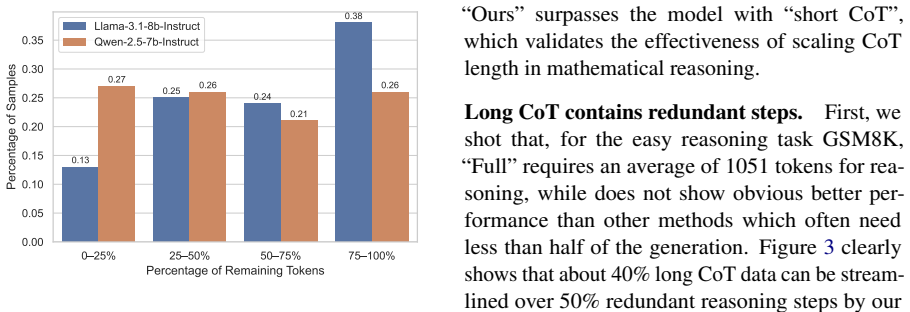
- [Figure 3 caption] The caption contains an apparent encoding artifact, a run of "/uni000000..." tokens, which should be removed before publication.
- [§5.3 and Table 4] There are several small language issues, for example "We are surprising to find" in §5.3 and "natureal drawback" near Table 4; please proofread the manuscript.
Circularity Check
No significant circularity: the measured benchmark accuracies and token counts are independent of the on-policy validation criterion, so no prediction reduces to its input by construction.
full rationale
The paper's central pipeline curates long-CoT data via binary cutting plus on-policy validation (Eq. 1), then reports post-SFT/DPO accuracy and token counts on held-out benchmarks. No fitted parameter is renamed as a prediction, and no measured quantity is defined in terms of the validation function itself. The on-policy validation is self-referential in the sense that the untrained target model selects prefixes it can already interpret, but the final evaluation is an independent generalization measurement, not an identity with the curation filter. The binary-cutting algorithm's stated guarantee of finding the minimal valid prefix is algorithmically questionable under the paper's own backtracking pseudocode, but that is a correctness concern, not circularity. The only potentially load-bearing self-citation is absent: prior work by the authors (e.g., Wang et al. 2023b) appears only in related-work context and is not used to justify the method's premises. The comparison against FCS is a fair external baseline, and the token-reduction results are empirical outputs rather than consequences of how the method was defined. Therefore the paper's derivation chain is self-contained with respect to the circularity patterns considered.
Assumptions & free parameters
free parameters (2)
- DPO SFT loss weight =
0.3 for Llama, 0.1 for Qwen
- DPO temperature beta =
0.1
assumptions (4)
- domain assumption Validity of a prefix is sufficiently monotone that binary search over prefix lengths identifies a useful minimal valid prefix.
- domain assumption The target SLM's direct-answer behavior under the on-policy prompt is a reliable proxy for how the model will learn from that prefix during SFT/DPO.
- domain assumption Paragraph-level segmentation of the thinking trace into atomic reasoning steps preserves the logical units needed for pruning.
- domain assumption The final-answer exact-match extraction via regex is a correct measure of reasoning success.
Cite this review
Pith. "Pith review of Efficient Long CoT Reasoning in Small Language Models." pith.science (2026). https://pith.science/paper/5PURD63E
@misc{pith2026250518440,
  author       = {Pith},
  title        = {Pith review of: Efficient Long CoT Reasoning in Small Language Models},
  year         = {2026},
  howpublished = {\url{https://pith.science/paper/5PURD63E}},
  note         = {Machine review of arXiv:2505.18440}
}
read the original abstract
Recent large reasoning models such as DeepSeek-R1 exhibit strong complex problems solving abilities by generating long chain-of-thought (CoT) reasoning steps. It is challenging to directly train small language models (SLMs) to emerge long CoT. Thus, distillation becomes a practical method to enable SLMs for such reasoning ability. However, the long CoT often contains a lot of redundant contents (e.g., overthinking steps) which may make SLMs hard to learn considering their relatively poor capacity and generalization. To address this issue, we propose a simple-yet-effective method to prune unnecessary steps in long CoT, and then employ an on-policy method for the SLM itself to curate valid and useful long CoT training data. In this way, SLMs can effectively learn efficient long CoT reasoning and preserve competitive performance at the same time. Experimental results across a series of mathematical reasoning benchmarks demonstrate the effectiveness of the proposed method in distilling long CoT reasoning ability into SLMs which maintains the competitive performance but significantly reduces generating redundant reasoning steps.
Figures


Figures from the paper (5 more)


Reference graph
Works this paper leans on
-
[1]
Marah Abdin, Jyoti Aneja, Hany Awadalla, Ahmed Awadallah, Ammar Ahmad Awan, Nguyen Bach, Amit Bahree, Arash Bakhtiari, Jianmin Bao, Harkirat Behl, et al. 2024. Phi-3 technical report: A highly capable language model locally on your phone. arXiv preprint arXiv:2404.14219
arXiv 2024
-
[2]
Pranjal Aggarwal and Sean Welleck. 2025. L1: Controlling how long a reasoning model thinks with reinforcement learning. arXiv preprint arXiv:2503.04697
arXiv 2025
-
[3]
Xingyu Chen, Jiahao Xu, Tian Liang, Zhiwei He, Jianhui Pang, Dian Yu, Linfeng Song, Qiuzhi Liu, Mengfei Zhou, Zhuosheng Zhang, Rui Wang, Zhaopeng Tu, Haitao Mi, and Dong Yu. 2025. https://arxiv.org/abs/2412.21187 Do not think that much for 2+3=? on the overthinking of o1-like llms . Preprint, arXiv:2412.21187
arXiv 2025
-
[4]
Karl Cobbe, Vineet Kosaraju, Mohammad Bavarian, Mark Chen, Heewoo Jun, Lukasz Kaiser, Matthias Plappert, Jerry Tworek, Jacob Hilton, Reiichiro Nakano, Christopher Hesse, and John Schulman. 2021. https://arxiv.org/abs/2110.14168 Training verifiers to solve math word problems . Preprint, arXiv:2110.14168
arXiv 2021
-
[5]
Hugging Face. 2025. https://github.com/huggingface/open-r1 Open r1: A fully open reproduction of deepseek-r1
2025
-
[6]
Yao Fu, Hao Peng, Litu Ou, Ashish Sabharwal, and Tushar Khot. 2023. https://proceedings.mlr.press/v202/fu23d.html Specializing smaller language models towards multi-step reasoning . In Proceedings of the 40th International Conference on Machine Learning, volume 202 of Proceedings of Machine Learning Research, pages 10421--10430. PMLR
work page 2023
-
[7]
Daya Guo, Dejian Yang, Haowei Zhang, Junxiao Song, and Ruoyu Zhang. 2025. https://arxiv.org/abs/2501.12948 Deepseek-r1: Incentivizing reasoning capability in llms via reinforcement learning . Preprint, arXiv:2501.12948
arXiv 2025
-
[8]
Tingxu Han, Zhenting Wang, Chunrong Fang, Shiyu Zhao, Shiqing Ma, and Zhenyu Chen. 2025. https://arxiv.org/abs/2412.18547 Token-budget-aware llm reasoning . Preprint, arXiv:2412.18547
arXiv 2025
Show all 41 references
-
[9]
Dan Hendrycks, Collin Burns, Saurav Kadavath, Akul Arora, Steven Basart, Eric Tang, Dawn Song, and Jacob Steinhardt. 2021. https://arxiv.org/abs/2103.03874 Measuring mathematical problem solving with the math dataset . Preprint, arXiv:2103.03874
2021 arXiv
-
[10]
Geoffrey Hinton, Oriol Vinyals, and Jeff Dean. 2015. https://arxiv.org/abs/1503.02531 Distilling the knowledge in a neural network . Preprint, arXiv:1503.02531
2015 arXiv
-
[11]
Namgyu Ho, Laura Schmid, and Se-Young Yun. 2023. https://doi.org/10.18653/v1/2023.acl-long.830 Large language models are reasoning teachers . In Proceedings of the 61st Annual Meeting of the Association for Computational Linguistics (Volume 1: Long Papers), pages 14852--14882,...
2023 doi
-
[12]
Takeshi Kojima, Shixiang Shane Gu, Machel Reid, Yutaka Matsuo, and Yusuke Iwasawa. 2022. https://openreview.net/forum?id=e2TBb5y0yFf Large language models are zero-shot reasoners . In Advances in Neural Information Processing Systems
2022
-
[13]
Jia LI, Edward Beeching, Lewis Tunstall, Ben Lipkin, Roman Soletskyi, Shengyi Costa Huang, Kashif Rasul, Longhui Yu, Albert Jiang, Ziju Shen, Zihan Qin, Bin Dong, Li Zhou, Yann Fleureau, Guillaume Lample, and Stanislas Polu. 2024. Numinamath. [https://huggingface.co/AI-MO/Numi...
2024
-
[14]
Aixin Liu, Bei Feng, Bing Xue, Bingxuan Wang, Bochao Wu, Chengda Lu, Chenggang Zhao, Chengqi Deng, Chenyu Zhang, Chong Ruan, et al. 2024. Deepseek-v3 technical report. arXiv preprint arXiv:2412.19437
2024 arXiv
-
[15]
MAA . 2024. https://maa.org/math-competitions/american-invitational-mathematics-examination-aime American invitational mathematics examination --- aime . American Invitational Mathematics Examination -- AIME 2024, February 2024
2024
-
[16]
Lucie Charlotte Magister, Jonathan Mallinson, Jakub Adamek, Eric Malmi, and Aliaksei Severyn. 2023. https://doi.org/10.18653/v1/2023.acl-short.151 Teaching small language models to reason . In Proceedings of the 61st Annual Meeting of the Association for Computational Linguist...
2023 doi
-
[17]
Sara Vera Marjanovi \'c , Arkil Patel, Vaibhav Adlakha, Milad Aghajohari, Parishad BehnamGhader, Mehar Bhatia, Aditi Khandelwal, Austin Kraft, Benno Krojer, Xing Han L \`u , et al. 2025. Deepseek-r1 thoughtology: Let's< think> about llm reasoning. arXiv preprint arXiv:2504.07128
2025
-
[18]
Meta-AI. 2024. Introducing meta llama 3: The next generation of open models. https://ai.meta.com/blog/meta-llama-3-1/. Accessed: 2025-05-18
2024
-
[19]
Tergel Munkhbat, Namgyu Ho, Seo Hyun Kim, Yongjin Yang, Yujin Kim, and Se-Young Yun. 2025. Self-training elicits concise reasoning in large language models. arXiv preprint arXiv:2502.20122
2025 arXiv
-
[20]
Sania Nayab, Giulio Rossolini, Marco Simoni, Andrea Saracino, Giorgio Buttazzo, Nicolamaria Manes, and Fabrizio Giacomelli. 2025. https://arxiv.org/abs/2407.19825 Concise thoughts: Impact of output length on llm reasoning and cost . Preprint, arXiv:2407.19825
2025 arXiv
-
[21]
OpenAI. 2024. https://openai.com/index/ learning-to-reason-with-llms Learning to reason with llms. Accessed: 2025-03-05
2024
-
[22]
Qwen-Team. 2024. https://qwenlm.github.io/blog/qwen2.5/ Qwen2.5: A party of foundation models
2024
-
[23]
Rafael Rafailov, Archit Sharma, Eric Mitchell, Christopher D Manning, Stefano Ermon, and Chelsea Finn. 2023. Direct preference optimization: Your language model is secretly a reward model. Advances in Neural Information Processing Systems, 36:53728--53741
2023
-
[24]
Kumar Shridhar, Alessandro Stolfo, and Mrinmaya Sachan. 2023. https://doi.org/10.18653/v1/2023.findings-acl.441 Distilling reasoning capabilities into smaller language models . In Findings of the Association for Computational Linguistics: ACL 2023, pages 7059--7073, Toronto, C...
2023 doi
-
[25]
Yang Sui, Yu-Neng Chuang, Guanchu Wang, Jiamu Zhang, Tianyi Zhang, Jiayi Yuan, Hongyi Liu, Andrew Wen, Shaochen Zhong, Hanjie Chen, et al. 2025. Stop overthinking: A survey on efficient reasoning for large language models. arXiv preprint arXiv:2503.16419
2025 arXiv
-
[26]
Gemma Team, Morgane Riviere, Shreya Pathak, Pier Giuseppe Sessa, Cassidy Hardin, Surya Bhupatiraju, L \'e onard Hussenot, Thomas Mesnard, Bobak Shahriari, Alexandre Ram \'e , et al. 2024. Gemma 2: Improving open language models at a practical size. arXiv preprint arXiv:2408.00118
2024 arXiv
-
[27]
Kimi Team. 2025 a . https://arxiv.org/abs/2501.12599 Kimi k1.5: Scaling reinforcement learning with llms . Preprint, arXiv:2501.12599
2025 arXiv
-
[28]
Qwen Team. 2025 b . https://qwenlm.github.io/blog/qwq-32b/ Qwq-32b: Embracing the power of reinforcement learning
2025
-
[29]
Chi, Sharan Narang, Aakanksha Chowdhery, and Denny Zhou
Xuezhi Wang, Jason Wei, Dale Schuurmans, Quoc V Le, Ed H. Chi, Sharan Narang, Aakanksha Chowdhery, and Denny Zhou. 2023 a . https://openreview.net/forum?id=1PL1NIMMrw Self-consistency improves chain of thought reasoning in language models . In International Conference on Learn...
2023
-
[30]
Zhaoyang Wang, Shaohan Huang, Yuxuan Liu, Jiahai Wang, Minghui Song, Zihan Zhang, Haizhen Huang, Furu Wei, Weiwei Deng, Feng Sun, and Qi Zhang. 2023 b . https://arxiv.org/abs/2310.13332 Democratizing reasoning ability: Tailored learning from large language model . Preprint, ar...
2023 arXiv
-
[31]
Chi, Tatsunori Hashimoto, Oriol Vinyals, Percy Liang, Jeff Dean, and William Fedus
Jason Wei, Yi Tay, Rishi Bommasani, Colin Raffel, Barret Zoph, Sebastian Borgeaud, Dani Yogatama, Maarten Bosma, Denny Zhou, Donald Metzler, Ed H. Chi, Tatsunori Hashimoto, Oriol Vinyals, Percy Liang, Jeff Dean, and William Fedus. 2022 a . https://openreview.net/forum?id=yzkSU...
2022
-
[32]
Chi, Quoc V
Jason Wei, Xuezhi Wang, Dale Schuurmans, Maarten Bosma, Brian Ichter, Fei Xia, Ed H. Chi, Quoc V. Le, and Denny Zhou. 2022 b . Chain-of-thought prompting elicits reasoning in large language models. In Advances in Neural Information Processing Systems
2022
-
[33]
Tong Wu, Chong Xiang, Jiachen T Wang, and Prateek Mittal. 2025. Effectively controlling reasoning models through thinking intervention. arXiv preprint arXiv:2503.24370
2025 arXiv
-
[34]
Heming Xia, Yongqi Li, Chak Tou Leong, Wenjie Wang, and Wenjie Li. 2025. https://arxiv.org/abs/2502.12067 Tokenskip: Controllable chain-of-thought compression in llms . Preprint, arXiv:2502.12067
2025
-
[35]
Xiaohan Xu, Ming Li, Chongyang Tao, Tao Shen, Reynold Cheng, Jinyang Li, Can Xu, Dacheng Tao, and Tianyi Zhou. 2024. https://arxiv.org/abs/2402.13116 A survey on knowledge distillation of large language models . Preprint, arXiv:2402.13116
2024 arXiv
-
[36]
Junjie Yang, Ke Lin, and Xing Yu. 2025. Think when you need: Self-adaptive chain-of-thought learning. arXiv preprint arXiv:2504.03234
2025 arXiv
-
[37]
Jingyang Yi and Jiazheng Wang. 2025. Shorterbetter: Guiding Reasoning Models to Find Optimal Inference Length for Efficient Reasoning . arXiv
2025
-
[38]
Jintian Zhang, Yuqi Zhu, Mengshu Sun, Yujie Luo, Shuofei Qiao, Lun Du, Da Zheng, Huajun Chen, and Ningyu Zhang. 2025. https://arxiv.org/abs/2502.15589 Lightthinker: Thinking step-by-step compression . Preprint, arXiv:2502.15589
2025
-
[39]
Denny Zhou, Nathanael Sch \"a rli, Le Hou, Jason Wei, Nathan Scales, Xuezhi Wang, Dale Schuurmans, Claire Cui, Olivier Bousquet, Quoc V Le, and Ed H. Chi. 2023. https://openreview.net/forum?id=WZH7099tgfM Least-to-most prompting enables complex reasoning in large language mode...
2023
-
[40]
online" 'onlinestring :=
ENTRY address archivePrefix author booktitle chapter edition editor eid eprint eprinttype howpublished institution journal key month note number organization pages publisher school series title type volume year doi pubmed url lastchecked label extra.label sort.label short.list...
-
[41]
write newline
" write newline "" before.all 'output.state := FUNCTION n.dashify 't := "" t empty not t #1 #1 substring "-" = t #1 #2 substring "--" = not "--" * t #2 global.max substring 't := t #1 #1 substring "-" = "-" * t #2 global.max substring 't := while if t #1 #1 substring * t #2 gl...
Reviewed August 7, 2026 · model on record in the stance chip above.
Discussion (0). Continue with ORCID to comment.