REVIEW 1 major objections 5 minor 49 references
MemChain argues that the missing step in memory-augmented agents is a trainable post-retrieval mediator that turns raw retrieved memories into a compact, grounded evidence context, and that this step alone yields large accuracy and cost gai
Reviewed by Pith at T0; open to challenge. T0 means a machine referee read the full paper against a public rubric. the ladder, T0–T4 →
T0 review · deepseek-v4-flash
2026-07-31 23:04 UTC pith:5Q65F5X2
load-bearing objection A well-specified post-retrieval mediator with a plausible training story, but the headline LoCoMo numbers are scored by a co-author-affiliated judge that the policy was trained against, and the original judge's numbers are never shown. the 1 major comments →
MemChain: Learning Interpretable Memory Traces for Memory-Augmented LLM Agents
The pith
A machine-rendered reading of the paper's core claim, the machinery that carries it, and where it could break.
Core claim
MemChain's central claim is that a trainable post-retrieval memory policy, inserted between retrieval and answer generation and leaving both retriever and answer model frozen, converts the retrieved candidate set into 'active memory': a compact evidence context with every statement citing a retrieved candidate. The policy first writes a question-specific evidence plan, then an ordered grounded trace that marks support, contrast, temporal update, and resolution relations among candidates, then a sequence of explicit memory actions (keep, drop, merge, refine, and add), and finally the evidence context handed to the frozen answer model. Two-stage training first teaches structurally valid packet
What carries the argument
The central object is the serialized memory packet (z, T, A, E) produced by the policy from query q and candidate set C_q: an evidence plan z, a grounded evidence trace T in which each step cites candidate IDs and assigns an evidence role, a memory-action sequence A using the five-action vocabulary KEEP, DROP, MERGE, REFINE, ADD, and the final answer-facing active memory E, with E the only input the frozen answer model sees. Citations validate the packet: every trace step and every evidence statement must cite at least one candidate ID from the closed candidate boundary. The training mechanism is Trace-Guided Memory Policy Optimization (TMPO), a group-relative, sequence-level clipped policy
Load-bearing premise
The load-bearing premise is that the refined LoCoMo judge used for the headline numbers is a fair measure of answer correctness — the same judge also supplies 65% of the training reward, and it comes from a source tied to one of the co-authors, so if it systematically favors MemChain's concise, entity-and-date style, the headline advantage could be an evaluation artifact.
What would settle it
Take the MemChain and baseline predictions produced under the exact Table 1 protocol and re-score them with the original LoCoMo judge (or a human-annotated subset) instead of the refined judge; if the accuracy advantage over the strongest baseline collapses or reverses while the token reduction remains, the claim that mediation improves answer quality would be falsified. The paper's own appendix says the original judge is used only for compatibility checks but never reports those numbers.
If this is right
- Retrieval-as-evidence is not enough: with the same candidates, the same frozen answer model, and the same answer prompt, the mediated interface outperforms feeding candidates directly, so evidence formation is a separate, learnable bottleneck.
- Comparable accuracy gains transfer across frozen answer models of different families and sizes: a single small policy lifts open-weight answer models to 80.26 percent overall accuracy on LoCoMo while passing 143.3 tokens per question.
- Answer-facing context drops from thousands of tokens to about 143 — a roughly 24x reduction against the strongest baseline — which translates into cheaper per-query calls to the generator, with memory-side construction cost separated out.
- Every evidence statement cites a retrieved candidate ID, leaving an audit trail that can be checked at inference time; invalid packets are caught by structural validation.
- The mediation step composes with upstream memory work: improvements to memory construction and retrieval remain useful, since the mediator works inside whatever candidate boundary the retriever supplies.
Where Pith is reading between the lines
- Inference: The closed-candidate-boundary formulation is general, so the same trainable mediator should transfer to retrieval-augmented generation beyond long-term memory — any setting where a frozen generator consumes retrieved passages. If the mediator's gains come mainly from resolving conflicts and temporal updates, RAG pipelines with stale or redundant passages are the obvious test bed.
- Inference: The five-action vocabulary and explicit trace effectively turn post-retrieval processing into a learned, auditable compiler for memory. A testable extension is to compare the policy's chosen actions against human annotations of which memories are sufficient, which would tell whether the learned trace semantics match human notions of evidence.
- Inference: The reported gains depend on the refined judge used both for evaluation and for the dominant reward signal. A neutral check — re-scoring with the original benchmark judge or on a human-annotated subset — would show whether the 6-19 point gaps are robust or partly an artifact of the reward/evaluation judge. The paper's own appendix says the original judge is used only for compatibility c
Editorial analysis
A structured set of objections, weighed in public.
Referee Report
Summary. The paper proposes MemChain, a trainable post-retrieval memory policy for long-term memory QA. Given a query and a retrieved candidate set, MemChain generates a structured packet containing an evidence plan, a grounded trace, memory actions, and a compact evidence context; only the evidence context is passed to a frozen answer model. Training is two-stage: supervised trace learning on teacher-generated packets, then TMPO, a GRPO-style RL objective with a multi-signal reward combining answer correctness, stability, trace grounding, and evidence support. Experiments on LoCoMo and LongMemEval-S claim state-of-the-art accuracy with much shorter answer-facing contexts across GPT-4.1-mini, GPT-4o, and Qwen3 answer models. Ablations show large drops when the plan, the trace, or the training stage is removed.
Significance. The proposed post-retrieval mediation interface is well motivated and the method is coherent. If the empirical results hold, MemChain is a useful contribution: it makes evidence formation explicit, trainable, and interpretable, while substantially reducing the context passed to the answer model. The ablation study isolates the contribution of planning, grounded tracing, and training, and the transfer across frozen answer models is internally consistent. The code link and the promise of machine-checkable reproducibility are strengths. However, the main empirical claim is currently not adequately supported because the evaluation metric is the same judge used as the dominant RL reward, and the alternative judge control is missing. The method itself is not circular in a formal sense, but the evaluation loop is coupled, and the headline SOTA claim requires an external check.
major comments (1)
- [Table 1; Eq. (16); Table 8; Appendix A.4] The headline LoCoMo SOTA claim rests on the 'LoCoMo-Refined' judge by Memorax AI, the affiliation of co-author Dong Li. The same judge's correctness c_g is the dominant term of the TMPO reward (Eq. 16: 0.65·c_g; Table 8). Thus the policy is RL-optimized against the exact metric used for the main comparison. The original LoCoMo judge (Maharana et al., 2024) is mentioned in A.4 as a compatibility check, but its numerical results never appear; the refined judge is not cited, linked, or versioned. Because the +6.10pp / +19.09pp margins depend on this protocol, please (i) report all Table 1 methods under the original judge; (ii) cite/version LoCoMo-Refined and disclose the author affiliation; (iii) show that the TMPO reward does not diverge from the original judge, e.g., reward vs. original-judge accuracy on a validation split. Without this external control, the reported SOTA could be an arti
minor comments (5)
- [Table 2] The LongMemEval-S evaluation protocol is not specified: is scoring done by the official benchmark scripts or by an LLM-as-judge, and if so which judge? Also, only Mem0 and Mem-α are compared; reporting SimpleMem/CoM would make the 'consistently state-of-the-art' claim more complete.
- [A.3] The teacher packet generation process is not described in enough detail. Please state which model/version generates the 5,882 SFT packets, what prompt is used, and whether any human validation or automatic consistency checks are applied. Since SFT depends entirely on these packets, this is important for reproducibility.
- [Table 4] The table note is truncated: 'S1-Base-8B refers to ScienceOne-AI/...' should be completed with the full model identifier and a citation if available.
- [Eq. (14)] The clipping bounds epsilon_low and epsilon_high are not listed in Table 6. Please provide their values in the hyperparameter table.
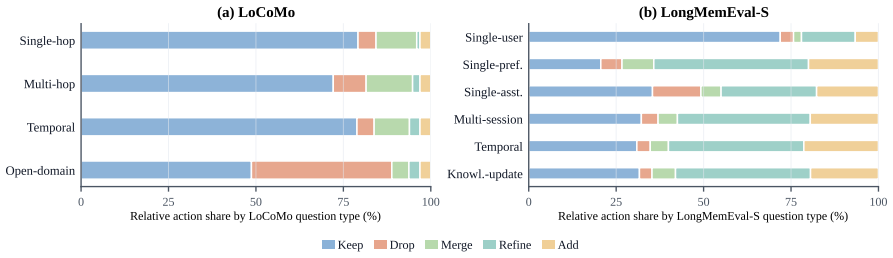
- [Figure 4 caption] The caption contains apparent encoding artifacts ('Relative/uni00A0action/uni00A0share...'). Please fix the typography.
Circularity Check
LoCoMo headline accuracy is scored by the same co-author-affiliated 'LoCoMo-Refined' judge that provides the dominant TMPO reward; the original external judge is referenced as a compatibility check but never reported.
specific steps
-
other
[Eq. (16) / Appendix B.2 Table 8; Table 1 note; Appendix A.4; title-page affiliation (3Memorax AI)]
"Rg = m_g(0.65c_g + 0.15s_g + 0.15t_g + 0.05e_g) ... Here, c_g is mean answer correctness over repeated frozen-model generations. ... Main results use the open-source LoCoMo-Refined judge by Memorax AI ... [A.4] The refined judge refers to the open-source LoCoMo-Refined judge by Memorax AI, which we use for the main reported results rather than introducing a new evaluation protocol."
The paper's strongest empirical claim—'state-of-the-art' LoCoMo accuracy—is measured by the LoCoMo-Refined judge, and that same judge's correctness output c_g is the dominant term of the TMPO reward (weight 0.65). The policy is therefore RL-optimized against the exact function that produces the reported Table 1 numbers. The judge is authored by Memorax AI, the affiliation of co-author Dong Li, and is neither cited nor versioned in the preprint, while the original external LoCoMo judge is mentioned only as a 'compatibility check' with no numeric results shown. This makes the headline comparison a self-referential optimization-evaluation loop rather than an independently anchored result, although it does not reduce a prediction to a fitted constant.
full rationale
Most of MemChain is an empirical method paper, not a derivation: the transformation C_q -> E is learned and evaluated, and no predicted quantity is defined as a fitted parameter. LongMemEval-S results, which use an external benchmark and are reported in Table 2, provide partial independent support. However, the LoCoMo SOTA claim is coupled to the evaluation instrument: Eq. 16 makes the refined-judge correctness c_g the dominant reward signal, Table 1 reports accuracy from that same judge, and Appendix A.4 defers to the original LoCoMo judge only as an unshown 'compatibility check.' Because the refined judge is also affiliated with a co-author and is not cited or versioned, the central claim that MemChain 'consistently achieves state-of-the-art performance' on LoCoMo is not externally anchored. This is evaluation-loop coupling rather than definitional circularity; it warrants a moderate score but not a charge that the method's derivation is equivalent to its inputs.
Axiom & Free-Parameter Ledger
free parameters (4)
- TMPO reward weights =
0.65·cg + 0.15·sg + 0.15·tg + 0.05·eg; gate mg = 0.35·jg + 0.25·vg + 0.20·ig + 0.20·hg
- TMPO hyperparameters =
beta_KL=0.006, lambda_entropy=0.001, group size G=3, LR 2e-7, warmup 0.05, batch 32, BF16
- SFT hyperparameters =
LoRA rank 32, alpha 64, dropout 0.05, LR 8e-5, 2 epochs, warmup 0.03
- Retrieval budget and soft evidence-count target b =
up to 24 candidate memories per policy input; b is a soft target
axioms (4)
- domain assumption Closed-boundary sufficiency: all evidence needed for q is inside the retrieved candidate set Cq.
- domain assumption LoCoMo-Refined and original LoCoMo LLM judges score answer correctness faithfully for all methods.
- domain assumption The self-generated SFT teacher packets are correct, complete, and pedagogically sufficient.
- standard math GRPO-style group-relative advantage with sequence-level importance ratios provides valid policy credit assignment.
invented entities (1)
-
Active memory packet (z, T, A, E) — evidence plan, grounded trace, action sequence, evidence context
independent evidence
read the original abstract
Memory-augmented LLM agents typically answer queries by retrieving relevant memories and feeding them directly to an answer model. This retrieval-as-evidence paradigm assumes retrieved memories are already suitable for reasoning, leaving the answer model to resolve redundancy, conflicts, and weak relevance while incurring substantial context overhead in long-term memory tasks. We propose MemChain, a trainable post-retrieval memory policy that transforms retrieved candidates into answer-facing active memory, represented as a compact and grounded evidence context. Given a user query and retrieved candidates, MemChain first generates a question-conditioned evidence plan, then constructs an ordered grounded evidence trace that organizes retrieved memories according to their semantic roles and dependencies, and finally executes explicit memory actions to produce a concise evidence context for answer generation. To train the mediator, we introduce a two-stage learning framework. Supervised trace learning first teaches the policy to generate structurally valid plans, traces, actions, and evidence contexts. We then propose Trace-Guided Memory Policy Optimization (TMPO), a reinforcement learning objective that optimizes the memory policy using downstream answer quality while jointly encouraging trace grounding, evidence support, structural validity, and answer stability across multiple rollouts. Experiments on LoCoMo and LongMemEval-S demonstrate that MemChain consistently achieves state-of-the-art performance across both closed-source and open-weight frozen answer models while substantially reducing the memory context passed to the answer model.
Figures




Reference graph
Works this paper leans on
-
[1]
2026 , eprint=
Memory for Autonomous LLM Agents: Mechanisms, Evaluation, and Emerging Frontiers , author=. 2026 , eprint=
2026
-
[2]
2026 , eprint=
Agentic Memory: Learning Unified Long-Term and Short-Term Memory Management for Large Language Model Agents , author=. 2026 , eprint=
2026
-
[3]
2026 , eprint=
SimpleMem: Efficient Lifelong Memory for LLM Agents , author=. 2026 , eprint=
2026
-
[4]
2026 , eprint=
EvolveMem: Self-Evolving Memory Architecture via AutoResearch for LLM Agents , author=. 2026 , eprint=
2026
-
[5]
2026 , eprint=
Lightweight LLM Agent Memory with Small Language Models , author=. 2026 , eprint=
2026
-
[6]
2026 , eprint=
Membox: Weaving Topic Continuity into Long-Range Memory for LLM Agents , author=. 2026 , eprint=
2026
-
[7]
2026 , eprint=
HiMem: Hierarchical Long-Term Memory for LLM Long-Horizon Agents , author=. 2026 , eprint=
2026
-
[8]
2026 , eprint=
Mnemis: Dual-Route Retrieval on Hierarchical Graphs for Long-Term LLM Memory , author=. 2026 , eprint=
2026
-
[9]
2026 , eprint=
Choosing How to Remember: Adaptive Memory Structures for LLM Agents , author=. 2026 , eprint=
2026
-
[10]
2026 , eprint=
GAM: Hierarchical Graph-based Agentic Memory for LLM Agents , author=. 2026 , eprint=
2026
-
[11]
2026 , eprint=
HiGMem: A Hierarchical and LLM-Guided Memory System for Long-Term Conversational Agents , author=. 2026 , eprint=
2026
-
[12]
2026 , eprint=
MemBuilder: Reinforcing LLMs for Long-Term Memory Construction via Attributed Dense Rewards , author=. 2026 , eprint=
2026
-
[13]
2026 , eprint=
Mem-T: Densifying Rewards for Long-Horizon Memory Agents , author=. 2026 , eprint=
2026
-
[14]
2026 , eprint=
DeltaMem: Towards Agentic Memory Management via Reinforcement Learning , author=. 2026 , eprint=
2026
-
[15]
2026 , eprint=
Memex(RL): Scaling Long-Horizon LLM Agents via Indexed Experience Memory , author=. 2026 , eprint=
2026
-
[16]
2026 , eprint=
Tree-based Credit Assignment for Multi-Agent Memory System , author=. 2026 , eprint=
2026
-
[17]
2026 , eprint=
FadeMem: Biologically-Inspired Forgetting for Efficient Agent Memory , author=. 2026 , eprint=
2026
-
[18]
2026 , eprint=
PlugMem: A Task-Agnostic Plugin Memory Module for LLM Agents , author=. 2026 , eprint=
2026
-
[19]
2026 , eprint=
Oblivion: Self-Adaptive Agentic Memory Control through Decay-Driven Activation , author=. 2026 , eprint=
2026
-
[20]
2026 , eprint=
Memory in the LLM Era: Modular Architectures and Strategies in a Unified Framework , author=. 2026 , eprint=
2026
-
[21]
2026 , eprint=
AMemGym: Interactive Memory Benchmarking for Assistants in Long-Horizon Conversations , author=. 2026 , eprint=
2026
-
[22]
2026 , eprint=
MemoryCD: Benchmarking Long-Context User Memory of LLM Agents for Lifelong Cross-Domain Personalization , author=. 2026 , eprint=
2026
-
[23]
Advances in Neural Information Processing Systems , year=
Retrieval-Augmented Generation for Knowledge-Intensive NLP Tasks , author=. Advances in Neural Information Processing Systems , year=
-
[24]
2020 , eprint=
Dense Passage Retrieval for Open-Domain Question Answering , author=. 2020 , eprint=
2020
-
[25]
International Conference on Machine Learning , year=
Improving Language Models by Retrieving from Trillions of Tokens , author=. International Conference on Machine Learning , year=
-
[26]
Proceedings of the 36th Annual ACM Symposium on User Interface Software and Technology , year=
Generative Agents: Interactive Simulacra of Human Behavior , author=. Proceedings of the 36th Annual ACM Symposium on User Interface Software and Technology , year=
-
[27]
2023 , eprint=
MemGPT: Towards LLMs as Operating Systems , author=. 2023 , eprint=
2023
-
[28]
2025 , eprint=
Mem0: Building Production-Ready AI Agents with Scalable Long-Term Memory , author=. 2025 , eprint=
2025
-
[29]
2025 , eprint=
A-Mem: Agentic Memory for LLM Agents , author=. 2025 , eprint=
2025
-
[30]
2026 , eprint=
Chain-of-Memory: Lightweight Memory Construction with Dynamic Evolution for LLM Agents , author=. 2026 , eprint=
2026
-
[31]
2025 , eprint=
Memory OS of AI Agent , author=. 2025 , eprint=
2025
-
[32]
2025 , eprint=
Zep: A Temporal Knowledge Graph Architecture for Agent Memory , author=. 2025 , eprint=
2025
-
[33]
Proceedings of the 62nd Annual Meeting of the Association for Computational Linguistics , year=
Evaluating Very Long-Term Conversational Memory of LLM Agents , author=. Proceedings of the 62nd Annual Meeting of the Association for Computational Linguistics , year=
-
[34]
International Conference on Learning Representations , year=
LongMemEval: Benchmarking Chat Assistants on Long-Term Interactive Memory , author=. International Conference on Learning Representations , year=
-
[35]
Proceedings of the 10th SIGHAN Workshop on Chinese Language Processing , year=
PerLTQA: A Personal Long-Term Memory Dataset for Memory Classification, Retrieval, and Fusion in Question Answering , author=. Proceedings of the 10th SIGHAN Workshop on Chinese Language Processing , year=
-
[36]
2024 , eprint=
From Local to Global: A Graph RAG Approach to Query-Focused Summarization , author=. 2024 , eprint=
2024
-
[37]
2024 , eprint=
LightRAG: Simple and Fast Retrieval-Augmented Generation , author=. 2024 , eprint=
2024
-
[38]
Transactions of the Association for Computational Linguistics , volume=
Lost in the Middle: How Language Models Use Long Contexts , author=. Transactions of the Association for Computational Linguistics , volume=
-
[39]
2023 , eprint=
Self-RAG: Learning to Retrieve, Generate, and Critique through Self-Reflection , author=. 2023 , eprint=
2023
-
[40]
2023 , eprint=
Active Retrieval Augmented Generation , author=. 2023 , eprint=
2023
-
[41]
2024 , eprint=
A Human-Inspired Reading Agent with Gist Memory of Very Long Contexts , author=. 2024 , eprint=
2024
-
[42]
Proceedings of the 63rd Annual Meeting of the Association for Computational Linguistics , year=
In Prospect and Retrospect: Reflective Memory Management for Long-Term Personalized Dialogue Agents , author=. Proceedings of the 63rd Annual Meeting of the Association for Computational Linguistics , year=
-
[43]
2025 , eprint=
Memory-R1: Enhancing Large Language Model Agents to Manage and Utilize Memories via Reinforcement Learning , author=. 2025 , eprint=
2025
-
[44]
2025 , eprint=
Reinforcement Learning with Verifiable yet Noisy Rewards under Imperfect Verifiers , author=. 2025 , eprint=
2025
-
[45]
Zhu, Chunzheng and Zeng, Jiaqi and Jiang, Junyu and Lin, Jianxin and Wang, Yijun , year=. 2604.26283 , archivePrefix=
-
[46]
Shi, Yibo and Li, Jungang and Zhang, Linghao and Dongfang, Zihao and Wu, Biao and Tao, Sicheng and Yan, Yibo and Qin, Chenxi and Liu, Weiting and Lin, Zhixin and Li, Hanqian and Huang, Yu and Dai, Song and Hei, Yonghua and Ding, Yue and Li, Xiang and Wang, Shikang and Xu, Chengdong and Liu, Jingqi and Ma, Xueying and Zheng, Zhiwen and Zhang, Xiaofei and W...
-
[47]
Sun, Jingbo and Chong, Wenyue and Tu, Songjun and Zhang, Qichao and Zhang, Yaocheng and Chai, Jiajun and Wang, Xiaohan and Lin, Wei and Yin, Guojun and Zhao, Dongbin , year=. 2604.17337 , archivePrefix=
-
[48]
Dynamic Dual-Granularity Skill Bank for Agentic
Tu, Songjun and Xu, Chengdong and Zhang, Qichao and Zhang, Yaocheng and Lan, Xiangyuan and Li, Linjing and Li, Dong and Zhao, Dongbin , year=. Dynamic Dual-Granularity Skill Bank for Agentic. 2603.28716 , archivePrefix=
-
[49]
Tu, Songjun and Xu, Chengdong and Zhang, Qichao and Ma, Yiwen and Zhang, Yaocheng and Li, Linjing and Li, Dong and Lan, Xiangyuan and Zhao, Dongbin , year=. 2606.29502 , archivePrefix=
discussion (0)
Sign in with ORCID, Apple, or X to comment. Anyone can read and Pith papers without signing in.