REVIEW 4 major objections 5 minor 3 cited by
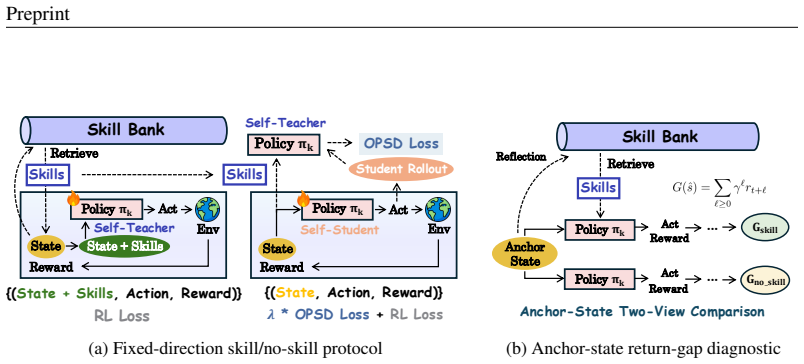
UCOB's thesis: a retrieved skill is a candidate context, not a privileged teacher — the higher-return view at each anchor state teaches the other, and the same local credit drives skill-memory evolution.
Reviewed by Pith at T0; open to challenge. T0 means a machine referee read the full paper against a public rubric. the ladder, T0–T4 →
T0 review · deepseek-v4-flash
2026-08-02 09:38 UTC pith:Q5FI6A25
load-bearing objection The core idea is right and the ablation support is good, but the undefined anchor-state function makes the central credit signal unverifiable until it is pinned down. the 4 major comments →
UCOB: Learning to Utilize and Evolve Agentic Skills via Credit-Aware On-Policy Bidirectional Self-Distillation
The pith
A machine-rendered reading of the paper's core claim, the machinery that carries it, and where it could break.
Core claim
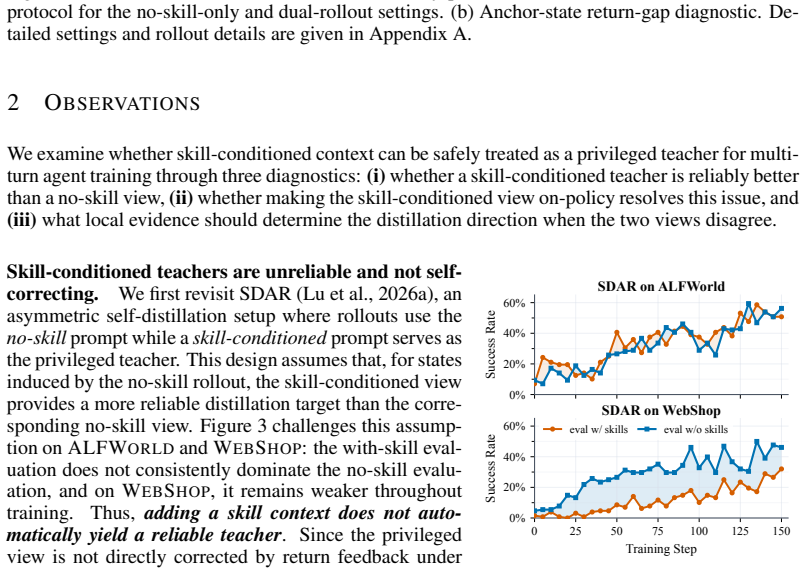
The central discovery is that teacher quality is local: within the same task and anchor-state group, the skill-conditioned branch sometimes returns more and sometimes less than the no-skill branch, and the better branch can switch between decision steps. UCOB exploits this by selecting the highest-return record in each anchor-state group as the credited reference, distilling its token-level distribution to the opposite prompt view (with a confidence gate and a gap-scaled weight), and feeding the same evidence back into skill-memory utilities and reflection self-training. Empirically this yields the best reported success rates among compared methods on ALFWorld (93.0/92.2/89.1 across Qwen2.5-
What carries the argument
The load-bearing mechanism is anchor-state grouped credit comparison: rollouts from both prompt views are grouped by task and a canonical anchor-state abstraction, and return-to-go is compared within each group. This yields credited pairs (higher-return reference, opposite view) that drive three coupled loops: credit-aware bidirectional self-distillation (CBSD), which distills the reference's top-K token support to the opposite view; utility-aware UCB skill retrieval with task- and state-level memory pools updated by EMA from the same gaps; and reflection-based skill-writer self-training with pool-normalized advantages. The anchor-state grouping is what converts a sparse RL return into a den
Load-bearing premise
The method assumes that grouping by task and anchor state isolates the effect of skill conditioning, so that the same-state return gap measures skill utility rather than state confounds; if the anchor-state abstraction is too coarse or inconsistent, the teacher-direction signal is noisy or biased.
What would settle it
Re-run UCOB with anchor-state groups replaced by random groupings of the same size while keeping all other components fixed; if the success-rate gains survive, the same-state return comparison is not the active ingredient. A second test: force the teacher direction to be the reverse of the local gap and check that gains vanish, or compute the gap under two different anchor abstractions and check whether teacher directions flip.
If this is right
- Both context views improve during training, so the final policy works whether or not skills are supplied at evaluation time.
- No-skill-to-skill routing occurs more often than skill-to-no-skill in the reported runs, implying that many retrieved skills are locally misleading and that correcting them, not just internalizing them, is a major source of gain.
- Because utilities are updated from on-policy return gaps and feed back into UCB retrieval, the growing skill bank stays useful rather than drifting into stale advice.
- The extra training cost is localized to log-probability and reference-logit computation, keeping the overhead modest relative to rollout cost.
- Benefits concentrate in multi-turn agentic benchmarks; search QA stays competitive but not dominant, suggesting the mechanism pays off where credit assignment is hard.
Where Pith is reading between the lines
- The same locally-credited teacher-selection rule could apply to other context augmentations besides skills — prompt styles, tool-use descriptions, or retrieved documents — wherever two views of the same policy disagree at the same state.
- If anchor states were replaced by learned state embeddings, the approach could transfer to domains without natural canonical states, such as open-ended dialogue or physical control; the paper leaves the abstraction abstract.
- The largest gains on the smallest model hint that bidirectional credit is most valuable when the base policy is weak; a scaling study could test whether the margin narrows as base competence grows.
- Reporting the exact anchor-state abstraction — which the paper leaves unspecified — would be the natural first step for replication.
Editorial analysis
A structured set of objections, weighed in public.
Referee Report
Summary. The paper proposes UCOB, a framework for agentic reinforcement learning with textual skill memories. UCOB treats skill-conditioned and no-skill prompts as two on-policy context views of the same policy, groups rollout records by task and 'anchor state,' compares return-to-go within each group, and uses the higher-return view as the local teacher in a bidirectional self-distillation objective (CBSD). The same credit signal is reused to update task- and state-level skill utilities and to train a reflection-based skill writer. Experiments on ALFWorld, WebShop, and Search-QA across three backbones report state-of-the-art or near-state-of-the-art success rates, supported by ablations, mechanism analyses, and a local policy-improvement theorem for an idealized version of CBSD.
Significance. If the results are reproducible, the paper makes a useful conceptual contribution: it challenges the fixed privileged-teacher assumption in skill-conditioned agent training and replaces it with a local, return-based teacher selection mechanism. The paper also ships code, provides a detailed appendix, and includes a local policy-improvement proof with an explicit statement that it is not a global convergence claim. These are strengths. However, the central mechanism depends on an anchor-state abstraction that is never defined concretely, and the headline empirical results are reported without error bars or seed counts. The significance is therefore conditional: the method's core comparison and the 'SOTA' claim are not yet fully verifiable from the manuscript.
major comments (4)
- [Section 3, Eq. (6)-(8); Appendix A] The central grouping mechanism is not operationalized. The paper writes \tilde{s}=anchor(s) as 'the canonical anchor-state abstraction' but never defines anchor(s) for ALFWorld, WebShop, or Search-QA. This grouping is used in Eq. (2), Eq. (6), Eq. (8), Figure 5, state-skill writing (Section 4.4), and the theory (Section 5). If the abstraction is too coarse, records in C(u, anchor(s)) may have different unobserved progress or object states, so the return gap would reflect confounds rather than skill utility. Please define anchor(s) concretely per environment and include a sensitivity analysis over coarser and finer abstractions; without this, the central empirical and theoretical claims are not verifiable.
- [Section 6.1, Table 2; Appendix B] All headline results are reported as single numbers without error bars or number of seeds. Rollout group size is 8 (Appendix B), so the same-anchor return estimates are noisy. Several wins are small: on ALFWorld with Qwen2.5-7B, UCOB's 93.0 is 0.8 points above Skill1's 92.2; on Search-QA UCOB is within 0.8 points of the best baseline. Without variance or significance testing, the claim of 'consistent' improvement is not established. Please report means and standard deviations over at least 3 seeds, or confidence intervals, for the main tables and key ablations.
- [Section 5; Appendix C, Eq. (18)-(20), (12)] The theoretical guarantee is for an idealized mixture update with exact branch expectations and correct ordering. The implemented loss uses noisy group returns (group size 8), a top-K support set, a sigmoid confidence gate, and clipped gap weights. The paper states that Eq. (12) 'can be viewed as a KL-proximal stochastic approximation' but does not bound the gap between the idealized update and the implemented one. Please provide a finite-sample or approximation-error statement, or explicitly restrict the theoretical claim to the idealized direction-selection principle. As written, the theorem does not directly certify the CBSD objective as implemented.
- [Appendix C, Corollary 1; Section 5] The conditional contraction result assumes that the higher-return branch is also KL-closer to an optimal local policy (Eq. (41)). The paper acknowledges that 'return gaps alone do not imply distributional closeness.' This is significant because the entire method selects teachers by returns. Please add empirical or conceptual evidence that higher-return branch choice is correlated with closeness to optimal responses in these environments, or clearly state that the theory does not cover the method's main premise.
minor comments (5)
- [Title and running head] The title and running head contain formatting artifacts ('LEARNING TOU TILIZE ANDEVOLVE', 'AGENTICSKILLS VIAC REDIT-AWAREO N-POLICY'). Please proofread.
- [Section 4.2, Eq. (7)] The notation P_{bar c} is confusing: the opposite prompt is said to be stored but not used to generate actions. Clarify whether it is ever executed or is only used as the target context in CBSD.
- [Appendix B] Many hyperparameters (e.g., at most two accepted pairs per anchor group, top-K=32, beta_gate=5.0) are only in the appendix and not summarized in the main text. Consider a consolidated table of CBSD and memory hyperparameters.
- [Figure 5 and Figure 8] The x-axis labels and panel contents in Figures 5 and 8 are underspecified. State explicitly what 'State Rank by Count' and the panel quantities represent, and note the scale of the y-axis in Figure 8(a).
- [Section 6.3] The ablations 'with gap-gated distill' and 'force-directed distill' are not defined precisely. State exactly which components differ from full CBSD beyond the teacher direction.
Circularity Check
No significant circularity: UCOB's local credit rule is an on-policy design, its local improvement lemma is conditional, and the central claims are supported by held-out benchmarks; self-citations are not load-bearing.
full rationale
The paper's derivation chain runs from the Section 2 observations (skill-conditioned teachers are not uniformly better), to the CBSD teacher-selection rule based on same-task/same-anchor returns, to the utility and reflection updates, and finally to held-out benchmark evaluation. The theoretical statement (Proposition 1) is explicitly conditional: it assumes the higher-value branch is correctly identified (µ_h(x) > µ_l(x)) and then shows that interpolating the lower branch toward the higher branch improves the local advantage surrogate by ηδ_x. This is a standard performance-difference identity, not a fitted prediction or a result that assumes the benchmark improvement it is used to explain. The same-anchor comparison is an algorithmic grouping choice, not a parameter fitted to the test data; although the paper never concretely defines the 'canonical anchor-state abstraction' (Section 3: 'write s-tilde = anchor(s) for the canonical anchor-state abstraction'), this is a specification/robustness gap rather than circularity, because the reported successes are measured on evaluation episodes rather than on the same records used to select the teacher. Self-citations such as D2Skill (Tu et al., 2026) and several OPSD-related papers with overlapping authors are used as baselines or related-work context; none carries the load-bearing argument for UCOB's central claim. External baselines (SDAR, Skill1, GiGPO) and ablations provide independent points of comparison. No specific step reduces by construction to its own input, so the circularity score is low; the score of 2 reflects only the presence of minor, non-load-bearing self-citations.
Axiom & Free-Parameter Ledger
free parameters (7)
- lambda_CBSD =
0.1
- tau_CBSD =
0.2
- w_max =
2.0
- epsilon_CBSD =
0.05
- K_tok =
32
- alpha =
not reported
- beta_U =
0.2
axioms (5)
- domain assumption Both prompt views share the same state-value baseline at the same anchor state, so return-to-go gaps are advantage differences.
- domain assumption The anchor-state grouping is a sufficient statistic for the local state; same anchor implies the same continuation value for the same action.
- standard math Performance-difference lemma and trust-region bounds (Kakade & Langford, TRPO) hold for the policy update.
- domain assumption The response sampled under one prompt can be evaluated under the opposite prompt's distribution for distillation, despite distribution shift.
- domain assumption The agent's reflection writer can produce useful skills from its own rollouts, and utilities provide a valid advantage signal.
read the original abstract
Skill memories can improve agentic reinforcement learning by reusing past experience as textual guidance, but retrieved skills are not oracular: they may help in one state while misleading the same policy in another. This makes the common privileged-teacher assumption fragile, namely that a skill-conditioned prompt can be treated as a fixed teacher for the no-skill prompt. We introduce UCOB, a framework for learning to utilize and evolve agentic skills via credit-aware on-policy bidirectional self-distillation. UCOB treats skill-conditioned and no-skill prompts as two on-policy context views of the same model, compares their return-to-go within the same task and anchor state, and uses the higher-return view as the local teacher. This local credit signal internalizes useful skill-conditioned behavior, corrects misleading skill usage, and guides task/state skill memory updates, utility-aware retrieval, and reflection self-training. Experiments on agentic tasks, including ALFWorld, WebShop, and Search-QA, show that UCOB outperforms skill-free RL, skill-memory baselines, and self-distillation methods across model scales, with up to 23.5 and 18.0 point gains over SOTA baselines on ALFWorld and WebShop. Ablations and analyses further validate its core mechanisms, continual adaptation across environments, and modest training overhead. Code is available at https://github.com/TU2021/UCOB.
Figures



Forward citations
Cited by 3 Pith papers
-
From Scoring to Acting: Outcome-Verified Comparative Self-Distillation for LLM Agents
Outcome-verified teacher continuations from student failure prefixes, plus divergence-local comparison and suffix distillation, raise skill-free agent success over scoring-based self-distillation.
-
MemChain: Learning Interpretable Memory Traces for Memory-Augmented LLM Agents
A trainable post-retrieval policy that converts retrieved memories into a compact, provenance-linked evidence context improves long-term-memory QA accuracy while cutting answer-model context from ~3,500 to ~143 tokens...
-
Turning Off-Policy Tokens On-Policy: A Plug-in Approach for Improving LLM Alignment
SIS converts many off-policy tokens to unit-weight on-policy tokens via rejection sampling, tightening the token-vs-sequence IS gap and improving LLM RL post-training as a low-overhead plug-in.
Reference graph
Works this paper leans on
-
[2]
URLhttps://arxiv.org/abs/2602.08234. An Yang, Anfeng Li, Baosong Yang, Beichen Zhang, Binyuan Hui, Bo Zheng, Bowen Yu, Chang Gao, Chengen Huang, Chenxu Lv, Chujie Zheng, Dayiheng Liu, Fan Zhou, Fei Huang, Feng Hu, Hao Ge, Haoran Wei, Huan Lin, Jialong Tang, Jian Yang, Jianhong Tu, Jianwei Zhang, Jianxin Yang, Jiaxi Yang, Jing Zhou, Jingren Zhou, Junyang L...
Pith/arXiv arXiv 2025
-
[4]
URLhttps://arxiv.org/abs/2605.13217. A DETAILEDPROTOCOLS FOR THEOBSERVATIONSTUDY We give the full experimental settings and protocols behind the observation study in Section 2, whose schematic is shown in Figure 2. We useP + andP 0 to denote the skill-conditioned and no-skill prompts, respectively. The first two protocols instantiate fixed-direction on-po...
Pith/arXiv arXiv 2026
-
[2023]
Siliang Zeng, Quan Wei, William Brown, Oana Frunza, Yuriy Nevmyvaka, Yang Zhao, and Mingyi Hong
URLhttps://arxiv.org/abs/2210.03629. Siliang Zeng, Quan Wei, William Brown, Oana Frunza, Yuriy Nevmyvaka, Yang Zhao, and Mingyi Hong. Reinforcing multi-turn reasoning in llm agents via turn-level reward design.arXiv preprint arXiv:2505.11821, 2025. URLhttps://arxiv.org/abs/2505.11821. Xiaoying Zhang, Zichen Liu, Yipeng Zhang, Xia Hu, and Wenqi Shao. Retro...
Pith/arXiv arXiv 2025
-
[2026]
URLhttps://arxiv.org/abs/2605.27899. Zhengxi Lu, Zhiyuan Yao, Zhuowen Han, Zi-Han Wang, Jinyang Wu, Qi Gu, Xunliang Cai, Weim- ing Lu, Jun Xiao, Yueting Zhuang, and Yongliang Shen. Self-distilled agentic reinforcement learning.arXiv preprint arXiv:2605.15155, 2026a. URLhttps://arxiv.org/abs/2605. 15155. Zhengxi Lu, Zhiyuan Yao, Jinyang Wu, Chengcheng Han,...
Pith/arXiv arXiv 2026
discussion (0)
Sign in with ORCID, Apple, or X to comment. Anyone can read and Pith papers without signing in.