Resonance and Stochastic Dynamics of Interplanetary Dust
Pith reviewed 2026-06-26 07:38 UTC · model grok-4.3
The pith
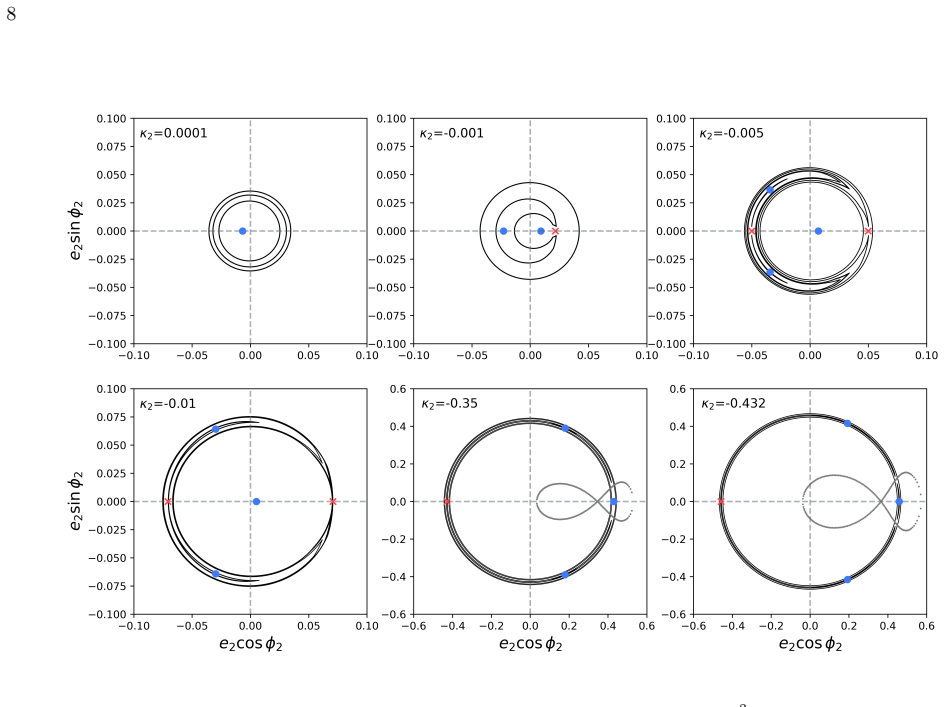
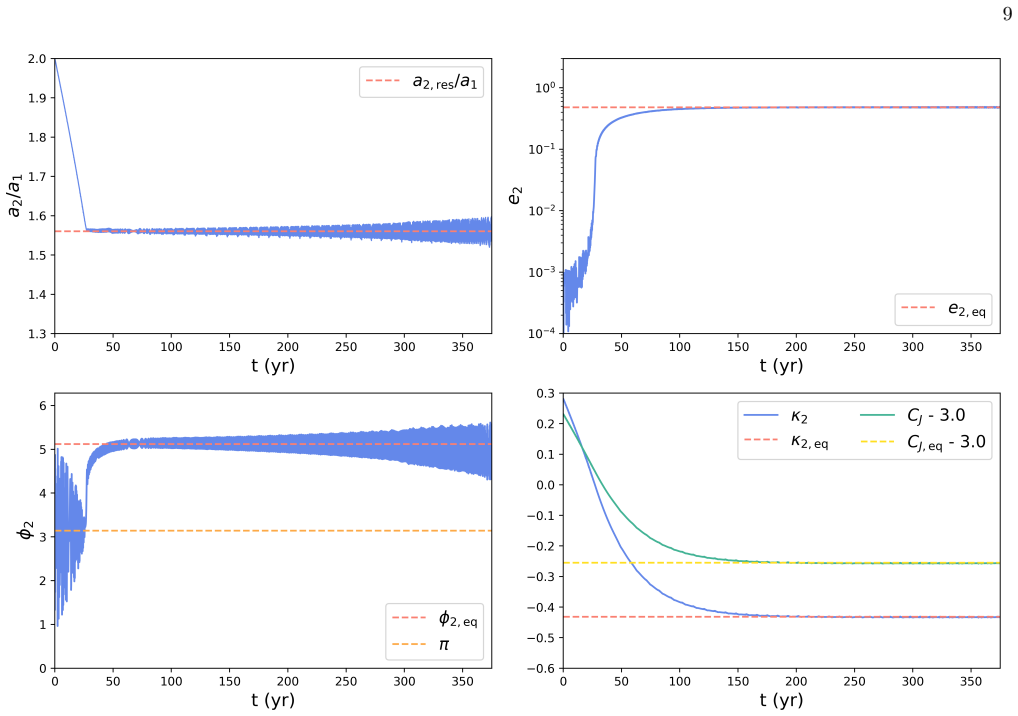
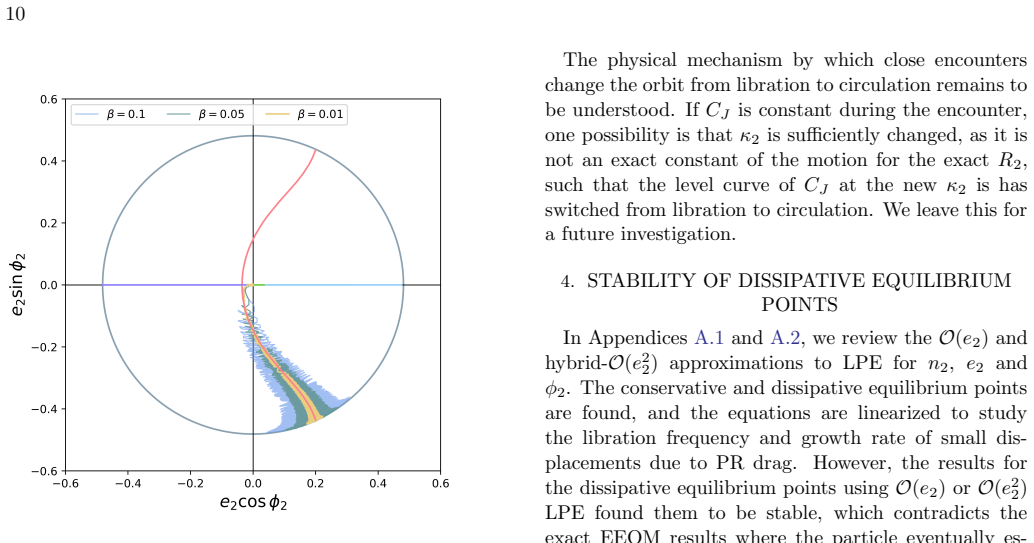
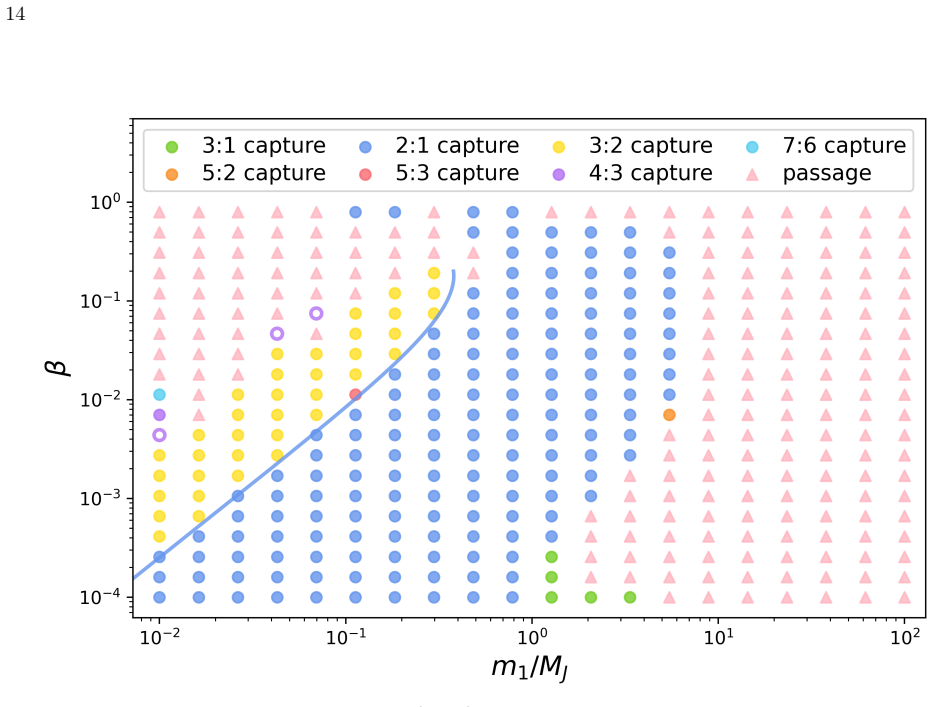
Librations are overstable in low-order resonances, so dust capture is temporary and followed by stochastic scattering.
A machine-rendered reading of the paper's core claim, the machinery that carries it, and where it could break.
Core claim
The central claim is that librations are generically overstable in important low-order resonances such as 3:1, 2:1, and 3:2. This implies resonant capture is ultimately temporary and dust particles escape over a wide range of planet masses and dust size. After resonance escape, the dust orbit is planet-crossing and its subsequent evolution is intrinsically stochastic, governed by repeated close encounters that produce random gravitational kicks. An epicycle-based scattering model derives the impact parameter distribution and energy changes to enable Monte Carlo predictions of outcomes.
What carries the argument
Exact rapid-phase-averaged disturbing function to locate and assess stability of resonant equilibria, together with epicycle approximation for post-escape scattering distributions.
If this is right
- Resonant capture becomes temporary in low-order MMRs like 3:1, 2:1, 3:2.
- Escaped dust follows planet-crossing stochastic paths driven by random kicks.
- Analytic P(b) and P(Δx) distributions enable Monte Carlo fraction calculations.
- Predicted fractions for planet collision, stellar sublimation, and ejection match integrations.
- The method applies across broad planet masses and dust sizes.
Where Pith is reading between the lines
- The temporary nature of resonance may limit dust accumulation in resonant belts observed in debris disks.
- Stochastic scattering could mix dust compositions before delivery to inner planets.
- The model suggests testable predictions for atmospheric metallicity in close-in planets from dust accretion.
- Extending the scattering analysis to inclined orbits or multiple planets would broaden applicability.
Load-bearing premise
The exact rapid-phase-averaged disturbing function accurately locates resonant equilibria and determines their stability, while the epicycle approximation suffices for the scattering impact parameters.
What would settle it
Numerical simulations demonstrating stable, non-growing librations persisting indefinitely in the 2:1 resonance for a range of dust sizes would contradict the generic overstability result.
Figures





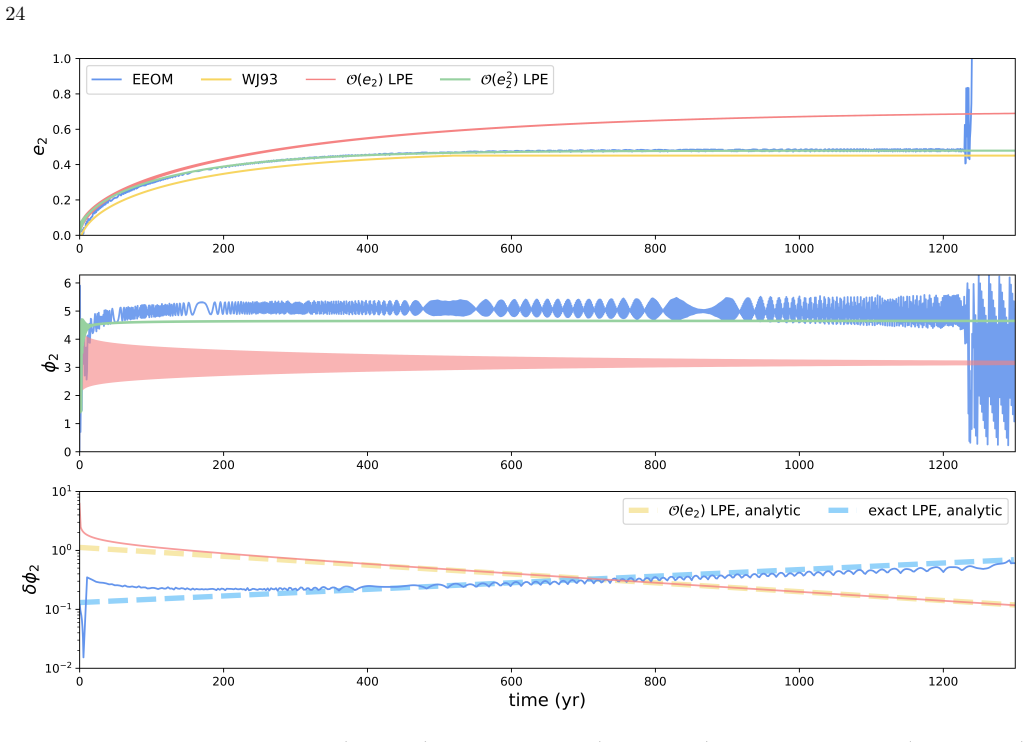
read the original abstract
We study the motion of dust particles inspiraling from distant dust reservoirs toward a close-in planetary system, including the combined effects of radiation pressure and Poynting-Robertson (PR) drag. As dust particles migrate inward, they can be trapped in mean motion resonances (MMRs) depending on the competition between the planet's gravity and PR drag. Our goals are to understand the conditions under which particles can be trapped in MMRs, the evolution in and eventual escape from resonance, and the fraction of dust particles which will hit the planetary upper atmosphere, seeding it with heavy elements. Low-order eccentricity expansions of the disturbing function break down, so we employ an exact, rapid-phase--averaged disturbing function to determine resonant equilibrium points and their stability. We derive analytic expressions for the growth rate of dissipative equilibrium points and confirm that librations are generically overstable in important low-order resonances such as $3\!:\!1$, $2\!:\!1$, and $3\!:\!2$, implying that resonant capture is ultimately temporary and dust particles escape over a wide range of planet masses and dust size. After resonance escape, the dust orbit is planet-crossing and its subsequent evolution is intrinsically stochastic, governed by repeated close encounters that produce random gravitational kicks. We develop an analytic, epicycle-based scattering model to derive the impact parameter distribution $P(b)$ and the resulting energy change distribution $P(\Delta x)$. Using these encounter distributions, we construct a Monte Carlo method that predicts the fractions of dust particles that collide with the planet, sublimate near the star, or are ejected. Comparison of the Monte Carlo calculations with orbit integrations shows good agreement across the cases studied.
Editorial analysis
A structured set of objections, weighed in public.
Referee Report
Summary. The manuscript claims that librations in low-order mean-motion resonances (such as 3:1, 2:1, and 3:2) are generically overstable for inspiraling dust particles subject to PR drag, rendering resonant capture temporary across a wide range of planet masses and particle sizes. After escape the orbits become planet-crossing and evolve stochastically via repeated close encounters; an analytic epicycle-based scattering model supplies the impact-parameter distribution P(b) and energy-change distribution P(Δx), which are fed into a Monte Carlo scheme that predicts the fractions of particles that collide with the planet, sublimate, or are ejected. Direct comparison of the Monte Carlo results with orbit integrations is reported to show good agreement.
Significance. If the central claims hold, the work supplies an analytic route to the temporary nature of resonant dust trapping and the subsequent stochastic delivery of material to planets, with direct implications for atmospheric enrichment. Strengths include the use of an exact rapid-phase-averaged disturbing function (avoiding low-order eccentricity expansions) and the explicit Monte Carlo–integration comparison, which provides a falsifiable test of the overall model without adjustable parameters.
major comments (1)
- [Scattering model (post-resonance section)] Scattering model (post-resonance section): the epicycle approximation used to derive P(b) and P(Δx) linearizes the planet–particle interaction and assumes small deflections. On planet-crossing orbits the relevant encounters include impact parameters b ≲ a few Hill radii, where trajectories are hyperbolic and deflections are order-unity; the approximation is therefore outside its stated regime of validity. Although the Monte Carlo collision/ejection fractions are stated to agree with orbit integrations, the manuscript does not demonstrate that the analytic P(b) itself reproduces the encounter statistics extracted from the integrations, leaving open the possibility that the reported agreement is coincidental rather than confirmatory of the scattering model.
minor comments (1)
- The abstract asserts “good agreement” between Monte Carlo and orbit integrations; the manuscript should report quantitative metrics (e.g., fractional discrepancies or Kolmogorov–Smirnov statistics on the final orbital-element distributions) rather than a qualitative statement.
Simulated Author's Rebuttal
We thank the referee for their careful reading of the manuscript and for highlighting an important point regarding the validity of the scattering model. We respond to the major comment below.
read point-by-point responses
-
Referee: Scattering model (post-resonance section): the epicycle approximation used to derive P(b) and P(Δx) linearizes the planet–particle interaction and assumes small deflections. On planet-crossing orbits the relevant encounters include impact parameters b ≲ a few Hill radii, where trajectories are hyperbolic and deflections are order-unity; the approximation is therefore outside its stated regime of validity. Although the Monte Carlo collision/ejection fractions are stated to agree with orbit integrations, the manuscript does not demonstrate that the analytic P(b) itself reproduces the encounter statistics extracted from the integrations, leaving open the possibility that the reported agreement is coincidental rather than confirmatory of the scattering model.
Authors: We agree that the epicycle approximation is formally valid only for small deflections and that planet-crossing orbits involve encounters with b of order a few Hill radii where deflections can be large. The P(b) derivation is based on the geometric probability of orbit crossings under the assumption of randomized phases rather than a linearization of each individual encounter trajectory. Nevertheless, the referee is correct that the manuscript would be strengthened by an explicit test of whether the analytic P(b) matches the impact-parameter statistics measured directly from the integrations. In the revised version we will extract the distribution of minimum approach distances from the N-body runs, compare it to the analytic prediction, and discuss any discrepancies. This will provide a more direct validation of the scattering model and reduce the possibility that agreement in the final collision/ejection fractions is coincidental. revision: yes
Circularity Check
No significant circularity; derivations are independent and validated externally
full rationale
The paper derives resonant equilibrium points and overstability growth rates from an exact rapid-phase-averaged disturbing function, then derives P(b) and P(Δx) from an epicycle scattering model, feeds those into Monte Carlo, and compares the resulting collision/ejection fractions to separate orbit integrations. No parameters are fitted to the same data used for validation, no self-citations are invoked as load-bearing uniqueness theorems, and no step reduces by construction to its own inputs. The numerical comparisons serve as external benchmarks, keeping the chain self-contained.
Axiom & Free-Parameter Ledger
axioms (2)
- domain assumption Rapid-phase-averaged disturbing function accurately captures resonant equilibrium points and stability
- domain assumption Epicycle approximation yields the impact parameter distribution P(b) for close encounters
Reference graph
Works this paper leans on
-
[1]
2013, A&A, 555, A104, doi: 10.1051/0004-6361/201321673
Absil, O., Defr` ere, D., Coud´ e du Foresto, V., et al. 2013, A&A, 555, A104, doi: 10.1051/0004-6361/201321673
-
[2]
2021, A&A, 651, A45, doi: 10.1051/0004-6361/202140561
Absil, O., Marion, L., Ertel, S., et al. 2021, A&A, 651, A45, doi: 10.1051/0004-6361/202140561
-
[3]
2022, ApJ, 932, 90, doi: 10.3847/1538-4357/ac625e
Arras, P., Wilson, M., Pryal, M., & Baker, J. 2022, ApJ, 932, 90, doi: 10.3847/1538-4357/ac625e
-
[4]
Batygin, K., & Petit, A. C. 2023, ApJL, 946, L11, doi: 10.3847/2041-8213/acc015 28
-
[5]
1994, Icarus, 110, 239, doi: 10.1006/icar.1994.1119
Beauge, C., & Ferraz-Mello, S. 1994, Icarus, 110, 239, doi: 10.1006/icar.1994.1119
-
[6]
2008, Galactic Dynamics: Second Edition
Binney, J., & Tremaine, S. 2008, Galactic Dynamics: Second Edition
2008
-
[7]
Bonsor, A., Wyatt, M. C., Kral, Q., et al. 2018, MNRAS, 480, 5560, doi: 10.1093/mnras/sty2200
-
[8]
Burns, J. A., Lamy, P. L., & Soter, S. 1979, Icarus, 40, 1, doi: 10.1016/0019-1035(79)90050-2
-
[9]
Chang, E., Samra, D., Gao, P., & Arras, P. 2026,
2026
-
[10]
2017, ApJ, 834, 17, doi: 10.3847/1538-4357/834/1/17
Chen, J., & Kipping, D. 2017, ApJ, 834, 17, doi: 10.3847/1538-4357/834/1/17
-
[11]
Deck, K. M., & Batygin, K. 2015, ApJ, 810, 119, doi: 10.1088/0004-637X/810/2/119
-
[12]
Draine, B. T. 2011, Physics of the Interstellar and Intergalactic Medium
2011
-
[13]
The Astronomical Journal , keywords =
Duncan, M., Quinn, T., & Tremaine, S. 1987, AJ, 94, 1330, doi: 10.1086/114571
-
[14]
2014, A&A, 570, A128, doi: 10.1051/0004-6361/201424438
Ertel, S., Absil, O., Defr` ere, D., et al. 2014, A&A, 570, A128, doi: 10.1051/0004-6361/201424438
-
[15]
1968, AJ, 73, 1039, doi: 10.1086/110766
Everhart, E. 1968, AJ, 73, 1039, doi: 10.1086/110766
-
[16]
Fernandez, J. A. 1981, A&A, 96, 26
1981
-
[17]
1989, A&A, 225, 541
Ferraz-Mello, S., & Sato, M. 1989, A&A, 225, 541
1989
-
[18]
1975, Icarus, 25, 489, doi: 10.1016/0019-1035(75)90016-0
Gold, T. 1975, Icarus, 25, 489, doi: 10.1016/0019-1035(75)90016-0
-
[19]
Goldreich, P., & Schlichting, H. E. 2014, AJ, 147, 32, doi: 10.1088/0004-6256/147/2/32
-
[20]
2002, Classical mechanics
Goldstein, H., Poole, C., & Safko, J. 2002, Classical mechanics
2002
-
[21]
1986, Celestial Mechanics, 38, 67, doi: 10.1007/BF01234287
Henon, M., & Petit, J.-M. 1986, Celestial Mechanics, 38, 67, doi: 10.1007/BF01234287
-
[22]
2017, ApJ, 847, 32, doi: 10.3847/1538-4357/aa88ce
Lavvas, P., & Koskinen, T. 2017, ApJ, 847, 32, doi: 10.3847/1538-4357/aa88ce
-
[23]
Mang, J., Gao, P., Hood, C. E., et al. 2022, ApJ, 927, 184, doi: 10.3847/1538-4357/ac51d3
-
[24]
Mang, J., Morley, C. V., Robinson, T. D., & Gao, P. 2024, ApJ, 974, 190, doi: 10.3847/1538-4357/ad6c4c
-
[25]
PeerJ Computer Science3, e103 (Jan 2017)
Meurer, A., Smith, C. P., Paprocki, M., et al. 2017, PeerJ Computer Science, 3, e103, doi: 10.7717/peerj-cs.103
-
[26]
2013, in Planets, Stars and Stellar Systems
Moro-Martin, A. 2013, in Planets, Stars and Stellar Systems. Volume 3: Solar and Stellar Planetary Systems, ed. T. D. Oswalt, L. M. French, & P. Kalas, 431, doi: 10.1007/978-94-007-5606-9 9
-
[27]
Murray, C. D., & Dermott, S. F. 1999, Solar System Dynamics, doi: 10.1017/CBO9781139174817
-
[28]
Murray-Clay, R. A., & Chiang, E. I. 2005, ApJ, 619, 623, doi: 10.1086/426425
-
[29]
Opik, E. J. 1976, Interplanetary encounters : close-range gravitational interactions
1976
-
[30]
Rein, H., & Liu, S. F. 2012, A&A, 537, A128, doi: 10.1051/0004-6361/201118085
work page internal anchor Pith review doi:10.1051/0004-6361/201118085 2012
-
[31]
Shannon, A., Mustill, A. J., & Wyatt, M. 2015, MNRAS, 448, 684, doi: 10.1093/mnras/stv045
-
[32]
1994, A&A, 289, 972
Sidlichovsky, M., & Nesvorny, D. 1994, A&A, 289, 972
1994
-
[33]
Tamayo, D., Rein, H., Shi, P., & Hernandez, D. M. 2020, MNRAS, 491, 2885, doi: 10.1093/mnras/stz2870
-
[34]
Virtanen, P., Gommers, R., Oliphant, T. E., et al. 2020, Nature Methods, 17, 261, doi: 10.1038/s41592-019-0686-2
-
[35]
Weidenschilling, S. J., & Jackson, A. A. 1993, Icarus, 104, 244, doi: 10.1006/icar.1993.1099
-
[36]
Wyatt, S. P., & Whipple, F. L. 1950, ApJ, 111, 134, doi: 10.1086/145244
-
[37]
1980, A&A, 85, 77
Yabushita, S. 1980, A&A, 85, 77
1980
discussion (0)
Sign in with ORCID, Apple, or X to comment. Anyone can read and Pith papers without signing in.