HyperGuide: Hyperbolic Guidance for Efficient Multi-Step Reasoning in Large Language Models
Pith reviewed 2026-06-30 16:08 UTC · model grok-4.3
The pith
Projecting LLM hidden states into hyperbolic space creates a geometric signal that guides step-by-step reasoning and improves accuracy on longer chains.
A machine-rendered reading of the paper's core claim, the machinery that carries it, and where it could break.
Core claim
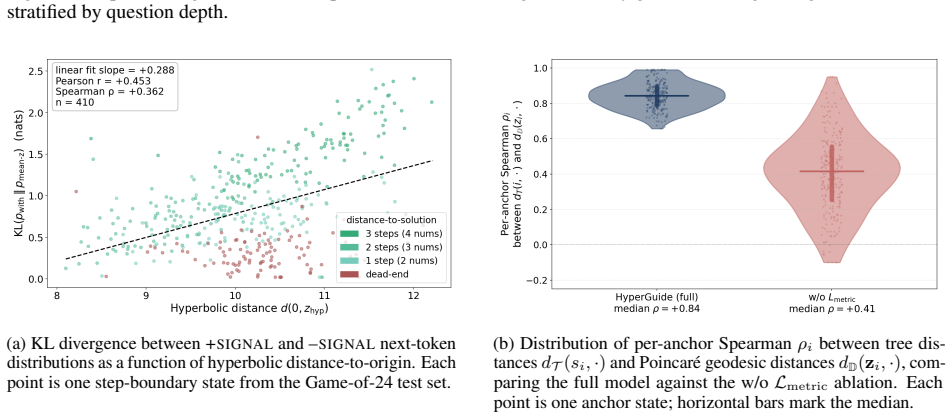
Embedding LLM hidden states in hyperbolic space allows distance-to-origin to serve as a proxy for solution proximity and angular separation to differentiate distinct reasoning branches, so that a low-rank adapter fine-tuned on the model's own attempts can use this signal to improve step-by-step generation.
What carries the argument
The hyperbolic projection head that maps hidden states so distance-to-origin encodes solution proximity and angular separation distinguishes reasoning branches.
If this is right
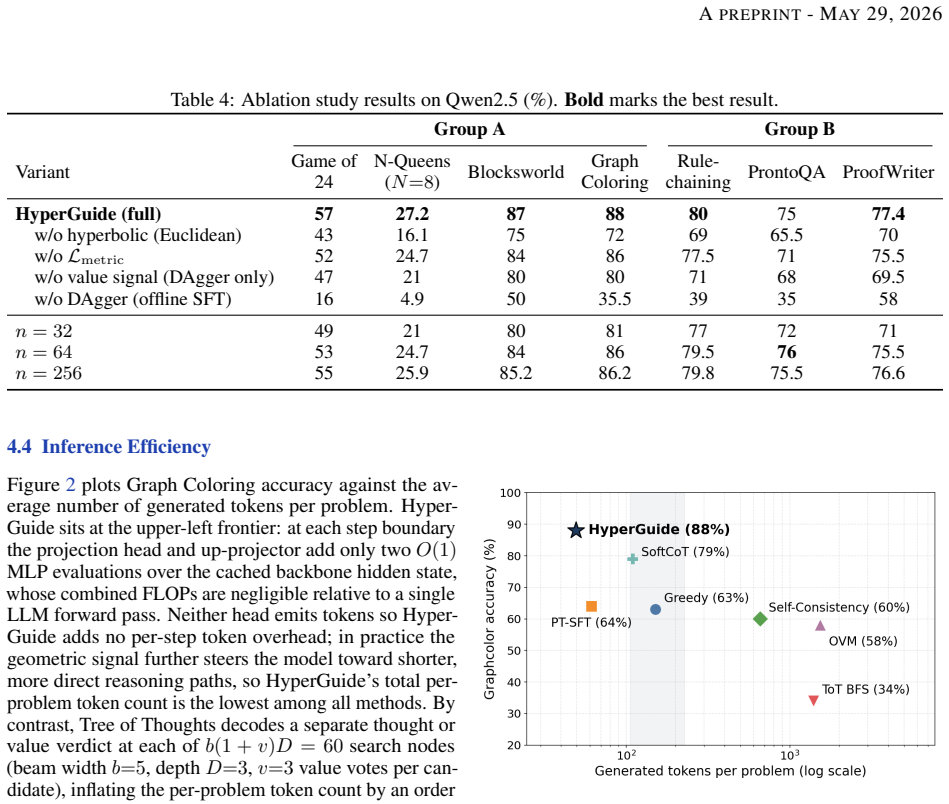
- The geometric signal produces consistent accuracy gains across multiple reasoning benchmarks.
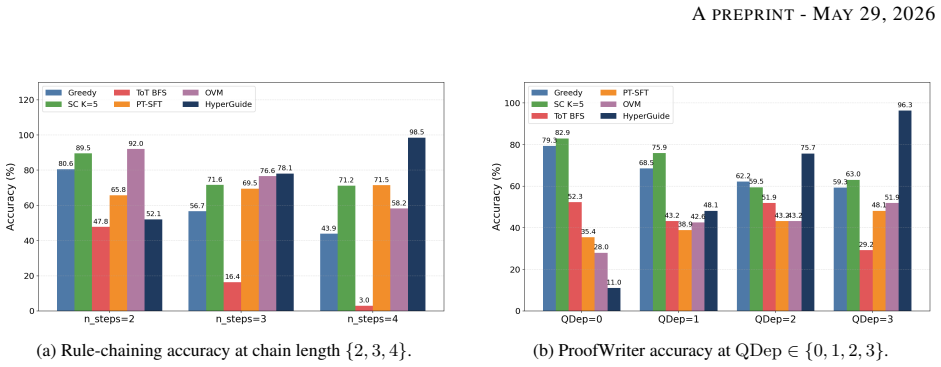
- Improvements are larger on deeper reasoning chains than on shallow ones.
- The method remains more efficient than full tree-search approaches while exceeding single-pass generation accuracy.
Where Pith is reading between the lines
- If the signal works as described, hyperbolic geometry may be especially suited to any search problem whose state space expands rapidly away from goal states.
- The interactive fine-tuning loop could be tested in isolation to determine how much of the gain comes from the geometric signal versus the adaptation procedure itself.
- The same projection idea might be applied to other structured generation tasks such as program synthesis or planning where dead-end states vastly outnumber solutions.
Load-bearing premise
The asymmetry of reasoning trees, with few solutions and exponentially many dead ends, is captured by distance-to-origin and angular separation in hyperbolic space so that a lightweight head can extract a usable guidance signal.
What would settle it
Training an otherwise identical low-rank adapter on the same tasks but without the hyperbolic projection head, or with a Euclidean projection instead, and finding no gain or smaller gains on deep chains would falsify the claim that the geometric signal is responsible.
Figures

read the original abstract
Multi-step reasoning remains a central challenge for large language models: single-pass generation is efficient but lacks accuracy; tree-search methods explore multiple paths but are computation-heavy. We address this gap by distilling reasoning progress into a hyperbolic geometric signal that guides step-by-step generation. Our approach is motivated by a structural observation: in combinatorial reasoning trees, solution-bearing states are few while dead ends are exponentially numerous. The hyperbolic space matches this asymmetry, with compact volume near the origin and exponentially expanding capacity toward the boundary, so that distance-to-origin naturally encodes solution proximity while angular separation distinguishes branches requiring different next operations. We train a lightweight head to project LLM hidden states into this space, then fine-tune a low-rank adapter interactively on its own reasoning attempts to act on the injected signal. Across multiple benchmarks, the geometric signal yields consistent gains, with larger improvements on deeper reasoning chains. Our code is publicly available at https://github.com/yuyuliu11037/HyperGuide.
Editorial analysis
A structured set of objections, weighed in public.
Referee Report
Summary. The paper proposes HyperGuide, which distills reasoning progress from LLM hidden states into a hyperbolic geometric signal for guiding multi-step generation. Motivated by the asymmetry of combinatorial reasoning trees (few solutions, exponentially many dead ends), it projects states such that distance-to-origin encodes solution proximity and angular separation distinguishes branches. A lightweight projection head is trained, followed by interactive LoRA fine-tuning on the model's own attempts; the method reports consistent gains across benchmarks, with larger improvements on deeper chains.
Significance. If the hyperbolic projection reliably encodes the claimed tree structure, the approach could offer a lightweight alternative to explicit tree search for improving LLM reasoning efficiency. Public code release supports reproducibility.
major comments (1)
- [Abstract] The central claim that distance-to-origin and angular separation in the projected hyperbolic space track solution proximity and branch distinction (Abstract) rests on an unverified modeling assumption. No correlation is reported between projected radius and remaining solution depth, or between angular separation and distinct operator sequences; without this, gains on deeper chains could arise from generic auxiliary guidance rather than the specific hyperbolic properties.
Simulated Author's Rebuttal
We thank the referee for the constructive feedback on the modeling assumptions underlying HyperGuide. We agree that the central claims about the hyperbolic geometry would be strengthened by explicit empirical verification of the correlations between the projected signals and reasoning structure. We address this below and commit to revisions that directly test the assumption.
read point-by-point responses
-
Referee: [Abstract] The central claim that distance-to-origin and angular separation in the projected hyperbolic space track solution proximity and branch distinction (Abstract) rests on an unverified modeling assumption. No correlation is reported between projected radius and remaining solution depth, or between angular separation and distinct operator sequences; without this, gains on deeper chains could arise from generic auxiliary guidance rather than the specific hyperbolic properties.
Authors: We acknowledge that the current manuscript does not report direct quantitative correlations (e.g., between projected radius and remaining depth, or angular separation and operator-sequence divergence). The performance improvements on deeper chains are consistent with the intended mechanism but do not by themselves isolate the hyperbolic geometry from other forms of auxiliary guidance. In the revised manuscript we will add a dedicated analysis subsection (in Section 4 or the appendix) that computes and reports: (1) correlation coefficients between the projected radius and ground-truth remaining solution depth on held-out traces; (2) the relationship between hyperbolic angular separation and divergence in the sequence of reasoning operators (measured via edit distance on the derivation trees). If the observed correlations are weak, we will revise the abstract and discussion to qualify the geometric interpretation accordingly. This addition will allow readers to assess whether the gains derive specifically from the hyperbolic properties. revision: yes
Circularity Check
No significant circularity; derivation rests on external geometric motivation
full rationale
The paper motivates hyperbolic projection from the independent structural asymmetry of combinatorial trees (few solutions vs. exponential dead-ends) and the known volume properties of hyperbolic space. It then trains a projection head and LoRA adapter on this signal. No equations, self-citations, or training steps are shown that reduce a claimed prediction or uniqueness result to a fitted input by construction. The interactive fine-tuning on own attempts introduces self-dependency but does not collapse the central geometric claim into a tautology. The derivation chain remains self-contained against the stated geometric prior.
Axiom & Free-Parameter Ledger
free parameters (1)
- low-rank adapter rank and learning rate
axioms (2)
- domain assumption In combinatorial reasoning trees, solution-bearing states are few while dead ends are exponentially numerous.
- domain assumption Hyperbolic space matches this asymmetry, with compact volume near the origin and exponentially expanding capacity toward the boundary.
Reference graph
Works this paper leans on
-
[1]
Reasoning with Language Model is Planning with World Model
URLhttp://arxiv.org/abs/2206.10498. arXiv:2206.10498 [cs]. Jason Wei, Xuezhi Wang, Dale Schuurmans, Maarten Bosma, Brian Ichter, Fei Xia, Ed Chi, Quoc Le, and Denny Zhou. Chain-of-Thought Prompting Elicits Reasoning in Large Language Models, January 2023. URL http: //arxiv.org/abs/2201.11903. arXiv:2201.11903 [cs]. Shunyu Yao, Dian Yu, Jeffrey Zhao, Izhak...
-
[2]
Mastering Chess and Shogi by Self-Play with a General Reinforcement Learning Algorithm
ISSN 1476-4687. doi: 10.1038/nature16961. URLhttps://www.nature.com/articles/nature16961. David Silver, Thomas Hubert, Julian Schrittwieser, Ioannis Antonoglou, Matthew Lai, Arthur Guez, Marc Lanctot, Laurent Sifre, Dharshan Kumaran, Thore Graepel, Timothy Lillicrap, Karen Simonyan, and Demis Hassabis. Mastering Chess and Shogi by Self-Play with a General...
work page internal anchor Pith review Pith/arXiv arXiv doi:10.1038/nature16961 2026
-
[3]
URLhttp://arxiv.org/abs/1910.12933. arXiv:1910.12933 [cs]. Weize Chen, Xu Han, Yankai Lin, Hexu Zhao, Zhiyuan Liu, Peng Li, Maosong Sun, and Jie Zhou. Fully Hyperbolic Neural Networks, March 2022. URLhttp://arxiv.org/abs/2105.14686. arXiv:2105.14686 [cs]. Valentin Khrulkov, Leyla Mirvakhabova, Evgeniya Ustinova, Ivan Oseledets, and Victor Lempitsky. Hyper...
-
[4]
URLhttp://arxiv.org/abs/2412.15115. arXiv:2412.15115 [cs]. OpenAI, Sandhini Agarwal, Lama Ahmad, Jason Ai, Sam Altman, Andy Applebaum, Edwin Arbus, Rahul K. Arora, Yu Bai, Bowen Baker, Haiming Bao, Boaz Barak, Ally Bennett, Tyler Bertao, Nivedita Brett, Eugene Brevdo, Greg Brockman, Sebastien Bubeck, Che Chang, Kai Chen, Mark Chen, Enoch Cheung, Aidan Cla...
work page internal anchor Pith review Pith/arXiv arXiv doi:10.18653/v1/2024.findings-naacl.55 2025
-
[5]
sure”, “likely
Inter-rollout pairs.Two rollouts ρ(1), ρ(2) that share a common prefix up to step t and then diverge yield dT s(1) t+j, s (2) t+k =j+k. Importance weighting.Trajectory-local distances become less reliable as the offset from the shared prefix grows, because the inferred tree structure is based on a finite sample of rollouts rather than an exhaustive enumer...
2023
discussion (0)
Sign in with ORCID, Apple, or X to comment. Anyone can read and Pith papers without signing in.