REVIEW 4 major objections 5 minor 1 cited by
DDUNet: Dual Dynamic U-Net for Highly-Efficient Cloud Segmentation
T0 review · 4 major / 5 minor · reviewed 2026-08-10 · deepseek-v4-flash
Pith's one-line read A 0.33M-parameter U-Net variant reports 95.3% accuracy on cloud segmentation.
desk verdict Abstract overclaims accuracy superiority, but the 0.33M-parameter model is a real lightweight segmentation contribution worth refereeing after fixes. read the letter →
The pith
A machine-rendered reading of the paper's core claim, the machinery that carries it, and where it could break.
The reading
What carries the argument
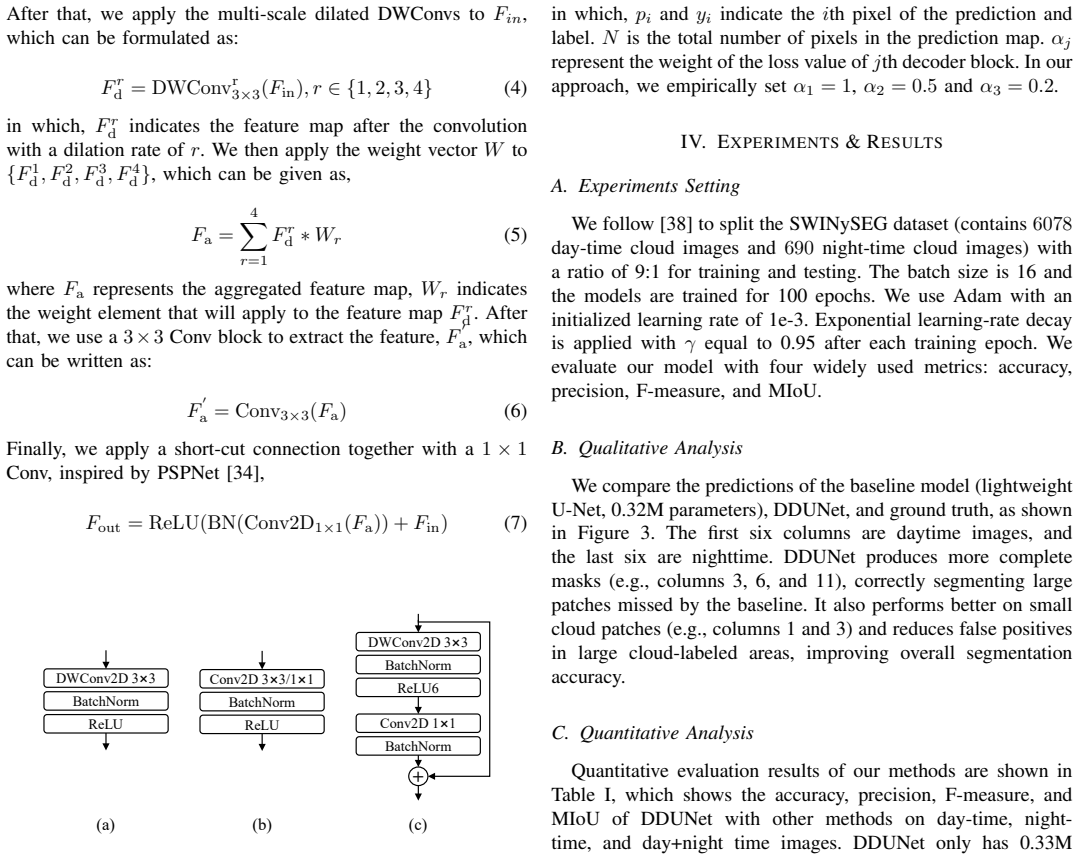
The two load-bearing modules are the Dynamic Multi-scale Conv2D (DMSC) and the Dynamic Weights and Bias Generator (DWBG). DMSC is a multi-branch block: after a 1x1 projection, four depthwise three-by-three convolutions with dilation rates 1 through 4 capture different receptive fields, a small linear-plus-softmax head computes per-image branch weights from global pooled features, and the weighted sum is fused by a short-cut connection. DWBG pools and concatenates encoder and decoder features, then runs two linear layers to generate the three-by-three weights and bias of the final classification convolution, so the classifier adapts to each input instead of using fixed kernels. Depthwise convolution throughout keeps the parameter count at 0.33M, and deep supervision on the last three decoder outputs with binary cross-entropy losses weighted 1, 0.5, and 0.2 drives convergence.
What would settle it
Run the released code on SWINySEG with the stated 9:1 split and the reported training schedule; the central claim fails if 95.3% accuracy and 0.884 MIoU do not reproduce, or if DeepLabV3+ and CloudU-Net, retrained under an identical protocol, match DDUNet's accuracy at a comparable parameter count.
Extended reading notes
Core claim
The central claim is that binary cloud segmentation can be made dramatically cheaper without sacrificing accuracy by making the convolution kernels themselves conditional on the input. On SWINySEG, DDUNet reports 95.3% accuracy, 95.2% precision, 94.7% F-measure, and 0.884 MIoU on the combined day+night split, with 0.33M parameters; the ablation attributes most of the gain to the dynamic multi-scale convolution (93.0% to 94.8% accuracy at 0.28M parameters) and the remainder to the dynamic weight-and-bias generator (94.8% to 95.3% at 0.33M parameters). The authors claim superior accuracy-efficiency trade-offs across day-time, night-time, and day+night configurations, while noting that the raw accuracy of the largest baseline, MA-SegCloud, remains higher.
Load-bearing premise
The comparison against prior models in Table I is fair, meaning the baseline numbers were obtained under the same 9:1 SWINySEG split and the same training protocol as DDUNet.
Editorial extensions
If this is right
- At 0.33M parameters and 95.3% accuracy on the day+night SWINySEG split, a model this small can plausibly run in low-latency settings on embedded devices for ground-based sky monitoring.
- The ablation shows that swapping the baseline encoder for DMSC improves accuracy from 93.0% to 94.8% while reducing parameters to 0.28M, so multi-scale dynamic aggregation is the main source of the gain.
- Adding DWBG raises accuracy from 94.8% to 95.3% at 0.33M parameters, demonstrating that per-input classifier weights add accuracy without adding many parameters.
- Scaling the base channel count from 8 to 4 shrinks the model to 0.09M parameters with 93.6% accuracy, while scaling to 1.25M parameters yields only 95.4%, indicating that the chosen size sits near a useful efficiency frontier.
- If the reported numbers reproduce, DDUNet offers a direct lightweight alternative to models like DeepLabV3+ and CloudU-Net that report similar accuracy with 1/9 to 1/100 of the parameter count.
Reading between the lines
- A natural extension the paper leaves untested is applying DDUNet to other all-sky datasets such as SWIMSEG and SWINSEG to see whether the input-dependent classifier generalizes across camera hardware and sky conditions.
- Because DMSC computes branch weights from the input image itself, DDUNet should in principle adapt to scale distributions; this could be tested directly by comparing it against fixed-dilation U-Nets on images with unusually large or small cloud patches.
- The efficiency ranking depends on the baseline numbers as reported; re-benchmarking all methods under a unified training protocol could shift the ordering, since the highest-accuracy baseline in Table I reports 96.9% accuracy with 16.3M parameters.
Editorial analysis
A structured set of objections, weighed in public.
Referee Report
Summary. The paper proposes DDUNet, a U-Net variant for cloud segmentation that introduces two modules: Dynamic Multi-scale Conv2D (DMSC), which aggregates dilated depth-wise convolutions with input-dependent weights, and a Dynamic Weights and Bias Generator (DWBG), which generates per-sample classifier weights from pooled encoder and decoder features. The model is evaluated on the SWINySEG dataset under day-time, night-time, and day+night splits, achieving 95.3% accuracy and 0.884 MIoU on the day+night split with 0.33M parameters. The central claim is that DDUNet is both highly accurate and highly efficient, with a favorable accuracy-parameter tradeoff relative to existing cloud segmentation models.
Significance. If the reported results are reproducible and the comparison is fair, DDUNet would be a useful contribution to lightweight cloud segmentation: it is an order of magnitude smaller than DeeplabV3+, CloudU-Net, and MA-SegCloud while maintaining competitive accuracy. The code is publicly available, which strengthens reproducibility. However, the significance is currently undercut by overbroad claims in the abstract, unverified baseline comparability, and the absence of direct efficiency measurements such as latency or FLOPs.
major comments (4)
- [Abstract and Table I] The abstract claims that DDUNet 'achieve[s] superior performance over three different configurations of the SWINySEG dataset in both accuracy and efficiency.' This is directly contradicted by Table I, where MA-SegCloud [38] reports higher accuracy, precision, mFβ, and MIoU than DDUNet on every split (e.g., day+night accuracy 96.9% vs. 95.3%, MIoU 0.940 vs. 0.884). The only unambiguous advantage in the table is parameter count (0.33M vs. 16.3M). The claim should be revised to state that DDUNet offers comparable accuracy with far fewer parameters, rather than superior accuracy.
- [Section IV.A (Experiments Setting)] The paper states that the authors follow [38] to split the SWINySEG dataset at 9:1, but it does not state whether the competing methods (U-Net, PSPNet, DeeplabV3+, CloudSegNet, SegCloud, CloudU-Net, CloudU-Netv2, MA-SegCloud) were retrained under this exact split and with the same training protocol, or whether the reported numbers were copied from their original papers. If the baselines used different splits or training settings, the accuracy and parameter-efficiency comparisons in Table I are not controlled, and the central efficiency-accuracy claim is not established. The authors need to clarify the baseline evaluation protocol and ideally retrain all baselines under identical conditions.
- [Section IV.C (Quantitative Analysis)] The title and text describe DDUNet as 'highly-efficient' and suitable for 'real-time' deployment, but the paper reports no FPS, inference latency, or FLOPs. Parameter count alone does not determine efficiency, and the per-sample weight generation in DWBG (Section III.C) may introduce runtime overhead that offsets the parameter savings. The paper should report direct efficiency measurements, preferably on the same hardware for all methods, before claiming real-time capability.
- [Table I and Section IV.A] All quantitative results are based on a single train/test split with no error bars or multiple-seed runs. The differences between DDUNet and several baselines are small in some splits (e.g., day-time accuracy 95.3% vs. U-Net's 94.3%; night-time MIoU 0.900 vs. CloudU-Net's 0.912), and without variance estimates or statistical testing, it is not possible to determine whether these differences are meaningful. The paper should add results over multiple runs and report standard deviations or confidence intervals.
minor comments (5)
- [Abstract and Introduction] There is inconsistent naming between 'SWINSEG' (line in Introduction) and 'SWINySEG' (used elsewhere); please standardize to a single dataset name.
- [Throughout] The terms 'reception field' should be 'receptive field', and 'Wights' (in 'Dynamic Wights and Bias Generator' and Figure 1c) should be 'Weights'.
- [Section II (Related Works)] The paragraph beginning 'Recent research in remote sensing...' appears twice verbatim; one copy should be removed.
- [Table II] The ablation table is numbered 1, 2, 3, 5, 6, skipping 4. This appears to be a typo and should be renumbered consecutively.
- [Section IV.A] The sentence 'We follow [38] to split the SWINySEG dataset ... with a ratio of 9:1 for training and testing' would benefit from specifying whether the split is stratified by day/night and how the day+night configuration is formed, since these choices affect comparability.
Circularity Check
No significant circularity: DDUNet's accuracy and efficiency claims rest on an external benchmark and an independent architecture, not on self-referential construction.
full rationale
The paper is an empirical architecture paper. DDUNet's reported accuracy (95.3% and MIoU 0.884 on the day+night split) is obtained by training on the external SWINySEG dataset with a split taken from [38]; no equation in the paper is constructed to reproduce these numbers. The DMSC weight vector is learned from the input via linear layers and softmax, and the DWBG generates per-sample classifier weights from pooled encoder and decoder features; these are ordinary network components, not parameters fitted to make the central claim true. The loss weights alpha_j and the base-channel count are hand-set design choices, and the ablation study reports independent test-set outcomes for each configuration rather than retrofitting a target result. Self-citations such as CloudSegNet and UCloudNet appear as related work and baselines, not as justification for the central accuracy claim. Concerns about baseline protocol comparability and the phrase 'superior performance ... in both accuracy and efficiency' are experimental-reporting and correctness issues, not circularity, because the central claim does not reduce by construction to its inputs.
Assumptions & free parameters
free parameters (4)
- base_channels =
8
- loss weights alpha_1, alpha_2, alpha_3 =
1, 0.5, 0.2
- dilation rates d1-d4 =
1, 2, 3, 4
- learning rate schedule =
Adam, lr 1e-3, gamma 0.95
assumptions (3)
- domain assumption U-Net encoder-decoder with skip concatenation is an effective segmentation backbone
- domain assumption The 9:1 train/test split following [38] is an appropriate evaluation protocol
- domain assumption SWINySEG ground-truth cloud masks are accurate
Cite this review
Pith. "Pith review of DDUNet: Dual Dynamic U-Net for Highly-Efficient Cloud Segmentation." pith.science (2026). https://pith.science/paper/5W2PWODC
@misc{pith2026250115385,
  author       = {Pith},
  title        = {Pith review of: DDUNet: Dual Dynamic U-Net for Highly-Efficient Cloud Segmentation},
  year         = {2026},
  howpublished = {\url{https://pith.science/paper/5W2PWODC}},
  note         = {Machine review of arXiv:2501.15385}
}
read the original abstract
Cloud segmentation amounts to separating cloud pixels from non-cloud pixels in an image. Current deep learning methods for cloud segmentation suffer from three issues. (a) Constrain on their receptive field due to the fixed size of the convolution kernel. (b) Lack of robustness towards different scenarios. (c) Requirement of a large number of parameters and limitations for real-time implementation. To address these issues, we propose a Dual Dynamic U-Net (DDUNet) for supervised cloud segmentation. The DDUNet adheres to a U-Net architecture and integrates two crucial modules: the dynamic multi-scale convolution (DMSC), improving merging features under different reception fields, and the dynamic weights and bias generator (DWBG) in classification layers to enhance generalization ability. More importantly, owing to the use of depth-wise convolution, the DDUNet is a lightweight network that can achieve 95.3% accuracy on the SWINySEG dataset with only 0.33M parameters, and achieve superior performance over three different configurations of the SWINySEg dataset in both accuracy and efficiency.
Figures


Forward citations
Cited by 1 Pith paper
-
RAINER: A Robust Ensemble Learning Grid Search-Tuned Framework for Rainfall Patterns Prediction
A grid-search-tuned ensemble framework with new temperature and humidity difference features claims 93.8% accuracy for next-day rainfall prediction, but the evaluation may be optimistically biased by target-informed p...
Reference graph
Works this paper leans on
-
[38]
L. Zhang, W. Wei, B. Qiu, A. Luo, M. Zhang, and X. Li, “A Novel Ground-Based Cloud Image Segmentation Method Based on a Multibranch Asymmetric Convolution Module and Attention Mechanism,” Remote Sensing, vol. 14, no. 16, p. 3970, 2022
work page 2022
-
[1]
An extremely-low cost ground-based whole sky imager,
M. Jain, I. Gollini, M. Bertolotto, G. McArdle, and S. Dev, “An extremely-low cost ground-based whole sky imager,” in Proc. IEEE International Geoscience and Remote Sens- ing Symposium (IGARSS) . IEEE, 2021, pp. 8209–8212
work page 2021
-
[2]
Design of low-cost, compact and weather-proof whole sky imagers for high-dynamic-range captures,
S. Dev, F. M. Savoy, Y . H. Lee, and S. Winkler, “Design of low-cost, compact and weather-proof whole sky imagers for high-dynamic-range captures,” in Proc. IEEE International Geoscience and Remote Sensing Symposium (IGARSS) . IEEE, 2015, pp. 5359–5362
work page 2015
-
[3]
Color-based segmen- tation of sky/cloud images from ground-based cameras,
S. Dev, Y . H. Lee, and S. Winkler, “Color-based segmen- tation of sky/cloud images from ground-based cameras,” IEEE Journal of Selected Topics in Applied Earth Obser- vations and Remote Sensing , vol. 10, no. 1, pp. 231–242, 2016
work page 2016
-
[4]
Nighttime sky/cloud image segmentation,
S. Dev, F. M. Savoy, Y . H. Lee, and S. Winkler, “Nighttime sky/cloud image segmentation,” in Proc. IEEE Interna- tional Conference on Image Processing (ICIP) . IEEE, 2017, pp. 345–349
work page 2017
-
[5]
Cloud- segnet: A deep network for nychthemeron cloud image seg- mentation,
S. Dev, A. Nautiyal, Y . H. Lee, and S. Winkler, “Cloud- segnet: A deep network for nychthemeron cloud image seg- mentation,” IEEE Geoscience and Remote Sensing Letters , vol. 16, no. 12, pp. 1814–1818, 2019
work page 2019
-
[6]
Fully Convolutional Networks for Semantic Segmentation,
J. Long, E. Shelhamer, and T. Darrell, “Fully Convolutional Networks for Semantic Segmentation,” in Proceedings of the IEEE/CVF Conference on Computer Vision and Pattern Recognition (CVPR) , 2015, pp. 3431–3440
work page 2015
-
[7]
Feature pyramid networks for object detec- tion,
T.-Y . Lin, P. Doll´ar, R. Girshick, K. He, B. Hariharan, and S. Belongie, “Feature pyramid networks for object detec- tion,” in Proceedings of the IEEE conference on computer vision and pattern recognition , 2017, pp. 2117–2125
work page 2017
Show all 38 references
-
[8]
Re- trieving cloud characteristics from ground-based daytime color all-sky images,
C. N. Long, J. M. Sabburg, J. Calb ´o, and D. Pag `es, “Re- trieving cloud characteristics from ground-based daytime color all-sky images,” Journal of Atmospheric and Oceanic Technology, vol. 23, no. 5, pp. 633–652, 2006
2006
-
[9]
Systematic study of color spaces and components for the segmentation of sky/cloud images,
S. Dev, Y . H. Lee, and S. Winkler, “Systematic study of color spaces and components for the segmentation of sky/cloud images,” in Proc. IEEE International Conference on Image Processing (ICIP) . IEEE, 2014, pp. 5102–5106
2014
-
[10]
Multi- label cloud segmentation using a deep network,
S. Dev, S. Manandhar, Y . H. Lee, and S. Winkler, “Multi- label cloud segmentation using a deep network,” in 2019 USNC-URSI Radio Science Meeting (Joint with AP-S Sym- posium). IEEE, 2019, pp. 113–114
2019
-
[11]
CloudU- Net: A Deep Convolutional Neural Network Architecture for Daytime and Nighttime Cloud Images’ Segmentation,
C. Shi, Y . Zhou, B. Qiu, D. Guo, and M. Li, “CloudU- Net: A Deep Convolutional Neural Network Architecture for Daytime and Nighttime Cloud Images’ Segmentation,” IEEE Geoscience and Remote Sensing Letters (GRSL) , vol. 18, no. 10, pp. 1688–1692, 2020
2020
-
[12]
CloudU-Netv2: A Cloud Seg- mentation Method for Ground-Based Cloud Images Based on Deep Learning,
C. Shi, Y . Zhou, and B. Qiu, “CloudU-Netv2: A Cloud Seg- mentation Method for Ground-Based Cloud Images Based on Deep Learning,” Neural Processing Letters , vol. 53, no. 4, pp. 2715–2728, 2021
2021
-
[13]
UCloudNet: A Residual U-Net with Deep Super- vision for Cloud Image Segmentation,
Y . Li, H. Wang, S. Wang, Y . H. Lee, M. S. Pathan, and S. Dev, “UCloudNet: A Residual U-Net with Deep Super- vision for Cloud Image Segmentation,” in IGARSS 2024- 2024 IEEE International Geoscience and Remote Sensing Symposium. IEEE, 2024, pp. 5553–5557
2024
-
[14]
Superpixel-based and Spatially-regularized Diffusion Learning for Unsupervised Hyperspectral Image Clustering,
K. Cui, R. Li, S. L. Polk, Y . Lin, H. Zhang, J. M. Murphy, R. J. Plemmons, and R. H. Chan, “Superpixel-based and Spatially-regularized Diffusion Learning for Unsupervised Hyperspectral Image Clustering,” IEEE Transactions on Geoscience and Remote Sensing , 2024
2024
-
[15]
Real-Time Localization and Bimodal Point Pattern Analysis of Palms Using UA V Imagery,
K. Cui, W. Tang, R. Zhu, M. Wang, G. D. Larsen, V . P. Pauca, S. Alqahtani, F. Yang, D. Segurado, P. Fine et al. , “Real-Time Localization and Bimodal Point Pattern Analysis of Palms Using UA V Imagery,” arXiv preprint arXiv:2410.11124, 2024
-
[16]
U-net: Convo- lutional networks for biomedical image segmentation,
O. Ronneberger, P. Fischer, and T. Brox, “U-net: Convo- lutional networks for biomedical image segmentation,” in Proc. International Conference on Medical image comput- ing and computer-assisted intervention . Springer, 2015, pp. 234–241
2015
-
[17]
AMDCNet: An attentional multi-directional convolutional network for stereo matching,
H. Wang, Y . Li, S. Xi, S. Wang, M. S. Pathan, and S. Dev, “AMDCNet: An attentional multi-directional convolutional network for stereo matching,” Displays, vol. 74, p. 102243, 2022
2022
-
[18]
Stereo Matching Based on Visual Sensitive Information,
H. Wang, M. S. Pathan, and S. Dev, “Stereo Matching Based on Visual Sensitive Information,” in 2021 6th In- ternational Conference on Image, Vision and Computing (ICIVC), 2021, pp. 312–316
2021
-
[19]
DMCNet: Diversified model combination network for understanding engagement from video screengrabs,
S. Batra, H. Wang, A. Nag, P. Brodeur, M. Checkley, A. Klinkert, and S. Dev, “DMCNet: Diversified model combination network for understanding engagement from video screengrabs,” Systems and Soft Computing , vol. 4, p. 200039, 2022
2022
-
[20]
SYGNet: A SVD-YOLO based GhostNet for Real- time Driving Scene Parsing,
H. Wang, B. Zhu, Y . Li, K. Gong, Z. Wen, S. Wang, and S. Dev, “SYGNet: A SVD-YOLO based GhostNet for Real- time Driving Scene Parsing,” in 2022 IEEE International Conference on Image Processing (ICIP) , 2022, pp. 2701– 2705
2022
-
[21]
Optimized Hard Exudate Detection with Supervised Contrastive Learning,
W. Tang, K. Cui, and R. H. Chan, “Optimized Hard Exudate Detection with Supervised Contrastive Learning,” in 2024 IEEE International Symposium on Biomedical Imaging (ISBI). IEEE, 2024, pp. 1–5
2024
-
[22]
Accurate detection and instance segmentation of unstained living adherent cells in differential interference contrast images,
F. Pan, Y . Wu, K. Cui, S. Chen, Y . Li, Y . Liu, A. Shakoor, H. Zhao, B. Lu, S. Zhi et al. , “Accurate detection and instance segmentation of unstained living adherent cells in differential interference contrast images,” Computers in Biology and Medicine , vol. 182, p. 109151, 2024
2024
-
[23]
DAANet: Dual Attention Aggregating Network for Salient Object Detection,
Y . Li, H. Wang, Z. Li, S. Wang, S. Dev, and G. Zuo, “DAANet: Dual Attention Aggregating Network for Salient Object Detection,” in IEEE International Conference on Robotics and Biomimetics (ROBIO) . IEEE, 2023, pp. 1–7
2023
-
[24]
CPDR: Towards Highly-Efficient Salient Object Detection via Crossed Post- decoder Refinement,
Y . Li, H. Wang, and A. Katsaggelos, “CPDR: Towards Highly-Efficient Salient Object Detection via Crossed Post- decoder Refinement,” in 35th British Machine Vision Con- ference 2024, BMVC 2024, Glasgow, UK, November 25-28,
2024
-
[25]
AlignGroup: Learning and Aligning Group Consensus with Member Preferences for Group Recommendation,
J. Xu, Z. Chen, J. Li, S. Yang, H. Wang, and E. C. Ngai, “AlignGroup: Learning and Aligning Group Consensus with Member Preferences for Group Recommendation,” in Proceedings of the 33rd ACM International Conference on Information and Knowledge Management , 2024, pp. 2682– 2691
2024
-
[26]
MENTOR: Multi-level Self-supervised Learn- ing for Multimodal Recommendation,
J. Xu, Z. Chen, S. Yang, J. Li, H. Wang, and E. C.- H. Ngai, “MENTOR: Multi-level Self-supervised Learn- ing for Multimodal Recommendation,” arXiv preprint arXiv:2402.19407, 2024
2024 arXiv
-
[27]
VGRISys: A Vision-Guided Robotic Intelligent System for Autonomous Instrument Calibration*,
Z. Li, H. Wang, Y . Li, S. Dev, and G. Zuo, “VGRISys: A Vision-Guided Robotic Intelligent System for Autonomous Instrument Calibration*,” in 2023 IEEE International Con- ference on Robotics and Biomimetics (ROBIO) , 2023, pp. 1–6
2023
-
[28]
AbHE: All Attention-Based Homography Estimation,
M. Huo, Z. Zhang, X. Ren, X. Yang, and C. Ye, “AbHE: All Attention-Based Homography Estimation,”IEEE Trans- actions on Instrumentation and Measurement , vol. 73, pp. 1–11, 2024
2024
-
[29]
Fanuc manipulation: A dataset for learning- based manipulation with fanuc mate 200id robot,
X. Zhu, R. Tian, C. Xu, M. Huo, W. Zhan, M. Tomizuka, and M. Ding, “Fanuc manipulation: A dataset for learning- based manipulation with fanuc mate 200id robot,” 2023
2023
-
[30]
AirShot: Efficient Few-Shot Detection for Autonomous Exploration,
Z. Wang, B. Li, C. Wang, and S. Scherer, “AirShot: Efficient Few-Shot Detection for Autonomous Exploration,” in IEEE/RSJ International Conference on Intelligent Robots and Systems (IROS) , 2024. [Online]. Available: https://arxiv.org/pdf/2404.05069.pdf
2024 arXiv
-
[31]
ONLS: OPTIMAL NOISE LEVEL SEARCH IN DIFFUSION AUTOENCODERS WITHOUT FINE- TUNING,
Z. Wang, “ONLS: OPTIMAL NOISE LEVEL SEARCH IN DIFFUSION AUTOENCODERS WITHOUT FINE- TUNING,” in The Second Tiny Papers Track at ICLR 2024, 2024. [Online]. Available: https://openreview.net/ forum?id=Q8diCUHTZd
2024
-
[32]
Mobilenetv2: Inverted residuals and linear bottlenecks,
M. Sandler, A. Howard, M. Zhu, A. Zhmoginov, and L.-C. Chen, “Mobilenetv2: Inverted residuals and linear bottlenecks,” in Proceedings of the IEEE conference on computer vision and pattern recognition , 2018, pp. 4510– 4520
2018
-
[33]
Deeplab: Semantic image segmentation with deep convolutional nets, atrous convolution, and fully con- nected crfs,
L.-C. Chen, G. Papandreou, I. Kokkinos, K. Murphy, and A. L. Yuille, “Deeplab: Semantic image segmentation with deep convolutional nets, atrous convolution, and fully con- nected crfs,” IEEE transactions on pattern analysis and machine intelligence, vol. 40, no. 4, pp. 834–848, 2017
2017
-
[34]
Pyramid scene parsing network,
H. Zhao, J. Shi, X. Qi, X. Wang, and J. Jia, “Pyramid scene parsing network,” in Proceedings of the IEEE conference on computer vision and pattern recognition , 2017, pp. 2881– 2890
2017
-
[35]
Pyramid Scene Parsing Network,
——, “Pyramid Scene Parsing Network,” in Proceedings of the IEEE Conference on Computer Vision and Pattern Recognition (CVPR) , July 2017
2017
-
[36]
Rethinking Atrous Convolution for Semantic Image Seg- mentation,
L.-C. Chen, G. Papandreou, F. Schroff, and H. Adam, “Rethinking Atrous Convolution for Semantic Image Seg- mentation,” arXiv preprint arXiv:1706.05587 , 2017
2017 arXiv
-
[37]
SegCloud: A novel cloud image segmentation model using a deep convo- lutional neural network for ground-based all-sky-view cam- era observation,
W. Xie, D. Liu, M. Yang, S. Chen, B. Wang, Z. Wang, Y . Xia, Y . Liu, Y . Wang, and C. Zhang, “SegCloud: A novel cloud image segmentation model using a deep convo- lutional neural network for ground-based all-sky-view cam- era observation,” Atmospheric Measurement Techniques ,...
1953
Reviewed August 10, 2026 · model on record in the stance chip above.
Discussion (0). Continue with ORCID to comment.