Minimality, transitivity and sensitivity of non-uniform cellular automata
Pith reviewed 2026-05-22 03:12 UTC · model grok-4.3
The pith
A two-dimensional non-uniform cellular automaton can be minimal and transitive without sensitivity to initial conditions.
A machine-rendered reading of the paper's core claim, the machinery that carries it, and where it could break.
Core claim
The authors construct a two-dimensional non-uniform cellular automaton that is minimal, hence transitive, but not sensitive to initial conditions. The construction relies on an odometer-like system over the space of sequences in {0,1,2}^N that uses a different local rule only at the first cell and remains minimal despite this non-uniformity. They show that recurrent assignments of local rules restore the implication from transitivity to sensitivity.
What carries the argument
The nearly uniform odometer non-uniform cellular automaton on {0,1,2}^N with a modified local rule only at the first cell, extended to two dimensions to produce a minimal but insensitive system.
If this is right
- Transitivity implies sensitivity when the assignment of local rules is recurrent.
- Minimality of a non-uniform cellular automaton does not guarantee sensitivity.
- The classical implication from transitivity to sensitivity is specific to the uniform case.
- Non-uniformity allows dynamical properties to separate in ways forbidden for ordinary cellular automata.
Where Pith is reading between the lines
- Uniformity of the local rule may be the essential ingredient that links transitivity and sensitivity in one dimension.
- Similar nearly uniform constructions could separate other properties such as mixing or entropy in non-uniform settings.
- The result raises the question of which dynamical features survive when uniformity is relaxed only at finitely many or sparsely distributed cells.
Load-bearing premise
The specific odometer construction with a rule change confined to the first cell remains minimal even though it is not sensitive.
What would settle it
An explicit computation showing that the constructed two-dimensional NUCA actually has sensitive dependence on initial conditions, or that the one-dimensional odometer fails to be minimal.
Figures



read the original abstract
Every transitive cellular automaton (CA) is sensitive to initial conditions. We study this implication in the more general context of non-uniform cellular automata (NUCA) with finitely many different local update rules assigned to cells. We construct a two-dimensional NUCA that is minimal -- and hence transitive -- but that is not sensitive to initial conditions. The construction is based on an odometer NUCA on $\{0,1,2\}^\mathbb{N}$ which is nearly uniform in the sense that only the first cell uses a different local rule. Then we show that if the assignment of local rules in the cells is recurrent then transitivity implies sensitivity.
Editorial analysis
A structured set of objections, weighed in public.
Referee Report
Summary. The manuscript constructs a two-dimensional non-uniform cellular automaton (NUCA) that is minimal (hence transitive) but not sensitive to initial conditions, providing a counterexample to the implication that holds for uniform cellular automata. The construction proceeds by first defining a nearly uniform odometer NUCA on {0,1,2}^N in which only the local rule at the first cell differs from the standard addition-with-carry rule modulo 3, then lifting the example to two dimensions. The paper additionally proves that when the assignment of local rules across cells is recurrent, transitivity does imply sensitivity.
Significance. If the central construction is verified, the result supplies a concrete separation between minimality/transitivity and sensitivity in the NUCA setting, clarifying the boundary between uniform and non-uniform systems. The explicit odometer-based construction and the positive theorem for recurrent rule assignments are strengths that offer testable examples for further work in symbolic dynamics.
major comments (2)
- [§3] §3 (one-dimensional construction): the argument that the modified odometer NUCA remains minimal must explicitly verify that altering the local rule only at position 0 preserves orbit density under carry propagation. The product-topology density claim for every initial configuration is load-bearing for the counterexample; without a detailed check that the first-cell modification does not trap orbits in a proper closed invariant subset, the minimality assertion is not yet secured.
- [§4] §4 (two-dimensional lift): the passage from the one-dimensional nearly uniform NUCA to the two-dimensional example must confirm that both minimality and the failure of sensitivity survive the product construction. It is unclear from the current exposition whether the boundary modification at the first cell interacts with the second dimension in a way that could restore sensitivity or destroy density.
minor comments (2)
- Notation for the local rules (especially the distinction between the standard carry rule and the modified rule at site 0) would benefit from an explicit table or diagram showing the update for a few sample configurations.
- A short remark on the precise definition of 'recurrent assignment' used in the positive theorem would improve readability for readers outside the immediate subfield.
Simulated Author's Rebuttal
We thank the referee for the careful reading of the manuscript and for identifying points where the exposition of the constructions requires additional detail. We respond to each major comment below.
read point-by-point responses
-
Referee: [§3] §3 (one-dimensional construction): the argument that the modified odometer NUCA remains minimal must explicitly verify that altering the local rule only at position 0 preserves orbit density under carry propagation. The product-topology density claim for every initial configuration is load-bearing for the counterexample; without a detailed check that the first-cell modification does not trap orbits in a proper closed invariant subset, the minimality assertion is not yet secured.
Authors: We agree that the minimality argument in §3 would be strengthened by an explicit verification of orbit density after the local-rule modification at position 0. In the revised manuscript we will insert a dedicated lemma that tracks carry propagation explicitly: for any finite initial segment and any target configuration, we exhibit a finite sequence of inputs whose carries reach the modified cell and then propagate to realize the desired finite pattern, thereby showing that no proper closed invariant subset can contain an orbit. This addition will make the density claim fully rigorous without altering the underlying construction. revision: yes
-
Referee: [§4] §4 (two-dimensional lift): the passage from the one-dimensional nearly uniform NUCA to the two-dimensional example must confirm that both minimality and the failure of sensitivity survive the product construction. It is unclear from the current exposition whether the boundary modification at the first cell interacts with the second dimension in a way that could restore sensitivity or destroy density.
Authors: We acknowledge that the interaction between the one-dimensional boundary modification and the second coordinate is not spelled out in sufficient detail. In the revision we will add a short subsection that treats the two-dimensional system as a product of the one-dimensional nearly-uniform NUCA with a uniform minimal odometer on the second coordinate. We will prove that (i) minimality is preserved because every finite cylinder in the product can be reached by independently controlling the first coordinate (via the already-established density) and the second coordinate (via its uniform minimality), and (ii) non-sensitivity is inherited because any perturbation that fails to propagate in the first coordinate remains invisible in the product metric, regardless of the uniform dynamics in the second coordinate. This will confirm that the boundary effect does not restore sensitivity. revision: yes
Circularity Check
Explicit construction of minimal non-sensitive 2D NUCA is self-contained with no circularity
full rationale
The paper's central result is an explicit construction of a two-dimensional NUCA that is minimal (hence transitive) but not sensitive, built from a nearly uniform odometer on {0,1,2}^N with a modified local rule only at the first cell. Minimality is shown by direct verification that every orbit remains dense in the product topology under carry propagation, and non-sensitivity follows immediately from the boundary modification preserving certain invariant subsets. This is a self-contained mathematical argument with no fitted parameters renamed as predictions, no self-definitional loops, and no load-bearing self-citations that reduce the claim to unverified prior inputs. The subsequent theorem on recurrent rule assignments implying sensitivity from transitivity is likewise proved independently from the construction.
Axiom & Free-Parameter Ledger
axioms (1)
- standard math Standard properties of odometers and minimality implying transitivity in symbolic dynamical systems
Lean theorems connected to this paper
-
IndisputableMonolith/Foundation/ArithmeticFromLogic.leanembed_injective / LogicNat orbit structure unclear?
unclearRelation between the paper passage and the cited Recognition theorem.
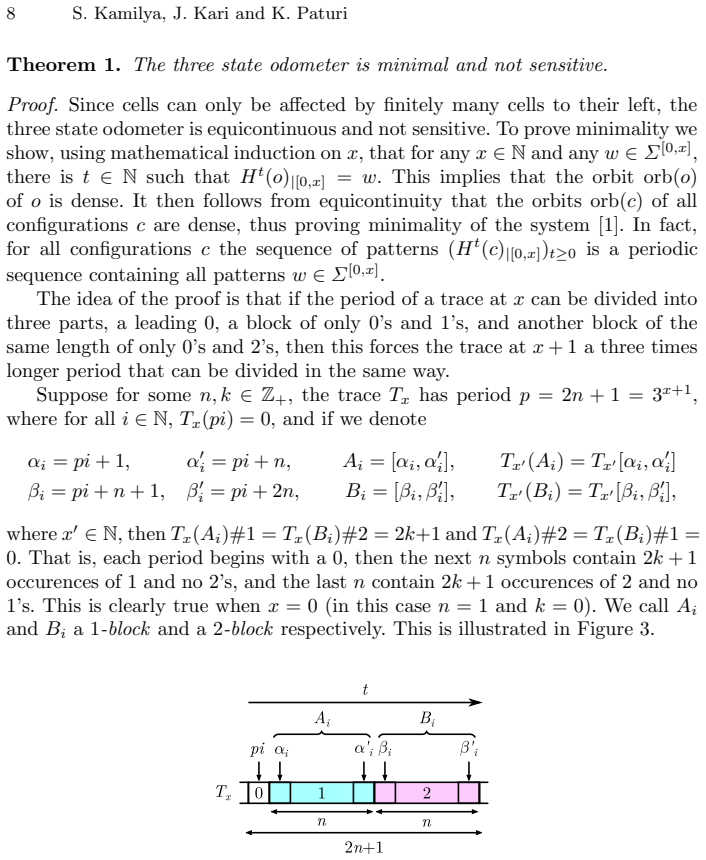
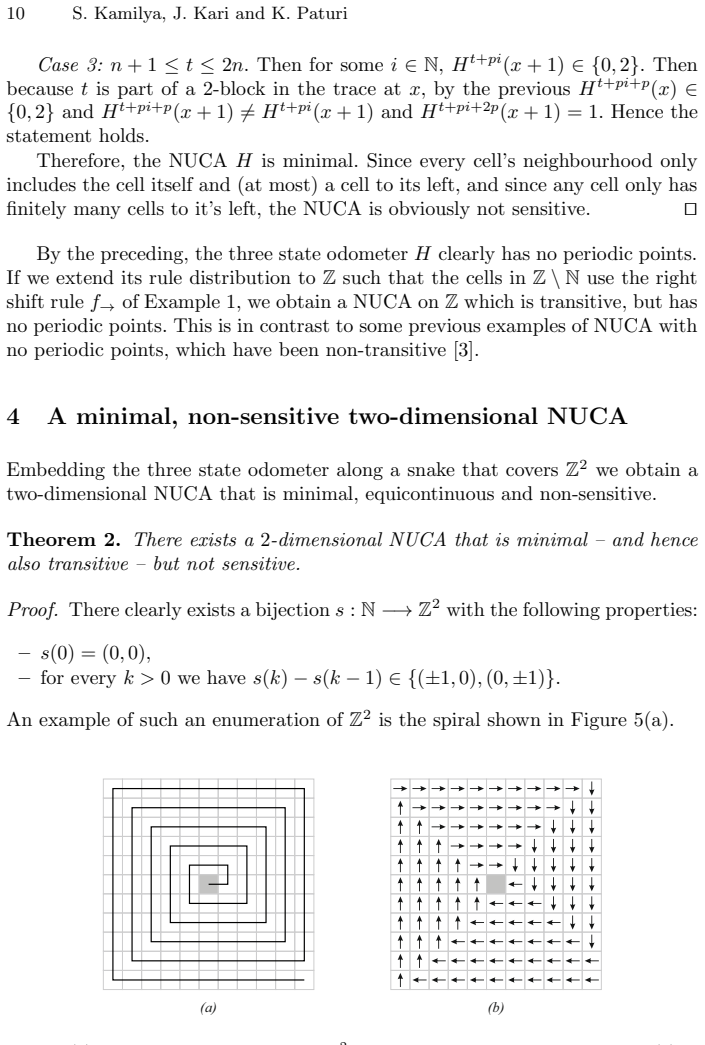
We construct a two-dimensional NUCA that is minimal -- and hence transitive -- but that is not sensitive to initial conditions. The construction is based on an odometer NUCA on {0,1,2}^N which is nearly uniform in the sense that only the first cell uses a different local rule.
-
IndisputableMonolith/Foundation/AlexanderDuality.leanalexander_duality_circle_linking (D=3 forcing) unclear?
unclearRelation between the paper passage and the cited Recognition theorem.
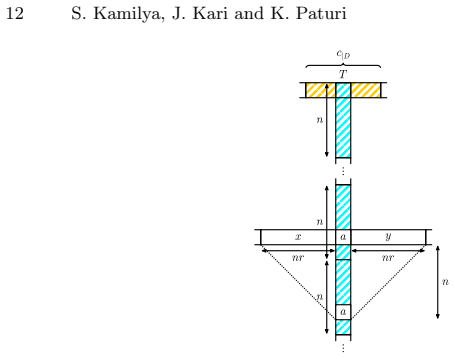
if the assignment of local rules in the cells is recurrent then transitivity implies sensitivity
What do these tags mean?
- matches
- The paper's claim is directly supported by a theorem in the formal canon.
- supports
- The theorem supports part of the paper's argument, but the paper may add assumptions or extra steps.
- extends
- The paper goes beyond the formal theorem; the theorem is a base layer rather than the whole result.
- uses
- The paper appears to rely on the theorem as machinery.
- contradicts
- The paper's claim conflicts with a theorem or certificate in the canon.
- unclear
- Pith found a possible connection, but the passage is too broad, indirect, or ambiguous to say the theorem truly supports the claim.
Reference graph
Works this paper leans on
-
[1]
Supreeti Kamilya and Jarkko Kari , title =. Acta Informatica , volume =
-
[2]
Katariina Paturi and Jarkko Kari , title =. Natural Computing , volume =
-
[3]
Katariina Paturi , title =. 22nd International Conference on Unconventional Computation and Natural Computation (UCNC 2025) , pages =. 2026 , volume =
work page 2025
-
[4]
The American Mathematical Monthly , volume =
Bruno Codenotti and Luciano Margara , title =. The American Mathematical Monthly , volume =
-
[5]
Ergodic Theory and Dynamical Systems , author=
Languages, equicontinuity and attractors in cellular automata , volume=. Ergodic Theory and Dynamical Systems , author=
-
[6]
Myhill, John , journal=
-
[7]
Proceedings of Symposia in Applied Mathematics , volume=
Machine models of self-reproduction , author=. Proceedings of Symposia in Applied Mathematics , volume=
-
[8]
Joseph Auslander and James A. Yorke , title =. Tohoku Mathematical Journal , number =
- [9]
-
[10]
Homogeneity of surjective cellular automata , journal =. 2005 , author =
work page 2005
discussion (0)
Sign in with ORCID, Apple, or X to comment. Anyone can read and Pith papers without signing in.