Realification of stably trivial vector bundles
Pith reviewed 2026-06-26 01:55 UTC · model grok-4.3
The pith
Stably trivial complex bundles over projective spaces and spheres carry a group structure making realification and stabilisation homomorphisms.
A machine-rendered reading of the paper's core claim, the machinery that carries it, and where it could break.
Core claim
The set of stably trivial complex vector bundles over CP^n and spheres has a natural group structure when the corank is small enough; with respect to this group structure the realification map and the stabilisation map are both group homomorphisms. These homomorphisms are computed explicitly in a range by reducing the problem to stable homotopy groups via Weiss calculus.
What carries the argument
The natural group structure on the set of stably trivial complex vector bundles of sufficiently small corank, under which realification and stabilisation become homomorphisms.
If this is right
- Realification induces well-defined maps between the computed groups of complex and real stably trivial bundles.
- Stabilisation maps between different coranks are homomorphisms and can be tracked through the stable homotopy computations.
- The image of each homomorphism can be read off from known stable homotopy groups in the relevant range.
- These computations give concrete information on which real bundles arise from complex ones over the given base spaces.
Where Pith is reading between the lines
- The same group structure may allow similar statements for other base spaces once their stably trivial bundles are enumerated.
- The reduction to stable homotopy suggests that further computations could be obtained by applying additional calculus functors or spectral sequences.
- If the group structure extends to larger coranks, the homomorphism property would give relations in real K-theory of these spaces.
Load-bearing premise
There exists a natural group structure on the set of these bundles when the corank is small enough.
What would settle it
An explicit pair of stably trivial complex bundles over CP^3 or S^6 whose sum fails to be stably trivial, or whose realifications fail to satisfy the homomorphism property under the proposed operation.
Figures





read the original abstract
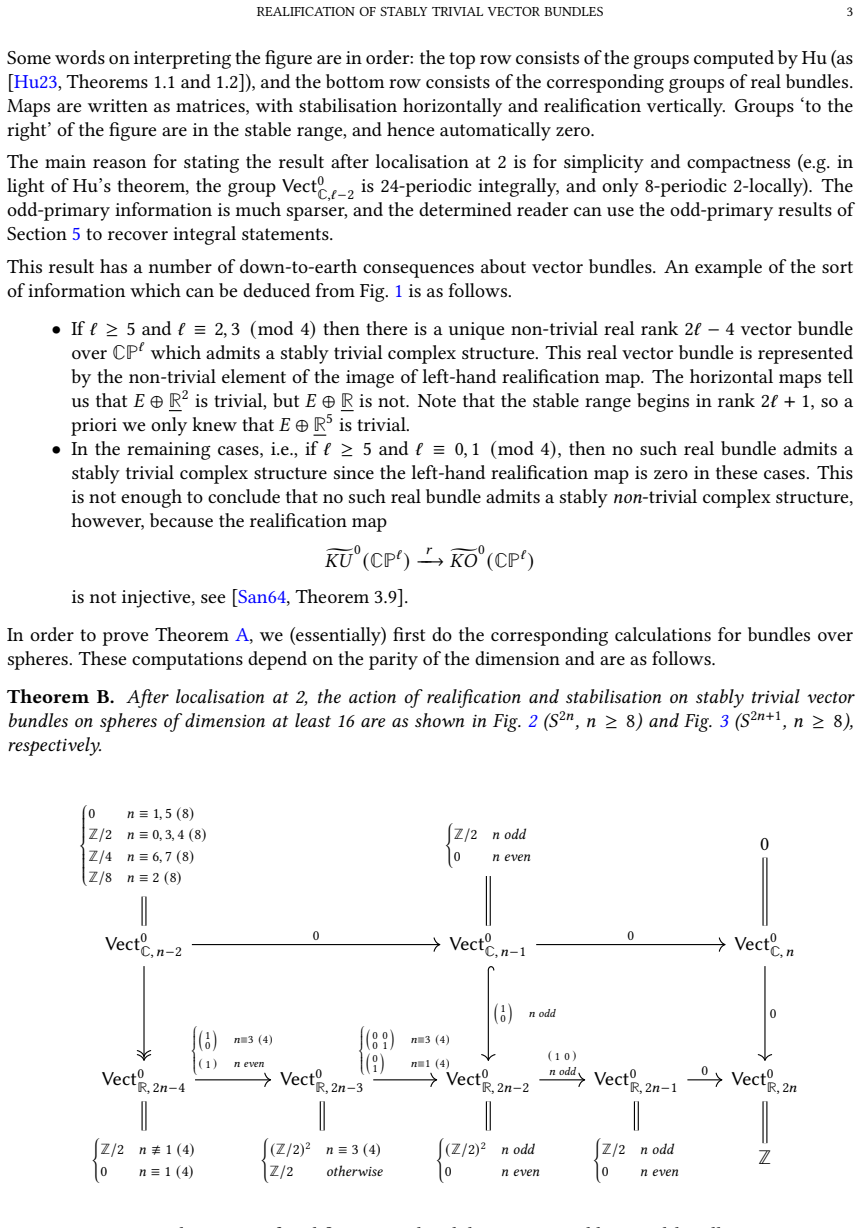
The set of stably trivial complex vector bundles over complex projective spaces and spheres has a natural group structure when the corank is small enough. With respect to this group structure, the operations of taking the underlying real vector bundle (realification) and of adding a trivial line bundle (stabilisation), are group homomorphisms. Building on Hu's recent enumerations of stably trivial complex bundles, we compute these homomorphisms in a range by using Weiss calculus to translate the problem to stable homotopy theory.
Editorial analysis
A structured set of objections, weighed in public.
Referee Report
Summary. The manuscript defines a natural group structure on the set of stably trivial complex vector bundles over complex projective spaces and spheres when the corank is small. It shows that realification (passage to the underlying real bundle) and stabilization (addition of a trivial complex line) are group homomorphisms with respect to this structure. Building on Hu's enumerations, the paper uses Weiss calculus to translate the problem into stable homotopy theory and computes the resulting homomorphisms in a range.
Significance. If the claims hold, the work supplies explicit homomorphisms between groups of stably trivial bundles and stable homotopy groups, clarifying the interaction between realification and stabilization in this setting. The reduction via Weiss calculus is a methodological strength that converts an enumerative problem into one amenable to existing stable-homotopy computations.
minor comments (3)
- [Abstract and §1] The precise range in which the computations are valid (e.g., the values of n and corank) is stated only informally in the abstract and introduction; an explicit statement, perhaps as a table or theorem label, would improve readability.
- [§2] Notation for the group law on the set of bundles is introduced without a dedicated display equation; adding a numbered definition would make subsequent references to the operation clearer.
- [§3] The manuscript cites Hu's enumerations but does not include a short self-contained summary of the input data used; a one-paragraph recap would help readers verify the starting point of the Weiss-calculus translation.
Simulated Author's Rebuttal
We thank the referee for the positive assessment of the manuscript, the recognition of the methodological contribution via Weiss calculus, and the recommendation for minor revision. No major comments appear in the report.
Circularity Check
No significant circularity
full rationale
The derivation relies on Hu's external enumerations of stably trivial bundles and standard applications of Weiss calculus to translate into stable homotopy theory. The group structure on the set of bundles (for small corank) and the homomorphism properties of realification and stabilisation are presented as following from the natural constructions in the area, without any reduction of the central claims to fitted parameters, self-definitions, or load-bearing self-citations. The paper is self-contained against external benchmarks.
Axiom & Free-Parameter Ledger
Reference graph
Works this paper leans on
-
[1]
[Ada62] J. F. Adams. “Vector fields on spheres”.Ann. of Math. (2)75 (1962), pp. 603–632.doi:10.2307/ 1970213. [Aro02] G. Arone. “The Weiss derivatives of BO(-) and BU(-)”.Topology41.3 (2002), pp. 451–481.doi: 10.1016/S0040-9383(01)00008-8. [Ati61] M. F. Atiyah. “Thom complexes”.Proc. London Math. Soc. (3)11 (1961), pp. 291–310.doi:10. 1112/plms/s3-11.1.29...
- [2]
-
[3]
arXiv:2303 . 00736 [math.AT]. [DM89] D. M. Davis and M. Mahowald. “TheSO(𝑛)-of-origin”.Forum Math.1.3 (1989), pp. 239–250. doi:10.1515/form.1989.1.239. [Fuj67] M. Fujii. “𝐾 𝑂-groups of projective spaces”.Osaka Math. J.4.1 (1967), pp. 141–149.doi:10 . 18910/6753. 50 REFERENCES [GM23] D. Gepner and L. Meier. “On equivariant topological modular forms”.Compos...
-
[4]
Metastable complex vector bundles over complex projective spaces
[Hu23] Y. Hu. “Metastable complex vector bundles over complex projective spaces”.Trans. Am. Math. Soc.376.11 (2023), pp. 7783–7814.doi:10.1090/tran/8955. [Joh95] B. Johnson. “The derivatives of homotopy theory”.Trans. Am. Math. Soc.347.4 (1995), pp. 1295– 1321.doi:10.2307/2154811. [Kac78] H. Kachi. “Homotopy groups of symmetric spacesΓ 𝑛”.J. Fac. Sci., Sh...
-
[5]
Diffeomorphisms of discs and the second Weiss derivative of BTop(-)
arXiv:2109.03500[math.AT]. [Lew00] L. G. Lewis.Splitting theorems for certain equivariant spectra. Vol
work page internal anchor Pith review Pith/arXiv arXiv
-
[6]
On conjectures of Mahowald, Segal and Sullivan
Mem. Am. Math. Soc. Providence, RI: American Mathematical Society (AMS), 2000.doi:10.1090/memo/0686. [Lin80] W. Lin. “On conjectures of Mahowald, Segal and Sullivan”.Math. Proc. Camb. Philos. Soc.87 (1980), pp. 449–458.doi:10.1017/S0305004100056887. [LM24] W. Lück and T. Macko.Surgery theory. Foundations. With contributions by Diarmuid Crowley. Vol
-
[7]
A short proof of the James periodicity of𝜋 𝑘+𝑝 (𝑉𝑘+𝑚,𝑚)
Grundlehren Math. Wiss. Cham: Springer, 2024.doi:10.1007/978-3-031-56334-8. [Mah65] M. Mahowald. “A short proof of the James periodicity of𝜋 𝑘+𝑝 (𝑉𝑘+𝑚,𝑚)”.Proc. Amer. Math. Soc. 16 (1965), p. 512.doi:10.2307/2034684. [Mas61] W. S. Massey. “Obstructions to the existence of almost complex structures”.Bull. Am. Math. Soc.67 (1961), pp. 559–564.doi:10.1090/S0...
-
[8]
A rational model for the fiberwise THH transfer I: Sullivan algebras
arXiv:2604.02516[math.AT]. [Opi24] M. P. Opie.Enumerating complex rank𝑛vector bundles onC𝑃 𝑛+1
work page internal anchor Pith review Pith/arXiv arXiv
-
[9]
Rational Pontryagin classes and functor calculus
arXiv:2410 . 23520 [math.AT]. [RW16] R. Reis and M. Weiss. “Rational Pontryagin classes and functor calculus”.J. Eur. Math. Soc. (JEMS)18.8 (2016), pp. 1769–1811.doi:10.4171/JEMS/629. [San64] B. J. Sanderson. “Immersions and embeddings of projective spaces”.Proc. London Math. Soc. (3)14 (1964), pp. 137–153.doi:10.1112/plms/s3-14.1.137. [Sch18] S. Schwede....
-
[10]
A classification theorem for fibre spaces
New Math. Monogr. Cambridge: Cambridge Uni- versity Press, 2018.doi:10.1017/9781108349161. [Sta63] J. D. Stasheff. “A classification theorem for fibre spaces”.Topology2 (1963), pp. 239–246.doi: 10.1016/0040-9383(63)90006-5. [Tag21] N. Taggart. “Comparing the orthogonal and unitary functor calculi”.Homology Homotopy Appl.23.2 (2021), pp. 227–256.doi:10.431...
discussion (0)
Sign in with ORCID, Apple, or X to comment. Anyone can read and Pith papers without signing in.