Gradient-Based Topology Optimization of Localized Defect Modes with Bandgap Preservation in Phononic Crystals
Pith reviewed 2026-06-29 17:40 UTC · model grok-4.3
The pith
A two-stage gradient optimization first opens a bandgap in a phononic host then tunes only the defect region to place one localized mode at a chosen frequency while pushing competing modes away.
A machine-rendered reading of the paper's core claim, the machinery that carries it, and where it could break.
Core claim
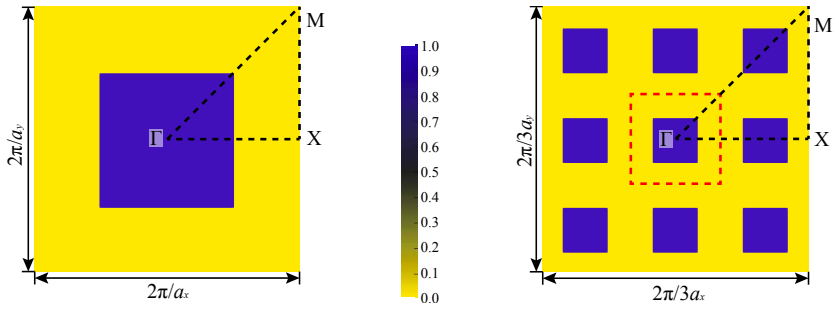
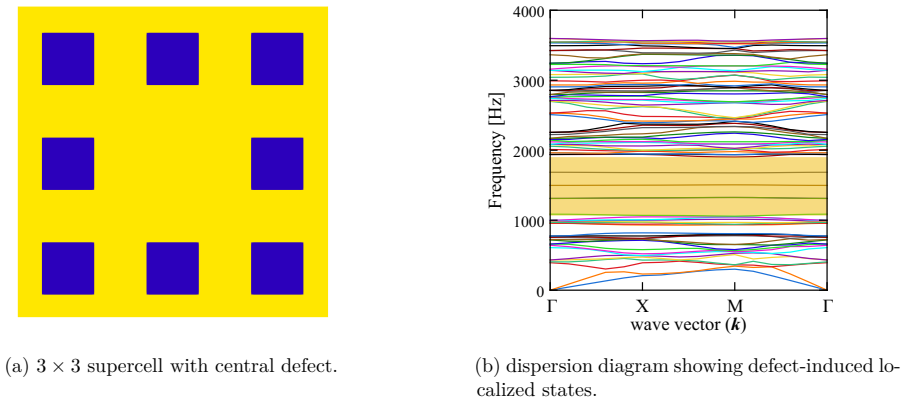
The central claim is that a gradient-based two-stage topology optimization framework can place a selected localized defect mode at a prescribed frequency inside a phononic bandgap while repelling non-target in-gap modes and largely preserving the host bandgap. The first stage optimizes the host unit cell to form the gap; the second stage modifies only the defect cell using a smooth mode-selection function that unifies attraction and repulsion in one objective. Optimization occurs at the Γ-point eigenspectrum because the branches of interest are nearly flat, with full dispersion relations verified afterward.
What carries the argument
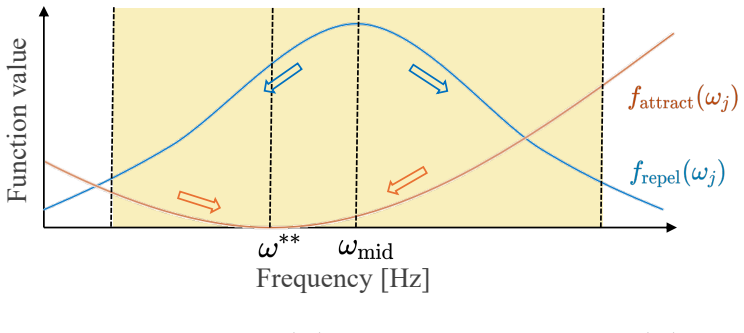
Two-stage gradient-based topology optimization with a unified mode-selection objective that attracts one defect branch and repels others, evaluated at the Γ point.
If this is right
- The target localized resonance appears at the chosen frequency with clear frequency separation from other in-gap modes.
- The host bandgap remains largely open after defect optimization.
- The final designs produce strong spatial localization of elastic waves at the defect.
- The same procedure works for at least two different material combinations and two supercell sizes.
Where Pith is reading between the lines
- The approach could be tested on three-dimensional or non-periodic host geometries to check whether the flat-branch assumption still holds.
- If the repulsion term is removed, competing modes might drift into the center of the gap and reduce isolation.
- The method supplies a concrete route to inverse design of vibration-trapping devices once fabrication constraints are added to the topology variables.
Load-bearing premise
The defect branches stay nearly flat, so optimizing only at the single Γ point captures the frequencies that matter across the full dispersion relation.
What would settle it
A computation on the optimized structures in which the target mode frequency moves by more than a few percent or merges with another in-gap mode once the full dispersion curve over the reduced Brillouin zone is calculated instead of the Γ point alone.
Figures





read the original abstract
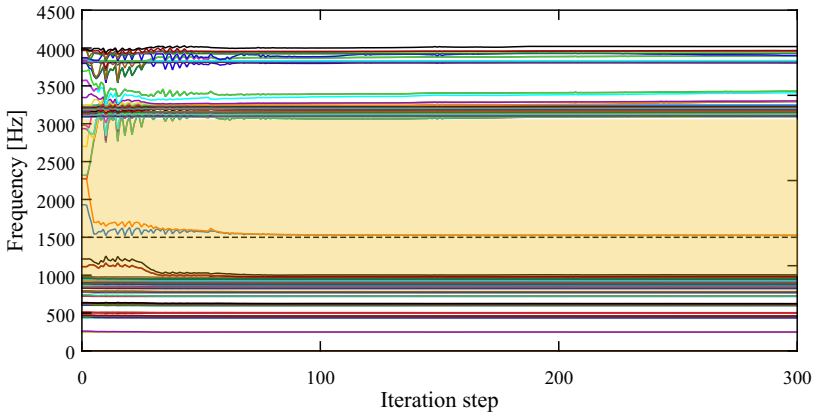
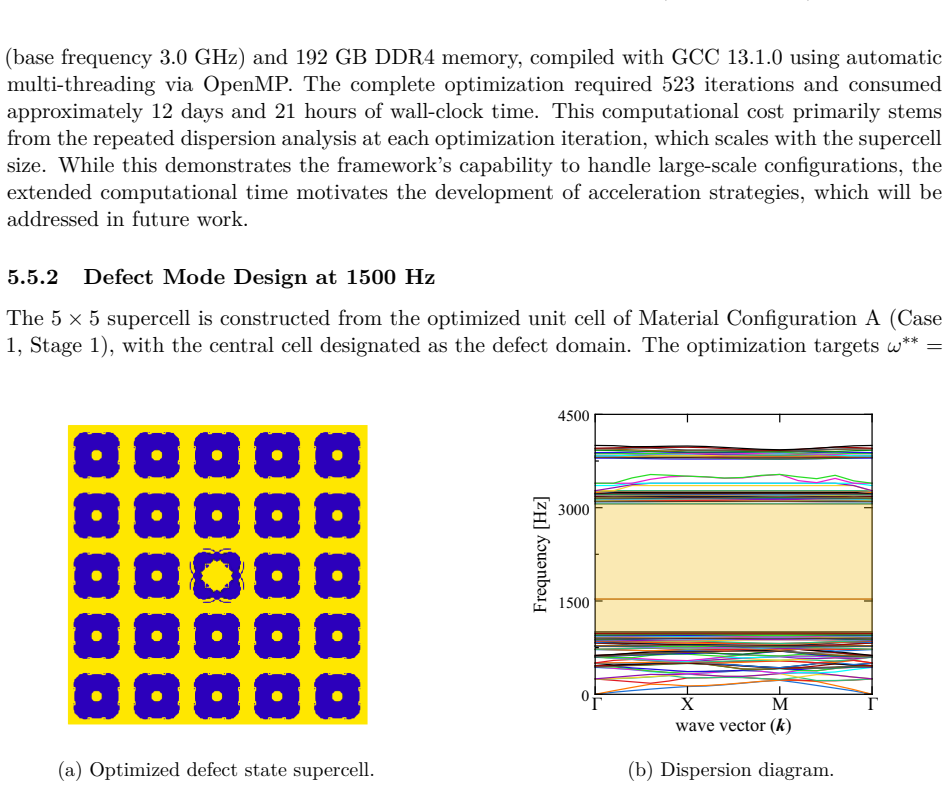
Phononic crystals can confine elastic waves through localized defect states within bandgaps, offering promising opportunities for vibration control and energy localization. However, designing defect states at prescribed frequencies while maintaining adequate separation from other in-gap modes remains a significant challenge. Existing optimization approaches generally treat the target mode indirectly and provide limited control over competing localized modes. This study presents a gradient-based two-stage topology optimization framework for the frequency placement of localized defect modes in periodic elastic media. First, a host unit cell is optimized to create a bandgap around a prescribed frequency. Subsequently, only the defect cell is modified to attract a selected localized mode toward the target frequency while repelling non-target modes away from the central region of the bandgap. The formulation incorporates a smooth mode-selection function that combines mode attraction and repulsion within a unified objective, enabling automatic tracking of the relevant modes throughout the optimization process. Because the localized defect branches of interest are nearly flat, the optimization is performed using only the $\Gamma$-point eigenspectrum, while the corresponding dispersion relations over a reduced irreducible Brillouin zone are evaluated afterwards for verification. Numerical examples involving two material systems and two supercell sizes demonstrate accurate placement of localized resonances, clear separation from competing in-gap modes, and substantial preservation of the host bandgap. The resulting structures exhibit strong elastic-wave localization, highlighting the potential of the proposed approach for the design of phononic devices for vibration confinement and energy trapping.
Editorial analysis
A structured set of objections, weighed in public.
Referee Report
Summary. The paper presents a gradient-based two-stage topology optimization framework for placing localized defect modes at prescribed frequencies in phononic crystals while preserving the host bandgap and separating target modes from competing in-gap modes. Stage one optimizes the host unit cell to open a bandgap around a target frequency; stage two modifies only the defect cell using a smooth mode-selection function in the objective that attracts the target mode and repels others. Optimization uses solely the Γ-point eigenspectrum on the basis that defect branches are nearly flat, with full dispersion relations evaluated post-optimization for verification. Numerical examples on two material systems and two supercell sizes are reported to achieve accurate frequency placement, mode separation, and bandgap preservation, with resulting structures showing strong wave localization.
Significance. If the results hold under the stated assumptions, the work provides a systematic, gradient-based method with explicit control over both target-mode attraction and competing-mode repulsion via a unified objective, which addresses limitations in prior indirect treatments of defect modes. The two-stage separation of bandgap creation from defect tuning and the use of automatic mode tracking are strengths that could facilitate design of phononic devices for vibration confinement. The numerical demonstrations across multiple systems add practical value, though the post-hoc nature of dispersion verification limits claims of robustness.
major comments (2)
- [Method section (two-stage framework)] Method section (two-stage framework, after bandgap stage): The optimization is performed exclusively at the Γ-point because 'the localized defect branches of interest are nearly flat,' yet no a-priori bound on dispersion, sensitivity analysis, or penalty term for non-flatness is supplied. This assumption is load-bearing for the central claim of accurate frequency placement and separation, as any k-dependent shift or hybridization would invalidate the Γ-only designs; post-optimization verification alone does not protect the gradient updates themselves.
- [Numerical examples section] Numerical examples section: While examples with two material systems and two supercell sizes are presented as demonstrating 'accurate placement' and 'clear separation,' the manuscript supplies no quantitative metrics (e.g., maximum frequency deviation across the reduced Brillouin zone or minimum separation distance) that directly test the flat-branch assumption to within the tolerance needed for the claimed performance.
minor comments (2)
- [Abstract] Abstract and method: The phrase 'substantial preservation of the host bandgap' is used without a precise definition (e.g., percentage retention of gap width or edge shift tolerance); a quantitative criterion should be stated.
- [Method section] The description of the smooth mode-selection function would benefit from an explicit equation reference or pseudocode to clarify how attraction and repulsion are combined into a single differentiable objective.
Simulated Author's Rebuttal
We thank the referee for the detailed review and constructive feedback on our manuscript. We address each major comment below and outline the revisions we plan to make.
read point-by-point responses
-
Referee: [Method section (two-stage framework)] The optimization is performed exclusively at the Γ-point because 'the localized defect branches of interest are nearly flat,' yet no a-priori bound on dispersion, sensitivity analysis, or penalty term for non-flatness is supplied. This assumption is load-bearing for the central claim of accurate frequency placement and separation, as any k-dependent shift or hybridization would invalidate the Γ-only designs; post-optimization verification alone does not protect the gradient updates themselves.
Authors: We agree that an a-priori justification or bound would strengthen the methodological foundation. The near-flatness assumption stems from the strong localization of defect modes, which typically exhibit minimal dispersion in phononic crystals. While post-optimization verification is provided, we acknowledge that it does not safeguard the optimization process itself. In the revised manuscript, we will include a sensitivity analysis demonstrating the dispersion characteristics of the optimized defect modes across the Brillouin zone and discuss the validity of the Γ-point approximation for the reported designs. revision: yes
-
Referee: [Numerical examples section] While examples with two material systems and two supercell sizes are presented as demonstrating 'accurate placement' and 'clear separation,' the manuscript supplies no quantitative metrics (e.g., maximum frequency deviation across the reduced Brillouin zone or minimum separation distance) that directly test the flat-branch assumption to within the tolerance needed for the claimed performance.
Authors: We concur that explicit quantitative metrics would better substantiate the claims. The current manuscript relies on visual inspection of the dispersion relations for verification. To address this, we will add quantitative measures in the revised numerical examples section, including the maximum frequency deviation of the target mode over the reduced Brillouin zone and the minimum frequency separation to competing modes for each case study. revision: yes
Circularity Check
No significant circularity; standard optimization with post-hoc verification
full rationale
The paper applies standard gradient-based topology optimization to a custom objective combining mode attraction and repulsion. The Γ-point restriction is justified by the explicit modeling assumption that target defect branches are nearly flat, with dispersion checked only after optimization; this is an a-priori modeling choice rather than a definitional reduction or fitted input renamed as prediction. No self-citations appear as load-bearing uniqueness theorems, no ansatz is smuggled via prior work, and no result is shown to equal its inputs by construction. The numerical examples serve as external validation of the designs rather than tautological confirmation. The derivation chain therefore remains self-contained against external benchmarks.
Axiom & Free-Parameter Ledger
Reference graph
Works this paper leans on
-
[1]
M. S. Kushwaha, P. Halevi, L. Dobrzynski, B. Djafari-Rouhani, Acoustic band structure of periodic elastic composites, Physical Review Letters 71 (13) (1993) 2022–2025. doi:10.1103/ PhysRevLett.71.2022
1993
-
[2]
M. Sigalas, E. Economou, Elastic and acoustic wave band structure, Journal of Sound and Vibration 158 (2) (1992) 377–382. doi:10.1016/0022-460X(92)90059-7
-
[3]
R. Martínez-Sala, J. Sancho, J. V. Sánchez, V. Gómez, J. Llinares, F. Meseguer, Sound atten- uation by sculpture, Nature 378 (6554) (1995) 241–241. doi:10.1038/378241a0. 27
-
[4]
Muhammad, C. W. Lim, From Photonic Crystals to Seismic Metamaterials: A Review via Phononic Crystals and Acoustic Metamaterials, Archives of Computational Methods in Engi- neering 29 (2) (2022) 1137–1198. doi:10.1007/s11831-021-09612-8
-
[5]
Y. Bai, Y. Chen, J. Zheng, Design of phononic crystal for enhancing low-frequency sound absorption in mufflers, Scientific Reports 14 (1) (2024) 28921. doi:10.1038/ s41598-024-79762-9
2024
-
[6]
G. Lee, D. Lee, J. Park, Y. Jang, M. Kim, J. Rho, Piezoelectric energy harvesting using mechanical metamaterials and phononic crystals, Communications Physics 5 (1) (2022) 94. doi:10.1038/s42005-022-00869-4
-
[7]
Laude, Principles and properties of phononic crystal waveguides, APL Materials 9 (8) (2021) 080701
V. Laude, Principles and properties of phononic crystal waveguides, APL Materials 9 (8) (2021) 080701. doi:10.1063/5.0059035
-
[8]
M. Torres, F. R. Montero De Espinosa, D. García-Pablos, N. García, Sonic Band Gaps in Finite Elastic Media: Surface States and Localization Phenomena in Linear and Point Defects, Physical Review Letters 82 (15) (1999) 3054–3057. doi:10.1103/PhysRevLett.82.3054
-
[9]
Kafesaki, M
M. Kafesaki, M. M. Sigalas, N. García, Frequency Modulation in the Transmittivity of Wave Guides in Elastic-Wave Band-Gap Materials, Physical Review Letters 85 (19) (2000) 4044–
2000
-
[10]
doi:10.1103/PhysRevLett.85.4044
-
[11]
J. D. Joannopoulos, J. N. Winn, S. G. Johnson, Photonic Crystals: Molding the Flow of Light - Second Edition, Princeton University Press, Princeton, NJ, 2011. doi:10.1515/ 9781400828241
2011
-
[12]
S.-H. Jo, H. Yoon, Y. C. Shin, B. D. Youn, Revealing defect-mode-enabled energy localiza- tion mechanisms of a one-dimensional phononic crystal, International Journal of Mechanical Sciences 215 (2022) 106950. doi:10.1016/j.ijmecsci.2021.106950
-
[13]
J. O. Vasseur, P. A. Deymier, B. Djafari-Rouhani, Y. Pennec, A.-C. Hladky-Hennion, Absolute forbidden bands and waveguiding in two-dimensional phononic crystal plates, Physical Review B 77 (8) (2008) 085415. doi:10.1103/PhysRevB.77.085415
-
[14]
A. Khelif, B. Djafari-Rouhani, J. O. Vasseur, P. A. Deymier, Ph. Lambin, L. Dobrzynski, Transmittivity through straight and stublike waveguides in a two-dimensional phononic crystal, Physical Review B 65 (17) (2002) 174308. doi:10.1103/PhysRevB.65.174308
-
[15]
A. H. M. Almawgani, H. Makhlouf Fathy, H. E. Alfassam, A. M. El-Sherbeeny, A. Hajjiah, H. A. Elsayed, M. R. Abukhadra, W. Al Zoubi, R. Semeda, M. Ismail Fathy, A. A. H. Al- Athwary, A. Mehaney, Fano resonance in one-dimensional quasiperiodic topological phononic crystals towards a stable and high-performance sensing tool, Scientific Reports 14 (1) (2024) 1...
-
[16]
S.-H. Jo, Electrically controllable behaviors in defective phononic crystals with inductive- resistive circuits, International Journal of Mechanical Sciences 278 (2024) 109485. doi: 10.1016/j.ijmecsci.2024.109485
-
[17]
G. Lee, J. Park, W. Choi, B. Ji, M. Kim, J. Rho, Multiband elastic wave energy localization for highly amplified piezoelectric energy harvesting using trampoline metamaterials, Mechanical Systems and Signal Processing 200 (2023) 110593. doi:10.1016/j.ymssp.2023.110593. 28
-
[18]
M. P. Bendsøe, O. Sigmund, Topology Optimization: Theory, Methods, and Applications, Springer, Berlin ; New York, 2003
2003
-
[19]
S. J. Van Den Boom, R. Abedi, F. Van Keulen, A. M. Aragón, A level set-based interface- enriched topology optimization for the design of phononic crystals with smooth boundaries, Computer Methods in Applied Mechanics and Engineering 408 (2023) 115888. doi:10.1016/ j.cma.2023.115888
-
[20]
Huang, Y
X. Huang, Y. M. Xie, EVOLUTIONARY TOPOLOGY OPTIMIZATION OF CONTINUUM STRUCTURES : METHODS AND APPLICATIONS
-
[21]
Y. F. Li, X. Huang, F. Meng, S. Zhou, Evolutionary topological design for phononic band gap crystals, Structural and Multidisciplinary Optimization 54 (3) (2016) 595–617. doi:10.1007/ s00158-016-1424-3
2016
-
[22]
Sigmund, J
O. Sigmund, J. S. Jensen, Systematic Design of Phononic Band-Gap Materials and Structures by Topology Optimization, Philosophical Transactions: Mathematical, Physical and Engineer- ing Sciences 361 (1806,) (2003) 1001–1019. arXiv:3559206
2003
-
[23]
Y. Lu, Y. Yang, J. K. Guest, A. Srivastava, 3-D phononic crystals with ultra-wide band gaps, Scientific Reports 7 (1) (2017) 43407. doi:10.1038/srep43407
-
[24]
W. Li, F. Meng, Y. F. Li, X. Huang, Topological design of 3D phononic crystals for ultra- wide omnidirectional bandgaps, Structural and Multidisciplinary Optimization 60 (6) (2019) 2405–2415. doi:10.1007/s00158-019-02329-0
-
[25]
Q. Wu, J. He, W. Chen, Q. Li, S. Liu, Topology optimization of phononic crystal with pre- scribed band gaps, Computer Methods in Applied Mechanics and Engineering 412 (2023) 116071. doi:10.1016/j.cma.2023.116071
-
[26]
Q. Wu, S. Liu, Q. Li, Y. He, Targeted-frequency bandgap maximization for phononic crystals via topology optimization, International Journal of Mechanical Sciences 302 (2025) 110553. doi:10.1016/j.ijmecsci.2025.110553
-
[27]
Dong, X.-X
H.-W. Dong, X.-X. Su, Y.-S. Wang, Multi-objective optimization of two-dimensional porous phononic crystals, Journal of Physics D: Applied Physics 47 (15) (2014) 155301. doi:10.1088/ 0022-3727/47/15/155301
2014
-
[28]
H. Chen, Y. Fu, Y. Hu, L. Ling, A novel single variable based topology optimization method for band gaps of multi-material phononic crystals, Structural and Multidisciplinary Optimization 65 (9) (2022) 253. doi:10.1007/s00158-022-03355-1
-
[29]
Liang, J
X. Liang, J. Du, Design of phononic-like structures and band gap tuning by concurrent two- scale topology optimization, Structural and Multidisciplinary Optimization 61 (3) (2020) 943–
2020
-
[30]
doi:10.1007/s00158-020-02489-4
-
[31]
J. Gao, Z. Luo, H. Li, P. Li, L. Gao, Dynamic multiscale topology optimization for multi- regional micro-structured cellular composites, Composite Structures 211 (2019) 401–417. doi: 10.1016/j.compstruct.2018.12.031
-
[32]
H. Chen, Y. Fu, L. Ling, Y. Hu, L. Li, Multiscale topology optimization for designing lo- cally resonant acoustic metamaterials with specified low-frequency bandgaps, Materials Today Communications 41 (2024) 110900. doi:10.1016/j.mtcomm.2024.110900. 29
-
[33]
C.-X. Liu, G.-L. Yu, Deep learning for the design of phononic crystals and elastic metamaterials, Journal of Computational Design and Engineering 10 (2) (2023) 602–614. doi:10.1093/jcde/ qwad013
-
[34]
D. Lee, B. D. Youn, S.-H. Jo, Deep-learning-based framework for inverse design of a defective phononic crystal for narrowband filtering, International Journal of Mechanical Sciences 255 (2023) 108474. doi:10.1016/j.ijmecsci.2023.108474
-
[35]
W. W. Chen, R. Sun, D. Lee, C. M. Portela, W. Chen, Generative Inverse Design of Meta- materials with Functional Responses by Interpretable Learning, Advanced Intelligent Systems 7 (6) (2025) 2400611. doi:10.1002/aisy.202400611
-
[36]
J. Jensen, O. Sigmund, Topology optimization for nano-photonics, Laser & Photonics Reviews 5 (2) (2011) 308–321. doi:10.1002/lpor.201000014
-
[37]
D. Reyes, D. Martínez, M. Mayorga, H. Heo, E. Walker, A. Neogi, Optimization of the Spatial Configuration of Local Defects in Phononic Crystals for High Q Cavity, Frontiers in Mechanical Engineering 6 (2020) 592787. doi:10.3389/fmech.2020.592787
-
[38]
T. S. Kim, Y. Y. Kim, Mac-based mode-tracking in structural topology optimization, Com- puters & Structures 74 (3) (2000) 375–383. doi:10.1016/S0045-7949(99)00056-5
-
[39]
T. D. Tsai, C. C. Cheng, Structural design for desired eigenfrequencies and mode shapes using topology optimization, Structural and Multidisciplinary Optimization 47 (5) (2013) 673–686. doi:10.1007/s00158-012-0840-2
-
[40]
J. S. Jensen, O. Sigmund, Systematic design of photonic crystal structures using topology optimization: Low-loss waveguide bends, Applied Physics Letters 84 (12) (2004) 2022–2024. doi:10.1063/1.1688450
-
[41]
Y. Pennec, J. O. Vasseur, B. Djafari-Rouhani, L. Dobrzyński, P. A. Deymier, Two-dimensional phononic crystals: Examples and applications, Surface Science Reports 65 (8) (2010) 229–291. doi:10.1016/j.surfrep.2010.08.002
-
[42]
G. Yi, B. D. Youn, A comprehensive survey on topology optimization of phononic crys- tals, Structural and Multidisciplinary Optimization 54 (5) (2016) 1315–1344. doi:10.1007/ s00158-016-1520-4
2016
-
[43]
H.-W. Dong, C. Shen, Z. Liu, S.-D. Zhao, Z. Ren, C.-X. Liu, X. He, S. A. Cummer, Y.-S. Wang, D. Fang, L. Cheng, Inverse design of phononic meta-structured materials, Materials Today 80 (2024) 824–855. doi:10.1016/j.mattod.2024.09.012
-
[44]
H.-W. Dong, Y.-S. Wang, C. Zhang, Inverse design of high- Q wave filters in two-dimensional phononic crystals by topology optimization, Ultrasonics 76 (2017) 109–124. doi:10.1016/j. ultras.2016.12.018
work page doi:10.1016/j 2017
-
[45]
P. Min, Z. Song, L. Yang, V. G. Ralchenko, J. Zhu, Optically Transparent Flexible Broadband Metamaterial Absorber Based on Topology Optimization Design, Micromachines 12 (11) (2021)
2021
-
[46]
doi:10.3390/mi12111419
-
[47]
X. Zhang, Y. Li, Y. Wang, Z. Jia, Y. Luo, Narrow-band filter design of phononic crystals with periodic point defects via topology optimization, International Journal of Mechanical Sciences 212 (2021) 106829. doi:10.1016/j.ijmecsci.2021.106829. 30
- [48]
-
[49]
C. Lan, G. Hu, L. Tang, Y. Yang, Energy localization and topological protection of a locally resonant topological metamaterial for robust vibration energy harvesting, Journal of Applied Physics 129 (18) (2021) 184502. doi:10.1063/5.0047965
-
[50]
T. J. Clark, S. Bernard, J. Ma, V. Dumont, J. C. Sankey, Optically Defined Phononic Crystal Defect, Physical Review Letters 133 (22) (2024) 226904. doi:10.1103/PhysRevLett.133. 226904
-
[51]
Brillouin, Wave propagation in periodic structures (1946)
L. Brillouin, Wave propagation in periodic structures (1946)
1946
-
[52]
M. I. Hussein, M. J. Leamy, M. Ruzzene, Dynamics of Phononic Materials and Structures: Historical Origins, Recent Progress, and Future Outlook, Applied Mechanics Reviews 66 (4) (2014) 040802. doi:10.1115/1.4026911
-
[53]
X. Xu, K. Nishiguchi, J. Kato, A two-stage topology optimization framework for designing multi-scale elastic metamaterials with cross-scale dual bandgaps, SSRN preprint, under review. A vailable at SSRN: https://ssrn.com/abstract=6625038 (Mar. 2026). doi:10.2139/ssrn. 6625038
-
[54]
A. P. Seyranian, E. Lund, N. Olhoff, Multiple eigenvalues in structural optimization problems, Structural Optimization 8 (4) (1994) 207–227. doi:10.1007/BF01742705. 31
discussion (0)
Sign in with ORCID, Apple, or X to comment. Anyone can read and Pith papers without signing in.