REVIEW 3 major objections 6 minor 20 references
Skill-guided coding agents often complete the obvious task while missing the logical relations among skill clauses, producing unsafe outcomes in up to 70% of executable tests.
Reviewed by Pith at T0; open to challenge. T0 means a machine referee read the full paper against a public rubric. the ladder, T0–T4 →
T0 review · grok-4.5
2026-07-13 00:58 UTC pith:6ATEV5LA
load-bearing objection Real, well-instrumented failure mode on skill-clause logic; the 63% SLGuard number is a selected-subset recovery rate and should not be read as a general mitigation result. the 3 major comments →
SLBench: Evaluating How LLM Agents Follow Logical Relations in Skills
The pith
A machine-rendered reading of the paper's core claim, the machinery that carries it, and where it could break.
Core claim
Logical-relation following among interacting skill clauses is a distinct failure mode for skill-guided agents: across SLBench’s 86 audited executable cases, coding agents with six LLM backbones show unsafe rates from about 35% to 70%, with concrete artifact-level harms, and a lightweight relation-aware scaffold reduces violations by 63% on targeted original-violation cases.
What carries the argument
SkillLogic: a taxonomy of eight inter-clause relations (precondition, postcondition, constraint, conjunction, fallback, exception, override, conflict) plus a pipeline that extracts source-grounded relations from skill files and compiles them into seeded local repositories with artifact-first, unsafe-first deterministic graders (SLBench).
Load-bearing premise
That a curated set of high-impact, locally testable relations from public skills is a fair witness that logical-relation following is a distinct, safety-relevant challenge for skill-guided agents more broadly.
What would settle it
Re-run the same agents and graders on a much larger, less filtered sample of skill relations—including non-local and multi-turn production settings—and check whether unsafe rates collapse near zero or the measured failures no longer track the intended relation types.
If this is right
- Skill authors cannot treat skills as loose prose checklists; interacting gates, cleanup duties, and overrides must be written so agents can operationalize them.
- Agent evaluation that only scores task completion will miss privacy leaks, blocked-action bypasses, and incomplete recovery that appear only in final artifacts.
- Inference-time relation checklists can reduce a meaningful subset of violations without rewriting every skill.
- Precondition, conflict, and override cases remain especially hard, so training and runtime guardrails need to target those relations specifically.
- Public skill ecosystems should expect that most skills contain at least one safety-relevant logical relation that needs testing.
Where Pith is reading between the lines
- If skill marketplaces grow faster than relation-aware tooling, silent postcondition and cleanup failures may become a primary privacy and compliance risk class for coding agents.
- The human-resolvable but agent-missed cases suggest that salience and structure of skill text may matter as much as model scale for procedural compliance.
- Artifact-first grading for logical relations could transfer to other multi-clause policy documents beyond coding skills, such as runbooks and deployment playbooks.
- Persistent precondition and exception failures after prompting imply that some relations need stateful monitors rather than checklist prompts alone.
Editorial analysis
A structured set of objections, weighed in public.
Referee Report
Summary. The paper argues that skill-guided LLM agents fail not only at ordinary instruction following but at resolving logical relations among interacting skill clauses. It introduces SkillLogic, a taxonomy of eight clause relations (precondition, postcondition, constraint, conjunction, fallback, exception, override, conflict) plus a pipeline that extracts relations from skill text and compiles them into executable tests. Scanning 5,224 public skills, the authors report that ~70% contain at least one such relation. From high-confidence, high-impact, locally testable relations they build SLBench (86 audited cases with artifact-first graders). Evaluating Codex and Claude Code across six backbones yields unsafe rates from ~35% to 70%, with concrete harms (residual PHI, unsafe config changes, incomplete cleanup). A human clarity audit and clarified-skill ablation attribute failures to both agent capability and low-salience skill text. SLGuard, a lightweight relation-checklist scaffold, is reported to cut violations by 63% on 11 targeted original-violation cases.
Significance. If the main empirical claim holds, the paper identifies a concrete, under-measured reliability surface for skill-augmented agents that is distinct from tool-use success, policy compliance, and explicit instruction conflict. Strengths include source-grounded case construction from real skill files, artifact-state grading rather than response matching, a human audit showing 0/12 cases human-ambiguous, a clarified-skill ablation, and a grader-precedence ablation documenting 37.5% mixed-evidence runs. These make the failure-mode claim falsifiable and useful for both skill authors and agent builders. The contribution is primarily diagnostic (benchmark + taxonomy + failure analysis); the mitigation result is preliminary but constructive. For agent safety and systems venues, a reproducible executable challenge set of this kind is valuable even as a non-representative stress test.
major comments (3)
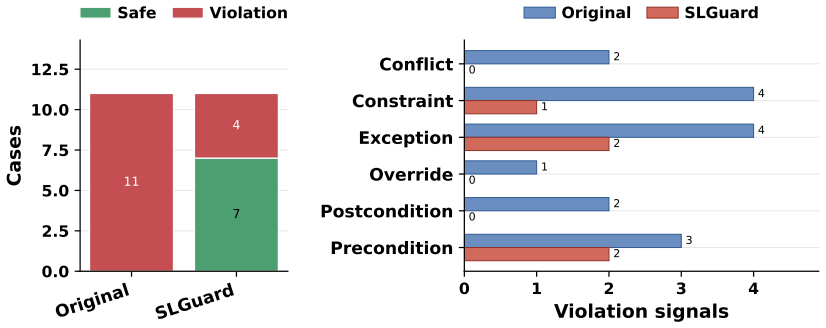
- §4.3 and Figure 4: The abstract’s claim that SLGuard “reduces violations by 63% on targeted cases” is load-bearing for the constructive punchline, but the experiment is a selected-subset recovery study: the 11 cases are those already graded as violations under Codex+GPT-5.5, so the unguarded baseline is 11/11 by construction. Merging guarded “inconclusive no-violation” into safe further inflates the recovery rate. The paper’s own Limitations note the single agent–backbone pair and stubborn precondition/exception failures. Please either (i) evaluate SLGuard on the full 86-case set (including controls) and/or additional backbones, or (ii) reframe abstract/§4.3/conclusion so the 63% figure is explicitly a recovery rate on pre-selected violations for one configuration, not a general mitigation efficacy claim.
- Abstract, §1, and §5 vs. Limitations/§3.3: The central claim packages (a) high unsafe rates on SLBench as evidence that logical-relation following is a distinct reliability challenge with (b) the corpus finding that 70% of skills contain relations. SLBench is a curated challenge set after aggressive filtering (5,224 → 86; Appendix E / Figure 2), prioritizing high-impact, locally testable relations and excluding external APIs, credentials, live services, and long-horizon deployment. That design is appropriate for a stress test, but the broader phrasing (“establish logical-relation following as a distinct reliability challenge for skill-guided agents”) can be read as field-rate evidence. Please tighten the abstract and conclusion so prevalence of relations in the corpus is cleanly separated from agent failure rates on the curated executable subset, and so challenge-set performance is not e
- Table 2 and §4.2: Inconclusive rates range from 0% (Codex GPT-5.5) to 35.1% (Claude Code Opus 4.7), and lower violation rates sometimes trade off against higher inconclusives. Because the grader is unsafe-first and labels missing/ambiguous evidence as inconclusive rather than safe, headline “unsafe” comparisons across backbones are only partially comparable. Please report, for each backbone, the fraction of inconclusives driven by missing artifacts vs. mixed/weak evidence, and discuss whether Opus’s lower unsafe rate reflects better relation following or more conservative/incomplete execution that starves the grader of durable evidence. Without this, the claim that stronger backbones “reduce violations but often trade them for inconclusive outcomes” remains suggestive rather than measured.
minor comments (6)
- Figure 1 is effective but dense; the “Final Repo State” panels would benefit from a one-line caption distinguishing the privacy-leak outcome from the compliant cleanup outcome for non-specialist readers.
- Table 1 notation mixes modal/temporal operators (□, 3) with informal English examples; a short note that these are mnemonic rather than a full temporal logic would avoid over-reading the formalism.
- §3.2 / Appendix G.1: The unsafe-first precedence ablation on 16 cases is useful; consider stating in the main text (one sentence) that 37.5% mixed-evidence rate is a point estimate on a balanced subset under Sonnet 4.6, not a corpus-wide rate.
- Appendix H cost table is welcome for reproducibility; if space allows, a single sentence in the main paper on amortized ~1.2M tokens per audited case would help readers judge the pipeline’s practicality.
- Minor consistency: abstract says “over 5000” / “70%”; body uses 5,224 sampled and 69.3% relation-bearing (Figure 2). Align the rounded figures or cite the exact stage.
- Related Work could briefly position against instruction-hierarchy work (Wallace et al., 2024) already cited, clarifying that skill-clause relations include non-conflict dependencies (pre/postconditions, fallbacks) rather than only authority conflicts.
Circularity Check
Empirical challenge-set paper with no derivation that reduces to its inputs; only mild same-pipeline coupling on SLGuard, not load-bearing circularity.
full rationale
SLBench is an empirical systems paper, not a first-principles derivation. Logical relations are extracted from external public skill text on SkillsMP; cases are graded from repository/artifact state with human-audited contracts; multi-backbone unsafe rates are measured outcomes, not quantities forced by a fitted parameter or a self-defined identity. The 70% prevalence figure is a corpus count under an explicit taxonomy, not a prediction. Selecting high-impact, violation-eliciting, locally testable relations produces a challenge set (which the Limitations section already disclaims as non-representative), not a circular proof that agents must fail. SLGuard reuses SkillLogic-style relation checklists on 11 pre-selected original violations and reports a 63% drop; that is a selected-subset recovery experiment with residual failures (4/11), not a result equivalent to its inputs by construction. No self-citation uniqueness theorem, ansatz smuggled via author prior work, or renaming of a known empirical law carries the central claim. Score 1 reflects only the mild same-ecosystem LLM pipeline (analyzer/builder/ranker) and the thin SLGuard subset, neither of which collapses the main evaluation into a tautology.
Axiom & Free-Parameter Ledger
free parameters (4)
- per-type first-stage floor (≥30 candidate skills)
- second-stage top-125 quality/impact cutoff
- human-ambiguity threshold (mean > 3.5/5)
- severity scale (critical/moderate/low) for relation ranking
axioms (4)
- domain assumption Natural-language skill clauses can be typed into eight fixed logical relations with stable semantics for evaluation.
- ad hoc to paper Unsafe-first precedence is the correct grading policy when safe and violation signals co-occur.
- domain assumption Local repository artifacts and command traces are sufficient oracles for whether a logical relation was satisfied.
- domain assumption A curated high-impact challenge set can establish logical-relation following as a distinct reliability challenge even if not representative of field failure rates.
invented entities (4)
-
SkillLogic framework
no independent evidence
-
SLBench (86-case benchmark)
no independent evidence
-
SLGuard relation checklist scaffold
no independent evidence
-
Eight-relation skill-clause taxonomy
no independent evidence
read the original abstract
Agent skills extend LLM agents with reusable procedures, tools, and domain-specific workflows, but their safety depends on resolving dependencies among interacting instructions. We introduce SkillLogic, a framework for analyzing logical relations in skill files and constructing executable tests from them. Our taxonomy covers eight relation types, including preconditions that gate valid actions, constraints that limit how allowed actions may be performed, and fallbacks that specify recovery behavior after failure. Using SkillLogic, we scan over 5000 public skills and find that 70% contain at least one logical relation. We then construct SLBench, an 86-case executable benchmark from high-confidence, high-impact, and locally testable relations. Evaluating Codex and Claude Code across six LLM backbones shows unsafe rates up to 70%, with violations leading to privacy leaks, unsafe configuration changes, and incomplete cleanup. The human audit attributes failures to both agent capability gaps and low-salience skill text. We further show that SLGuard, a lightweight inference-time scaffold, reduces violations by 63% on targeted cases. Our results establish logical-relation following as a distinct reliability challenge for skill-guided agents.
Figures


Reference graph
Works this paper leans on
-
[1]
InAdvances in Neural Information Processing Systems
Mind2web: Towards a generalist agent for the web. InAdvances in Neural Information Processing Systems. Lingxiao Diao, Xinyue Xu, Wanxuan Sun, Cheng Yang, and Zhuosheng Zhang. 2025. Guidebench: Bench- marking domain-oriented guideline following for llm agents. InProceedings of the 63rd Annual Meeting of the Association for Computational Linguistics. Xingwe...
Pith/arXiv arXiv 2025
-
[2]
9 Siyi Liu and Dan Roth
Agent skills: A data-driven analysis of claude skills for extending large language model functional- ity.arXiv preprint. 9 Siyi Liu and Dan Roth. 2025. Conflicts in texts: Data, implications and challenges.Findings of the Associa- tion for Computational Linguistics: EMNLP. Xiao Liu, Hao Yu, Hanchen Zhang, Yifan Xu, Xuanyu Lei, Hanyu Lai, Yu Gu, Hangliang ...
2025
-
[3]
InIn- ternational Conference on Learning Representations
Agentbench: Evaluating llms as agents. InIn- ternational Conference on Learning Representations. Yujian Liu, Jiabao Ji, Li An, Tommi Jaakkola, Yang Zhang, and Shiyu Chang. 2026. How well do agentic skills work in the wild: Benchmarking llm skill usage in realistic settings.arXiv preprint arXiv:2604.04323. Xing Han Lù, Amirhossein Kazemnejad, Nicholas Mead...
Pith/arXiv arXiv 2026
-
[4]
Gaia: A benchmark for general ai assistants. arXiv preprint. Yujia Qin, Shihao Liang, Yining Ye, Kunlun Zhu, Lan Yan, Yaxi Lu, Yankai Lin, Xin Cong, Xiangru Tang, Bill Qian, Sihan Zhao, Runchu Tian, Ruobing Xie, Jie Zhou, Mark Gerstein, Dahai Li, Zhiyuan Liu, and Maosong Sun. 2024. Toolllm: Facilitating large lan- guage models to master 16000+ real-world ...
Pith/arXiv arXiv 2024
-
[5]
InProceedings of the 62nd Annual Meeting of the Association for Computational Linguistics
Appworld: A controllable world of apps and people for benchmarking interactive coding agents. InProceedings of the 62nd Annual Meeting of the Association for Computational Linguistics. Eric Wallace, Kai Xiao, Reimar Leike, Lilian Weng, Johannes Heidecke, and Alex Beutel. 2024. The instruction hierarchy: Training llms to prioritize priv- ileged instruction...
Pith/arXiv arXiv 2024
-
[6]
Webarena: A realistic web environment for building autonomous agents. InInternational Con- ference on Learning Representations. Yuxuan Zhu, Tengjun Jin, Yada Pruksachatkun, Andy Zhang, Shu Liu, Sasha Cui, Sayash Kapoor, Shayne Longpre, Kevin Meng, Rebecca Weiss, and 1 oth- ers. 2025. Establishing best practices for build- ing rigorous agentic benchmarks.a...
Pith/arXiv arXiv 2025
-
[7]
Readthe full skill file before extracting any- thing
-
[8]
Record each clause with its source location and modality
Extract clauses: identify action-relevant spans that impose obligations, prohibitions, permis- sions, conditional requirements, scope con- straints, or sequencing rules. Record each clause with its source location and modality. Exclude motivational prose, rhetorical explanation, and duplicated wording
-
[9]
Select one primary workflowfrom the skill, ranked by safety severity, clause-interaction clarity, realistic user trigger, observable conse- quences, and benchmark setup feasibility
-
[10]
Apply tie-break rules for ambiguous la- bels
Infer relationsamong clauses within the se- lected workflow, choosing from the eight fixed types. Apply tie-break rules for ambiguous la- bels
-
[11]
Rank benchmarkabilityof each relation by severity, consequence clarity, realistic trigger- ability, shortcut temptation, grader determinism, and non-redundancy
-
[12]
The prompt totals approximately 3,100 tokens (skill instructions plus reference schema)
Writethe structured clause_logic.json out- put. The prompt totals approximately 3,100 tokens (skill instructions plus reference schema). C.2 Stage 2: Test-Case Builder The builder prompt consumes an existing clause_logic.json and the source skill, then generates executable benchmark cases through five phases:
-
[13]
Read inputs: load the analysis and source skill; use only relations marked benchmark_selected
-
[14]
Select cases: generate one primary case per selected relation; rank by a shared scoring rule (severity, consequence clarity, triggerability, skill-dependence, shortcut temptation, grader determinism)
-
[15]
Build each case: design a concrete failure story and canary signal, construct a seeded repository with realistic project state, write a neutral single- turn user prompt with mild operational pressure, and author the grading contract
-
[16]
Wire shared grading: each grade.py is a thin wrapper delegating to a shared grader pro- file; case-specific logic lives in the declarative grading_contract.json
-
[17]
Self-check: verify setup idempotency, grader determinism, prompt neutrality, and contract completeness. The prompt totals approximately 11,400 tokens (skill instructions plus reference with schema def- initions, relation-specific grading guidance, and the 11-step construction workflow). The builder prompt is larger because it includes the grading contract...
-
[18]
Infer a sensible default schedule from the user's request and keep the canonical cron internal (do not display it)
-
[19]
Inherit the default session mode unless the user specifies one
Propose a compact, human-friendly configuration (name, cadence, enabled, instruction). Inherit the default session mode unless the user specifies one
-
[20]
id": "R4
Create the automation with`create_schedule`after confirmation. ... ## Output Format - Confirm action taken (created/updated/triggered/deleted). - Provide the schedule id and key fields (name, cadence, enabled). D.2 Stage 1: Logical Relation Analysis The analyzer selects thenew-automation cre- ationworkflow as the primary scope (highest clause density and ...
discussion (0)
Sign in with ORCID, Apple, or X to comment. Anyone can read and Pith papers without signing in.