eCNNTO: A Highly Generalizable ConvNet for Accelerating Topology Optimization
Pith reviewed 2026-06-26 17:35 UTC · model grok-4.3
The pith
An element-based convolutional network accelerates topology optimization by predicting final densities from early stages across new problems.
A machine-rendered reading of the paper's core claim, the machinery that carries it, and where it could break.
Core claim
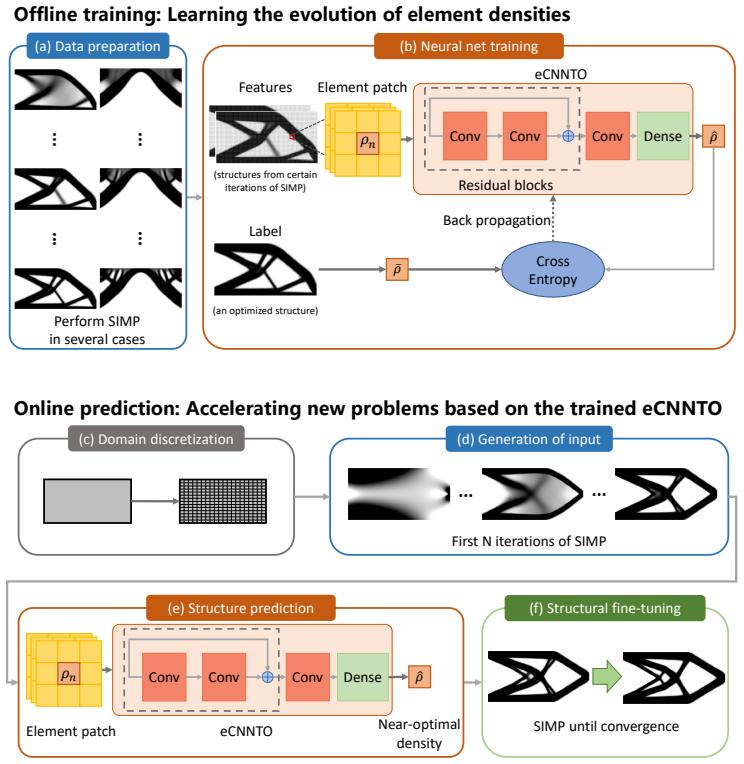
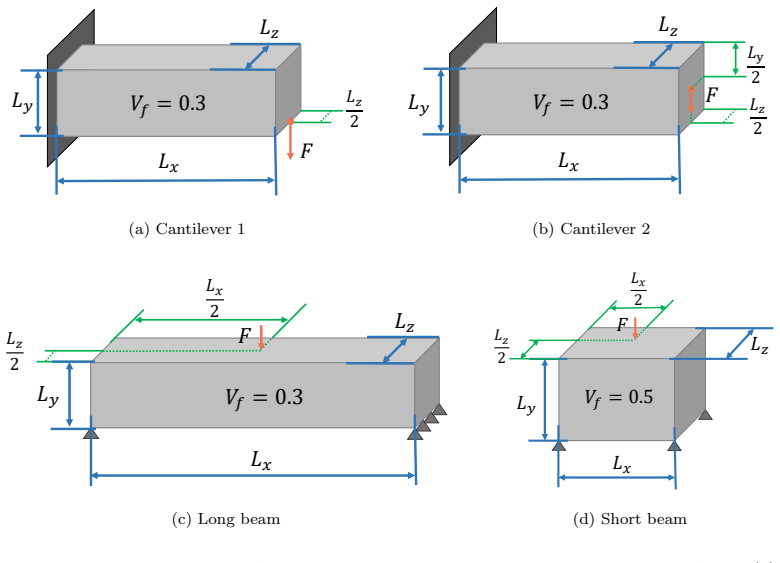
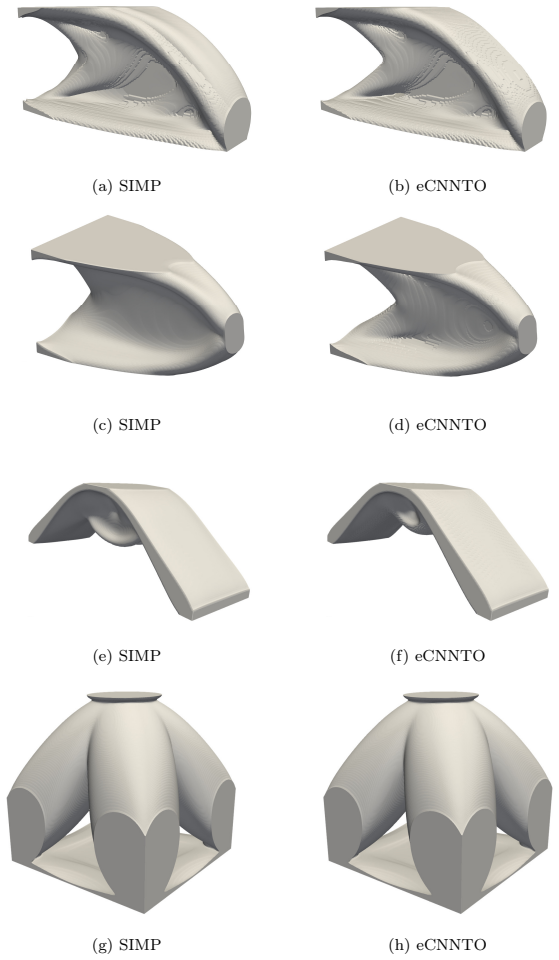
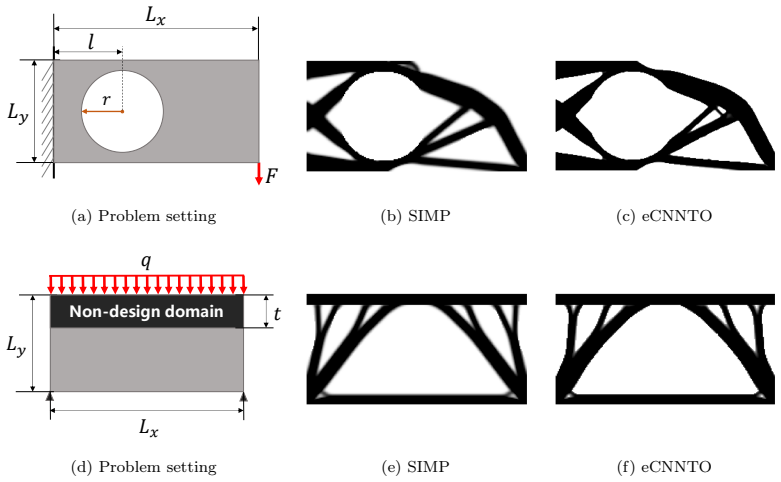
The central claim is that training an element-wise convolutional neural network with residual connections on the final-stage density histories of a limited set of topology optimization problems enables accurate prediction of near-optimal densities from early histories on previously unseen problems that differ in boundary conditions, loading, geometry, mesh resolution, and non-design domains, thereby skipping the majority of iterations.
What carries the argument
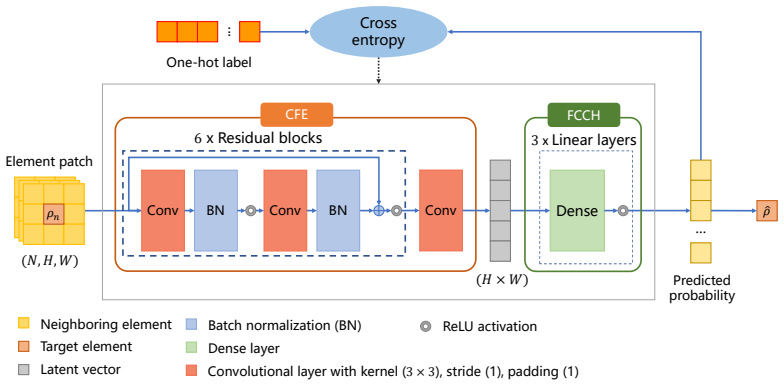
Element-based convolutional neural network with residual connections, trained on final rather than early density histories.
If this is right
- Topology optimization becomes feasible for much finer meshes without a matching rise in total computation.
- The same trained model works for three-dimensional problems as well as two-dimensional ones.
- Structures with non-design domains can be optimized without special handling or extra data.
- Overall design time decreases substantially for repeated or varied structural problems.
Where Pith is reading between the lines
- The method might allow integration into design tools for near-instant feedback on structural layouts.
- Generalization to varying mesh resolutions suggests it could support multi-resolution optimization workflows.
- If extended, the approach may apply to other iterative density-field optimizations like those in fluid dynamics.
- Validation on problems with time-dependent loads or material nonlinearity would test the limits of the current training strategy.
Load-bearing premise
The density patterns at the end of optimization from a few training problems contain enough information for a CNN to predict correct early-stage densities that lead to valid connected topologies in many different new optimization scenarios.
What would settle it
Apply the trained network to an optimization problem with a loading case and domain geometry outside the training distribution, run the reduced iterations, and verify whether the resulting structure matches the fully optimized one in terms of connectivity and mechanical performance.
Figures
read the original abstract
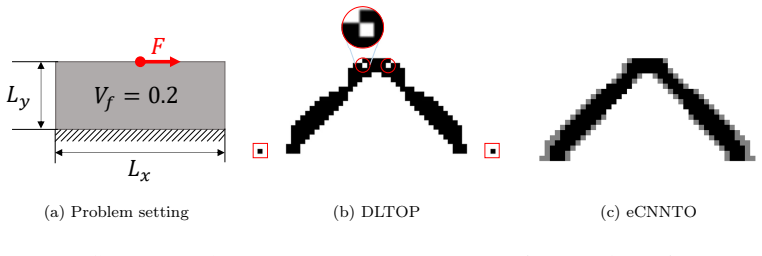
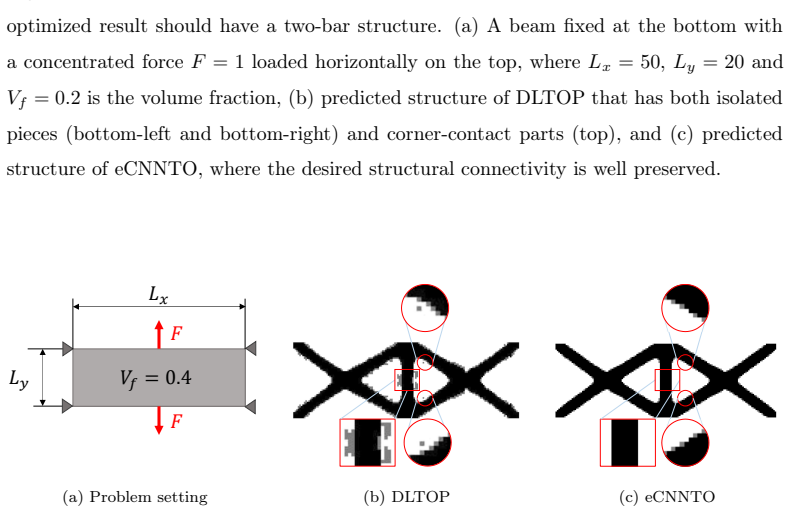
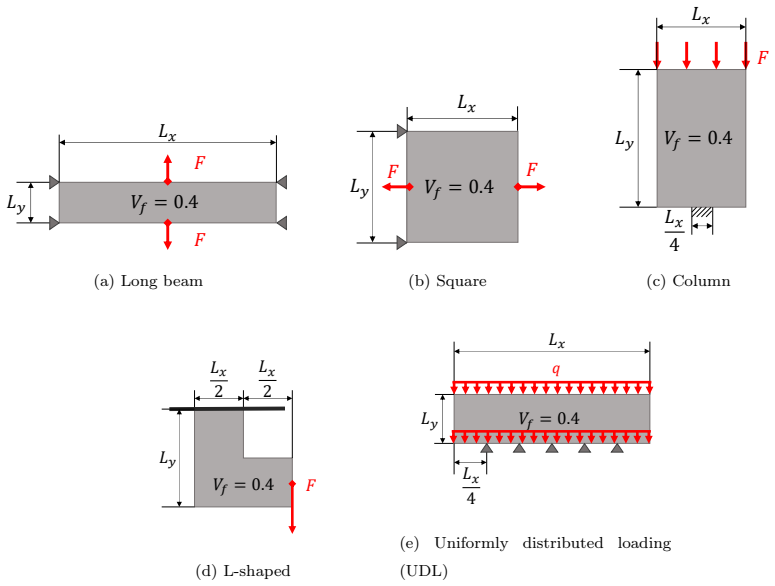
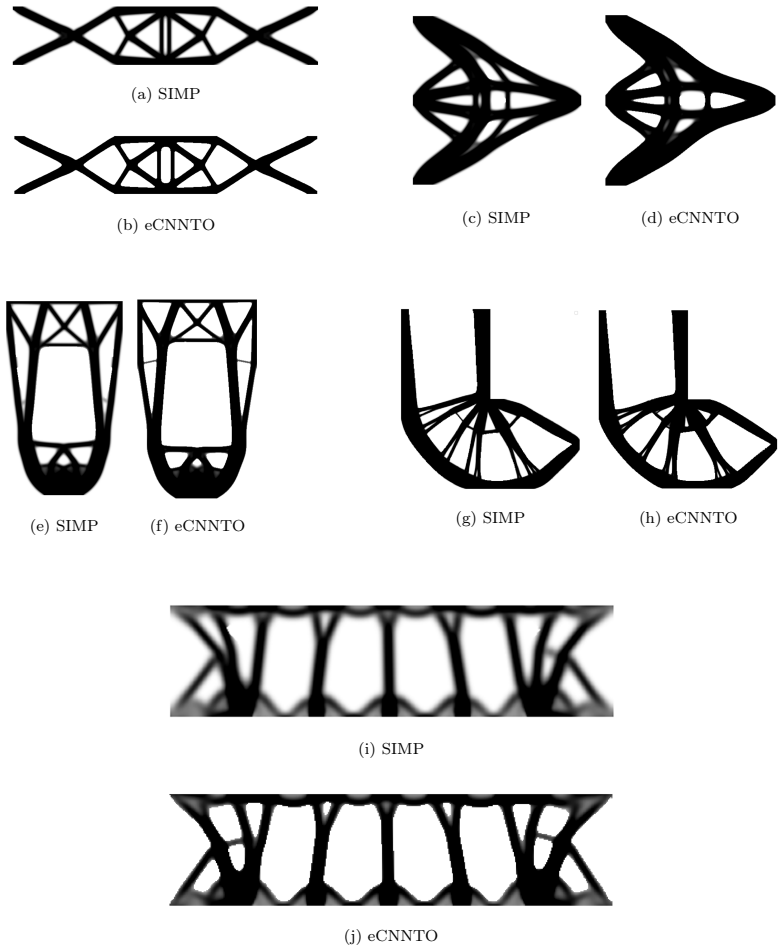
This work proposes an element-based Convolutional Neural Network (CNN) to accelerate density-based Topology Optimization (TO), termed eCNNTO. TO generally undergoes a large number of iterations, where finite element analysis is performed in every iteration, leading to the efficiency bottleneck especially when dense meshes are used to achieve high-resolution designs. To address this limitation, eCNNTO is proposed to build upon Kallioras et al. (2020), where a Deep Belief Network (DBN) was trained for every element to predict its near-optimal density from its early history, thereby skipping the great majority of iterations and significantly accelerating the TO procedure. However, the method lacks spatial correlations among neighboring elements and may lead to disconnected features in the final structure. The proposed method employs CNN with residual connections to address this issue. On top of it, a novel training strategy is introduced to further enhance the optimization efficiency, where the training dataset consists of the final stage density histories rather than early ones. This change can also help reduce the required training data size. eCNNTO requires only a small dataset to train and yet it can be generalized to problems with largely different boundary conditions, loading cases, design domain geometries, mesh resolutions, as well as non-design domains. In the end, the generalization capabilities and efficiency of eCNNTO are demonstrated through a variety of examples in two and three dimensions, achieving up to 90% and 97% reduction of iterations, respectively.
Editorial analysis
A structured set of objections, weighed in public.
Referee Report
Summary. The paper proposes eCNNTO, an element-based CNN with residual connections to accelerate density-based topology optimization. Building on Kallioras et al. (2020), it trains the network to predict near-optimal densities from early-iteration histories but uses final-stage density histories for training to reduce data needs and improve generalization. The method claims to handle problems with substantially different boundary conditions, loads, domain geometries, mesh resolutions, and non-design domains while achieving up to 90% (2D) and 97% (3D) iteration reductions, addressing disconnected features in prior DBN approaches via spatial correlations.
Significance. If the generalization and validity claims hold with low compliance errors and mechanically valid topologies, the work would provide a practical, data-efficient acceleration technique for high-resolution TO that improves on element-wise DBN methods. The novel final-stage training strategy and residual CNN architecture are potentially reusable ideas for surrogate-based optimization.
major comments (2)
- [Abstract] Abstract: the central generalization claim (to 'largely different' BCs, loads, geometries, meshes, and non-design domains) is stated without any quantitative metrics on prediction error, compliance deviation, constraint violation rates, or measures of distribution shift between training and test problems. This absence makes the 90%/97% iteration-reduction claim unverifiable from the provided text and is load-bearing for the acceleration result.
- [Abstract] Abstract and §1 (implied from context): the training change to final-stage densities is presented as enabling reliable early-history prediction on unseen problems, yet no evidence is supplied that the learned mapping avoids disconnected or invalid topologies (the exact failure mode attributed to the prior DBN). A concrete test (e.g., topology validity or mechanical feasibility metrics on held-out cases) is required to substantiate transfer.
minor comments (2)
- Notation for the element-wise CNN input (early density history tensor) and output (predicted density) should be defined explicitly, including how non-design domains are masked or handled.
- The manuscript should report the exact number of training problems, their mesh resolutions, and the precise differences (e.g., quantitative distance metrics) between training and test instances to allow readers to assess the claimed generalization.
Simulated Author's Rebuttal
We thank the referee for the constructive feedback. We agree that the abstract requires strengthening with quantitative support and will revise accordingly. Our point-by-point responses to the major comments are provided below.
read point-by-point responses
-
Referee: [Abstract] Abstract: the central generalization claim (to 'largely different' BCs, loads, geometries, meshes, and non-design domains) is stated without any quantitative metrics on prediction error, compliance deviation, constraint violation rates, or measures of distribution shift between training and test problems. This absence makes the 90%/97% iteration-reduction claim unverifiable from the provided text and is load-bearing for the acceleration result.
Authors: We agree that the abstract would benefit from explicit quantitative metrics to make the generalization and acceleration claims self-contained. The body of the manuscript presents these details through the experimental results on held-out problems. In the revised version we will update the abstract to include specific values drawn from those experiments, such as ranges for compliance deviation and prediction error. revision: yes
-
Referee: [Abstract] Abstract and §1 (implied from context): the training change to final-stage densities is presented as enabling reliable early-history prediction on unseen problems, yet no evidence is supplied that the learned mapping avoids disconnected or invalid topologies (the exact failure mode attributed to the prior DBN). A concrete test (e.g., topology validity or mechanical feasibility metrics on held-out cases) is required to substantiate transfer.
Authors: The CNN architecture with residual connections is introduced precisely to capture spatial correlations and thereby mitigate the disconnected-feature issue of element-wise DBNs. The experimental section shows resulting topologies that remain connected and mechanically feasible across the tested distribution shifts. We acknowledge that the abstract itself does not quantify topology-validity rates; we will add a concise reference to such metrics (computed on the held-out cases) in the revised abstract. revision: yes
Circularity Check
No significant circularity; derivation relies on external simulation data and independent testing
full rationale
The paper trains an element-based residual CNN on density histories generated by standard topology optimization simulations (building on but not self-citing the 2020 DBN baseline). The claimed generalization and iteration reductions are demonstrated via explicit experiments on held-out problems with altered boundary conditions, loads, geometries, and meshes. No equation equates a reported speed-up to a fitted constant, no prediction reduces to its own training input by construction, and the central premise does not rest on a load-bearing self-citation chain. The method is therefore self-contained against external benchmarks.
Axiom & Free-Parameter Ledger
free parameters (1)
- CNN hyperparameters (layers, filters, residual blocks)
axioms (1)
- domain assumption Density history of an element and its spatial neighborhood is predictive of its near-optimal density value.
Reference graph
Works this paper leans on
-
[1]
Giga-Voxel Computational Morphogenesis for Structural Design , author =. Nature , volume =. doi:10.1038/nature23911 , urldate =
-
[2]
Topology optimization of coronary artery stent considering structural and hemodynamic parameters , author =. Heliyon , volume =. doi:10.1016/j.heliyon.2024.e39452 , urldate =
-
[3]
Structural and Multidisciplinary Optimization , volume = 43, number = 1, pages =
Andreassen, Erik and Clausen, Anders and Schevenels, Mattias and Lazarov, Boyan S. and Sigmund, Ole , year = 2011, month = jan, journal =. Efficient topology optimization in. doi:10.1007/s00158-010-0594-7 , urldate =
-
[4]
3D Topology Optimization using Convolutional Neural Networks
Banga, Saurabh and Gehani, Harsh and Bhilare, Sanket and Patel, Sagar and Kara, Levent , year = 2018, month = aug, number =. doi:10.48550/arXiv.1808.07440 , urldate =. 1808.07440 , primaryclass =
work page internal anchor Pith review Pith/arXiv arXiv doi:10.48550/arxiv.1808.07440 2018
-
[5]
Journal of Mechanical Design , pages =
Behzadi, Mohammad Mahdi and Ilie. Journal of Mechanical Design , volume =. doi:10.1115/1.4052757 , urldate =
-
[6]
Structural Optimization , volume = 1, number = 4, pages =
Optimal shape design as a material distribution problem , author =. Structural optimization , volume =. doi:10.1007/BF01650949 , urldate =
-
[7]
Bends. Topology. doi:10.1007/978-3-662-05086-6 , urldate =
-
[8]
Structural and Multidisciplinary Optimization , publisher =
Chandrasekhar, Aaditya and Suresh, Krishnan , year = 2021, month = mar, journal =. doi:10.1007/s00158-020-02748-4 , urldate =
-
[9]
Dosovitskiy, Alexey and Beyer, Lucas and Kolesnikov, Alexander and Weissenborn, Dirk and Zhai, Xiaohua and Unterthiner, Thomas and Dehghani, Mostafa and Minderer, Matthias and Heigold, Georg and Gelly, Sylvain and Uszkoreit, Jakob and Houlsby, Neil , year = 2021, month = jun, number =. An. doi:10.48550/arXiv.2010.11929 , urldate =. 2010.11929 , primaryclass =
work page internal anchor Pith review Pith/arXiv arXiv doi:10.48550/arxiv.2010.11929 2021
-
[10]
Guo, Xu and Zhang, Weisheng and Zhong, Wenliang , year = 2014, month = aug, journal =. Doing. doi:10.1115/1.4027609 , urldate =
-
[11]
He, Kaiming and Zhang, Xiangyu and Ren, Shaoqing and Sun, Jian , year = 2016, pages =. Deep. Proceedings of the
2016
-
[12]
Engineering Applications of Artificial Intelligence , volume =
Dynamic Graph-Based Convergence Acceleration for Topology Optimization in Unstructured Meshes , author =. Engineering Applications of Artificial Intelligence , volume =. doi:10.1016/j.engappai.2024.107916 , urldate =
-
[13]
Joo, Younghwan and Yu, Yonggyun and Jang, In Gwun , year = 2021, journal =. Unit. doi:10.1109/ACCESS.2021.3125014 , urldate =
-
[14]
Structural and Multidisciplinary Optimization , volume =
Accelerated Topology Optimization by Means of Deep Learning , author =. Structural and Multidisciplinary Optimization , volume =. doi:10.1007/s00158-020-02545-z , urldate =
-
[15]
Heaviside Projection Based Topology Optimization by a
Kawamoto, Atsushi and Matsumori, Tadayoshi and Yamasaki, Shintaro and Nomura, Tsuyoshi and Kondoh, Tsuguo and Nishiwaki, Shinji , year = 2011, month = jul, journal =. Heaviside Projection Based Topology Optimization by a. doi:10.1007/s00158-010-0562-2 , urldate =
-
[16]
Deep learning.Nature, 521(7553):436–444, 2015.doi:10.1038/nature14539
Deep Learning , author =. Nature , volume =. doi:10.1038/nature14539 , urldate =
-
[17]
Engineering Applications of Artificial Intelligence , volume =
Accelerating Topology Optimization Using Deep Learning-Based Image Super-Resolution , author =. Engineering Applications of Artificial Intelligence , volume =. doi:10.1016/j.engappai.2024.108370 , urldate =
-
[18]
International Journal of Heat and Mass Transfer , volume =
Genetic Algorithm Based Topology Optimization of Heat Exchanger Fins Used in Aerospace Applications , author =. International Journal of Heat and Mass Transfer , volume =. doi:10.1016/j.ijheatmasstransfer.2021.121002 , urldate =
-
[19]
doi:10.1115/1.4049533 , urldate =
Nie, Zhenguo and Lin, Tong and Jiang, Haoliang and Kara, Levent Burak , year = 2021, month = feb, journal =. doi:10.1115/1.4049533 , urldate =
-
[20]
Engineering Applications of Artificial Intelligence , volume =
Deep Learning Accelerated Efficient Framework for Topology Optimization , author =. Engineering Applications of Artificial Intelligence , volume =. doi:10.1016/j.engappai.2024.108559 , urldate =
-
[21]
Structural and Multidisciplinary Optimization , volume =
Accelerating Gradient-Based Topology Optimization Design with Dual-Model Artificial Neural Networks , author =. Structural and Multidisciplinary Optimization , volume =. doi:10.1007/s00158-020-02770-6 , urldate =
-
[22]
Computer Methods in Applied Mechanics and Engineering , volume =
Isogeometric Topology Optimization of Thin-Walled Structures with Complex Design Domains , author =. Computer Methods in Applied Mechanics and Engineering , volume =. doi:10.1016/j.cma.2025.118114 , urldate =
-
[23]
, year = 2001, month = apr, journal =
Sigmund, O. , year = 2001, month = apr, journal =. A 99 Line Topology Optimization Code Written in. doi:10.1007/s001580050176 , urldate =
-
[24]
Structural and Multidisciplinary Optimization , volume =
Morphology-Based Black and White Filters for Topology Optimization , author =. Structural and Multidisciplinary Optimization , volume =. doi:10.1007/s00158-006-0087-x , urldate =
-
[25]
Sigmund, O. and Petersson, J. , year = 1998, month = aug, journal =. Numerical Instabilities in Topology Optimization:. doi:10.1007/BF01214002 , urldate =
-
[26]
Structural and Multidisciplinary Optimization , volume =
Sensitivity Filtering from a Continuum Mechanics Perspective , author =. Structural and Multidisciplinary Optimization , volume =. doi:10.1007/s00158-012-0814-4 , urldate =
-
[27]
Russian Journal of Numerical Analysis and Mathematical Modelling , volume =
Neural Networks for Topology Optimization , author =. Russian Journal of Numerical Analysis and Mathematical Modelling , volume =. doi:10.1515/rnam-2019-0018 , urldate =
-
[28]
The International Journal of Advanced Manufacturing Technology , volume =
Topology Optimization and Lightweight Design of Stamping Dies for Forming Automobile Panels , author =. The International Journal of Advanced Manufacturing Technology , volume =. doi:10.1007/s00170-022-09683-2 , urldate =
-
[29]
International Journal for Numerical Methods in Engineering , volume =
The Method of Moving Asymptotes---a New Method for Structural Optimization , author =. International Journal for Numerical Methods in Engineering , volume =. doi:10.1002/nme.1620240207 , urldate =
-
[30]
Wang, Junpeng and Aage, Niels and Wu, Jun and Sigmund, Ole and Westermann, R. Efficient Large-Scale. Structural and Multidisciplinary Optimization , volume =. doi:10.1007/s00158-025-04127-3 , urldate =
-
[31]
Computer Methods in Applied Mechanics and Engineering , volume =
A Level Set Method for Structural Topology Optimization , author =. Computer Methods in Applied Mechanics and Engineering , volume =. doi:10.1016/S0045-7825(02)00559-5 , urldate =
-
[32]
Applied Mathematical Modelling , volume =
Phase-Field Method Combined with Optimality Criteria Approach for Topology Optimization , author =. Applied Mathematical Modelling , volume =. doi:10.1016/j.apm.2024.02.006 , urldate =
-
[33]
Structural and Multidisciplinary Optimization , volume =
On the Use of Artificial Neural Networks in Topology Optimisation , author =. Structural and Multidisciplinary Optimization , volume =. doi:10.1007/s00158-022-03347-1 , urldate =
-
[34]
Xia, Liang and Xia, Qi and Huang, Xiaodong and Xie, Yi Min , year = 2018, month = apr, journal =. Bi-directional. doi:10.1007/s11831-016-9203-2 , urldate =
-
[35]
Computers & Structures , volume =
A Simple Evolutionary Procedure for Structural Optimization , author =. Computers & Structures , volume =. doi:10.1016/0045-7949(93)90035-C , urldate =
-
[36]
Thin-Walled Structures , volume =
An Online Autonomous Learning and Prediction Scheme for Machine Learning Assisted Structural Optimization , author =. Thin-Walled Structures , volume =. doi:10.1016/j.tws.2022.110500 , urldate =
-
[37]
Xue, Huipeng and Luo, Zhen and Brown, Terry and Beier, Susann , year = 2020, month = jul, journal =. Design of. doi:10.3389/fbioe.2020.00736 , urldate =
-
[38]
Structural and Multidisciplinary Optimization , volume =
An Integrated Multi-Objective Topology Optimization Method for Automobile Wheels Made of Lightweight Materials , author =. Structural and Multidisciplinary Optimization , volume =. doi:10.1007/s00158-021-02913-3 , urldate =
discussion (0)
Sign in with ORCID, Apple, or X to comment. Anyone can read and Pith papers without signing in.