When one protocol fits none: Self-organized network routing through evolutionary game dynamics
Pith reviewed 2026-07-01 02:51 UTC · model grok-4.3
The pith
Evolutionary competition among routing strategies spontaneously balances efficiency and robustness on scale-free networks.
A machine-rendered reading of the paper's core claim, the machinery that carries it, and where it could break.
Core claim
When adaptive packet routing on scale-free networks is recast as an evolutionary game, heterogeneous strategies compete under selection generated by their own performance; the resulting dynamics delay the jamming transition relative to shortest-path routing and avoid the violent collapse of fixed congestion-aware routing, with the improvement arising spontaneously without centralized coordination or global information.
What carries the argument
Evolutionary game dynamics in which routing strategies compete for prevalence under selection pressure set by their measured performance on the network.
If this is right
- Under local update rules the node-level volatility of strategy choices reaches a sharp peak precisely at the jamming transition, providing a local early-warning signal.
- The same delay of jamming and avoidance of collapse appear under both packet-level and node-level strategy anchoring and under both payoff metrics tested.
- The balance between low-load efficiency and high-load robustness emerges without any node needing global knowledge of the network state.
- The improvement holds for the full range of traffic loads rather than optimizing only one regime.
Where Pith is reading between the lines
- The volatility peak could be monitored locally in deployed networks to anticipate congestion before global metrics degrade.
- The same evolutionary framing might be applied to other load-dependent network tasks such as load balancing or resource allocation.
- Allowing strategies to mutate or recombine could further extend the range of loads handled without external intervention.
Load-bearing premise
Modeling the competition among routing strategies as an evolutionary process driven by performance payoffs produces dynamics representative of real adaptive routing.
What would settle it
A simulation run under the evolutionary model that shows the onset of jamming at exactly the same load as shortest-path routing, or that exhibits the same sharp collapse as fixed congestion-aware routing.
Figures




read the original abstract
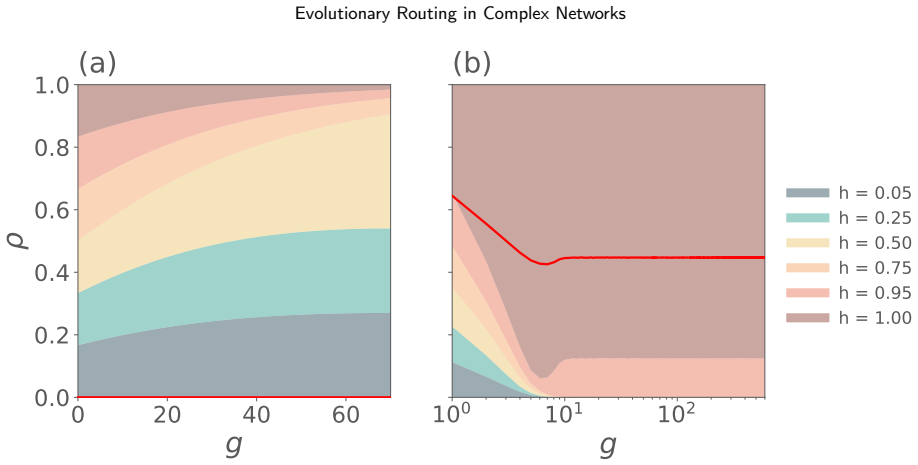
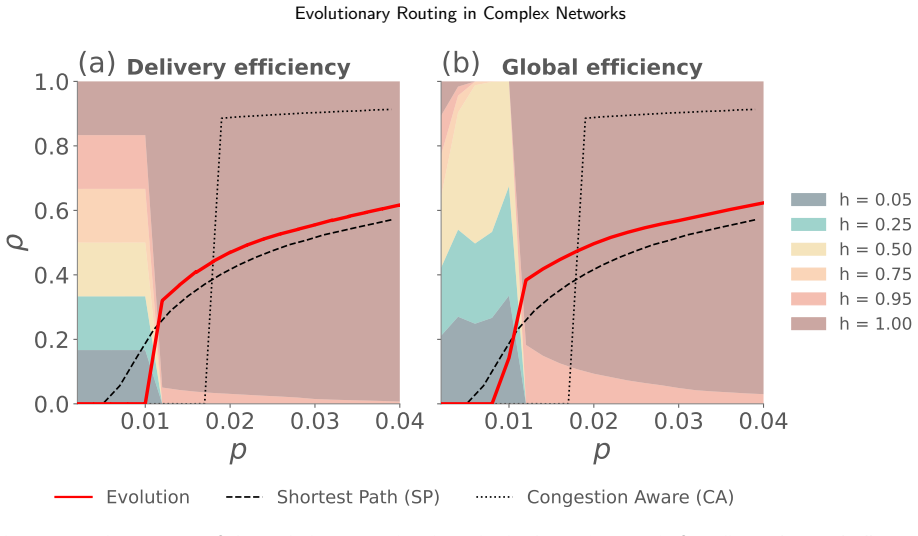
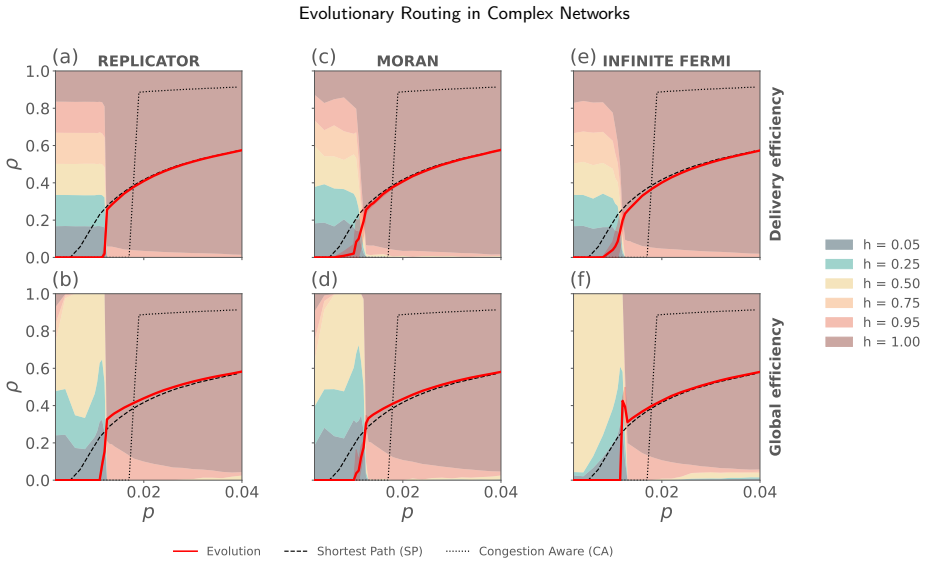
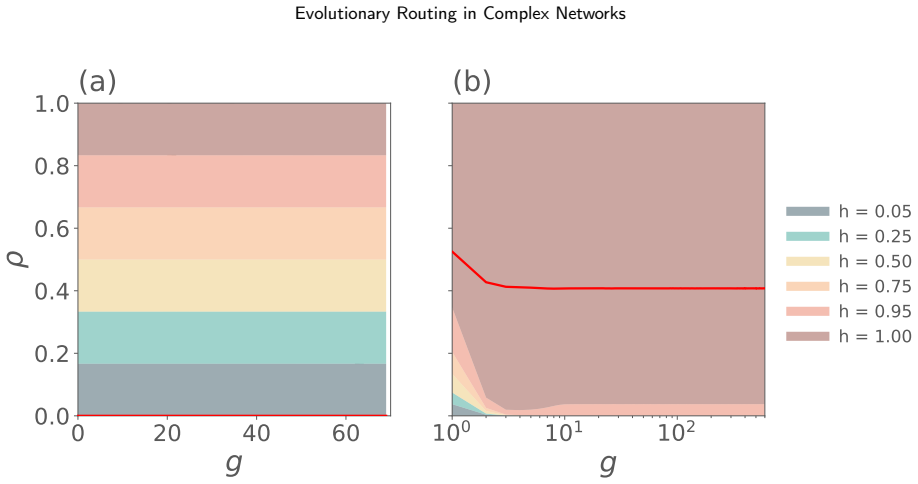
Packet routing on scale-free networks faces a fundamental trade-off: shortest-path routing is efficient at low demand but funnels traffic through hubs and jams early, whereas congestion-aware routing postpones jamming at the price of a sharper collapse. Since neither paradigm dominates across the full range of traffic load, here we ask whether the appropriate balance can emerge endogenously rather than being imposed by design. To answer this, we recast adaptive packet routing on networks as an evolutionary game letting a heterogeneous population of strategies compete for prevalence under selection pressure generated by their own performance. We study this competition under two formalisms (strategy anchored to the packet or to the generating node), global and local update rules, and two payoff metrics. Across every implementation the evolutionary dynamics yield the same outcome: the jamming transition is delayed relative to shortest-path routing while the violent collapse of fixed congestion-aware routing is avoided. This improvement emerges spontaneously, without centralized coordination or global information. Crucially, under local update rules, the node-level volatility of strategy choices peaks sharply at the transition, furnishing a purely local early-warning signal of imminent jamming that requires no global monitoring.
Editorial analysis
A structured set of objections, weighed in public.
Referee Report
Summary. The paper models adaptive packet routing on scale-free networks as an evolutionary game in which heterogeneous routing strategies compete under selection driven by their own performance. It examines this setup under two strategy-anchoring formalisms (packet-level vs. node-level), global and local update rules, and two payoff metrics. The central claim is that the evolutionary dynamics produce the same qualitative outcome in all cases: the jamming transition is delayed relative to pure shortest-path routing while the abrupt collapse seen in fixed congestion-aware routing is avoided. The improvement arises spontaneously without centralized control or global information. Under local updates, node-level strategy volatility peaks sharply at the transition, providing a purely local early-warning signal.
Significance. If the reported consistency across implementations holds, the work provides a concrete demonstration that evolutionary-game dynamics can generate adaptive routing protocols that balance low-load efficiency and high-load robustness. The spontaneous emergence of a local early-warning signal from node-level volatility is a notable byproduct with potential monitoring applications. The parameter-free character of the evolutionary selection (no external tuning of strategy prevalences) and the cross-implementation robustness are strengths that would elevate the result above typical simulation studies in network science.
major comments (2)
- [§4] §4 (or equivalent results section), the paragraph reporting cross-implementation consistency: the claim that 'the same outcome' appears 'across every implementation' requires explicit quantitative comparison (e.g., critical load values or collapse slopes with error bars) rather than qualitative description; without these numbers it is impossible to judge whether the improvement is uniform or merely directionally similar.
- [§3] The definition of the two payoff metrics and the local-update rule (likely Eqs. in §3): the manuscript must show that the reported avoidance of violent collapse is not an artifact of the particular functional form chosen for congestion cost; a brief sensitivity check replacing the metric with a monotonic alternative would strengthen the claim that the outcome is driven by the evolutionary mechanism rather than the payoff definition.
minor comments (2)
- Figure captions should explicitly state the network size, degree exponent, and number of independent realizations used for each curve; several panels appear to omit these details.
- The abstract states results for 'two formalisms... global and local update rules, and two payoff metrics' but the main text should include a compact table (perhaps Table 1) listing the exact parameter settings for each of the eight combinations so readers can reproduce the consistency test.
Simulated Author's Rebuttal
We thank the referee for the positive evaluation and the recommendation of minor revision. The comments identify opportunities to strengthen the presentation of robustness across implementations and the sensitivity of results to payoff definitions. We address each point below.
read point-by-point responses
-
Referee: [§4] §4 (or equivalent results section), the paragraph reporting cross-implementation consistency: the claim that 'the same outcome' appears 'across every implementation' requires explicit quantitative comparison (e.g., critical load values or collapse slopes with error bars) rather than qualitative description; without these numbers it is impossible to judge whether the improvement is uniform or merely directionally similar.
Authors: We agree that quantitative metrics are needed to substantiate the uniformity claim. In the revised manuscript we will add a table in §4 (or a new supplementary table) reporting the critical load values at the jamming transition together with their standard deviations across independent runs, as well as the average slope of the throughput collapse, for every combination of strategy anchoring, update rule, and payoff metric. These numbers will replace the purely qualitative statement. revision: yes
-
Referee: [§3] The definition of the two payoff metrics and the local-update rule (likely Eqs. in §3): the manuscript must show that the reported avoidance of violent collapse is not an artifact of the particular functional form chosen for congestion cost; a brief sensitivity check replacing the metric with a monotonic alternative would strengthen the claim that the outcome is driven by the evolutionary mechanism rather than the payoff definition.
Authors: We accept that an explicit sensitivity check is warranted. We will include a short additional analysis (as a paragraph in §3 or a brief appendix) that replaces the original congestion-cost function with a monotonic alternative (a simple linear form) while keeping all other elements fixed, and we will demonstrate that the evolutionary dynamics continue to delay the transition and avoid abrupt collapse. This will confirm that the reported behavior is driven by the selection mechanism rather than the specific functional form. revision: yes
Circularity Check
No significant circularity
full rationale
The paper recasts routing as an evolutionary game and reports that the same qualitative outcome (delayed jamming transition, avoided collapse) emerges across multiple independent implementations (strategy anchoring, global/local updates, payoff metrics). This is presented as a simulation result of the dynamics under selection pressure, with no equations, fitted parameters, or self-citations shown to reduce the claimed consistency to the model inputs by construction. The derivation chain is self-contained as an exploration of emergent behavior in the stated game-theoretic setup.
Axiom & Free-Parameter Ledger
axioms (2)
- domain assumption Evolutionary selection pressure generated by strategy performance drives strategy prevalence in the population.
- domain assumption Scale-free networks and packet routing dynamics can be modeled via the described formalisms without additional external constraints.
Reference graph
Works this paper leans on
-
[1]
Albert, A.-L
R. Albert, A.-L. Barabási, Statistical mechanics of complex networks, Reviews of Modern Physics 74 (2002) 47–97
2002
-
[2]
M. E. J. Newman, The structure and function of complex networks, SIAM Review 45 (2003) 167–256
2003
-
[3]
Boccaletti, V
S. Boccaletti, V. Latora, Y. Moreno, M. Chavez, D.-U. Hwang, Complex networks: Structure and dynamics, Physics Reports 424 (2006) 175–308
2006
-
[4]
Masuda, M
N. Masuda, M. A. Porter, R. Lambiotte, Random walks and diffusion on networks, Physics Reports 716-717 (2017) 1–58
2017
-
[5]
Barabási, R
A. Barabási, R. Albert, Emergence of scaling in random networks, Science 286 (1999) 509–512
1999
-
[6]
Albert, H
R. Albert, H. Jeong, A. Barabási, Error and attack tolerance of complex networks, Nature 406 (2000) 378–382
2000
-
[7]
Ohira, R
T. Ohira, R. Sawatari, Phase transition in a computer network traffic model, Physical Review E 58 (1998) 193
1998
-
[8]
Arenas, A
A. Arenas, A. Díaz-Guilera, R. Guimerà, Communication in networks with hierarchical branching, Physical Review Letters 86 (2001) 3196–3199
2001
-
[9]
R.Guimerà,A.Díaz-Guilera,F.Vega-Redondo,A.Cabrales,A.Arenas, Optimalnetworktopologiesforlocalsearchwithcongestion, Physical Review Letters 89 (2002) 248701
2002
-
[10]
Echenique, J
P. Echenique, J. Gardeñes, Y. Moreno, Improved routing strategies for internet traffic delivery, Physical Review E 70 (2004) 056105
2004
-
[11]
Zhao, Y.-C
L. Zhao, Y.-C. Lai, K. Park, N. Ye, Onset of traffic congestion in complex networks, Physical Review E 71 (2005) 026125
2005
-
[12]
P.Echenique,J.Gómez-Gardeñes,Y.Moreno,Dynamicsofjammingtransitionsincomplexnetworks,EurophysicsLetters71(2005)325–331
2005
-
[13]
Danila, Y
B. Danila, Y. Yu, J. A. Marsh, K. E. Bassler, Optimal transport on complex networks, Physical Review E 74 (2006) 046106
2006
-
[14]
Toroczkai, K
Z. Toroczkai, K. E. Bassler, Jamming is limited in scale-free systems, Nature 428 (2004) 716
2004
-
[15]
Meloni, J
S. Meloni, J. Gómez-Gardeñes, Local empathy provides global minimization of congestion in communication networks, Physical Review E 82 (2010) 056105
2010
-
[16]
Gavaldà, J
A. Gavaldà, J. Duch, J. Gómez-Gardeñes, Reciprocal interactions out of congestion-free adaptive networks, Physical Review E 85 (2012) 026112
2012
-
[17]
Z.Wang,C.T.Bauch,S.Bhattacharyya,A.d’Onofrio,P.Manfredi,M.Perc,N.Perra,M.Salathé,D.Zhao, Statisticalphysicsofvaccination, Physics Reports 664 (2016) 1–113
2016
-
[18]
C.T.Bauch,D.J.D.Earn, Vaccinationandthetheoryofgames, ProceedingsoftheNationalAcademyofSciences101(2004)13391–13394
2004
-
[19]
C. T. Bauch, A. P. Galvani, D. J. D. Earn, Group interest versus self-interest in smallpox vaccination policy, Proceedings of the National Academy of Sciences 100 (2003) 10564–10567
2003
-
[20]
Cardillo, C
A. Cardillo, C. Reyes-Suárez, F. Naranjo, J. Gómez-Gardeñes, Evolutionary vaccination dilemma in complex networks, Physical Review E 88 (2013) 032803. F. Dilisante et al.:Preprint submitted to ElsevierPage 12 of 14 Evolutionary Routing in Complex Networks
2013
-
[21]
Steinegger, A
B. Steinegger, A. Cardillo, P. De los Rios, J. Gómez-Gardeñes, A. Arenas, Interplay between cost and benefits triggers nontrivial vaccination uptake, Physical Review E 97 (2018) 032308
2018
-
[22]
Steinegger, A
B. Steinegger, A. Arenas, J. Gómez-Gardeñes, C. Granell, Human prophylaxis driven by risk may cause oscillations in sexually transmitted diseases, Physical Review Research 2 (2020) 023181
2020
-
[23]
M.Khanjanianpak,N.Azimi-Tafreshi,A.Arenas,J.Gómez-Gardeñes, Emergenceofprotectivebehaviourunderdifferentriskperceptionsto disease spreading, Philosophical Transactions of the Royal Society A 380 (2022) 20200412
2022
-
[24]
L. Feng, Z. Han, L. Ming, R. Feng-Yuan, Z. Yan-Bo, Adaptive local routing strategy on a scale-free network, Chinese Physics B 19 (2010) 040513
2010
-
[25]
Zhang, Z
H. Zhang, Z. Liu, M. Tang, P. M. Hui, An adaptive routing strategy for packet delivery in complex networks, Physics Letters A 364 (2007) 325–331
2007
-
[26]
Pandit, A
V. Pandit, A. Mukhopadhyay, C. Sagar, Weight of fitness deviation governs strict physical chaos in replicator dynamics, Chaos 28 (2018) 033104
2018
-
[27]
C. P. Roca, J. A. Cuesta, Á. Sánchez, Effect of spatial structure on the evolution of cooperation, Physical Review E 80 (2009) 046106
2009
-
[28]
Szabó, G
G. Szabó, G. Fath, Evolutionary games on graphs, Physics Reports 446 (2007) 97–216
2007
-
[29]
P. A. P. Moran, The Statistical Processes of Evolutionary Theory, Clarendon Press, Oxford, 1962
1962
-
[30]
Szabó, C
G. Szabó, C. Tóke, Evolutionary prisoner’s dilemma game on a square lattice, Physical Review E 58 (1998) 69
1998
-
[31]
Hauert, G
C. Hauert, G. Szabó, Game theory and physics, American Journal of Physics 73 (2005) 405–414
2005
-
[32]
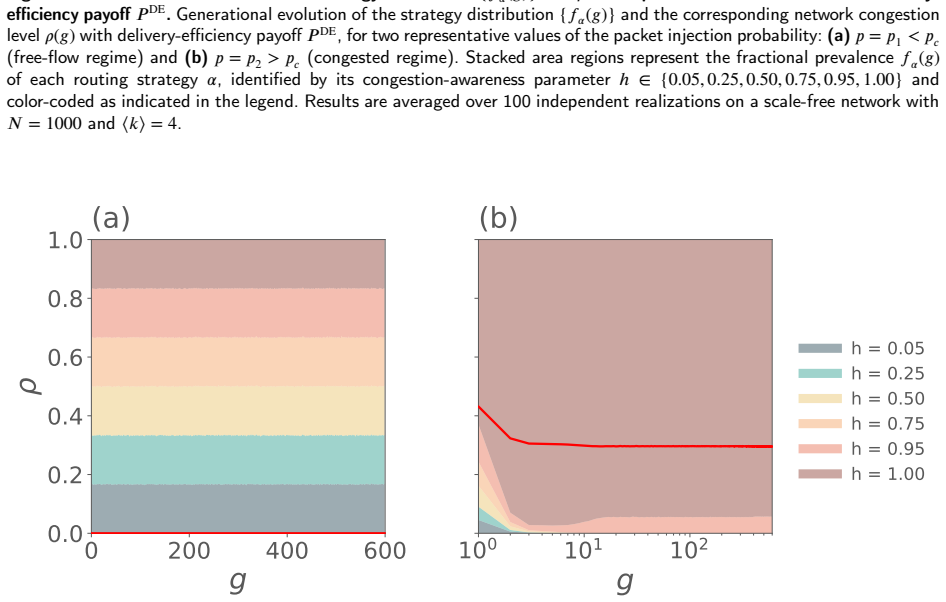
M.Scheffer,J.Bascompte,W.A.Brock,V.Brovkin,S.R.Carpenter,V.Dakos,H.Held,E.H.vanNes,M.Rietkerk,G.Sugihara,Early-warning signals for critical transitions, Nature 461 (2009) 53–59. F. Dilisante et al.:Preprint submitted to ElsevierPage 13 of 14 Evolutionary Routing in Complex Networks 0 20 40 60 g 0.0 0.2 0.4 0.6 0.8 1.0 (a) 100 101 102 g (b) h = 0.05 h = 0....
2009
discussion (0)
Sign in with ORCID, Apple, or X to comment. Anyone can read and Pith papers without signing in.