REVIEW 3 major objections 6 minor 1 cited by
Verbalized Bayesian Persuasion
T0 review · 3 major / 6 minor · reviewed 2026-08-09 · deepseek-v4-flash
Pith's one-line read The paper claims that Bayesian persuasion, traditionally solved only for small discrete games, can be solved in natural language by representing both players as LLMs and searching over prompt strategies until an approximate equilibrium is…
desk verdict A useful empirical integration of Prompt-PSRO and Bayesian persuasion, but the headline convergence guarantee is unverified for the algorithm actually run. read the letter →
The pith
A machine-rendered reading of the paper's core claim, the machinery that carries it, and where it could break.
The reading
What carries the argument
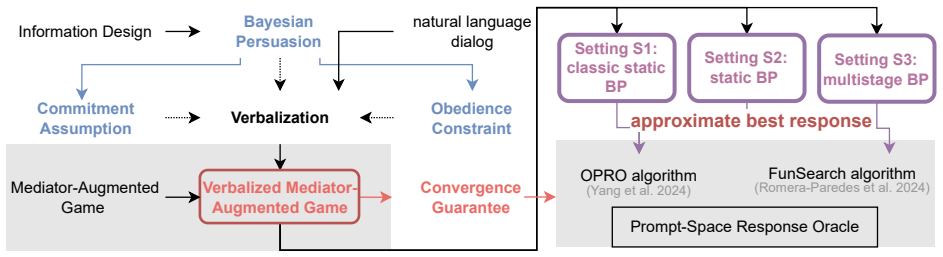
The central object is the verbalized mediator-augmented extensive-form game, a reformulation of Bayesian persuasion in which the sender acts as a mediator who commits to a signaling scheme and the receiver best-responds, with states, signals, and actions rendered as text rather than numbers. The solver that carries the argument is the prompt-space response oracle (Prompt-PSRO), which restricts each player's strategy space to a growing pool of prompt categories and contents, computes a meta-game equilibrium over that pool, and uses LLM-based optimizers, namely OPRO in static settings and FunSearch in multistage settings, as approximate best-response oracles. Three supporting mechanisms make the reduction work: the commitment assumption is verbalized by writing the sender's style and its probability into the receiver's prompt, obedience constraints are estimated by sampling and added as a penalty, and information obfuscation uses self-reflection to help aligned LLMs produce strategically vague signals. The theoretical load is carried by rewriting the obedience-constrained maximization as a bilinear saddle-point problem, which connects the verbalized game to the known polynomial-time equilibrium results for mediator-augmented games.
What would settle it
Compare the receiver LLM's chosen actions, over many signals in the three benchmark problems, with the Bayes best response to the posterior induced by the sender's actual mixed strategy; if the deviation rate is non-negligible, the obedience constraints are misestimated and the claimed $\varepsilon$-approximate Bayes correlated equilibrium does not hold for these agents.
Extended reading notes
Core claim
The paper's central claim is that a Bayesian persuasion problem can be faithfully represented as a verbalized mediator-augmented extensive-form game, in which the state, the sender's signal, the receiver's action, and the commitment assumption are all expressed as text, and that this game can be solved by a generalized equilibrium-finding algorithm that alternates between LLM-based approximate best response and a meta-game solver. Strategies are not optimized in the LLM's weight space; they are optimized in prompt space, where a signaling scheme is a probability distribution over writing-style prompts such as tone, detail level, and emphasis. The paper further claims that the sender's commitment can be verbalized by including the sender's style and its probability in the receiver's prompt, that obedience constraints can be estimated by sampling and penalized through reward shaping, and that a step-wise variant using conditional prompt functions extends the method to multistage games. Proposition 5.1 states that the result is a $\varepsilon$-approximate Bayes correlated equilibrium in static BP and a $\varepsilon$-approximate Bayes-Nash equilibrium in multistage BP, and the experiments on three classic problems are presented as evidence that the framework reproduces known equilibria and transfers to richer language settings.
Load-bearing premise
The load-bearing premise is that a receiver LLM instructed to follow the Bayesian decision rule actually does so, and that a small set of prompt categories such as tone and detail level spans enough of the signaling space for near-optimal persuasion.
Editorial extensions
If this is right
- If VBP works as claimed, Bayesian persuasion can be run on arbitrary conversational text rather than binary states and discrete signals, so recommendation letters, legal arguments, and public announcements can be analyzed as strategic information design problems.
- The framework yields a convergence guarantee: in static settings the output is a $\varepsilon$-approximate Bayes correlated equilibrium, so a sender that deploys the found meta-strategy cannot gain more than $\varepsilon$ by deviating, with an analogous guarantee in multistage settings.
- The verbalized commitment assumption gives a practical implementation of the defining feature that separates Bayesian persuasion from cheap talk: the receiver's prompt contains the sender's strategy and its probability.
- Multistage persuasion with a long-lived receiver becomes tractable through conditional prompt functions, and the observed honesty-deception oscillations suggest bargaining-like dynamics rather than a fixed unilateral commitment.
- The method is designed to generalize across dialogue domains without retraining the LLM, since the experiments require only LLM inference plus prompt optimization, not fine-tuning.
Reading between the lines
- If the receiver LLM's Bayesian updating is imperfect, the equilibrium guarantee describes best response to the simulated receiver, not to the human it stands in for; a direct test against human receivers would be needed before treating VBP as a tool for real-world persuasion.
- The oscillation between honesty and deception observed with aligned models, which vanishes with an unaligned model, suggests alignment acts as an extra payoff perturbation; one could test this by varying the receiver's stated normative preferences and measuring the equilibrium lie rate.
- The same mediator-augmented interface could be pointed at multi-receiver mechanism design: since the formulation already supports multiple players, VBP-style prompt search may solve information design problems where one sender recommends actions to many receivers, a direction the paper lists as future work.
Editorial analysis
A structured set of objections, weighed in public.
Referee Report
Summary. The paper introduces VBP (Verbalized Bayesian Persuasion), a framework that recasts Bayesian persuasion as a verbalized mediator-augmented extensive-form game in which both the sender and the receiver are implemented as LLMs. The sender's signaling scheme is represented by prompt categories (e.g., tone, detail level), and strategy optimization is performed via a prompt-space response-oracle (Prompt-PSRO) combined with OPRO and FunSearch. The authors claim in Proposition 5.1 that VBP returns an epsilon-approximate Bayes correlated equilibrium in static BP and an epsilon-approximate Bayes-Nash equilibrium in multistage BP. Experiments on recommendation-letter, courtroom, and law-enforcement scenarios show that VBP approaches the computed BCE baselines in terms of sender and receiver rewards, with exploitability decreasing to about 0.1, and that it produces interesting phenomena such as honesty oscillations and bargaining-like dynamics in the multistage setting.
Significance. If the convergence guarantee were substantiated, VBP would be a meaningful step toward applying information design to natural-language settings, a domain where existing numeric BP methods do not apply. The paper includes several strengths: it provides detailed prompt templates in Appendix C.4 that aid reproducibility, it evaluates on three classic BP scenarios plus a multistage variant, and it documents qualitatively interesting sender behaviors that connect to honesty and deception. However, the headline formal claim is currently not supported by the proof as written, and the experimental validation is partly built into the receiver's prompt rather than emergent from the model. The framework itself is promising, but the gap between the claimed guarantee and the implemented algorithm must be resolved before the central contribution can be accepted.
major comments (3)
- [§5.3 and Appendix A, Eq. (3)] Proposition 5.1 asserts an epsilon-approximate equilibrium guarantee, but the proof in Appendix A invokes 'Algorithm 1 in Zhang et al. (2024a)', a binary-search saddle-point method with a Lagrangian, a zero-sum utility transformation, and a threshold tau. The algorithm actually presented and evaluated in the main text (Algorithm 1) is a generic PSRO loop: it maintains finite prompt sets, computes a payoff tensor, finds LLM best responses, expands the sets, and updates a meta-strategy. There is no binary search over tau, no Lagrangian multiplier, and no zero-sum conversion. The convergence theorem therefore applies to a different algorithm than the one whose results are reported. Either Algorithm 1 must be shown to solve or approximate the saddle-point problem in Eq. (3), or a separate convergence proof for the PSRO variant with LLM approximate best responses must be supplied. Without this, the central theoretical claim is unverified for the executed solver.
- [§5.1 (Verbalized Commitment Assumption) and Appendix C.4] The receiver's prompt explicitly instructs the LLM to 'first guess the student's quality given the sent recommendation letter according to the Bayesian decision rule' and embeds the sender's writing style and its probability into the receiver's context as the commitment assumption. This means the empirical reproduction of the BCE baselines in Figures 4 and 5 is partly by construction: the experiments demonstrate that the LLM follows the prescribed Bayesian update and best-response rule, not that the VBP framework induces this behavior from a more neutral prompt. To support the claim that VBP solves real BP problems, the authors should evaluate the receiver's behavior without the explicit Bayesian-rule instruction, or at least report a control condition that measures how much of the observed proximity to BCE is due to the prompt content versus the learning dynamics.
- [§5.1 (Action A) and §6.4] The convergence guarantee and the experimental results are restricted to a finite set of prompt categories (e.g., tone, detail level, specificity) that the Prompt-PSRO loop is allowed to optimize. The paper assumes, without proof, that this low-dimensional prompt space spans the signaling space well enough to approximate optimal persuasion. The exploitability values in Figure 6 are computed within this restricted meta-game, not against the full space of natural-language signals, so they do not directly quantify the gap to an equilibrium of the original verbalized game. The claims about solving 'real, non-abstract BP problems' should be scoped to the expressiveness of the chosen prompt categories, and the paper should either justify the choice of categories or discuss the sensitivity of the results to that choice.
minor comments (6)
- [§5.3] The word 'mutlistage' appears in the sentence 'In mutlistage BP, this significantly restricts...'; it should be 'multistage'.
- [Appendix A] In the last sentence of the proof, 'strategties' is a typo for 'strategies', and 'utilty' is a typo for 'utility'.
- [Figure 7 caption] The caption contains 'comparision' instead of 'comparison'.
- [§6.4] The text says 'the table columns in Figure 9 reflect this structure', but Figure 9 appears to be a screenshot or diagram rather than a formatted table; please clarify the layout or refer to it consistently as a table.
- [§6.4] The statement that 'the probabilities in Figure 9 are computed as the average probability of selecting each prompt from the strategy pool across iterations' is ambiguous: it is unclear whether the reported probabilities are averaged over all iterations or taken from the final converged meta-strategy, and the figure itself should state which iteration or time window is shown.
- [§6.2] For the BCE and MARL baselines in Figure 4, the paper plots 'Probability of lie' and 'Probability of honest' without specifying how these probabilities are derived from the computed equilibrium or the MARL policy; a brief definition or reference would improve interpretability.
Circularity Check
No significant circularity: the verbalized commitment and Bayesian-updating instructions are BP assumptions, not fitted outputs; the proof–algorithm mismatch in Proposition 5.1 is a rigor gap, not a circular reduction.
full rationale
I walked the paper's derivation chain. The central formal claim, Proposition 5.1 in Section 5.3, states that VBP returns an epsilon-approximate Bayes correlated equilibrium in static BP and an epsilon-approximate Bayes-Nash equilibrium in multistage BP. Its proof in Appendix A rewrites Equation 1 into the bilinear saddle-point problem Equation 3 and invokes the binary-search-based Algorithm 1 of Zhang et al. (2024a). The algorithm actually implemented in the main text, Algorithm 1, is a generic PSRO loop with no Lagrangian multiplier, no binary search over tau, and no zero-sum utility transformation. This is a genuine proof gap: the convergence guarantee is not verified for the executed solver. However, it is an internal inconsistency or omitted proof, not a circular reduction. The target equilibrium concept is not an input to Algorithm 1 or to the cited theorem; the guarantee is claimed for a different solver than the one analyzed. The receiver prompt in Appendix C.4 instructs the receiver to 'first guess the student's quality given the sent recommendation letter according to the Bayesian decision rule, then choose the best response' and includes the sender's writing style with its probability under the commitment assumption. This encodes the BP model itself, not a fitted parameter being renamed as a prediction. In classical BP, Bayesian updating and commitment are assumptions of the solution concept, not outputs to be verified, and the sender's prompt search, meta-strategy updates, and honesty/lying dynamics are learned through PSRO rather than read off from the equilibrium. The comparisons against analytically computed BCE baselines in Appendix B are external benchmarks, not products of the framework. Self-citations such as Lin et al. (2023) supply code, extended obedience constraints, and baseline implementations, but none is load-bearing for the central convergence argument, which relies on external results from Zhang and Sandholm (2022) and Zhang et al. (2024a). I therefore find no step that reduces by construction to its own inputs; the main issues are a proof-algorithm mismatch and unverified LLM-behavior assumptions, which belong to correctness risk rather than circularity.
Assumptions & free parameters
free parameters (4)
- Prompt-PSRO strategy pool size =
10 (top prompts retained)
- OPRO candidate count per step =
8
- Self-reflection rounds =
3
- Temperature settings =
0 for scorer, 1.0 for optimizer
assumptions (5)
- domain assumption LLM agents act as rational expected-utility maximizers and perform Bayesian updating when instructed.
- domain assumption The restricted prompt-category space preserves enough signaling power to approximate optimal persuasion.
- standard math The mediator-augmented game equivalence and Theorem 3.7 of Zhang et al. (2024a) apply to the verbalized LLM game.
- domain assumption Verbalized commitment assumption creates common knowledge of the signaling scheme.
- domain assumption The sampled obedience constraint estimate is accurate enough for training.
Cite this review
Pith. "Pith review of Verbalized Bayesian Persuasion." pith.science (2026). https://pith.science/paper/6EK67C6J
@misc{pith2026250201587,
  author       = {Pith},
  title        = {Pith review of: Verbalized Bayesian Persuasion},
  year         = {2026},
  howpublished = {\url{https://pith.science/paper/6EK67C6J}},
  note         = {Machine review of arXiv:2502.01587}
}
read the original abstract
Information design (ID) explores how a sender influence the optimal behavior of receivers to achieve specific objectives. While ID originates from everyday human communication, existing game-theoretic and machine learning methods often model information structures as numbers, which limits many applications to toy games. This work leverages LLMs and proposes a verbalized framework in Bayesian persuasion (BP), which extends classic BP to real-world games involving human dialogues for the first time. Specifically, we map the BP to a verbalized mediator-augmented extensive-form game, where LLMs instantiate the sender and receiver. To efficiently solve the verbalized game, we propose a generalized equilibrium-finding algorithm combining LLM and game solver. The algorithm is reinforced with techniques including verbalized commitment assumptions, verbalized obedience constraints, and information obfuscation. Numerical experiments in dialogue scenarios, such as recommendation letters, courtroom interactions, and law enforcement, validate that our framework can both reproduce theoretical results in classic BP and discover effective persuasion strategies in more complex natural language and multi-stage scenarios.
Figures


Figures from the paper (18 more)


Forward citations
Cited by 1 Pith paper
-
Game Theory Meets Large Language Models: A Systematic Survey with Taxonomy and New Frontiers
A taxonomy-based survey of bidirectional game theory and LLM research, spanning evaluation, alignment, economic competition, and LLM-driven game solving.
Reference graph
Works this paper leans on
-
[1]
write newline
" write newline "" before.all 'output.state := FUNCTION n.dashify 't := "" t empty not t #1 #1 substring "-" = t #1 #2 substring "--" = not "--" * t #2 global.max substring 't := t #1 #1 substring "-" = "-" * t #2 global.max substring 't := while if t #1 #1 substring * t #2 global.max substring 't := if while FUNCTION format.date year duplicate empty "emp...
-
[2]
S., Chien, J., D \' az, M., El-Sayed, S., Pittman, J., Mohamed, S., and McKee, K
Agnew, W., Bergman, A. S., Chien, J., D \' az, M., El-Sayed, S., Pittman, J., Mohamed, S., and McKee, K. R. The illusion of artificial inclusion. In CHI, 2024
2024
-
[3]
Learning to deceive in multi-agent hidden role games
Aitchison, M., Benke, L., and Sweetser, P. Learning to deceive in multi-agent hidden role games. In International Workshop on Deceptive AI, 2021
2021
-
[4]
Akata, E., Schulz, L., Coda-Forno, J., Oh, S. J., Bethge, M., and Schulz, E. Playing repeated games with large language models. arXiv preprint arXiv:2305.16867, 2023
arXiv 2023
-
[5]
Albrecht, S. V. and Stone, P. Autonomous agents modelling other agents: A comprehensive survey and open problems. Artificial Intelligence, 258: 0 66--95, 2018
2018
-
[6]
Persuasion is now 30 per cent of us gdp: Revisiting mccloskey and klamer after a quarter of a century
Antioch, G. Persuasion is now 30 per cent of us gdp: Revisiting mccloskey and klamer after a quarter of a century. Economic Round-up, pp.\ 1--10, 2013
2013
-
[7]
M., and Atia, M
Asgharnia, A., Schwartz, H. M., and Atia, M. Deception in the game of guarding multiple territories: A machine learning approach. In SMC, 2020
2020
-
[8]
Assos, A., Attias, I., Dagan, Y., Daskalakis, C., and Fishelson, M. K. Online learning and solving infinite games with an erm oracle. In COLT, 2023
2023
Show all 134 references
-
[9]
E., Castiglioni, M., Gatti, N., and Marchesi, A
Bacchiocchi, F., Stradi, F. E., Castiglioni, M., Gatti, N., and Marchesi, A. Markov persuasion processes: How to persuade multiple agents from scratch. In ICML Workshop: Aligning Reinforcement Learning Experimentalists and Theorists, 2024
2024
-
[10]
Efficient model-agnostic alignment via bayesian persuasion
Bai, F., Wang, M., Zhang, Z., Chen, B., Xu, Y., Wen, Y., and Yang, Y. Efficient model-agnostic alignment via bayesian persuasion. arXiv preprint arXiv:2405.18718, 2024
2024 arXiv
-
[11]
G., Eichstaedt, j
Bai, H., Voelkel, J. G., Eichstaedt, j. C., and Willer, R. Artificial intelligence can persuade humans on political issues, Feb 2023. URL osf.io/stakv
2023
-
[12]
R., and Talgam-Cohen, I
Bar-Gill, O., Sunstein, C. R., and Talgam-Cohen, I. Algorithmic harm in consumer markets. Journal of Legal Analysis, 15 0 (1): 0 1--47, 2023
2023
-
[13]
Bennett, P. G. Hypergames: developing a model of conflict. Futures, 12 0 (6): 0 489--507, 1980
1980
-
[14]
and Morris, S
Bergemann, D. and Morris, S. Robust predictions in games with incomplete information. Econometrica, 81 0 (4): 0 1251--1308, 2013
2013
-
[15]
and Morris, S
Bergemann, D. and Morris, S. Bayes correlated equilibrium and the comparison of information structures in games. Theoretical Economics, 11 0 (2): 0 487--522, 2016
2016
-
[16]
and Morris, S
Bergemann, D. and Morris, S. Information design: A unified perspective. Journal of Economic Literature, 57 0 (1): 0 44--95, 2019
2019
-
[17]
Sequential information design: Learning to persuade in the dark
Bernasconi, M., Castiglioni, M., Marchesi, A., Gatti, N., and Trov \`o , F. Sequential information design: Learning to persuade in the dark. In NeurIPS, 2022
2022
-
[18]
Bighashdel, A., Wang, Y., McAleer, S., Savani, R., and Oliehoek, F. A. Policy space response oracles: A survey. arXiv preprint arXiv:2403.02227, 2024
2024 arXiv
-
[19]
and Cotton, C
Boleslavsky, R. and Cotton, C. Grading standards and education quality. American Economic Journal: Microeconomics, 7 0 (2): 0 248--279, 2015
2015
-
[20]
Bond, C. F. and Robinson, M. The evolution of deception. Journal of nonverbal behavior, 12: 0 295--307, 1988
1988
-
[21]
superstition
Bontrager, P., Khalifa, A., Anderson, D., Stephenson, M., Salge, C., and Togelius, J. " superstition" in the network: Deep reinforcement learning plays deceptive games. In AIIDE, 2019
2019
-
[22]
M., Egdal, D
Breum, S. M., Egdal, D. V., Mortensen, V. G., M ller, A. G., and Aiello, L. M. The persuasive power of large language models. In AAAI, 2024
2024
-
[23]
and Woodside, T
Burtell, M. and Woodside, T. Artificial influence: An analysis of ai-driven persuasion. arXiv preprint arXiv:2303.08721, 2023
2023 arXiv
-
[24]
Large language models are as persuasive as humans, but why? about the cognitive effort and moral-emotional language of llm arguments
Carrasco-Farre, C. Large language models are as persuasive as humans, but why? about the cognitive effort and moral-emotional language of llm arguments. arXiv preprint arXiv:2404.09329, 2024
2024 arXiv
-
[25]
Carroll, T. E. and Grosu, D. A game theoretic investigation of deception in network security. Security and Communication Networks, 4 0 (10): 0 1162--1172, 2011
2011
-
[26]
Multi-receiver online bayesian persuasion
Castiglioni, M., Marchesi, A., Celli, A., and Gatti, N. Multi-receiver online bayesian persuasion. In ICML. PMLR, 2021
2021
-
[27]
Deception in social learning: A multi-agent reinforcement learning perspective
Chelarescu, P. Deception in social learning: A multi-agent reinforcement learning perspective. arXiv preprint arXiv:2106.05402, 2021
2021 arXiv
-
[28]
P., and Richardson, K
Chen, J., Yuan, S., Ye, R., Majumder, B. P., and Richardson, K. Put your money where your mouth is: Evaluating strategic planning and execution of llm agents in an auction arena. arXiv preprint arXiv:2310.05746, 2023
2023 arXiv
-
[29]
Crawford, V. P. and Sobel, J. Strategic information transmission. Econometrica: Journal of the Econometric Society, pp.\ 1431--1451, 1982
1982
-
[30]
M., Gidel, G., Tracey, B., Tuyls, K., Omidshafiei, S., Balduzzi, D., and Jaderberg, M
Czarnecki, W. M., Gidel, G., Tracey, B., Tuyls, K., Omidshafiei, S., Balduzzi, D., and Jaderberg, M. Real world games look like spinning tops. In NeurIPS, 2020
2020
-
[31]
R., Leibo, J
Dafoe, A., Hughes, E., Bachrach, Y., Collins, T., McKee, K. R., Leibo, J. Z., Larson, K., and Graepel, T. Open problems in cooperative ai. arXiv preprint arXiv:2012.08630, 2020
2012 arXiv
-
[32]
Reducing congestion through information design
Das, S., Kamenica, E., and Mirka, R. Reducing congestion through information design. In 2017 55th annual allerton conference on communication, control, and computing (allerton), pp.\ 1279--1284. IEEE, 2017
2017
-
[33]
Gtbench: Uncovering the strategic reasoning limitations of llms via game-theoretic evaluations
Duan, J., Zhang, R., Diffenderfer, J., Kailkhura, B., Sun, L., Stengel-Eskin, E., Bansal, M., Chen, T., and Xu, K. Gtbench: Uncovering the strategic reasoning limitations of llms via game-theoretic evaluations. arXiv preprint arXiv:2402.12348, 2024
2024 arXiv
-
[34]
Algorithmic information structure design: a survey
Dughmi, S. Algorithmic information structure design: a survey. ACM SIGecom Exchanges, 15 0 (2): 0 2--24, 2017
2017
-
[35]
Measuring the persuasiveness of language models, 2024
Durmus, E., Lovitt, L., Tamkin, A., Ritchie, S., Clark, J., and Ganguli, D. Measuring the persuasiveness of language models, 2024. URL https://www.anthropic.com/news/measuring-model-persuasiveness
2024
-
[36]
and Martini, G
Dworczak, P. and Martini, G. The simple economics of optimal persuasion. Journal of Political Economy, 127 0 (5): 0 1993--2048, 2019
1993
-
[37]
and Jehiel, P
Ettinger, D. and Jehiel, P. A theory of deception. American Economic Journal: Microeconomics, 2 0 (1): 0 1--20, 2010
2010
-
[38]
FAIR, M. F. A. R. D. T., Bakhtin, A., Brown, N., Dinan, E., Farina, G., Flaherty, C., Fried, D., Goff, A., Gray, J., Hu, H., et al. Human-level play in the game of diplomacy by combining language models with strategic reasoning. Science, 378 0 (6624): 0 1067--1074, 2022
2022
-
[39]
Can large language models serve as rational players in game theory? a systematic analysis
Fan, C., Chen, J., Jin, Y., and He, H. Can large language models serve as rational players in game theory? a systematic analysis. In AAAI, 2024
2024
-
[40]
Evolutionary conditions for the emergence of communication in robots
Floreano, D., Mitri, S., Magnenat, S., and Keller, L. Evolutionary conditions for the emergence of communication in robots. Current biology, 17 0 (6): 0 514--519, 2007
2007
-
[41]
A., De Freitas, N., and Whiteson, S
Foerster, J., Assael, I. A., De Freitas, N., and Whiteson, S. Learning to communicate with deep multi-agent reinforcement learning. In NeurIPS, 2016
2016
-
[42]
Bayesian persuasion in sequential decision-making
Gan, J., Majumdar, R., Radanovic, G., and Singla, A. Bayesian persuasion in sequential decision-making. In AAAI, 2022
2022
-
[43]
Gandhi, K., Sadigh, D., and Goodman, N. D. Strategic reasoning with language models. arXiv preprint arXiv:2305.19165, 2023
2023 arXiv
-
[44]
States as strings as strategies: Steering language models with game-theoretic solvers
Gemp, I., Bachrach, Y., Lanctot, M., Patel, R., Dasagi, V., Marris, L., Piliouras, G., and Tuyls, K. States as strings as strategies: Steering language models with game-theoretic solvers. arXiv preprint arXiv:2402.01704, 2024
2024 arXiv
-
[45]
and Cort \'e s, J
Gharesifard, B. and Cort \'e s, J. Stealthy deception in hypergames under informational asymmetry. IEEE Transactions on Systems, Man, and Cybernetics: Systems, 44 0 (6): 0 785--795, 2013
2013
-
[46]
and Sycara, K
Ghiya, S. and Sycara, K. Learning complex multi-agent policies in presence of an adversary. arXiv preprint arXiv:2008.07698, 2020
2008 arXiv
-
[47]
Deepseek-r1: Incentivizing reasoning capability in llms via reinforcement learning
Guo, D., Yang, D., Zhang, H., Song, J., Zhang, R., Xu, R., Zhu, Q., Ma, S., Wang, P., Bi, X., et al. Deepseek-r1: Incentivizing reasoning capability in llms via reinforcement learning. arXiv preprint arXiv:2501.12948, 2025
2025 arXiv
-
[48]
Can large language models play games? a case study of a self-play approach
Guo, H., Liu, Z., Zhang, Y., and Wang, Z. Can large language models play games? a case study of a self-play approach. arXiv preprint arXiv:2403.05632, 2024
2024 arXiv
-
[49]
Unpacking reward shaping: Understanding the benefits of reward engineering on sample complexity
Gupta, A., Pacchiano, A., Zhai, Y., Kakade, S., and Levine, S. Unpacking reward shaping: Understanding the benefits of reward engineering on sample complexity. In NeurIPS, 2022
2022
-
[50]
Q., et al
Han, Z., Gao, C., Liu, J., Zhang, S. Q., et al. Parameter-efficient fine-tuning for large models: A comprehensive survey. arXiv preprint arXiv:2403.14608, 2024
2024 arXiv
-
[51]
Teams, signaling, and information theory
Ho, Y.-C., Kastner, M., and Wong, E. Teams, signaling, and information theory. IEEE Transactions on Automatic Control, 23 0 (2): 0 305--312, 1978
1978
-
[52]
F., DiFranzo, D., Aghajari, Z., Mieczkowski, H., Levy, K., Naaman, M., Hancock, J., and Jung, M
Hohenstein, J., Kizilcec, R. F., DiFranzo, D., Aghajari, Z., Mieczkowski, H., Levy, K., Naaman, M., Hancock, J., and Jung, M. F. Artificial intelligence in communication impacts language and social relationships. Scientific Reports, 13 0 (1): 0 5487, 2023
2023
-
[53]
C., and Xu, H
Hossain, S., Wang, T., Lin, T., Chen, Y., Parkes, D. C., and Xu, H. Multi-sender persuasion--a computational perspective. In ICML, 2024
2024
-
[54]
Game-theoretic llm: Agent workflow for negotiation games
Hua, W., Liu, O., Li, L., Amayuelas, A., Chen, J., Jiang, L., Jin, M., Fan, L., Sun, F., Wang, W., et al. Game-theoretic llm: Agent workflow for negotiation games. arXiv preprint arXiv:2411.05990, 2024
2024 arXiv
-
[55]
pigovian tax
Hua, Y., Gao, S., Li, W., Jin, B., Wang, X., and Zha, H. Learning optimal" pigovian tax" in sequential social dilemmas. In AAMAS, 2023
2023
-
[56]
S., Hou, L., Wu, Y., Wang, X., Yu, H., and Han, J
Huang, J., Gu, S. S., Hou, L., Wu, Y., Wang, X., Yu, H., and Han, J. Large language models can self-improve. In EMNLP, 2023
2023
-
[57]
J., Lam, M
Huang, J.-t., Li, E. J., Lam, M. H., Liang, T., Wang, W., Yuan, Y., Jiao, W., Wang, X., Tu, Z., and Lyu, M. R. How far are we on the decision-making of llms? evaluating llms' gaming ability in multi-agent environments. arXiv preprint arXiv:2403.11807, 2024
2024 arXiv
-
[58]
Z., Phillips, M., Tuyls, K., Due \ n ez-Guzman, E., Garc \' a Casta \ n eda, A., Dunning, I., Zhu, T., McKee, K., Koster, R., et al
Hughes, E., Leibo, J. Z., Phillips, M., Tuyls, K., Due \ n ez-Guzman, E., Garc \' a Casta \ n eda, A., Dunning, I., Zhu, T., McKee, K., Koster, R., et al. Inequity aversion improves cooperation in intertemporal social dilemmas. In NeurIPS, 2018
2018
-
[59]
P., Shen, Y., Farina, G., and Andreas, J
Jacob, A. P., Shen, Y., Farina, G., and Andreas, J. The consensus game: Language model generation via equilibrium search. In ICLR, 2024. URL https://openreview.net/forum?id=n9xeGcI4Yg
2024
-
[60]
Z., and De Freitas, N
Jaques, N., Lazaridou, A., Hughes, E., Gulcehre, C., Ortega, P., Strouse, D., Leibo, J. Z., and De Freitas, N. Social influence as intrinsic motivation for multi-agent deep reinforcement learning. In ICML, 2019
2019
-
[61]
A., Tessler, M
Jarrett, D., Pislar, M., Bakker, M. A., Tessler, M. H., Koster, R., Balaguer, J., Elie, R., Summerfield, C., and Tacchetti, A. Language agents as digital representatives in collective decision-making. In NeurIPS Foundation Models for Decision Making Workshop, 2023
2023
-
[62]
Bayesian persuasion and information design
Kamenica, E. Bayesian persuasion and information design. Annual Review of Economics, 11 0 (1): 0 249--272, 2019
2019
-
[63]
and Gentzkow, M
Kamenica, E. and Gentzkow, M. Bayesian persuasion. American Economic Review, 101 0 (6): 0 2590--2615, 2011
2011
-
[64]
X., Park, J
Karinshak, E., Liu, S. X., Park, J. S., and Hancock, J. T. Working with ai to persuade: Examining a large language model's ability to generate pro-vaccination messages. Proceedings of the ACM on Human-Computer Interaction, 7 0 (CSCW1): 0 1--29, 2023
2023
-
[65]
and Skreta, V
Koessler, F. and Skreta, V. Informed information design. Journal of Political Economy, 131 0 (11): 0 3186--3232, 2023
2023
-
[66]
Long information design
Koessler, F., Laclau, M., Renault, J., and Tomala, T. Long information design. Theoretical Economics, 17 0 (2): 0 883--927, 2022 a
2022
-
[67]
Interactive information design
Koessler, F., Laclau, M., and Tomala, T. Interactive information design. Mathematics of Operations Research, 47 0 (1): 0 153--175, 2022 b
2022
-
[68]
S., Reid, M., Matsuo, Y., and Iwasawa, Y
Kojima, T., Gu, S. S., Reid, M., Matsuo, Y., and Iwasawa, Y. Large language models are zero-shot reasoners. In NeurIPS, 2022
2022
-
[69]
Optimal information disclosure: A linear programming approach
Kolotilin, A. Optimal information disclosure: A linear programming approach. Theoretical Economics, 13 0 (2): 0 607--635, 2018
2018
-
[70]
S., Gibson, A
Kovach, N. S., Gibson, A. S., and Lamont, G. B. Hypergame theory: a model for conflict, misperception, and deception. Game Theory, 2015 0 (1): 0 570639, 2015
2015
-
[71]
A unified game-theoretic approach to multiagent reinforcement learning
Lanctot, M., Zambaldi, V., Gruslys, A., Lazaridou, A., Tuyls, K., P \'e rolat, J., Silver, D., and Graepel, T. A unified game-theoretic approach to multiagent reinforcement learning. In NeurIPS, 2017
2017
-
[72]
Lazear, E. P. Speeding, terrorism, and teaching to the test. The Quarterly Journal of Economics, 121 0 (3): 0 1029--1061, 2006
2006
-
[73]
Z., Zambaldi, V., Lanctot, M., Marecki, J., and Graepel, T
Leibo, J. Z., Zambaldi, V., Lanctot, M., Marecki, J., and Graepel, T. Multi-agent reinforcement learning in sequential social dilemmas. In AAMAS, 2017
2017
-
[74]
Z., Due \ n ez-Guzman, E
Leibo, J. Z., Due \ n ez-Guzman, E. A., Vezhnevets, A., Agapiou, J. P., Sunehag, P., Koster, R., Matyas, J., Beattie, C., Mordatch, I., and Graepel, T. Scalable evaluation of multi-agent reinforcement learning with melting pot. In ICML. PMLR, 2021
2021
-
[75]
An effective maximum entropy exploration approach for deceptive game in reinforcement learning
Li, C., Wei, X., Zhao, Y., and Geng, X. An effective maximum entropy exploration approach for deceptive game in reinforcement learning. Neurocomputing, 403: 0 98--108, 2020
2020
-
[76]
Information design in multi-agent reinforcement learning
Lin, Y., Li, W., Zha, H., and Wang, B. Information design in multi-agent reinforcement learning. In NeurIPS, 2023
2023
-
[77]
Llm+ p: Empowering large language models with optimal planning proficiency
Liu, B., Jiang, Y., Zhang, X., Liu, Q., Zhang, S., Biswas, J., and Stone, P. Llm+ p: Empowering large language models with optimal planning proficiency. arXiv preprint arXiv:2304.11477, 2023
2023 arXiv
-
[78]
L., de Witt, C
Lo, Y. L., de Witt, C. S., Sokota, S., Foerster, J. N., and Whiteson, S. Cheap talk discovery and utilization in multi-agent reinforcement learning. In ICLR, 2023. URL https://openreview.net/forum?id=cddbeL1HWaD
2023
-
[79]
and Heydari, B
Lor \`e , N. and Heydari, B. Strategic behavior of large language models: Game structure vs. contextual framing. arXiv preprint arXiv:2309.05898, 2023
2023 arXiv
-
[80]
and Heydari, B
Lor \`e , N. and Heydari, B. Strategic behavior of large language models and the role of game structure versus contextual framing. Scientific Reports, 14 0 (1): 0 18490, 2024
2024
-
[81]
and Precup, D
Lupu, A. and Precup, D. Gifting in multi-agent reinforcement learning. In AAMAS, 2020
2020
-
[82]
Red teaming game: A game-theoretic framework for red teaming language models
Ma, C., Yang, Z., Gao, M., Ci, H., Gao, J., Pan, X., and Yang, Y. Red teaming game: A game-theoretic framework for red teaming language models. arXiv preprint arXiv:2310.00322, 2023
2023 arXiv
-
[83]
M., Lipovetzky, N., Ramirez, M., and Pearce, A
MacNally, A. M., Lipovetzky, N., Ramirez, M., and Pearce, A. R. Action selection for transparent planning. In AAMAS, 2018
2018
-
[84]
Artificial intelligence can generate fraudulent but authentic-looking scientific medical articles: Pandora’s box has been opened
M \'a jovsk \`y , M., C ern \`y , M., Kasal, M., Komarc, M., and Netuka, D. Artificial intelligence can generate fraudulent but authentic-looking scientific medical articles: Pandora’s box has been opened. Journal of medical Internet research, 25: 0 e46924, 2023
2023
-
[85]
and Renou, L
Makris, M. and Renou, L. Information design in multistage games. Theoretical Economics, 18 0 (4): 0 1475--1509, 2023
2023
-
[86]
Alympics: Language agents meet game theory
Mao, S., Cai, Y., Xia, Y., Wu, W., Wang, X., Wang, F., Ge, T., and Wei, F. Alympics: Language agents meet game theory. arXiv preprint arXiv:2311.03220, 2023
2023 arXiv
-
[87]
Bargaining games, pp.\ 622–658
Maschler, M., Solan, E., and Zamir, S. Bargaining games, pp.\ 622–658. Cambridge University Press, 2013
2013
-
[88]
and Sardina, S
Masters, P. and Sardina, S. Deceptive path-planning. In IJCAI, pp.\ 4368--4375, 2017
2017
-
[89]
S., Peters, H., Harari, G., and Cerf, M
Matz, S., Teeny, J., Vaid, S. S., Peters, H., Harari, G., and Cerf, M. The potential of generative ai for personalized persuasion at scale. Scientific Reports, 14 0 (1): 0 4692, 2024
2024
-
[90]
and Klamer, A
McCloskey, D. and Klamer, A. One quarter of gdp is persuasion. The American Economic Review, 85 0 (2): 0 191--195, 1995
1995
-
[91]
R., Gemp, I., McWilliams, B., Du \`e \ n ez-Guzm \'a n, E
McKee, K. R., Gemp, I., McWilliams, B., Du \`e \ n ez-Guzm \'a n, E. A., Hughes, E., and Leibo, J. Z. Social diversity and social preferences in mixed-motive reinforcement learning. In AAMAS, 2020
2020
-
[92]
Myerson, R. B. Incentive compatibility and the bargaining problem. Econometrica: journal of the Econometric Society, pp.\ 61--73, 1979
1979
-
[93]
Two-person cooperative games
Nash, J. Two-person cooperative games. Econometrica: Journal of the Econometric Society, pp.\ 128--140, 1953
1953
-
[94]
Nash, J. F. et al. The bargaining problem. Econometrica, 18 0 (2): 0 155--162, 1950
1950
-
[95]
K., Eck, D., Levine, S., and Jaques, N
Ndousse, K. K., Eck, D., Levine, S., and Jaques, N. Emergent social learning via multi-agent reinforcement learning. In ICML, 2021
2021
-
[96]
Y., Harada, D., and Russell, S
Ng, A. Y., Harada, D., and Russell, S. Policy invariance under reward transformations: Theory and application to reward shaping. In ICML, 1999
1999
-
[97]
Learning to reason with llms
OpenAI. Learning to reason with llms. https://openai.com/index/learning-to-reason-with-llms/, 2024. Accessed: 2024-10-02
2024
-
[98]
A., and Botvinick, M
Rabinowitz, N., Perbet, F., Song, F., Zhang, C., Eslami, S. A., and Botvinick, M. Machine theory of mind. In ICML. PMLR, 2018
2018
-
[99]
P., Karande, S., Bhatia, Y., et al
Ramani, G. P., Karande, S., Bhatia, Y., et al. Persuasion games using large language models. arXiv preprint arXiv:2408.15879, 2024
2024 arXiv
-
[100]
and Segal, I
Rayo, L. and Segal, I. Optimal information disclosure. Journal of political Economy, 118 0 (5): 0 949--987, 2010
2010
-
[101]
and Smolin, A
Romanyuk, G. and Smolin, A. Cream skimming and information design in matching markets. American Economic Journal: Microeconomics, 11 0 (2): 0 250--276, 2019
2019
-
[102]
P., Dupont, E., Ruiz, F
Romera-Paredes, B., Barekatain, M., Novikov, A., Balog, M., Kumar, M. P., Dupont, E., Ruiz, F. J., Ellenberg, J. S., Wang, P., Fawzi, O., et al. Mathematical discoveries from program search with large language models. Nature, 625 0 (7995): 0 468--475, 2024
2024
-
[103]
H., Gallotti, R., and West, R
Salvi, F., Ribeiro, M. H., Gallotti, R., and West, R. On the conversational persuasiveness of large language models: A randomized controlled trial. arXiv preprint arXiv:2403.14380, 2024
2024 arXiv
-
[104]
Measuring the non-transitivity in chess
Sanjaya, R., Wang, J., and Yang, Y. Measuring the non-transitivity in chess. Algorithms, 15 0 (5): 0 152, 2022
2022
-
[105]
Learning structured communication for multi-agent reinforcement learning
Sheng, J., Wang, X., Jin, B., Yan, J., Li, W., Chang, T.-H., Wang, J., and Zha, H. Learning structured communication for multi-agent reinforcement learning. Autonomous Agents and Multi-Agent Systems, 36 0 (2): 0 50, 2022
2022
-
[106]
and Kim, J
Shin, M. and Kim, J. Enhancing human persuasion with large language models. arXiv preprint arXiv:2311.16466, 2023
2023 arXiv
-
[107]
and Kim, J
Shin, M. and Kim, J. Large language models can enhance persuasion through linguistic feature alignment. Available at SSRN 4725351, 2024
2024
-
[108]
Reflexion: Language agents with verbal reinforcement learning
Shinn, N., Cassano, F., Gopinath, A., Narasimhan, K., and Yao, S. Reflexion: Language agents with verbal reinforcement learning. In NeurIPS, 2024
2024
-
[109]
Large language models playing mixed strategy nash equilibrium games
Silva, A. Large language models playing mixed strategy nash equilibrium games. arXiv preprint arXiv:2406.10574, 2024
2024 arXiv
-
[110]
Strouse, D., Kleiman-Weiner, M., Tenenbaum, J., Botvinick, M., and Schwab, D. J. Learning to share and hide intentions using information regularization. In NeurIPS, 2018
2018
-
[111]
A survey on self-evolution of large language models
Tao, Z., Lin, T.-E., Chen, X., Li, H., Wu, Y., Li, Y., Jin, Z., Huang, F., Tao, D., and Zhou, J. A survey on self-evolution of large language models. arXiv preprint arXiv:2404.14387, 2024
2024 arXiv
-
[112]
and Weiss, G
Tuyls, K. and Weiss, G. Multiagent learning: Basics, challenges, and prospects. Ai Magazine, 33 0 (3): 0 41--41, 2012
2012
-
[113]
and Lehner, P
Vane, R. and Lehner, P. Using hypergames to increase planned payoff and reduce risk. Autonomous Agents and Multi-Agent Systems, 5: 0 365--380, 2002
2002
-
[114]
Carbon market simulation with adaptive mechanism design
Wang, H., Li, W., Zha, H., and Wang, B. Carbon market simulation with adaptive mechanism design. In IJCAI Demostrations Track, 2024
2024
-
[115]
Wellman, M. P. Methods for empirical game-theoretic analysis. In AAAI, 2006
2006
-
[116]
When and why is persuasion hard? a computational complexity result
Wojtowicz, Z. When and why is persuasion hard? a computational complexity result. arXiv preprint arXiv:2408.07923, 2024
2024 arXiv
-
[117]
I., and Xu, H
Wu, J., Zhang, Z., Feng, Z., Wang, Z., Yang, Z., Jordan, M. I., and Xu, H. Sequential information design: Markov persuasion process and its efficient reinforcement learning. In EC, 2022
2022
-
[118]
J., Tao, X., and Wang, F
Xu, L., Xie, H., Qin, S.-Z. J., Tao, X., and Wang, F. L. Parameter-efficient fine-tuning methods for pretrained language models: A critical review and assessment. arXiv preprint arXiv:2312.12148, 2023
2023 arXiv
-
[119]
Magic: Investigation of large language model powered multi-agent in cognition, adaptability, rationality and collaboration
Xu, L., Hu, Z., Zhou, D., Ren, H., Dong, Z., Keutzer, K., Ng, S.-K., and Feng, J. Magic: Investigation of large language model powered multi-agent in cognition, adaptability, rationality and collaboration. In ICLR Workshop on Large Language Model (LLM) Agents, 2024
2024
-
[120]
V., Zhou, D., and Chen, X
Yang, C., Wang, X., Lu, Y., Liu, H., Le, Q. V., Zhou, D., and Chen, X. Large language models as optimizers. In ICLR, 2024. URL https://openreview.net/forum?id=Bb4VGOWELI
2024
-
[121]
Learning to incentivize other learning agents
Yang, J., Li, A., Farajtabar, M., Sunehag, P., Hughes, E., and Zha, H. Learning to incentivize other learning agents. In NeurIPS, 2020
2020
-
[122]
and Wang, J
Yang, Y. and Wang, J. An overview of multi-agent reinforcement learning from game theoretical perspective. arXiv preprint arXiv:2011.00583, 2020
2011 arXiv
-
[123]
Designing incentives for heterogeneous researchers
Yoder, N. Designing incentives for heterogeneous researchers. Journal of Political Economy, 130 0 (8): 0 2018--2054, 2022
2018
-
[124]
Star: Bootstrapping reasoning with reasoning
Zelikman, E., Wu, Y., Mu, J., and Goodman, N. Star: Bootstrapping reasoning with reasoning. In NeurIPS, 2022
2022
-
[125]
Zelikman, E., Harik, G., Shao, Y., Jayasiri, V., Haber, N., and Goodman, N. D. Quiet-star: Language models can teach themselves to think before speaking. arXiv preprint arXiv:2403.09629, 2024
2024 arXiv
-
[126]
and Sandholm, T
Zhang, B. and Sandholm, T. Polynomial-time optimal equilibria with a mediator in extensive-form games. In NeurIPS, 2022
2022
-
[127]
Computing optimal equilibria and mechanisms via learning in zero-sum extensive-form games
Zhang, B., Farina, G., Anagnostides, I., Cacciamani, F., McAleer, S., Haupt, A., Celli, A., Gatti, N., Conitzer, V., and Sandholm, T. Computing optimal equilibria and mechanisms via learning in zero-sum extensive-form games. In NeurIPS, 2024 a
2024
-
[128]
Multi-agent reinforcement learning: A selective overview of theories and algorithms
Zhang, K., Yang, Z., and Ba s ar, T. Multi-agent reinforcement learning: A selective overview of theories and algorithms. Handbook of reinforcement learning and control, pp.\ 321--384, 2021
2021
-
[129]
Llm as a mastermind: A survey of strategic reasoning with large language models
Zhang, Y., Mao, S., Ge, T., Wang, X., de Wynter, A., Xia, Y., Wu, W., Song, T., Lan, M., and Wei, F. Llm as a mastermind: A survey of strategic reasoning with large language models. arXiv preprint arXiv:2404.01230, 2024 b
2024 arXiv
-
[130]
K-level reasoning with large language models
Zhang, Y., Mao, S., Ge, T., Wang, X., Xia, Y., Lan, M., and Wei, F. K-level reasoning with large language models. arXiv preprint arXiv:2402.01521, 2024 c
2024 arXiv
-
[131]
X., Zhou, K., Li, J., Tang, T., Wang, X., Hou, Y., Min, Y., Zhang, B., Zhang, J., Dong, Z., et al
Zhao, W. X., Zhou, K., Li, J., Tang, T., Wang, X., Hou, Y., Min, Y., Zhang, B., Zhang, J., Dong, Z., et al. A survey of large language models. arXiv preprint arXiv:2303.18223, 2023
2023 arXiv
-
[132]
C., and Socher, R
Zheng, S., Trott, A., Srinivasa, S., Parkes, D. C., and Socher, R. The ai economist: Taxation policy design via two-level deep multiagent reinforcement learning. Science advances, 8 0 (18): 0 eabk2607, 2022
2022
-
[133]
The design and implementation of xiaoice, an empathetic social chatbot
Zhou, L., Gao, J., Li, D., and Shum, H.-Y. The design and implementation of xiaoice, an empathetic social chatbot. Computational Linguistics, 46 0 (1): 0 53--93, 2020
2020
-
[134]
A survey of multi-agent reinforcement learning with communication
Zhu, C., Dastani, M., and Wang, S. A survey of multi-agent reinforcement learning with communication. arXiv preprint arXiv:2203.08975, 2022
2022 arXiv
Reviewed August 9, 2026 · model on record in the stance chip above.
Discussion (0). Continue with ORCID to comment.