REVIEW 3 major objections 4 minor 51 references
Toward early-type eclipsing binaries as extragalactic milestones: IV. Physical properties of three detached O/B-type systems in the LMC
T0 review · 3 major / 4 minor · reviewed 2026-08-10 · deepseek-v4-flash
Pith's one-line read Masses and radii of six hot LMC stars are pinned down to new precision.
desk verdict Strong masses and radii for three LMC eclipsing binaries, but the quoted luminosity uncertainties forget the adopted temperature errors, and the mass-luminosity relation needs refitting. read the letter →
The pith
A machine-rendered reading of the paper's core claim, the machinery that carries it, and where it could break.
The reading
What carries the argument
The central mechanism is combined eclipse-timing and radial-velocity modeling: light curves from several photometric surveys are fitted together with radial velocities extracted by the broadening-function technique, using a standard binary-modeling code. For the O-type system, non-LTE model-atmosphere calculations set the effective temperatures from helium lines, while for the B-type systems the temperatures are anchored by color-temperature calibrations or a prior ultraviolet-based determination. The analysis also uses O-C diagrams, that is, observed-minus-calculated eclipse timings, to detect apsidal motion and light-travel-time effects from additional bodies; the measured apsidal-motion rates are converted, through the internal structure constant $k_2$, into a comparison with theoretical stellar models.
What would settle it
Measure the effective temperatures of BLMC-04 and BLMC-06 from high-resolution non-LTE spectral fits; if they differ from the adopted 28000 and 23000 K by about 1000 K, the quoted luminosities and the mass-luminosity placement shift by roughly 15 percent.
Extended reading notes
Core claim
The central claim is that simultaneous modeling of light curves and radial velocities, supplemented by non-LTE spectral analysis for the O-type system, produces a self-consistent set of masses, radii, temperatures, and orbital solutions for BLMC-04, BLMC-05, and BLMC-06. The derived quantities place all components of the six systems analyzed in the series on the mass-luminosity and mass-radius diagrams as main-sequence stars that have evolved past the zero-age main sequence. The paper further claims that BLMC-04 is at least a triple system with a companion on a roughly 520-day orbit and probably a fourth body on a wide orbit, and that HV 2274 shows a significant non-linear period decrease whose origin is not yet identified. A new empirical relation for LMC O and B stars, $\log L/L_\odot = 3.18\,\log M/M_\odot + 0.86$, is presented.
Load-bearing premise
The absolute temperature scale for the two B-type systems is adopted from color-temperature calibrations or a prior study rather than measured spectroscopically in this paper, so a few hundred Kelvin of systematic temperature error would shift the derived luminosities by several percent and move the stars on the mass-luminosity diagram.
Editorial extensions
If this is right
- The components of all six systems in the series sit near the terminal-age main sequence, meaning they are evolved stars whose larger radii make them visible as eclipsing binaries.
- HV 2274 now has masses and radii about six times more precise than earlier values, making it a stronger anchor for the surface brightness-color distance scale.
- The new LMC mass-luminosity relation covers the 11 to 23 solar mass range and can be compared directly with Milky Way and theoretical relations.
- The apsidal-motion comparison shows good agreement between observed and theoretical internal structure constants for the O-type systems but a significant difference for the B-type systems, a discrepancy the authors leave open.
- If the period decrease of HV 2274 is caused by a third body, its long-term eclipse timing will continue to reveal that companion.
Reading between the lines
- Because the B-type temperatures come from adopted calibrations rather than independent spectroscopic fits, a systematic offset of about 1000 K would move the quoted luminosities by roughly 15 percent, changing the mass-luminosity placement.
- The triple interpretation of BLMC-04 predicts a periodic light-travel-time signal with a period near 520 days, which future radial-velocity and eclipse-timing observations can confirm and use to measure the third component.
- If confirmed with more systems, the fitted LMC mass-luminosity relation would provide a direct test of metallicity-dependent stellar evolution models in the 11 to 23 solar mass range.
- The same reanalysis approach applied to HV 2274 shows that long photometric baselines can shift parameters of previously studied extragalactic binaries by several sigma, suggesting other well-studied systems may deserve similar reanalysis.
Signed reviews
Editorial analysis
A structured set of objections, weighed in public.
Referee Report
Summary. The paper presents a detailed analysis of three detached early-type eclipsing binaries in the LMC (BLMC-04, BLMC-05, BLMC-06), combining OGLE, EROS, MACHO, Gaia, and VMC/SOFI photometry with UVES/MIKE radial velocities. The authors perform simultaneous PHOEBE modeling of light and RV curves, including apsidal motion, third light, a light-travel-time correction for a third body in BLMC-04, and a period-change term for BLMC-06. For the O-type system BLMC-05, a FASTWIND non-LTE spectroscopic analysis sets the effective temperatures. The main outputs are component masses, radii, temperatures, luminosities, apsidal-motion parameters, a comparison of observed and theoretical internal-structure constants, a new mass-luminosity relation, and an assessment of the main-sequence evolutionary advancement of the six systems in the series.
Significance. If the results hold, the paper substantially improves the precision of physical parameters for LMC early-type binaries, especially HV 2274, whose masses and radii are reported at roughly six times higher precision than in Ribas et al. (2000). The detailed treatment of apsidal motion, third light, and multiplicity, together with the consistency check between the photometric luminosity ratio and the FASTWIND model ratio (3.18 vs. 3.23) for BLMC-05, are strengths. The systems provide valuable anchors for the surface-brightness-color relation and for empirical mass-luminosity and mass-radius relations in the 11-23 Msun range. However, the luminosity error propagation is internally inconsistent, which undermines the quoted uncertainties of the mass-luminosity relation and the evolutionary-advancement conclusion. The orbital parameters and mass-radius determinations appear robust, but the luminosity-related claims require revision.
major comments (3)
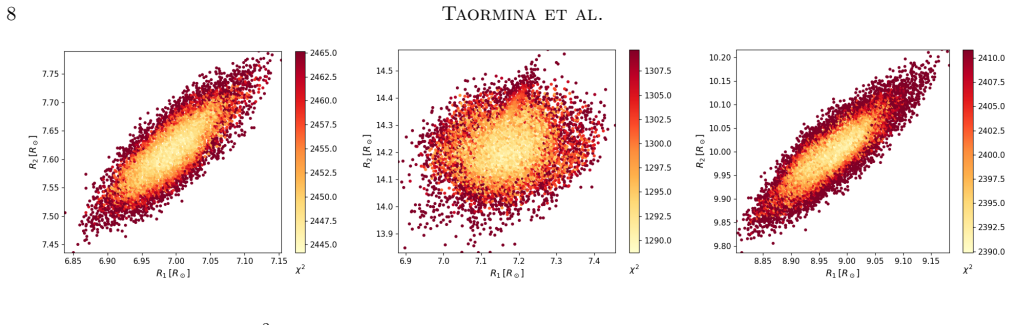
- [§3.1, Table 3] The quoted uncertainties on log L are incompatible with the adopted effective-temperature uncertainties. If log L is computed from the Stefan-Boltzmann relation, log L = 2 log R + 4 log T + const., the temperature term alone contributes d(log L) = 4 (σ_T/T)/ln 10. For BLMC-04 primary (T = 27800 ± 1500 K) this term is ≈ 0.094 dex; for the secondary ≈ 0.093 dex; yet Table 3 quotes ±0.004 for both. For BLMC-05 primary the term is ≈ 0.024 dex versus the quoted ±0.010, and for BLMC-06 primary ≈ 0.037 dex versus ±0.004. The quoted values appear to propagate only the radius errors. Since the luminosities are used in §4.3 to derive the new mass-luminosity relation and in Figures 10 and 11 to conclude that the components are evolutionarily advanced, the M-L fit parameters (log L/Lsun = 3.18 ± 0.12 log M/Msun + 0.86 ± 0.14) and the statements about evolutionary advancement are not supported at the stated precision. Please recompute the luminosity uncertainties with full propagation of the adopted Teff errors (and justify the Teff uncertainties themselves), or provide an independent distance-based luminosity derivation, and update Table 3, Figure 10, and all derived claims accordingly.
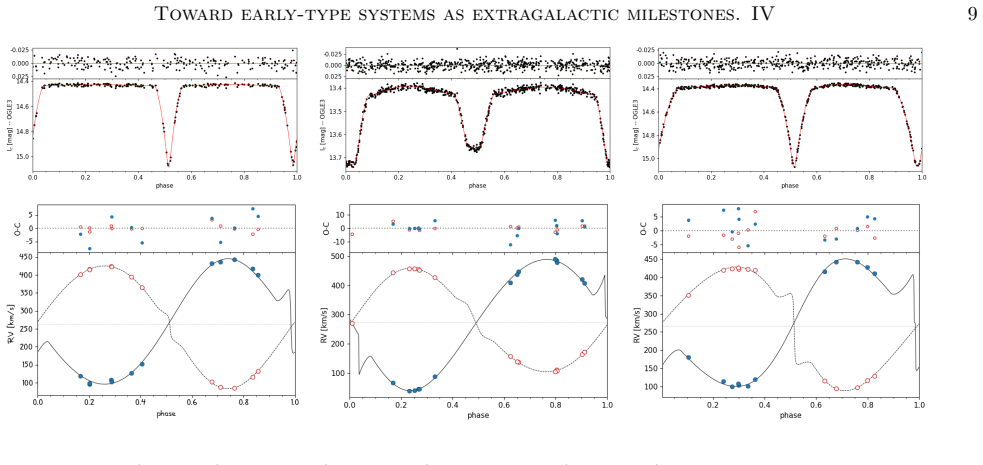
- [§3.2] The correction for the third body in BLMC-04 is not sufficiently documented. The paper states that including the 520-day LTTE orbit reduces the radial-velocity scatter from 12.4 to 3.9 km s^-1, but it does not provide the parameters of this orbit (period, eccentricity, semi-amplitude, or their uncertainties) and does not clarify whether these parameters were fitted simultaneously with the binary model or held fixed from the O-C fit. Because this correction directly affects the derived masses and radii of BLMC-04, the quoted mass and radius uncertainties in Table 3 should include the additional model component. Please provide the third-body orbital parameters and uncertainties, a description of the joint fitting procedure, and residual plots before and after the correction so that the reader can assess the robustness of the corrected solution.
- [§3.4, Table 4] The period decrease for BLMC-06 is a headline claim in the abstract ('a significant non-linear period decrease was determined'), but no uncertainty or significance test is reported. Table 4 lists 'Pdot -5.0e-9' without units or an error bar, and the text does not state how Pdot was fitted (globally over all photometric epochs or in segments) or whether the χ² improvement from 500 to 453 for the OGLE-III light curve is statistically significant given the number of additional parameters. Please provide the fitted Pdot with its uncertainty, a formal comparison against a constant-period model (e.g., Δχ² and degrees of freedom), and a discussion of possible degeneracies with apsidal motion and third light.
minor comments (4)
- [§5] The comparison with Ribas et al. (2000) states both that the previous values are 'in agreement with our results within their error bars' and that 'using our error bars, their best values lie from 1.2 to 5σ away, partly inconsistent with our solution.' These statements are not contradictory, but the wording should be rephrased to make clear that the old values agree with the new values only within the old, larger error bars, not within the new, smaller ones.
- [Table 4] The units for Pdot should be specified explicitly (e.g., d d^-1) and uncertainties should be provided for all reported values, including Pdot and the apsidal-motion periods where they are not already given in parentheses.
- [§3.1] The text should clarify more prominently that the effective temperatures for BLMC-04 and BLMC-06 are adopted from external calibrations (Worthey & Lee 2011 and Guinan et al. 1998a, respectively) and are not derived from the data analyzed in this work; this distinction is important for the interpretation of the luminosity uncertainties.
- [§4.3] The statement that 'the error bars are smaller than the point size for our DEB components with such an analysis' is only plausible if the external temperature uncertainties are ignored; after the luminosity error propagation is corrected, this sentence and the corresponding error bars in Figure 10 need to be updated.
Circularity Check
No significant circularity; parameters are derived from independent light-curve and RV fits with externally anchored temperatures.
full rationale
The paper's derivation chain is self-contained in the sense relevant to circularity: masses and radii come from simultaneous fits to independent light curves and radial velocities (Section 3.1), not from the quantities those fits are later compared with. The only externally imposed inputs are the absolute effective temperatures for the B-type systems — 28000 ± 1500 K for BLMC-04 from Worthey & Lee (2011) color-temperature calibrations and 23000 ± 500 K for BLMC-06 adopted from Guinan et al. (1998a) — and these are transparently stated as inputs, with the paper explicitly noting that the light-curve model fits only the temperature ratio. The non-LTE temperature determination for BLMC-05 is an independent spectroscopic analysis using FASTWIND, and the consistency check between the observed and model V-band flux ratio (3.18 vs 3.23) is an external validation, not a circular reuse. The BLMC-06 period-change term is a fitted model parameter; reporting it as a detection is parameter estimation, not a prediction of a separate quantity, and the paper documents the chi-square improvement. The apsidal-motion comparison uses the Claret (2019) theoretical internal-structure constants as external benchmarks, and the mass-luminosity relation is an empirical fit to new and previously published DEB measurements compared with independent MIST tracks. Self-citations to Papers I-III are methodological and not load-bearing. The quoted luminosity uncertainties in Table 3 appear incompatible with naive propagation of the adopted temperature errors, but that is an error-propagation and robustness concern, not circularity of the claimed derivation.
Assumptions & free parameters
free parameters (9)
- Orbital period P (BLMC-04, BLMC-05, BLMC-06) =
6.2290957(4), 5.9468115(22), 5.7259370(4) days
- Eccentricity e and argument of periastron omega =
e = 0.0554(6), 0.0635(11), 0.1338(5); omega = 5.715(16), 2.338(16), 5.0948(19) rad
- Orbital inclination i =
89.88(10) deg, 87.7(6) deg, 89.16(15) deg
- Apsidal motion rate dw/dt =
0.0000576(15), 0.000123(6), 0.0001234(6) rad/day
- Period change Pdot (BLMC-06) =
-5.0e-9 (no uncertainty given)
- Effective temperatures (primaries and secondaries) =
BLMC-04: 27800 +/- 1500, 28000 +/- 1500 K; BLMC-05: 36000 +/- 500, 31500 +/- 500 K; BLMC-06: 23500 +/- 500, 23000 +/…
- Third light contribution in V band =
0.04 mag (BLMC-04), 0.06 mag (BLMC-05)
- LTTE period of third body in BLMC-04 =
P_out approximately 520 days
- Mass-luminosity relation slope and intercept =
slope = 3.18 +/- 0.12, intercept = 0.86 +/- 0.14 in log L/Lsun vs log M/Msun
assumptions (6)
- standard math Keplerian orbits and the Roche or ellipsoidal geometry implemented in PHOEBE describe the binary light and RV curves.
- domain assumption The rotation axis of each component is aligned with the orbital axis.
- domain assumption Color-temperature calibrations of Worthey & Lee (2011) and the temperature adopted from Guinan et al. (1998a) set the absolute temperature scale of the B-type systems at LMC metallicity.
- ad hoc to paper The period change of BLMC-06 can be approximated by a constant Pdot over the observed interval.
- domain assumption The theoretical internal structure constants from Claret (2019) tracks, interpolated to Z = 0.008, are applicable to these stars.
- domain assumption The third body in BLMC-04 has a stable Keplerian orbit with P_out around 520 days over the data span.
invented entities (3)
-
Third body in BLMC-04
-
Tentative fourth body in BLMC-04
-
Possible faint low-mass companion in BLMC-06
Cite this review
Pith. "Pith review of Toward early-type eclipsing binaries as extragalactic milestones: IV. Physical properties of three detached O/B-type systems in the LMC." pith.science (2026). https://pith.science/paper/6I4TVQ3M
@misc{pith2026250104080,
  author       = {Pith},
  title        = {Pith review of: Toward early-type eclipsing binaries as extragalactic milestones: IV. Physical properties of three detached O/B-type systems in the LMC},
  year         = {2026},
  howpublished = {\url{https://pith.science/paper/6I4TVQ3M}},
  note         = {Machine review of arXiv:2501.04080}
}
abstract
We present a complete set of physical parameters for three early-type eclipsing binary systems in the Large Magellanic Cloud (LMC): OGLE LMC-ECL-17660, OGLE LMC-ECL-18794, and HV 2274, together with the orbital solutions. The first and third systems comprise B-type stars, while the second has O-type components and exhibits a total eclipse. We performed a complex analysis that included modeling light and radial velocity curves, O-C analysis, and additional non-LTE spectroscopic analysis for the O-type system. We found that OGLE LMC-ECL-17660 is at least a triple and, tentatively, a quadruple. A significant non-linear period decrease was determined for HV 2274. Its origin is unclear, possibly due to a faint, low-mass companion on a wide orbit. The analyzed components have masses ranging from 11.7 M$_\odot$ to 22.1 M$_\odot$, radii from 7.0 R$_\odot$ to 14.2 R$_\odot$, and temperatures between 22500 K and 36000 K. For HV 2274, the precision of our masses and radii is about six times higher than in previous studies. The position of the components of all six systems analyzed in this series on the mass-luminosity and mass-radius diagrams indicates they are evolutionarily advanced on the main sequence. Our sample contributes significantly to the knowledge of physical parameters of early-type stars in the mass range of 11 M$_\odot$ to 23 M$_\odot$. A new mass-luminosity relation for O and B-type stars in the LMC is provided. Additionally, we used the measured apsidal motion of the systems to compare the observational and theoretical internal structure constant.
Figures


Figures from the paper (7 more)




Reference graph
Works this paper leans on
-
[1]
, " * write output.state after.block = add.period write newline
ENTRY address archivePrefix author booktitle chapter doi edition editor eprint howpublished institution journal key month number organization pages publisher school series title misctitle type volume year version url label extra.label sort.label short.list INTEGERS output.state before.all mid.sentence after.sentence after.block FUNCTION init.state.consts ...
-
[2]
write newline
" write newline "" before.all 'output.state := FUNCTION format.url url empty "" new.block "" url * "" * if FUNCTION format.eprint eprint empty "" archivePrefix empty "" archivePrefix "arXiv" = new.block " " eprint * " " * new.block " " eprint * " " * if if if FUNCTION format.doi doi empty "" " " doi * " " * if FUNCTION format.pid doi empty eprint empty ur...
-
[3]
37o|" .] x-SL ]v 9r9 !ܑHHHV/ Z ۷L29N h/UT Jʕ+ 3f 666 |!XQ ! B 3 ! B 3 ! EJGl P !( I̵k4 ! B7ID\\ 燧'qqq:L ! E '! Dtt4/_V?a4 @=@xxx¨]v B
thebibliography [1] 20pt to REFERENCES 6pt =0pt -12pt 10pt plus 3pt =0pt =0pt =1pt plus 1pt =0pt =0pt -12pt =13pt plus 1pt =20pt =13pt plus 1pt \@M =10000 =-1.0em =0pt =0pt 0pt =0pt =1.0em @enumiv\@empty 10000 10000 `\.\@m \@noitemerr \@latex@warning Empty `thebibliography' environment \@ifnextchar \@reference \@latexerr Missing key on reference command E...
2021
-
[4]
Alcock , C., Allsman , R. A., Alves , D., et al. 1997, , 114, 326, 10.1086/118477
-
[5]
1991, , 3, 91, 10.1007/BF00873538
Andersen , J. 1991, , 3, 91, 10.1007/BF00873538
-
[6]
Bernstein , R., Shectman , S. A., Gunnels , S. M., Mochnacki , S., & Athey , A. E. 2003, in , Vol. 4841, Instrument Design and Performance for Optical/Infrared Ground-based Telescopes, ed. M. Iye & A. F. M. Moorwood , 1694--1704, 10.1117/12.461502
-
[7]
2016, , 823, 102, 10.3847/0004-637X/823/2/102
Choi , J., Dotter , A., Conroy , C., et al. 2016, , 823, 102, 10.3847/0004-637X/823/2/102
-
[8]
L., Clementini , G., Girardi , L., et al
Cioni , M.-R. L., Clementini , G., Girardi , L., et al. 2011, , 527, A116, 10.1051/0004-6361/201016137
Show all 51 references
-
[9]
2019, , 628, A29, 10.1051/0004-6361/201936007
Claret , A. 2019, , 628, A29, 10.1051/0004-6361/201936007
2019 doi
-
[10]
2000, in , Vol
Dekker , H., D'Odorico , S., Kaufer , A., Delabre , B., & Kotzlowski , H. 2000, in , Vol. 4008, Optical and IR Telescope Instrumentation and Detectors, ed. M. Iye & A. F. Moorwood , 534--545, 10.1117/12.395512
2000 doi
-
[11]
2016, , 222, 8, 10.3847/0067-0049/222/1/8
Dotter , A. 2016, , 222, 8, 10.3847/0067-0049/222/1/8
2016 doi
-
[12]
J., van Loon , J
Evans , C. J., van Loon , J. T., Hainich , R., & Bailey , M. 2015, , 584, A5, 10.1051/0004-6361/201525882
2015 doi
-
[13]
L., Ribas , I., Guinan , E
Fitzpatrick , E. L., Ribas , I., Guinan , E. F., et al. 2002, , 564, 260, 10.1086/324184
2002 doi
-
[14]
M., et al
Freudling , W., Romaniello , M., Bramich , D. M., et al. 2013, , 559, A96, 10.1051/0004-6361/201322494
2013 doi
-
[15]
Gaia Collaboration , Vallenari , A., Brown , A. G. A., et al. 2023, , 674, A1, 10.1051/0004-6361/202243940
2023 doi
-
[16]
Gaposhkin , S. I. 1977, SAO Special Report, 380
1977
- [17]
-
[18]
F., Ostrov , P., Morrell , N., & Minniti , D
Gonz \'a lez , J. F., Ostrov , P., Morrell , N., & Minniti , D. 2005, , 624, 946, 10.1086/428920
2005 doi
-
[19]
2011, , 61, 103
Graczyk , D., Soszy \'n ski , I., Poleski , R., et al. 2011, , 61, 103. 1108.0446
2011 arXiv
-
[20]
Groenewegen , M. A. T., & Salaris , M. 2001, , 366, 752, 10.1051/0004-6361:20010014
2001 doi
-
[21]
F., Ribas , I., Fitzpatrick , E
Guinan , E. F., Ribas , I., Fitzpatrick , E. L., & Pritchard , J. D. 1998 a , in ESA Special Publication, Vol. 413, Ultraviolet Astrophysics Beyond the IUE Final Archive, ed. W. Wamsteker , R. Gonzalez Riestra , & B. Harris , 315
1998
-
[22]
F., Fitzpatrick , E
Guinan , E. F., Fitzpatrick , E. L., DeWarf , L. E., et al. 1998 b , , 509, L21, 10.1086/311760
1998 doi
-
[23]
2017, , 597, A137, 10.1051/0004-6361/201629505
Kervella , P., Bigot , L., Gallenne , A., & Th \'e venin , F. 2017, , 597, A137, 10.1051/0004-6361/201629505
2017 doi
-
[24]
1978, Dynamics of close binary systems , 10.1007/978-94-009-9780-6
Kopal , Z. 1978, Dynamics of close binary systems , 10.1007/978-94-009-9780-6
1978 doi
-
[25]
I., Neugent , K
Massey , P., Morrell , N. I., Neugent , K. F., et al. 2012, , 748, 96, 10.1088/0004-637X/748/2/96
2012 doi
-
[26]
R., & Vukovich , J
Massey , P., Penny , L. R., & Vukovich , J. 2002, , 565, 982, 10.1086/324783
2002 doi
-
[27]
G., & Lidman , C
Moorwood , A., Cuby , J. G., & Lidman , C. 1998, The Messenger, 91, 9
1998
-
[28]
A., Cook , K
Nelson , C. A., Cook , K. H., Popowski , P., & Alves , D. R. 2000, , 119, 1205, 10.1086/301268
2000 doi
-
[29]
2016, , 457, 4323, 10.1093/mnras/stw269
Pawlak , M. 2016, , 457, 4323, 10.1093/mnras/stw269
2016 doi
-
[30]
I., et al
Pilecki , B., Pietrzy \'n ski , G., Anderson , R. I., et al. 2021, , 910, 118, 10.3847/1538-4357/abe7e9
2021 doi
-
[31]
2017, , 842, 110, 10.3847/1538-4357/aa6ff7
Pilecki , B., Gieren , W., Smolec , R., et al. 2017, , 842, 110, 10.3847/1538-4357/aa6ff7
2017 doi
-
[32]
2005, , 628, 426, 10.1086/430591
Pr s a , A., & Zwitter , T. 2005, , 628, 426, 10.1086/430591
2005 doi
-
[33]
2016, , 152, 41, 10.3847/0004-6256/152/2/41
Pr s a , A., Harmanec , P., Torres , G., et al. 2016, , 152, 41, 10.3847/0004-6256/152/2/41
2016 doi
-
[34]
A., Venero , R., et al
Puls , J., Urbaneja , M. A., Venero , R., et al. 2005, , 435, 669, 10.1051/0004-6361:20042365
2005 doi
-
[35]
L., Maloney , F
Ribas , I., Fitzpatrick , E. L., Maloney , F. P., Guinan , E. F., & Udalski , A. 2002, , 574, 771, 10.1086/341003
2002 doi
-
[36]
F., Fitzpatrick , E
Ribas , I., Guinan , E. F., Fitzpatrick , E. L., et al. 2000, , 528, 692, 10.1086/308210
2000 doi
-
[37]
G., Puls , J., Najarro , F., & Brott , I
Rivero Gonz \'a lez , J. G., Puls , J., Najarro , F., & Brott , I. 2012, , 537, A79, 10.1051/0004-6361/201117790
2012 doi
-
[38]
1999, in Astronomical Society of the Pacific Conference Series, Vol
Rucinski , S. 1999, in Astronomical Society of the Pacific Conference Series, Vol. 185, IAU Colloq. 170: Precise Stellar Radial Velocities, ed. J. B. Hearnshaw & C. D. Scarfe , 82
1999
-
[39]
Rucinski , S. M. 1992, , 104, 1968, 10.1086/116372
1992 doi
- [40]
-
[41]
2020, , 890, 137, 10.3847/1538-4357/ab6bd0
Taormina , M., Kudritzki , R.-P., Puls , J., et al. 2020, , 890, 137, 10.3847/1538-4357/ab6bd0
2020 doi
-
[42]
2019, , 886, 111, 10.3847/1538-4357/ab4b57
Taormina , M., Pietrzy \'n ski , G., Pilecki , B., et al. 2019, , 886, 111, 10.3847/1538-4357/ab4b57
2019 doi
-
[43]
P., Pilecki , B., et al
Taormina , M., Kudritzki , R. P., Pilecki , B., et al. 2024, , 967, 64, 10.3847/1538-4357/ad3af0
2024 doi
-
[44]
2007, , 469, 387, 10.1051/0004-6361:20066017
Tisserand , P., Le Guillou , L., Afonso , C., et al. 2007, , 469, 387, 10.1051/0004-6361:20066017
2007 doi
-
[45]
2010, , 18, 67, 10.1007/s00159-009-0025-1
Torres , G., Andersen , J., & Gim \'e nez , A. 2010, , 18, 67, 10.1007/s00159-009-0025-1
2010 doi
- [46]
-
[47]
1998, , 509, L25, 10.1086/311763
Udalski , A., Pietrzy \'n ski , G., Wo \'z niak , P., et al. 1998, , 509, L25, 10.1086/311763
1998 doi
-
[48]
K., et al
Udalski , A., Soszy \'n ski , I., Szyma \'n ski , M. K., et al. 2015, , 65, 341
2015
-
[49]
D., West , S
Watson , R. D., West , S. R. D., Tobin , W., & Gilmore , A. C. 1992, , 258, 527, 10.1093/mnras/258.3.527
1992 doi
-
[50]
2011, , 193, 1, 10.1088/0067-0049/193/1/1
Worthey , G., & Lee , H.-c. 2011, , 193, 1, 10.1088/0067-0049/193/1/1
2011 doi
-
[51]
2013, , 558, A51, 10.1051/0004-6361/201322054
Zasche , P., & Wolf , M. 2013, , 558, A51, 10.1051/0004-6361/201322054
2013 doi
Reviewed August 10, 2026 · model on record in the stance chip above.
Discussion (0). Continue with ORCID to comment.