REVIEW 5 major objections 6 minor 47 references
A Tunable Despeckling Neural Network Stabilized via Diffusion Equation
T0 review · 5 major / 6 minor · reviewed 2026-08-12 · deepseek-v4-flash
Pith's one-line read Unrolling a shallow denoiser with an implicit heat-equation step yields a SAR despeckling network that is provably convergent, stable, and resistant to adversarial attacks via a single tunable time step.
desk verdict A simple, plausible SAR-despeckling architecture with a tunable heat-equation block, but the convergence proof is not valid as written and the empirical case needs tighter reporting. read the letter →
The pith
A machine-rendered reading of the paper's core claim, the machinery that carries it, and where it could break.
The reading
What carries the argument
The central mechanism is the diffusion regularity block: the implicit heat-equation step $u_{k+1}=z_{k+1}+\tau\Delta u_{k+1}$, solved in the Fourier domain by multiplying by $1/(1-2\tau(\cos z_i+\cos z_j-2))$, so it acts as a fixed low-pass filter with a single tunable time step $\tau$. Unrolled $K$ times with a five-layer DnCNN block, the recursion accumulates regularization and yields the contraction proof: the resolvent norm $\|(I-\tau\Delta)^{-1}\|<1$ combined with the non-expansive denoiser gives a global contraction. This combines the fitting power of the neural block with the dissipative, noise-distribution-agnostic smoothing of the heat equation.
What would settle it
Compute the Lipschitz constant (maximum singular value of the Jacobian) of the trained $D_\Theta$ on the test set, or measure the contraction ratio $\|u_{k+1}-v_{k+1}\|/\|u_k-v_k\|$ for two nearby inputs through the full unrolled network; if the ratio exceeds 1 for any pair, the claimed global contraction—and the stability guarantee derived from it—fails as stated. Alternatively, run a white-box PGD attack directly against the proposed model and check whether high-frequency oscillations reappear.
Extended reading notes
Core claim
On its own terms, the paper's discovery is that a linear heat equation, discretized implicitly and interleaved with a shallow DnCNN denoiser in a fixed-point recursion, acts as a regularity block that stabilizes the whole network. The update reads $z_{k+1}=D_\Theta(u_k)$, $u_{k+1}=z_{k+1}+\tau\Delta u_{k+1}$, so the diffusion step is the resolvent $(I-\tau\Delta)^{-1}$ applied to the denoiser output; the paper proves the sequence converges and the scheme is stable provided $D_\Theta$ is non-expansive. The same recursion lets a single parameter $\tau$ control output smoothness after training, and the authors show that increasing $\tau$ removes attack-induced oscillations while decreasing it preserves detail. Empirically, the model attains the best PSNR/SSIM on simulated data among the compared methods and visually removes oscillations on adversarial samples and real SAR images.
Load-bearing premise
The convergence and stability proof assumes the trained denoising network is non-expansive, yet the paper does not check that its five-layer DnCNN satisfies this, and the periodic-boundary implementation used in practice has a constant mode that makes the resolvent's contraction factor equal to 1 rather than strictly less.
Editorial extensions
If this is right
- If the claim holds, learned SAR despecklers can gain adversarial robustness by inserting a classical diffusion prior rather than by adversarial training, cutting training cost and avoiding the need for attack samples.
- The single time-step hyperparameter becomes a post-training control knob: operators can trade noise removal against detail preservation on real images without retraining.
- The same unrolling pattern may transfer to other image restoration tasks where high-frequency artifacts are induced by distribution shift or attack.
- The theoretical convergence guarantee, when the non-expansiveness premise is met, provides a certificate that the recursion's output does not depend sensitively on initialization or attack direction.
- The model's performance gain over end-to-end CNNs suggests that hybrid model-driven/data-driven unrolling is a viable route to robust remote-sensing processing.
Reading between the lines
- The paper's contraction argument relies on a strict contraction factor for the resolvent, which holds for Dirichlet but not periodic boundary conditions; a natural extension would be to verify whether the trained network's Jacobian norm stays below $1/\varepsilon$ on the data manifold, which would close the gap between the theorem and the implemented FFT solver.
- Because the diffusion block is linear and fixed, its low-pass action is equivalent to a fixed convolutional layer; one could test whether learning that kernel (or making it anisotropic) preserves the robustness gain while improving detail retention.
- The adversarial-robustness benefit may extend beyond denoising: the same dissipative block inserted after any feature extractor could damp oscillation-type adversarial perturbations in classification or detection, though the paper only demonstrates despeckling.
- The experiments measure robustness via denoising-PGD transfer attacks from a specific 10-layer SAR-CNN; stronger attacks tailored to the proposed network itself might reveal the limits of the diffusive defense.
Editorial analysis
A structured set of objections, weighed in public.
Referee Report
Summary. The paper proposes a SAR despeckling network obtained by unrolling a shallow five-layer DnCNN block and an implicit heat-equation block. The heat-equation block is solved by FFT under periodic boundary conditions, and a single time-step parameter τ can be changed after training to control output smoothness. The authors claim that the stability and convergence of the model are theoretically proven, that the diffusion block suppresses high-frequency oscillations caused by adversarial attacks, and that the method outperforms several state-of-the-art despeckling methods on simulated images, adversarial samples, and real SAR images.
Significance. If the theoretical guarantee were valid and the robustness benefit were rigorously demonstrated, the proposal would be a useful and interpretable unrolled architecture: it avoids adversarial training, needs only one tunable post-training parameter, and uses a simple FFT-based implicit diffusion block. The empirical core on simulated and real SAR images is plausible and includes comparisons with several relevant baselines. However, the paper's central theoretical claim is not established as written, and the adversarial-robustness evidence is weaker than the abstract suggests. The main value of the paper at present is the empirical framework and the tunable τ mechanism, not the claimed convergence theorem.
major comments (5)
- [III-D, Theorem 2] The theorem assumes that the denoising block DΘ is nonexpansive, but the block described in Section III-C is a five-layer DnCNN with ReLU activations, batch normalization, and residual connections, and no Lipschitz constraint is enforced or verified on the trained network. Without evidence that ∥DΘ(u1)−DΘ(u2)∥ ≤ ∥u1−u2∥ for the actually trained block, the contraction argument does not apply to the implemented model. The authors should either enforce nonexpansiveness (for example by spectral normalization or contractive activations) or verify it empirically and state the theorem conditionally on that verification.
- [III-D and III-E] The proof of Theorem 2 uses the bound ∥(I−τΔ)^{-1}∥ ≤ ε < 1, justified by claiming that −Δ is positive definite. However, the numerical scheme in Section III-E imposes periodic boundary conditions, under which the discrete Laplacian has a zero mode. In Eq. (10), the zero frequency (ξ_i = ξ_j = 0) gives denominator 1, so the resolvent has eigenvalue 1 and norm 1, not a value strictly below 1. With the implemented periodic scheme, the composition DΘ followed by the resolvent is at best nonexpansive, not a strict contraction, so the claimed global convergence does not follow from the stated argument. The theorem and the numerical scheme must be made consistent, for example by using Dirichlet boundary conditions matched to the discrete scheme, or by proving convergence under nonexpansiveness plus an additional compactness or asymptotic regularity argument.
- [III-D, Eq. (8)] Equation (8) contains a typographical error: the right-hand side reads DΘ(u_k) − DΘ(u_k), which is identically zero; it should be DΘ(u_k) − DΘ(v_k). This is a local error, but it obscures the proof and should be corrected in revision.
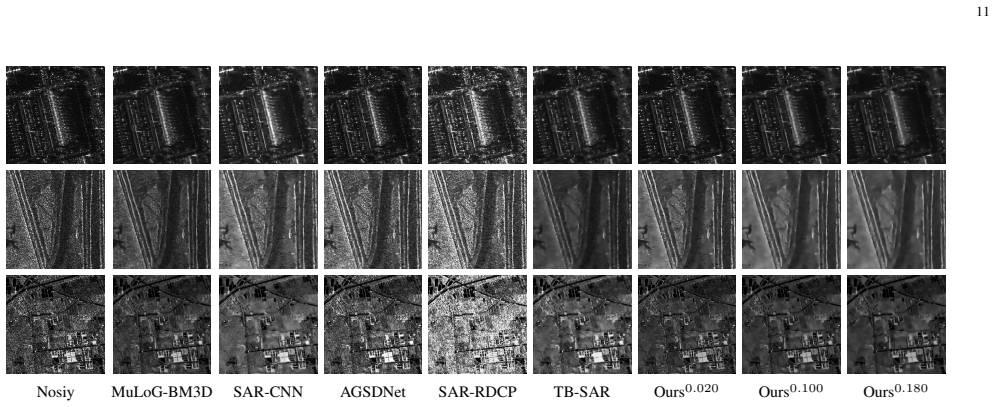
- [IV-D, Table II] The adversarial experiments do not yet substantiate the claim that the model 'effectively eliminates high-frequency oscillations induced by adversarial attacks'. Table II reports only PSNR on Set12, with a margin of 0.04 dB over the second-best method, and no SSIM, no perturbation budget, no error bars, and no attack targeted at the proposed model (the adversarial samples are transferred from a 10-layer SAR-CNN). The authors should report robustness under attacks generated against their own model, across several perturbation strengths, and with statistical significance measures.
- [IV-D, text] The sentence 'From quantitative index, our model is better than ours, but not too much' appears to be a typo and is confusing; it presumably should say 'better than the other methods' or similar. This is a presentation issue, but it matters because the quantitative advantage in Table II is small and needs a precise, non-contradictory description.
minor comments (6)
- [Algorithm 1] The denominator in Algorithm 1 uses cos(2π/N1 x_i) + cos(2π/N1 y_j), whereas Eq. (10) and the definitions of z_i and z_j use cos(2π/N1 x_i) + cos(2π/N2 y_j); for non-square images these differ, so the algorithm should be corrected to match the formula.
- [III-E and Table III] The text uses 'RPD-ROA' while Table III and the surrounding discussion use 'EPD-ROA'; the notation should be made consistent.
- [IV-B] The evaluation of real SAR images uses ENL, C_x, and EPD-ROA, but the paper does not specify how the homogeneous regions used to compute these metrics are selected; this should be stated for reproducibility.
- [IV-A] The test-set description says 12 and 14 images were picked randomly from FloodNet and RESISC45, but the dataset names in Table I list 'FloodNet' and 'NWPU'; 'NWPU' should be defined as RESISC45 or the table label should be changed.
- [II-B, Figure 2] Figure 2 is referenced as showing the low-pass property of the heat equation, but the caption does not define the color or line conventions; adding a short caption description would improve readability.
- [IV-C] The claim that the model provides 'superior detail preservation' is supported mainly by average PSNR/SSIM values; reporting standard deviations across the 10 noise realizations per image would strengthen the comparison.
Circularity Check
No significant circularity: the framework and benchmarks are self-contained; the theoretical proof gap in Theorem 2 is a correctness issue, not a circular derivation.
full rationale
I walked the claimed derivation chain: the proposed model unrolls a shallow DnCNN block and an implicit heat-equation block with a tunable time step tau, trained end-to-end against simulated Gamma-noise data and evaluated on external benchmarks. No fitted parameter is renamed as a prediction: tau is a post-training dial, and the comparison methods are independent baselines. The self-citation to prior work [36] is motivational rather than load-bearing for the stability claim. The main theoretical statement, Theorem 2, assumes that DTheta is nonexpansive and asserts that ||(I - tau Delta)^{-1}|| < 1 because -Delta is positive definite; Section III-E then implements periodic boundary conditions, whose zero-frequency mode makes the resolvent eigenvalue exactly 1, and the trained five-layer DnCNN is not verified to be nonexpansive. This is a genuine gap in the proof as written, and it undercuts the abstract's unconditional claim that 'the stability and convergence of our model are theoretically proven.' However, this is not circularity: the nonexpansiveness hypothesis is an unverified stability-type assumption, not the theorem's conclusion, and the resolvent-norm issue is a mathematical error rather than the target result being presupposed by construction. The empirical robustness results remain independently testable. Thus, no self-definitional reduction, fitted-input prediction, or load-bearing self-citation chain is present; the appropriate finding is no significant circularity.
Assumptions & free parameters
free parameters (2)
- tau (diffusion time step) =
0.1 during training; 0.02 to 0.18 at inference in experiments
- K (unrolling depth) =
5
assumptions (6)
- domain assumption SAR observation model f = u*eta with Gamma noise of mean 1 and L looks (Eq. 1)
- standard math Heat equation solution is a convolution with the fundamental solution and is infinitely smooth; low-pass property attenuates high frequencies (Theorem 1, Eq. 2)
- ad hoc to paper The denoiser block DTheta is non-expansive (Theorem 2 assumption)
- ad hoc to paper ||(I-tau Delta)^{-1}|| <= epsilon < 1 for the discrete operator (Theorem 2 proof)
- domain assumption Adversarial samples generated by denoising-PGD are a valid proxy for real-world distribution shift (Section II-A and IV-D)
- domain assumption Logarithmic transformation converts multiplicative Gamma noise into additive noise with known nonzero mean c (Section III-C)
Cite this review
Pith. "Pith review of A Tunable Despeckling Neural Network Stabilized via Diffusion Equation." pith.science (2026). https://pith.science/paper/6JFUSNFZ
@misc{pith2026241115921,
  author       = {Pith},
  title        = {Pith review of: A Tunable Despeckling Neural Network Stabilized via Diffusion Equation},
  year         = {2026},
  howpublished = {\url{https://pith.science/paper/6JFUSNFZ}},
  note         = {Machine review of arXiv:2411.15921}
}
read the original abstract
The removal of multiplicative Gamma noise is a critical research area in the application of synthetic aperture radar (SAR) imaging, where neural networks serve as a potent tool. However, real-world data often diverges from theoretical models, exhibiting various disturbances, which makes the neural network less effective. Adversarial attacks can be used as a criterion for judging the adaptability of neural networks to real data, since adversarial attacks can find the most extreme perturbations that make neural networks ineffective. In this work, the diffusion equation is designed as a regularization block to provide sufficient regularity to the whole neural network, due to its spontaneous dissipative nature. We propose a tunable, regularized neural network framework that unrolls a shallow denoising neural network block and a diffusion regularity block into a single network for end-to-end training. The linear heat equation, known for its inherent smoothness and low-pass filtering properties, is adopted as the diffusion regularization block. In our model, a single time step hyperparameter governs the smoothness of the outputs and can be adjusted dynamically, significantly enhancing flexibility. The stability and convergence of our model are theoretically proven. Experimental results demonstrate that the proposed model effectively eliminates high-frequency oscillations induced by adversarial attacks. Finally, the proposed model is benchmarked against several state-of-the-art denoising methods on simulated images, adversarial samples, and real SAR images, achieving superior performance in both quantitative and visual evaluations.
Figures


Figures from the paper (7 more)


Reference graph
Works this paper leans on
-
[1]
Interferometric synthetic aperture radar (sar) missions employing formation flying,
G. Krieger, I. Hajnsek, K. P. Papathanassiou, M. Younis, and A. Mor- eira, “Interferometric synthetic aperture radar (sar) missions employing formation flying,” Proceedings of the IEEE, vol. 98, no. 5, pp. 816–843, 2010
work page 2010
-
[2]
Learning a dilated residual network for sar image despeckling,
Q. Zhang, Q. Yuan, J. Li, Z. Yang, and X. Ma, “Learning a dilated residual network for sar image despeckling,” Remote Sensing , vol. 10, no. 2, p. 196, 2018
work page 2018
-
[3]
Polarimetric-spatial classification of sar images based on the fusion of multiple classifiers,
X. Ma, H. Shen, J. Yang, L. Zhang, and P. Li, “Polarimetric-spatial classification of sar images based on the fusion of multiple classifiers,” IEEE Journal of Selected Topics in Applied Earth Observations and Remote Sensing, vol. 7, no. 3, pp. 961–971, 2013
work page 2013
-
[4]
Some fundamental properties of speckle,
J. W. Goodman, “Some fundamental properties of speckle,” JOSA, vol. 66, no. 11, pp. 1145–1150, 1976
1976
-
[5]
Digital image enhancement and noise filtering by use of local statistics,
J.-S. Lee, “Digital image enhancement and noise filtering by use of local statistics,” IEEE transactions on pattern analysis and machine intelligence, no. 2, pp. 165–168, 1980
work page 1980
-
[6]
Adaptive noise smoothing filter for images with signal-dependent noise,
D. T. Kuan, A. A. Sawchuk, T. C. Strand, and P. Chavel, “Adaptive noise smoothing filter for images with signal-dependent noise,” IEEE transactions on pattern analysis and machine intelligence , no. 2, pp. 165–177, 1985
work page 1985
-
[7]
A model for radar images and its application to adaptive digital filtering of multiplicative noise,
V . S. Frost, J. A. Stiles, K. S. Shanmugan, and J. C. Holtzman, “A model for radar images and its application to adaptive digital filtering of multiplicative noise,” IEEE Transactions on pattern analysis and machine intelligence, no. 2, pp. 157–166, 1982. 12
work page 1982
-
[8]
Maximum a posteriori speckle filtering and first order texture models in sar images,
A. Lopes, E. Nezry, R. Touzi, and H. Laur, “Maximum a posteriori speckle filtering and first order texture models in sar images,” in 10th annual international symposium on geoscience and remote sensing . Ieee, 1990, pp. 2409–2412
work page 1990
Show all 47 references
-
[9]
A variational approach to removing multi- plicative noise,
G. Aubert and J.-F. Aujol, “A variational approach to removing multi- plicative noise,” SIAM journal on applied mathematics , vol. 68, no. 4, pp. 925–946, 2008
2008
-
[10]
A nonlinear inverse scale space method for a convex multiplicative noise model,
J. Shi and S. Osher, “A nonlinear inverse scale space method for a convex multiplicative noise model,” SIAM Journal on imaging sciences , vol. 1, no. 3, pp. 294–321, 2008
2008
-
[11]
A convex adaptive total variation model based on the gray level indicator for multiplicative noise removal,
G. Dong, Z. Guo, B. Wu et al., “A convex adaptive total variation model based on the gray level indicator for multiplicative noise removal,” in Abstract and Applied Analysis , vol. 2013. Hindawi, 2013
2013
-
[12]
A dou- bly degenerate diffusion model based on the gray level indicator for multiplicative noise removal,
Z. Zhou, Z. Guo, G. Dong, J. Sun, D. Zhang, and B. Wu, “A dou- bly degenerate diffusion model based on the gray level indicator for multiplicative noise removal,” IEEE Transactions on Image Processing , vol. 24, no. 1, pp. 249–260, 2014
2014
-
[13]
Image denoising based on a variable spatially exponent pde,
A. Laghrib and L. Afraites, “Image denoising based on a variable spatially exponent pde,” Applied and Computational Harmonic Analysis, vol. 68, p. 101608, 2024
2024
-
[14]
Multiplicative noise removal for texture images based on adaptive anisotropic fractional diffusion equations,
W. Yao, Z. Guo, J. Sun, B. Wu, and H. Gao, “Multiplicative noise removal for texture images based on adaptive anisotropic fractional diffusion equations,” SIAM Journal on Imaging Sciences , vol. 12, no. 2, pp. 839–873, 2019
2019
-
[15]
Multiplicative noise removal based on the smooth diffusion equation,
X. Shan, J. Sun, and Z. Guo, “Multiplicative noise removal based on the smooth diffusion equation,” Journal of Mathematical Imaging and Vision, vol. 61, pp. 763–779, 2019
2019
-
[16]
Sar image despeckling through convolutional neural networks,
G. Chierchia, D. Cozzolino, G. Poggi, and L. Verdoliva, “Sar image despeckling through convolutional neural networks,” in 2017 IEEE international geoscience and remote sensing symposium (IGARSS) . IEEE, 2017, pp. 5438–5441
2017
-
[17]
Beyond a gaussian denoiser: Residual learning of deep cnn for image denoising,
K. Zhang, W. Zuo, Y . Chen, D. Meng, and L. Zhang, “Beyond a gaussian denoiser: Residual learning of deep cnn for image denoising,” IEEE transactions on image processing , vol. 26, no. 7, pp. 3142–3155, 2017
2017
-
[18]
Sar image despeckling using a convolutional neural network,
P. Wang, H. Zhang, and V . M. Patel, “Sar image despeckling using a convolutional neural network,” IEEE Signal Processing Letters , vol. 24, no. 12, pp. 1763–1767, 2017
2017
-
[19]
Sar image despeckling using plug-and-play admm,
S. Baraha and A. K. Sahoo, “Sar image despeckling using plug-and-play admm,” IET Radar, Sonar & Navigation, vol. 14, no. 9, pp. 1297–1309, 2020
2020
-
[20]
Robustness to spatially-correlated speckle in plug-and-play polsar despeckling,
C. U. Mendes, L. Denis, C. Deledalle, and F. Tupin, “Robustness to spatially-correlated speckle in plug-and-play polsar despeckling,” IEEE Transactions on Geoscience and Remote Sensing , 2024
2024
-
[21]
Plug-and-play priors enabled sar image inpainting in the presence of speckle noise,
S. Baraha and A. K. Sahoo, “Plug-and-play priors enabled sar image inpainting in the presence of speckle noise,” in 2020 IEEE 17th India Council International Conference (INDICON) . IEEE, 2020, pp. 1–6
2020
-
[22]
Coupling model-and data-driven methods for remote sensing image restoration and fusion: Improving physical interpretability,
H. Shen, M. Jiang, J. Li, C. Zhou, Q. Yuan, and L. Zhang, “Coupling model-and data-driven methods for remote sensing image restoration and fusion: Improving physical interpretability,” IEEE Geoscience and Remote Sensing Magazine , vol. 10, no. 2, pp. 231–249, 2022
2022
-
[23]
Sar image despeckling employing a recursive deep cnn prior,
H. Shen, C. Zhou, J. Li, and Q. Yuan, “Sar image despeckling employing a recursive deep cnn prior,” IEEE Transactions on Geoscience and Remote Sensing, vol. 59, no. 1, pp. 273–286, 2020
2020
-
[24]
Deep un- rolling network for sar image despeckling,
C. Chen, L. Chen, X. Jiang, X. Liu, and A. M. Zoubir, “Deep un- rolling network for sar image despeckling,” in ICASSP 2024-2024 IEEE International Conference on Acoustics, Speech and Signal Processing (ICASSP). IEEE, 2024, pp. 4085–4089
2024
-
[25]
A comprehen- sive study on the robustness of deep learning-based image classification and object detection in remote sensing: Surveying and benchmarking,
S. Mei, J. Lian, X. Wang, Y . Su, M. Ma, and L.-P. Chau, “A comprehen- sive study on the robustness of deep learning-based image classification and object detection in remote sensing: Surveying and benchmarking,” Journal of Remote Sensing , vol. 4, p. 0219, 2024
2024
-
[26]
Explaining and harnessing adversarial examples,
I. J. Goodfellow, J. Shlens, and C. Szegedy, “Explaining and harnessing adversarial examples,” arXiv preprint arXiv:1412.6572 , 2014
2014 arXiv
-
[27]
Adversarial examples in the physical world,
A. Kurakin, I. J. Goodfellow, and S. Bengio, “Adversarial examples in the physical world,” in Artificial intelligence safety and security . Chapman and Hall/CRC, 2018, pp. 99–112
2018
-
[28]
Evaluating similitude and robustness of deep image denoising models via adversarial attack,
J. Ning, J. Sun, Y . Li, Z. Guo, and W. Zuo, “Evaluating similitude and robustness of deep image denoising models via adversarial attack,” arXiv preprint arXiv:2306.16050, 2023
2023 arXiv
-
[29]
Towards adver- sarially robust deep image denoising,
H. Yan, J. Zhang, J. Feng, M. Sugiyama, and V . Y . Tan, “Towards adver- sarially robust deep image denoising,” arXiv preprint arXiv:2201.04397, 2022
2022 arXiv
-
[30]
Agsdnet: Attention and gradient-based sar denoising network,
R. K. Thakur and S. K. Maji, “Agsdnet: Attention and gradient-based sar denoising network,” IEEE Geoscience and Remote Sensing Letters , vol. 19, pp. 1–5, 2022
2022
-
[31]
Towards deep learning models resistant to adversarial attacks,
A. Madry, A. Makelov, L. Schmidt, D. Tsipras, and A. Vladu, “Towards deep learning models resistant to adversarial attacks,” stat, vol. 1050, no. 9, 2017
2017
-
[32]
Adversarial training for free!
A. Shafahi, M. Najibi, M. A. Ghiasi, Z. Xu, J. Dickerson, C. Studer, L. S. Davis, G. Taylor, and T. Goldstein, “Adversarial training for free!” Advances in neural information processing systems , vol. 32, 2019
2019
-
[33]
Lipschitz regularized deep neural networks converge and generalize,
A. M. Oberman and J. Calder, “Lipschitz regularized deep neural networks converge and generalize,” arXiv preprint arXiv:1808.09540 , 2018
2018 arXiv
-
[34]
Clip: Cheap lipschitz training of neural networks,
L. Bungert, R. Raab, T. Roith, L. Schwinn, and D. Tenbrinck, “Clip: Cheap lipschitz training of neural networks,” inInternational Conference on Scale Space and Variational Methods in Computer Vision. Springer, 2021, pp. 307–319
2021
-
[35]
Lipschitz regularity of deep neural networks: analysis and efficient estimation,
A. Virmaux and K. Scaman, “Lipschitz regularity of deep neural networks: analysis and efficient estimation,” Advances in Neural Infor- mation Processing Systems , vol. 31, 2018
2018
-
[36]
A diffusion equation for improving the robustness of deep learning speckle removal model,
L. Cheng, Y . Xing, Y . Li, and Z. Guo, “A diffusion equation for improving the robustness of deep learning speckle removal model,” Journal of Mathematical Imaging and Vision , pp. 1–21, 2024
2024
-
[37]
Intriguing properties of neural networks,
C. Szegedy, “Intriguing properties of neural networks,” arXiv preprint arXiv:1312.6199, 2013
2013 arXiv
-
[38]
L. C. Evans, Partial differential equations . American Mathematical Society, 2022, vol. 19
2022
-
[39]
Weickert et al., Anisotropic diffusion in image processing
J. Weickert et al., Anisotropic diffusion in image processing . Teubner Stuttgart, 1998, vol. 1
1998
-
[40]
A fast algorithm for euler’s elastica model using augmented lagrangian method,
X.-C. Tai, J. Hahn, and G. J. Chung, “A fast algorithm for euler’s elastica model using augmented lagrangian method,” SIAM Journal on Imaging Sciences, vol. 4, no. 1, pp. 313–344, 2011
2011
-
[41]
On single image scale-up using sparse-representations,
R. Zeyde, M. Elad, and M. Protter, “On single image scale-up using sparse-representations,” in Curves and Surfaces: 7th International Con- ference, Avignon, France, June 24-30, 2010, Revised Selected Papers 7 . Springer, 2012, pp. 711–730
2010
-
[42]
Color demosaicking by local directional interpolation and nonlocal adaptive thresholding,
L. Zhang, X. Wu, A. Buades, and X. Li, “Color demosaicking by local directional interpolation and nonlocal adaptive thresholding,” Journal of Electronic imaging, vol. 20, no. 2, pp. 023 016–023 016, 2011
2011
-
[43]
Floodnet: A high resolution aerial imagery dataset for post flood scene understanding,
M. Rahnemoonfar, T. Chowdhury, A. Sarkar, D. Varshney, M. Yari, and R. Murphy, “Floodnet: A high resolution aerial imagery dataset for post flood scene understanding,” arXiv preprint arXiv:2012.02951 , 2020
2012 arXiv
-
[44]
Remote sensing image scene classifi- cation: Benchmark and state of the art,
G. Cheng, J. Han, and X. Lu, “Remote sensing image scene classifi- cation: Benchmark and state of the art,” Proceedings of the IEEE , vol. 105, no. 10, pp. 1865–1883, 2017
2017
-
[45]
Batch normalization: Accelerating deep network training by reducing internal covariate shift,
S. Ioffe, “Batch normalization: Accelerating deep network training by reducing internal covariate shift,” arXiv preprint arXiv:1502.03167 , 2015
2015 arXiv
-
[46]
Mulog, or how to apply gaussian denoisers to multi-channel sar speckle reduction?
C.-A. Deledalle, L. Denis, S. Tabti, and F. Tupin, “Mulog, or how to apply gaussian denoisers to multi-channel sar speckle reduction?” IEEE Transactions on Image Processing, vol. 26, no. 9, pp. 4389–4403, 2017
2017
-
[47]
Transformer-based sar image despeckling,
M. V . Perera, W. G. C. Bandara, J. M. J. Valanarasu, and V . M. Patel, “Transformer-based sar image despeckling,” inIGARSS 2022-2022 IEEE International Geoscience and Remote Sensing Symposium. IEEE, 2022, pp. 751–754
2022
Reviewed August 12, 2026 · model on record in the stance chip above.
Discussion (0). Continue with ORCID to comment.