REVIEW 3 major objections 5 minor 1 cited by
FLAMES: Improving LLM Math Reasoning via a Fine-Grained Analysis of the Data Synthesis Pipeline
T0 review · 3 major / 5 minor · reviewed 2026-08-05 · deepseek-v4-flash
Pith's one-line read A 50-20-20-10 blend of four data-synthesis agents makes a 7B math model reach 81.4% on MATH, beating much larger models.
desk verdict FLAMES is a well-controlled testbed for synthetic math data, but its headline gains over public datasets are likely inflated by eval-set tuning and missing decontamination. read the letter →
The pith
A machine-rendered reading of the paper's core claim, the machinery that carries it, and where it could break.
The reading
What carries the argument
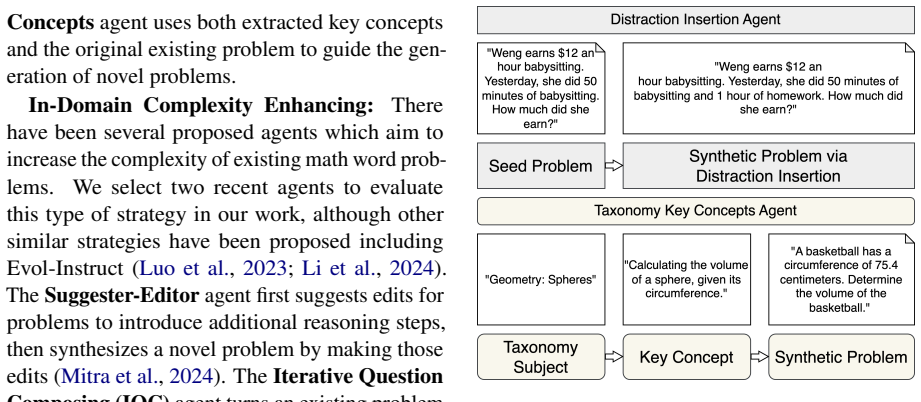
The load-bearing object is the FLAMES framework: a standardized synthetic-data pipeline with fixed seed datasets (GSM8K and MATH), fixed problem-generation model (Qwen2.5-32B-Instruct), fixed solution-generation model (Qwen2.5-Math-7B-Instruct), fixed student model (DeepSeek-Math-7B), and fixed first-solution quality control. Inside it, the paper compares 12 data agents—prompt-based problem-synthesis strategies—including two new ones: Taxonomy-Based Key Concepts, which generates problems from a curated math taxonomy with no seed problems, and Distraction Insertion, which adds irrelevant details without changing the answer. The framework's one-factor-at-a-time design is what converts a jumble
What would settle it
Retrain a FLAMES mixture with the proportions chosen on only four of the five benchmarks, then evaluate on the held-out benchmark; if the margin over refreshed ScaleQuest shrinks or reverses on the held-out set, the reported superiority is partly benchmark tuning. A second check: replace the Qwen2.5-Math-7B-Instruct solution teacher with a weaker model and see whether the 'coverage beats precision' ordering flips on MATH.
Extended reading notes
Core claim
On its own terms, the paper's discovery is that the math data synthesis pipeline can be decomposed into controllable factors and that a few simple design rules dominate: complexity-enhancing agents (Suggester-Editor and IQC) give the best overall improvements; coverage of generated problems matters more than the reliability of their solutions, so 'keep the first solution' and 'majority + first' outperform solvability and reward-model filtering; and the choice of solution-generation teacher matters more than the choice of problem-generation model. It then claims that combining 50% Suggester-Editor, 20% IQC, 20% Taxonomy-Based Key Concepts, and 10% Distraction Insertion produces a dataset that
Load-bearing premise
The load-bearing assumption is that the FLAMES mixture proportions, selected by running candidate mixtures on the same five evaluation benchmarks later used to certify the dataset, do not create an unfair advantage over public datasets whose compositions were not tuned on those benchmarks.
Editorial extensions
If this is right
- With a fixed generation budget, complexity-enhancing agents should be preferred: they improved in-domain, robustness, and competition metrics simultaneously.
- Strict solvability and reward-model filtering can be skipped; keeping first solutions and broader problem coverage performs better and costs less compute.
- Synthetic data seeded only by GSM8K and MATH improved OlympiadBench, so easy problems can transfer to hard competition problems.
- Investing in a stronger solution-generation teacher yields more student-model improvement than a stronger problem generator.
- A small share (10%) of distraction-insertion data improves robustness and overall average without hurting in-domain scores.
Reading between the lines
- The exact 50/20/20/10 proportions were picked on the same five benchmarks used for the final comparison, so part of the margin over public datasets could be selection artifact; a cleaner test would tune on a subset and hold out one benchmark.
- The coverage-beats-precision result was established with Qwen2.5-Math-7B-Instruct as solution teacher; with a weaker teacher, noisy solutions could plausibly reverse the ordering.
- The two novel agents suggest a general recipe: explicitly target the failure mode (OOD breadth via taxonomy, distraction robustness via insertion) and add a small portion of that data to a strong base mixture.
- The easy-to-hard transfer result is tested only on English benchmarks; applying the same pipeline to other languages or formal math domains would show whether the finding generalizes.
Editorial analysis
A structured set of objections, weighed in public.
Referee Report
Summary. The paper introduces FLAMES, a standardized framework for controlled comparison of synthetic math data pipelines. It studies 10 existing plus 2 novel data synthesis agents, 6 quality-control strategies, 2 problem-generation and 2 solution-generation models, and mixture proportions. The empirical findings are that complexity-enhancing agents help most, problem coverage matters more than solution precision, easy-to-hard generalization occurs, and a tuned blend (FLAMES Small/Large/XL) outperforms public datasets on MATH, CollegeMath, GSMPlus, and OlympiadBench. The internal comparisons are carefully controlled, but the dataset-level claims depend on decontamination and selection protocols that are currently incomplete.
Significance. If the dataset gains are robust, this is a valuable contribution: the framework enables apples-to-apples comparison of data synthesis strategies, the public baselines are refreshed with the same solution generator as a fairness control, and the final data pipeline uses only open-source models. The two novel agents are plausible and directly tested. The main risk is that the headline superiority over public datasets may be inflated by evaluation-set contamination and by tuning the mixture and checkpoints on the same benchmarks used for certification.
major comments (3)
- [§2, Appendix A; Tables 3, 9] Decontamination is described only against the GSM8K and MATH test sets (Appendix A: 'decontaminating synthetic problems against the GSM8K and MATH test sets'). The largest reported gains are on OlympiadBench, CollegeMath, and GSMPlus, and these are exactly the benchmarks not audited. The Distraction Insertion agent (Figure 9) modifies GSM8K problems by inserting misleading details, the same perturbation family as GSMPlus; the Taxonomy-Based Key Concepts agent generates unseeded problems from a web-derived taxonomy and may reproduce or near-duplicate existing competition problems. Please run an overlap audit of FLAMES Large/XL against CollegeMath, GSMPlus, and OlympiadBench, report near-duplicate counts, and re-evaluate after removing them. The Limitations section (Section 7) does not mention this gap.
- [§5.3, Appendix D.2, Table 11] The FLAMES mixture proportions were selected by evaluating candidate mixtures on the same five evaluation benchmarks that later certify the dataset (Table 11, Appendix D.2), and checkpoints were selected by highest average on GSM8K/MATH (Appendix A). The public datasets were not tuned in this way. This makes the claimed superiority over public datasets partly a selection artifact. Please provide a holdout evaluation or otherwise quantify the effect of benchmark-guided selection on the reported margins.
- [Abstract vs §5.3, Tables 3 and 9] The headline numbers are computed against different baselines. The abstract's +15.7/+4.5/+6.5/+3.1 match the original (non-refreshed) ScaleQuest in Table 9, while Section 5.3's +12.8/+5.8/+4.9/+1.3 appear to be per-column best refreshed baselines from Table 3. This makes the claimed improvements difficult to interpret. Please report all deltas against a single consistent baseline, preferably the best refreshed public dataset at comparable scale.
minor comments (5)
- [Appendix D.2] In the text describing mixture-D, 'IDC agent' should be 'IQC agent'.
- [Table 5] The label 'DeepSeek-7B' for the solution-generation model should be expanded to 'DeepSeek-Math-7B-RL' to avoid confusion with the student model.
- [Table 3] The 'GSM8K/MATH 15K' row should clarify whether this is the combined train split size or a subsample.
- [§5.2] The statement 'data agents, while using only GSM8K and MATH as seed sets, lead to improvement over competition level benchmarks' is inaccurate for the QFT and Taxonomy agents, which do not use those seed sets. Please qualify.
- [Section 7] The limitations section should also acknowledge the decontamination scope and the benchmark-guided mixture selection as potential threats to the dataset-level claims.
Circularity Check
No significant circularity: FLAMES is an empirical evaluation study, and the concerns raised (mixture selection on eval benchmarks, limited decontamination) are validity risks, not self-referential reductions.
full rationale
FLAMES does not contain a derivation chain in which an output is defined in terms of an input, so none of the circularity patterns apply. The reader's main concern is that the FLAMES mixture proportions (50% Suggester-Editor, 20% IQC, 20% Taxonomy Key Concepts, 10% Distraction Insertion) were selected using the same five evaluation benchmarks that later certify FLAMES Large/XL (Section 5.3; Appendix D.2, Table 11). That is a legitimate selection-bias / overfitting concern, but it is not circularity by the standard used here: the mixture is a hyperparameter chosen by validation, and the reported 1M/1.5M results are measurements of the chosen configuration, not predictions derived from the selection criterion. No equation or definition in the paper makes the reported gains equal to the optimization target by construction. Similarly, decontamination only against GSM8K and MATH tests while evaluating on CollegeMath, GSMPlus, and OlympiadBench is a possible contamination risk, but it is an empirical validity gap, not a self-referential reduction. The paper's claims are supported by controlled comparisons and external benchmarks rather than by a self-citation chain or an imported uniqueness theorem. The few citations to prior work by overlapping authors (e.g., Hase et al. 2024; He et al. 2024) are contextual and not load-bearing. Therefore the honest finding is no significant circularity.
Assumptions & free parameters
free parameters (5)
- FLAMES Small mixture weights (50% Suggester-Editor, 20% IQC, 20% Taxonomy Key Concepts, 10% Distraction Insertion) =
0.5/0.2/0.2/0.1
- Quality control default: 'First solution' (keep first generated solution, no verification) =
First
- Data generation budget per agent =
150K problems (75K GSM8K-seeded + 75K MATH-seeded)
- Checkpoint selection rule =
best average GSM8K+MATH among 10 saved checkpoints
- Solution sampling policy =
one sample (temperature 0.7), first kept
assumptions (4)
- domain assumption Fine-tuning a base math LLM on the generated synthetic data improves performance on held-out math benchmarks and transfers across model families.
- domain assumption The five evaluation benchmarks (GSM8K, MATH, CollegeMath, GSMPlus, OlympiadBench) are a valid proxy for math reasoning ability.
- domain assumption The solution generation model's outputs are mostly correct and can serve as training targets; inaccurate solutions remain useful up to a point.
- domain assumption Data agents listed in Table 7 faithfully reproduce the strategies from their source papers.
invented entities (4)
-
FLAMES dataset (Small 150K, Large 1M, XL 1.5M)
-
Taxonomy-Based Key Concepts agent
-
Distraction Insertion agent
-
Math taxonomy curated from several sources
Cite this review
Pith. "Pith review of FLAMES: Improving LLM Math Reasoning via a Fine-Grained Analysis of the Data Synthesis Pipeline." pith.science (2026). https://pith.science/paper/6K3A5KX6
@misc{pith2026250816514,
  author       = {Pith},
  title        = {Pith review of: FLAMES: Improving LLM Math Reasoning via a Fine-Grained Analysis of the Data Synthesis Pipeline},
  year         = {2026},
  howpublished = {\url{https://pith.science/paper/6K3A5KX6}},
  note         = {Machine review of arXiv:2508.16514}
}
read the original abstract
Recent works improving LLM math reasoning with synthetic data have used unique setups, making comparison of data synthesis strategies impractical. This leaves many unanswered questions about the roles of different factors in the synthetic data pipeline, such as the impact of filtering low-quality problems. To address this gap, we introduce FLAMES, a Framework for LLM Assessment of Math rEasoning Data Synthesis, and perform a systematic study of 10 existing data synthesis strategies and multiple other factors impacting the performance of synthetic math reasoning data. Our FLAMES experiments provide several valuable insights about the optimal balance of difficulty and diversity of synthetic data. First, data agents designed to increase problem complexity lead to best improvements on most math metrics. Second, with a fixed data generation budget, keeping higher problem coverage is more important than keeping only problems with reliable solutions. Third, GSM8K- and MATH-based synthetic data can lead to improvements on competition-level benchmarks, showcasing easy-to-hard generalization. Leveraging insights from our FLAMES experiments, we design two novel data synthesis strategies for improving out-of-domain generalization and robustness. Further, we develop the FLAMES dataset, an effective blend of our novel and existing data synthesis strategies, outperforming public datasets on OlympiadBench (+15.7), CollegeMath (+4.5), GSMPlus (+6.5), and MATH (+3.1). Fine-tuning Qwen2.5-Math-7B on the FLAMES dataset achieves 81.4% on MATH, surpassing larger Llama3 405B, GPT-4o and Claude 3.5 Sonnet.
Figures


Figures from the paper (7 more)


Forward citations
Cited by 1 Pith paper
-
R1-SyntheticVL: Is Synthetic Data from Generative Models Ready for Multimodal Large Language Model?
A collective adversarial data-synthesis pipeline produces 20K synthetic multimodal training examples whose GRPO-trained 7B model beats several listed open-source MLLMs on reasoning benchmarks.
Reference graph
Works this paper leans on
-
[1]
Your response is about generic concept and does not use specifics like numbers or words or object from the problem, so that the key concept can be used to generate related but different problems
-
[2]
Numinamath. [https://huggingface.co/ AI-MO/NuminaMath-CoT](https://github.com/ project-numina/aimo-progress-prize/blob/ main/report/numina_dataset.pdf). Qintong Li, Leyang Cui, Xueliang Zhao, Lingpeng Kong, and Wei Bi. 2024. Gsm-plus: A comprehen- sive benchmark for evaluating the robustness of llms as mathematical problem solvers. arXiv preprint arXiv:24...
arXiv 2024
-
[5]
Your response provide granular details so that this response can be independently used to create a similar problem for teaching this key concept. Below are few examples : Problem : In how many ways can 5 students be selected from a group of 6 students? Solution : We can choose 5 students out of a group of 6 students without regard to order in binom{6}{5} ...
-
[6]
The given problem is a math problem
-
[7]
Please reason step by step and conclude with either ‘Yes’ or ‘No’
The given math problem can be solved based on the conditions provided in the problem (You can first try to solve it and then judge its solvability). Please reason step by step and conclude with either ‘Yes’ or ‘No’. Given Problem: {problem} Figure 10: Prompt used to filter unsolvable synthetic problems (Ding et al., 2024), see Section 4
work page 2024
-
[2021]
and MATH (Hendrycks et al., 2021) training sets. These agents interact with the Qwen2.5-32B- Instruct model (Yang et al., 2024b) to generate new problems, an open-source instruction-tuned Factor Value Controlled/PriorLocation Problem Generation Data Synthesis Agent 10 Existing, 2 Novel Controlled Section 5.2 Problem Generation Model Qwen2.5-32B-Instruct C...
work page 2021
-
[2024]
arXiv preprint arXiv:2406.11704
Nemotron-4 340b technical report. arXiv preprint arXiv:2406.11704. Zheng Cai, Maosong Cao, Haojiong Chen, Kai Chen, Keyu Chen, Xin Chen, Xun Chen, Zehui Chen, Zhi Chen, Pei Chu, et al. 2024. Internlm2 technical re- port. arXiv preprint arXiv:2403.17297. Zui Chen, Tianqiao Liu, Mi Tian, Qing Tong, Weiqi Luo, and Zitao Liu. 2025. Advancing math reasoning in...
arXiv 2024
Reviewed August 5, 2026 · model on record in the stance chip above.
Discussion (0). Sign in to comment.