Pantheon+ supernovae corrected for progenitor age indicate the universe is decelerating
Pith reviewed 2026-06-27 15:41 UTC · model grok-4.3
The pith
Applying progenitor age corrections to Pantheon+ supernovae shifts the large-scale monopole of q0 to positive values, indicating deceleration.
A machine-rendered reading of the paper's core claim, the machinery that carries it, and where it could break.
Core claim
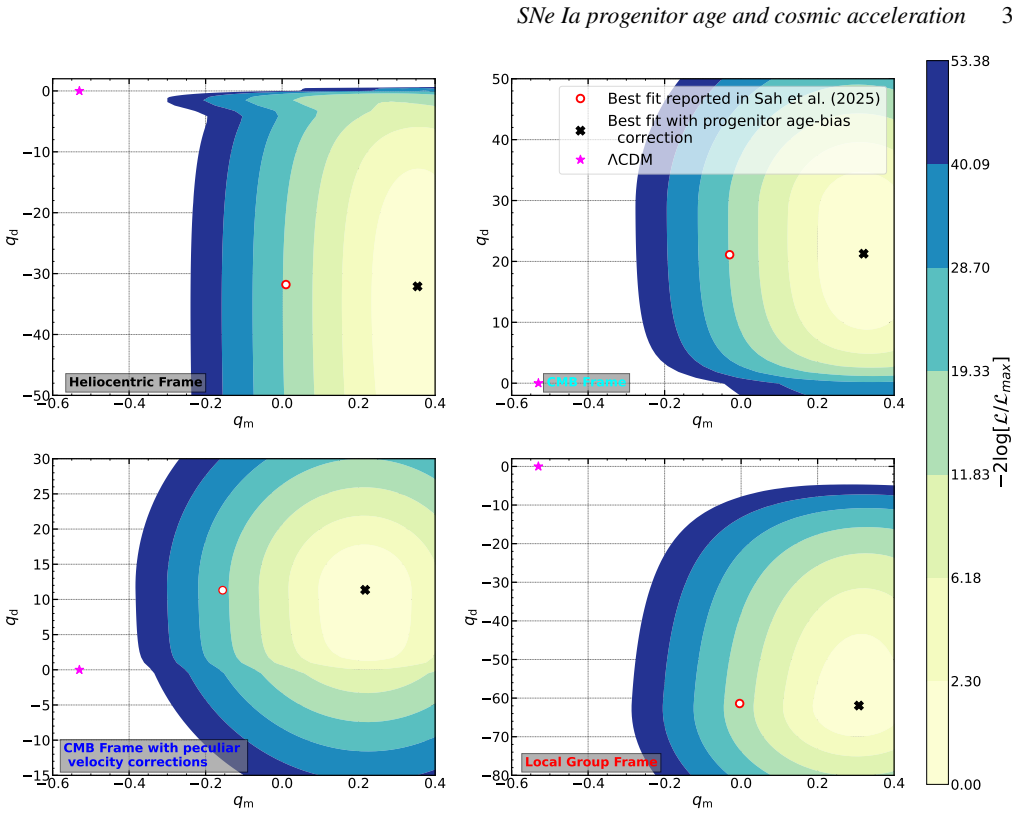
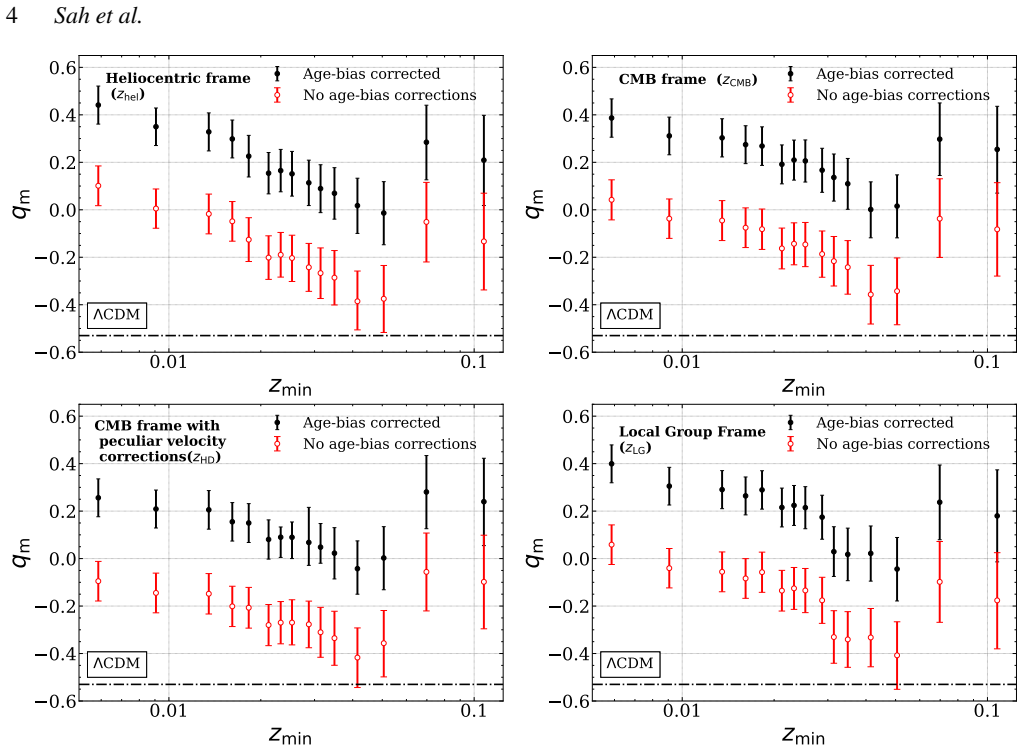
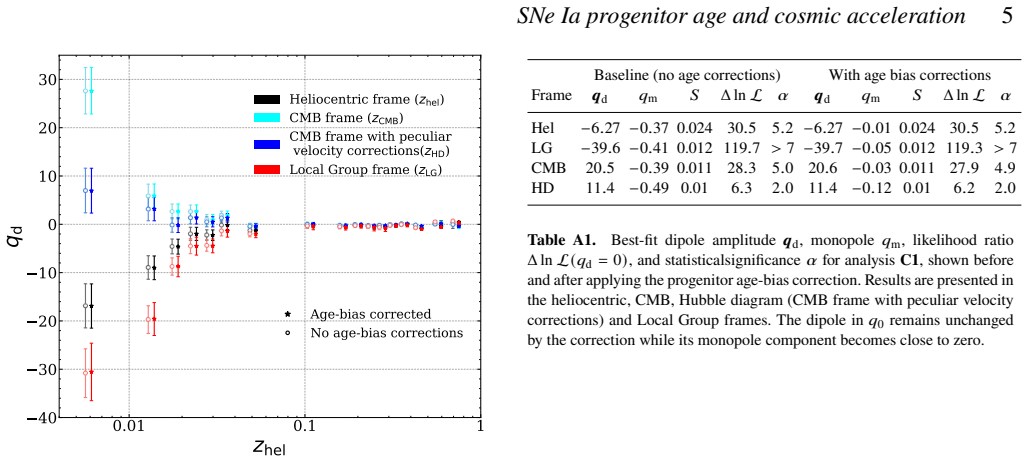
Our recent redshift tomographic analysis showed that locally q0 has a strong dipole anisotropy aligned approximately with the bulk flow, and only a small monopole component remains at distances exceeding a few hundred Mpc. Applying redshift-dependent corrections for progenitor age to the Pantheon+ catalogue, we find that this shifts the monopole component of q0 to positive values (i.e. deceleration), while leaving the local dipole component essentially unchanged.
What carries the argument
Redshift-dependent progenitor age corrections applied to Pantheon+ Type Ia supernovae within a tomographic decomposition of q0 into monopole and dipole components.
If this is right
- The monopole component of q0 becomes positive on scales exceeding a few hundred Mpc.
- The local dipole anisotropy in q0 remains largely unchanged and aligned with the bulk flow.
- Cosmographic inferences of cosmic acceleration from supernovae depend on the treatment of progenitor age effects.
- Standard interpretations of the Pantheon+ data for dark energy models are altered by these corrections.
Where Pith is reading between the lines
- If the corrections hold, the need for a dominant dark energy component at late times would be reduced or eliminated in supernova-based analyses.
- This result could be tested by applying the same age corrections to other supernova compilations such as those from DES or LSST.
- It raises the possibility that other distance indicators may also require similar evolutionary adjustments to reconcile local and global expansion measures.
Load-bearing premise
The redshift-dependent progenitor age corrections accurately capture luminosity evolution without introducing new systematic biases.
What would settle it
A measurement showing that the monopole of q0 remains near zero or negative after the same age corrections are applied to an independent supernova sample or after direct empirical checks of luminosity versus progenitor age.
Figures
read the original abstract
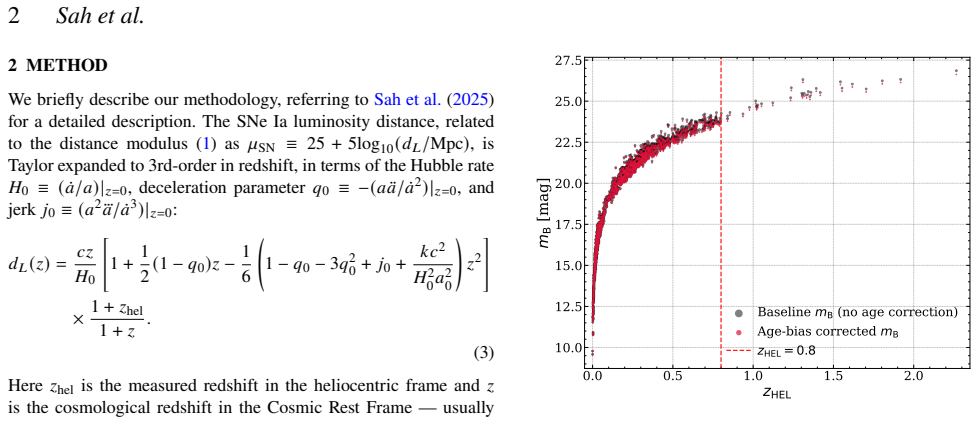
We examine the impact of progenitor age-dependent luminosity evolution of Type Ia supernovae on a cosmographic measurement of the deceleration parameter $q_0$. Our recent redshift tomographic analysis showed that locally $q_0$ has a strong dipole anisotropy aligned approximately with the bulk flow, and only a small monopole component remains at distances exceeding a few hundred Mpc. Applying redshift-dependent corrections for progenitor age to the Pantheon+ catalogue, we find that this shifts the monopole component of $q_0$ to positive values (i.e. deceleration), while leaving the local dipole component essentially unchanged.
Editorial analysis
A structured set of objections, weighed in public.
Referee Report
Summary. The manuscript applies redshift-dependent corrections for progenitor age luminosity evolution to the Pantheon+ Type Ia supernova catalogue. Building on the authors' prior redshift tomographic analysis, it reports that these corrections shift the monopole component of the deceleration parameter q0 to positive values (indicating deceleration at large distances), while the local dipole anisotropy aligned with the bulk flow remains essentially unchanged.
Significance. If the age corrections prove robust and independent of the tomographic fitting choices, the result would challenge the standard interpretation of SNIa data as evidence for cosmic acceleration, suggesting instead that apparent acceleration arises from unaccounted progenitor evolution. The analysis benefits from the large Pantheon+ sample and the tomographic decomposition approach, which allows separation of monopole and dipole components.
major comments (2)
- [Methods] The central claim that the monopole shifts to positive q0 rests on the redshift-dependent age corrections accurately isolating luminosity evolution without introducing distance-dependent biases or correlations with Pantheon+ selection effects. The manuscript should provide the explicit functional form of the correction, its calibration sample, and a test showing that the correction is uncorrelated with the distance modulus residuals used in the q0 fit.
- [Results] The reported shift is defined relative to the monopole and dipole values obtained in the authors' prior tomographic analysis. A re-derivation of the full tomographic decomposition on the age-corrected magnitudes is needed to demonstrate that the monopole change is not an artifact of the inherited fitting assumptions or parameter choices from that earlier work.
minor comments (2)
- [Abstract] The abstract would benefit from a brief quantitative statement of the magnitude of the monopole shift and its uncertainty.
- Notation for q0 components (monopole vs. dipole) should be defined consistently in the text and any equations.
Simulated Author's Rebuttal
We thank the referee for the constructive review and the recommendation for major revision. We address each major comment below and indicate the revisions that will be incorporated into the manuscript.
read point-by-point responses
-
Referee: [Methods] The central claim that the monopole shifts to positive q0 rests on the redshift-dependent age corrections accurately isolating luminosity evolution without introducing distance-dependent biases or correlations with Pantheon+ selection effects. The manuscript should provide the explicit functional form of the correction, its calibration sample, and a test showing that the correction is uncorrelated with the distance modulus residuals used in the q0 fit.
Authors: We agree that further documentation of the age correction procedure is needed to substantiate the central claim. In the revised manuscript we will explicitly state the functional form of the redshift-dependent progenitor age correction, identify the calibration sample, and include a quantitative test confirming that the correction shows no significant correlation with the distance modulus residuals entering the q0 fit. These additions will directly address concerns about possible distance-dependent biases or selection-effect correlations. revision: yes
-
Referee: [Results] The reported shift is defined relative to the monopole and dipole values obtained in the authors' prior tomographic analysis. A re-derivation of the full tomographic decomposition on the age-corrected magnitudes is needed to demonstrate that the monopole change is not an artifact of the inherited fitting assumptions or parameter choices from that earlier work.
Authors: We acknowledge that re-deriving the tomographic decomposition directly on the age-corrected Pantheon+ magnitudes would eliminate any ambiguity arising from the use of previously published monopole and dipole values. We will carry out this full re-derivation in the revised manuscript, thereby confirming that the reported shift to positive monopole q0 is independent of the fitting assumptions inherited from the earlier analysis. revision: yes
Circularity Check
Monopole shift in q0 defined relative to authors' prior self-cited tomographic decomposition
specific steps
-
self citation load bearing
[Abstract]
"Our recent redshift tomographic analysis showed that locally q0 has a strong dipole anisotropy aligned approximately with the bulk flow, and only a small monopole component remains at distances exceeding a few hundred Mpc. Applying redshift-dependent corrections for progenitor age to the Pantheon+ catalogue, we find that this shifts the monopole component of q0 to positive values (i.e. deceleration), while leaving the local dipole component essentially unchanged."
The claimed shift is defined relative to the monopole and dipole values from the authors' prior tomographic analysis (same team). The new conclusion therefore inherits the fitting choices, data handling, and decomposition assumptions of that earlier self-cited work; the result is not independently derived from the age corrections alone.
full rationale
The paper's central result—that age corrections shift the q0 monopole to positive values while the dipole is unchanged—is explicitly measured against the monopole/dipole values obtained in the authors' own recent redshift tomographic analysis. This makes the load-bearing baseline a self-citation whose assumptions (tomographic binning, fitting procedure, Pantheon+ handling) are inherited without re-derivation or external check in the present work. The age-correction step itself is new and not shown to reduce to the prior result by construction, so the circularity is partial rather than total. No self-definitional equations, fitted-input predictions, or ansatz smuggling are exhibited in the provided text.
Axiom & Free-Parameter Ledger
Reference graph
Works this paper leans on
-
[1]
Planck 2018 results. I. Overview and the cosmological legacy of Planck
Aghanim, N. and others. Planck 2018 results. I. Overview and the cosmological legacy of Planck. Astron. Astrophys. 2020. doi:10.1051/0004-6361/201833880. arXiv:1807.06205
work page internal anchor Pith review Pith/arXiv arXiv doi:10.1051/0004-6361/201833880 2018
-
[2]
Overdispersed Radio Source Counts and Excess Radio Dipole Detection
B. Overdispersed Radio Source Counts and Excess Radio Dipole Detection. Phys. Rev. Lett. 2025. doi:10.1103/6z32-3zf4. arXiv:2509.16732
-
[3]
On the Root Cause of the Host ``Mass Step'' in the Hubble Residuals of Type Ia Supernovae. , keywords =. doi:10.3847/1538-4357/ad0121 , archivePrefix =. 2310.06011 , primaryClass =
-
[4]
Strong progenitor age bias in supernova cosmology I
Chung, Chul and Park, Seunghyun and Son, Junhyuk and Cho, Hyejeon and Lee, Young-Wook. Strong progenitor age bias in supernova cosmology I. Robust and ubiquitous evidence from a larger sample of host galaxies in a broader redshift range. Mon. Not. Roy. Astron. Soc. 2025. doi:10.1093/mnras/staf497
-
[5]
Evidence for anisotropy of cosmic acceleration
Colin, Jacques and Mohayaee, Roya and Rameez, Mohamed and Sarkar, Subir. Evidence for anisotropy of cosmic acceleration. Astron. Astrophys. 2019. doi:10.1051/0004-6361/201936373. arXiv:1808.04597
-
[6]
The effect of peculiar velocities on supernova cosmology
Davis, Tamara M. and others. The Effect of Peculiar Velocities on Supernova Cosmology. Astrophys. J. 2011. doi:10.1088/0004-637X/741/1/67. arXiv:1012.2912
work page internal anchor Pith review Pith/arXiv arXiv doi:10.1088/0004-637x/741/1/67 2011
-
[7]
Heinesen, Asta. Multipole decomposition of the general luminosity distance 'Hubble law' -- a new framework for observational cosmology. JCAP. 2021. doi:10.1088/1475-7516/2021/05/008. arXiv:2010.06534
-
[8]
Gupta, Ravi R. and others. Improved Constraints on Type Ia Supernova Host Galaxy Properties using Multi-Wavelength Photometry and their Correlations with Supernova Properties. Astrophys. J. 2011. doi:10.1088/0004-637X/740/2/92. arXiv:1107.6003
work page internal anchor Pith review Pith/arXiv arXiv doi:10.1088/0004-637x/740/2/92 2011
-
[9]
Early-type Host Galaxies of Type Ia Supernovae
Kang, Yijung and Lee, Young-Wook and Kim, Young-Lo and Chung, Chul and Ree, Chang Hee. Early-type Host Galaxies of Type Ia Supernovae. II. Evidence for Luminosity Evolution in Supernova Cosmology. Astrophys. J. 2020. doi:10.3847/1538-4357/ab5afc. arXiv:1912.04903
-
[10]
and Seifert, Antonia and Ridden-Harper, Ryan and Wiltshire, David L
Lane, Zachary G. and Seifert, Antonia and Ridden-Harper, Ryan and Wiltshire, David L. Cosmological foundations revisited with Pantheon+. Mon. Not. Roy. Astron. Soc. 2025. doi:10.1093/mnras/stae2437. arXiv:2311.01438
-
[11]
Lee, Young-Wook and Chung, Chul and Kang, Yijung and Jee, M. James. Further evidence for significant luminosity evolution in supernova cosmology. Astrophys. J. 2020. doi:10.3847/1538-4357/abb3c6. arXiv:2008.12309
-
[12]
Lee, Young-Wook and Chung, Chul and Demarque, Pierre and Park, Seunghyun and Son, Junhyuk and Kang, Yijung. Evidence for strong progenitor age dependence of type Ia supernova luminosity standardization process. Mon. Not. Roy. Astron. Soc. 2022. doi:10.1093/mnras/stac2840. arXiv:2107.06288
-
[13]
Marginal evidence for cosmic acceleration from Type Ia supernovae
Nielsen, Jeppe Tr st and Guffanti, Alberto and Sarkar, Subir. Marginal evidence for cosmic acceleration from Type Ia supernovae. Sci. Rep. 2016. doi:10.1038/srep35596. arXiv:1506.01354
work page internal anchor Pith review Pith/arXiv arXiv doi:10.1038/srep35596 2016
-
[14]
Do supernovae indicate an accelerating universe?
Mohayaee, Roya and Rameez, Mohamed and Sarkar, Subir. Do supernovae indicate an accelerating universe?. Eur. Phys. J. ST. 2021. doi:10.1140/epjs/s11734-021-00199-6. arXiv:2106.03119
-
[15]
Navas, S. and others. Review of particle physics. Phys. Rev. D. 2024. doi:10.1103/PhysRevD.110.030001
-
[16]
Anisotropy in the cosmic acceleration inferred from supernovae
Rameez, Mohamed. Anisotropy in the cosmic acceleration inferred from supernovae. Phil. Trans. Roy. Soc. Lond. A. 2025. doi:10.1098/rsta.2024.0032. arXiv:2411.14758
-
[17]
Rose, B. M. and Rubin, D. and Cikota, A. and Deustua, S. E. and Dixon, S. and Fruchter, A. and Jones, D. O. and Riess, A. G. and Scolnic, D. M. Evidence for Cosmic Acceleration is Robust to Observed Correlations Between Type Ia Supernova Luminosity and Stellar Age. Astrophys. J. Lett. 2020. doi:10.3847/2041-8213/ab94ad. arXiv:2002.12382
-
[18]
Rose, B. M. and Garnavich, P. M. and Berg, M. A. Think Global, Act Local: The Influence of Environment Age and Host Mass on Type Ia Supernova Light Curves. Astrophys. J. 2019. doi:10.3847/1538-4357/ab0704. arXiv:1902.01433
work page internal anchor Pith review Pith/arXiv arXiv doi:10.3847/1538-4357/ab0704 2019
-
[19]
Is the expansion of the universe accelerating? All signs point to yes
Rubin, David and Hayden, Brian. Is the expansion of the universe accelerating? All signs point to yes. Astrophys. J. Lett. 2016. doi:10.3847/2041-8213/833/2/L30. arXiv:1610.08972
work page internal anchor Pith review Pith/arXiv arXiv doi:10.3847/2041-8213/833/2/l30 2016
-
[20]
Rubin, David and Heitlauf, Jessica. Is the expansion of the universe accelerating? All signs still point to yes a local dipole anisotropy cannot explain dark energy. Astrophys. J. 2020. doi:10.3847/1538-4357/ab7a16. arXiv:1912.02191
-
[21]
Anisotropy in Pantheon+ supernovae
Sah, Animesh and Rameez, Mohamed and Sarkar, Subir and Tsagas, Christos G. Anisotropy in Pantheon+ supernovae. Eur. Phys. J. C. 2025. doi:10.1140/epjc/s10052-025-14222-w. arXiv:2411.10838
-
[22]
The Pantheon+ Analysis: The Full Dataset and Light-Curve Release
Scolnic, Dan and others. The Pantheon+ Analysis: The Full Data Set and Light-curve Release. Astrophys. J. 2022. doi:10.3847/1538-4357/ac8b7a. arXiv:2112.03863
work page internal anchor Pith review Pith/arXiv arXiv doi:10.3847/1538-4357/ac8b7a 2022
-
[23]
Secrest, Nathan J. The Ellis Baldwin test. Phil. Trans. Roy. Soc. Lond. A. 2025. doi:10.1098/rsta.2024.0027
-
[24]
Secrest, Nathan J. and von Hausegger, Sebastian and Rameez, Mohamed and Mohayaee, Roya and Sarkar, Subir and Colin, Jacques. A Test of the Cosmological Principle with Quasars. Astrophys. J. Lett. 2021. doi:10.3847/2041-8213/abdd40. arXiv:2009.14826
-
[25]
and von Hausegger, Sebastian and Rameez, Mohamed and Mohayaee, Roya and Sarkar, Subir
Secrest, Nathan J. and von Hausegger, Sebastian and Rameez, Mohamed and Mohayaee, Roya and Sarkar, Subir. A Challenge to the Standard Cosmological Model. Astrophys. J. Lett. 2022. doi:10.3847/2041-8213/ac88c0. arXiv:2206.05624
-
[26]
Forty years of the Ellis Baldwin test
Secrest, Nathan and von Hausegger, Sebastian and Rameez, Mohamed and Mohayaee, Roya and Sarkar, Subir. Forty years of the Ellis Baldwin test. Nature Rev. Phys. 2025. doi:10.1038/s42254-024-00803-3. arXiv:2501.06450
-
[27]
Colloquium: The cosmic dipole anomaly
Secrest, Nathan and von Hausegger, Sebastian and Rameez, Mohamed and Mohayaee, Roya and Sarkar, Subir. Colloquium: The cosmic dipole anomaly. Rev. Mod. Phys. 2025. doi:10.1103/9ygx-z2yq. arXiv:2505.23526
-
[28]
Strong Progenitor Age-bias in Supernova Cosmology
Son, Junhyuk and Lee, Young-Wook and Chung, Chul and Park, Seunghyun and Cho, Hyejeon. Strong Progenitor Age-bias in Supernova Cosmology. II. Alignment with DESI BAO and Signs of a Non-Accelerating Universe. Monthly Notices of the Royal Astronomical Society , volume =. 2025 , month =. arXiv:2510.13121
arXiv 2025
-
[29]
The deceleration parameter in `tilted' Friedmann universes
Tsagas, Christos G. and Kadiltzoglou, Miltiadis I. Deceleration parameter in tilted Friedmann universes. Phys. Rev. D. 2015. doi:10.1103/PhysRevD.92.043515. arXiv:1507.04266
work page internal anchor Pith review Pith/arXiv arXiv doi:10.1103/physrevd.92.043515 2015
-
[30]
The deceleration parameter in tilted universes: generalising the Friedmann background
Tsagas, Christos G. The deceleration parameter in tilted universes: generalising the Friedmann background. Eur. Phys. J. C. 2022. doi:10.1140/epjc/s10052-022-10452-4. arXiv:2112.04313
-
[31]
Wagenveld, J. D. and Kl. The cosmic radio dipole: Bayesian estimators on new and old radio surveys. Astron. Astrophys. 2023. doi:10.1051/0004-6361/202346210. arXiv:2305.15335
-
[32]
Still Accelerating: Type Ia supernova cosmology is robust to host galaxy age evolution
Wiseman, Phil and others. Still Accelerating: Type Ia supernova cosmology is robust to host galaxy age evolution. 2026. arXiv:2601.13785
Pith/arXiv arXiv 2026
-
[33]
Still Accelerating: Type Ia supernova cosmology is robust to host galaxy age evolution
Still Accelerating: Type Ia supernova cosmology is robust to host galaxy age evolution. arXiv e-prints , keywords =. doi:10.48550/arXiv.2601.13785 , archivePrefix =. 2601.13785 , primaryClass =
work page internal anchor Pith review Pith/arXiv arXiv doi:10.48550/arxiv.2601.13785
-
[34]
Wojtak, Rados aw and Hjorth, Jens. Stretch to stretch, dust to dust: Lower-value local H0 measurements from the two-population modelling of type Ia supernovae. Astron. Astrophys. 2025. doi:10.1051/0004-6361/202556288. arXiv:2506.22150
-
[35]
Isotropy of Hubble Expansion in the Early and Late Universe
Zhou, Alan Junzhe and Dodelson, Scott and Scolnic, Daniel. Isotropy of Hubble Expansion in the Early and Late Universe. Phys. Rev. Lett. 2025. doi:10.1103/w99g-lgnn. arXiv:2506.14878
-
[36]
2023 , url =
Rohatgi, Ankit , title =. 2023 , url =
2023
-
[37]
Ellis, G. F. R. and Stoeger, W. The 'fitting problem' in cosmology. Class. Quant. Grav. 1987. doi:10.1088/0264-9381/4/6/025
discussion (0)
Sign in with ORCID, Apple, or X to comment. Anyone can read and Pith papers without signing in.