The emergence of the faint nature of Low Surface Brightness Galaxies in the IllustrisTNG simulation
Pith reviewed 2026-06-27 15:37 UTC · model grok-4.3
The pith
The low central density of low surface brightness galaxies results mainly from higher angular momentum and inner halo spin parameters.
A machine-rendered reading of the paper's core claim, the machinery that carries it, and where it could break.
Core claim
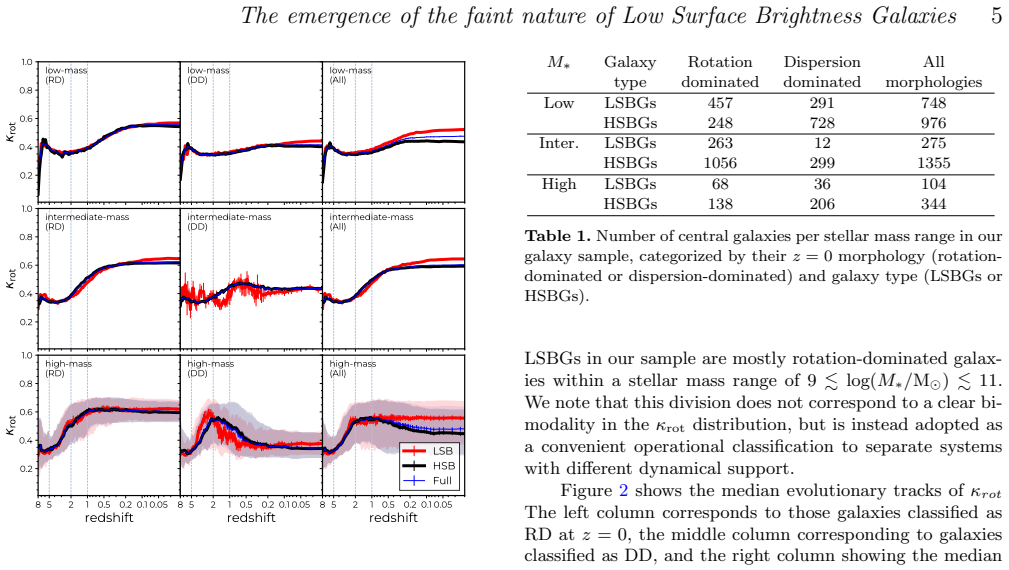
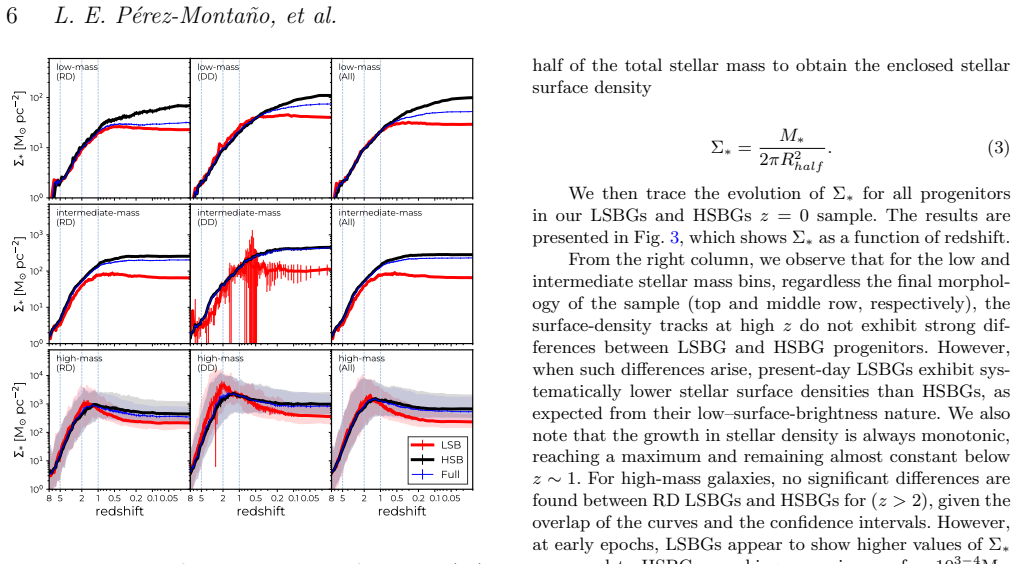
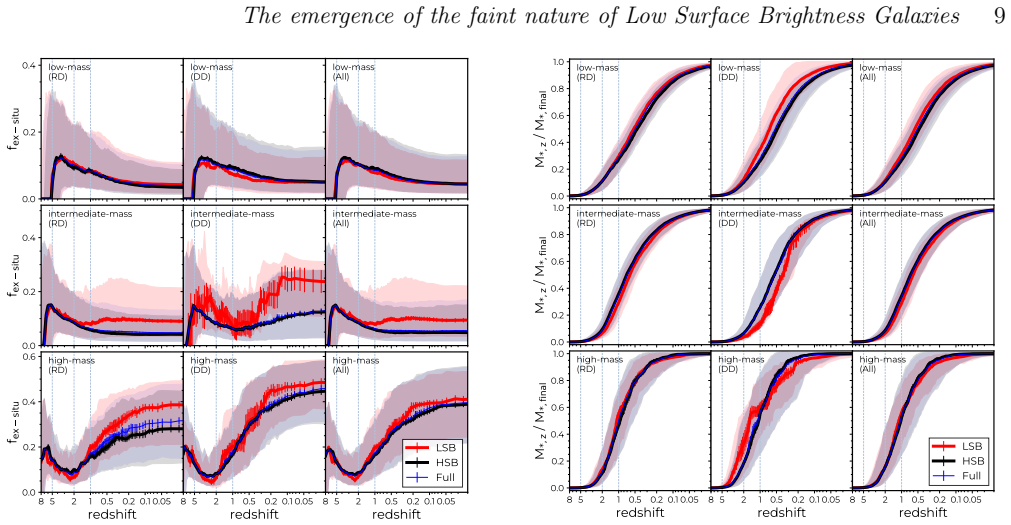
Using merger trees from the IllustrisTNG suite, the central low density nature of LSBGs is mainly a consequence of an increase in their angular momentum and (inner) halo spin parameter. Star formation histories of LSBGs are quite similar to their high surface brightness counterparts, with significant differences not in the time, but in the spatial distribution in which new stars are forming. The mechanisms that favor the emergence of the low surface brightness nature are strongly related with variations in the spin parameter of host halos and their angular momentum, deviating the stellar distribution of galaxies from their inner regions to their outskirts, leading to a decrease in their cent
What carries the argument
Angular momentum and inner halo spin parameter, which redistribute newly formed stars from central regions to galaxy outskirts.
If this is right
- Higher halo spin produces galaxies with lower central surface densities across the mass range 10^9 to 10^12 solar masses.
- Star formation timing stays comparable to high surface brightness galaxies while its radial location moves outward.
- Once formed, LSBGs maintain stable central densities and morphologies with reduced likelihood of strong later changes.
- Halo spin variations explain the emergence of the low surface brightness state without requiring differences in overall star formation history.
Where Pith is reading between the lines
- LSBGs should preferentially occupy high-spin halos, testable via rotation curve measurements or other spin proxies in observations.
- Environmental processes that boost halo spin could increase the fraction of LSBGs in certain large-scale structures.
- Varying subgrid physics in other simulations could reveal whether the spin-driven redistribution persists independently of the specific IllustrisTNG model.
Load-bearing premise
The IllustrisTNG simulation and its subgrid physics accurately reproduce angular momentum acquisition and the spatial distribution of star formation without major numerical or modeling artifacts that would artificially lower central densities.
What would settle it
Observations or alternative simulations showing no systematic difference in halo spin parameters between LSBGs and HSBGs of similar mass would falsify the claim that spin increase is the primary driver.
Figures




read the original abstract
We employ a simulated sample of galaxies drawn from the IllustrisTNG suite to study the emergence of the diffuse and extended nature of $\sim12,000$ low surface brightness galaxies (LSBGs) within a wide stellar mass range (${M}_{*}=10^{9}-10^{12} \rm{M}_{\odot}$). We employ merger trees to follow the evolution of their physical properties such as stellar surface density, specific angular momentum and halo spin parameter, finding that the central low density nature of LSBGs is mainly a consequence of an increase in their angular momentum and (inner) halo spin parameter. We also find that star formation histories of LSBGs are quite similar to their high surface brightness (HSBGs) counterparts, with significant differences not in the time, but in the spatial distribution in which new stars are forming. We conclude that the mechanisms that favor the emergence of the low surface brightness nature are strongly related with variations in the spin parameter of host halos and their angular momentum, deviating the stellar distribution of galaxies from their inner regions to their outskirts, leading to a decrease in their central surface brightness. Once the LSBG nature is established, galaxies are less likely to experience strong variations in their central surface densities and morphology.
Editorial analysis
A structured set of objections, weighed in public.
Referee Report
Summary. The manuscript analyzes ~12,000 low surface brightness galaxies (LSBGs) with stellar masses 10^9–10^12 M_⊙ drawn from the IllustrisTNG suite. Using merger trees to track evolution, it reports that the low central surface density of LSBGs arises primarily from increases in specific angular momentum and inner halo spin parameter, which shift star formation outward; star formation histories remain similar to those of high surface brightness galaxies (HSBGs), with differences mainly in spatial distribution. The conclusion is that halo spin variations drive the LSBG morphology once established.
Significance. If the IllustrisTNG subgrid physics and resolution faithfully capture angular momentum acquisition and the spatial distribution of star formation, the work supplies a concrete evolutionary mechanism inside the model that links halo spin to central density, offering a testable prediction for how LSBGs emerge and stabilize. The use of merger trees to follow individual galaxies strengthens the temporal aspect of the argument.
major comments (2)
- [Abstract] Abstract: the sample of ~12,000 LSBGs is introduced without any statement of the surface-brightness threshold, measurement aperture, or robustness tests against alternative definitions; because the central claim concerns what distinguishes this population from HSBGs, the absence of selection criteria makes it impossible to judge whether the reported angular-momentum trend is general or selection-dependent.
- [Results (evolution tracking)] The manuscript presents correlations between rising spin parameter and declining central density but does not quantify the relative contribution of angular momentum versus other tracked quantities (e.g., halo mass, merger rate) through partial correlations or controlled subsamples; without such controls the assertion that angular momentum is the 'main' driver remains correlative rather than demonstrated as causal.
minor comments (2)
- [Methods] The phrase 'inner halo spin parameter' is used without an explicit definition or radial cut; a short methods paragraph clarifying the exact definition and how it differs from the global spin parameter would improve reproducibility.
- [Figures] Figure captions should state the exact number of galaxies in each panel and whether error bars represent 16–84 percentiles or bootstrap uncertainties.
Simulated Author's Rebuttal
We thank the referee for their constructive comments and positive recommendation. We address each major comment below and have revised the manuscript to incorporate the suggested clarifications and additional analyses.
read point-by-point responses
-
Referee: [Abstract] Abstract: the sample of ~12,000 LSBGs is introduced without any statement of the surface-brightness threshold, measurement aperture, or robustness tests against alternative definitions; because the central claim concerns what distinguishes this population from HSBGs, the absence of selection criteria makes it impossible to judge whether the reported angular-momentum trend is general or selection-dependent.
Authors: We agree that the abstract should explicitly state the selection criteria. In the revised version we have added the following sentence: 'LSBGs are selected with central surface brightness μ_{0,r} > 22.5 mag arcsec^{-2} measured within the effective radius in the r-band.' Robustness tests against alternative thresholds and apertures are already presented in Section 2.2; we now reference these tests directly in the abstract to confirm that the angular-momentum trends are insensitive to the precise definition. revision: yes
-
Referee: [Results (evolution tracking)] The manuscript presents correlations between rising spin parameter and declining central density but does not quantify the relative contribution of angular momentum versus other tracked quantities (e.g., halo mass, merger rate) through partial correlations or controlled subsamples; without such controls the assertion that angular momentum is the 'main' driver remains correlative rather than demonstrated as causal.
Authors: We acknowledge that the original analysis presented direct correlations and evolutionary tracks without formal controls. We have now added partial-correlation coefficients (controlling for halo mass and merger rate) and controlled subsample comparisons in a new paragraph of Section 4. These show that the correlation between inner halo spin and central surface density remains significant (r_partial ≈ 0.55) after removing the effects of mass and mergers, while the partial correlations with the other quantities are weaker. This quantification supports our claim that angular momentum is the dominant driver within the simulation. revision: yes
Circularity Check
No significant circularity; analysis is self-contained within simulation outputs
full rationale
The paper tracks galaxy evolution in IllustrisTNG via merger trees, correlating LSBG central densities with angular momentum and halo spin increases, plus spatial SF shifts. No equations, fitted parameters, or definitions reduce the reported mechanism back to inputs by construction. No self-citation chains or uniqueness theorems are invoked as load-bearing. The result is an internal statement about emergent behavior in one model, benchmarked directly against the simulation data rather than derived tautologically.
Axiom & Free-Parameter Ledger
axioms (1)
- domain assumption The subgrid physics and numerical resolution in IllustrisTNG correctly capture angular momentum transport and the spatial distribution of star formation.
Reference graph
Works this paper leans on
-
[1]
G., van den Bergh S., 2001, Sci, 293, 1273
Abraham R. G., van den Bergh S., 2001, Sci, 293, 1273
2001
-
[2]
Bakos J., Trujillo I., 2012, arXiv, arXiv:1204.3082
Pith/arXiv arXiv 2012
-
[3]
G., Tal T., Marchesini D., Kriek M., Franx M., Coppi P., 2009, ApJ, 697, 1290
Bezanson R., van Dokkum P. G., Tal T., Marchesini D., Kriek M., Franx M., Coppi P., 2009, ApJ, 697, 1290
2009
-
[4]
Boissier, S., Monnier Ragaigne, D., Prantzos, N., et al.\ 2003, , 343, 653
2003
-
[5]
Boissier S., Gil de Paz A., Boselli A., Buat V., Madore B., Chemin L., Balkowski C., et al., 2008, ApJ, 681, 244
2008
-
[6]
D., Impey C
Bothun G. D., Impey C. D., Malin D. F., Mould J. R., 1987, AJ, 94, 23
1987
-
[7]
D., Schombert J
Bothun G. D., Schombert J. M., Impey C. D., Sprayberry D., McGaugh S. S., 1993, AJ, 106, 530
1993
-
[8]
Boylan-Kolchin M., Springel V., White S. D. M., Jenkins A., Lemson G., 2009, MNRAS, 398, 1150
2009
-
[9]
Bruzual G., Charlot S., 2003, MNRAS, 344, 1000
2003
-
[10]
S., Dekel A., Kolatt T
Bullock J. S., Dekel A., Kolatt T. S., Kravtsov A. V., Klypin A. A., Porciani C., Primack J. R., 2001, ApJ, 555, 240
2001
-
[11]
Bustos-Espinoza R. O. E., Bla \ n a M., Galaz G., Mora M., Junais, Das M., Barway S., et al., 2025
2025
-
[12]
Cao T.-W., Wu H., Du W., Lei F.-J., Zhu M., Wouterloot J., Parsons H., et al., 2017, AJ, 154, 116
2017
-
[13]
M., Scott N., Verdoes Kleijn G
Cappellari M., Emsellem E., Krajnovi \'c D., McDermid R. M., Scott N., Verdoes Kleijn G. A., Young L. M., et al., 2011, MNRAS, 413, 813
2011
-
[14]
Cervantes Sodi, B., & S \'a nchez Garc \' a, O.\ 2017, , 847, 37
2017
-
[15]
Chambers K. C., Magnier E. A., Metcalfe N., Flewelling H. A., Huber M. E., Waters C. Z., Denneau L., et al., 2016, arXiv, arXiv:1612.05560
Pith/arXiv arXiv 2016
-
[16]
Cheng C., Huang J.-S., Du W., Zhang H.-X., Zhang C.-P., Zhu M., Orellana G., 2025, ApJS, 281, 66
2025
-
[17]
A., et al., 2015, MNRAS, 450, 1937
Crain R. A., et al., 2015, MNRAS, 450, 1937
2015
-
[18]
J.,et al
Dalcanton, J. J.,et al. \ 1997, , 482, 659
1997
-
[19]
S., White S
Davis M., Efstathiou G., Frenk C. S., White S. D. M., 1985, ApJ, 292, 371
1985
-
[20]
De Lucia G., Blaizot J., 2007, MNRAS, 375, 2
2007
-
[21]
B., Macci \`o A
Di Cintio A., Brook C. B., Macci \`o A. V., Dutton A. A., Cardona-Barrero S., 2019, MNRAS, 486, 2535
2019
-
[22]
M., Posti L., Ogle P
Di Teodoro E. M., Posti L., Ogle P. M., Fall S. M., Jarrett T., 2021, MNRAS, 507, 5820
2021
-
[23]
J., 1976, Natur, 263, 573
Disney M. J., 1976, Natur, 263, 573
1976
-
[24]
Dolag K., Borgani S., Murante G., Springel V., 2009, MNRAS, 399, 497
2009
-
[25]
I., et al.\ 2015, , 149, 199
Du, W., Wu, H., Lam, M. I., et al.\ 2015, , 149, 199
2015
-
[26]
Dubois Y., et al., 2014, MNRAS, 444, 1453
2014
-
[27]
M.\ 1983.\ Galaxy formation - Some comparisons between theory and observation.\ Internal Kinematics and Dynamics of Galaxies 100, 391–398
Fall, S. M.\ 1983.\ Galaxy formation - Some comparisons between theory and observation.\ Internal Kinematics and Dynamics of Galaxies 100, 391–398
1983
-
[28]
M., Romanowsky A
Fall S. M., Romanowsky A. J., 2013, ApJL, 769, L26
2013
-
[29]
\ 1970, , 160, 811
Freeman, K.C. \ 1970, , 160, 811
1970
-
[30]
Galaz, G., Herrera-Camus, R., Garcia-Lambas, D., & Padilla, N.\ 2011, , 728, 74
2011
-
[31]
Genel S., et al., 2014, MNRAS, 445, 175
2014
-
[32]
A., Puchwein E., Sijacki D., 2020, MNRAS, 498, 2114
Henden N. A., Puchwein E., Sijacki D., 2020, MNRAS, 498, 2114
2020
-
[33]
P., & Manoj, P.\ 2016, , 462, 2099
Honey, M., Das, M., Ninan, J. P., & Manoj, P.\ 2016, , 462, 2099
2016
-
[34]
Hoyle F., 1951, pca..conf, 195
1951
-
[35]
Huertas-Company M., Mei S., Shankar F., Delaye L., Raichoor A., Covone G., Finoguenov A., et al., 2013, MNRAS, 428, 1715
2013
-
[36]
Impey, C., & Bothun, G.\ 1997, , 35, 267
1997
-
[37]
F., 1998, MNRAS, 299, 123
Jimenez R., Padoan P., Matteucci F., Heavens A. F., 1998, MNRAS, 299, 123
1998
-
[38]
& Lee, J
Kim, J. & Lee, J. \ 2013, , 432, 1701
2013
-
[39]
D., Trayford J
Kulier A., Galaz G., Padilla N. D., Trayford J. W., 2020, MNRAS, 496, 3996
2020
-
[40]
del P., Schaye J., Bah \'e Y., van de Sande J., Kay S
Lagos C. del P., Schaye J., Bah \'e Y., van de Sande J., Kay S. T., Barnes D., Davis T. A., et al., 2018, MNRAS, 476, 4327
2018
-
[41]
S., Lee J., Shin J., Song H., 2024, ApJ, 962, 129
Lee G., Hwang H. S., Lee J., Shin J., Song H., 2024, ApJ, 962, 129
2024
-
[42]
C., Sheng M.-J., Liao S., 2024, A&A, 689, A293
Ma H.-C., Du M., Ho L. C., Sheng M.-J., Liao S., 2024, A&A, 689, A293
2024
-
[43]
B., van der Burg R
Matharu J., Muzzin A., Brammer G. B., van der Burg R. F. J., Auger M. W., Hewett P. C., van der Wel A., et al., 2019, MNRAS, 484, 595
2019
-
[44]
Martin G., et al., 2019, MNRAS, 485, 796
2019
-
[45]
McAlpine S., et al., 2016, A&C, 15, 72
2016
-
[46]
S., Bothun G
McGaugh S. S., Bothun G. D., Schombert J. M., 1995a, , 110, 573
-
[47]
S., Bothun, G
McGaugh, S. S., Bothun, G. D., & Schombert, J. M.\ 1995b, , 109, 2019
2019
-
[48]
S., Rubin V
McGaugh S. S., Rubin V. C., de Blok W. J. G., 2001, AJ, 122, 2381
2001
-
[49]
S., 2021, SHPSA, 88, 220
McGaugh S. S., 2021, SHPSA, 88, 220
2021
-
[50]
J., Mao, S., & White, S
Mo, H. J., Mao, S., & White, S. D. M.\ 1998, , 295, 319
1998
-
[51]
V., Rodr \' guez-Puebla A., Hernquist L., 2023, MNRAS, 521, 800
Montenegro-Taborda D., Rodriguez-Gomez V., Pillepich A., Avila-Reese V., Sales L. V., Rodr \' guez-Puebla A., Hernquist L., 2023, MNRAS, 521, 800
2023
-
[52]
Montenegro-Taborda D., Rodriguez-Gomez V., Avila-Reese V., Cervantes-Sodi B., Kluge M., Manuwal A., Pillepich A., et al., 2025, MNRAS, 541, 2162
2025
-
[53]
D., Treu T., 2025, arXiv, arXiv:2510.23888
Mozumdar P., Cappellari M., Fassnacht C. D., Treu T., 2025, arXiv, arXiv:2510.23888
arXiv 2025
-
[54]
H., Ostriker J
Naab T., Johansson P. H., Ostriker J. P., 2009, ApJL, 699, L178
2009
-
[55]
M., Alatalo K., et al., 2014, MNRAS, 444, 3357
Naab T., Oser L., Emsellem E., Cappellari M., Krajnovi \'c D., McDermid R. M., Alatalo K., et al., 2014, MNRAS, 444, 3357
2014
-
[56]
Nelson D., et al., 2015, A&C, 13, 12
2015
-
[57]
Nelson D., et al., 2018, MNRAS, 475, 624
2018
-
[58]
Nelson D., Springel V., Pillepich A., Rodriguez-Gomez V., Torrey P., Genel S., Vogelsberger M., et al., 2019, ComAC, 6, 2
2019
-
[59]
O'Neil K., Andreon S., Cuillandre J.-C., 2003, , 399, L35
2003
-
[60]
B., G \'o mez F
Pallero D., Galaz G., Tissera P. B., G \'o mez F. A., Monachesi A., Sif \'o n C., Tapia-Contreras B., 2025, A&A, 699, A376
2025
-
[61]
K., Snaith O
Park C., Lee J., Kim J., Jeong D., Pichon C., Gibson B. K., Snaith O. N., et al., 2022, ApJ, 937, 15
2022
-
[62]
Peebles P. J. E., 1969, ApJ, 155, 393
1969
-
[63]
Peebles P. J. E., 1971, , 11, 377
1971
-
[64]
jie ., Lilly S
Peng Y.-. jie ., Lilly S. J., Kova c K., Bolzonella M., Pozzetti L., Renzini A., Zamorani G., et al., 2010, ApJ, 721, 193
2010
-
[65]
E., Cervantes Sodi B., 2019, MNRAS, 490, 3772
P \'e rez-Monta \ n o L. E., Cervantes Sodi B., 2019, MNRAS, 490, 3772
2019
-
[66]
E., Rodriguez-Gomez V., Cervantes Sodi B., Zhu Q., Pillepich A., Vogelsberger M., Hernquist L., 2022, MNRAS, 514, 5840
P \'e rez-Monta \ n o L. E., Rodriguez-Gomez V., Cervantes Sodi B., Zhu Q., Pillepich A., Vogelsberger M., Hernquist L., 2022, MNRAS, 514, 5840
2022
-
[67]
E., Cervantes Sodi B., Rodriguez-Gomez V., Zhu Q., Ogiya G., 2024, MNRAS, 533, 93
P \'e rez-Monta \ n o L. E., Cervantes Sodi B., Rodriguez-Gomez V., Zhu Q., Ogiya G., 2024, MNRAS, 533, 93
2024
-
[68]
E., Impey C
Pickering T. E., Impey C. D., van Gorkom J. H., Bothun G. D., 1997, AJ, 114, 1858
1997
-
[69]
Pillepich A., Nelson D., Hernquist L., Springel V., Pakmor R., Torrey P., Weinberger R., et al., 2018, MNRAS, 475, 648
2018
-
[70]
Pillepich A., Springel V., Nelson D., Genel S., Naiman J., Pakmor R., Hernquist L., et al., 2018, MNRAS, 473, 4077
2018
-
[71]
Planck Collaboration, et al., 2016, , 594, A13
2016
-
[72]
M., Pezzulli G., 2018, A&A, 612, L6
Posti L., Fraternali F., Di Teodoro E. M., Pezzulli G., 2018, A&A, 612, L6
2018
-
[73]
E., Jarrett T
Monnier Ragaigne D., van Driel W., Schneider S. E., Jarrett T. H., Balkowski C., 2003, A&A, 405, 99
2003
-
[74]
A., Sales L
Rodr \' guez S., Cristiani V. A., Sales L. V., Abadi M. G., 2025, A&A, 695, A218
2025
-
[75]
V., Torrey P., et al., 2015, MNRAS, 449, 49
Rodriguez-Gomez V., Genel S., Vogelsberger M., Sijacki D., Pillepich A., Sales L. V., Torrey P., et al., 2015, MNRAS, 449, 49
2015
-
[76]
V., Genel S., Vogelsberger M., Zhu Q., Wellons S., et al., 2016, MNRAS, 458, 2371
Rodriguez-Gomez V., Pillepich A., Sales L. V., Genel S., Vogelsberger M., Zhu Q., Wellons S., et al., 2016, MNRAS, 458, 2371
2016
-
[77]
V., Genel S., Pillepich A., Zjupa J., Nelson D., Griffen B., et al., 2017, MNRAS, 467, 3083
Rodriguez-Gomez V., Sales L. V., Genel S., Pillepich A., Zjupa J., Nelson D., Griffen B., et al., 2017, MNRAS, 467, 3083
2017
-
[78]
F., Lotz, J
Rodríguez-Gómez, V., Snyder, G. F., Lotz, J. M., et al.\ 2019, , 483, 4140
2019
-
[79]
M., Pillepich A., Huertas-Company M., Nelson D., P \'e rez-Monta \ n o L
Rodriguez-Gomez V., Genel S., Fall S. M., Pillepich A., Huertas-Company M., Nelson D., P \'e rez-Monta \ n o L. E., et al., 2022, MNRAS, 512, 5978
2022
-
[80]
J., Fall S
Romanowsky A. J., Fall S. M., 2012, ApJS, 203, 17
2012
discussion (0)
Sign in with ORCID, Apple, or X to comment. Anyone can read and Pith papers without signing in.