Can a Slow and Strong Phase Transition in Neutron Stars Relieve Major Compact-Star Observation Tensions?
Pith reviewed 2026-06-27 02:03 UTC · model grok-4.3
The pith
Slow hadron-quark phase transitions produce stable hybrid branches that fit both high-mass and low-radius compact-star data.
A machine-rendered reading of the paper's core claim, the machinery that carries it, and where it could break.
Core claim
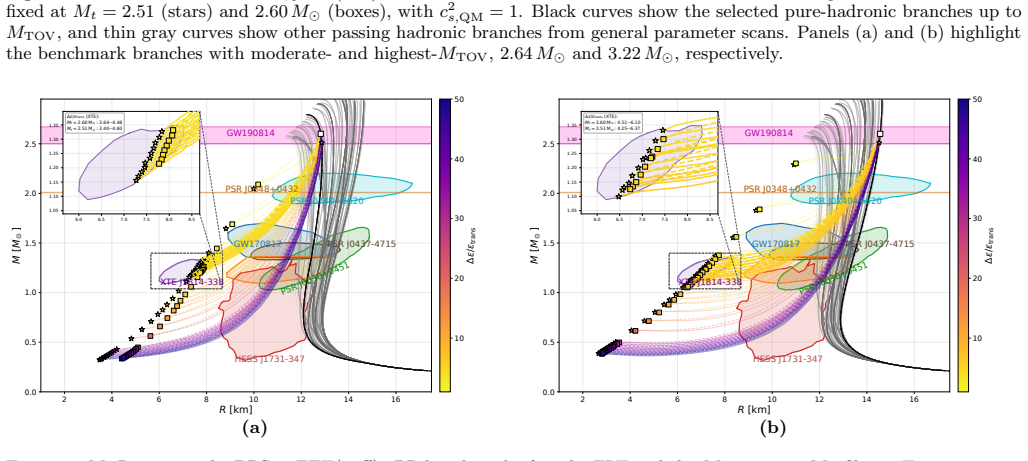
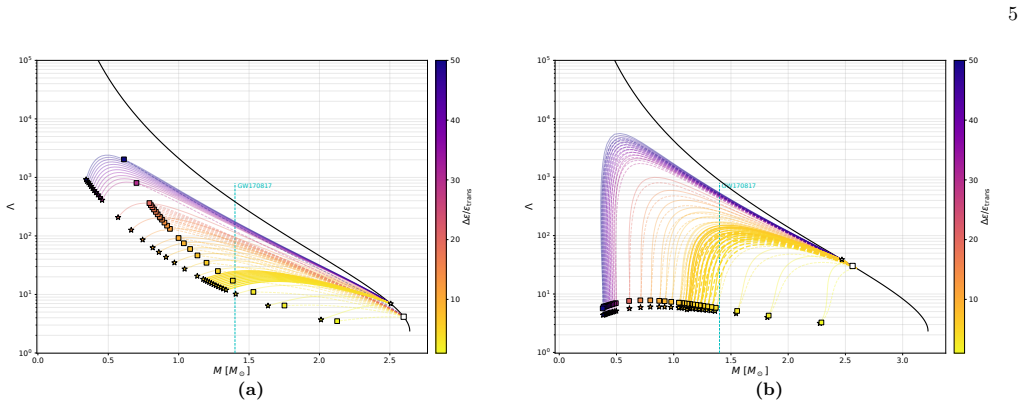
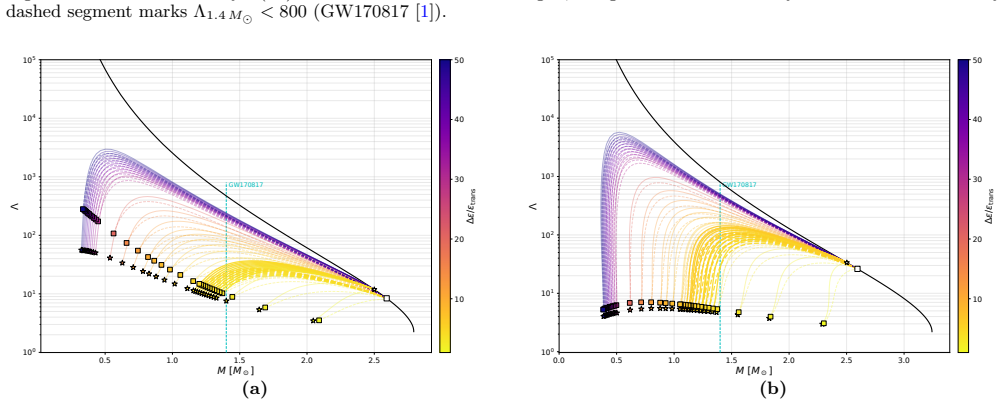
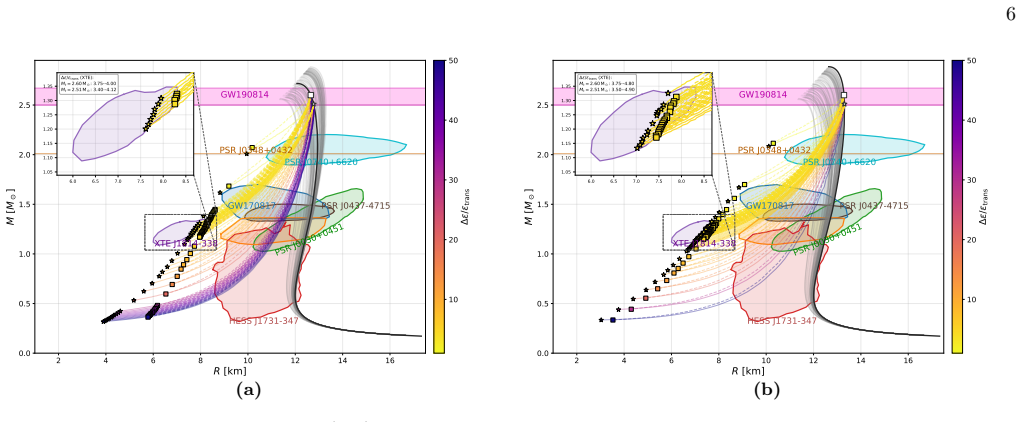
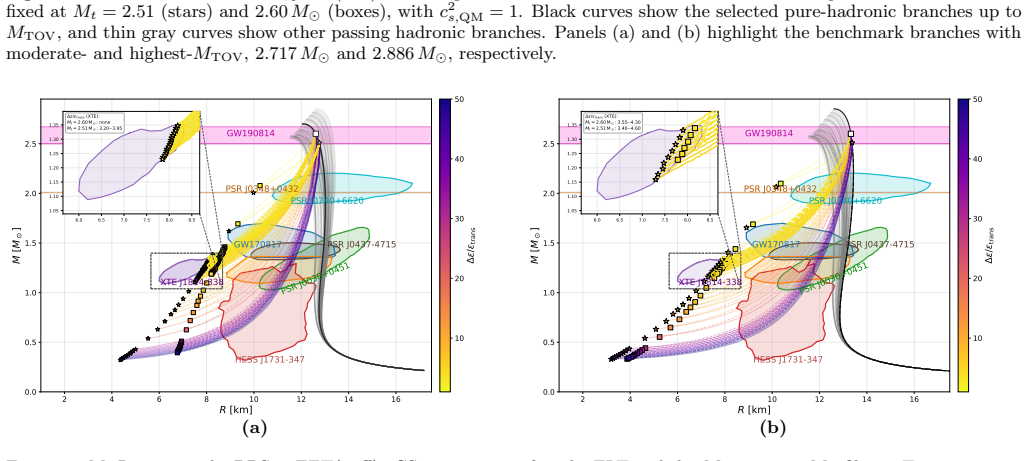
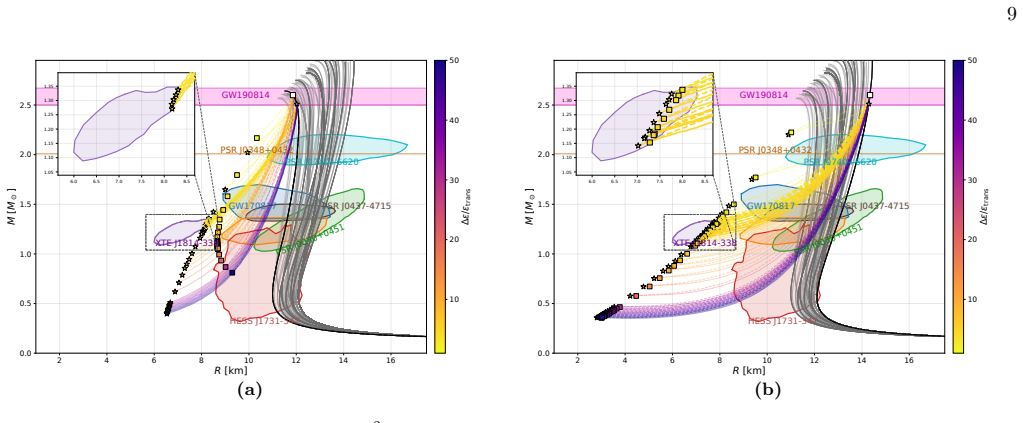
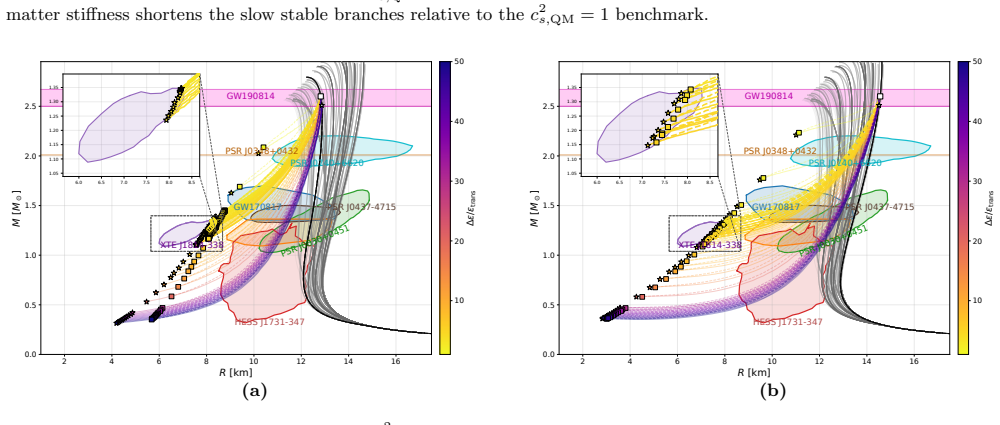
In both piecewise-polytropic and speed-of-sound parametrizations, two viable patterns emerge: one EOS places the GW190814-scale mass on the pure hadronic branch, HESS J1731-347 also on the hadronic branch, and XTE J1814-338 on the slow stable hybrid branch; the second pattern reaches the two small-radius objects on slow hybrid branches in different transition-strength regimes while keeping the high-mass object on the hadronic branch.
What carries the argument
Slow stable hybrid branches that appear when the hadron-quark phase conversion time exceeds the radial oscillation period, allowing metastable configurations beyond the usual maximum mass.
If this is right
- One equation of state can simultaneously accommodate the GW190814 secondary mass, HESS J1731-347 radius, and XTE J1814-338 radius on different branches.
- The hybrid branches remain compatible with the tidal deformability limits from GW170817 and the NICER radius measurements.
- Strong transitions produce two distinct patterns depending on whether the small-radius objects share the same transition strength.
- The hadronic branch alone can reach the high-mass regime while the hybrid branch supplies the low-radius solutions.
Where Pith is reading between the lines
- Future gravitational-wave events with intermediate masses could populate both branches and thereby map the transition density.
- If confirmed, the mechanism would imply that some observed compact objects are hybrid stars even if their masses overlap the ordinary neutron-star range.
- The same slow-conversion assumption might affect cooling rates or glitch behavior in a way distinguishable from purely hadronic models.
Load-bearing premise
The phase conversion between hadronic and quark matter must occur slowly relative to the star's radial oscillation timescale.
What would settle it
A precise mass-radius measurement of a single object whose properties lie outside both the hadronic and slow-hybrid branches of every EOS that otherwise fits the current data set.
Figures

read the original abstract
Recent anomalous compact-star observations challenge the conventional neutron-star interpretation in complementary ways: HESS J1731--347 and XTE J1814--338 favor unusually small radii at low mass, while the secondary component of GW190814 appears too massive for an ordinary neutron star under GW170817-based maximum-mass inferences. We examine whether neutron stars with a strong first-order hadron--quark phase transition can address these tensions via the extended stable hybrid branches that arise when the phase conversion is slow compared to radial oscillations, while remaining consistent with GW170817 and NICER constraints. Using a piecewise-polytropic (PP) benchmark, supplemented by an independent speed-of-sound (CS) parametrization comparison, we find two viable patterns in a general parameter scan over both the hadronic and hybrid branches. Scenario 1 realizes an all-at-once solution: the same EOS has a pure hadronic branch compatible with both the GW190814-scale mass and HESS J1731--347, while its slow stable hybrid branch reaches XTE J1814--338. Scenario 2 retains the GW190814-scale hadronic branch but reaches XTE J1814--338 and HESS J1731--347 on slow stable branches in different transition-strength regimes.
Editorial analysis
A structured set of objections, weighed in public.
Referee Report
Summary. The paper claims that slow and strong first-order hadron-quark phase transitions can relieve tensions among compact-star observations (GW190814 high mass, HESS J1731-347 and XTE J1814-338 small radii at low mass) by permitting extended stable hybrid branches. Using piecewise-polytropic and speed-of-sound parametrizations, a general scan over hadronic and hybrid branches identifies two viable patterns: Scenario 1 where one EOS satisfies GW190814 and HESS J1731-347 on the hadronic branch and XTE J1814-338 on the slow-stable hybrid branch; Scenario 2 where the small-radius objects are reached on hybrid branches in different transition-strength regimes, all while remaining consistent with GW170817 and NICER constraints.
Significance. If the slow-conversion stability extension holds and the scan results are robust, the work supplies a concrete mechanism that unifies apparently incompatible mass-radius measurements within a single EOS family, offering a falsifiable alternative to purely hadronic or other exotic explanations.
major comments (2)
- [stability criterion and scan results sections] The central claim that slow phase conversion (relative to radial-oscillation timescales) renders otherwise unstable hybrid configurations stable and accessible is load-bearing, yet the parameter scan applies the Maxwell-construction conditions without reporting explicit computation of the fundamental radial mode frequency (or an adjusted turning-point criterion) for any of the reported viable EOS points.
- [parameter scan description] The manuscript states that two viable patterns were found in a general parameter scan but provides no details on the scan procedure, convergence criteria, or selection rules used to identify viable patterns from the hadronic/hybrid parameter space; this directly affects the reliability of Scenarios 1 and 2.
minor comments (1)
- Tabulate the specific transition densities, strength parameters, and resulting maximum masses/radii for the two scenarios to allow direct reproducibility checks.
Simulated Author's Rebuttal
We thank the referee for their careful reading and constructive feedback. We address the two major comments point by point below.
read point-by-point responses
-
Referee: [stability criterion and scan results sections] The central claim that slow phase conversion (relative to radial-oscillation timescales) renders otherwise unstable hybrid configurations stable and accessible is load-bearing, yet the parameter scan applies the Maxwell-construction conditions without reporting explicit computation of the fundamental radial mode frequency (or an adjusted turning-point criterion) for any of the reported viable EOS points.
Authors: We agree that explicit verification of the radial stability for the reported viable points would strengthen the central claim. The manuscript relies on the established result from the literature that slow phase conversion extends stability beyond the usual turning-point criterion, but does not present new frequency calculations for the specific EOS identified in the scan. In revision we will add explicit fundamental-mode frequency computations (or equivalent adjusted turning-point checks) for representative viable EOS in both scenarios. revision: yes
-
Referee: [parameter scan description] The manuscript states that two viable patterns were found in a general parameter scan but provides no details on the scan procedure, convergence criteria, or selection rules used to identify viable patterns from the hadronic/hybrid parameter space; this directly affects the reliability of Scenarios 1 and 2.
Authors: We accept that additional methodological detail is required for reproducibility. The revised manuscript will include a new subsection that specifies the parameter ranges and sampling strategy for both the piecewise-polytropic and speed-of-sound families, the quantitative selection criteria (consistency with GW170817, NICER, and the target observations), and any convergence or filtering rules applied to isolate the two viable patterns. revision: yes
Circularity Check
No significant circularity; viability claims rest on explicit parameter scan
full rationale
The paper reports results from a general parameter scan over piecewise-polytropic and speed-of-sound EOS families, identifying regions where hadronic branches match high-mass constraints and slow-conversion hybrid branches match low-mass small-radius observations. No derivation step equates a claimed prediction to its own fitted inputs by construction, nor does any load-bearing premise reduce to a self-citation chain or imported uniqueness theorem. The slow-conversion stability extension is treated as an input assumption rather than derived within the scan, but this does not create a definitional loop. The central findings therefore remain independent of the scanned quantities themselves.
Axiom & Free-Parameter Ledger
free parameters (3)
- hadronic EOS parameters
- hybrid EOS parameters
- transition strength and density
axioms (2)
- domain assumption The hadron-quark conversion is a strong first-order phase transition.
- domain assumption Phase conversion proceeds slowly relative to radial oscillation timescales.
Forward citations
Cited by 1 Pith paper
-
Systematic study of the morphology and length of slow stable hybrid star branches
Systematic numerical survey classifies four types of slow stable hybrid star branches and shows slow conversion opens new viable parameter space for stiff hadronic models.
Reference graph
Works this paper leans on
-
[1]
For slow conversion, used in the main analysis, they are [ξ] + − = 0 and [∆P] + − = 0
For rapid phase conversion, the interface conditions are [∆P] + − = 0 and [ξ−∆P/(rP ′)]+ − = 0. For slow conversion, used in the main analysis, they are [ξ] + − = 0 and [∆P] + − = 0. For comparisons with gravitational wave observations, the dimensionless tidal deformability Λ = 2k2/(3C5) can be computed, whereC=M/Ris the compactness and k2 is the Love num...
-
[2]
(A2), using the boundary conditiony(0) = 2
concurrently with the TOV equation Eq. (A2), using the boundary conditiony(0) = 2. For hybrid stars, the matching conditiony(r + d )−y(r − d ) =−4πr 3 d∆εd/(m(rd)+ 4πr3 dP(r d)) must be applied atr d (i.e., at the transition interface wherer core =r(P=P trans)), where an energy density jump ∆ε d occurs [99, 100]. Appendix B: Accelerated endpoints search: ...
-
[3]
integrate the TOV equations outward to the surface P(R) = 0
-
[4]
(A3) and (A4) withω 2 = 0, using the regular central conditionsξ(0) = 1 and (∆P) r=0 = −3(ξΓP) r=0
integrate Eqs. (A3) and (A4) withω 2 = 0, using the regular central conditionsξ(0) = 1 and (∆P) r=0 = −3(ξΓP) r=0
-
[5]
at a first-order phase transition, apply the slow- conversion junction conditions [ξ] + − = 0 and [∆P] + − = 0 by keeping both perturbation variables continuous while switching the EOS branch in the background coefficients
-
[6]
evaluateF(P c) at the surface. The endpoint central pressureP ∗ c is the root of the one- dimensional equation F(P ∗ c ) = 0,(B2) which may be located with any robust scalar root finder once a bracketing interval has been identified. Each eval- uation ofF(P c) requires only one background integration and one zero-frequency perturbation integration, so the...
-
[7]
For the polytropic benchmark, each Hebeler et al. Fig. 6 parameter range is discretized withequally spaced samples between the quoted endpoints: four samples for hadronic selection and the coloured transition scans, and eight samples for the denser gray-background pool (the latter combined with causal-limit adaptive pruning). Both scans apply the same fil...
-
[8]
B. P. Abbottet al.(LIGO Scientific Collaboration and Virgo Collaboration), Phys. Rev. Lett.119, 161101 (2017)
2017
-
[9]
Hinderer, Astrophys
T. Hinderer, Astrophys. J.677, 1216 (2008)
2008
-
[10]
Hinderer, B
T. Hinderer, B. D. Lackey, R. N. Lang, and J. S. Read, Phys. Rev. D81, 123016 (2010)
2010
-
[11]
Postnikov, M
S. Postnikov, M. Prakash, and J. M. Lattimer, Phys. Rev. D82, 024016 (2010)
2010
-
[12]
M. C. Milleret al., Astrophys. J. Lett.887, L24 (2019)
2019
-
[13]
T. E. Rileyet al., Astrophys. J. Lett.887, L21 (2019)
2019
-
[14]
M. C. Milleret al., Astrophys. J. Lett.918, L28 (2021)
2021
-
[15]
T. E. Rileyet al., Astrophys. J. Lett.918, L27 (2021)
2021
-
[16]
Choudhuryet al., Astrophys
D. Choudhuryet al., Astrophys. J. Lett.971, L20 (2024)
2024
-
[17]
Rutherfordet al., Astrophys
N. Rutherfordet al., Astrophys. J. Lett.971, L19 (2024)
2024
- [18]
- [19]
-
[20]
Y. Fujimoto, K. Fukushima, L. D. McLerran, and M. Praszalowicz, Phys. Rev. Lett.129, 252702 (2022), arXiv:2207.06753 [nucl-th]
arXiv 2022
-
[21]
O. Komoltsev, Phys. Rev. D110, L071502 (2024), arXiv:2404.05637 [nucl-th]
arXiv 2024
-
[22]
Abbottet al.(LIGO Scientific Collaboration and Virgo Collaboration), Astrophys
R. Abbottet al.(LIGO Scientific Collaboration and Virgo Collaboration), Astrophys. J. Lett.896, L44 (2020)
2020
-
[23]
Margalit and B
B. Margalit and B. D. Metzger, Astrophys. J. Lett.850, L19 (2017)
2017
-
[24]
Rezzolla, E
L. Rezzolla, E. R. Most, and L. R. Weih, Astrophys. J. Lett.852, L25 (2018)
2018
-
[25]
M. Ruiz, S. L. Shapiro, and A. Tsokaros, Phys. Rev. D 97, 021501 (2018)
2018
-
[26]
Shibata, E
M. Shibata, E. Zhou, K. Kiuchi, and S. Fujibayashi, Phys. Rev. D100, 023015 (2019). 10
2019
-
[27]
Doroshenko, V
V. Doroshenko, V. Suleimanov, G. Puehlhofer, and A. Santangelo, Nature Astronomy6, 1444 (2022)
2022
-
[28]
Kiniet al., Mon
Y. Kiniet al., Mon. Not. Roy. Astron. Soc. (2024), mass–radius inference used here through the project XTE 95 percent contour
2024
-
[29]
Laskos-Patkos, P
P. Laskos-Patkos, P. S. Koliogiannis, and C. C. Mous- takidis, Phys. Rev. D109, 063017 (2024)
2024
-
[30]
P. Laskos-Patkos and C. C. Moustakidis, arXiv e-prints , arXiv:2410.18498 (2025), arXiv:2410.18498 [astro- ph.HE]
arXiv 2025
-
[31]
S.-H. Yang, C.-M. Pi, and F. Weber, Phys. Rev. D111, 043037 (2025), arXiv:2409.15969 [astro-ph.HE]
arXiv 2025
-
[32]
Mariani, I
M. Mariani, I. F. Ranea-Sandoval, G. Lugones, and M. G. Orsaria, Phys. Rev. D110, 043026 (2024)
2024
-
[33]
T. Zhou and C. Huang, arXiv e-prints , arXiv:2501.06379 (2025), arXiv:2501.06379 [astro- ph.HE]
arXiv 2025
-
[34]
M. Mariani and I. F. Ranea-Sandoval, Symmetry18, 27 (2026), arXiv:2602.06170 [astro-ph.HE]
arXiv 2026
-
[35]
Zhou and C
T. Zhou and C. Huang, Astrophys. J.1002, 120 (2026)
2026
-
[36]
X. Dong, H. Shen, J. Hu, and Y. Zhang, (2026), arXiv:2604.21379 [astro-ph.HE]
Pith/arXiv arXiv 2026
-
[37]
Dexheimer, L
V. Dexheimer, L. T. T. Soethe, J. Roark, R. O. Gomes, S. O. Kepler, and S. Schramm, Int. J. Mod. Phys. E 27, 1830008 (2018)
2018
-
[38]
Alford, M
M. Alford, M. Braby, M. W. Paris, and S. Reddy, As- trophys. J.629, 969 (2005)
2005
-
[39]
M. G. Alford, S. Han, and M. Prakash, Phys. Rev. D 88, 083013 (2013)
2013
-
[40]
Z. F. Seidov, Soviet Astronomy15, 347 (1971)
1971
-
[41]
Schertler, C
K. Schertler, C. Greiner, J. Schaffner-Bielich, and M. H. Thoma, Nucl. Phys. A677, 463 (2000)
2000
-
[42]
Haensel, J
P. Haensel, J. L. Zdunik, and R. Schaeffer, Astron. Astrophys.217, 137 (1989)
1989
-
[43]
J. P. Pereira, C. V. Flores, and G. Lugones, Astrophys. J.860, 12 (2018)
2018
-
[44]
Mariani, M
M. Mariani, M. G. Orsaria, I. F. Ranea-Sandoval, and G. Lugones, Mon. Not. Roy. Astron. Soc.489, 4261 (2019)
2019
-
[45]
Lugones and A
G. Lugones and A. G. Grunfeld, Universe7, 493 (2021)
2021
-
[46]
G. Lugones, M. Mariani, and I. F. Ranea-Sandoval, JCAP03, 028 (2023), arXiv:2106.10380 [nucl-th]
arXiv 2023
-
[47]
V. P. Goncalves, J. C. Jimenez, and L. Lazzari, Eur. Phys. J. C82, 1117 (2022)
2022
-
[48]
P. B. Rau and A. Sedrakian, Phys. Rev. D107, 103042 (2023)
2023
-
[49]
P. B. Demorest, T. Pennucci, S. M. Ransom, M. S. E. Roberts, and J. W. T. Hessels, Nature467, 1081 (2010)
2010
-
[50]
Antoniadiset al., Science340, 6131 (2013), arXiv:1304.6875 [astro-ph.HE]
J. Antoniadiset al., Science340, 6131 (2013), arXiv:1304.6875 [astro-ph.HE]
Pith/arXiv arXiv 2013
-
[51]
H. T. Cromartieet al.(NANOGrav), Nature Astronomy 4, 72 (2020), arXiv:1904.06759 [astro-ph.HE]
arXiv 2020
- [52]
-
[53]
Z. Yang, T. Zeng, Y. Yan, W.-L. Yuan, C. Zhang, and E. Zhou, Phys. Rev. D113, 023021 (2026), arXiv:2507.00776 [astro-ph.HE]
arXiv 2026
-
[54]
C. Zhang and J. Ren, Phys. Rev. D108, 063012 (2023), arXiv:2211.12043 [astro-ph.HE]
arXiv 2023
- [55]
-
[56]
R. Negreiros, C. Zhang, and R. Xu, Phys. Rev. D111, 063026 (2025), arXiv:2407.06410 [astro-ph.HE]
arXiv 2025
- [57]
- [58]
-
[59]
Haensel, J
P. Haensel, J. L. Zdunik, and R. Schaeffer, Astron. Astrophys.160, 121 (1986)
1986
-
[60]
Alcock, E
C. Alcock, E. Farhi, and A. Olinto, Astrophys. J.310, 261 (1986)
1986
- [61]
- [62]
- [63]
-
[64]
W.-L. Yuan, A. Li, Z. Miao, B. Zuo, and Z. Bai, Phys. Rev. D105, 123004 (2022), arXiv:2203.04798 [nucl-th]
arXiv 2022
-
[65]
C. Zhang and R. B. Mann, Phys. Rev. D103, 063018 (2021), arXiv:2009.07182 [astro-ph.HE]
arXiv 2021
- [66]
-
[67]
J. M. Z. Pretel and C. Zhang, JCAP10, 032 (2024), arXiv:2401.12519 [nucl-th]
arXiv 2024
-
[68]
Y. Zhou, C. Zhang, J. Zhao, K. Kiuchi, S. Fu- jibayashi, and E. Zhou, Phys. Rev. D110, 103012 (2024), arXiv:2407.08544 [astro-ph.HE]
arXiv 2024
-
[69]
W.-J. Xie, C.-J. Xia, C. Zhang, and R. Xu, arXiv e- prints (2025), arXiv:2506.22781 [astro-ph.HE]
Pith/arXiv arXiv 2025
-
[70]
Z. Miao, Z. Zhu, and D. Lai, Phys. Rev. Lett.135, 091402 (2025), arXiv:2411.09013 [astro-ph.HE]
arXiv 2025
-
[71]
X. Y. Lai and R. X. Xu, Monthly Notices of the Royal Astronomical Society: Letters398, L31 (2009)
2009
- [72]
-
[73]
C.-M. Li, G.-H. Yu, Y.-P. Zhao, Z. Li, J.-L. Zhang, Y.-L. Ma, and Y.-F. Huang, arXiv e-prints (2026), arXiv:2604.22382 [hep-ph]
Pith/arXiv arXiv 2026
-
[74]
W.-L. Yuan, C. Huang, C. Zhang, E. Zhou, and R. Xu, Phys. Rev. D111, 063033 (2025), arXiv:2411.14938 [astro-ph.HE]
arXiv 2025
- [75]
-
[76]
A. R. Bodmer, Phys. Rev. D4, 1601 (1971)
1971
-
[77]
Witten, Phys
E. Witten, Phys. Rev. D30, 272 (1984)
1984
-
[78]
Farhi and R
E. Farhi and R. L. Jaffe, Phys. Rev. D30, 2379 (1984)
1984
-
[79]
B. Holdom, J. Ren, and C. Zhang, Phys. Rev. Lett. 120, 222001 (2018), arXiv:1707.06610 [hep-ph]
Pith/arXiv arXiv 2018
-
[80]
R.-X. Xu, Astrophys. J. Lett.596, L59 (2003), arXiv:astro-ph/0302165
Pith/arXiv arXiv 2003
discussion (0)
Sign in with ORCID, Apple, or X to comment. Anyone can read and Pith papers without signing in.