The Beauty of k2: Probing Stellar Interiors Using Apsidal Motion. I. The Benchmark Massive Binary HD 152248
Pith reviewed 2026-05-22 08:49 UTC · model grok-4.3
The pith
Apsidal motion in the massive binary HD 152248 requires large convective overshooting to match observed stellar structure constants k2.
A machine-rendered reading of the paper's core claim, the machinery that carries it, and where it could break.
Core claim
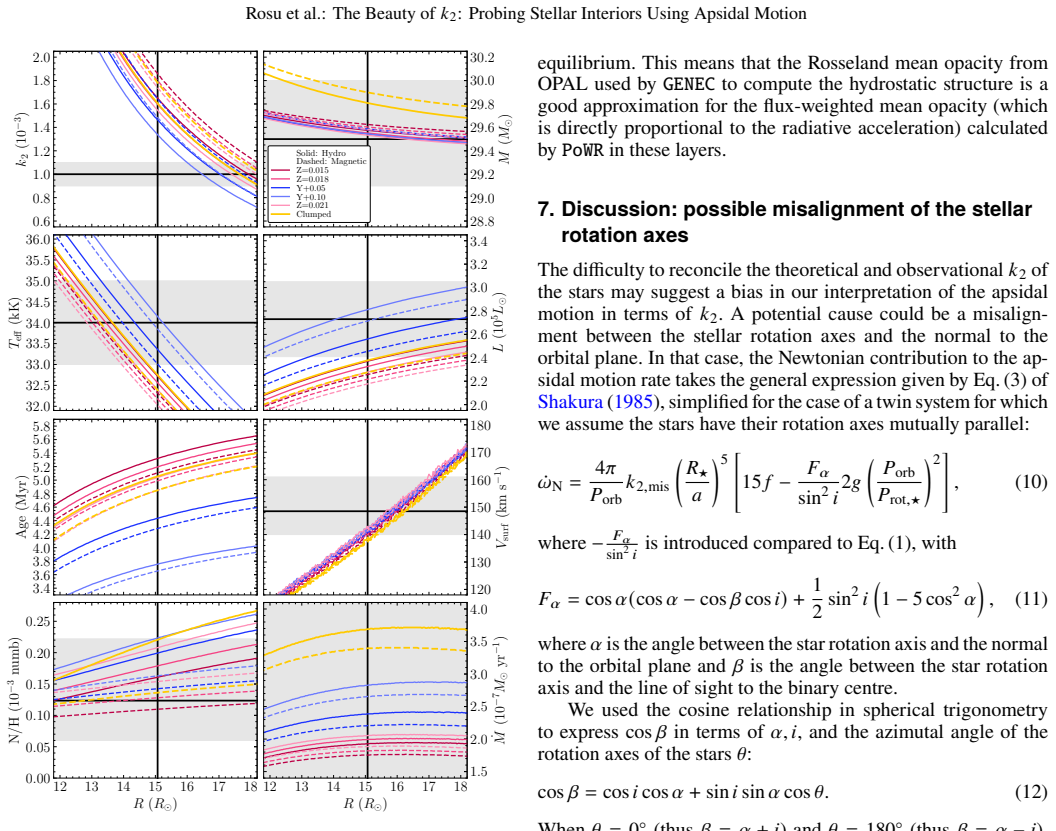
Models of the stars in HD 152248, computed with the GENEC code under both purely hydrodynamic and magneto-diffusive angular momentum transport, yield k2 values systematically larger than those inferred from the observed apsidal motion. To reproduce the stellar parameters including the apsidal motion, both model families require a step-overshoot parameter of 1.2 pressure scale heights. This points to an insufficient density contrast between the core and external layers in the models. Other parameters such as initial mass, metallicity, helium content, and mass-loss rate have negligible impact on the evolution of k2. The assumption of pseudo-synchronization due to efficient tidal locking is a
What carries the argument
The internal structure constant k2, which quantifies the departure from uniform density and enters the expression for the apsidal motion rate in close binaries.
If this is right
- Massive star models need significantly larger convective overshooting than currently standard to match internal structure.
- The k2 discrepancy suggests current models have insufficient core-envelope density contrast.
- Apsidal motion observations can constrain mixing physics independently of other parameters like mass loss.
- For this system, pseudo-synchronization due to tides is a valid assumption, limiting misalignment angles to about 50 degrees.
Where Pith is reading between the lines
- This approach could be applied to other massive binaries to build a larger sample of k2 measurements.
- If the large overshoot is confirmed, it would affect predictions for supernova progenitors and chemical enrichment.
- The result highlights the value of binary systems for testing single-star evolution assumptions.
Load-bearing premise
The observed apsidal motion rate is determined solely by the internal structure constants k2 of the two stars, with negligible contributions from unmodeled tidal or rotational effects.
What would settle it
A high-precision asteroseismic measurement of the core size or density profile in one of the stars would directly test whether the large overshoot value of 1.2 is required.
Figures




read the original abstract
Over the last decades, several independent studies have shown the need for large convective boundary mixing (CBM) and convective core sizes in massive stars to reproduce a variety of their observed properties. Yet, stars more massive than 20Msun lack a quantitative prescription for CBM as well as an unequivocal constraint on the internal mixing mechanisms acting in them. We use the apsidal motion observed in the twin binary HD152248 - linked to the internal stellar structure constants k2 of the stars - to constrain massive stars' internal density stratification and CBM. We build GENEC stellar models assuming two different angular momentum transports: purely hydrodynamic (hydro) and magneto-diffusive (magnetic). We confront single- and binary-star models to assess the impact of tidal locking on the star's evolution. We investigate the impact of CBM (overshooting), metallicity, initial helium abundance and mass, mass-loss rate, and mixing length parameter on the evolution of stellar parameters. We highlight that k2 from the models are systematically larger than observed ones, the so-called k2-discrepancy. Models predict stars with too low a density contrast between their core and external layers. Both hydro and magnetic models require large step-overshoot of 1.2 to reproduce stellar parameters, including k2. Other parameters have almost no impact. Given the efficiency of tides to synchronise systems, the assumption of pseudo-synchronisation is sound for this system. It sets an upper limit on the misalignment angle of stellar rotation axes of ~50{\deg}. Even with such unexpected large angles, the k2-discrepancy is not solved. Even if the mass-loss rate was underestimated by a factor two, it would have no impact on stellar parameters evolution, including k2. It demonstrates that the apsidal motion is a powerful, robust means to probe stellar interiors.
Editorial analysis
A structured set of objections, weighed in public.
Referee Report
Summary. The manuscript models the massive twin binary HD 152248 with the GENEC code under purely hydrodynamic and magneto-diffusive angular-momentum transport. By comparing predicted apsidal-motion constants k2 to the value inferred from the observed apsidal rate, the authors conclude that a step-overshoot parameter of 1.2 is required to reproduce both the stellar parameters and k2, that models systematically under-predict the core-to-envelope density contrast (the k2-discrepancy), and that apsidal motion remains a robust interior probe even after allowing for misalignment angles up to ~50°.
Significance. If the mapping from observed apsidal rate to k2 is robust, the work supplies a rare quantitative anchor for convective-boundary mixing in stars above 20 solar masses, where prescriptions remain largely unconstrained. The side-by-side hydro versus magnetic comparison and the systematic exploration of mass, metallicity, helium, mass-loss, and mixing-length variations are positive features that isolate overshoot as the dominant degree of freedom.
major comments (2)
- [Abstract and results section describing the overshoot scan] The central numerical result (step-overshoot = 1.2) is obtained by tuning the overshoot parameter until the model k2 matches the observed value. This procedure converts the exercise into a calibration rather than an independent test of the internal-structure prediction; the k2-discrepancy is therefore an empirical finding only after the fit has been performed.
- [Discussion of pseudo-synchronization and misalignment limit] The assumption that the observed apsidal rate is determined solely by the two stars' k2 values, with negligible contributions from GR precession, higher-order tidal terms, or residual misalignment, is stated but not quantified relative to the measurement precision. The manuscript checks misalignment up to ~50° and invokes efficient tidal synchronization, yet does not report the magnitude of the omitted terms or propagate them into the uncertainty on the inferred k2.
minor comments (2)
- [Parameter-variation subsection] Explicit tables or figures showing the change in k2 when each secondary parameter (metallicity, initial helium, mass-loss rate, mixing length) is varied would strengthen the claim that these quantities have 'almost no impact'.
- [Observational constraints paragraph] The observational error budget on the apsidal rate, the data-reduction steps, and the precise fitting procedure used to extract the observed k2 should be stated with numerical values rather than summarized qualitatively.
Simulated Author's Rebuttal
We thank the referee for the thoughtful and constructive report. Below we respond point by point to the two major comments, indicating the changes we will make to the manuscript.
read point-by-point responses
-
Referee: [Abstract and results section describing the overshoot scan] The central numerical result (step-overshoot = 1.2) is obtained by tuning the overshoot parameter until the model k2 matches the observed value. This procedure converts the exercise into a calibration rather than an independent test of the internal-structure prediction; the k2-discrepancy is therefore an empirical finding only after the fit has been performed.
Authors: We agree that the specific value of 1.2 is identified by matching the model k2 to the observed apsidal-motion constant. Our systematic parameter study nevertheless shows that overshoot is the only input that substantially alters k2, while changes in mass, metallicity, initial helium, mass-loss rate and mixing length produce negligible shifts. The k2-discrepancy therefore remains a genuine finding: models computed with the smaller overshoot values commonly adopted for lower-mass stars systematically under-predict the core-to-envelope density contrast required by the data. We will revise the abstract and the results section that describes the overshoot scan to frame the exercise explicitly as a determination of the convective-boundary-mixing parameter needed to reproduce both the stellar parameters and k2, rather than as an a-priori prediction. revision: yes
-
Referee: [Discussion of pseudo-synchronization and misalignment limit] The assumption that the observed apsidal rate is determined solely by the two stars' k2 values, with negligible contributions from GR precession, higher-order tidal terms, or residual misalignment, is stated but not quantified relative to the measurement precision. The manuscript checks misalignment up to ~50° and invokes efficient tidal synchronization, yet does not report the magnitude of the omitted terms or propagate them into the uncertainty on the inferred k2.
Authors: We acknowledge that the manuscript does not yet provide explicit estimates of the general-relativistic precession term, higher-order tidal contributions, or the residual misalignment effect expressed relative to the observational uncertainty on the apsidal rate. The present text shows only that misalignment angles up to 50° leave the k2-discrepancy intact and that tidal synchronisation is expected to be efficient. In the revised version we will calculate the magnitude of the GR term for the observed orbital period and masses, estimate the size of higher-order tidal corrections, and propagate these contributions into the uncertainty budget on the inferred k2. This will allow a direct comparison with the measurement precision and will strengthen the claim that the observed apsidal motion remains a robust interior diagnostic. revision: yes
Circularity Check
No significant circularity detected
full rationale
The paper derives an observed k2 value from the measured apsidal motion rate of HD 152248 and then adjusts the step-overshoot parameter in GENEC models (both hydro and magnetic) until the model k2 matches the observed value. This is presented as a constraint on convective boundary mixing rather than a first-principles prediction. The abstract and text explicitly frame the large overshoot of 1.2 as required 'to reproduce stellar parameters, including k2' and highlight the k2-discrepancy as a comparison between model outputs and external observational data. No equation reduces to its input by construction, no fitted quantity is relabeled as an independent prediction, and no self-citation chain is load-bearing for the central result. The derivation remains self-contained against the external benchmark of the observed apsidal motion once the stated assumptions (pseudo-synchronization, negligible higher-order tides) are granted.
Axiom & Free-Parameter Ledger
free parameters (1)
- step-overshoot =
1.2
axioms (1)
- domain assumption Observed apsidal motion constant k2 directly reflects the internal density stratification of the stars
Lean theorems connected to this paper
-
IndisputableMonolith/Foundation/AlexanderDuality.leanalexander_duality_circle_linking unclear?
unclearRelation between the paper passage and the cited Recognition theorem.
Both hydro and magnetic models require large step-overshoot of 1.2 to reproduce stellar parameters, including k2.
What do these tags mean?
- matches
- The paper's claim is directly supported by a theorem in the formal canon.
- supports
- The theorem supports part of the paper's argument, but the paper may add assumptions or extra steps.
- extends
- The paper goes beyond the formal theorem; the theorem is a base layer rather than the whole result.
- uses
- The paper appears to rely on the theorem as machinery.
- contradicts
- The paper's claim conflicts with a theorem or certificate in the canon.
- unclear
- Pith found a possible connection, but the passage is too broad, indirect, or ambiguous to say the theorem truly supports the claim.
Reference graph
Works this paper leans on
-
[1]
Abbott,B.P.,Abbott,R.,Abbott,T.D.,etal.2016,Phys.Rev.Lett.,116,061102
work page 2016
-
[2]
2021, Reviews of Modern Physics, 93, 015001
Aerts, C. 2021, Reviews of Modern Physics, 93, 015001
work page 2021
-
[3]
Asplund, M., Grevesse, N., Sauval, A. J., & Scott, P. 2009, ARA&A, 47, 481
work page 2009
-
[4]
2023, MNRAS, 519, 5333 Björklund, R., Sundqvist, J
Baraffe, I., Clarke, J., Morison, A., et al. 2023, MNRAS, 519, 5333 Björklund, R., Sundqvist, J. O., Puls, J., & Najarro, F. 2021, A&A, 648, A36
work page 2023
-
[5]
A., de Koter, A., Bestenlehner, J
Brands, S. A., de Koter, A., Bestenlehner, J. M., et al. 2022, A&A, 663, A36
work page 2022
-
[6]
Brott, I., de Mink, S. E., Cantiello, M., et al. 2011, A&A, 530, A115
work page 2011
- [7]
- [8]
- [9]
- [10]
-
[11]
S., Monteiro, H., Moitinho, A., et al
Dias, W. S., Monteiro, H., Moitinho, A., et al. 2021, MNRAS, 504, 356
work page 2021
-
[12]
Eddington, A. S. 1925, The Observatory, 48, 73
work page 1925
-
[13]
Eggenberger, P., Meynet, G., Maeder, A., et al. 2008, Ap&SS, 316, 43
work page 2008
-
[14]
Eggenberger, P., Moyano, F. D., & den Hartogh, J. W. 2022, A&A, 664, L16 Ekström, S., Georgy, C., Eggenberger, P., et al. 2012, A&A, 537, A146
work page 2022
-
[15]
E., Sukhbold, T., & Ugliano, M
Ertl, T., Janka, H.-T., Woosley, S. E., Sukhbold, T., & Ugliano, M. 2016, ApJ, 818, 124
work page 2016
- [16]
- [17]
-
[18]
2021, MNRAS, 503, 1884 Gräfener, G., Koesterke, L., & Hamann, W.-R
Gilkis, A., Shenar, T., Ramachandran, V., et al. 2021, MNRAS, 503, 1884 Gräfener, G., Koesterke, L., & Hamann, W.-R. 2002, A&A, 387, 244
work page 2021
- [19]
-
[20]
Hejlesen, P. M. 1987, A&AS, 69, 251
work page 1987
-
[21]
Higgins, E. R. & Vink, J. S. 2019, A&A, 622, A50
work page 2019
-
[22]
Josiek, J., Sander, A. A. C., Bernini-Peron, M., et al. 2025, A&A, 697, A193
work page 2025
- [23]
-
[24]
Kaiser, E. A., Hirschi, R., Arnett, W. D., et al. 2020, MNRAS, 496, 1967 Krtička, J. & Kubát, J. 2017, A&A, 606, A31 Krtička, J. & Kubát, J. 2018, A&A, 612, A20 Krtička, J., Kubát, J., & Krtičková, I. 2024, A&A, 681, A29
work page 2020
-
[25]
Lennon, D. J. & Dufton, P. L. 1983, MNRAS, 203, 443
work page 1983
- [26]
- [27]
- [28]
- [29]
- [30]
- [31]
-
[32]
Marcussen, M. L. & Albrecht, S. H. 2022, ApJ, 933, 227
work page 2022
-
[33]
Martinet, S., Meynet, G., Ekström, S., et al. 2021, A&A, 648, A126
work page 2021
- [34]
-
[35]
M., Barbuy, B., Cunha, K., & Korotin, S
Mathys, G., Andrievsky, S. M., Barbuy, B., Cunha, K., & Korotin, S. A. 2002, A&A, 387, 890
work page 2002
-
[36]
Nandal, D., Meynet, G., Ekström, S., et al. 2024, A&A, 684, A169
work page 2024
-
[37]
Paunzen, E., Heiter, U., Netopil, M., & Soubiran, C. 2010, A&A, 517, A32
work page 2010
-
[38]
Pedersen, M. G., Aerts, C., Pápics, P. I., et al. 2021, Nature Astronomy, 5, 715
work page 2021
- [39]
- [40]
-
[41]
Sana, H., Rauw, G., Sung, H., Gosset, E., & Vreux, J. M. 2007, MNRAS, 377, 945
work page 2007
- [42]
-
[43]
Sanyal, D., Grassitelli, L., Langer, N., & Bestenlehner, J. M. 2015, A&A, 580, A20
work page 2015
-
[44]
Sciarini, L., Ekström, S., Eggenberger, P., et al. 2024, A&A, 681, L1
work page 2024
-
[45]
2026, arXiv e-prints, arXiv:2601.14363
Sciarini, L., Rosu, S., Ekström, S., et al. 2026, arXiv e-prints, arXiv:2601.14363
-
[46]
Scott, L. J. A., Hirschi, R., Georgy, C., et al. 2021, MNRAS, 503, 4208
work page 2021
-
[47]
Scuflaire, R., Théado, S., Montalbán, J., et al. 2008, Ap&SS, 316, 83
work page 2008
-
[48]
Shakura, N. I. 1985, Soviet Astronomy Letters, 11, 224
work page 1985
-
[49]
F., Maeder, A., Meynet, G., et al
Song, H. F., Maeder, A., Meynet, G., et al. 2013, A&A, 556, A100 Song,H.F.,Meynet,G.,Maeder,A.,Ekström,S.,&Eggenberger,P.2016,A&A, 585, A120
work page 2013
-
[50]
Spruit, H. C. 2002, A&A, 381, 923
work page 2002
- [51]
-
[52]
Sung, H., Sana, H., & Bessell, M. S. 2013, AJ, 145, 37
work page 2013
-
[53]
Sweet, P. A. 1950, MNRAS, 110, 548
work page 1950
-
[54]
Tadross, A. L. 2003, New A, 8, 737
work page 2003
-
[55]
Tkachenko, A., Pavlovski, K., Johnston, C., et al. 2020, A&A, 637, A60
work page 2020
-
[56]
Vink, J. S., de Koter, A., & Lamers, H. J. G. L. M. 2001, A&A, 369, 574 Šurlan, B., Hamann, W.-R., Kubát, J., Oskinova, L. M., & Feldmeier, A. 2012, A&A, 541, A37
work page 2001
- [57]
-
[58]
Zahn, J. P. 1992, A&A, 265, 115 Article number, page 12 Rosu et al.: The Beauty of𝑘2: Probing Stellar Interiors Using Apsidal Motion Appendix A: Additional figures 0.5 1.0 1.5 2.0 2.5 3.0 3.5 4.0 4.5 5.0 k2 (10□3) Solid: Hydro Dashed: Magnetic Reference Period free vini/vcr = 0.1 vini/vcr = 0.2 28.8 29.0 29.2 29.4 29.6 29.8 30.0 30.2 M (M⊙) 32.0 32.5 33.0...
work page 1992
discussion (0)
Sign in with ORCID, Apple, or X to comment. Anyone can read and Pith papers without signing in.