Evaluating causal indirect effects when mediators are left-censored by assay limit of quantification
Pith reviewed 2026-05-21 03:18 UTC · model grok-4.3
The pith
Fractional imputation and semi-parametric EM enable estimation of natural direct and indirect effects when mediators are left-censored by assay limits.
A machine-rendered reading of the paper's core claim, the machinery that carries it, and where it could break.
Core claim
The natural direct and indirect effects remain identifiable and estimable under deterministic left-censoring of the mediator at the assay limit of quantification by factorizing the data likelihood and recovering its censored components through fractional imputation embedded in a semi-parametric EM algorithm, which yields both plug-in and efficient estimators together with an m-out-of-n bootstrap that accounts for the imputation step.
What carries the argument
Fractional imputation inside a semi-parametric EM algorithm that flexibly estimates the factorized observed-data likelihood components under known deterministic left-censoring.
If this is right
- Natural direct and indirect effects can be estimated without discarding or naively imputing censored mediator values.
- Both traditional plug-in and asymptotically efficient estimators become available once the likelihood components are recovered.
- The m-out-of-n bootstrap supplies valid standard errors that incorporate uncertainty from the imputation procedure.
- Application to the ACTIV-2 trial indicates that viral RNA mediates only a modest fraction of the monoclonal antibody effect on hospitalization and death.
Where Pith is reading between the lines
- The same factorization-plus-imputation structure could be reused for other deterministic MNAR mechanisms such as right-censoring or detection limits in different assay types.
- Extending the framework to time-to-event mediators or multiple partially censored mediators would require only modest changes to the likelihood factorization.
- In surrogate-endpoint validation settings, the method could supply more accurate mediation proportions when the candidate surrogate is subject to assay censoring.
Load-bearing premise
The censoring mechanism is known and deterministic at the assay limit, and the usual causal mediation assumptions of sequential ignorability and positivity hold.
What would settle it
A simulation experiment with known true direct and indirect effects, known censoring threshold, and repeated application of the proposed versus naive estimators; large remaining bias or coverage failure would falsify the claim.
Figures

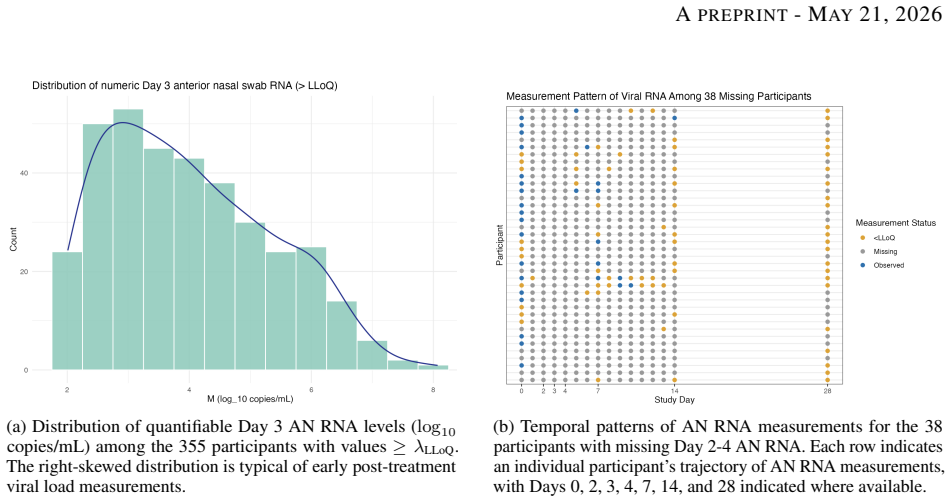
read the original abstract
Causal mediation analysis is essential for disentangling the mechanisms by which investigational therapeutic and preventive agents impact clinical outcomes. However, the measurement of biological mediators is often subject to left-censoring by technical measurement limitations, most commonly an assay's limit of quantification. This form of censoring can pose severe challenges for both identification and estimation of causal mediation estimands, particularly when the censoring mechanism is deterministic and the resulting missingness is missing not at random (MNAR) or nonignorable. Motivated by the question of assessing the role of viral RNA in the action mechanism of monoclonal antibody therapies for COVID-19 in the Accelerating COVID-19 Therapeutics and Vaccine (ACTIV)-2 platform trial, we develop a semi-parametric framework for estimation of the natural direct and indirect effects when the mediator of interest is partially subject to this form of left-censoring. Our proposed strategy combines fractional imputation with a semi-parametric EM algorithm to flexibly estimate key components of the factorized data likelihood. Applying the proposed strategy to circumvent the left-censoring, we discuss both traditional plug-in and asymptotically efficient estimators of the direct and indirect effect estimands, introducing a data-adaptive $m$-out-of-$n$ bootstrap for robust inference under the imputation procedure. We demonstrate in numerical experiments that our approach significantly reduces bias and allows for reliable inference. An application to data from the ACTIV-2 platform trial confirms that monoclonal antibody therapies reduce the risk of hospitalization and death due to COVID-19, while suggesting that changes in viral RNA mediate only a modest proportion of the overall treatment effect.
Editorial analysis
A structured set of objections, weighed in public.
Referee Report
Summary. The manuscript develops a semi-parametric framework for estimating natural direct and indirect effects in causal mediation analysis when the mediator is subject to deterministic left-censoring at an assay limit of quantification, inducing MNAR missingness. The proposed strategy combines fractional imputation with a semi-parametric EM algorithm to estimate components of the observed-data likelihood, discusses plug-in and asymptotically efficient estimators, and introduces a data-adaptive m-out-of-n bootstrap for inference. Numerical experiments show bias reduction relative to naive approaches, and the method is applied to ACTIV-2 trial data to evaluate viral RNA as a mediator of monoclonal antibody effects on COVID-19 hospitalization and death.
Significance. If the central estimators are correctly derived under the stated assumptions (sequential ignorability, positivity, and known deterministic censoring), the work provides a practical and flexible tool for mediation analysis in settings common to biomedical trials where mediators like viral loads are frequently left-censored. The integration of fractional imputation and EM, together with the bootstrap procedure for robust inference, represents a methodological advance that could improve reliability of indirect-effect estimates in infectious-disease and therapeutic-mechanism studies. The application to ACTIV-2 data illustrates real-world relevance.
major comments (2)
- [§3] §3 (Methods): the identification of the natural indirect effect under MNAR censoring relies on the factorization of the observed-data likelihood; however, the manuscript should explicitly state whether the semi-parametric EM guarantees consistency when the censoring threshold is estimated from the data rather than treated as known, as this affects the central claim of reliable inference.
- [§4] §4 (Numerical experiments): the reported bias reduction is shown for specific simulation settings, but the manuscript does not report results under varying censoring proportions (e.g., 30% vs. 70% censored) or under mild violations of positivity; these are load-bearing for assessing whether the approach 'significantly reduces bias' in general.
minor comments (3)
- [Abstract, §2] Abstract and §2: the phrase 'data-adaptive m-out-of-n bootstrap' is introduced without a brief definition or reference to how the adaptivity (choice of m) is implemented; this should be clarified for readers unfamiliar with the technique.
- [§5] §5 (Application): the proportion of left-censored viral RNA observations in the ACTIV-2 dataset is not reported; including this summary statistic would help readers gauge the practical severity of the censoring problem addressed.
- [Throughout] Notation: the manuscript uses M for the mediator but does not consistently distinguish the observed (possibly censored) version from the latent uncensored version in equations; a short notational table or explicit definition would improve clarity.
Simulated Author's Rebuttal
We thank the referee for their positive evaluation and constructive comments on our manuscript. We address the major comments point by point below.
read point-by-point responses
-
Referee: [§3] §3 (Methods): the identification of the natural indirect effect under MNAR censoring relies on the factorization of the observed-data likelihood; however, the manuscript should explicitly state whether the semi-parametric EM guarantees consistency when the censoring threshold is estimated from the data rather than treated as known, as this affects the central claim of reliable inference.
Authors: We appreciate this point. Our framework assumes the censoring threshold is known, which is the case for the assay limit of quantification in the ACTIV-2 application and similar settings. The semi-parametric EM algorithm is developed under this known threshold assumption, ensuring consistency of the estimators. We will revise the manuscript to explicitly state this assumption and clarify that the consistency guarantees apply when the threshold is known. If the threshold were to be estimated from the data, further theoretical work would be required to account for the estimation uncertainty, but this is outside the scope of the current work as the threshold is typically fixed and known. revision: partial
-
Referee: [§4] §4 (Numerical experiments): the reported bias reduction is shown for specific simulation settings, but the manuscript does not report results under varying censoring proportions (e.g., 30% vs. 70% censored) or under mild violations of positivity; these are load-bearing for assessing whether the approach 'significantly reduces bias' in general.
Authors: We agree that exploring a wider range of simulation settings would provide stronger support for the method's performance. In the revised manuscript, we will include additional numerical experiments varying the censoring proportion (including 30% and 70% censored cases) and incorporating mild violations of the positivity assumption to assess the robustness of bias reduction and inference. revision: yes
Circularity Check
No significant circularity; estimation strategy is self-contained
full rationale
The paper develops a new semi-parametric estimation procedure (fractional imputation + EM algorithm) for natural direct and indirect effects under deterministic left-censoring of the mediator. Identification rests on standard sequential ignorability and positivity assumptions that are stated explicitly and are not derived from the fitted quantities themselves. The central claims of bias reduction and reliable inference are supported by numerical experiments and an application to ACTIV-2 data rather than by re-expressing fitted parameters as predictions or by load-bearing self-citations. No equation or step reduces the target estimands to the inputs by construction.
Axiom & Free-Parameter Ledger
axioms (2)
- domain assumption Standard causal mediation identification assumptions (sequential ignorability, positivity, consistency) hold for the natural direct and indirect effects.
- domain assumption The left-censoring mechanism is deterministic and known (censoring at the assay limit of quantification).
Lean theorems connected to this paper
-
IndisputableMonolith/Foundation/AbsoluteFloorClosure.leanabsolute_floor_iff_bare_distinguishability unclear?
unclearRelation between the paper passage and the cited Recognition theorem.
we impose a parametric structure that renders the natural direct and indirect effects identifiable from the observed data
What do these tags mean?
- matches
- The paper's claim is directly supported by a theorem in the formal canon.
- supports
- The theorem supports part of the paper's argument, but the paper may add assumptions or extra steps.
- extends
- The paper goes beyond the formal theorem; the theorem is a base layer rather than the whole result.
- uses
- The paper appears to rely on the theorem as machinery.
- contradicts
- The paper's claim conflicts with a theorem or certificate in the canon.
- unclear
- Pith found a possible connection, but the passage is too broad, indirect, or ambiguous to say the theorem truly supports the claim.
Reference graph
Works this paper leans on
-
[1]
arXiv preprint arXiv:2507.10984 , year =
Herath, Vindyani and Bosch, Ronald J and Lok, Judith J , title =. arXiv preprint arXiv:2507.10984 , year =
-
[2]
Mixed Effects Models with Censored Data with Application to
Hughes, James P , journal=. Mixed Effects Models with Censored Data with Application to. 1999 , month=. doi:10.1111/j.0006-341X.1999.00625.x , url=
-
[3]
Nonparametric inverse-probability-weighted estimators based on the highly adaptive lasso , author=. Biometrics , volume=. 2023 , publisher=
work page 2023
-
[4]
Journal of the American Statistical Association , volume=
Separable effects for causal inference in the presence of competing events , author=. Journal of the American Statistical Association , volume=. 2022 , publisher=
work page 2022
-
[5]
Ignacio, Rachel A Bender and Chew, Kara W and Moser, Carlee and Currier, Judith S and Eron, Joseph J and Javan, Arzhang Cyrus and Giganti, Mark J and Aga, Evgenia and Gibbs, Michael and Kouekam, Herv. Safety and efficacy of combined tixagevimab and cilgavimab administered intramuscularly or intravenously in nonhospitalized patients with. JAMA Network Open...
work page 2023
-
[6]
Journal of Computational and Graphical Statistics , pages=
Extrapolation before imputation reduces bias when imputing censored covariates , author=. Journal of Computational and Graphical Statistics , pages=. 2025 , publisher=
work page 2025
-
[7]
Neutralizing monoclonal antibodies for treatment of
Taylor, Peter C and Adams, Andrew C and Hufford, Matthew M and De La Torre, Inmaculada and Winthrop, Kevin and Gottlieb, Robert L , journal=. Neutralizing monoclonal antibodies for treatment of. 2021 , publisher=
work page 2021
-
[8]
Bamlanivimab plus etesevimab in mild or moderate
Dougan, Michael and Nirula, Ajay and Azizad, Masoud and Mocherla, Bharat and Gottlieb, Robert L and Chen, Peter and Hebert, Corey and Perry, Russell and Boscia, Joseph and Heller, Barry and others , journal=. Bamlanivimab plus etesevimab in mild or moderate. 2021 , publisher=
work page 2021
- [9]
-
[10]
Journal of Applied Statistics: Environmental Statistics and Data Science , pages=
Non-parametric treatment effect bounds for left-censored outcomes: estimating the effect of herbicide use on 2, 4-D exposure , author=. Journal of Applied Statistics: Environmental Statistics and Data Science , pages=. 2025 , publisher=
work page 2025
-
[11]
Applied Occupational and Environmental Hygiene , volume=
Estimation of average concentration in the presence of nondetectable values , author=. Applied Occupational and Environmental Hygiene , volume=. 1990 , publisher=
work page 1990
-
[12]
Learning density ratios in causal inference using
Hines, Oliver J and Miles, Caleb H , journal=. Learning density ratios in causal inference using
-
[13]
arXiv preprint arXiv:2511.18530 , year=
Transforming Conditional Density Estimation Into a Single Nonparametric Regression Task , author=. arXiv preprint arXiv:2511.18530 , year=
-
[14]
Semiparametric density estimation under a two-sample density ratio model , author=. Bernoulli , volume=. 2004 , publisher=
work page 2004
-
[15]
Density ratio estimation in machine learning , author=. 2012 , publisher=
work page 2012
-
[16]
Inferences for case-control and semiparametric two-sample density ratio models , author=. Biometrika , volume=. 1998 , publisher=
work page 1998
-
[17]
International Conference on Machine Learning , pages=
Riesznet and forestriesz: Automatic debiased machine learning with neural nets and random forests , author=. International Conference on Machine Learning , pages=. 2022 , organization=
work page 2022
-
[18]
Causality and psychopathology: Finding the determinants of disorders and their cures , volume=
Alternative graphical causal models and the identification of direct effects , author=. Causality and psychopathology: Finding the determinants of disorders and their cures , volume=. 2010 , publisher=
work page 2010
-
[19]
Regularized outcome weighted subgroup identification for differential treatment effects , author=. Biometrics , volume=. 2015 , publisher=
work page 2015
-
[20]
Statistical Challenges When Analyzing
Moser, Carlee B and Chew, Kara W and Giganti, Mark J and Li, Jonathan Z and Aga, Eugenia and Ritz, Justin and Greninger, Alexander L and Javan, Arzhang Cyrus and Ignacio, Rachel Bender and others , journal=. Statistical Challenges When Analyzing. 2023 , publisher=
work page 2023
-
[21]
Association between anterior nasal and plasma
Giganti, Mark J and Chew, Kara W and Eron, Joseph J and Li, Jonathan Z and Pinilla, Mauricio and Moser, Carlee and Javan, Arzhang Cyrus and Fischer, William A and Klekotka, Paul and Margolis, David and others , journal=. Association between anterior nasal and plasma. 2023 , publisher=
work page 2023
-
[22]
Catherine A. Hogan and Malaya K. Sahoo and ChunHong Huang and Benjamin A. Garamani and Angela W. Stevens and James Zehnder and Benjamin A. Pinsky , title =. Clinical Infectious Diseases , year =
-
[23]
James A. Hay and Stephen M. Kissler and Yonatan H. Grad , title =. Nature Communications , year =
-
[24]
Non-regular inference for dynamic weighted ordinary least squares: understanding the impact of solid food intake in infancy on childhood weight , author=. Biostatistics , volume=. 2018 , publisher=
work page 2018
-
[25]
Making Sense of Censored Covariates: Statistical Methods for Studies of
Lotspeich, Sarah C and Ashner, Marissa C and Vazquez, Jesus E and Richardson, Brian D and Grosser, Kyle F and Bodek, Benjamin E and Garcia, Tanya P , journal=. Making Sense of Censored Covariates: Statistical Methods for Studies of. 2024 , publisher=
work page 2024
-
[26]
Hughes, Michael D , journal=. Analysis and design issues for studies using censored biomarker measurements with an example of viral load measurements in. 2000 , publisher=
work page 2000
-
[27]
Fractional imputation in survey sampling: A comparative review , author=
-
[28]
McLachlan, Geoffrey J and Krishnan, Thriyambakam , year=. The
-
[29]
Journal of Econometrics , volume=
Asymptotic efficiency in estimation with conditional moment restrictions , author=. Journal of Econometrics , volume=. 1987 , publisher=
work page 1987
-
[30]
Econometrica: Journal of the Econometric Society , pages=
Large sample properties of generalized method of moments estimators , author=. Econometrica: Journal of the Econometric Society , pages=. 1982 , publisher=
work page 1982
-
[31]
Maximum likelihood from incomplete data via the
Dempster, Arthur P and Laird, Nan M and Rubin, Donald B , journal=. Maximum likelihood from incomplete data via the. 1977 , publisher=
work page 1977
-
[32]
Jackknife variance estimation with survey data under hot deck imputation , author=. Biometrika , volume=. 1992 , publisher=
work page 1992
-
[33]
Journal of the American Statistical Association , volume=
Nonparametric causal effects based on incremental propensity score interventions , author=. Journal of the American Statistical Association , volume=. 2019 , publisher=
work page 2019
-
[34]
Annals of Statistics , volume=
Uniformly valid post-regularization confidence regions for many functional parameters in Z-estimation framework , author=. Annals of Statistics , volume=
-
[35]
Weak Convergence and Empirical Processes: with Applications to Statistics , pages=
Weak convergence , author=. Weak Convergence and Empirical Processes: with Applications to Statistics , pages=. 1996 , publisher=
work page 1996
-
[36]
The Annals of Probability , pages=
Some limit theorems for empirical processes , author=. The Annals of Probability , pages=. 1984 , publisher=
work page 1984
-
[37]
Statistical Methods for Handling Incomplete Data , author=. 2021 , publisher=
work page 2021
-
[38]
Proceedings of the Survey Research Methods Section , pages =
Rubin, Donald B , title =. Proceedings of the Survey Research Methods Section , pages =. 1978 , address =
work page 1978
-
[39]
Identifiability and exchangeability for direct and indirect effects , author=. Epidemiology , volume=. 1992 , publisher=
work page 1992
-
[40]
Non-parametric efficient causal mediation with intermediate confounders , author=. 2020 , url =. doi:10.1093/biomet/asaa085 , journal=
-
[41]
Journal of the Royal Statistical Society, Series B: Statistical Methodology , volume =
D. Journal of the Royal Statistical Society, Series B: Statistical Methodology , volume =. 2020 , publisher =. doi:10.1111/rssb.12362 , url =
-
[42]
Hejazi, Nima S and Rudolph, Kara E and. Biostatistics , volume =. 2023 , publisher =. doi:10.1093/biostatistics/kxac002 , url =
-
[43]
Journal of Open Source Software , publisher =
Hejazi, Nima S and Rudolph, Kara E and D. Journal of Open Source Software , publisher =. 2022 , doi =
work page 2022
-
[44]
Practical causal mediation analysis: extending nonparametric estimators to accommodate multiple mediators and multiple intermediate confounders , author=. Biostatistics , volume=. 2024 , publisher=
work page 2024
-
[45]
Journal of the Royal Statistical Society Series B: Statistical Methodology , volume=
Non-agency interventions for causal mediation in the presence of intermediate confounding , author=. Journal of the Royal Statistical Society Series B: Statistical Methodology , volume=. 2024 , publisher=
work page 2024
-
[46]
Efficient and flexible estimation of natural direct and indirect effects under intermediate confounding and monotonicity constraints , author=. Biometrics , volume=. 2023 , publisher=
work page 2023
-
[47]
Journal of Causal Inference , volume=
Efficient and flexible mediation analysis with time-varying mediators, treatments, and confounders , author=. Journal of Causal Inference , volume=. 2023 , publisher=
work page 2023
-
[48]
Explanation in Causal Inference: Methods for Mediation and Interaction , author =. 2015 , publisher =
work page 2015
-
[49]
Direct and Indirect Effects , author =. Proceedings of the Seventeenth Conference on Uncertainty in Artificial Intelligence (UAI'01) , pages =. 2001 , publisher =
work page 2001
- [50]
-
[51]
On varieties of doubly robust estimators under missingness not at random with a shadow variable , author=. Biometrika , volume=. 2016 , publisher=
work page 2016
-
[52]
The international journal of biostatistics , volume=
A generally efficient targeted minimum loss based estimator based on the highly adaptive lasso , author=. The international journal of biostatistics , volume=. 2017 , publisher=
work page 2017
-
[53]
Uniform Consistency of the Highly Adaptive Lasso Estimator of Infinite Dimensional Parameters
Uniform consistency of the highly adaptive lasso estimator of infinite dimensional parameters , author=. arXiv preprint arXiv:1709.06256 , year=
work page internal anchor Pith review Pith/arXiv arXiv
-
[54]
arXiv preprint arXiv:1907.09244 , year=
Fast rates for empirical risk minimization over c adl ag functions with bounded sectional variation norm , author=. arXiv preprint arXiv:1907.09244 , year=
-
[55]
Inference for optimal dynamic treatment regimes using an adaptive m-out-of-n bootstrap scheme , author=. Biometrics , volume=. 2013 , publisher=
work page 2013
-
[56]
On the choice of m in the m-out-of-n bootstrap and confidence bounds for extrema , author=. Statistica Sinica , pages=. 2008 , publisher=
work page 2008
-
[57]
Iterating the m out of n bootstrap in nonregular smooth function models , author=. Statistica Sinica , pages=. 2005 , publisher=
work page 2005
-
[58]
Journal of the Royal Statistical Society Series B: Statistical Methodology , volume=
On a class of m out of n bootstrap confidence intervals , author=. Journal of the Royal Statistical Society Series B: Statistical Methodology , volume=. 1999 , publisher=
work page 1999
-
[59]
Selected works of Willem van Zwet , pages=
Resampling fewer than n observations: gains, losses, and remedies for losses , author=. Selected works of Willem van Zwet , pages=. 2011 , publisher=
work page 2011
-
[60]
Proceedings of the American Mathematical Society , volume=
Bootstrap sample size in nonregular cases , author=. Proceedings of the American Mathematical Society , volume=
-
[61]
R package version 0.4 , volume=
hal9001: The scalable highly adaptive lasso , author=. R package version 0.4 , volume=
-
[62]
Journal of Open Source Software , volume=
hal9001: Scalable highly adaptive lasso regression inr , author=. Journal of Open Source Software , volume=
- [63]
-
[64]
Journal of Open Source Software , volume =
Hejazi, Nima S and. Journal of Open Source Software , volume =. 2022 , publisher =. doi:10.21105/joss.04522 , url =
-
[65]
2016 IEEE international conference on data science and advanced analytics (DSAA) , pages=
The highly adaptive lasso estimator , author=. 2016 IEEE international conference on data science and advanced analytics (DSAA) , pages=. 2016 , organization=
work page 2016
-
[66]
Journal of the Royal Statistical Society: Series B (Methodological) , volume=
Regression shrinkage and selection via the lasso , author=. Journal of the Royal Statistical Society: Series B (Methodological) , volume=
-
[67]
Multidimensional variation for quasi-Monte Carlo , author=. Contemporary Multivariate Analysis and Design of Experiments: In Celebration of Professor Kai-Tai Fang's 65th Birthday , pages=. 2005 , publisher=
work page 2005
-
[68]
Universal sieve-based strategies for efficient estimation using machine learning tools , author=. Bernoulli: official journal of the Bernoulli Society for Mathematical Statistics and Probability , volume=
-
[69]
Observational studies , volume=
Propensity score in the face of interference: Discussion of Rosenbaum and Rubin (1983) , author=. Observational studies , volume=. 2023 , publisher=
work page 1983
-
[70]
Nonparametric identification using instrumental variables: sufficient conditions for completeness , author=. Econometric Theory , volume=. 2018 , publisher=
work page 2018
-
[71]
Instrumental variable estimation of nonparametric models , author=. Econometrica , volume=. 2003 , publisher=
work page 2003
- [72]
-
[73]
Estimation of direct causal effects , author=. Epidemiology , volume=. 2006 , publisher=
work page 2006
-
[74]
Journal of the American statistical Association , volume=
Statistics and causal inference , author=. Journal of the American statistical Association , volume=. 1986 , publisher=
work page 1986
-
[75]
On the convergence properties of the
Wu, C F Jeff , journal=. On the convergence properties of the. 1983 , publisher=
work page 1983
-
[76]
Causal organic indirect and direct effects: Closer to the original approach to mediation analysis, with a product method for binary mediators , author=. Epidemiology , volume=. 2021 , publisher=
work page 2021
-
[77]
Journal of the American Statistical Association , volume=
Mediation analysis with the mediator and outcome missing not at random , author=. Journal of the American Statistical Association , volume=. 2024 , publisher=
work page 2024
- [78]
- [79]
-
[80]
The international journal of biostatistics , volume=
Direct effect models , author=. The international journal of biostatistics , volume=. 2008 , publisher=
work page 2008
discussion (0)
Sign in with ORCID, Apple, or X to comment. Anyone can read and Pith papers without signing in.