Bifurcation Analysis of a Reaction-Diffusion System with a Cognitive Map Memory Kernel
Pith reviewed 2026-06-28 12:20 UTC · model grok-4.3
The pith
A dynamic cognitive map memory kernel in a reaction-diffusion system produces both Hopf and steady-state bifurcations even for weak kernels.
A machine-rendered reading of the paper's core claim, the machinery that carries it, and where it could break.
Core claim
The paper establishes that incorporating a dynamic cognitive map into the memory kernel enables Hopf bifurcations and steady-state bifurcations even for weak exponentially decaying kernels. This occurs because the map supplies additional flexibility in the memory term. The result follows from transforming the system via auxiliary variables into a delay-free equivalent, then locating the bifurcation points through modal analysis; numerical simulations confirm the effect on solution distributions in the different regions.
What carries the argument
The auxiliary-variables transformation that converts the original integro-PDE with spatiotemporal memory kernel into an equivalent system of delay-free reaction-diffusion equations.
If this is right
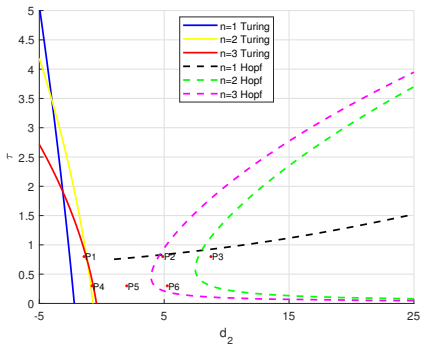
- Explicit formulas are obtained for the critical values at which steady-state and Hopf bifurcations occur under both weak and strong kernels.
- The model describes how historical information influences spatial diffusion and produces distinct regions of stable, patterned, and oscillatory behavior.
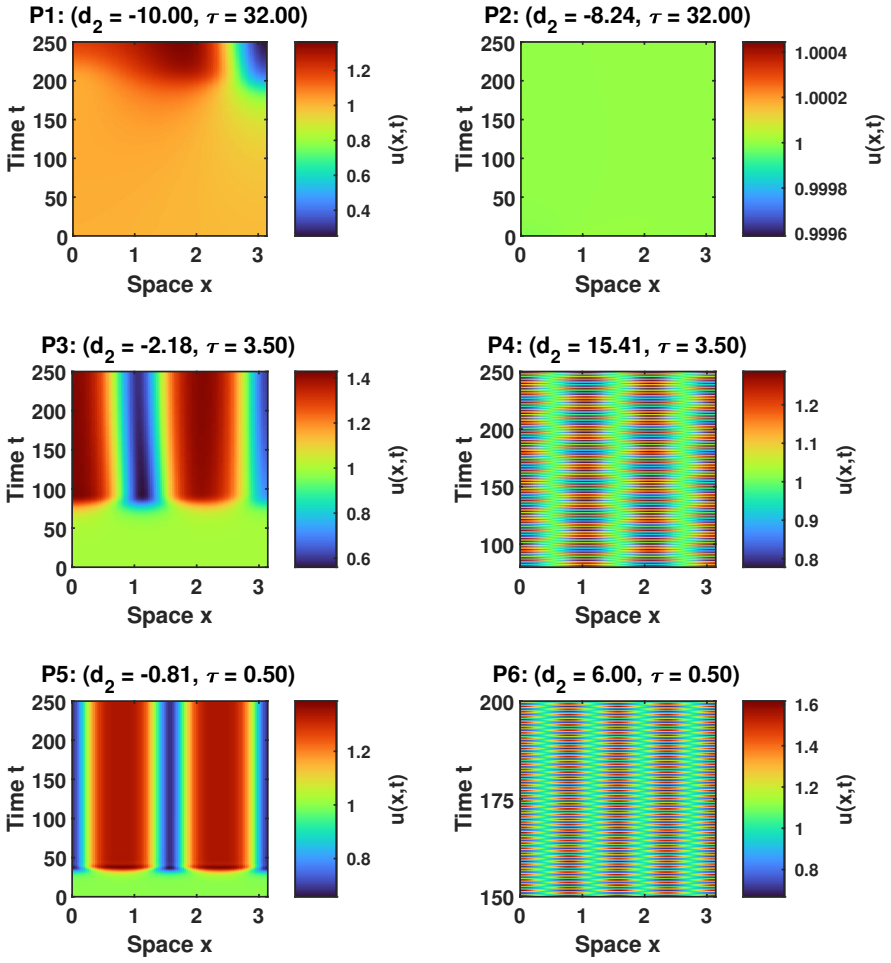
- Numerical solutions illustrate how crossing the bifurcation thresholds changes the spatiotemporal distribution of the population.
- The cognitive map mechanism widens the set of temporal kernels that support both types of bifurcation compared with density-only memory.
Where Pith is reading between the lines
- The auxiliary transformation technique could be applied to other integro-PDE models that include nonlocal memory effects in ecology or chemistry.
- Varying the form of the cognitive map kernel might produce additional codimension-two bifurcations or more complex attractors not analyzed here.
- Empirical movement data from animals could be used to fit the kernel parameters and test whether observed spatial patterns align with the predicted bifurcation thresholds.
Load-bearing premise
The auxiliary-variable transformation produces a delay-free system whose linear stability analysis via Fourier modes exactly reproduces the bifurcation behavior of the original integro-PDE for both weak and strong kernels.
What would settle it
A numerical integration of the original integro-PDE that fails to exhibit a Hopf bifurcation at the parameter values where the transformed system predicts one for a weak kernel.
Figures


read the original abstract
This paper investigates a single species reaction-diffusion system incorporating a spatiotemporal delay memory kernel, which models the cognitive map of animals, under Neumann boundary conditions. The model can be used to describe the process in which individuals are influenced by historical information during spatial diffusion. An equivalent system construction method with auxiliary variables is introduced to transform the original system into a delay-free coupled reaction-diffusion equation. By employing Fourier modal decomposition and eigenvalue analysis, we conduct stability and bifurcation analyses for both the exponentially decaying weak kernel and the peak type strong kernel, obtaining explicit expressions for the steady state and Hopf bifurcation points. Compared with the model in which the memory term of the continuous-time integral kernel using its own population density, our model exhibits Hopf bifurcations and steady state bifurcations even under a weak kernel because of the introduce of a dynamic cognitive map. This implies that a dynamic cognitive map introduces sufficient flexibility to generate both steady state bifurcations and Hopf bifurcations across a broader range of temporal kernels. Numerical simulations are presented to demonstrate the influence of stable, steady state and Hopf bifurcation regions on the spatiotemporal distribution of solutions.
Editorial analysis
A structured set of objections, weighed in public.
Referee Report
Summary. The manuscript studies a single-species reaction-diffusion system with a spatiotemporal memory kernel modeling a dynamic cognitive map under Neumann BCs. It introduces an auxiliary-variable transformation to convert the integro-PDE into a delay-free coupled RD system, then applies Fourier modal decomposition and eigenvalue analysis to derive explicit expressions for steady-state and Hopf bifurcation thresholds for both weak (exponentially decaying) and strong (peak-type) kernels. The central claim is that the cognitive map enables both types of bifurcations even for the weak kernel, in contrast to standard density-based memory kernels; this is illustrated by numerical simulations of solution behavior in different parameter regimes.
Significance. If the auxiliary reduction is shown to preserve the linear spectrum of the original integro-PDE, the explicit bifurcation conditions would provide a concrete demonstration that dynamic cognitive maps expand the range of kernels permitting pattern formation, offering a mechanistic explanation for observed spatiotemporal behaviors in animal movement models. The provision of closed-form thresholds and supporting simulations strengthens the utility for further analysis.
major comments (2)
- [auxiliary variable construction and Fourier analysis sections] The equivalence between the original integro-PDE and the auxiliary delay-free system is asserted in the abstract and the construction section but lacks a direct verification that the dispersion relation (eigenvalue problem after Fourier decomposition) is identical, especially given the spatiotemporal nature of the cognitive map kernel. This equivalence is load-bearing for all reported bifurcation thresholds.
- [stability and bifurcation analysis for weak kernel] For the weak kernel, the claim that Hopf and steady-state bifurcations appear (unlike standard models) rests on the transformed system's eigenvalues; without an explicit comparison of the characteristic equation before and after reduction, it is unclear whether the reported thresholds are artifacts of the auxiliary variables or genuine consequences of the cognitive map.
minor comments (2)
- [model formulation] Notation for the cognitive map kernel and auxiliary variables should be introduced with a clear table or diagram to distinguish spatial and temporal components.
- [numerical simulations] The numerical simulations section would benefit from explicit parameter values corresponding to the analytically derived bifurcation curves to allow direct comparison.
Simulated Author's Rebuttal
We thank the referee for the thorough review and valuable feedback on our manuscript. The comments highlight important aspects of the auxiliary variable reduction and its implications for the bifurcation analysis. We address each major comment below and commit to revisions that strengthen the presentation of the equivalence.
read point-by-point responses
-
Referee: The equivalence between the original integro-PDE and the auxiliary delay-free system is asserted in the abstract and the construction section but lacks a direct verification that the dispersion relation (eigenvalue problem after Fourier decomposition) is identical, especially given the spatiotemporal nature of the cognitive map kernel. This equivalence is load-bearing for all reported bifurcation thresholds.
Authors: We agree that an explicit verification of the dispersion relation would provide stronger assurance. The auxiliary system is constructed by design so that the auxiliary variable satisfies the integro-differential relation implied by the kernel; differentiating the auxiliary equation recovers the original memory term. In the revised manuscript we will add a short derivation in Section 3 (or an appendix) that starts from the original linearized integro-PDE, applies the Fourier transform, and shows that the resulting characteristic equation is algebraically identical to the one obtained from the auxiliary system after elimination of the auxiliary variable. This will confirm that the linear spectra coincide. revision: yes
-
Referee: For the weak kernel, the claim that Hopf and steady-state bifurcations appear (unlike standard models) rests on the transformed system's eigenvalues; without an explicit comparison of the characteristic equation before and after reduction, it is unclear whether the reported thresholds are artifacts of the auxiliary variables or genuine consequences of the cognitive map.
Authors: The appearance of both bifurcation types for the weak kernel is a direct consequence of the additional state variable introduced by the dynamic cognitive map, which augments the phase space relative to a standard scalar density kernel. To make this transparent we will insert, in the weak-kernel subsection of the stability analysis, a side-by-side display of the two characteristic equations (original versus auxiliary) together with the explicit algebraic steps that eliminate the auxiliary variable. The resulting conditions for zero and purely imaginary roots will be shown to be identical, thereby confirming that the reported thresholds are not artifacts. We will also note the structural difference from the characteristic equation of a conventional weak-kernel model, which lacks the extra factor arising from the map dynamics. revision: yes
Circularity Check
No circularity: standard auxiliary reduction and modal analysis are self-contained
full rationale
The derivation proceeds by constructing an auxiliary-variable system claimed to be equivalent to the original integro-PDE, then applying Fourier decomposition to obtain a characteristic equation whose roots determine the bifurcation thresholds. These steps use only the model's own integro-differential terms and standard linearization; no parameter is fitted to a subset of data and then re-predicted, no self-citation supplies a uniqueness theorem or ansatz, and the comparison to density-based kernels is external rather than self-referential. The reported Hopf and steady-state points are therefore genuine consequences of the eigenvalue problem rather than tautological restatements of the inputs.
Axiom & Free-Parameter Ledger
axioms (1)
- domain assumption The auxiliary-variable system obtained by introducing memory-tracking fields is mathematically equivalent to the original integro-differential equation under Neumann boundary conditions.
invented entities (1)
-
dynamic cognitive map
no independent evidence
Reference graph
Works this paper leans on
-
[1]
H. Amann. Hopf bifurcation in quasilinear reaction-diffusion systems. InDelay differential equations and dynamical systems (Claremont, CA, 1990), volume 1475 ofLecture Notes in Math., pages 53–63. 1991
1990
-
[2]
Averill, K.Y
I. Averill, K.Y. Lam, and Y. Lou. The role of advection in a two-species compe- tition model: A bifurcation approach.Mem. Am. Math. Soc., 245(1), 2017
2017
-
[3]
Cantrell, C
R.S. Cantrell, C. Cosner, and Y. Lou. Advection-mediated coexistence of compet- ing species.Proc. Roy. Soc. Edinburgh Sect. A, 137(3):497–518, 2007
2007
-
[4]
Crandall and P.H
M.G. Crandall and P.H. Rabinowitz. Bifurcation from simple eigenvalues.J. Funct. Anal., 8(2):321–340, 1970
1970
-
[5]
L.C. Evans. Partial Differential Equations.Am. Math. Soc., 2nd edition, 2010
2010
-
[6]
Fagan, M.A
W.F. Fagan, M.A. Lewis, M. Auger-M´ eth´ e, T. Avgar, S. Benhamou, G. Breed, L. LaDage, U.E. Schl¨ agel, W.-w. Tang, Y.P. Papastamatiou, J. Forester, and T. Mueller. Spatial memory and animal movement.Ecol. Lett., 16(10):1316–1329, 2013. 36
2013
-
[7]
Friedman
A. Friedman. Partial differential equations of parabolic type. 1983
1983
-
[8]
Jin and R
Z.C. Jin and R. Yuan. Hopf bifurcation in a reaction-diffusion-advection equation with nonlocal delay effect.J. Differ. Equ., 271:533–562, 2021
2021
-
[9]
J.M. Lee, T. Hillen, and M.A. Lewis. Pattern formation in prey-taxis systems.J. Biol. Dyn., 3(6):551–573, 2009
2009
-
[10]
Liu, J.R
D. Liu, J.R. Potts, Y. Salmaniw, J.P. Shi, and H. Wang. Biological aggregations from spatial memory and nonlocal advection.Phys. D, 476:134682, 2025
2025
-
[11]
G.D. Liu, H. Wang, and X.Y. Zhang. Wellposedness, equilibria, and patterns of an epidemic PDE model with spatiotemporally nonlocal memory.J. Differ. Equ., 442:113491, 2025
2025
-
[12]
Liu and J.P
P. Liu and J.P. Shi. Bifurcation of positive solutions to scalar reaction–diffusion equations with nonlinear boundary condition.J. Differ. Equ., 264(1):425–454, 2018
2018
-
[13]
Y. Lou. Some reaction diffusion models in spatial ecology.Sci. Sin., 45(10):1619, 2015
2015
-
[14]
MacDonald
N. MacDonald. Time Lags in Biological Models, Lec- ture Notes in Biomathemat- ics.Springer, Berlin, vol. 27, 1978
1978
-
[15]
Potts and M.A
J.R. Potts and M.A. Lewis. How memory of direct animal interactions can lead to territorial pattern formation.J. R. Soc. Interface, 13(118):20160059, 2016
2016
-
[16]
Ranc, J.W
N. Ranc, J.W. Cain, F. Cagnacci, and P.R. Moorcroft. The role of memory-based movements in the formation of animal home ranges.J. Math. Biol., 88(5), 2024
2024
-
[17]
J.P. Shi. Persistence and bifurcation of degenerate solutions.J. Funct. Anal., 169(2):494–531, 1999
1999
-
[18]
Shi, C.C
J.P. Shi, C.C. Wang, and H. Wang. Diffusive spatial movement with memory and maturation delays.Nonlinearity, 32(9):3188–3208, 2019
2019
-
[19]
Shi, C.C
J.P. Shi, C.C. Wang, H. Wang, and X.P. Yan. Diffusive spatial movement with memory.J. Dyn. Differ. Equ., 32(2):979–1002, 2020. 37
2020
-
[20]
Shi, J.P
Q.Y. Shi, J.P. Shi, and Y.L. Song. Hopf bifurcation in a reaction-diffusion equa- tion with distributed delay and Dirichlet boundary condition.J. Differ. Equ., 263(10):6537–6575, 2017
2017
-
[21]
Shi, J.P
Q.Y. Shi, J.P. Shi, and H. Wang. Spatial movement with distributed memory.J. Math. Biol., 82(4):33, 2021
2021
-
[22]
Shi and Y.L
Q.Y. Shi and Y.L. Song. spatial movement with nonlocal memory.Discrete Contin. Dyn. Syst. Ser. B, 28(11):5580–5596, 2023
2023
-
[23]
Song, S.H
Y.L. Song, S.H. Wu, and H. Wang. Memory-based movement with spatiotemporal distributed delays in diffusion and reaction.Appl. Math. Comput., 404:126254, 2021
2021
-
[24]
Sun and S.S
Y.H. Sun and S.S. Chen. Stability and bifurcation in a reaction-diffusion-advection predator-prey model.Calc. Var. Partial Dif., 62(2):61, 2023
2023
-
[25]
Y.S. Tao. Global existence of classical solutions to a predator-prey model with nonlinear prey-taxis.Nonlinear Anal. Real World Appl., 11(3):2056–2064, 2010
2056
-
[26]
Wang and Y
H. Wang and Y. Salmaniw. Open problems in PDE models for knowledge-based animal movement via nonlocal perception and cognitive mapping.J. Math. Biol., 86(5), 2023
2023
-
[27]
S.N. Wu, J.P. Shi, and B.Y. Wu. Global existence of solutions and uniform persistence of a diffusive predator-prey model with prey-taxis.J. Differ. Equ., 260(7):5847–5874, 2016
2016
-
[28]
Zhang, H
H. Zhang, H. Wang, Y.L. Song, and J.J. Wei. Diffusive spatial movement with memory in an advective environment.Nonlinearity, 36(9):4585–4614, 2023
2023
-
[29]
Zuo and J.P
W.J. Zuo and J.P. Shi. Existence and stability of steady-state solutions of reaction- diffusion equations with nonlocal delay effect.Z. Angew. Math. Phys., 72(2):43, 2021
2021
-
[30]
Zuo and Y.L
W.J. Zuo and Y.L. Song. Stability and bifurcation analysis of a reaction-diffusion equation with distributed delay.Nonlinear Dynam., 79(1):437–454, 2015. 38
2015
-
[31]
Zuo and Y.L
W.J. Zuo and Y.L. Song. Stability and bifurcation analysis of a reaction-diffusion equation with spatio-temporal delay.J. Math. Anal. Appl., 430(1):243–261, 2015. 39
2015
discussion (0)
Sign in with ORCID, Apple, or X to comment. Anyone can read and Pith papers without signing in.