Busse balloon deformation and splitting by non-local interaction: the influence of grazing on a Klausmeier vegetation model
Pith reviewed 2026-06-26 12:27 UTC · model grok-4.3
The pith
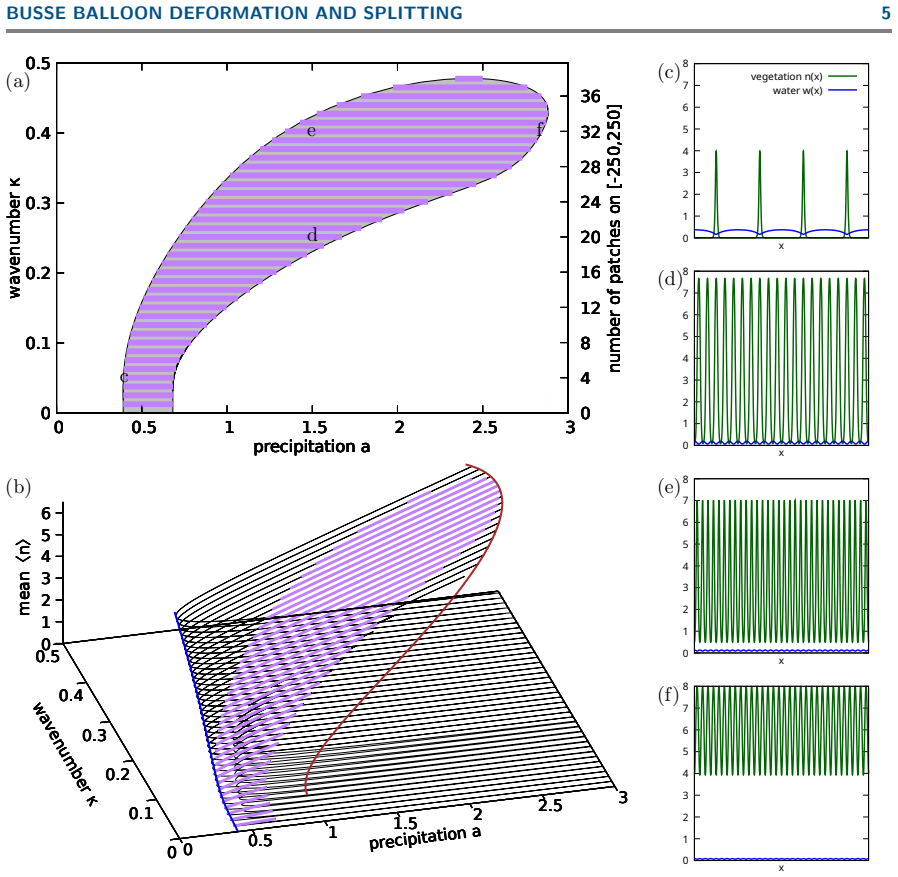
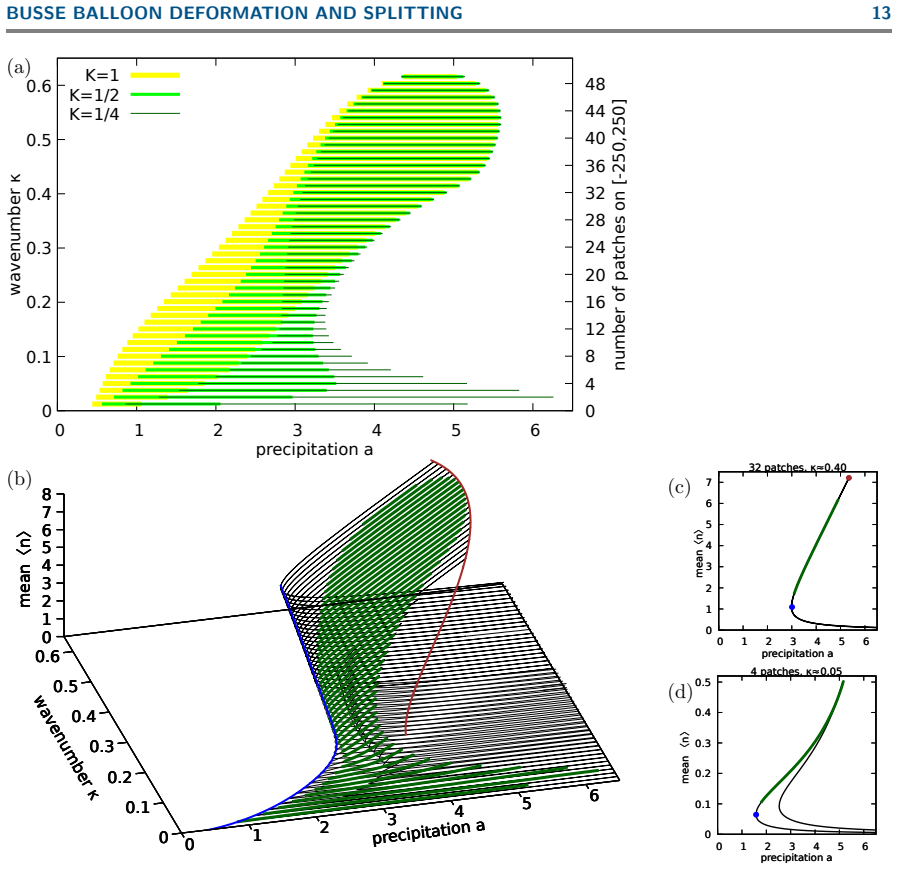
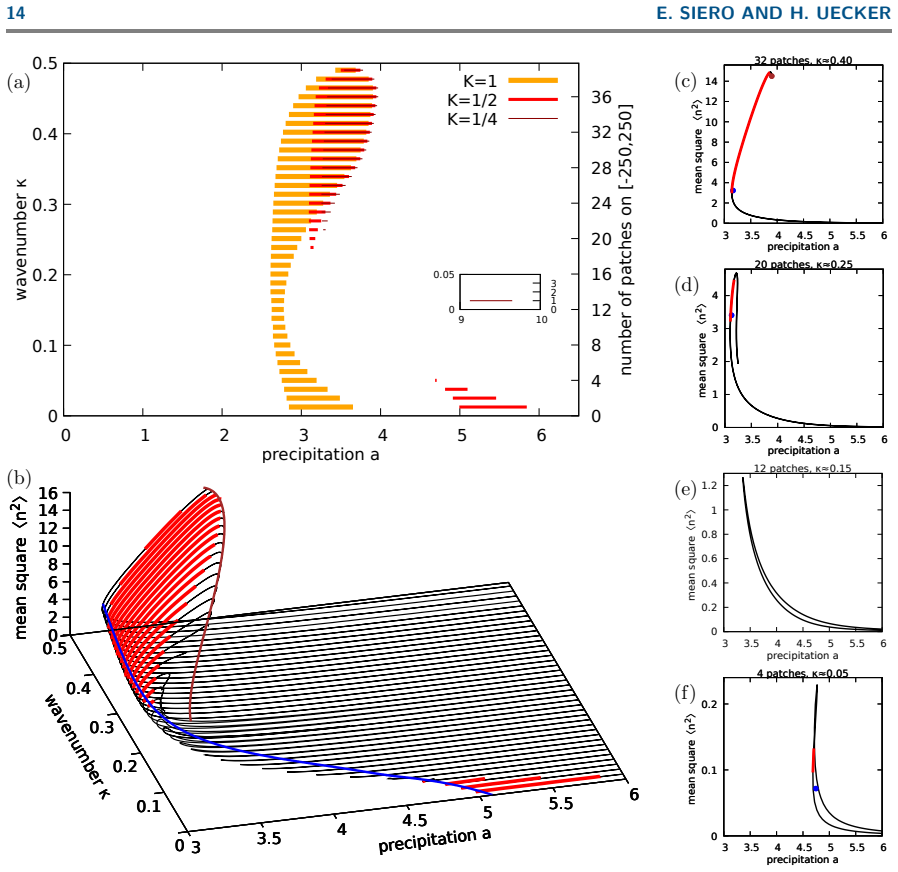
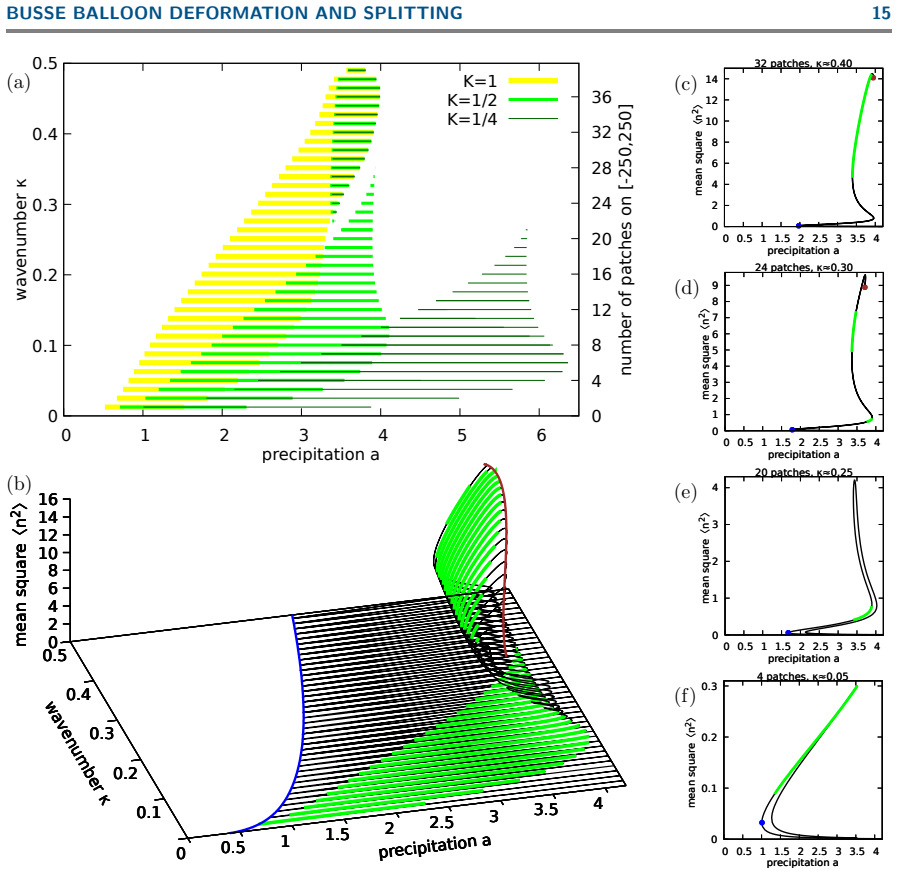
The Busse balloon deforms away from its banana shape and splits in four non-local grazing regimes for the Klausmeier vegetation model.
A machine-rendered reading of the paper's core claim, the machinery that carries it, and where it could break.
Core claim
In the Klausmeier model with non-local grazing, the Busse balloon representation of multi-stability deforms away from the typical banana shape and splits in four distinct non-local grazing regimes, shown by extending singular perturbation analysis for analytical control near the homoclinic limit and by numerical continuation.
What carries the argument
The Busse balloon, the parameter region of multi-stable pattern wavelengths, deformed and split by the non-local grazing term.
If this is right
- The range of stable pattern wavelengths changes with the form of non-local grazing.
- Ecosystem response to climate change must be read from the altered shape of the Busse balloon rather than its classical form.
- Four separate grazing regimes produce qualitatively different balloon geometries.
- Singular perturbation supplies explicit control near the homoclinic limit even with non-local interaction.
Where Pith is reading between the lines
- Predictions of tipping avoidance in drylands would shift once the deformed balloon is used instead of the standard shape.
- Grazing management could be tuned to keep the system inside one of the split stable regions.
- The same deformation might appear in other pattern-forming systems once non-local terms are added.
Load-bearing premise
The assumption that multi-stability of patterns in the model also holds for real-world vegetation patterns.
What would settle it
A field measurement or simulation that records whether the range of observed stable wavelengths under varying grazing intensity matches the deformed and split balloon or remains a single connected banana shape.
Figures


read the original abstract
Large areas on all continents except Antarctica are covered by dryland vegetation patterns, with wavelengths typically in the range of tens of meters. In models, many wavelengths are simultaneously stable, and we argue that this multi-stability also holds for real world patterns. We then study the shape of the Busse balloon representation of multi-stability for a previously introduced Klausmeier model with non-local grazing. For this we first extend application of singular perturbation to Klausmeier/Gray-Scott models to include non-local interaction, providing analytical control near the homoclinic limit, and then use numerical continuation to demonstrate deformation of Busse balloons away from the typical banana shape, in four non-local grazing regimes. Since the Busse balloon has been invoked to support "evasion of tipping", we underscore the importance of the shape of the Busse balloon when inferring ecosystem response to, e.g., climate change.
Editorial analysis
A structured set of objections, weighed in public.
Referee Report
Summary. The paper extends singular perturbation analysis to incorporate non-local grazing terms in the Klausmeier model, yielding analytical control near the homoclinic limit, and then applies numerical continuation to demonstrate that the Busse balloon deforms away from the typical banana shape and splits in four non-local grazing regimes. It argues that this shape change is relevant for inferring ecosystem responses such as evasion of tipping under climate change, building on the claim that multi-stability of patterns holds in real-world vegetation.
Significance. If the central claims hold, the work is significant for dynamical systems and mathematical ecology because it shows how non-local interactions can structurally alter multi-stability regions in pattern-forming PDEs. The analytical extension supplies new asymptotic control for non-local Klausmeier/Gray-Scott-type models, while the numerical results illustrate concrete changes to the Busse balloon that could affect tipping predictions; explicit strengths include the combination of perturbation theory with continuation across multiple regimes.
major comments (1)
- [Numerical continuation results (after the singular perturbation extension)] The load-bearing step connecting the singular perturbation analysis to the numerical results is not validated: no direct comparison (e.g., scaling of the balloon boundary against the homoclinic asymptotics, or overlay of predicted vs. computed edges near the homoclinic limit) is provided in the numerical continuation section. Without this, the reported deformation and splitting could arise from discretization, kernel approximation, or continuation tolerances rather than the non-local grazing itself.
minor comments (2)
- [Abstract] The abstract states that multi-stability 'also holds for real world patterns' but provides no additional evidence or reference beyond the model; this claim is not load-bearing for the mathematical results but should be qualified or supported if retained.
- [Introduction / Abstract] The four non-local grazing regimes are mentioned but not enumerated or characterized (e.g., by parameter ranges or kernel properties) until later sections; a brief definition early on would improve readability.
Simulated Author's Rebuttal
We thank the referee for their careful reading and constructive comments on the manuscript. We address the single major comment below.
read point-by-point responses
-
Referee: [Numerical continuation results (after the singular perturbation extension)] The load-bearing step connecting the singular perturbation analysis to the numerical results is not validated: no direct comparison (e.g., scaling of the balloon boundary against the homoclinic asymptotics, or overlay of predicted vs. computed edges near the homoclinic limit) is provided in the numerical continuation section. Without this, the reported deformation and splitting could arise from discretization, kernel approximation, or continuation tolerances rather than the non-local grazing itself.
Authors: We agree that an explicit quantitative link between the extended singular perturbation analysis and the numerical continuation results near the homoclinic limit would strengthen the validation. In the revised manuscript we will add direct comparisons, including overlays of the asymptotic scaling of the Busse balloon boundary against the numerically computed edges in each of the four non-local grazing regimes. This will confirm that the observed deformations and splittings are attributable to the non-local terms. revision: yes
Circularity Check
No significant circularity; derivation is self-contained
full rationale
The paper's central steps consist of an extension of singular perturbation analysis to non-local grazing (providing analytical control near homoclinics) followed by separate numerical continuation to map Busse balloon shapes. Neither reduces to a self-definition, a fitted parameter renamed as prediction, nor a load-bearing self-citation chain. The multi-stability claim for real-world patterns is stated as an assumption without deriving it from the model's outputs. No quoted equation or step equates a result to its own input by construction.
Axiom & Free-Parameter Ledger
axioms (1)
- domain assumption Multi-stability of vegetation patterns holds for real world systems
Reference graph
Works this paper leans on
-
[1]
A. Asch, M. Avery, A. Cortez, and A. Scheel. Slow passage through the busse balloon – predicting steps on the eckhaus staircase.European Journal of Applied Mathematics, 36(1):1–26, 2025
2025
-
[2]
Banerjee, M
S. Banerjee, M. Baudena, P. Carter, R. Bastiaansen, A. Doelman, and M. Rietkerk. Rethinking tipping points in spatial ecosystems.The American Naturalist, 207(4):483–502, 2026. PMID: 41855520
2026
-
[3]
Bastiaansen, O
R. Bastiaansen, O. Ja¨ ıbi, V. Deblauwe, M.B. Eppinga, K. Siteur, E. Siero, S. Mermoz, A. Bouvet, A. Doelman, and M. Rietkerk. Multistability of model and real dryland ecosystems through spatial self-organization.Proceedings of the National Academy of Sciences, 115(44):11256–11261, 2018
2018
-
[4]
Bennett and J.A
J.R. Bennett and J.A. Sherratt. Large scale patterns in mussel beds: stripes or spots?Journal of Mathematical Biology, 78(3), 2019
2019
-
[5]
F. Busse. Non-linear properties of thermal convection.Reports on Progress in Physics, 41:1929–1967, 1978
1929
-
[6]
F. H. Busse and J. A. Whitehead. Instabilities of convection rolls in a high prandtl number fluid.Journal of Fluid Mechanics, 47(2):305–320, 1971
1971
-
[7]
Deblauwe, N
V. Deblauwe, N. Barbier, P. Couteron, O. Lejeune, and J. Bogaert. The global biogeography of semi-arid periodic vegetation patterns.Global Ecology and Biogeography, 17:715–723, 2008
2008
-
[8]
Deblauwe, P
V. Deblauwe, P. Couteron, O. Lejeune, J. Bogaert, and N. Barbier. Environmental modulation of self- organized periodic vegetation patterns in sudan.Ecography, 34:990–1001, 2011
2011
-
[9]
Detmer, S
A. Detmer, S. Miller, A. Dubel, K. Ring, C. John, C. Briggs, A. Rassweiler, and H. Moeller. A busse balloon in the lagoon: Herbivore behaviour generates spatial patterns in coral reef ecosystems.Ecology Letters, 28(3):e70098, 2025. e70098 ELE-00156-2025.R1
2025
-
[10]
E.J. Doedel. Auto-07p: Continuation and bifurcation software for ordinary differential equations. http://cmvl.cs.concordia.ca/auto
-
[11]
Doelman, W
A. Doelman, W. Eckhaus, and T. Kaper. Slowly modulated two-pulse solutions in the gray-scott model i: Asymptotic construction and stability.SIAM Journal on Applied Mathematics, 61(3):1080–1102, 2000
2000
-
[12]
Doelman, J
A. Doelman, J. Rademacher, B. de Rijk, and F. Veerman. Destabilization mechanisms of periodic pulse patterns near a homoclinic limit.SIAM Journal on Applied Dynamical Systems, 17(2):1833–1890, 2018
2018
-
[13]
Eigentler and M
L. Eigentler and M. Sensi. Wavelength selection for periodic travelling waves: An unsolved problem. Bulletin of Mathematical Biology, 88(2):22, 2026
2026
-
[14]
Fenichel
N. Fenichel. Geometric singular perturbation theory for ordinary differential equations.Journal of Differential Equations, 31(1):53–98, 1979
1979
-
[15]
Ferr´ e, I
M. Ferr´ e, I. Pavithran, B. Bera, H. Uecker, and E. Meron. Vegetation pattern formation and community BUSSE BALLOON DEFORMATION AND SPLITTING 19 assembly under drying climate trends.Chaos: An Interdisciplinary Journal of Nonlinear Science, 35(9):093114, 09 2025
2025
-
[16]
Fretwell and H.L
S.D. Fretwell and H.L. Lucas. On territorial behavior and other factors influencing habitat distribution in birds.Acta Biotheoretica, 19(1):16–36, 1969
1969
-
[17]
Gandhi, S
P. Gandhi, S. Iams, S. Bonetti, and M. Silber.Vegetation Pattern Formation in Drylands, pages 469–509. Springer International Publishing, Cham, 2019
2019
-
[18]
Gilad, J
E. Gilad, J. von Hardenberg, A. Provenzale, M. Shachak, and E. Meron. Ecosystem engineers: From pattern formation to habitat creation.Physical Review Letters, 93:1–4, 2004
2004
-
[19]
Hamster, P
C. Hamster, P. van Heijster, and E. Siero. Blurring the busse balloon: Patterns in a stochastic klausmeier model.Physica D: Nonlinear Phenomena, 482:134863, 2025
2025
-
[20]
HilleRisLambers, M
R. HilleRisLambers, M. Rietkerk, F.V.D. Bosch, H.H.T. Prins, and H.D. Kroon. Vegetation pattern formation in semi-arid grazing systems.Ecology, 82:50–61, 2001
2001
-
[21]
C.S. Holling. The components of predation as revealed by a study of small-mammal predation of the european pine sawfly.The Canadian Entomologist, 91(5):234–261, 1959
1959
-
[22]
Klausmeier
C.A. Klausmeier. Regular and irregular patterns in semi-arid vegetation.Science, 284:1826–1828, 1999
1999
-
[23]
Noy-Meir
I. Noy-Meir. Stability of grazing systems: An application of predator-prey graphs.Journal of Ecology, 63(2):459–481, 1975
1975
-
[24]
https://pde2path.uol.de/, 2026
pde2path. https://pde2path.uol.de/, 2026
2026
-
[25]
Press, S
W. Press, S. Teukolsky, W. Vetterling, and B. Flannery.Numerical Recipes: The Art of Scientific Computing. Cambridge University Press, 2007
2007
-
[26]
Rietkerk, R
M. Rietkerk, R. Bastiaansen, S. Banerjee, J. van de Koppel, M. Baudena, and A. Doelman. Evasion of tipping in complex systems through spatial pattern formation.Science, 374(6564), 2021
2021
-
[27]
Sherratt
J.A. Sherratt. History-dependent patterns of whole ecosystems.Ecological Complexity, 14:8–20, 2013
2013
-
[28]
Sherratt
J.A. Sherratt. Using wavelength and slope to infer the historical origin of semiarid vegetation bands. Proceedings of the National Academy of Sciences, 112(14):4202–4207, 2015
2015
-
[29]
Siero.A recipe for desert: Analysis of an extended Klausmeier model
E. Siero.A recipe for desert: Analysis of an extended Klausmeier model. PhD thesis, Leiden University, 2016
2016
-
[30]
E. Siero. Nonlocal grazing in patterned ecosystems.Journal of Theoretical Biology, 436:64–71, 2018
2018
-
[31]
E. Siero. Resolving soil and surface water flux as drivers of pattern formation in turing models of dryland vegetation: A unified approach.Physica D: Nonlinear Phenomena, 414, 2020
2020
-
[32]
Siero, K
E. Siero, K. Siteur, A. Doelman, J. van de Koppel, M. Rietkerk, and M.B. Eppinga. Grazing away the resilience of patterned ecosystems.The American Naturalist, 2019
2019
-
[33]
Siteur, E
K. Siteur, E. Siero, M.B. Eppinga, J.D.M. Rademacher, A. Doelman, and M. Rietkerk. Beyond Turing: the response of patterned ecosystems to environmental change.Ecological Complexity, 20:81–96, 2014
2014
-
[34]
A. Turing. The chemical basis of morphogenesis.Philosophical Transactions of the Royal Society of London. Series B, Biological Sciences, 237:37–72, 1952
1952
-
[35]
Uecker.Numerical continuation and bifurcation in Nonlinear PDEs
H. Uecker.Numerical continuation and bifurcation in Nonlinear PDEs. SIAM, Philadelphia, PA, 2021
2021
-
[36]
Uecker, D
H. Uecker, D. Wetzel, and J.D.M. Rademacher. pde2path - A Matlab package for continuation and bifurcation in 2D elliptic systems.Num. Math.: Th. Meth. Appl., 7:58–106, 2014
2014
-
[37]
van der Stelt, A
S. van der Stelt, A. Doelman, G. Hek, and J.D.M. Rademacher. Rise and fall of periodic patterns for a Generalized Klausmeier-Gray-Scott model.J. Nonl. Sc., 23:39–95, 2013
2013
-
[38]
Leveraging scientific machine learning to infer eco- hydrological dynamics from remote sensing time series: towards quantitative prediction of dryland vegetation Turing patterns
Jens van der Zee, Diego Marcos, and Eric Siero. Leveraging scientific machine learning to infer eco- hydrological dynamics from remote sensing time series: towards quantitative prediction of dryland vegetation Turing patterns. https://ssrn.com/abstract=6681398
discussion (0)
Sign in with ORCID, Apple, or X to comment. Anyone can read and Pith papers without signing in.