Spectral Geometry and Bosonic-Bloch Probes: Explorations in Quantum Learning
Pith reviewed 2026-07-02 19:32 UTC · model grok-4.3
The pith
Training quantum networks induces spectral geometry measurable by bosonic interference and Bloch drift.
A machine-rendered reading of the paper's core claim, the machinery that carries it, and where it could break.
Core claim
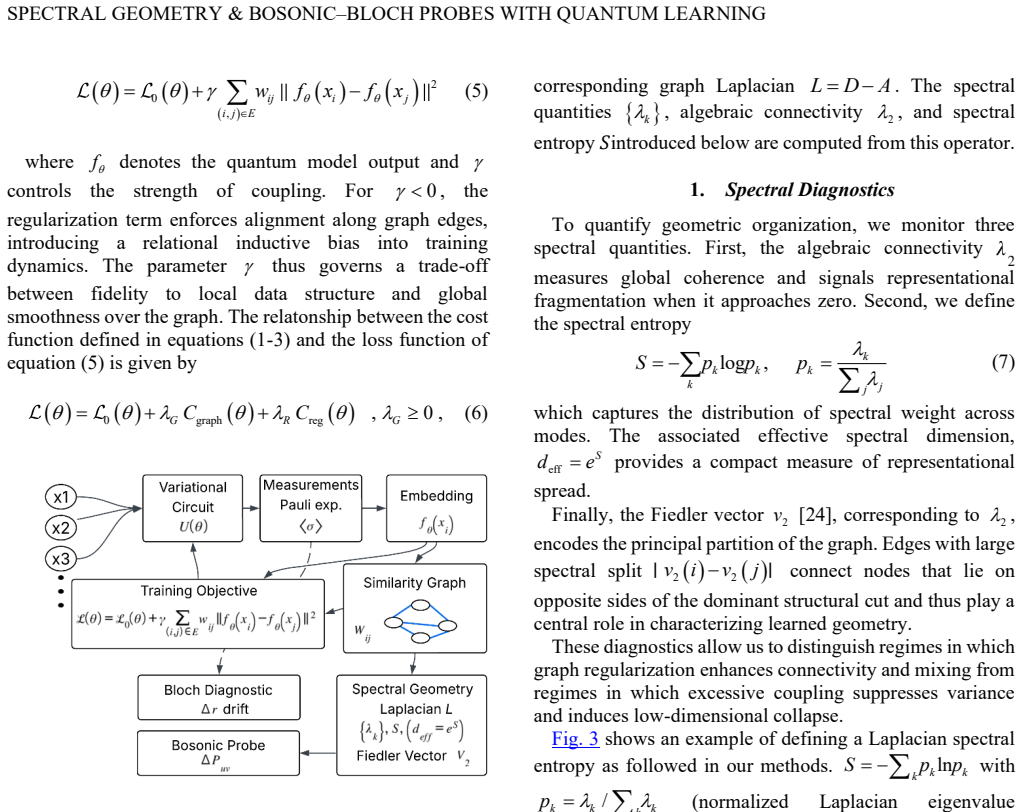
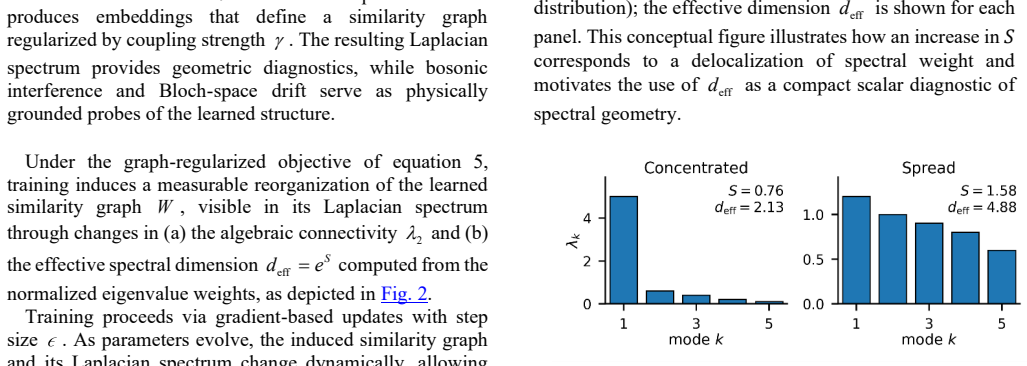
In graph-regularized quantum networks training reorganizes the output similarity graph, increases the effective spectral dimension by 0.23, and reshapes the Laplacian spectrum. Edge-resolved two-boson interference probes this with bosonic enhancement correlating to Fiedler edge split at r = -0.50. A phase diagram shows nonmonotonic dependence on coupling strength and noise. For a hybrid quantum autoencoder, absolute Bloch drift discriminates anomalies with ROC-AUC at least 0.9 while consecutive drift gives about 0.5. Through the geometry of reduced single-qubit states and quantum Fisher information, learning-induced spectral organization appears as measurable quantum-state structure.
What carries the argument
edge-resolved two-boson interference and Bloch-space drift of reduced single-qubit states as probes of the Laplacian spectrum and learned partitions
Load-bearing premise
The reported correlation of -0.50 between bosonic enhancement and Fiedler split arises directly from learned spectral partitions rather than from modeling choices or data selection in the graph-regularized networks.
What would settle it
Repeating the edge-resolved two-boson interference experiment after training and finding no significant correlation between bosonic enhancement and Fiedler edge split would falsify the claimed link between spectral partitions and interference signatures.
Figures



read the original abstract
This paper studies how spectral geometry emerges in quantum learning models and how it can be diagnosed with physically grounded probes. In graph-regularized quantum networks, training reorganizes the output similarity graph, increases the effective spectral dimension Delta S = +0.23, and reshapes the Laplacian spectrum. Edge-resolved two-boson interference directly probes this restructuring: the bosonic enhancement Delta P_uv correlates with the Fiedler edge split |Delta v_2| (r = -0.50), linking learned spectral partitions to interference signatures. A phase diagram shows a nonmonotonic dependence of performance on coupling strength gamma and noise delta, with graph regularization improving fidelity only in a restricted regime; hardware experiments confirm the predicted interference behavior within shot-noise uncertainty. We also analyze a hybrid quantum autoencoder and introduce Bloch-space drift as a geometric diagnostic of its latent representation. With an unsupervised benign-data threshold, the model achieves high ranking performance (ROC-AUC about 0.99) and negligible false-negative rates. Absolute Bloch drift strongly discriminates anomalies (ROC-AUC at least about 0.9), while consecutive drift is near random (ROC-AUC about 0.5), showing that detection arises from persistent state-space displacement rather than local fluctuations. Through the geometry of reduced single-qubit states and associated quantum Fisher information, these results show that learning-induced spectral organization appears as measurable quantum-state structure, establishing a unified spectral-geometric framework for diagnosing quantum learning systems with bosonic and Bloch probes.
Editorial analysis
A structured set of objections, weighed in public.
Referee Report
Summary. This manuscript investigates the emergence of spectral geometry in quantum learning models, particularly graph-regularized quantum networks. It reports that training increases the effective spectral dimension by ΔS = +0.23 and reorganizes the Laplacian spectrum. Using edge-resolved two-boson interference, it finds a correlation (r = -0.50) between bosonic enhancement ΔP_uv and the Fiedler edge split |Δv_2|, which is interpreted as linking learned spectral partitions to interference signatures. A phase diagram shows nonmonotonic dependence on coupling strength γ and noise δ, with graph regularization improving fidelity only in a restricted regime. Hardware experiments confirm predicted interference within shot-noise uncertainty. For a hybrid quantum autoencoder, Bloch-space drift serves as a geometric diagnostic, achieving ROC-AUC ≈ 0.99 for ranking performance and ≥ 0.9 for anomaly detection, with absolute drift discriminating anomalies while consecutive drift does not.
Significance. If the reported correlations and numerical results are supported by appropriate controls, derivations, and statistical details, the work could provide a valuable unified spectral-geometric framework for diagnosing quantum learning systems. The combination of bosonic probes and Bloch-space analysis offers a physically grounded approach to understanding learning-induced changes in quantum state structure. Strengths include the use of hardware experiments and the distinction between different drift measures in anomaly detection.
major comments (3)
- [Abstract (edge-resolved two-boson interference paragraph)] Abstract (edge-resolved two-boson interference paragraph): The correlation r = -0.50 between ΔP_uv and |Δv_2| is presented as evidence linking learned spectral partitions to interference signatures and is load-bearing for the central claim. However, the abstract provides no description of controls (e.g., untrained baselines, randomized edge weights, or explicit data-selection criteria), leaving open whether the observed value arises from the regularization procedure itself rather than the claimed spectral-geometric mechanism.
- [Abstract (numerical claims)] Abstract (numerical claims): Specific values such as ΔS = +0.23, r = -0.50, and ROC-AUC ≈ 0.99 are stated without derivations, error bars, data exclusion rules, or methods details. This prevents verification of the data support for the central claim that learning-induced spectral organization appears as measurable quantum-state structure.
- [Abstract (hardware experiments)] Abstract (hardware experiments): The assertion that hardware experiments confirm the predicted interference behavior 'within shot-noise uncertainty' is load-bearing for the bosonic probe results, but without details on shot counts, circuit implementations, or comparison to theoretical predictions, the confirmation cannot be evaluated.
minor comments (2)
- [Abstract] Abstract: The phrasing 'about 0.99', 'at least about 0.9', and 'about 0.5' for ROC-AUC values is imprecise and should be replaced with exact reported values or ranges accompanied by uncertainties.
- [Abstract] Abstract: The term 'unsupervised benign-data threshold' is introduced without a definition or reference to its computation, reducing clarity of the anomaly detection procedure.
Simulated Author's Rebuttal
We thank the referee for the careful reading and constructive comments on the abstract. We address each point below and agree that targeted revisions to the abstract will improve clarity and self-containment while preserving brevity.
read point-by-point responses
-
Referee: [Abstract (edge-resolved two-boson interference paragraph)] Abstract (edge-resolved two-boson interference paragraph): The correlation r = -0.50 between ΔP_uv and |Δv_2| is presented as evidence linking learned spectral partitions to interference signatures and is load-bearing for the central claim. However, the abstract provides no description of controls (e.g., untrained baselines, randomized edge weights, or explicit data-selection criteria), leaving open whether the observed value arises from the regularization procedure itself rather than the claimed spectral-geometric mechanism.
Authors: We agree the abstract would be strengthened by briefly noting the controls. The manuscript body details comparisons against untrained baselines and randomized edge weights (with explicit data-selection criteria) in the results on bosonic interference. We will revise the abstract to indicate that the reported correlation is obtained relative to these controls. revision: yes
-
Referee: [Abstract (numerical claims)] Abstract (numerical claims): Specific values such as ΔS = +0.23, r = -0.50, and ROC-AUC ≈ 0.99 are stated without derivations, error bars, data exclusion rules, or methods details. This prevents verification of the data support for the central claim that learning-induced spectral organization appears as measurable quantum-state structure.
Authors: The quoted values are obtained from the numerical simulations, statistical fits, and hardware runs whose derivations, error bars, and exclusion rules appear in the main text and supplementary material. Space limits preclude full methods in the abstract, but we will add a concise parenthetical reference to the source of the values and the presence of reported uncertainties in the figures. revision: partial
-
Referee: [Abstract (hardware experiments)] Abstract (hardware experiments): The assertion that hardware experiments confirm the predicted interference behavior 'within shot-noise uncertainty' is load-bearing for the bosonic probe results, but without details on shot counts, circuit implementations, or comparison to theoretical predictions, the confirmation cannot be evaluated.
Authors: Shot counts, circuit implementations, and direct comparisons to theoretical predictions are provided in the Experimental Methods section. We will revise the abstract to include a short clause referencing the shot statistics and the quantitative agreement with theory within the stated uncertainty. revision: yes
Circularity Check
No significant circularity; claims rest on reported empirical correlations and hardware confirmation
full rationale
The abstract and described results present measured quantities such as the correlation r = -0.50 between ΔP_uv and |Δv_2|, the spectral dimension shift ΔS = +0.23, and hardware confirmation of interference behavior. No equations or derivations are shown that reduce a claimed prediction or central result to a fitted parameter or self-citation by construction. The reported findings are framed as outcomes of training and probing rather than tautological re-expressions of inputs. This is the expected non-finding for an empirical study whose load-bearing steps are external measurements.
discussion (0)
Sign in with ORCID, Apple, or X to comment. Anyone can read and Pith papers without signing in.