Fine-Grained Bounds for Courcelle's Theorem
Pith reviewed 2026-07-03 04:06 UTC · model grok-4.3
The pith
Courcelle's theorem admits a fine-grained algorithm whose dependence on quantifier structure nearly matches the ETH lower bound.
A machine-rendered reading of the paper's core claim, the machinery that carries it, and where it could break.
Core claim
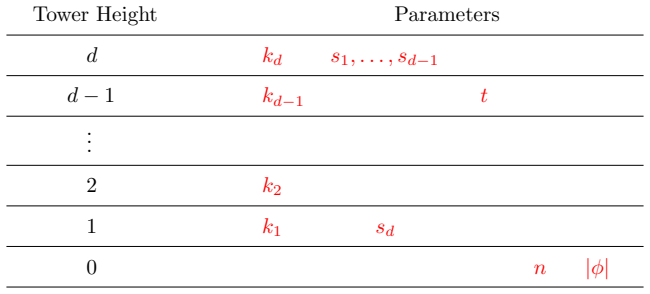
We prove a fine-grained version of Courcelle's theorem with nearly ETH-tight dependence on the treewidth parameter t and the quantifier structure of φ (specifically, the number of first order and second order variables in each quantifier alternation block).
What carries the argument
Dynamic programming on a tree decomposition whose state is sized according to the counts of first-order and second-order variables appearing inside each quantifier alternation block of the input MSO formula.
If this is right
- The height of the exponential tower remains linear in the number of alternation blocks, yet the size of each level is governed by the variable counts inside those blocks.
- Formulas whose quantifier blocks contain only a constant number of variables admit algorithms whose dependence on t is singly exponential rather than doubly exponential.
- Any future improvement that reduces the tower height for a fixed variable-count signature would contradict ETH.
- The same refined parameterization immediately yields tighter bounds for every MSO-expressible problem previously handled by the coarse Courcelle statement.
Where Pith is reading between the lines
- The same block-wise variable counting may let other logical meta-theorems on bounded-width graphs be sharpened in the same way.
- Implementations of MSO solvers could monitor the variable counts of the input formula and switch to cheaper subroutines when blocks are small.
- If the measure is preserved by standard reductions, the technique could be lifted to clique-width or other width parameters.
Load-bearing premise
The variable-count-per-block measure used to build the new algorithm is the same measure that appears in the Frick-Grohe ETH lower bound.
What would settle it
An explicit reduction from 3-SAT to an MSO formula on treewidth-t graphs in which the per-block variable counts do not produce the tower height predicted by the lower bound would falsify the claimed near-tightness.
Figures
read the original abstract
Courcelle's theorem states that there exists an algorithm that takes as input a graph $G$ of treewidth at most $t$ and a MSO formula $\phi$, and determines whether $G$ satisfies $\phi$ in time $f(\phi,t) \cdot n$. It is folklore that the the function $f$ contains a tower of exponentials whose height depends as a linear function of the number of quantifier alternations of the input formula $\phi$. A classic reduction of Frick and Grohe shows that, assuming the Exponential Time Hypothesis (ETH), the linear growth of the height of the tower is unavoidable. Nevertheless, there is still a huge gap between existing upper and lower bounds -- after all, there is quite a difference between a single exponential and a double exponential running time. In addition, this only gives us a very coarse understanding in the time complexity of Courcelle's theorem. In this paper, we prove a fine-grained version of Courcelle's theorem with nearly ETH-tight dependence on the treewidth parameter $t$ and the quantifier structure of $\phi$ (specifically, the number of first order and second order variables in each quantifier alternation block).
Editorial analysis
A structured set of objections, weighed in public.
Referee Report
Summary. The paper claims to prove a fine-grained version of Courcelle's theorem for MSO model checking on graphs of treewidth t, with running time f(φ, t) · n where f depends on t and the precise quantifier structure of φ (specifically, the number of first-order and second-order variables in each alternation block), and shows these bounds are nearly tight under ETH via comparison to the Frick-Grohe lower bound.
Significance. If the central claim holds, the result would substantially refine the complexity landscape for Courcelle's theorem beyond the known tower-height dependence, giving a more precise and practically relevant parameterization. The explicit use of ETH for near-tightness is a positive feature, as is the focus on variable counts per block rather than just alternation depth.
major comments (2)
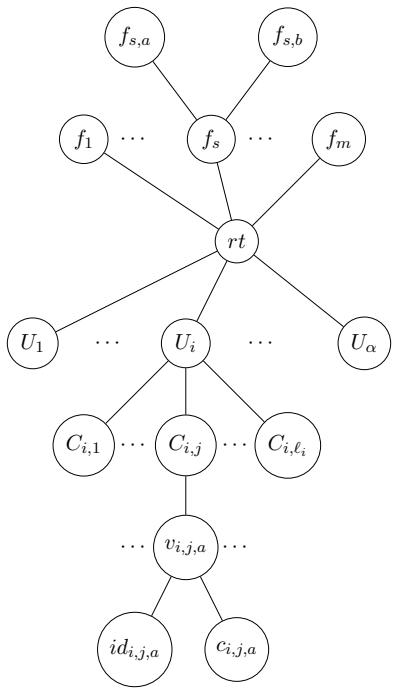
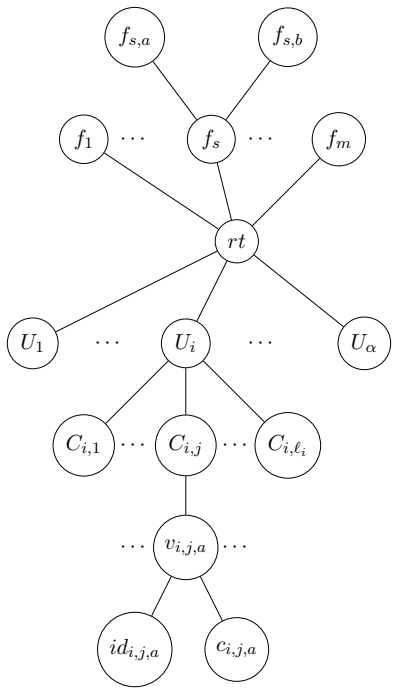
- [Lower-bounds section (adaptation of Frick-Grohe)] The load-bearing claim of near-ETH-tightness requires that the upper-bound parameterization (FO/SO variable counts per alternation block) aligns exactly with the instances produced by the Frick-Grohe reduction. The manuscript must contain an explicit argument (likely in the lower-bounds section) showing that the reduction can be adapted or instantiated to produce formulas with independently prescribed numbers of FO and SO variables in each block without weakening the ETH-hardness; the abstract provides no such detail and the full text must verify this alignment.
- [Upper-bound construction] Upper-bound construction (likely §4 or the main algorithmic section): the dynamic-programming or automata construction must be shown to achieve a dependence on the per-block variable counts that matches the lower bound up to sub-exponential factors in t; any looseness in how the block structure is encoded into the state space would undermine the fine-grained tightness claim.
minor comments (2)
- The abstract would benefit from a one-sentence statement of the main theorem (including the precise form of f(φ, t)) rather than a high-level description only.
- [Preliminaries] Notation for the quantifier-block measure (number of FO vs. SO variables) should be introduced with a formal definition early in the preliminaries to avoid ambiguity when comparing upper and lower bounds.
Simulated Author's Rebuttal
We thank the referee for the careful and constructive report. The comments help clarify the presentation of our fine-grained bounds. We address each major comment below.
read point-by-point responses
-
Referee: [Lower-bounds section (adaptation of Frick-Grohe)] The load-bearing claim of near-ETH-tightness requires that the upper-bound parameterization (FO/SO variable counts per alternation block) aligns exactly with the instances produced by the Frick-Grohe reduction. The manuscript must contain an explicit argument (likely in the lower-bounds section) showing that the reduction can be adapted or instantiated to produce formulas with independently prescribed numbers of FO and SO variables in each block without weakening the ETH-hardness; the abstract provides no such detail and the full text must verify this alignment.
Authors: We agree that an explicit alignment argument strengthens the lower-bound section. In Section 5 we adapt the Frick-Grohe construction by building each quantifier block from independent sets of first-order variables (for vertex selection) and second-order variables (for edge-set quantification) whose cardinalities are chosen freely while preserving the linear-size formula and the ETH reduction from 3-SAT. The number of alternations remains unchanged, so the hardness carries over directly. We will insert a short dedicated paragraph (and a small diagram) in the revised Section 5 that states this independence explicitly. revision: yes
-
Referee: [Upper-bound construction] Upper-bound construction (likely §4 or the main algorithmic section): the dynamic-programming or automata construction must be shown to achieve a dependence on the per-block variable counts that matches the lower bound up to sub-exponential factors in t; any looseness in how the block structure is encoded into the state space would undermine the fine-grained tightness claim.
Authors: Section 4 presents a dynamic-programming algorithm on tree decompositions whose state at each bag is the set of all possible assignments to the first-order and second-order variables appearing in the current quantifier block. The state-space size is therefore bounded by a function whose dominant term is determined exactly by the per-block variable counts (roughly 2^{O(v_{FO} + v_{SO})} per bag, with the tower height governed by the number of blocks). This yields a running time whose dependence on t and the block-wise variable numbers matches the ETH lower bound up to factors of the form 2^{o(t)} (arising from standard treewidth techniques such as nice decompositions). The block structure is processed sequentially, so no extra exponential factors in t are introduced. We will add a short lemma in the revised Section 4 that isolates this state-size calculation to make the matching explicit. revision: yes
Circularity Check
No circularity; upper bound and ETH comparison are independent
full rationale
The paper derives a new fine-grained upper bound for Courcelle's theorem, parameterized by treewidth t and the per-block counts of FO/SO variables in the MSO formula φ. The claimed near-ETH-tightness is obtained by direct comparison to the external Frick-Grohe lower bound (different authors), which is invoked only as an existing result rather than re-derived or fitted inside the paper. No equation reduces the claimed f(φ,t) to a self-defined quantity, no prediction is obtained by fitting a subset of the target data, and no load-bearing step relies on a self-citation chain. The derivation is therefore self-contained against external benchmarks.
Axiom & Free-Parameter Ledger
axioms (1)
- domain assumption Exponential Time Hypothesis (ETH)
Reference graph
Works this paper leans on
-
[1]
Richard B. Borie and R. Gary Parker and Craig A. Tovey , title =. Algorithmica , volume =. 1992 , url =. doi:10.1007/BF01758777 , timestamp =
-
[2]
Elementary first-order model checking for sparse graphs , year =
Gajarsk\'. Elementary first-order model checking for sparse graphs , year =. Proceedings of the 39th Annual ACM/IEEE Symposium on Logic in Computer Science , articleno =. doi:10.1145/3661814.3662094 , abstract =
-
[3]
Proceedings of the Twenty-Ninth Annual ACM-SIAM Symposium on Discrete Algorithms , pages=
Beating brute force for (quantified) satisfiability of circuits of bounded treewidth , author=. Proceedings of the Twenty-Ninth Annual ACM-SIAM Symposium on Discrete Algorithms , pages=. 2018 , organization=
2018
-
[4]
Optimal Dynamic Program for r-Domination Problems over Tree Decompositions , booktitle =
Glencora Borradaile and Hung Le , editor =. Optimal Dynamic Program for r-Domination Problems over Tree Decompositions , booktitle =. 2016 , url =. doi:10.4230/LIPICS.IPEC.2016.8 , timestamp =
-
[5]
Doklady Akademii Nauk SSSR , volume=
The impossibility of an algorithm for the decision problem for finite domains (Russian) , author=. Doklady Akademii Nauk SSSR , volume=
-
[6]
SIAM Journal on Computing , volume=
A c^k n 5-approximation algorithm for treewidth , author=. SIAM Journal on Computing , volume=. 2016 , publisher=
2016
-
[7]
SIAM Journal on Computing , number=
A single-exponential time 2-approximation algorithm for treewidth , author=. SIAM Journal on Computing , number=. 2023 , publisher=
2023
-
[8]
ACM Transactions on Algorithms (TALG) , volume=
Fully polynomial-time parameterized computations for graphs and matrices of low treewidth , author=. ACM Transactions on Algorithms (TALG) , volume=. 2018 , publisher=
2018
-
[9]
50th International Colloquium on Automata, Languages, and Programming (ICALP 2023) , volume=
First Order Logic on Pathwidth Revisited Again , author=. 50th International Colloquium on Automata, Languages, and Programming (ICALP 2023) , volume=. 2023 , organization=
2023
-
[10]
Electronic Notes in Theoretical Computer Science , volume=
A practical approach to Courcelle's theorem , author=. Electronic Notes in Theoretical Computer Science , volume=. 2009 , publisher=
2009
-
[11]
Annals of pure and applied logic , volume=
The complexity of first-order and monadic second-order logic revisited , author=. Annals of pure and applied logic , volume=. 2004 , publisher=
2004
-
[12]
The monadic second-order logic of graphs. I. Recognizable sets of finite graphs , author=. Information and computation , volume=. 1990 , publisher=
1990
-
[13]
Information Processing Letters , volume=
Optimal time bounds for some proximity problems in the plane , author=. Information Processing Letters , volume=. 1992 , publisher=
1992
-
[14]
, author=
On the relative complexities of some geometric problems. , author=. Proceedings of the 7th Canadian Conference on Computational Geometry (CCCG) , volume=
-
[15]
A near linear time constant factor approximation for
Indyk, Piotr , booktitle=. A near linear time constant factor approximation for. 2007 , organization=
2007
-
[16]
March, William B and Ram, Parikshit and Gray, Alexander G , booktitle=. Fast
-
[17]
Truly optimal
Le, Hung and Solomon, Shay , journal=. Truly optimal. 2022 , publisher=
2022
-
[18]
Proceedings of the 24th Annual ACM-SIAM Symposium on Discrete Algorithms (SODA) , pages=
Euclidean spanners in high dimensions , author=. Proceedings of the 24th Annual ACM-SIAM Symposium on Discrete Algorithms (SODA) , pages=. 2013 , organization=
2013
-
[19]
Proceedings of the 27th Annual ACM Symposium on Theory of Computing (STOC) , pages=
Euclidean spanners: short, thin, and lanky , author=. Proceedings of the 27th Annual ACM Symposium on Theory of Computing (STOC) , pages=
-
[20]
de Berg, Mark and Bodlaender, Hans L and Kisfaludi-Bak, S. An. Proceedings of the 59th Annual Symposium on Foundations of Computer Science (FOCS) , pages=. 2018 , organization=
2018
-
[21]
Nearly linear time approximation schemes for
Arora, Sanjeev , booktitle=. Nearly linear time approximation schemes for. 1997 , organization=
1997
-
[22]
Polynomial time approximation schemes for
Arora, Sanjeev , booktitle=. Polynomial time approximation schemes for. 1996 , organization=
1996
-
[23]
Proceedings of the 35th Annual ACM-SIAM Symposium on Discrete Algorithms (SODA) , pages=
Euclidean Bottleneck Steiner Tree is Fixed-Parameter Tractable , author=. Proceedings of the 35th Annual ACM-SIAM Symposium on Discrete Algorithms (SODA) , pages=. 2024 , organization=
2024
-
[24]
How to find Steiner minimal trees in
Smith, Warren D , journal=. How to find Steiner minimal trees in. 1992 , publisher=
1992
-
[25]
On the history of the
Brazil, Marcus and Graham, Ronald L and Thomas, Doreen A and Zachariasen, Martin , journal=. On the history of the. 2014 , publisher=
2014
-
[26]
16th Annual Symposium on Foundations of Computer Science (FOCS) , pages=
Closest-point problems , author=. 16th Annual Symposium on Foundations of Computer Science (FOCS) , pages=. 1975 , organization=
1975
-
[27]
Discrete & Computational Geometry , volume=
Euclidean minimum spanning trees and bichromatic closest pairs , author=. Discrete & Computational Geometry , volume=. 1991 , publisher=
1991
-
[28]
Vaidya, Pravin M , journal=. An. 1989 , publisher=
1989
-
[29]
SIAM Journal on Applied Mathematics , volume=
Minimum covers of fixed cardinality in weighted graphs , author=. SIAM Journal on Applied Mathematics , volume=. 1971 , publisher=
1971
-
[30]
Proceedings of the American Mathematical Society , volume=
An algorithm for a minimum cover of a graph , author=. Proceedings of the American Mathematical Society , volume=
-
[31]
2019 , school=
A 4/3-approximation for Minimum Weight Edge Cover , author=. 2019 , school=
2019
-
[32]
Applied mathematical modelling , volume=
Fuzzy minimum weight edge covering problem , author=. Applied mathematical modelling , volume=. 2008 , publisher=
2008
-
[33]
Proceedings of the 54th Annual ACM SIGACT Symposium on Theory of Computing (STOC) , pages=
Deterministic, near-linear -approximation algorithm for geometric bipartite matching , author=. Proceedings of the 54th Annual ACM SIGACT Symposium on Theory of Computing (STOC) , pages=
-
[34]
Proceedings of the 39th Annual Symposium on Foundations of Computer Science (FOCS) , pages=
A divide-and-conquer algorithm for min-cost perfect matching in the plane , author=. Proceedings of the 39th Annual Symposium on Foundations of Computer Science (FOCS) , pages=. 1998 , organization=
1998
-
[35]
SIAM Journal on Computing , volume=
On locality-sensitive orderings and their applications , author=. SIAM Journal on Computing , volume=. 2020 , publisher=
2020
-
[36]
Discrete & Computational Geometry , volume=
Dynamic planar Voronoi diagrams for general distance functions and their algorithmic applications , author=. Discrete & Computational Geometry , volume=. 2020 , publisher=
2020
-
[37]
Journal of the ACM , volume=
Fibonacci heaps and their uses in improved network optimization algorithms , author=. Journal of the ACM , volume=. 1987 , publisher=
1987
-
[38]
Proceedings of the XI Encuentros de Geometria Computacional , pages=
Faster algorithms for computing distances between one-dimensional point sets , author=. Proceedings of the XI Encuentros de Geometria Computacional , pages=. 2005 , publisher=
2005
-
[39]
32nd International Symposium on Algorithms and Computation (ISAAC) , year=
Exact and Approximation Algorithms for Many-To-Many Point Matching in the Plane , author=. 32nd International Symposium on Algorithms and Computation (ISAAC) , year=
-
[40]
Semantic web , volume=
A machine learning approach for product matching and categorization , author=. Semantic web , volume=. 2018 , publisher=
2018
-
[41]
Applied Intelligence , volume=
Data mining-based approach for ontology matching problem , author=. Applied Intelligence , volume=. 2020 , publisher=
2020
-
[42]
Japanese Conference on Discrete and Computational Geometry , pages=
The geometry of musical rhythm , author=. Japanese Conference on Discrete and Computational Geometry , pages=. 2004 , organization=
2004
-
[43]
, author=
A Comparison of Rhythmic Similarity Measures. , author=. ISMIR , year=
-
[44]
Journal of Combinatorial Theory, Series B , volume=
An efficient algorithm for minimum-weight bibranching , author=. Journal of Combinatorial Theory, Series B , volume=. 1998 , publisher=
1998
-
[45]
Mudabir Kabir Asathulla and Sanjeev Khanna and Nathaniel Lahn and Sharath Raghvendra , title =
-
[46]
Agarwal , title =
Sharath Raghvendra and Pankaj K. Agarwal , title =. Journal of the ACM , volume =
-
[47]
arXiv preprint arXiv:1904.05184 , year=
A fast and efficient algorithm for many-to-many matching of points with demands in one dimension , author=. arXiv preprint arXiv:1904.05184 , year=
-
[48]
arXiv preprint arXiv:1904.03015 , year=
A faster algorithm for the limited-capacity many-to-many point matching in one dimension , author=. arXiv preprint arXiv:1904.03015 , year=
-
[49]
Fatemeh Rajabi. An. Algorithmica , volume =
-
[50]
S. M. Ferdous and Alex Pothen and Arif Khan , editor =. New Approximation Algorithms for Minimum Weighted Edge Cover , booktitle =
-
[51]
Souvaine and Godfried Toussaint , title =
Justin Colannino and Mirela Damian and Ferran Hurtado and Stefan Langerman and Henk Meijer and Suneeta Ramaswami and Diane L. Souvaine and Godfried Toussaint , title =. Graphs and Combinatorics , volume =
-
[52]
Acta informatica , volume=
Distance measures for point sets and their computation , author=. Acta informatica , volume=. 1997 , publisher=
1997
-
[53]
SIAM Journal on Computing , volume=
Geometry helps in matching , author=. SIAM Journal on Computing , volume=. 1989 , publisher=
1989
-
[54]
Proceedings of the 10th Annual ACM-SIAM Symposium on Discrete Algorithms (SODA) , organization=
Approximation Algorithms for Bipartite and Non-Bipartite Matching in the Plane , author=. Proceedings of the 10th Annual ACM-SIAM Symposium on Discrete Algorithms (SODA) , organization=
-
[55]
Variants of the
Kuhn, Harold W , journal=. Variants of the. 1956 , publisher=
1956
-
[56]
SIAM Journal on Computing , volume=
Faster scaling algorithms for network problems , author=. SIAM Journal on Computing , volume=. 1989 , publisher=
1989
-
[57]
Hopcroft, John E and Karp, Richard M , journal=. An n^. 1973 , publisher=
1973
-
[58]
Proceedings of the 6th Annual International Conference on Computational Biology , pages=
The restriction scaffold problem , author=. Proceedings of the 6th Annual International Conference on Computational Biology , pages=
-
[59]
Mathematical Programming , volume=
Vertex packings: structural properties and algorithms , author=. Mathematical Programming , volume=. 1975 , publisher=
1975
-
[60]
Greedy Spanners in
Le, Hung and Than, Cuong , booktitle=. Greedy Spanners in. 2022 , organization=
2022
-
[61]
Fomin and Lukasz Kowalik and Daniel Lokshtanov and D
Marek Cygan and Fedor V. Fomin and Lukasz Kowalik and Daniel Lokshtanov and D. Parameterized Algorithms , publisher =
-
[62]
Approximation algorithms for
Baker, Brenda S , journal=. Approximation algorithms for. 1994 , publisher=
1994
-
[63]
Theoretical Computer Science , volume=
Approximation algorithms for node deletion problems on bipartite graphs with finite forbidden subgraph characterization , author=. Theoretical Computer Science , volume=. 2014 , publisher=
2014
-
[64]
Hitting minors on bounded treewidth graphs. I. General upper bounds , author=. SIAM Journal on Discrete Mathematics , volume=. 2020 , publisher=
2020
-
[65]
2012 IEEE 53rd Annual Symposium on Foundations of Computer Science , pages=
Planar F-deletion: Approximation, kernelization and optimal FPT algorithms , author=. 2012 IEEE 53rd Annual Symposium on Foundations of Computer Science , pages=. 2012 , organization=
2012
-
[66]
Slightly Superexponential Parameterized Problems , journal =
Daniel Lokshtanov and D. Slightly Superexponential Parameterized Problems , journal =. 2018 , url =. doi:10.1137/16M1104834 , timestamp =
-
[67]
Known Algorithms on Graphs of Bounded Treewidth Are Probably Optimal , journal =
Daniel Lokshtanov and D. Known Algorithms on Graphs of Bounded Treewidth Are Probably Optimal , journal =. 2018 , url =. doi:10.1145/3170442 , timestamp =
-
[68]
Tim A. Hartmann and D. Independence and Domination on Bounded-Treewidth Graphs: Integer, Rational, and Irrational Distances , booktitle =. 2025 , url =. doi:10.4230/LIPICS.STACS.2025.44 , timestamp =
-
[69]
Fundamental Problems on Bounded-Treewidth Graphs: The Real Source of Hardness , booktitle =
Baris Can Esmer and Jacob Focke and D. Fundamental Problems on Bounded-Treewidth Graphs: The Real Source of Hardness , booktitle =. 2024 , url =. doi:10.4230/LIPICS.ICALP.2024.34 , timestamp =
-
[70]
Jacob Focke and D. Tight Complexity Bounds for Counting Generalized Dominating Sets in Bounded-Treewidth Graphs , booktitle =. 2023 , url =. doi:10.1137/1.9781611977554.CH140 , timestamp =
-
[71]
Marek Cygan and Jesper Nederlof and Marcin Pilipczuk and Michal Pilipczuk and Johan M. M. van Rooij and Jakub Onufry Wojtaszczyk , title =. 2022 , url =. doi:10.1145/3506707 , timestamp =
-
[72]
Problems Parameterized by Treewidth Tractable in Single Exponential Time:
Michal Pilipczuk , editor =. Problems Parameterized by Treewidth Tractable in Single Exponential Time:. Mathematical Foundations of Computer Science 2011 - 36th International Symposium,. 2011 , url =. doi:10.1007/978-3-642-22993-0\_47 , timestamp =
-
[73]
Michael Lampis , title =. Algorithmica , volume =. 2012 , url =. doi:10.1007/S00453-011-9554-X , timestamp =
-
[74]
Michael Lampis , title =. Log. Methods Comput. Sci. , volume =. 2014 , url =. doi:10.2168/LMCS-10(1:18)2014 , timestamp =
-
[75]
First Order Logic on Pathwidth Revisited Again , booktitle =
Michael Lampis , editor =. First Order Logic on Pathwidth Revisited Again , booktitle =. 2023 , url =. doi:10.4230/LIPICS.ICALP.2023.132 , timestamp =
-
[76]
Jakub Gajarsk. Kernelizing. Log. Methods Comput. Sci. , volume =. 2015 , url =. doi:10.2168/LMCS-11(1:19)2015 , timestamp =
-
[77]
Twin-Cover: Beyond Vertex Cover in Parameterized Algorithmics , booktitle =
Robert Ganian , editor =. Twin-Cover: Beyond Vertex Cover in Parameterized Algorithmics , booktitle =. 2011 , url =. doi:10.1007/978-3-642-28050-4\_21 , timestamp =
-
[78]
to appear in SODA 2026 , eprint=
A Logic-based Algorithmic Meta-Theorem for Treedepth: Single Exponential FPT Time and Polynomial Space , author=. to appear in SODA 2026 , eprint=
2026
-
[79]
On the Parameterised Intractability of Monadic Second-Order Logic , booktitle =
Stephan Kreutzer , editor =. On the Parameterised Intractability of Monadic Second-Order Logic , booktitle =. 2009 , url =. doi:10.1007/978-3-642-04027-6\_26 , timestamp =
-
[80]
Proceedings of the 25th Annual
Stephan Kreutzer and Siamak Tazari , title =. Proceedings of the 25th Annual. 2010 , url =. doi:10.1109/LICS.2010.39 , timestamp =
discussion (0)
Sign in with ORCID, Apple, or X to comment. Anyone can read and Pith papers without signing in.