MeGAS: Thermomechanical Dynamic Gaussian Splatting for Thermophysical Scene Editing
Pith reviewed 2026-06-26 08:59 UTC · model grok-4.3
The pith
MeGAS adds temperature attributes and thermomechanical dynamics to 3D Gaussian Splatting for realistic phase-change simulation.
A machine-rendered reading of the paper's core claim, the machinery that carries it, and where it could break.
Core claim
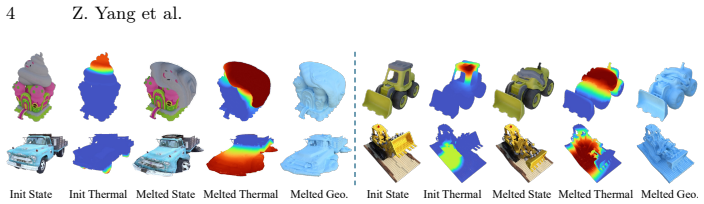
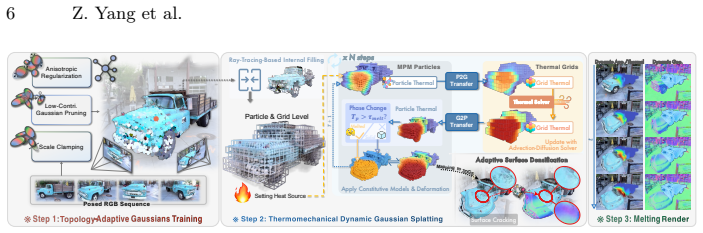
MeGAS is a framework that augments 3D Gaussian Splatting with temperature attributes and employs a heat advection-diffusion solver with MPM dynamics incorporating phase transitions, enabling physically plausible and visually realistic synthesis of thermophysical phenomena, with a topology-adaptive Gaussian rendering strategy to mitigate artifacts under extreme deformation.
What carries the argument
thermomechanical dynamic Gaussian Splatting representation that augments standard 3DGS with temperature attributes and integrates heat advection-diffusion solving with MPM dynamics for phase transitions
If this is right
- Produces physically consistent thermomechanical behavior in rendered scenes
- Maintains high-fidelity photorealistic rendering during dynamic changes
- Enables synthesis of phenomena such as melting and solidification
- Advances the development of physics-integrated world models
Where Pith is reading between the lines
- Scenes could be edited by adjusting temperature parameters to trigger phase changes without manual modeling
- This method might generalize to other physical factors beyond temperature if similar solvers are added
- Real-time applications could benefit if the computational overhead of the dynamics solver is optimized
Load-bearing premise
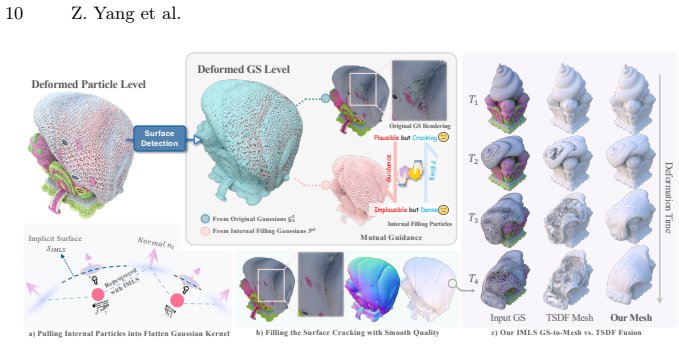
The topology-adaptive Gaussian rendering strategy successfully mitigates cracking and floaters under extreme deformation caused by phase transitions.
What would settle it
A test rendering where phase transitions cause visible cracking, floaters, or temperature dynamics that do not match physical expectations in the visual output.
Figures


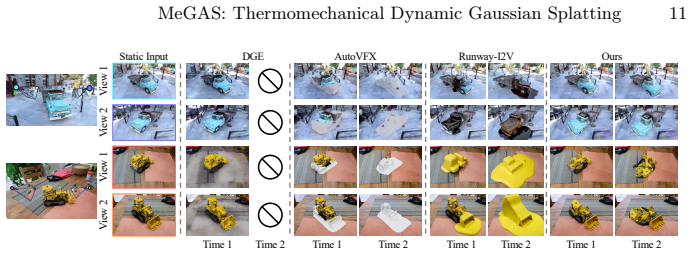


read the original abstract
Recent advances integrate physically grounded Newtonian dynamics with neural rendering frameworks, narrowing the gap between photorealistic scene reconstruction and physics-based animation. However, existing approaches focus on mechanically driven dynamics while neglecting temperature, a fundamental yet invisible physical factor underlying phenomena such as melting, solidification, and other thermomechanical processes. In this paper, we propose MeGAS, a novel framework that incorporates thermomechanical phase-change dynamics into 3D Gaussian Splatting (3DGS). Specifically, we propose a new thermomechanical dynamic Gaussian Splatting representation that augments 3DGS with temperature attributes and employs a heat advection-diffusion solver with MPM dynamics incorporating phase transitions, enabling physically plausible and visually realistic synthesis of thermophysical phenomena. Furthermore, a new topology-adaptive Gaussian rendering strategy is proposed to mitigate cracking and floaters under extreme deformation. Extensive experiments demonstrate that MeGAS produces physically consistent thermomechanical behavior while maintaining high-fidelity photorealistic rendering, advancing toward physics-integrated world models.
Editorial analysis
A structured set of objections, weighed in public.
Referee Report
Summary. The paper proposes MeGAS, a framework integrating thermomechanical phase-change dynamics into 3D Gaussian Splatting (3DGS). It augments 3DGS with temperature attributes, employs a heat advection-diffusion solver combined with MPM dynamics that incorporate phase transitions, and introduces a topology-adaptive Gaussian rendering strategy to mitigate cracking and floaters under extreme deformation. The central claim is that extensive experiments demonstrate physically consistent thermomechanical behavior alongside high-fidelity photorealistic rendering, advancing physics-integrated world models.
Significance. If the technical claims hold, the work would meaningfully extend recent integrations of Newtonian dynamics with neural rendering by incorporating temperature as a driver of phase changes (e.g., melting, solidification). This addresses a gap in existing mechanically focused approaches and could enable more realistic thermophysical scene editing and animation.
major comments (1)
- [Abstract] Abstract: the claim that 'extensive experiments demonstrate physically consistent thermomechanical behavior' cannot be evaluated because the provided manuscript text contains no methods section, equations, implementation details, quantitative results, figures, or tables.
Simulated Author's Rebuttal
We thank the referee for the detailed review and the opportunity to clarify the manuscript. We address the single major comment below.
read point-by-point responses
-
Referee: [Abstract] Abstract: the claim that 'extensive experiments demonstrate physically consistent thermomechanical behavior' cannot be evaluated because the provided manuscript text contains no methods section, equations, implementation details, quantitative results, figures, or tables.
Authors: The full manuscript contains a complete Methods section that details the thermomechanical dynamic Gaussian representation, the heat advection-diffusion solver, MPM dynamics with phase transitions, the topology-adaptive rendering strategy, implementation specifics, quantitative metrics, ablation studies, and multiple figures and tables. The abstract is a concise summary of those results. If the version under review was truncated or missing these sections, we will ensure the complete manuscript is supplied; otherwise the claims are directly supported by the provided content. revision: no
Circularity Check
No significant circularity in provided text
full rationale
The abstract presents a high-level description of a novel framework integrating temperature attributes, heat advection-diffusion solver, MPM dynamics with phase transitions, and topology-adaptive Gaussian rendering into 3DGS. No equations, parameter-fitting procedures, self-citations, or derivation steps are supplied that could reduce any claimed result to its own inputs by construction. Without access to methods, equations, or citations in the manuscript, no load-bearing circular steps of the enumerated kinds can be identified or quoted. The derivation chain is therefore self-contained at the level of the given text.
Axiom & Free-Parameter Ledger
Reference graph
Works this paper leans on
-
[1]
Achiam, J., Adler, S., Agarwal, S., Ahmad, L., Akkaya, I., Aleman, F.L., Almeida, D., Altenschmidt, J., Altman, S., Anadkat, S., et al.: Gpt-4 technical report. arXiv preprint arXiv:2303.08774 (2023)
work page internal anchor Pith review Pith/arXiv arXiv 2023
-
[2]
In: Proceedings Visualization, 2001
Alexa, M., Behr, J., Cohen-Or, D., Fleishman, S., Levin, D., Silva, C.T.: Point set surfaces. In: Proceedings Visualization, 2001. VIS’01. pp. 21–29. IEEE (2001)
2001
-
[3]
Fluid Flow Handbook1, 1–49 (2002)
Ashgriz, N., Mostaghimi, J.: An introduction to computational fluid dynamics. Fluid Flow Handbook1, 1–49 (2002)
2002
-
[4]
In: IEEE/CVF Conference on Computer Vision and Pattern Recognition (2022)
Barron, J.T., Mildenhall, B., Verbin, D., Srinivasan, P.P., Hedman, P.: Mip-nerf 360: Unbounded anti-aliased neural radiance fields. In: IEEE/CVF Conference on Computer Vision and Pattern Recognition (2022)
2022
-
[5]
Cambridge University Press (2000)
Batchelor, G.K.: An Introduction to Fluid Dynamics. Cambridge University Press (2000)
2000
-
[6]
Stable Video Diffusion: Scaling Latent Video Diffusion Models to Large Datasets
Blattmann, A., Dockhorn, T., Kulal, S., Mendelevitch, D., Kilian, M., Lorenz, D., Levi, Y., English, Z., Voleti, V., Letts, A., et al.: Stable video diffusion: Scaling latent video diffusion models to large datasets. arXiv preprint arXiv:2311.15127 (2023)
work page internal anchor Pith review Pith/arXiv arXiv 2023
-
[7]
IEEE Transactions on Visualization and Computer Graphics (2024)
Chen, D., Li, H., Ye, W., Wang, Y., Xie, W., Zhai, S., Wang, N., Liu, H., Bao, H., Zhang, G.: Pgsr: Planar-based gaussian splatting for efficient and high-fidelity sur- face reconstruction. IEEE Transactions on Visualization and Computer Graphics (2024)
2024
-
[8]
In: European Conference on Computer Vision
Chen, M., Laina, I., Vedaldi, A.: Dge: Direct gaussian 3d editing by consistent multi-view editing. In: European Conference on Computer Vision. pp. 74–92. Springer (2024)
2024
-
[9]
In: European Conference on Computer Vision
Chen, Q., Shu, S., Bai, X.: Thermal3d-gs: Physics-induced 3d gaussians for thermal infrared novel-view synthesis. In: European Conference on Computer Vision. pp. 253–269. Springer (2024)
2024
-
[10]
In: IEEE/CVF Conference on Computer Vision and Pattern Recognition
Dai, Q., Ni, X., Shen, Q., Chen, W., Chen, B., Chu, M.: Rainygs: Efficient rain synthesis with physically-based gaussian splatting. In: IEEE/CVF Conference on Computer Vision and Pattern Recognition. pp. 16153–16162 (2025)
2025
-
[11]
In: IEEE/CVF Conference on Computer Vision and Pattern Recognition
Feng, Y., Feng, X., Shang, Y., Jiang, Y., Yu, C., Zong, Z., Shao, T., Wu, H., Zhou, K., Jiang, C., et al.: Gaussian splashing: Unified particles for versatile motion syn- thesis and rendering. In: IEEE/CVF Conference on Computer Vision and Pattern Recognition. pp. 518–529 (2025)
2025
-
[12]
In: IEEE/CVF Conference on Computer Vi- sion and Pattern Recognition
Feng, Y., Shang, Y., Li, X., Shao, T., Jiang, C., Yang, Y.: Pie-nerf: Physics-based interactive elastodynamics with nerf. In: IEEE/CVF Conference on Computer Vi- sion and Pattern Recognition. pp. 4450–4461 (2024)
2024
-
[13]
Physical Review E65(4), 046308 (2002)
Guo, Z., Zheng, C., Shi, B.: Discrete lattice effects on the forcing term in the lattice boltzmann method. Physical Review E65(4), 046308 (2002)
2002
-
[14]
In: 2025 International Conference on 3D Vision (3DV)
Hsu, H.Y., Lin, C.H., Zhai, A.J., Xia, H., Wang, S.: Autovfx: Physically realistic video editing from natural language instructions. In: 2025 International Conference on 3D Vision (3DV). pp. 769–780. IEEE (2025) MeGAS: Thermomechanical Dynamic Gaussian Splatting 17
2025
-
[15]
ACM Transactions on Graphics37(4), 1–14 (2018)
Hu, Y., Fang, Y., Ge, Z., Qu, Z., Zhu, Y., Pradhana, A., Jiang, C.: A moving least squares material point method with displacement discontinuity and two-way rigid body coupling. ACM Transactions on Graphics37(4), 1–14 (2018)
2018
-
[16]
In: ACM SIGGRAPH 2024 Conference Papers
Huang, B., Yu, Z., Chen, A., Geiger, A., Gao, S.: 2d gaussian splatting for geo- metrically accurate radiance fields. In: ACM SIGGRAPH 2024 Conference Papers. pp. 1–11 (2024)
2024
-
[17]
ACM Transactions on Graphics34(4), 1–10 (2015)
Jiang, C., Schroeder, C., Selle, A., Teran, J., Stomakhin, A.: The affine particle- in-cell method. ACM Transactions on Graphics34(4), 1–10 (2015)
2015
-
[18]
In: ACM SIGGRAPH 2024 Conference Papers
Jiang, Y., Yu, C., Xie, T., Li, X., Feng, Y., Wang, H., Li, M., Lau, H., Gao, F., Yang, Y., et al.: Vr-gs: A physical dynamics-aware interactive gaussian splatting system in virtual reality. In: ACM SIGGRAPH 2024 Conference Papers. pp. 1–1 (2024)
2024
-
[19]
ACM Transactions on Graphics42(4) (July 2023),https://repo-sam.inria.fr/fungraph/3d-gaussian-splatting/
Kerbl, B., Kopanas, G., Leimkühler, T., Drettakis, G.: 3d gaussian splatting for real-time radiance field rendering. ACM Transactions on Graphics42(4) (July 2023),https://repo-sam.inria.fr/fungraph/3d-gaussian-splatting/
2023
-
[20]
Klár, G., Gast, T., Pradhana, A., Fu, C., Schroeder, C., Jiang, C., Teran, J.: Drucker-pragerelastoplasticityforsandanimation.ACMTransactionsonGraphics 35(4), 1–12 (2016)
2016
-
[21]
Knapitsch, A., Park, J., Zhou, Q.Y., Koltun, V.: Tanks and temples: Benchmarking large-scalescenereconstruction.ACMTransactionsonGraphics36(4),1–13(2017)
2017
-
[22]
ACM Transactions on Algorithms (TALG)4(2), 1–25 (2008)
Kolluri, R.: Provably good moving least squares. ACM Transactions on Algorithms (TALG)4(2), 1–25 (2008)
2008
-
[23]
In: International Conference on Learning Representations
Lei,Y.,Zhao,B.,Yang,Z.,Li,X.,Cheng,T.,Peng,H.,Zhang,R.,Yang,Y.,Huang, S., Shen, Y., et al.: Diffwind: Physics-informed differentiable modeling of wind- driven object dynamics. In: International Conference on Learning Representations
-
[24]
arXiv preprint arXiv:2303.05512 (2023)
Li, X., Qiao, Y.L., Chen, P.Y., Jatavallabhula, K.M., Lin, M., Jiang, C., Gan, C.: Pac-nerf: Physics augmented continuum neural radiance fields for geometry- agnostic system identification. arXiv preprint arXiv:2303.05512 (2023)
-
[25]
Li,Y.,Lin,Z.H.,Forsyth,D.,Huang,J.B.,Wang,S.:Climatenerf:Extremeweather synthesisinneuralradiancefield.In:IEEE/CVFInternationalConferenceonCom- puter Vision. pp. 3227–3238 (2023)
2023
-
[26]
In: International Conference on Learning Representations
Lin, Y., Lin, C., Xu, J., MU, Y.: Omniphysgs: 3d constitutive gaussians for gen- eral physics-based dynamics generation. In: International Conference on Learning Representations
-
[27]
In: 2024 IEEE International Conference on Computational Pho- tography (ICCP)
Lin, Y.Y., Pan, X.Y., Fridovich-Keil, S., Wetzstein, G.: Thermalnerf: Thermal radiance fields. In: 2024 IEEE International Conference on Computational Pho- tography (ICCP). pp. 1–12. IEEE (2024)
2024
-
[28]
In: European Conference on Computer Vision
Liu, S., Ren, Z., Gupta, S., Wang, S.: Physgen: Rigid-body physics-grounded image-to-video generation. In: European Conference on Computer Vision. pp. 360–
-
[29]
arXiv preprint arXiv:2409.07200 (2024)
Lu, R., Chen, H., Zhu, Z., Qin, Y., Lu, M., Zhang, L., Yan, C., Xue, A.: Thermal- gaussian: Thermal 3d gaussian splatting. arXiv preprint arXiv:2409.07200 (2024)
-
[30]
ACM Transactions on Graphics44(4) (Jul 2025).https://doi.org/10
Luo, Z., Cui, Z., Luo, S., Chu, M., Li, M.: Vr-doh: Hands-on 3d modeling in virtual reality. ACM Transactions on Graphics44(4) (Jul 2025).https://doi.org/10. 1145/3731154
2025
-
[31]
Commu- nications of the ACM65(1), 99–106 (2021)
Mildenhall, B., Srinivasan, P.P., Tancik, M., Barron, J.T., Ramamoorthi, R., Ng, R.: Nerf: Representing scenes as neural radiance fields for view synthesis. Commu- nications of the ACM65(1), 99–106 (2021)
2021
-
[32]
ACM Transactions on Graphics (2024) 18 Z
Moenne-Loccoz, N., Mirzaei, A., Perel, O., de Lutio, R., Martinez Esturo, J., State, G., Fidler, S., Sharp, N., Gojcic, Z.: 3d gaussian ray tracing: Fast tracing of particle scenes. ACM Transactions on Graphics (2024) 18 Z. Yang et al
2024
-
[33]
In: European Confer- ence on Computer Vision
Özer, M., Weiherer, M., Hundhausen, M., Egger, B.: Exploring multi-modal neural scene representations with applications on thermal imaging. In: European Confer- ence on Computer Vision. pp. 82–98. Springer (2024)
2024
-
[34]
In: Computer Graphics Forum
Oztireli, C., Guennebaud, G., Gross, M.: Feature preserving point set surfaces based on non-linear kernel regression. In: Computer Graphics Forum. vol. 28, pp. 493–501. Wiley (2009)
2009
-
[35]
In: European Conference on Computer Vision (2024)
Qiu, R.Z., Yang, G., Zeng, W., Wang, X.: Language-driven physics-based scene synthesis and editing via feature splatting. In: European Conference on Computer Vision (2024)
2024
-
[36]
Runway AI, Inc.: Introducing runway gen–4.https://runwayml.com/research/ introducing-runway-gen-4.5(2025), accessed: 2025-12-1
2025
-
[37]
In: International Conference on Learning Representations (ICLR) (2026)
Shen, Q., Tao, N., Dai, Q., Chen, T., Qin, M., Zhang, Y., Chu, M., Chen, W., Chen, B.: Fierygs: In-the-wild fire synthesis with physics-integrated gaussian splatting. In: International Conference on Learning Representations (ICLR) (2026)
2026
-
[38]
In: IEEE/CVF Conference on Computer Vision and Pattern Recognition
Shen, S., Shao, T., Zhou, K., Jiang, C., Yang, Y.: Enliveninggs: Active locomotion of 3dgs. In: IEEE/CVF Conference on Computer Vision and Pattern Recognition. pp. 896–905 (2025)
2025
-
[39]
Oxford University Press (2001)
Succi, S.: The Lattice Boltzmann Equation: For Fluid Dynamics and Beyond. Oxford University Press (2001)
2001
-
[40]
In: Advances in Neural Information Processing Systems (2025)
Vasile, F., Qiu, R.Z., Natale, L., Wang, X.: Gaussian-augmented physics simula- tion and identification with complex colliders. In: Advances in Neural Information Processing Systems (2025)
2025
-
[41]
Wan: Open and Advanced Large-Scale Video Generative Models
Wan, Team, Wang, A., Ai, B., Wen, B., Mao, C., Xie, C.W., Chen, D., Yu, F., Zhao, H., Yang, J., et al.: Wan: Open and advanced large-scale video generative models. arXiv preprint arXiv:2503.20314 (2025)
work page internal anchor Pith review Pith/arXiv arXiv 2025
-
[42]
In: IEEE/CVF Conference on Computer Vision and Pattern Recognition
Wang, M., Zhang, Y., Xu, W., Ma, R., Zou, C., Morris, D.: Decoupledgaussian: Object-scene decoupling for physics-based interaction. In: IEEE/CVF Conference on Computer Vision and Pattern Recognition. pp. 11361–11372 (2025)
2025
-
[43]
In: International Confer- ence on Learning Representations (2026),https://openreview.net/forum?id= P2Nw2LMkjH
Wang, Z., Ling, H., Zhang, W., Sun, Y., Sun, Q.: ETGS: Explicit thermodynamics gaussian splatting for dynamic thermal reconstruction. In: International Confer- ence on Learning Representations (2026),https://openreview.net/forum?id= P2Nw2LMkjH
2026
-
[44]
In: IEEE/CVF Confer- ence on Computer Vision and Pattern Recognition
Xie, T., Zong, Z., Qiu, Y., Li, X., Feng, Y., Yang, Y., Jiang, C.: Physgaussian: Physics-integrated 3d gaussians for generative dynamics. In: IEEE/CVF Confer- ence on Computer Vision and Pattern Recognition. pp. 4389–4398 (2024)
2024
-
[45]
In: IEEE/CVF Conference on Computer Vision and Pattern Recognition
Yang, K., Liu, Y., Cui, Z., Liu, Y., Zhang, M., Yan, S., Wang, Q.: Ntr-gaussian: Nighttime dynamic thermal reconstruction with 4d gaussian splatting based on thermodynamics. In: IEEE/CVF Conference on Computer Vision and Pattern Recognition. pp. 691–700 (2025)
2025
-
[46]
In: 2024 IEEE/RSJ International Conference on Intelligent Robots and Systems (IROS)
Ye, T., Wu, Q., Deng, J., Liu, G., Liu, L., Xia, S., Pang, L., Yu, W., Pei, L.: Thermal-nerf: Neural radiance fields from an infrared camera. In: 2024 IEEE/RSJ International Conference on Intelligent Robots and Systems (IROS). pp. 1046–
2024
-
[47]
ACM Transactions on Graphics 34(5), 1–20 (2015)
Yue, Y., Smith, B., Batty, C., Zheng, C., Grinspun, E.: Continuum foam: A ma- terial point method for shear-dependent flows. ACM Transactions on Graphics 34(5), 1–20 (2015)
2015
-
[48]
In: European Conference on Computer Vision
Zhong,L.,Yu,H.X.,Wu,J.,Li,Y.:Reconstructionandsimulationofelasticobjects with spring-mass 3d gaussians. In: European Conference on Computer Vision. pp. 407–423. Springer (2024) MeGAS: Thermomechanical Dynamic Gaussian Splatting 19
2024
-
[49]
In: SIGGRAPH Asia 2023 Conference Papers
Zong, Z., Li, X., Li, M., Chiaramonte, M.M., Matusik, W., Grinspun, E., Carlberg, K., Jiang, C., Chen, P.Y.: Neural stress fields for reduced-order elastoplasticity and fracture. In: SIGGRAPH Asia 2023 Conference Papers. pp. 1–11 (2023)
2023
discussion (0)
Sign in with ORCID, Apple, or X to comment. Anyone can read and Pith papers without signing in.