MATCH: Flow Matching for Multi-View Anomaly Detection
Pith reviewed 2026-06-26 00:30 UTC · model grok-4.3
The pith
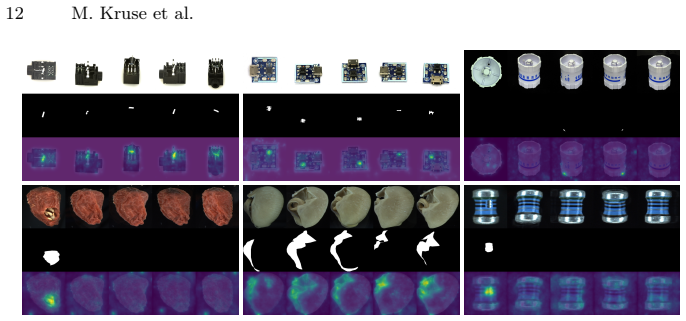
Flow matching uses ODE likelihood estimates to detect and segment anomalies in multi-view industrial images at object, image, and pixel levels.
A machine-rendered reading of the paper's core claim, the machinery that carries it, and where it could break.
Core claim
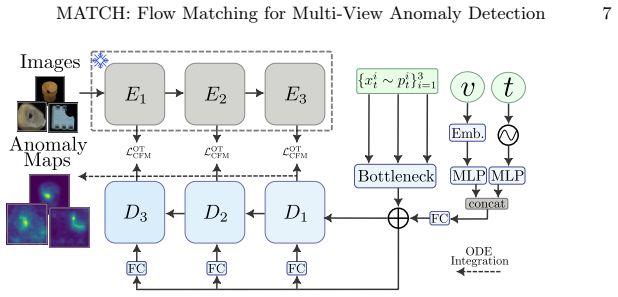
MATCH adapts flow matching to multi-view anomaly detection by using its ODE formulation to estimate likelihoods and derive anomaly scores at object, image, and pixel levels. The architectural flexibility of the models allows efficient mapping of features with varying spatial sizes to a normal distribution. This yields state-of-the-art detection and segmentation performance on Real-IAD and MANTA-Tiny while omitting the divergence term to enable real-time operation on consumer hardware.
What carries the argument
The ODE formulation of flow matching, which transforms multi-view features into a normal distribution to enable direct likelihood estimation for anomaly scoring.
If this is right
- Anomaly scores become available at object, image, and pixel levels from a single likelihood computation.
- Real-time production use becomes feasible on standard consumer hardware.
- The same model handles features of different spatial sizes without extra architectural changes.
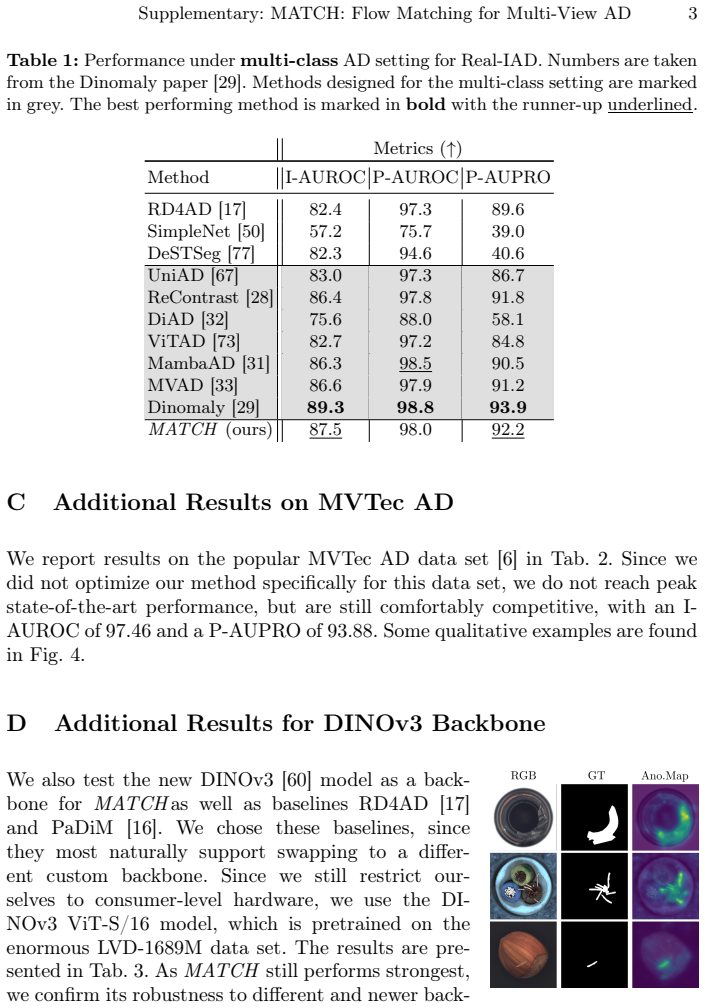
- Comprehensive benchmarks establish superiority over prior anomaly detection methods on both Real-IAD and MANTA-Tiny.
Where Pith is reading between the lines
- Omitting the divergence term may trade some theoretical properties of continuous normalizing flows for practical speed in time-critical settings.
- The multi-view likelihood approach could extend to other generative tasks that require consistent scoring across viewpoints.
- If the likelihoods remain stable across datasets, the method reduces dependence on reconstruction error or prototype memory for anomaly detection.
Load-bearing premise
The ODE formulation of flow matching directly produces reliable likelihood-based anomaly scores for multi-view data at object, image, and pixel levels without post-hoc adjustments.
What would settle it
A head-to-head evaluation on Real-IAD showing that MATCH's AUROC or AUPRO scores fall below those of prior methods such as reconstruction or memory-bank baselines would falsify the performance claim.
Figures



read the original abstract
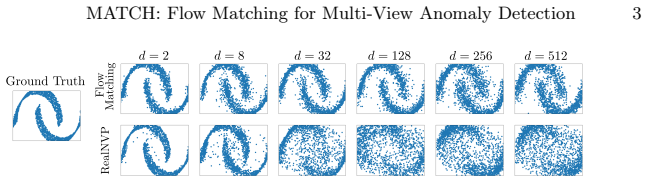
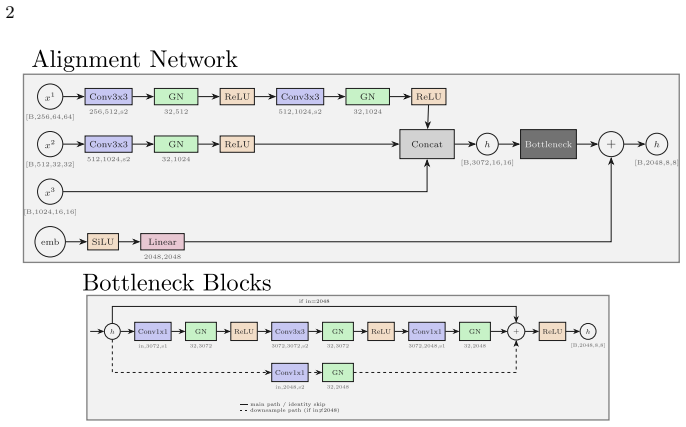
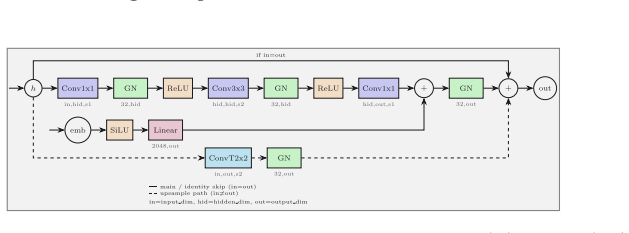
Detecting anomalies in industrial objects is an important topic for increasing production efficiency. More complex objects often require the analysis of several view points, which has led to the field of multi-view anomaly detection. We present MATCH, the first multi-view anomaly detection method based on Flow Matching (FM). With the ODE formulation of Flow Matching, we can estimate likelihoods and thereby derive an anomaly score to detect anomalies in multi-view image data at object, image, and pixel-level. The architectural flexibility of FM models allows us to efficiently transform features of different spatial sizes to the normal distribution. We evaluate thoroughly on the already established Real-IAD data set and are also the first to provide a comprehensive evaluation of popular anomaly detection methods for the MANTA-Tiny data set. MATCH achieves state-of-the-art performance in both anomaly detection and segmentation, all while running on consumer-level hardware. By omitting the costly divergence term needed for likelihood estimation, we ensure that MATCH is usable in real-time production scenarios. Lastly, several ablation studies are conducted to validate the methodological choices.
Editorial analysis
A structured set of objections, weighed in public.
Referee Report
Summary. The paper introduces MATCH, the first multi-view anomaly detection method based on Flow Matching. It uses the ODE formulation of FM to estimate likelihoods and derive anomaly scores at object, image, and pixel levels on multi-view industrial image data. The method is evaluated on Real-IAD and MANTA-Tiny, claims SOTA performance in detection and segmentation, runs on consumer hardware, and enables real-time use by omitting the divergence term required for likelihood estimation.
Significance. If the likelihood-based scoring mechanism without the divergence term can be shown to produce reliable anomaly rankings, the approach would offer an efficient, architecture-flexible alternative for multi-view industrial anomaly detection that supports real-time deployment.
major comments (1)
- [Abstract] Abstract: the central claim that 'likelihoods' are estimated via the ODE formulation of Flow Matching to produce anomaly scores at multiple levels is load-bearing, yet the text simultaneously states that the divergence term needed for likelihood estimation is omitted. No derivation of the exact anomaly score formula (or proxy) appears, nor any comparison to a standard CNF log-likelihood estimator or validation that ranking quality is preserved on Real-IAD or MANTA-Tiny.
minor comments (1)
- [Abstract] The abstract mentions 'several ablation studies' but provides no details on which methodological choices were tested or their outcomes.
Simulated Author's Rebuttal
We thank the referee for the constructive comment on the abstract and the load-bearing claim regarding likelihood estimation. We address this directly below.
read point-by-point responses
-
Referee: [Abstract] Abstract: the central claim that 'likelihoods' are estimated via the ODE formulation of Flow Matching to produce anomaly scores at multiple levels is load-bearing, yet the text simultaneously states that the divergence term needed for likelihood estimation is omitted. No derivation of the exact anomaly score formula (or proxy) appears, nor any comparison to a standard CNF log-likelihood estimator or validation that ranking quality is preserved on Real-IAD or MANTA-Tiny.
Authors: We agree the abstract is imprecise and that the manuscript lacks an explicit derivation or validation. MATCH computes anomaly scores from the flow-matching ODE trajectory (integrating the learned vector field) without the divergence term; the resulting quantity is a computationally efficient proxy rather than exact log-likelihood. We will revise the abstract to describe the scores as derived from the ODE formulation via this proxy. In the revised manuscript we will add (i) the precise mathematical definition of the proxy score in Section 3, (ii) a short comparison of proxy versus full CNF log-likelihood rankings on a held-out subset of Real-IAD, and (iii) a note confirming that the proxy preserves anomaly ordering on the evaluated datasets. These additions will be included in the next version. revision: yes
Circularity Check
No circularity: derivation chain self-contained with no reductions to inputs by construction
full rationale
The abstract and provided text contain no equations, no fitted parameters renamed as predictions, and no self-citations invoked as load-bearing uniqueness theorems. The ODE-based likelihood claim and omission of the divergence term are presented as a methodological choice for efficiency, without any self-definitional loop or renaming of known results. No step reduces a claimed prediction to its own input by construction; the central performance claims rest on external evaluation on Real-IAD and MANTA-Tiny rather than internal tautology.
Axiom & Free-Parameter Ledger
Reference graph
Works this paper leans on
-
[1]
In: 2022 IEEE International Conference on Image Processing (ICIP)
Akcay, S., Ameln, D., Vaidya, A., Lakshmanan, B., Ahuja, N., Genc, U.: Anoma- lib: A deep learning library for anomaly detection. In: 2022 IEEE International Conference on Image Processing (ICIP). pp. 1706–1710. IEEE (2022)
2022
-
[2]
arXiv preprint arXiv:1907.02392 (2019)
Ardizzone, L., Lüth, C., Kruse, J., Rother, C., Köthe, U.: Guided image genera- tion with conditional invertible neural networks. arXiv preprint arXiv:1907.02392 (2019)
Pith/arXiv arXiv 1907
-
[3]
arXiv preprint arXiv:2504.10612 (2025)
Balcerak,M.,Amiranashvili,T.,Terpin,A.,Shit,S.,Bogensperger,L.,Kaltenbach, S., Koumoutsakos, P., Menze, B.: Energy matching: Unifying flow matching and energy-based models for generative modeling. arXiv preprint arXiv:2504.10612 (2025)
arXiv 2025
-
[4]
In: Proceedings of the IEEE/CVF Winter Conference on Applications of Computer Vision (WACV)
Batzner, K., Heckler, L., König, R.: Efficientad: Accurate visual anomaly detection at millisecond-level latencies. In: Proceedings of the IEEE/CVF Winter Conference on Applications of Computer Vision (WACV). pp. 128–138 (January 2024)
2024
-
[5]
International Journal of Computer Vision130(4), 947–969 (2022)
Bergmann,P.,Batzner,K.,Fauser,M.,Sattlegger,D.,Steger,C.:Beyonddentsand scratches: Logical constraints in unsupervised anomaly detection and localization. International Journal of Computer Vision130(4), 947–969 (2022)
2022
-
[6]
In: Proceedings of the IEEE/CVF conference on computer vision and pattern recognition
Bergmann, P., Fauser, M., Sattlegger, D., Steger, C.: Mvtec ad–a comprehen- sive real-world dataset for unsupervised anomaly detection. In: Proceedings of the IEEE/CVF conference on computer vision and pattern recognition. pp. 9592–9600 (2019)
2019
-
[7]
Bergmann,P.,Jin,X.,Sattlegger,D.,Steger,C.:Themvtec3d-addatasetforunsu- pervised 3d anomaly detection and localization. In: Proceedings of the 17th Inter- national Joint Conference on Computer Vision, Imaging and Computer Graphics Theory and Applications, VISIGRAPP 2022, Volume 5: VISAPP, Online Stream- ing, February 6-8, 2022. pp. 202–213. SCITEPRESS (2022)
2022
-
[8]
Bergmann, P., Löwe, S., Fauser, M., Sattlegger, D., Steger, C.: Improving unsu- pervised defect segmentation by applying structural similarity to autoencoders. In: Proceedings of the 14th International Joint Conference on Computer Vision, Imag- ing and Computer Graphics Theory and Applications, VISIGRAPP 2019, Volume 5: VISAPP, Prague, Czech Republic, Feb...
2019
-
[9]
Bhunia, A., Li, C., Bilen, H.: Looking 3d: Anomaly detection with 2d-3d align- ment. In: IEEE/CVF Conference on Computer Vision and Pattern Recognition, CVPR 2024, Seattle, WA, USA, June 16-22, 2024. pp. 17263–17272. IEEE (2024). https://doi.org/10.1109/CVPR52733.2024.01634,https://doi.org/10.1109/ CVPR52733.2024.01634
-
[10]
Don’t shake the wheel: Momentum-aware planning in end-to-end autonomous driving
Bhunia, A., Li, C., Bilen, H.: Odd-one-out: Anomaly detection by compar- ing with neighbors. In: IEEE/CVF Conference on Computer Vision and Pat- tern Recognition, CVPR 2025, Nashville, TN, USA, June 11-15, 2025. pp. 16 M. Kruse et al. 20395–20404. Computer Vision Foundation / IEEE (2025).https://doi.org/ 10.1109/CVPR52734.2025.01899,https://openaccess.the...
-
[11]
In: Proceedings of the 16th Asian Conference on Computer Vision (ACCV2022 (2022), aCCV
Bonfiglioli, L., Toschi, M., Silvestri, D., Fioraio, N., De Gregorio, D.: The eyecan- dies dataset for unsupervised multimodal anomaly detection and localization. In: Proceedings of the 16th Asian Conference on Computer Vision (ACCV2022 (2022), aCCV
2022
-
[12]
arXiv preprint arXiv:2505.10996 (2025)
Cao, Y., Cheng, Y., Xu, X., Zhang, Y., Sun, Y., Tan, Y., Zhang, Y., Huang, X., Shen, W.: Visual anomaly detection under complex view-illumination interplay: A large-scale benchmark. arXiv preprint arXiv:2505.10996 (2025)
arXiv 2025
-
[13]
Advances in neural information processing systems31(2018)
Chen, R.T., Rubanova, Y., Bettencourt, J., Duvenaud, D.K.: Neural ordinary dif- ferential equations. Advances in neural information processing systems31(2018)
2018
-
[14]
arXiv preprint arXiv:2005.02357 (2020)
Cohen, N., Hoshen, Y.: Sub-image anomaly detection with deep pyramid corre- spondences. arXiv preprint arXiv:2005.02357 (2020)
arXiv 2005
-
[15]
arXiv preprint arXiv:2307.08698 (2023)
Dao, Q., Phung, H., Nguyen, B., Tran, A.: Flow matching in latent space. arXiv preprint arXiv:2307.08698 (2023)
arXiv 2023
-
[16]
In: International Conference on Pattern Recognition
Defard,T.,Setkov,A.,Loesch,A.,Audigier,R.:Padim:apatchdistributionmodel- ing framework for anomaly detection and localization. In: International Conference on Pattern Recognition. pp. 475–489. Springer (2021)
2021
-
[17]
In: Proceedings of the IEEE/CVF Conference on Computer Vision and Pattern Recognition
Deng, H., Li, X.: Anomaly detection via reverse distillation from one-class em- bedding. In: Proceedings of the IEEE/CVF Conference on Computer Vision and Pattern Recognition. pp. 9737–9746 (2022)
2022
-
[18]
In: 2009 IEEE conference on computer vision and pattern recognition
Deng, J., Dong, W., Socher, R., Li, L.J., Li, K., Fei-Fei, L.: Imagenet: A large- scale hierarchical image database. In: 2009 IEEE conference on computer vision and pattern recognition. pp. 248–255. Ieee (2009)
2009
-
[19]
Ding, C., Pang, G., Shen, C.: Catching both gray and black swans: Open-set supervised anomaly detection. In: IEEE/CVF Conference on Computer Vision and Pattern Recognition, CVPR 2022, New Orleans, LA, USA, June 18-24, 2022. pp. 7378–7388. IEEE (2022).https://doi.org/10.1109/CVPR52688.2022.00724, https://doi.org/10.1109/CVPR52688.2022.00724
-
[20]
Dinh, L., Krueger, D., Bengio, Y.: NICE: non-linear independent components esti- mation. In: Bengio, Y., LeCun, Y. (eds.) 3rd International Conference on Learning Representations, ICLR 2015, San Diego, CA, USA, May 7-9, 2015, Workshop Track Proceedings (2015),http://arxiv.org/abs/1410.8516
Pith/arXiv arXiv 2015
-
[21]
In: 5th International Conference on Learning Representations, ICLR 2017, Toulon, France, April 24-26, 2017, Conference Track Proceedings
Dinh, L., Sohl-Dickstein, J., Bengio, S.: Density estimation using real NVP. In: 5th International Conference on Learning Representations, ICLR 2017, Toulon, France, April 24-26, 2017, Conference Track Proceedings. OpenReview.net (2017), https://openreview.net/forum?id=HkpbnH9lx
2017
-
[22]
Don’t shake the wheel: Momentum-aware planning in end-to-end autonomous driving
Fan, L., Fan, D., Hu, Z., Ding, Y., Di, D., Yi, K., Pagnucco, M., Song, Y.: MANTA: A large-scale multi-view and visual-text anomaly detection dataset for tiny objects. In: IEEE/CVF Conference on Computer Vision and Pattern Recognition, CVPR 2025, Nashville, TN, USA, June 11-15, 2025. pp. 25518–25527. Computer Vision Foundation / IEEE (2025).https://doi.or...
-
[23]
Don’t shake the wheel: Momentum-aware planning in end-to-end autonomous driving
Galappaththige, C.J., Lai, J., Windrim, L., Dansereau, D.G., Sünderhauf, N., Miller, D.: Multi-view pose-agnostic change localization with zero labels. In: IEEE/CVF Conference on Computer Vision and Pattern Recognition, CVPR 2025, Nashville, TN, USA, June 11-15, 2025. pp. 11600–11610. Computer Vision Foundation / IEEE (2025).https://doi.org/10.1109/CVPR52...
-
[24]
Fabian Mentzer, David Minnen, Eirikur Agustsson, and Michael Tschannen
Gong, D., Liu, L., Le, V., Saha, B., Mansour, M.R., Venkatesh, S., van den Hen- gel, A.: Memorizing normality to detect anomaly: Memory-augmented deep au- toencoder for unsupervised anomaly detection. In: 2019 IEEE/CVF International Conference on Computer Vision, ICCV 2019, Seoul, Korea (South), October 27 - November 2, 2019. pp. 1705–1714. IEEE (2019).ht...
-
[25]
In: 7th International Conference on Learning Representations, ICLR 2019, New Orleans, LA, USA, May 6-9, 2019
Grathwohl, W., Chen, R.T.Q., Bettencourt, J., Sutskever, I., Duvenaud, D.: FFJORD: free-form continuous dynamics for scalable reversible generative mod- els. In: 7th International Conference on Learning Representations, ICLR 2019, New Orleans, LA, USA, May 6-9, 2019. OpenReview.net (2019),https://openreview. net/forum?id=rJxgknCcK7
2019
-
[26]
In: Wooldridge, M.J., Dy, J.G., Natarajan, S
Gu, Z., Zhu, B., Zhu, G., Chen, Y., Tang, M., Wang, J.: Anomalygpt: Detect- ing industrial anomalies using large vision-language models. In: Wooldridge, M.J., Dy, J.G., Natarajan, S. (eds.) Thirty-Eighth AAAI Conference on Artificial Intel- ligence, AAAI 2024. pp. 1932–1940. AAAI Press (2024).https://doi.org/10. 1609/AAAI.V38I3.27963,https://doi.org/10.16...
-
[27]
In: Proceedings of the IEEE/CVF Winter Conference on Applications of Computer Vision
Gudovskiy,D.,Ishizaka,S.,Kozuka,K.:Cflow-ad:Real-timeunsupervisedanomaly detection with localization via conditional normalizing flows. In: Proceedings of the IEEE/CVF Winter Conference on Applications of Computer Vision. pp. 98–107 (2022)
2022
-
[28]
In: Oh, A., Naumann, T., Glober- son, A., Saenko, K., Hardt, M., Levine, S
Guo, J., Lu, S., Jia, L., Zhang, W., Li, H.: Recontrast: Domain-specific anomaly detection via contrastive reconstruction. In: Oh, A., Naumann, T., Glober- son, A., Saenko, K., Hardt, M., Levine, S. (eds.) Advances in Neural Infor- mation Processing Systems 36: Annual Conference on Neural Information Pro- cessing Systems 2023, NeurIPS 2023, New Orleans, L...
2023
-
[29]
Don’t shake the wheel: Momentum-aware planning in end-to-end autonomous driving
Guo, J., Lu, S., Zhang, W., Chen, F., Li, H., Liao, H.: Dinomaly: The less is more philosophy in multi-class unsupervised anomaly detection. In: IEEE/CVF Conference on Computer Vision and Pattern Recognition, CVPR 2025, Nashville, TN, USA, June 11-15, 2025. pp. 20405–20415. Computer Vision Foundation / IEEE (2025).https://doi.org/10.1109/CVPR52734.2025.01...
-
[30]
Springer (1993)
Hairer, E., Wanner, G., Nørsett, S.P.: Solving ordinary differential equations I: Nonstiff problems. Springer (1993)
1993
-
[31]
In: Globersons, A., Mackey, L., Belgrave, D., Fan, A., Paquet, U., Tomczak, J.M., Zhang, C
He, H., Bai, Y., Zhang, J., He, Q., Chen, H., Gan, Z., Wang, C., Li, X., Tian, G., Xie, L.: Mambaad: Exploring state space models for multi-class unsuper- vised anomaly detection. In: Globersons, A., Mackey, L., Belgrave, D., Fan, A., Paquet, U., Tomczak, J.M., Zhang, C. (eds.) Advances in Neural Infor- mation Processing Systems 38: Annual Conference on N...
2024
-
[32]
In: Wooldridge, M.J., Dy, J.G., Natarajan, S
He, H., Zhang, J., Chen, H., Chen, X., Li, Z., Chen, X., Wang, Y., Wang, C., Xie, L.: A diffusion-based framework for multi-class anomaly detection. In: Wooldridge, M.J., Dy, J.G., Natarajan, S. (eds.) Thirty-Eighth AAAI Conference on Artificial 18 M. Kruse et al. Intelligence, AAAI 2024, Thirty-Sixth Conference on Innovative Applications of Artificial In...
-
[33]
IEEE Transactions on Multimedia (2026)
He, H., Zhang, J., Tian, G., Wang, C., Xie, L.: Learning multi-view anomaly de- tection with efficient adaptive selection. IEEE Transactions on Multimedia (2026)
2026
-
[34]
Deep Residual Learning for Image Recognition,
He, K., Zhang, X., Ren, S., Sun, J.: Deep residual learning for image recognition. In: 2016 IEEE Conference on Computer Vision and Pattern Recognition, CVPR 2016, Las Vegas, NV, USA, June 27-30, 2016. pp. 770–778. IEEE Computer Society (2016).https://doi.org/10.1109/CVPR.2016.90,https://doi.org/10.1109/ CVPR.2016.90
-
[35]
In2023 IEEE/CVF Conference on Computer Vision and Pattern Recognition Workshops (CVPRW)
Heckler, L., König, R., Bergmann, P.: Exploring the importance of pretrained feature extractors for unsupervised anomaly detection and localization. In: IEEE/CVF Conference on Computer Vision and Pattern Recognition, CVPR 2023 - Workshops, Vancouver, BC, Canada, June 17-24, 2023. pp. 2917–2926. IEEE (2023).https://doi.org/10.1109/CVPRW59228.2023.00293,htt...
-
[36]
arXiv preprint arXiv:2503.21622 (2025)
Heckler-Kram, L., Neudeck, J.H., Scheler, U., König, R., Steger, C.: The mvtec ad 2 dataset: Advanced scenarios for unsupervised anomaly detection. arXiv preprint arXiv:2503.21622 (2025)
arXiv 2025
-
[37]
arXiv preprint arXiv:1606.08415 (2016)
Hendrycks, D., Gimpel, K.: Gaussian error linear units (gelus). arXiv preprint arXiv:1606.08415 (2016)
Pith/arXiv arXiv 2016
-
[38]
Communications in Statistics-Simulation and Com- putation18(3), 1059–1076 (1989)
Hutchinson, M.F.: A stochastic estimator of the trace of the influence matrix for laplacian smoothing splines. Communications in Statistics-Simulation and Com- putation18(3), 1059–1076 (1989)
1989
-
[39]
Jeong, J., Zou, Y., Kim, T., Zhang, D., Ravichandran, A., Dabeer, O.: Winclip: Zero-/few-shot anomaly classification and segmentation. In: IEEE/CVF Confer- ence on Computer Vision and Pattern Recognition, CVPR 2023, Vancouver, BC, Canada, June 17-24, 2023. pp. 19606–19616. IEEE (2023).https://doi.org/ 10.1109/CVPR52729.2023.01878,https://doi.org/10.1109/C...
-
[40]
Kingma, D.P., Ba, J.: Adam: A method for stochastic optimization. In: Bengio, Y., LeCun, Y. (eds.) 3rd International Conference on Learning Representations, ICLR 2015, San Diego, CA, USA, May 7-9, 2015, Conference Track Proceedings (2015),http://arxiv.org/abs/1412.6980
Pith/arXiv arXiv 2015
-
[41]
(eds.) Advances in Neural Information Processing Systems 31: Annual ConferenceonNeuralInformationProcessingSystems2018,NeurIPS2018,Decem- ber 3-8, 2018, Montréal, Canada
Kingma, D.P., Dhariwal, P.: Glow: Generative flow with invertible 1x1 convolu- tions.In:Bengio,S.,Wallach,H.M.,Larochelle,H.,Grauman,K.,Cesa-Bianchi,N., Garnett, R. (eds.) Advances in Neural Information Processing Systems 31: Annual ConferenceonNeuralInformationProcessingSystems2018,NeurIPS2018,Decem- ber 3-8, 2018, Montréal, Canada. pp. 10236–10245 (2018...
2018
-
[42]
In: Larochelle, H., Ranzato, M., Hadsell, R., Balcan, M., Lin, H
Kirichenko, P., Izmailov, P., Wilson, A.G.: Why normalizing flows fail to detect out-of-distribution data. In: Larochelle, H., Ranzato, M., Hadsell, R., Balcan, M., Lin, H. (eds.) Advances in Neural Information Processing Systems 33: Annual Con- ference on Neural Information Processing Systems 2020, NeurIPS 2020, December 6-12, 2020, virtual (2020),https:...
2020
-
[43]
In: IEEE/CVF Conference on Computer Vision and Pattern Recognition Workshops, CVPR Workshops 2025, Nashville, TN, USA, June 11-15, 2025
Kruse, M., Rosenhahn, B.: Multi-flow: Multi-view-enriched normalizing flows for industrial anomaly detection. In: IEEE/CVF Conference on Computer Vision and Pattern Recognition Workshops, CVPR Workshops 2025, Nashville, TN, USA, June 11-15, 2025. pp. 3933–3944. Computer Vision Foundation / IEEE (2025)
2025
-
[44]
Kruse, M., Rudolph, M., Woiwode, D., Rosenhahn, B.: Splatpose & detect: Pose- agnostic 3d anomaly detection. In: IEEE/CVF Conference on Computer Vision and Pattern Recognition, CVPR 2024 - Workshops, Seattle, WA, USA, June 17- 18, 2024. pp. 3950–3960. IEEE (2024).https://doi.org/10.1109/CVPRW63382. 2024.00399,https://doi.org/10.1109/CVPRW63382.2024.00399
-
[45]
IEEE Access10, 78446–78454 (2022)
Lee, S., Lee, S., Song, B.C.: CFA: coupled-hypersphere-based feature adaptation for target-oriented anomaly localization. IEEE Access10, 78446–78454 (2022). https://doi.org/10.1109/ACCESS.2022.3193699,https://doi.org/10.1109/ ACCESS.2022.3193699
-
[46]
In: Proceedings of the IEEE/CVF Conference on Computer Vision and Pattern Recognition
Lei, J., Hu, X., Wang, Y., Liu, D.: Pyramidflow: High-resolution defect contrastive localization using pyramid normalizing flow. In: Proceedings of the IEEE/CVF Conference on Computer Vision and Pattern Recognition. pp. 14143–14152 (2023)
2023
-
[47]
In: The Eleventh International Conference on Learning Rep- resentations, ICLR 2023, Kigali, Rwanda, May 1-5, 2023
Lipman, Y., Chen, R.T.Q., Ben-Hamu, H., Nickel, M., Le, M.: Flow matching for generative modeling. In: The Eleventh International Conference on Learning Rep- resentations, ICLR 2023, Kigali, Rwanda, May 1-5, 2023. OpenReview.net (2023), https://openreview.net/forum?id=PqvMRDCJT9t
2023
-
[48]
arXiv preprint arXiv:2412.06264 (2024)
Lipman, Y., Havasi, M., Holderrieth, P., Shaul, N., Le, M., Karrer, B., Chen, R.T., Lopez-Paz, D., Ben-Hamu, H., Gat, I.: Flow matching guide and code. arXiv preprint arXiv:2412.06264 (2024)
Pith/arXiv arXiv 2024
-
[49]
arXiv preprint arXiv:2503.11088 (2025)
Liu, Y., Xu, X., Li, S., Liao, J., Yang, X.: Multi-view industrial anomaly detec- tion with epipolar constrained cross-view fusion. arXiv preprint arXiv:2503.11088 (2025)
arXiv 2025
-
[50]
In: Proceedings of the IEEE/CVF Conference on Computer Vision and Pattern Recognition
Liu, Z., Zhou, Y., Xu, Y., Wang, Z.: Simplenet: A simple network for image anomaly detection and localization. In: Proceedings of the IEEE/CVF Conference on Computer Vision and Pattern Recognition. pp. 20402–20411 (2023)
2023
-
[51]
In: 7th Inter- national Conference on Learning Representations, ICLR 2019, New Orleans, LA, USA, May 6-9, 2019
Loshchilov, I., Hutter, F.: Decoupled weight decay regularization. In: 7th Inter- national Conference on Learning Representations, ICLR 2019, New Orleans, LA, USA, May 6-9, 2019. OpenReview.net (2019),https://openreview.net/forum? id=Bkg6RiCqY7
2019
-
[52]
Technometrics42(1), 55–61 (2000)
McKay, M.D., Beckman, R.J., Conover, W.J.: A comparison of three methods for selecting values of input variables in the analysis of output from a computer code. Technometrics42(1), 55–61 (2000)
2000
-
[53]
Journal of compu- tational physics122(2), 218–230 (1995)
Morokoff, W.J., Caflisch, R.E.: Quasi-monte carlo integration. Journal of compu- tational physics122(2), 218–230 (1995)
1995
-
[54]
The Journal of Machine Learning Research22(1), 2617–2680 (2021)
Papamakarios, G., Nalisnick, E., Rezende, D.J., Mohamed, S., Lakshminarayanan, B.: Normalizing flows for probabilistic modeling and inference. The Journal of Machine Learning Research22(1), 2617–2680 (2021)
2021
-
[55]
In: Inter- national conference on machine learning
Rezende, D., Mohamed, S.: Variational inference with normalizing flows. In: Inter- national conference on machine learning. pp. 1530–1538. PMLR (2015)
2015
-
[56]
In: Proceedings of the IEEE/CVF Conference on Computer Vision and Pattern Recognition
Roth, K., Pemula, L., Zepeda, J., Schölkopf, B., Brox, T., Gehler, P.: Towards total recall in industrial anomaly detection. In: Proceedings of the IEEE/CVF Conference on Computer Vision and Pattern Recognition. pp. 14318–14328 (2022)
2022
-
[57]
In: Proceedings of the IEEE/CVF winter conference on applications of computer vision
Rudolph, M., Wandt, B., Rosenhahn, B.: Same same but differnet: Semi-supervised defect detection with normalizing flows. In: Proceedings of the IEEE/CVF winter conference on applications of computer vision. pp. 1907–1916 (2021) 20 M. Kruse et al
1907
-
[58]
In: Proceedings of the IEEE/CVF Winter Conference on Applications of Computer Vision
Rudolph, M., Wehrbein, T., Rosenhahn, B., Wandt, B.: Fully convolutional cross- scale-flows for image-based defect detection. In: Proceedings of the IEEE/CVF Winter Conference on Applications of Computer Vision. pp. 1088–1097 (2022)
2022
-
[59]
In: WACV
Rudolph, M., Wehrbein, T., Rosenhahn, B., Wandt, B.: Asymmetric student- teacher networks for industrial anomaly detection. In: WACV. pp. 2591–2601. IEEE (2023)
2023
-
[60]
arXiv preprint arXiv:2508.10104 (2025)
Siméoni, O., Vo, H.V., Seitzer, M., Baldassarre, F., Oquab, M., Jose, C., Khali- dov, V., Szafraniec, M., Yi, S., Ramamonjisoa, M., et al.: Dinov3. arXiv preprint arXiv:2508.10104 (2025)
Pith/arXiv arXiv 2025
-
[61]
In: Proceedings of the IEEE/CVF Conference on Computer Vision and Pattern Recognition
Tien, T.D., Nguyen, A.T., Tran, N.H., Huy, T.D., Duong, S., Nguyen, C.D.T., Truong, S.Q.: Revisiting reverse distillation for anomaly detection. In: Proceedings of the IEEE/CVF Conference on Computer Vision and Pattern Recognition. pp. 24511–24520 (2023)
2023
-
[62]
Tong, A., Fatras, K., Malkin, N., Huguet, G., Zhang, Y., Rector-Brooks, J., Wolf, G., Bengio, Y.: Improving and generalizing flow-based generative mod- els with minibatch optimal transport. Trans. Mach. Learn. Res.2024(2024), https://openreview.net/forum?id=CD9Snc73AW
2024
-
[63]
Advances in neural information pro- cessing systems30(2017)
Vaswani,A.,Shazeer,N.,Parmar,N.,Uszkoreit,J.,Jones,L.,Gomez,A.N.,Kaiser, Ł., Polosukhin, I.: Attention is all you need. Advances in neural information pro- cessing systems30(2017)
2017
-
[64]
Wang, C., Zhu, W., Gao, B., Gan, Z., Zhang, J., Gu, Z., Qian, S., Chen, M., Ma, L.: Real-iad: A real-world multi-view dataset for benchmarking versatile industrial anomaly detection. In: IEEE/CVF Conference on Computer Vision and Pattern Recognition, CVPR 2024, Seattle, WA, USA, June 16-22, 2024. pp. 22883–22892. IEEE (2024).https://doi.org/10.1109/CVPR52...
-
[65]
In: British Machine Vision Conference (2021)
Wang, G., Han, S., Ding, E., Huang, D.: Student-teacher feature pyramid matching for anomaly detection. In: British Machine Vision Conference (2021)
2021
-
[66]
Yang, K., Cao, J., Bai, Z., Su, Z., Tagliasacchi, A.: Piad: Pose and illumination agnosticanomalydetection.In:ProceedingsoftheIEEE/CVFConferenceonCom- puter Vision and Pattern Recognition (CVPR). pp. 4734–4743 (June 2025)
2025
-
[67]
Advances in Neural Information Processing Systems 35, 4571–4584 (2022)
You, Z., Cui, L., Shen, Y., Yang, K., Lu, X., Zheng, Y., Le, X.: A unified model for multi-class anomaly detection. Advances in Neural Information Processing Systems 35, 4571–4584 (2022)
2022
-
[68]
arXiv preprint arXiv:2111.07677 (2021)
Yu, J., Zheng, Y., Wang, X., Li, W., Wu, Y., Zhao, R., Wu, L.: Fastflow: Unsuper- vised anomaly detection and localization via 2d normalizing flows. arXiv preprint arXiv:2111.07677 (2021)
arXiv 2021
-
[69]
In: Wilson, R.C., Hancock, E.R., Smith, W.A.P
Zagoruyko, S., Komodakis, N.: Wide residual networks. In: Wilson, R.C., Hancock, E.R., Smith, W.A.P. (eds.) Proceedings of the British Machine Vision Conference 2016, BMVC 2016, York, UK, September 19-22, 2016. BMVA Press (2016),https: //bmva-archive.org.uk/bmvc/2016/papers/paper087/index.html
2016
-
[70]
In: Proceedings of the IEEE/CVF International Conference on Computer Vision
Zavrtanik, V., Kristan, M., Skočaj, D.: Draem-a discriminatively trained re- construction embedding for surface anomaly detection. In: Proceedings of the IEEE/CVF International Conference on Computer Vision. pp. 8330–8339 (2021)
2021
-
[71]
In: European conference on computer vision
Zavrtanik, V., Kristan, M., Skočaj, D.: Dsr–a dual subspace re-projection network for surface anomaly detection. In: European conference on computer vision. pp. 539–554. Springer (2022)
2022
-
[72]
Zeiler, Dilip Krishnan, Graham W
Zeiler, M.D., Krishnan, D., Taylor, G.W., Fergus, R.: Deconvolutional networks. In: The Twenty-Third IEEE Conference on Computer Vision and Pattern Recog- nition, CVPR 2010, San Francisco, CA, USA, 13-18 June 2010. pp. 2528–2535. MATCH: Flow Matching for Multi-View Anomaly Detection 21 IEEE Computer Society (2010).https://doi.org/10.1109/CVPR.2010.5539957...
-
[73]
arXiv preprint arXiv:2312.07495 (2023)
Zhang, J., Chen, X., Wang, Y., Wang, C., Liu, Y., Li, X., Yang, M.H., Tao, D.: Exploring plain vit reconstruction for multi-class unsupervised anomaly detection. arXiv preprint arXiv:2312.07495 (2023)
arXiv 2023
-
[74]
In: Proceedings of the IEEE/CVF International Conference on Computer Vision
Zhang, J., He, H., Gan, Z., He, Q., Cai, Y., Xue, Z., Wang, Y., Wang, C., Xie, L., Liu, Y.: A comprehensive library for benchmarking multi-class visual anomaly de- tection. In: Proceedings of the IEEE/CVF International Conference on Computer Vision. pp. 3524–3533 (2025)
2025
-
[75]
Don’t shake the wheel: Momentum-aware planning in end-to-end autonomous driving
Zhang, J., Wang, G., Jin, Y., Huang, D.: Towards training-free anomaly detec- tion with vision and language foundation models. In: IEEE/CVF Conference on Computer Vision and Pattern Recognition, CVPR 2025, Nashville, TN, USA, June 11-15, 2025. pp. 15204–15213. Computer Vision Foundation / IEEE (2025).https: //doi.org/10.1109/CVPR52734.2025.01416,https://o...
-
[76]
Scene Adaptive Sparse Transformer for Event-based Object Detection
Zhang, X., Xu, M., Zhou, X.: Realnet: A feature selection network with realistic synthetic anomaly for anomaly detection. In: IEEE/CVF Conference on Com- puter Vision and Pattern Recognition, CVPR 2024, Seattle, WA, USA, June 16- 22, 2024. pp. 16699–16708. IEEE (2024).https://doi.org/10.1109/CVPR52733. 2024.01580,https://doi.org/10.1109/CVPR52733.2024.01580
-
[77]
In: Proceedings of the IEEE/CVF Conference on Computer Vision and Pattern Recognition
Zhang, X., Li, S., Li, X., Huang, P., Shan, J., Chen, T.: Destseg: Segmentation guided denoising student-teacher for anomaly detection. In: Proceedings of the IEEE/CVF Conference on Computer Vision and Pattern Recognition. pp. 3914– 3923 (2023)
2023
-
[78]
In: Proceedings of the 23rd ACM SIGKDD international conference on knowledge discovery and data mining
Zhou, C., Paffenroth, R.C.: Anomaly detection with robust deep autoencoders. In: Proceedings of the 23rd ACM SIGKDD international conference on knowledge discovery and data mining. pp. 665–674 (2017)
2017
-
[79]
arXiv preprint arXiv:2410.00713 (2024)
Zhou, K., Cao, Y., Kim, T., Zhao, H., Dong, H., Ting, K.M., Zhu, Y.: Rad: A dataset and benchmark for real-life anomaly detection with robotic observations. arXiv preprint arXiv:2410.00713 (2024)
Pith/arXiv arXiv 2024
-
[80]
In: Oh, A., Naumann, T., Globerson, A., Saenko, K., Hardt, M., Levine, S
Zhou, Q., Li, W., Jiang, L., Wang, G., Zhou, G., Zhang, S., Zhao, H.: PAD: A dataset and benchmark for pose-agnostic anomaly detection. In: Oh, A., Naumann, T., Globerson, A., Saenko, K., Hardt, M., Levine, S. (eds.) Ad- vances in Neural Information Processing Systems 36: Annual Conference on Neural Information Processing Systems 2023, NeurIPS 2023, New O...
2023
discussion (0)
Sign in with ORCID, Apple, or X to comment. Anyone can read and Pith papers without signing in.