REVIEW 3 major objections 5 minor 73 references
DGA$_2$D: Directed Graph-Guided Automated Algorithm Design with Large Language Models
T0 review · 3 major / 5 minor · reviewed 2026-08-15 · deepseek-v4-flash
Pith's one-line read The paper claims graph-guided evolution of both operator code and operator connections cuts average optimality gaps by up to 10.96 percentage points on 12 NP-hard optimization problems.
desk verdict Strong empirical framework for LLM-driven algorithm design, but the headline gains in Section 4.2.2 are mis-reported and the true gap versus the strongest baseline is smaller than claimed. read the letter →
The pith
A machine-rendered reading of the paper's core claim, the machinery that carries it, and where it could break.
The reading
What carries the argument
The machinery is a directed graph $D_t = (O_t, E_t)$ where each node $O_i$ is a functional operator carrying a pool $\mathcal{C}^{(t)}_i$ of code implementations, together with a first-order transition-credit estimator $Q_t(e)$ for transitions $e = (c_{t,j,i-1}, c_{t,j,i})$. Candidate algorithms are constructed by sampling a bounded directed walk from $O_{\mathrm{in}}$ to $O_{\mathrm{out}}$ and then sampling one implementation per operator from a softmax over transition credits. After evaluating $N$ candidates, the standardized terminal reward $\tilde{R}_{t,j}$ updates every activated transition via $Q_{t+1}(e) = (1-\alpha)Q_t(e) + \alpha \tilde{R}_{t,j}$, and aggregated credits drive dual-level evolution: delete, add, or replace the lowest-credit implementation of the lowest-credit operator, and replace the lowest-credit edge with a compatible new edge proposed by the LLM. The appendix proves that under a first-order sufficiency assumption on expected terminal rewards, first-order context minimizes finite-sample estimation risk among cell-mean estimators, and that the number of structural pipelines grows at the spectral radius of the input-output-relevant strongly connected components.
What would settle it
Record every activated implementation transition together with the two preceding implementations and its standardized terminal reward; fit $\mathbb{E}[Y \mid c_{i-1}, c_i]$ versus $\mathbb{E}[Y \mid c_{i-2}, c_{i-1}, c_i]$ on one half of the transitions and compare held-out predictive error. If the second-order context predicts significantly better, the first-order sufficiency assumption is false and the theoretical basis of the credit-assignment mechanism collapses; the empirical benchmark claims could also be tested by independent reruns on fresh instance splits.
Extended reading notes
Core claim
The central discovery is that jointly evolving operator implementations and operator connectivity is not only feasible but systematically better than tuning heuristics inside a fixed template, provided the algorithm space is represented as a directed graph with per-operator implementation pools. A pipeline is a bounded directed walk from an input sentinel to an output sentinel; cycles are allowed, so an operator motif can appear repeatedly as iterative refinement. Performance is observed only on complete candidate algorithms, so DGA2D distributes each standardized terminal reward back to first-order implementation transitions, pairs $(c_{i-1}, c_i)$, and uses the accumulated transition credits to sample implementations, to add or delete low-credit operator implementations, and to replace low-credit graph edges. The reported experiments show consistent wins over four LLM-based heuristic-design baselines across all 12 domains, with the largest average normalized-gap reduction of 10.96 percentage points under one of the two LLM backbones.
Load-bearing premise
The load-bearing premise is first-order sufficiency: the expected terminal reward of a code transition depends only on the immediate predecessor implementation and the current implementation, not on longer history; if that fails, higher-order contexts carry useful information and the theoretical case for first-order credit assignment weakens.
Editorial extensions
If this is right
- LLM-based automated heuristic design can move from module-level tuning to system-level evolution, and on the 12 tested NP-hard domains the average normalized gap drops by 9.67 percentage points under one backbone and 10.96 under the other.
- Cyclic directed-graph structure is useful: the DG representation beats fixed, linear, and DAG variants on CVRP, FJSP, MIS, and 3D-CLP, meaning repeated operator motifs can express iterative refinement.
- First-order path-dependent credit is the best context granularity among those tested, outperforming zero-order, second-order, and full-path credit, which suggests that overly long histories add noise rather than signal.
- The gains are not tied to a single LLM: DGA2D ranks first under both main backbones and across all eight backbones tested on flexible job-shop scheduling.
- The framework also produces competitive algorithms on continuous tasks such as ODE integration, feedback control, and root-finding, so the design principle may transfer beyond discrete combinatorial benchmarks.
Reading between the lines
- The first-order credit update is essentially temporal-difference-style reward estimation over program fragments; one could import exploration bonuses, upper-confidence bounds, or off-policy corrections into the same update, which the paper does not explore.
- Because the representation separates operator structure from operator implementation, a credit table learned on one domain might warm-start evolution on a related domain; the paper evaluates each domain from scratch.
- The poor performance of full-path credit is reported, not explained; a plausible reading is finite-sample variance, and a regularized higher-order estimator could test whether longer histories carry any true signal beyond first-order transitions.
- The paper itself acknowledges remaining limitations: computational cost of some generated algorithms, sensitivity to the initial operator pool, and potential cross-module inconsistencies, which delimit rather than overturn the reported benchmark gains.
Signed reviews
Editorial analysis
A structured set of objections, weighed in public.
Referee Report
Summary. The paper proposes DGA2D, a framework for LLM-driven automated heuristic design in which the space of complete solver programs is represented as a directed graph: nodes are functional operators, each with a pool of code implementations, and directed walks constitute algorithmic pipelines. An LLM proposes new implementations and edge edits, while a first-order path-dependent credit assignment mechanism, based on standardized terminal rewards of complete pipelines, guides implementation sampling and dual-level evolution of pools and graph topology. The authors claim consistent superiority over four prior LLM-based AHD baselines across 12 NP-hard combinatorial optimization problems under two LLM backbones, reporting average normalized-gap reductions of up to 10.96 percentage points, and they present ablations, convergence analyses, resource accounting, and extensions to continuous numerical tasks. The appendices contain formal statistical and spectral analysis of the credit assignment and graph representation.
Significance. If the claims hold after correction, the work is significant: it moves LLM-based automated heuristic design from isolated module tuning toward system-level algorithm architecture search, and it provides a concrete mechanism (directed-graph search space plus first-order transition credit) that appears broadly effective across very different problem domains. The paper is strong in breadth: 12 COP domains, two LLM backbones, ten independent runs, multiple ablations, wall-clock and token accounting, out-of-distribution tests, and extensions to ODE solving, control, and root finding. The formal appendices are careful and self-scoped, and the qualitative result that DGA2D is best on essentially every reported domain-backbone combination is consistent across Tables 1 and 8. However, the headline quantitative claims in the abstract and Section 4.2.2 do not survive direct recomputation from Table 1, and there are further table-to-text conflicts in the extended results. The central empirical direction appears defensible, but the reported magnitudes must be corrected and reconciled before the claims can be accepted as stated.
major comments (3)
- [§4.2.2 and Table 1] The headline improvement numbers are inconsistent with Table 1. Under DeepSeek-V4-Flash, DGA2D's four gaps in Table 1 average to (5.24+9.94+10.40+0.51)/4 = 6.52%, not the stated 6.02%. The strongest LLM baseline is MEoH at (19.17+26.37+16.48+0.73)/4 = 15.69%, so the actual improvement is 15.69−6.52 = 9.17 percentage points, not 9.67. Under GPT-5.6 Sol, the strongest baseline by Table 1 is MCTS-AHD at (18.50+23.32+15.16+1.05)/4 = 14.51%, not ReEvo at 15.56%; the improvement is 14.51−4.60 = 9.91 percentage points, not 10.96. Thus the claim that the 10.96 pp reduction is against the strongest baseline is false as written, and the DeepSeek claim relies on an incorrect DGA2D average. The authors should recompute all averages, correct the abstract and Section 4.2.2, and state explicitly which baseline is used for each comparison.
- [Appendix F.1 and Table 8] The extended results contain a further numerical inconsistency for GPT-5.6 Sol. The text states that DGA2D's average gap of 2.14% is compared with 9.77% for the strongest baseline, yielding a 7.63 pp improvement. From Table 8, the per-method baseline averages are EoH (6.75+24.36+0.25+9.07+9.68+16.53+6.59+6.01)/8 = 9.91%, MCTS-AHD 13.91%, MEoH 12.29%, and ReEvo 11.71%; no baseline average equals 9.77%. If EoH is the strongest baseline, the improvement is 9.91−2.14 = 7.77 pp, not 7.63. The authors need to reconcile the stated baseline average with the values in Table 8 or explain which subset of benchmarks was used.
- [Table 9 vs. Table 1] Table 9 reports an FJSP gap of 22.20% for MCTS-AHD under DeepSeek-V4-Flash, whereas Table 1 reports 24.59±5.25% for the same configuration, backbone, and benchmark. This is not a rounding difference. The claimed reduction range of 55.2%–60.1% for DGA2D relative to MCTS-AHD depends on the Table 9 value for its lower bound; using Table 1 would give a range of roughly 59.6%–60.1%. The authors should determine which table is correct and ensure that all backbone-sensitivity statistics are computed from the same underlying runs.
minor comments (5)
- [Abstract and §1] The abstract and the introduction repeat the 10.96 percentage-point improvement and the 'strongest baseline' framing; these statements should be revised after the Table 1 recomputation so that the abstract does not overstate the headline result.
- [§3.3, Eq. (1)] The pipeline notation uses L_{t,j} in Eq. (1) before the length bound and validity constraints are introduced; defining L_{t,j} and L_max before Eq. (1) would improve readability.
- [Appendix D.2] The theoretical support for first-order credit assignment explicitly relies on the first-order sufficiency assumption in Eq. (127), and the appendix itself notes that this assumption may fail. The main text should acknowledge this dependence when citing the statistical analysis, since the empirical ablation in Table 3 is the actual evidence for first-order credit in practice.
- [Appendix E.1] The text states that an anonymized repository is submitted with the supplementary material, but no link or access instructions appear in the manuscript. Given the table-to-text discrepancies noted above, providing the code, raw result files, and evaluation scripts is essential for verification.
- [Appendix F.1, final paragraph] The sentence 'DGA2D ranks first in all 16 combinations of the eight additional benchmarks and two LLM backbones' should say 'all 16 domain-backbone combinations' to avoid ambiguity about what is being counted.
Circularity Check
No significant circularity: the central empirical comparison is against external baselines, and the theoretical optimality result is explicitly conditional on a stated assumption.
full rationale
I walked the derivation chain from the directed-graph representation (Section 3.3) through credit assignment (Section 3.4) to the benchmark evaluation (Section 4.2). The main quantitative claim — that DGA2D reduces the average normalized gap relative to LLM-based AHD baselines — is supported by Table 1 and Table 8, which compare against externally published methods (EoH, MCTS-AHD, MEoH, ReEvo) on held-out test splits; the paper states that the evolution and test sets are mutually exclusive. The ablations in Tables 2–4 are experimental comparisons of design variants, not derivations from the method's own outputs. The only theorem bearing on the design choice, Theorem 2 in Appendix D.2, explicitly assumes first-order sufficiency in Eq. (127) and then derives a finite-sample risk comparison conditional on that assumption; the paper itself disclaims universal optimality, so the assumption is not disguised as a conclusion. There are no load-bearing self-citations, no imported uniqueness theorems, and no fitted quantity renamed as a prediction. The headline improvement numbers in Section 4.2.2 do not exactly match recomputation from Table 1, which is an internal-consistency and correctness concern rather than a circularity, so it does not raise the circularity score.
Assumptions & free parameters
free parameters (7)
- Operator pool capacity K =
Not fixed: sensitivity tested at 4, 8, 15, 20; best differs per problem (FJSP 15, CVRP/MIS/3D-CLP 20)
- Sampling temperature tau =
0.7
- Credit update rate alpha =
0.1
- Maximum implementation-pool size M =
10
- Pipelines per generation N =
4
- Shared instances per generation k =
3
- Maximum pipeline length L_max =
10
assumptions (6)
- domain assumption First-order sufficiency: E[Y_s | H_s] = mu(X^(1)_s), the expected terminal credit depends only on the immediate predecessor and current implementation (Appendix D.2, Eq. 127).
- domain assumption Martingale-difference noise model for terminal credits in the transition-credit update (Appendix D.4, Eqs. 207-209 and 221).
- standard math Perron-Frobenius theorem and standard nonnegative matrix theory (Appendix D.3).
- standard math Probability chain rule and softmax policy gradient identities (Appendix D.1).
- domain assumption Benchmark reference values (BKS or EP+FF for 3D-CLP) are valid performance anchors.
- domain assumption The LLM can generate interface-compatible operator code that passes AST, signature, runtime, and smoke validation (Appendix C.4).
invented entities (1)
-
First-order transition credit Q_t(e)
Cite this review
Pith. "Pith review of DGA$_2$D: Directed Graph-Guided Automated Algorithm Design with Large Language Models." pith.science (2026). https://pith.science/paper/7TTM3WAX
@misc{pith2026260800700,
  author       = {Pith},
  title        = {Pith review of: DGA$_2$D: Directed Graph-Guided Automated Algorithm Design with Large Language Models},
  year         = {2026},
  howpublished = {\url{https://pith.science/paper/7TTM3WAX}},
  note         = {Machine review of arXiv:2608.00700}
}
abstract
The rapid development of Large Language Models (LLMs) has opened new avenues for Automated Heuristic Design (AHD) for solving NP-hard combinatorial optimization problems (COPs). However, existing LLM-driven AHD methods are largely confined to rigid solver templates, relegating the search process to isolated module tuning. Transitioning to fully autonomous, system-level algorithm design is essential but fraught with low reliability of generated operators, extremely large search spaces, and ineffective credit assignment. To overcome these drawbacks, this paper proposes a Directed Graph-Guided Automated Algorithm Design framework, termed DGA$_2$D. It structures the open-ended program space as a directed graph, where each node represents a functional operator that can be instantiated using one of multiple candidate code implementations, while directed walks constitute complete algorithmic pipelines. A first-order path-dependent credit assignment mechanism is introduced to evaluate code variations strictly based on their topological context. Extensive experiments across 12 distinct COPs, ranging from complex scheduling to routing, demonstrate the consistent empirical advantages of DGA$_2$D. It reduces the average normalized gap by up to 10.96 percentage points compared to state-of-the-art LLM baselines.
Figures


Figures from the paper (2 more)

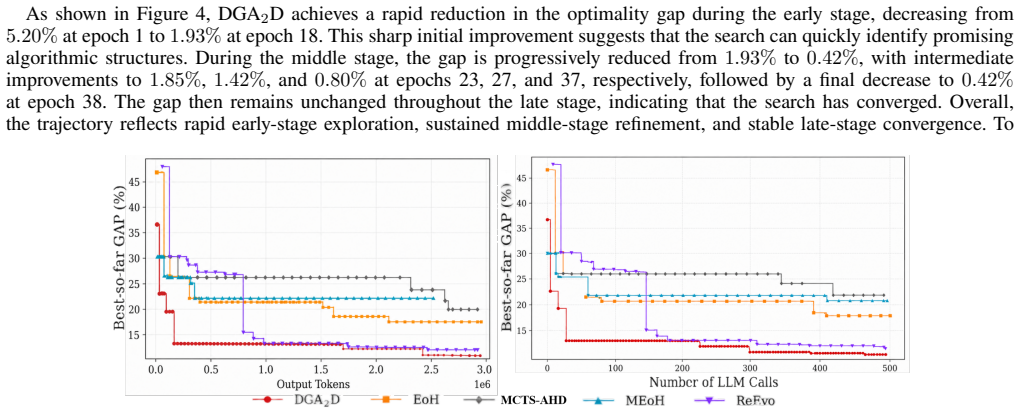
Reference graph
Works this paper leans on
-
[1]
Journal of the Operational Research Society , volume=
Hyper-heuristics: A survey of the state of the art , author=. Journal of the Operational Research Society , volume=. 2013 , publisher=
2013
-
[2]
Information Sciences , volume=
Population-based algorithm portfolios with automated constituent algorithms selection , author=. Information Sciences , volume=. 2014 , publisher=
work page 2014
-
[3]
Proceedings of the AAAI Conference on Artificial Intelligence , volume=
Hydra: Automatically configuring algorithms for portfolio-based selection , author=. Proceedings of the AAAI Conference on Artificial Intelligence , volume=
-
[4]
2005 IEEE congress on evolutionary computation , volume=
Logistic regression for parameter tuning on an evolutionary algorithm , author=. 2005 IEEE congress on evolutionary computation , volume=. 2005 , organization=
work page 2005
-
[5]
Procedia Computer Science , volume=
Automatic workflow scheduling tuning for distributed processing systems , author=. Procedia Computer Science , volume=. 2016 , publisher=
work page 2016
-
[6]
Handbook of metaheuristics , pages=
A classification of hyper-heuristic approaches , author=. Handbook of metaheuristics , pages=. 2010 , publisher=
work page 2010
-
[7]
European Journal of Operational Research , volume=
Recent advances in selection hyper-heuristics , author=. European Journal of Operational Research , volume=. 2020 , publisher=
work page 2020
-
[8]
Hyper-heuristics: theory and applications , author=. 2018 , publisher=
work page 2018
Show all 73 references
-
[9]
2026 , url =
Fei Liu and Yiming Yao and Ping Guo and Zhiyuan Yang and Xi Lin and Zhe Zhao and Xialiang Tong and Kun Mao and Zhichao Lu and Zhenkun Wang and Mingxuan Yuan and Qingfu Zhang , title =. 2026 , url =. doi:10.1145/3787585 , timestamp =
2026 doi
-
[10]
Nature , volume=
Mathematical discoveries from program search with large language models , author=. Nature , volume=. 2024 , publisher=
2024
-
[11]
Proceedings of the 41st International Conference on Machine Learning , pages =
Evolution of Heuristics: Towards Efficient Automatic Algorithm Design Using Large Language Model , author =. Proceedings of the 41st International Conference on Machine Learning , pages =. 2024 , editor =
2024
-
[12]
Advances in neural information processing systems , volume=
Reevo: Large language models as hyper-heuristics with reflective evolution , author=. Advances in neural information processing systems , volume=
-
[13]
Proceedings of the AAAI Conference on Artificial Intelligence , volume=
Hsevo: Elevating automatic heuristic design with diversity-driven harmony search and genetic algorithm using llms , author=. Proceedings of the AAAI Conference on Artificial Intelligence , volume=
-
[14]
arXiv preprint arXiv:2604.24043 , year=
A2DEPT: Large Language Model-Driven Automated Algorithm Design via Evolutionary Program Trees , author=. arXiv preprint arXiv:2604.24043 , year=
-
[15]
2025 , editor =
Zheng, Zhi and Xie, Zhuoliang and Wang, Zhenkun and Hooi, Bryan , booktitle =. 2025 , editor =
2025
-
[16]
arXiv preprint arXiv:2512.08609 , year=
CogMCTS: A Novel Cognitive-Guided Monte Carlo Tree Search Framework for Iterative Heuristic Evolution with Large Language Models , author=. arXiv preprint arXiv:2512.08609 , year=
-
[17]
50 Years of Integer Programming 1958-2008: from the Early Years to the State-of-the-Art , pages=
Reducibility among combinatorial problems , author=. 50 Years of Integer Programming 1958-2008: from the Early Years to the State-of-the-Art , pages=. 2009 , publisher=
1958
-
[18]
Computing , volume=
Job-shop scheduling with multi-purpose machines , author=. Computing , volume=. 1990 , publisher=
1990
-
[19]
Operations research , volume=
A survey of scheduling rules , author=. Operations research , volume=. 1977 , publisher=
1977
-
[20]
Operations research , volume=
Scheduling of vehicles from a central depot to a number of delivery points , author=. Operations research , volume=. 1964 , publisher=
1964
-
[21]
Omega , volume=
A heuristic algorithm for the m-machine, n-job flow-shop sequencing problem , author=. Omega , volume=. 1983 , publisher=
1983
-
[22]
Bell System Technical Journal , volume=
Computer solutions of the traveling salesman problem , author=. Bell System Technical Journal , volume=. 1965 , publisher=
1965
-
[23]
Operations research , volume=
An effective heuristic algorithm for the traveling-salesman problem , author=. Operations research , volume=. 1973 , publisher=
1973
-
[24]
Artificial Neural Networks: An Introduction to ANN Theory and Practice , pages=
Local search in combinatorial optimization , author=. Artificial Neural Networks: An Introduction to ANN Theory and Practice , pages=. 2005 , publisher=
2005
-
[25]
science , volume=
Optimization by simulated annealing , author=. science , volume=. 1983 , publisher=
1983
-
[26]
IEEE transactions on systems, man, and cybernetics, part b (cybernetics) , volume=
Ant system: optimization by a colony of cooperating agents , author=. IEEE transactions on systems, man, and cybernetics, part b (cybernetics) , volume=. 1996 , publisher=
1996
-
[27]
ACM computing surveys (CSUR) , volume=
Metaheuristics in combinatorial optimization: Overview and conceptual comparison , author=. ACM computing surveys (CSUR) , volume=. 2003 , publisher=
2003
-
[28]
Journal of heuristics , volume=
Testing heuristics: We have it all wrong , author=. Journal of heuristics , volume=. 1995 , publisher=
1995
-
[29]
The Twelfth International Conference on Learning Representations , year=
Large Language Models as Optimizers , author=. The Twelfth International Conference on Learning Representations , year=
-
[30]
2nd Workshop on Language and Robot Learning: Language as Grounding , year=
Eureka: Human-Level Reward Design via Coding Large Language Models , author=. 2nd Workshop on Language and Robot Learning: Language as Grounding , year=
-
[31]
arXiv preprint arXiv:2311.15249 , year=
Algorithm evolution using large language model , author=. arXiv preprint arXiv:2311.15249 , year=
-
[32]
Niki van Stein and Thomas B. LLaMEA:. 2025 , url =. doi:10.1109/TEVC.2024.3497793 , timestamp =
2025
-
[33]
Proceedings of the AAAI Conference on Artificial Intelligence , volume=
Multi-objective evolution of heuristic using large language model , author=. Proceedings of the AAAI Conference on Artificial Intelligence , volume=
-
[34]
ORSA Journal on computing , volume=
Tabu search—part I , author=. ORSA Journal on computing , volume=. 1989 , publisher=
1989
-
[35]
Handbook of metaheuristics , pages=
Iterated local search: Framework and applications , author=. Handbook of metaheuristics , pages=. 2018 , publisher=
2018
-
[36]
Advances in neural information processing systems , volume=
Pomo: Policy optimization with multiple optima for reinforcement learning , author=. Advances in neural information processing systems , volume=
-
[37]
2026 , url=
Xiangjie Xiao and Cong Zhang and Wen Song and Zhiguang Cao , booktitle=. 2026 , url=
2026
-
[38]
The Thirteenth International Conference on Learning Representations , year=
Scalable Discrete Diffusion Samplers: Combinatorial Optimization and Statistical Physics , author=. The Thirteenth International Conference on Learning Representations , year=
-
[39]
arXiv preprint arXiv:1708.05930 , year=
Solving a new 3d bin packing problem with deep reinforcement learning method , author=. arXiv preprint arXiv:1708.05930 , year=
-
[40]
Advances in Neural Information Processing Systems , volume=
Matrix encoding networks for neural combinatorial optimization , author=. Advances in Neural Information Processing Systems , volume=
-
[41]
The Twelfth International Conference on Learning Representations , year=
ReSched: Rethinking Flexible Job Shop Scheduling from a Transformer-based Architecture with Simplified States , author=. The Twelfth International Conference on Learning Representations , year=
-
[42]
Advances in neural information processing systems , volume=
Difusco: Graph-based diffusion solvers for combinatorial optimization , author=. Advances in neural information processing systems , volume=
-
[43]
Proceedings of the AAAI Conference on Artificial Intelligence , volume=
Learning to iteratively route vehicles via deep reinforcement learning , author=. Proceedings of the AAAI Conference on Artificial Intelligence , volume=
-
[44]
Advances in Neural Information Processing Systems , volume=
NeuroLKH: Combining deep learning model with Lin-Kernighan-Helsgaun heuristic for solving the traveling salesman problem , author=. Advances in Neural Information Processing Systems , volume=
-
[45]
Computers & Operations Research , volume=
Hybrid genetic search for the CVRP: Open-source implementation and SWAP* neighborhood , author=. Computers & Operations Research , volume=
-
[46]
Advances in neural information processing systems , volume=
DeepACO: Neural-enhanced ant systems for combinatorial optimization , author=. Advances in neural information processing systems , volume=
-
[47]
Mathematical Programming , pages=
Machine learning augmented branch and bound for mixed integer linear programming , author=. Mathematical Programming , pages=. 2024 , publisher=
2024
-
[48]
The Twelfth International Conference on Learning Representations , year=
L2p-MIP: Learning to presolve for mixed integer programming , author=. The Twelfth International Conference on Learning Representations , year=
-
[49]
arXiv preprint arXiv:2302.05636 , year=
A gnn-guided predict-and-search framework for mixed-integer linear programming , author=. arXiv preprint arXiv:2302.05636 , year=
-
[50]
International conference on machine learning , pages=
Learning to cut by looking ahead: Cutting plane selection via imitation learning , author=. International conference on machine learning , pages=. 2022 , organization=
2022
-
[51]
Advances in Neural Information Processing Systems , volume=
Learning to schedule heuristics in branch and bound , author=. Advances in Neural Information Processing Systems , volume=
-
[52]
Proceedings of the AAAI Conference on Artificial Intelligence , volume=
Ac-band: A combinatorial bandit-based approach to algorithm configuration , author=. Proceedings of the AAAI Conference on Artificial Intelligence , volume=
-
[53]
Computers & Industrial Engineering , volume=
Hyper-heuristics: A survey and taxonomy , author=. Computers & Industrial Engineering , volume=. 2024 , publisher=
2024
-
[54]
Proceedings of the 17th ACM/SIGEVO Conference on Foundations of Genetic Algorithms , pages=
Using automated algorithm configuration for parameter control , author=. Proceedings of the 17th ACM/SIGEVO Conference on Foundations of Genetic Algorithms , pages=
-
[55]
Proceedings of the AAAI Conference on Artificial Intelligence , volume=
Configx: Modular configuration for evolutionary algorithms via multitask reinforcement learning , author=. Proceedings of the AAAI Conference on Artificial Intelligence , volume=
-
[56]
Applied Soft Computing , volume=
A selection hyper-heuristic algorithm with Q-learning mechanism , author=. Applied Soft Computing , volume=. 2023 , publisher=
2023
-
[57]
Proceedings of the genetic and evolutionary computation conference , pages=
Learning from offline and online experiences: A hybrid adaptive operator selection framework , author=. Proceedings of the genetic and evolutionary computation conference , pages=
-
[58]
Algorithms , volume=
Automated Generation of Hybrid Metaheuristics Using Learning-to-Rank , author=. Algorithms , volume=. 2025 , publisher=
2025
-
[59]
Proceedings of the Genetic and Evolutionary Computation Conference Companion , pages=
Automated Generation of Trajectory-based Metaheuristics for Capacitated Vehicle Routing , author=. Proceedings of the Genetic and Evolutionary Computation Conference Companion , pages=
-
[60]
2024 , url =
Yuxiao Huang and Wei Zhou and Yu Wang and Min Li and Liang Feng and Kay Chen Tan , title =. 2024 , url =. doi:10.1109/TEVC.2023.3323877 , timestamp =
2024
-
[61]
Sustainable Scheduling of Distributed Flow Shop Group:
Yuhang Wang and Yuyan Han and Yuting Wang and Quan. Sustainable Scheduling of Distributed Flow Shop Group:. 2024 , url =. doi:10.1109/TEVC.2023.3339558 , timestamp =
2024
-
[62]
IEEE Transactions on Evolutionary Computation , year=
A feedback learning-based memetic algorithm for energy-aware distributed flexible job-shop scheduling with transportation constraints , author=. IEEE Transactions on Evolutionary Computation , year=
-
[63]
IEEE transactions on evolutionary computation , volume=
Knowledge learning for evolutionary computation , author=. IEEE transactions on evolutionary computation , volume=. 2023 , publisher=
2023
-
[64]
IEEE Transactions on Evolutionary Computation , volume=
Machine learning-assisted multiobjective evolutionary algorithm for routing and packing , author=. IEEE Transactions on Evolutionary Computation , volume=. 2024 , publisher=
2024
-
[65]
IEEE Transactions on Evolutionary Computation , volume=
Survey on genetic programming and machine learning techniques for heuristic design in job shop scheduling , author=. IEEE Transactions on Evolutionary Computation , volume=. 2023 , publisher=
2023
-
[66]
The Twelfth International Conference on Learning Representations , year=
Deep Reinforcement Learning Guided Improvement Heuristic for Job Shop Scheduling , author=. The Twelfth International Conference on Learning Representations , year=
-
[67]
arXiv preprint arXiv:2306.01276 , year=
Symmetric replay training: Enhancing sample efficiency in deep reinforcement learning for combinatorial optimization , author=. arXiv preprint arXiv:2306.01276 , year=
-
[68]
IEEE Transactions on Neural Networks and Learning Systems , volume=
Neural improvement heuristics for graph combinatorial optimization problems , author=. IEEE Transactions on Neural Networks and Learning Systems , volume=. 2023 , publisher=
2023
-
[69]
Advances in Neural Information Processing Systems , volume=
Fast t2t: Optimization consistency speeds up diffusion-based training-to-testing solving for combinatorial optimization , author=. Advances in Neural Information Processing Systems , volume=
-
[70]
CP-SAT , version =
Laurent Perron and Frédéric Didier , organization =. CP-SAT , version =
-
[71]
, author=
Towards a unified theory of state abstraction for MDPs. , author=. AI&M , volume=
-
[72]
European Journal of Operational Research , volume =
Bengio, Yoshua and Lodi, Andrea and Prouvost, Antoine , title =. European Journal of Operational Research , volume =. 2021 , doi =
2021
-
[73]
Wolpert and William G
David H. Wolpert and William G. Macready , title =. 1997 , url =. doi:10.1109/4235.585893 , timestamp =
1997
Reviewed August 15, 2026 · model on record in the stance chip above.
Discussion (0). Continue with ORCID to comment.