REVIEW 3 major objections 5 minor 71 references
Disorder driven multifractality transition in Weyl nodal loops
T0 review · 3 major / 5 minor · reviewed 2026-08-14 · deepseek-v4-flash
Pith's one-line read This paper establishes that arbitrarily small short-range disorder turns a clean Weyl nodal loop semimetal into a multifractal semimetal with a vanishing zero-energy density of states and a wavefunction concentrated on the nodal line.
desk verdict A careful numerical study that probably gets the finite-disorder phase diagram right, but the 'arbitrary small disorder' headline claim is an extrapolation, not a demonstrated result. read the letter →
The pith
A machine-rendered reading of the paper's core claim, the machinery that carries it, and where it could break.
The reading
What carries the argument
The central object is the generalized momentum-space inverse participation ratio, $I_k(q) = \left(\sum_{k,\alpha}|\Psi_{k,\alpha}|^2\right)^{-1}\sum_{k,\alpha}|\Psi_{k,\alpha}|^{2q} \propto L^{-\tau_k(q)}$, with $\tau_k(q)=D_k(q)(q-1)$. Its q-dependence is the diagnostic: a constant $D_k$ means a single fractal, a q-dependent $D_k$ means multifractality. The wavefunction's width around the nodal loop is defined as $\Gamma = 2\pi\sqrt{I_k L^3}/P$, with $I_k \equiv I_k(2)$ and $P$ the loop perimeter; the phase distinction is carried by whether $\Gamma \sim L^{-1}$ (multifractal semimetal) or $\Gamma \sim L^0$ (metal). The critical-point analysis is carried by the scaling forms of the density of states, $\rho(E) \sim \delta^{\nu(d-z)} F_\gamma(\delta^{-\nu z}|E|)$ and $\rho(E) \sim |E|^{d/z - 1}$ at $W = W_c$, whose collapse fixes $\nu$ and $z$.
What would settle it
Examine the ground-state wavefunction width $\Gamma$ for $W < 1.5$ at system sizes large enough that the average spacing of momentum points near the loop is well below $\Gamma$ (in particular resolving the $k_z$ direction). If the scaling exponent of $\Gamma$ versus $L$ remains $>1$ in that resolvable regime, or if the zero-energy density of states $\rho_0$ is found to be nonzero at arbitrarily small disorder, the claimed multifractal semimetal for arbitrary small disorder is ruled out.
Extended reading notes
Core claim
The central claim is that a clean Weyl nodal loop semimetal flows to a strong-coupling fixed point under any infinitesimal short-range disorder: a phase the authors call the multifractal semimetal. In this phase the zero-energy density of states obeys $\rho_0 = 0$, while the momentum-space ground-state wavefunction is concentrated along the nodal loop with width $\Gamma \sim L^{-1}$ and exhibits a q-dependent generalized dimension $D_k(q)$—equal to 3 for $q<1$ and 1 for $q>1$—which is the signature of multifractality. At the same critical disorder $W_c = 2.6 \pm 0.1$ where $\rho_0$ becomes nonzero, the wavefunction becomes single-fractal with $D_k(q)=3$, i.e. a standard three-dimensional diffusive metal. The transition is characterized by correlation-length exponent $\nu = 1.0 \pm 0.2$ and dynamical exponent $z = 1.9 \pm 0.1$, obtained from finite-size scaling of the width $\Gamma$ and from scaling collapse of the density of states; these differ from the 3D Anderson transition and from the disordered Weyl-semimetal transition. At considerably higher disorder, $W_c^l = 11.0 \pm 0.2$, the metal localizes through an Anderson transition.
Load-bearing premise
The load-bearing assumption is that the apparent scaling $\Gamma \sim L^{-x}$ with $1 < x < 2$ seen for $W \lesssim 1.5$ is only a finite-resolution artifact and would become $\Gamma \sim L^{-1}$ at larger system sizes; if that extrapolation is wrong, the 'arbitrary small disorder' part of the central claim collapses.
Editorial extensions
If this is right
- If the central claim is right, clean nodal-loop semimetals are not the appropriate zero-disorder starting point for describing real dirty samples: even tiny disorder produces the multifractal semimetal, so transport and spectral properties computed from clean states need revision.
- The semimetal-to-metal transition at $W_c \approx 2.6$ belongs to a new universality class, so scaling predictions based on the 3D Anderson transition or on the disordered Weyl-semimetal transition do not apply near that critical point.
- The finite $\rho_0$ in the metallic phase and its vanishing in the multifractal semimetal imply that the compressibility and low-frequency response change sharply at $W_c$, measurable in principle by transport and thermodynamic probes.
- At $W_c^l \approx 11$, the system undergoes a conventional Anderson metal-insulator transition, so any experimental signature of localization at strong disorder should be governed by the orthogonal-class Anderson universality class.
Reading between the lines
- A testable extension follows from the sharp momentum-space structure: in cold-atom or photonic realizations of nodal-loop Hamiltonians, momentum-resolved images of the ground state should show a bright ring around the loop whose thickness shrinks as $1/L$ for weak disorder and saturates for strong disorder.
- If the small-$W$ exponent $x>1$ is not a resolution artifact, the phase diagram would acquire an additional crossover or a distinct low-disorder fixed point; checking this requires studying $\Gamma$ at system sizes where the $k_z$-plane resolution is finer than $\Gamma$.
- The multifractal semimetal may have anomalous dynamical signatures, such as non-diffusive spreading of wavepackets or a non-standard conductivity exponent, because the momentum-space wavefunction is quasi-one-dimensional around the loop even though the system is three-dimensional in real space.
Signed reviews
Editorial analysis
A structured set of objections, weighed in public.
Referee Report
Summary. Gonçalves et al. study a two-band lattice model of a Weyl nodal loop (WNL) semimetal with box-distributed on-site disorder using three complementary numerical methods: kernel polynomial method (KPM) for the density of states, Lanczos exact diagonalization (ED) for low-energy eigenstates, and transfer matrix method (TMM) for the high-disorder localization transition. They report a three-regime phase diagram: for small disorder a 'multifractal semimetal' with zero-energy DOS rho0 = 0 and a momentum-space ground-state wavefunction concentrated around the nodal loop with width Gamma ~ L^{-1} and q-dependent generalized dimension Dk(q) (Dk = 1 for q > 1, Dk = 3 for q < 1); for 2.6 +/- 0.1 < W < 11.0 +/- 0.2 a diffusive ('single-fractal') metal with rho0 > 0; and an Anderson insulator for larger W. The semimetal-to-metal transition is characterized by correlation-length exponent nu = 1.0 +/- 0.2 and dynamical exponent z = 1.9 +/- 0.1 and is claimed to belong to a universality class different from both the 3D Anderson transition and the disordered Weyl semimetal transition. The central physics claim is that an infinitesimal amount of disorder destabilizes the clean WNL, which flows to the multifractal semimetal fixed point.
Significance. If the central claim holds, the Letter reports a genuinely new zero-temperature phase of a disordered nodal-line semimetal and a new semimetal-metal universality class, which would be of substantial interest to the disordered-semimetal community: the clean WNL is argued to be unstable to infinitesimal disorder, in contrast to the finite-disorder threshold of isolated Weyl nodes. The finite-disorder part of the phase diagram is credibly established by mutually consistent analyses (KPM rho'(E) crossings and maxima, ED energy-window crossing, tau_k(q) finite-size scaling, the phi_beta construction, and TMM for the Anderson transition), and the authors are explicit about resolution limits (SM S7) and about quantities they cannot extract (nu from xi_s, SM S4.1). The two-region wavefunction ansatz is validated against direct scaling collapses of the raw |Psi_k|^2 data, and the reported exponents constitute falsifiable predictions.
major comments (3)
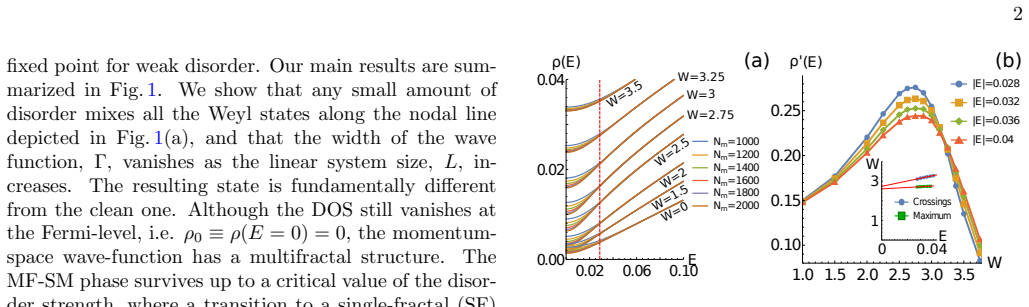
- [Abstract; Fig. 3(d); SM Sec. S7] The claim that an infinitesimal short-range disorder drives the clean WNL into the multifractal semimetal phase, which is the first sentence of the abstract and is repeated in the Discussion ('a clean WNL is unstable to an infinitesimal amount of disorder'), is not directly established by the numerics. For W < 1.5 the authors observe Gamma(W,L) ~ L^{-x} with 1 < x < 2 (e.g., x ≈ 1.4 at W = 0.5, Fig. S13(b)) and attribute this to the finite momentum-space resolution RL, demonstrating in SM S7 that sampling a Lorentzian of width Gamma ~ L^{-1} with RL > Gamma reproduces the spurious exponent. That demonstration shows the anomaly is compatible with a resolution artifact, but it does not exclude a genuine weak-disorder fixed point with an exponent different from unity. The point is load-bearing because the 'for arbitrary small disorder' part of the headline claim requires the true small-W fixed point to have Gamma ~ L^{-1}. The scaling collapse in Fig. 5(a) additionally includes W = 1.0 and 1.25, which lie inside the suspected resolution-limited region, and SM Sec. S4.1 states that nu cannot be extracted from xi_s for this same reason. I recommend either (i) a numerical test at larger L, which should be decisive because the resolution in the kz = 0 plane improves as L^{-2} while Gamma ~ L^{-1}, or (ii) a reformulation of the abstract and Discussion that presents the persistence down to W = 0 as an extrapolation supported by the marginal-relevance argument of Ref. [50] rather than as a directly demonstrated result.
- [Eq. (3) and footnote [59]] The printed definition of the central quantity Gamma is internally inconsistent. Combining the estimate N ≃ 2πGamma^2 P L^3/(2π)^3 with Ik ≡ Ik(q=2) ≃ 1/N gives Gamma = 2π/sqrt(Ik L^3 P), whereas Eq. (3) prints Gamma = 2π sqrt(Ik L^3 P). With the measured MF scaling Ik ~ L^{-1}, the printed equation would yield Gamma ~ L, contradicting the stated Gamma ~ L^{-1}. Footnote [59] states that the plots instead use Gamma = 1/(Ik L^3), which with Ik ~ L^{-1} scales as L^{-2} and is inconsistent with both Eq. (3) and the claimed L^{-1} behavior. Since Gamma enters the characteristic scales lambda_s and lambda_m and hence the phi_beta construction of W_c' (Sec. S3), the definition must be corrected and the quantity actually plotted in Fig. 3(c) stated unambiguously.
- [Discussion; Fig. 2(a); SM Sec. S2] The defining property of the MF-SM phase is a vanishing zero-energy DOS, rho0 = 0, but the manuscript itself records two limitations: KPM does not converge at E = 0 for small W (Fig. 2(a) and surrounding text, 'prevents a direct determination of rho0 for small W'), and the Discussion leaves open whether rare-region effects produce a finite contribution to rho0 in WNLs, citing Refs. [46,66,67]. The evidence for rho0 = 0 is therefore indirect (growth of rho'(E) with decreasing E, negative concavity of rho(E), and ED scaling of the energy window). I ask the authors to make the status of the rho0 = 0 statement precise: either provide a quantitative bound on rho0(W) within the box-disorder model at small W (for instance from ED with larger Nev or a rare-region argument for box disorder), or state explicitly in the abstract that rho0 = 0 is a numerically inferred statement within the attainable resolution rather than a directly measured zero. As written, the abstract overstates the certainty of this defining property.
minor comments (5)
- [MF-SF transition paragraph] The sentence 'As shown in Fig. 1(b) for a typical realization of disorder' appears to cite the phase-diagram schematic; the typical-realization wavefunction plots are in Fig. S10, and the momentum-space width is depicted in Fig. 1(a). Please correct the cross-reference.
- [Fig. 3(a)] The term 'multifractal' is used for a tau_k(q) that is piecewise linear with two slopes (Dk = 3 for q < 1 and Dk = 1 for q > 1), i.e., a bifractal spectrum. Please either justify the use of 'multifractal' for this piecewise-linear spectrum or state explicitly that the numerically accessible spectrum is bifractal.
- [Discussion (universality class)] The sentence stating that the critical exponents differ from those of a disordered Weyl semimetal is too strong: the quoted nu = 1.0 +/- 0.2 is fully consistent with the Weyl value nu ≈ 1, so the case for a distinct universality class rests on z = 1.9 +/- 0.1 versus z ≈ 1.5 and on the multifractal-to-single-fractal character of the transition, not on nu. Please rephrase accordingly.
- [Wc determination (Fig. 2(b))] The two KPM estimates (Wc = 2.61 +/- 0.01 from the maxima and Wc = 2.74 +/- 0.02 from the crossings) differ by more than their quoted statistical errors; the 'least squares' combination yielding 2.64 +/- 0.05 is not described, and the ED value 2.68 +/- 0.03 is quoted without stating how its error was obtained. Please specify the combination procedure or quote a systematic error covering the spread.
- [Fig. 3(d) and Eq. (2)] The two-region form |Psi_k|^2 ~ L^{-1} (k' < Gamma) and L^{-3} k'^{-2} (k' > Gamma) is a phenomenological parametrization inferred from the same data used to compute tau_k(q); the resulting tau_k(q) agrees with the scaling collapses in Fig. 3(d) and Fig. S11, but this is a consistency check rather than an independent derivation, and the text should say so explicitly.
Circularity Check
No circularity found: the phase diagram, Wc, and exponents are extracted from direct numerical observables with standard scaling assumptions, and the small-disorder extrapolation is a stated finite-size inference rather than a construction.
full rationale
The paper's derivation chain is self-contained against its numerical data. The central observables are the momentum-space inverse participation ratio Ik(q) (Eq. 2), the width Gamma defined from Ik (Eq. 3), and the DOS computed by KPM and ED. The multifractal-semimetal phase is characterized by directly measured scalings: Gamma ~ L^{-1} in the collapsed data of Fig. 3(d), and tau_k(q) with D_k(q)=3 for q<1 and D_k(q)=1 for q>1. The two-region wave-function model |Psi_k|^2 ~ L^{-1} for k'<Gamma and ~ L^{-3} k'^{-2} for k'>Gamma is used to reproduce tau_k(q), but it is checked against independent scaling collapses of the raw |Psi_k|^2 distributions rather than being imposed as the answer. The critical point Wc = 2.6 +/- 0.1 is obtained from two independent extrapolations (rho'(E) crossings/maxima and the phi_beta maximum procedure), and the exponents nu = 1.0 +/- 0.2 and z = 1.9 +/- 0.1 come from standard finite-size scaling collapses of Gamma, Gamma^{-1}/L, and rho(E); no fitted parameter is renamed as a prediction. The only admitted weak point is the small-disorder extrapolation: for W < 1.5 the paper observes Gamma ~ L^{-x} with 1<x<2 and attributes this to k-space resolution, supporting that attribution by showing that sampling a Lorentzian of width ~L^{-1} with resolution R_L > Gamma reproduces the spurious exponents (SM Sec. S7, Fig. S13). This is an unverified scaling extrapolation and a correctness risk, but it is not circular: the resolution-artifact demonstration is an independent check, not an input that forces the Gamma ~ L^{-1} conclusion. The one self-citation to forthcoming transport work (Ref. [65]) is not load-bearing for any result in this paper. No step reduces, by the paper's own equations or by citation, to its own inputs.
Assumptions & free parameters
free parameters (4)
- tx =
1.1
- ty =
0.9
- m =
2.12
- t2 =
0.8
assumptions (5)
- domain assumption The DOS scaling form near the transition, rho(E) ~ delta^{nu(d-z)} F(delta^{-nu z}|E|), from Ref [60], applies to this transition.
- domain assumption Gamma and Gamma^{-1}/L are the correct finite-size scaling variables in the SM and M phases respectively (Eqs. 4-5).
- domain assumption Twisted boundary conditions and averaging over disorder and the two lowest eigenstates give a representative sampling of the thermodynamic limit for the momentum-space IPR.
- ad hoc to paper The momentum-space probability distribution in the MF phase follows the two-region form |Psi_k|^2 ~ L^{-1} for k'<Gamma and ~ L^{-3} k'^{-2} for k'>Gamma, used to explain tau_k(q).
- domain assumption The crossing-point analyses (rho'(E) behavior, mu crossing, TMM crossings) correctly identify the thermodynamic critical points with the assumed scaling behavior.
Cite this review
Pith. "Pith review of Disorder driven multifractality transition in Weyl nodal loops." pith.science (2026). https://pith.science/paper/7WJKPPSP
@misc{pith2026190806910,
  author       = {Pith},
  title        = {Pith review of: Disorder driven multifractality transition in Weyl nodal loops},
  year         = {2026},
  howpublished = {\url{https://pith.science/paper/7WJKPPSP}},
  note         = {Machine review of arXiv:1908.06910}
}
read the original abstract
The effect of short-range disorder in nodal line semimetals is studied by numerically exact means. For arbitrary small disorder, a novel semimetallic phase is unveiled for which the momentum-space amplitude of the ground-state wave function is concentrated around the nodal line and follows a multifractal distribution. At a critical disorder strength, a semimetal to compressible metal transition occurs, coinciding with a multi- to single-fractality transition. The universality class of this critical point is characterized by the correlation length and dynamical exponents. At considerably higher disorder, an Anderson metal-insulator transition takes place. Our results show that the nature of the semimetallic phase in non-clean samples is fundamentally different from a clean nodal semimetal.
Figures


Figures from the paper (1 more)

Reference graph
Works this paper leans on
- [50]
-
[59]
As we were only interested in the scaling of Γ with L, in the plots we use Γ = 1/(IkL3)
-
[1]
M. Z. Hasan and C. L. Kane, Rev. Mod. Phys. 82, 3045 (2010)
2010
-
[2]
Qi and S.-C
X.-L. Qi and S.-C. Zhang, Rev. Mod. Phys. 83, 1057 (2011)
2011
-
[3]
C. K. Chiu, J. C. Teo, A. P. Schnyder, and S. Ryu, Rev. Mod. Phys. 88, 035005 (2016)
work page 2016
- [4]
-
[5]
N. P. Armitage, E. J. Mele, and A. Vishwanath, Rev. Mod. Phys. 90, 015001 (2018)
2018
-
[6]
Y. Kim, B. J. Wieder, C. L. Kane, and A. M. Rappe, Phys. Rev. Lett. 115, 036806 (2015)
work page 2015
Show all 71 references
-
[7]
H. Weng, Y. Liang, Q. Xu, R. Yu, Z. Fang, X. Dai, and Y. Kawazoe, Phys. Rev. B 92, 045108 (2015)
2015
-
[8]
Mullen, B
K. Mullen, B. Uchoa, and D. T. Glatzhofer, Phys. Rev. Lett. 115, 26403 (2015)
2015
-
[9]
L. S. Xie, L. M. Schoop, E. M. Seibel, Q. D. Gibson, W. Xie, and R. J. Cava, APL Mater. 3, 083602 (2015)
2015
-
[10]
Bian, T.-R
G. Bian, T.-R. Chang, R. Sankar, S.-Y. Xu, H. Zheng, T. Neupert, C.-K. Chiu, S.-M. Huang, G. Chang, I. Be- lopolski, D. S. Sanchez, M. Neupane, N. Alidoust, C. Liu, B. Wang, C.-C. Lee, H.-T. Jeng, C. Zhang, Z. Yuan, S. Jia, A. Bansil, F. Chou, H. Lin, and M. Z. Hasan, Nat. Com...
2016
-
[11]
L. M. Schoop, C. Straßer, A. Topp, V. Duppel, B. V. Lotsch, C. R. Ast, M. N. Ali, S. S. P. Parkin, A. Varykhalov, and D. Marchenko, Nat. Commun. 7, 11696 (2016)
2016
-
[12]
Okamoto, T
Y. Okamoto, T. Inohara, A. Yamakage, Y. Yamakawa, and K. Takenaka, J. Phys. Soc. Japan85, 123701 (2016)
2016
-
[13]
J. Hu, Z. Tang, J. Liu, X. Liu, Y. Zhu, D. Graf, K. Myhro, S. Tran, C. N. Lau, J. Wei, and Z. Mao, Phys. Rev. Lett. 117, 016602 (2016)
2016
-
[14]
J. Hu, Z. Tang, J. Liu, Y. Zhu, J. Wei, and Z. Mao, Phys. Rev. B 96, 045127 (2017)
2017
-
[15]
C. Q. Xu, W. Zhou, R. Sankar, X. Z. Xing, Z. X. Shi, Z. D. Han, B. Qian, J. H. Wang, Z. Zhu, J. L. Zhang, A. F. Bangura, N. E. Hussey, and X. Xu, Phys. Rev. Mater. 1, 064201 (2017)
2017
-
[16]
R. Lou, P. Guo, M. Li, Q. Wang, Z. Liu, S. Sun, C. Li, X. Wu, Z. Wang, Z. Sun, D. Shen, Y. Huang, K. Liu, Z.-Y. Lu, H. Lei, H. Ding, and S. Wang, npj Quantum Mater. 3, 43 (2018)
2018
-
[17]
A. Laha, S. Malick, R. Singha, P. Mandal, P. Rambabu, V. Kanchana, and Z. Hossain, Phys. Rev. B 99, 241102 (2019)
2019
-
[18]
Z. Qiu, C. Le, Z. Liao, B. Xu, R. Yang, J. Hu, Y. Dai, and X. Qiu, (2019), arXiv:1904.01811
2019 arXiv
-
[19]
C. Sims, M. M. Hosen, H. Aramberri, C.-Y. Huang, G. Dhakal, K. Dimitri, F. Kabir, S. Regmi, X. Zhou, T.-R. Chang, H. Lin, D. Kaczorowski, N. Kioussis, and M. Neupane, (2019), arXiv:1906.09642
2019 arXiv
-
[20]
Nakamura, S
T. Nakamura, S. Souma, Z. Wang, K. Yamauchi, D. Takane, H. Oinuma, K. Nakayama, K. Horiba, H. Ku- migashira, T. Oguchi, T. Takahashi, Y. Ando, and T. Sato, Phys. Rev. B 99, 245105 (2019)
2019
-
[21]
Rhim and Y
J.-W. Rhim and Y. B. Kim, Phys. Rev. B 92, 045126 (2015)
2015
-
[22]
C. Fang, Y. Chen, H.-Y. Kee, and L. Fu, Phys. Rev. B 92, 081201 (2015)
2015
-
[23]
Huang, J
H. Huang, J. Liu, D. Vanderbilt, and W. Duan, Phys. Rev. B 93, 201114 (2016)
2016
-
[24]
Chan, C.-K
Y.-H. Chan, C.-K. Chiu, M. Y. Chou, and A. P. Schny- der, Phys. Rev. B 93, 205132 (2016)
2016
-
[25]
J.-L. Lu, W. Luo, X.-Y. Li, S.-Q. Yang, J.-X. Cao, X.-G. Gong, and H.-J. Xiang, Chinese Phys. Lett. 34, 057302 (2017)
2017
-
[26]
Q. Xu, R. Yu, Z. Fang, X. Dai, and H. Weng, Phys. Rev. B 95, 045136 (2017)
2017
-
[27]
Y. Du, X. Bo, D. Wang, E.-j. Kan, C.-G. Duan, S. Y. Savrasov, and X. Wan, Phys. Rev. B 96, 235152 (2017)
2017
-
[28]
Liu and L
J. Liu and L. Balents, Phys. Rev. B 95, 075426 (2017)
2017
-
[29]
Oroszl´ any, B
L. Oroszl´ any, B. D´ ora, J. Cserti, and A. Cortijo, Phys. Rev. B 97, 205107 (2018)
2018
-
[30]
Mart´ ın-Ruiz and A
A. Mart´ ın-Ruiz and A. Cortijo, Phys. Rev. B98, 155125 (2018)
2018
-
[31]
Y. Wang, H. Hu, and S. Chen, Phys. Rev. B 98, 205410 (2018)
2018
-
[32]
Lau and C
A. Lau and C. Ortix, Phys. Rev. Lett. 122, 186801 (2019)
2019
-
[33]
Ezawa, Sci
M. Ezawa, Sci. Rep. 9, 5286 (2019)
2019
-
[34]
A. A. Burkov, M. D. Hook, and L. Balents, Phys. Rev. B 84, 235126 (2011)
2011
-
[35]
Y. Chen, Y. Xie, S. A. Yang, H. Pan, F. Zhang, M. L. Cohen, and S. Zhang, Nano Lett. 15, 6974 (2015)
2015
-
[36]
D. W. Zhang, Y. X. Zhao, R. B. Liu, Z. Y. Xue, S. L. Zhu, and Z. D. Wang, Phys. Rev. A 93, 043617 (2016)
2016
-
[37]
Sur and R
S. Sur and R. Nandkishore, New J. Phys. 18, 115006 (2016)
2016
-
[38]
Nandkishore, Phys
R. Nandkishore, Phys. Rev. B 93, 020506 (2016)
2016
-
[39]
Roy, Phys
B. Roy, Phys. Rev. B 96, 041113 (2017)
2017
-
[40]
Shapourian, Y
H. Shapourian, Y. Wang, and S. Ryu, Phys. Rev. B 97, 094508 (2018)
2018
-
[41]
M. A. N. Ara´ ujo and L. Li, Phys. Rev. B 98, 155114 (2018)
2018
-
[42]
S. V. Syzranov and B. Skinner, Phys. Rev. B 96, 161105 (2017)
2017
-
[43]
Chen, H.-Z
W. Chen, H.-Z. Lu, and O. Zilberberg, Phys. Rev. Lett. 122, 196603 (2019)
2019
-
[44]
J. H. Pixley, P. Goswami, and S. Das Sarma, Phys. Rev. Lett. 115, 076601 (2015)
2015
-
[45]
J. H. Pixley, P. Goswami, and S. Das Sarma, Phys. Rev. B 93, 085103 (2016). 6
2016
-
[46]
J. H. Pixley, D. A. Huse, and S. Das Sarma, Phys. Rev. X 6, 021042 (2016)
2016
-
[47]
Buchhold, S
M. Buchhold, S. Diehl, and A. Altland, Phys. Rev. B 98, 205134 (2018)
2018
-
[48]
However, these effects were shown to add finite spectral weight only in the neighborhood of E = 0, not affecting the finite-disorder semimetallic phase [47]
For Gaussian distributed disorder, rare region effects were proposed to add a finite spectral weight at zero energy, causing an avoided quantum critical point [46]. However, these effects were shown to add finite spectral weight only in the neighborhood of E = 0, not affecting the ...
-
[49]
Huh, E.-G
Y. Huh, E.-G. Moon, and Y. B. Kim, Phys. Rev. B 93, 35138 (2016)
2016
-
[51]
S. P. Mukherjee and J. P. Carbotte, Phys. Rev. B 95, 214203 (2017)
2017
-
[52]
quantum-kite/kite: Pre-release,
M. Andelkovi´ c, S. M. Jo˜ ao, L. Covaci, T. Rappoport, J. M. P. Lopes, and A. Ferreira, “quantum-kite/kite: Pre-release,” (2019)
2019
-
[53]
Non-linear optical response of non-interacting systems with spectral meth- ods,
S. M. Jo˜ ao and J. M. V. P. Lopes, “Non-linear optical response of non-interacting systems with spectral meth- ods,” arXiv:1810.03732v3
-
[54]
J. H. Pixley, J. H. Wilson, D. A. Huse, and S. Gopalakr- ishnan, Phys. Rev. Lett. 120, 207604 (2018)
2018
-
[55]
Y. Fu, E. J. K¨ onig, J. H. Wilson, Y.-Z. Chou, and J. H. Pixley, (2018), arXiv:1809.04604
2018 arXiv
-
[56]
Janssen, Int
M. Janssen, Int. J. Mod. Phys. B 08, 943 (2004)
2004
-
[57]
See supplemental material for: additional results ob- tained with ED, including the critical point computation, scaling analysis and level statistics; additional details on the computation of the critical point of the 1D-3D diffu- sive transition; characterization of large diso...
-
[58]
3(a) are used to extract τk
All the even system sizes within the L−intervals shown in the legend of Fig. 3(a) are used to extract τk
-
[60]
Kobayashi, T
K. Kobayashi, T. Ohtsuki, K. I. Imura, and I. F. Herbut, Phys. Rev. Lett. 112, 016402 (2014)
2014
-
[61]
F. J. Wegner, Zeitschrift f¨ ur Phys. B Condens. Matter Quanta 25, 327 (1976)
1976
-
[62]
Slevin and T
K. Slevin and T. Ohtsuki, Phys. Rev. Lett. 78, 4083 (1997)
1997
-
[63]
Slevin and T
K. Slevin and T. Ohtsuki, Phys. Rev. Lett. 82, 382 (1999)
1999
-
[64]
Asada, K
Y. Asada, K. Slevin, and T. Ohtsuki, J. Phys. Soc. Japan 74, 238 (2005)
2005
-
[65]
Gon¸ calves, P
M. Gon¸ calves, P. Ribeiro, E. V. Castro, and M. A. N. Ara´ ujo, (in preparation)
-
[66]
Nandkishore, D
R. Nandkishore, D. A. Huse, and S. L. Sondhi, Phys. Rev. B 89, 245110 (2014)
2014
-
[67]
J. H. Wilson, J. H. Pixley, D. A. Huse, G. Refael, and S. Das Sarma, Phys. Rev. B 97, 235108 (2018)
2018
-
[68]
Y. Y. Atas, E. Bogomolny, O. Giraud, and G. Roux, Phys. Rev. Lett. 110, 084101 (2013)
2013
-
[69]
MacKinnon and B
A. MacKinnon and B. Kramer, Phys. Rev. Lett. 47, 1546 (1981)
1981
-
[70]
MacKinnon and B
A. MacKinnon and B. Kramer, Zeitschrift f¨ ur Phys. B Condens. Matter 53, 1 (1983)
1983
-
[71]
Computational Sta- tistical Physics,
K. H. Hoffmann and M. Schreiber, “Computational Sta- tistical Physics,” in Comput. Stat. Phys. (Springer Berlin Heidelberg, Berlin, Heidelberg, 2002). SM - 1 Supplementary Materials for: Disorder driven multifractality transition in Weyl nodal loops In these supplemental materi...
2002
Reviewed August 14, 2026 · model on record in the stance chip above.
Discussion (0). Continue with ORCID to comment.