REVIEW 2 minor 31 references
Final Release of the OGLE Collection of Cepheids and RR Lyrae Stars in the Magellanic System. The Outer Regions
T0 review · 0 major / 2 minor · reviewed 2026-05-25 · grok-4.3
Pith's one-line read OGLE has compiled the final collection of 9650 classical Cepheids, 343 type II Cepheids, 278 anomalous Cepheids, and 47828 RR Lyrae stars in the Magellanic System after expanding coverage to 765 square degrees.
desk verdict This is the final OGLE catalog release for Cepheids and RR Lyrae in the Magellanic System, with coverage extended to 765 square degrees and final counts locked in. read the letter →
The pith
A machine-rendered reading of the paper's core claim, the machinery that carries it, and where it could break.
The reading
What carries the argument
The OGLE photometric survey data combined with Gaia observations for identifying and classifying the pulsating stars.
What would settle it
An independent survey of the same 765 square degrees that finds significantly different numbers or many misclassified objects would challenge the accuracy of this collection.
Extended reading notes
Core claim
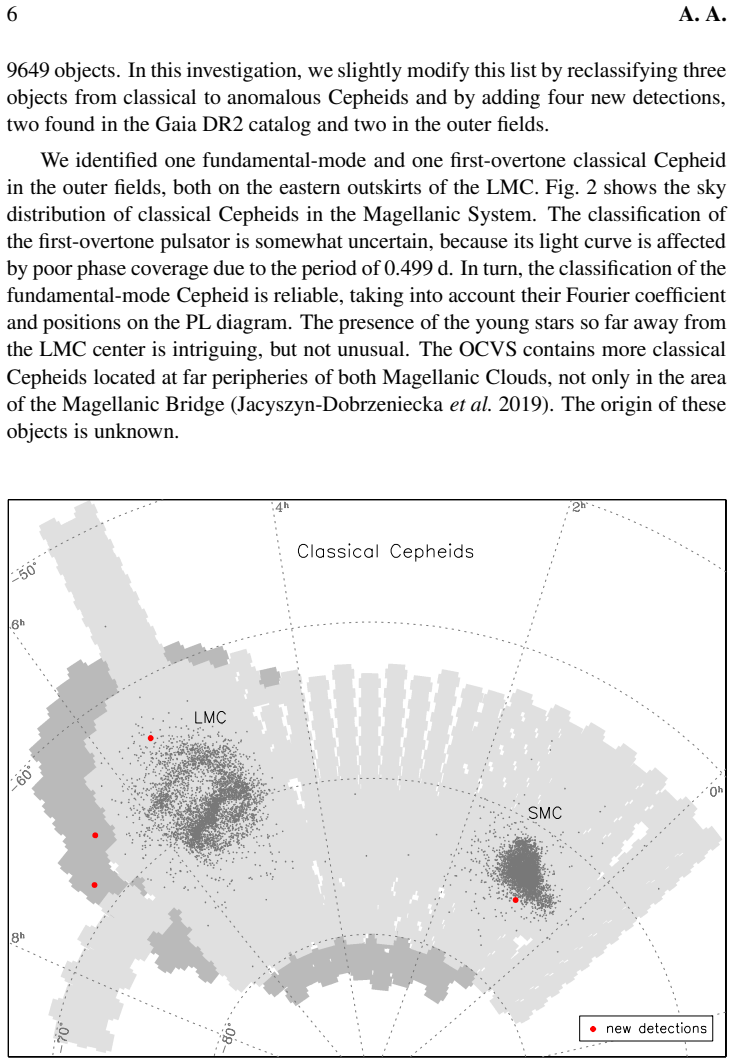
The paper establishes the final OGLE collection consisting of 9650 classical Cepheids, 343 type II Cepheids, 278 anomalous Cepheids, and 47828 RR Lyr stars inside and toward the Magellanic System, obtained by increasing the sky coverage to 765 square degrees and supplementing with Gaia detections.
Load-bearing premise
The classification based on light curves and Gaia data correctly and completely separates the stars into classical Cepheids, type II Cepheids, anomalous Cepheids, and RR Lyrae without major errors.
Editorial analysis
A structured set of objections, weighed in public.
Referee Report
Summary. The manuscript presents the final release of the OGLE collection of classical pulsators (Cepheids and RR Lyr stars) in the Large and Small Magellanic Clouds. Sky coverage is expanded from 670 to 765 square degrees. Additional stars identified by Gaia are incorporated and three Cepheids are reclassified. The final collection contains 9650 classical Cepheids, 343 type II Cepheids, 278 anomalous Cepheids, and 47828 RR Lyr stars inside and toward the Magellanic System.
Significance. This data-release paper supplies an expanded, publicly usable catalog of variable stars in the Magellanic System that builds directly on the long-running OGLE photometric survey. The increased areal coverage and inclusion of a limited Gaia cross-match improve completeness for studies of stellar populations, distances, and Magellanic structure; the work follows the survey’s established classification pipeline without introducing new parameters or derivations.
minor comments (2)
- [Abstract] Abstract: the statement that three Cepheids were reclassified would benefit from a brief parenthetical note on the objects or the reason for reclassification, even if the details appear later in the text.
- The manuscript refers to “standard OGLE photometric classification” and “limited Gaia cross-matching”; a short methods subsection or explicit pointer to the prior OGLE papers that define the light-curve criteria would improve traceability for readers who have not followed the series.
Simulated Author's Rebuttal
We thank the referee for their positive assessment of the manuscript and the recommendation to accept. The referee's summary accurately reflects the content and scope of the data release.
Circularity Check
No significant circularity detected
full rationale
This is an observational catalog release paper. The central claim is a direct count of classified stars (9650 classical Cepheids etc.) obtained via standard OGLE photometric light-curve classification plus limited Gaia cross-matching and three manual reclassifications. No equations, derivations, fitted parameters, predictions, or ansatzes appear; the result is a descriptive tabulation of survey output with no load-bearing self-citation chains or self-definitional steps. The paper is self-contained against external benchmarks (OGLE pipeline + Gaia) and receives score 0.
Assumptions & free parameters
Cite this review
Pith. "Pith review of Final Release of the OGLE Collection of Cepheids and RR Lyrae Stars in the Magellanic System. The Outer Regions." pith.science (2026). https://pith.science/paper/7WR3UX6V
@misc{pith2026190702073,
  author       = {Pith},
  title        = {Pith review of: Final Release of the OGLE Collection of Cepheids and RR Lyrae Stars in the Magellanic System. The Outer Regions},
  year         = {2026},
  howpublished = {\url{https://pith.science/paper/7WR3UX6V}},
  note         = {Machine review of arXiv:1907.02073}
}
read the original abstract
We present the final release of the OGLE collection of classical pulsators (Cepheids and RR Lyr stars) in the Large and Small Magellanic Clouds. The sky coverage has been increased from 670 to 765 square degrees compared to the previous edition of the collection. We also add some Cepheids and RR Lyr stars found by the Gaia team and reclassify three Cepheids. Ultimately, our collection consists of 9650 classical Cepheids, 343 type II Cepheids, 278 anomalous Cepheids, and 47828 RR Lyr stars inside and toward the Magellanic System.
Figures


Figures from the paper (4 more)


Reference graph
Works this paper leans on
- [1]
-
[2]
1960MNRAS.121...97A Bhardwaj, A., Kanbur, S.M., Marconi, M., Rejkuba, M., Singh , H.P ., and Ngeow, C.-C. 2017, MNRAS, 466,
work page 2017
-
[3]
Clementini, G., et al. 2019, A&A, 622, A60. Das, S., Bhardwaj, A., Kanbur, S.M., Singh, H.P ., and Marconi, M. 2018, MNRAS, 481,
work page 2019
-
[4]
Deb, S., Ngeow, C.-C., Kanbur, S.M., Singh, H.P ., Wysocki, D ., and Kumar, S. 2018, MNRAS, 478,
work page 2018
- [5]
-
[6]
García-V arela, A., Muñoz, J.R., Sabogal, B.E., V argas Domí nguez, S., and Martínez, J. 2016, ApJ, 824,
work page 2016
- [7]
-
[8]
12 A. A. Gieren, W., et al. 2018, A&A, 620, A99. Groenewegen, M.A.T. and Jurkovic, M.I. 2017a, A&A, 603, A70. Groenewegen, M.A.T. and Jurkovic, M.I. 2017b, A&A, 604, A29. Inno, L., et al. 2016, ApJ, 832,
work page 2018
Show all 31 references
-
[9]
2018, Acta Astron., 68,
Iwanek, P .,et al. 2018, Acta Astron., 68,
2018
-
[10]
2016, Acta Astron., 66,
Jacyszyn-Dobrzeniecka, A.M., et al. 2016, Acta Astron., 66,
2016
-
[11]
2017, Acta Astron., 67,
Jacyszyn-Dobrzeniecka, A.M., et al. 2017, Acta Astron., 67,
2017
-
[12]
2019, arXiv:1904.08220
Jacyszyn-Dobrzeniecka, A.M., et al. 2019, arXiv:1904.08220. Jayasinghe, T., et al. 2018, MNRAS, 477,
2019
-
[13]
2017, MNRAS, 466,
Marconi, M., et al. 2017, MNRAS, 466,
2017
-
[14]
2018, MNRAS, 473,
Muraveva, T., et al. 2018, MNRAS, 473,
2018
-
[15]
1985,ApJS, 57,
Nemec, J.M., Hesser, J.E., and Ugarte, P .P . 1985,ApJS, 57,
1985
-
[16]
2009,AJ, 138,
Nemec, J.M., Walker, A., Jeon, Y .-B. 2009,AJ, 138,
2009
-
[17]
2018, ApJ, 862,
Pilecki, B., et al. 2018, ApJ, 862,
2018
-
[18]
2018, MNRAS, 480,
Prudil, Z., Grebel, E.K., Dékány, I., and Smolec, R. 2018, MNRAS, 480,
2018
-
[19]
2017, MNRAS, 472,
Ripepi, V .,et al. 2017, MNRAS, 472,
2017
-
[20]
2016, Acta Astron., 66,
Skowron, D.M., et al. 2016, Acta Astron., 66,
2016
-
[21]
and ´Sniegowska, M
Smolec, R. and ´Sniegowska, M. 2016, MNRAS, 458,
2016
-
[22]
2017, MNRAS, 468,
Smolec, R. 2017, MNRAS, 468,
2017
-
[23]
2008, Acta Astron., 58,
Soszy´nski, I., et al. 2008, Acta Astron., 58,
2008
-
[24]
2009, Acta Astron., 59,
Soszy´nski, I., et al. 2009, Acta Astron., 59,
2009
-
[25]
2010, Acta Astron., 60,
Soszy´nski, I., et al. 2010, Acta Astron., 60,
2010
-
[26]
2017, Acta Astron., 67,
Soszy´nski, I., et al. 2017, Acta Astron., 67,
2017
-
[27]
2018, Acta Astron., 68,
Soszy´nski, I., et al. 2018, Acta Astron., 68,
2018
-
[28]
2019, ApJ, 873,
Soszy´nski, I., Smolec, R., Udalski, A., and Pietrukowicz, P . 2019, ApJ, 873,
2019
-
[29]
2018, Acta Astron., 68,
Udalski, A., et al. 2018, Acta Astron., 68,
2018
-
[30]
2006, Soc
Watson, C.L., Henden, A.A., and Price, A. 2006, Soc. Astron. Sci. Annu. Symp. , 25,
2006
-
[31]
2017, ApJ, 842, 116
Wielgórski, P .,et al. 2017, ApJ, 842, 116
2017
Reviewed May 25, 2026 · model on record in the stance chip above.
Discussion (0). Continue with ORCID to comment.