Quantum oscillations and Dirac dispersion in tunable kagome lattice Lu_(1-y)Y_y(Nb_(1-x)Ta_x)₆Sn₆
Pith reviewed 2026-06-26 12:32 UTC · model grok-4.3
The pith
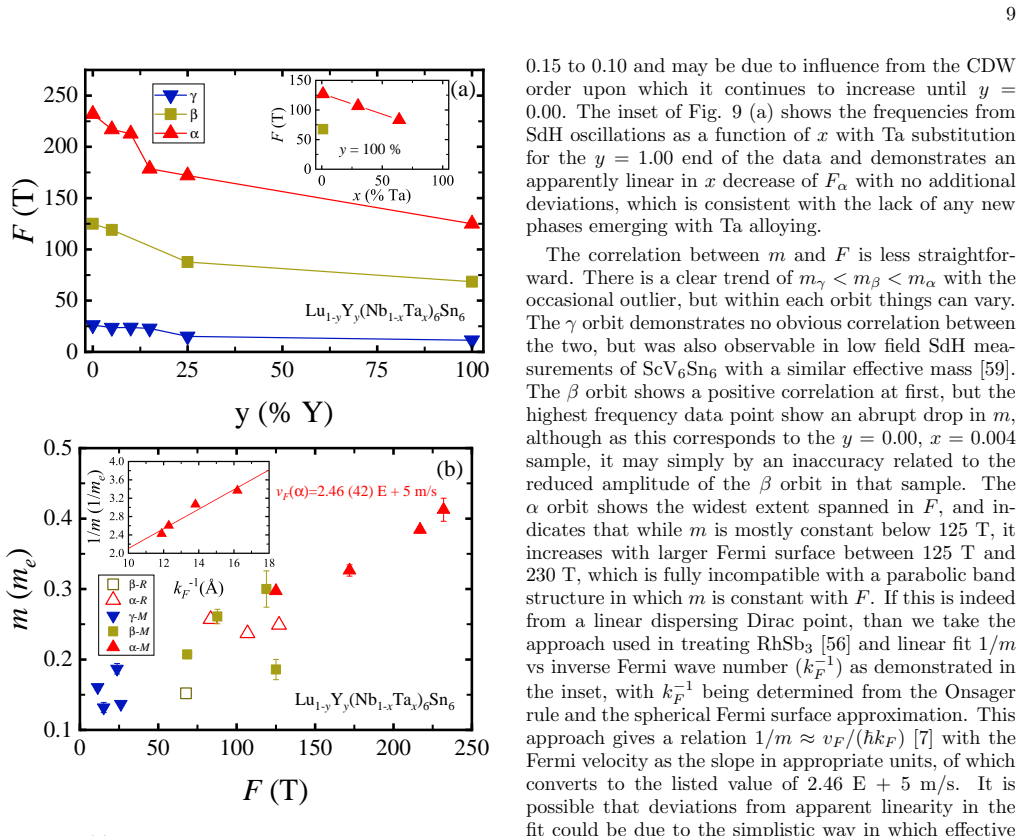
Quantum oscillations reveal a scaling between effective mass and Fermi wavevector consistent with Dirac-like dispersion across the full alloy series in Lu1-yYy(Nb1-xTax)6Sn6.
A machine-rendered reading of the paper's core claim, the machinery that carries it, and where it could break.
Core claim
The central claim is that the observed scaling between effective mass and Fermi wavevector throughout the Lu1-yYy(Nb1-xTax)6Sn6 alloy series indicates a regime of Dirac-like dispersion, with the Fermi surface parameters extracted from quantum oscillations remaining consistent with linear band crossing even as charge density wave order is suppressed.
What carries the argument
The scaling relation between effective mass m* and Fermi wavevector kF extracted from quantum oscillation frequencies and temperature damping, used to infer the form of the quasiparticle dispersion.
If this is right
- Fermi surface area decreases systematically with both yttrium and tantalum/niobium substitutions.
- Charge density wave transition temperature falls continuously with increasing yttrium content.
- Effective masses and quasiparticle lifetimes remain extractable across the entire alloy range.
- The system can be tuned while preserving the apparent Dirac dispersion relation.
Where Pith is reading between the lines
- The same mass-wavevector scaling could be checked in other kagome compounds to test whether linear dispersion is a generic feature of the lattice.
- If the scaling survives further disorder reduction, it would constrain models of how kagome flat bands and Dirac points interact under doping.
- Transport measurements at lower temperatures or higher fields might isolate whether multiple bands contribute to the observed scaling.
Load-bearing premise
The quantum oscillations come from bulk three-dimensional Fermi surfaces whose mass and wavevector values can be read out cleanly without major interference from alloy disorder, surface states, or overlapping bands.
What would settle it
A measured effective-mass versus Fermi-wavevector relation that deviates from the linear-dispersion expectation in cleaner samples or at higher substitution levels would falsify the claim of persistent Dirac-like behavior.
Figures





read the original abstract
Kagome lattice crystal systems present interesting symmetry-protected band structure features such as flat bands, van Hove singularities, and linearly dispersing Dirac/Weyl points that provide a rich playground for strongly correlated electron physics. Motivated by the rich properties and charge density wave evolution through the 1-6-6 series of compounds, we present our results in single crystal growth and characterization of the of Lu$_{1-y}$Y$_y$(Nb$_{1-x}$Ta$_x$)$_6$Sn$_6$ double-alloy system, including evolution of the charge density wave transition, electrical transport behavior and resultant phase diagrams. Using a novel growth technique, the synthesis of high quality crystals with extended length along the crystallographic $c$-axis allows us to follow the gradual suppression of charge density wave (CDW) order with Y substitution, and observe quantum oscillations in both magnetoresistance and magnetization throughout the series. We review the evolution of Fermi surfaces, effective masses and quasiparticle dispersion through the alloy series, revealing a decrease in size of Fermi surfaces that trends with both substitutions, and a scaling between effective mass and Fermi wavevector that suggests a regime with Dirac-like dispersion. The ability to fine-tune crystallographic, ground state and electronic dispersion properties of the \lit\ system with minimal impact of disorder opens a path torward further understanding the nature of the kagome lattice and its novel states and interactions.
Editorial analysis
A structured set of objections, weighed in public.
Referee Report
Summary. The manuscript reports single-crystal growth of the double-substituted kagome series Lu_{1-y}Y_y(Nb_{1-x}Ta_x)_6Sn_6 using a novel technique yielding extended c-axis crystals. It characterizes the suppression of the CDW transition with Y substitution, presents electrical transport data and phase diagrams, and reports quantum oscillations in both magnetoresistance and magnetization across the alloy series. From Onsager frequencies the authors extract shrinking Fermi-surface pockets and, via Lifshitz-Kosevich temperature damping, effective masses that scale linearly with Fermi wave-vector, which they interpret as evidence for Dirac-like dispersion persisting through the substitutions.
Significance. A convincingly demonstrated, tunable linear m*–k_F relation in a kagome system with controlled disorder would strengthen the case that Dirac cones can be engineered in this family while preserving bulk three-dimensional Fermi surfaces, providing a platform for studying correlation effects near van Hove singularities and flat bands. The extended-crystal growth method is a concrete experimental advance that enables the reported measurements.
major comments (2)
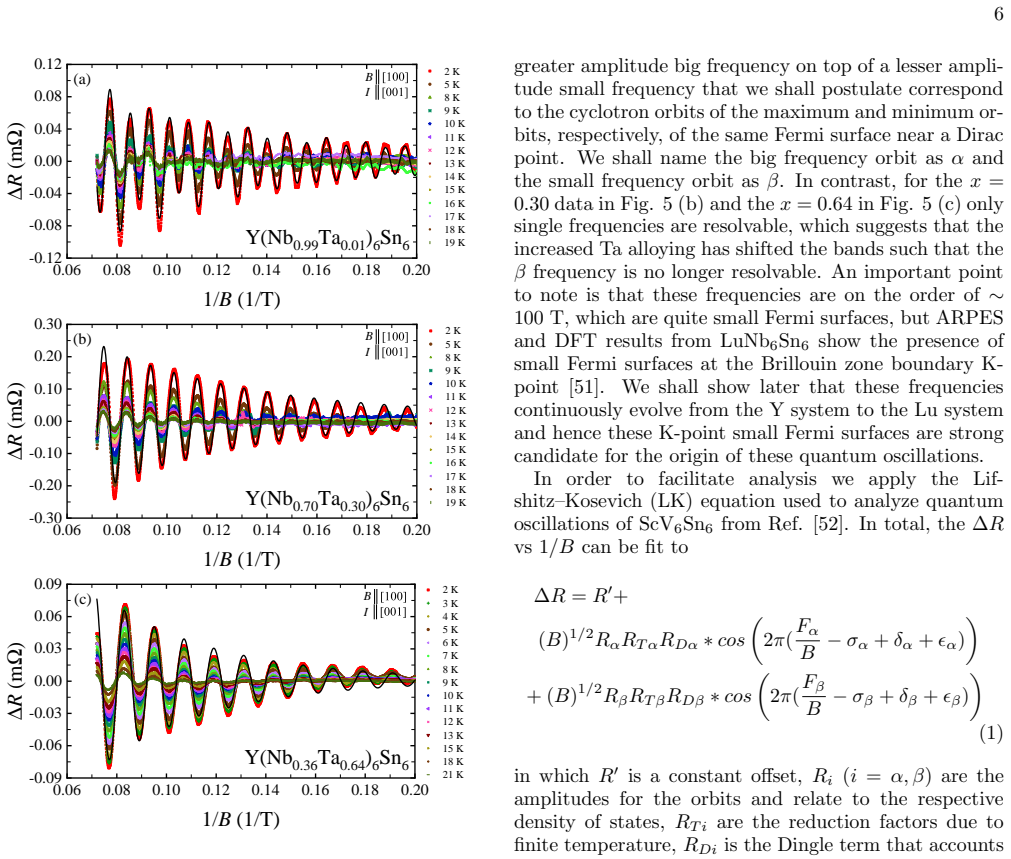
- [Quantum-oscillation analysis (results section)] The central scaling result (m* ∝ k_F) rests on effective-mass values obtained from Lifshitz-Kosevich fits to the temperature damping of oscillation amplitudes. The manuscript does not report separate field-dependent amplitude analysis or independent mobility/Dingle-temperature constraints that would rule out systematic bias arising from alloy-induced inhomogeneous Landau-level broadening, which increases across the substitution series and can artificially steepen the apparent m*–k_F slope.
- [Discussion of Fermi-surface evolution] The claim that disorder has “minimal impact” is used to justify interpreting the scaling as intrinsic Dirac dispersion, yet no quantitative comparison of Dingle temperatures or residual resistivities versus substitution level is provided to support that assertion.
minor comments (2)
- [Figure 4 and associated text] Figure captions for the oscillation data should explicitly state the field range, temperature window, and fitting procedure used for each composition so that the LK analysis can be reproduced.
- [Abstract] The abstract states that oscillations are observed “throughout the series” but does not indicate the maximum substitution levels at which oscillations remain detectable; this information belongs in the main text or a table.
Simulated Author's Rebuttal
We thank the referee for their careful reading of the manuscript and for highlighting these important points regarding the quantum-oscillation analysis and the role of disorder. We address each major comment below and have revised the manuscript to incorporate additional supporting data and discussion.
read point-by-point responses
-
Referee: The central scaling result (m* ∝ k_F) rests on effective-mass values obtained from Lifshitz-Kosevich fits to the temperature damping of oscillation amplitudes. The manuscript does not report separate field-dependent amplitude analysis or independent mobility/Dingle-temperature constraints that would rule out systematic bias arising from alloy-induced inhomogeneous Landau-level broadening, which increases across the substitution series and can artificially steepen the apparent m*–k_F slope.
Authors: We acknowledge that the original manuscript did not include explicit field-dependent amplitude analysis or Dingle-temperature constraints. To address the possibility of systematic bias from alloy-induced inhomogeneous broadening, we have now extracted Dingle temperatures from the field dependence of the oscillation amplitudes for representative compositions across the series. These values are reported in a new supplementary figure and discussed in the revised results section. The analysis shows a modest increase in scattering rate with substitution, but the temperature-damping factor remains the dominant contribution to the amplitude decay; the extracted m* values are robust against this correction and the m*–k_F scaling is preserved. We have added a brief discussion of the limitations of the Lifshitz-Kosevich analysis in the presence of disorder. revision: yes
-
Referee: The claim that disorder has “minimal impact” is used to justify interpreting the scaling as intrinsic Dirac dispersion, yet no quantitative comparison of Dingle temperatures or residual resistivities versus substitution level is provided to support that assertion.
Authors: We agree that a quantitative comparison is required to substantiate the statement that disorder has minimal impact. In the revised manuscript we have added a new panel (or supplementary table) that plots residual resistivity (extracted from zero-field transport) and Dingle temperatures against both Nb/Ta and Lu/Y substitution levels. The data show that the increase in scattering is modest relative to the observed shrinkage of the Fermi-surface pockets and does not track the linear m*–k_F relation. This comparison is now cited in the discussion section to support the interpretation that the scaling reflects the underlying Dirac-like dispersion rather than disorder-induced artifacts. revision: yes
Circularity Check
No significant circularity; experimental parameter extraction and empirical scaling observation are independent of self-referential inputs
full rationale
The manuscript is an experimental study reporting crystal growth, transport measurements, CDW suppression, and quantum oscillation data across an alloy series. Fermi surface parameters are obtained via the standard Onsager relation (frequency to extremal area/k_F) and Lifshitz-Kosevich temperature damping for m*; the reported m* ∝ k_F scaling is presented as an empirical observation suggesting Dirac-like dispersion rather than a derived prediction. No self-definitional steps, fitted inputs renamed as predictions, or load-bearing self-citations appear in the provided text. The central claim rests on direct data reduction using textbook formulas whose validity is external to the paper. This matches the default expectation for non-circular experimental characterization papers.
Axiom & Free-Parameter Ledger
Reference graph
Works this paper leans on
-
[1]
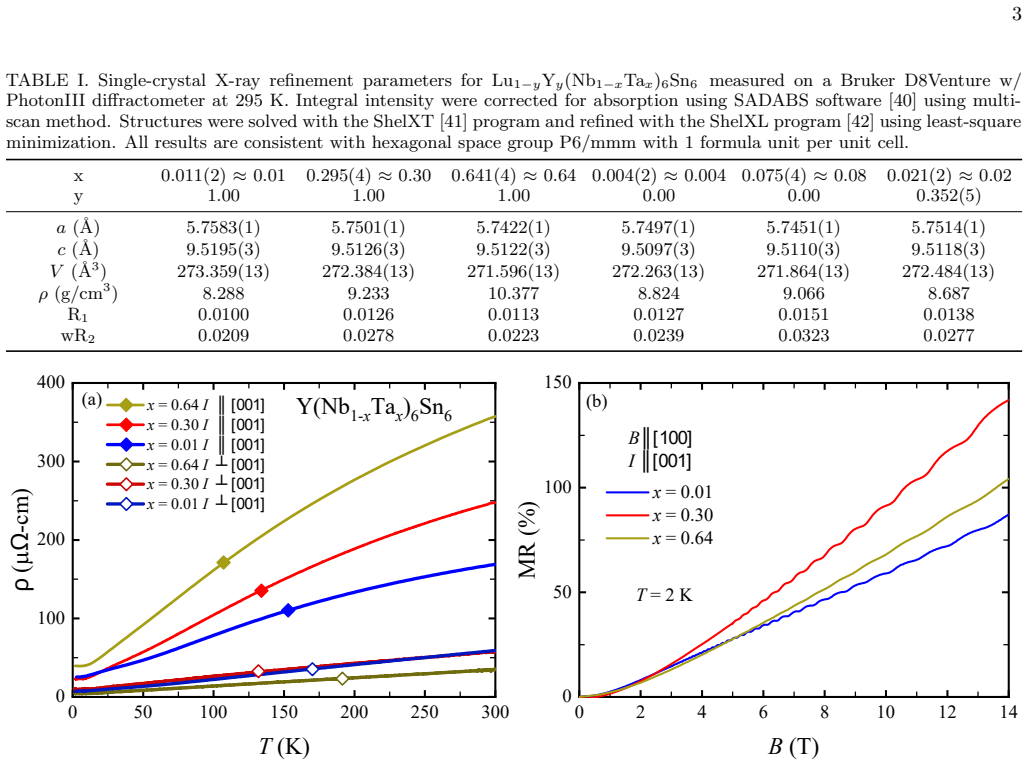
and UNb 6Sn6 [24] which is no surprise given the awe-inspiring range of ground states of uranium systems [25–27], as well as transition metal magnetism, such as spiral spin structures in YMn 6Sn6 [28, 29]. Interplay be- tween Mn magnetism and lanthanide magnetism enables investigation of large anomalous Hall effects with topol- ogy in RMn6Sn6 (R = Gd - Tm...
Pith/arXiv arXiv 2026
-
[2]
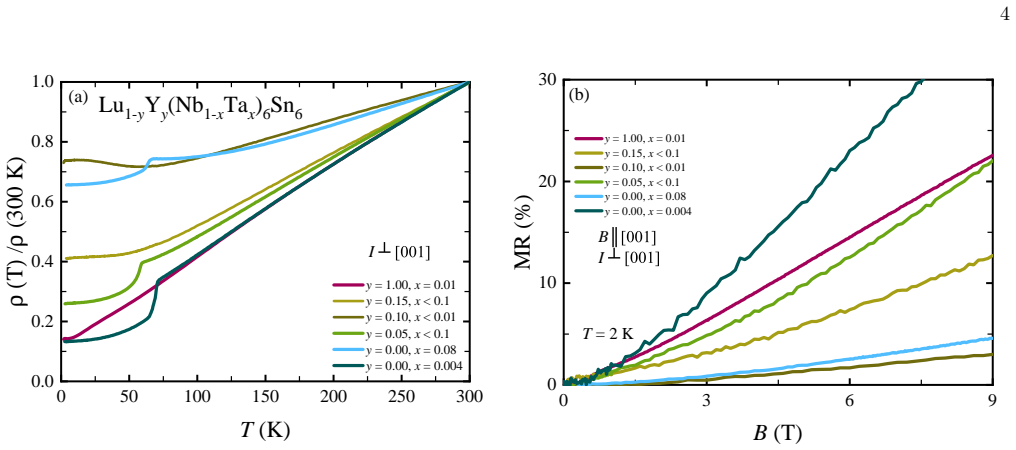
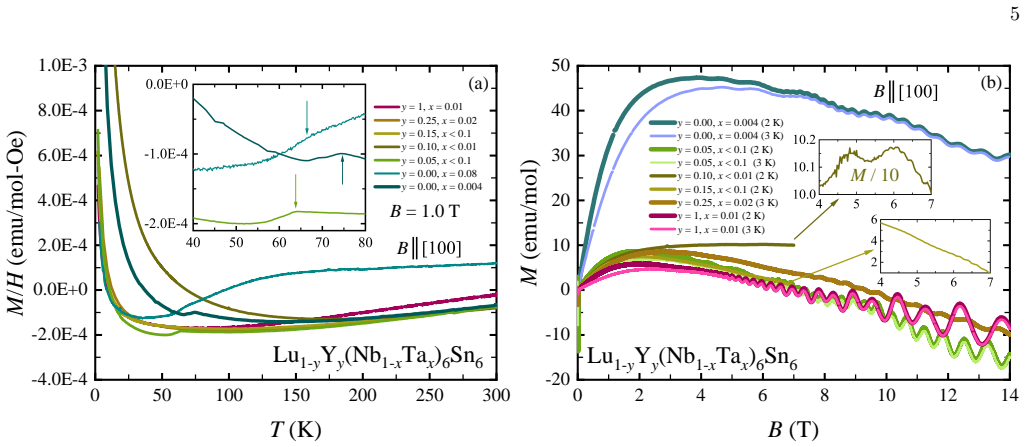
As the Ta only minutely suppresses the CDW order, we only show the samples with the lowest Ta amounts. This is in direct contrast to Sc(V 1−xCrx)6Sn6 in which a few percent Cr eliminates the CDW order [60], which indicates that the underlying mechanism of the CDW could be different between LuNb 6Sn6 and ScV 6Sn6, the only two materials of this 166 kagome ...
-
[3]
Singh, H
B. Singh, H. Lin, and A. Bansil, Advanced Materials 35, 2201058 (2023)
2023
-
[4]
M. Yin, J. Zhang, and D. D. Vvedensky, Symmetry 17 (2025), 10.3390/sym17060807
-
[5]
P. W. Brouwer and V. Dwivedi, Phys. Rev. B 108, 155137 (2023)
2023
-
[6]
Heavy fermions: electrons at the edge of magnetism,
P. Coleman, “Heavy fermions: electrons at the edge of magnetism,” (2007), arXiv:cond-mat/0612006 [cond- mat.str-el]
Pith/arXiv arXiv 2007
-
[7]
Yoshida, R
T. Yoshida, R. Peters, and N. Kawakami, Phys. Rev. B 98, 035141 (2018)
2018
-
[8]
S. E. Sebastian and C. Proust, Annual Review of Con- densed Matter Physics 6, 411 (2015)
2015
-
[9]
A. H. Castro Neto, F. Guinea, N. M. R. Peres, K. S. Novoselov, and A. K. Geim, Rev. Mod. Phys. 81, 109 (2009)
2009
-
[10]
Q. Wang, H. Lei, Y. Qi, and C. Felser, Accounts of Materials Research 5, 786 (2024)
2024
-
[11]
H.-R. Xia, Z. Wang, Y. Wang, Z. Gao, and M. Xiao, Phys. Rev. Lett. 135, 176902 (2025)
2025
-
[12]
Y. Wang, H. Wu, G. T. McCandless, J. Y. Chan, and M. N. Ali, Nature Reviews Physics 5, 635 (2023)
2023
-
[13]
W. Zhang, T. F. Poon, C. W. Tsang, W. Wang, X. Liu, J. Xie, S. T. Lam, S. Wang, K. T. Lai, A. Pourret, G. Seyfarth, G. Knebel, W. C. Yu, and S. K. Goh, Proceedings of the National Academy of Sciences 121, e2322270121 (2024), https://www.pnas.org/doi/pdf/10.1073/pnas.2322270121
-
[14]
S. D. Wilson and B. R. Ortiz, Nature Reviews Materials 9, 420 (2024)
2024
-
[15]
Z. Xu, T. Le, and X. Lin, Chinese Physics Letters 42, 037304 (2025)
2025
-
[16]
Zhang, X
W. Zhang, X. Liu, L. Wang, C. W. Tsang, Z. Wang, S. T. Lam, W. Wang, J. Xie, X. Zhou, Y. Zhao, S. Wang, J. Tallon, K. T. Lai, and S. K. Goh, Nano Letters 23, 872 (2023), pMID: 36662599
2023
-
[17]
H. Tan, Y. Li, Y. Liu, D. Kaplan, Z. Wang, and B. Yan, npj Quantum Materials 8, 39 (2023)
2023
-
[18]
L. Ye, M. Kang, J. Liu, F. von Cube, C. R. Wicker, T. Suzuki, C. Jozwiak, A. Bostwick, E. Rotenberg, D. C. Bell, L. Fu, R. Comin, and J. G. Checkelsky, Nature 555, 638 (2018)
2018
-
[19]
M. Kang, L. Ye, S. Fang, J.-S. You, A. Levitan, M. Han, J. I. Facio, C. Jozwiak, A. Bostwick, E. Rotenberg, M. K. Chan, R. D. McDonald, D. Graf, K. Kaznatcheev, E. Vescovo, D. C. Bell, E. Kaxiras, J. van den Brink, M. Richter, M. Prasad Ghimire, J. G. Checkelsky, and R. Comin, Nature Materials 19, 163 (2020)
2020
-
[20]
X. Teng, J. S. Oh, H. Tan, L. Chen, J. Huang, B. Gao, J.-X. Yin, J.-H. Chu, M. Hashimoto, D. Lu, C. Jozwiak, A. Bostwick, E. Rotenberg, G. E. Granroth, B. Yan, R. J. Birgeneau, P. Dai, and M. Yi, Nature Physics 19, 814 (2023)
2023
-
[21]
P. M. Bonetti, Y. Jiang, H. Hu, D. C˘ alug˘ aru, M. M. Scherer, B. A. Bernevig, and L. Classen, Phys. Rev. B 112, L220405 (2025)
2025
-
[22]
Di Sante, T
D. Di Sante, T. Neupert, G. Sangiovanni, R. Thomale, R. Comin, J. G. Checkelsky, I. Zeljkovic, and S. D. Wil- son, Rev. Mod. Phys. 98, 015002 (2026)
2026
-
[23]
Jovanovic and L
M. Jovanovic and L. M. Schoop, Journal of the American Chemical Society 144, 10978 (2022), pMID: 35675484
2022
-
[24]
A. K. Sharma, S. Chatterjee, P. Yanda, C. Felser, and C. Shekhar, npj Quantum Materials -1, (2026)
2026
-
[25]
S. M. Thomas, C. S. Kengle, W. Simeth, C.-y. Lim, Z. W. Riedel, K. Allen, A. Schmidt, M. Ruf, S. Gim, J. D. Thompson, F. Ronning, A. O. Scheie, C. Lane, J. D. Denlinger, S. Blanco-Canosa, J.-X. Zhu, E. D. Bauer, and P. F. S. Rosa, npj Quantum Materials 10, 66 (2025)
2025
-
[26]
Z. W. Riedel, W. Simeth, C. S. Kengle, S. M. Thomas, J. D. Thompson, A. O. Scheie, F. Ronning, C. Lane, J.- X. Zhu, P. F. S. Rosa, and E. D. Bauer, Phys. Rev. Mater. 9, 084401 (2025)
2025
-
[27]
Q. Gu, S. Wang, J. P. Carroll, K. Zhussupbekov, C. Broyles, S. Ran, N. P. Butch, J. A. Horn, S. Saha, J. Paglione, X. Liu, J. C. S. Davis, and D.-H. Lee, Sci- ence 388, 938 (2025)
2025
-
[28]
K. E. Avers, M. D. Nguyen, J. W. Scott, A. M. Zimmer- man, S. M. Thomas, P. F. S. Rosa, E. D. Bauer, J. D. Thompson, and W. P. Halperin, Phys. Rev. Mater. 5, 054803 (2021)
2021
-
[29]
Q. Xu, H. Siddiquee, S. Gould, J. A. Zhu, D. A. Martinez, C. Broyles, G. Ni, T. Kong, and S. Ran, Phys. Rev. B 110, 165162 (2024)
2024
-
[30]
N. J. Ghimire, R. L. Dally, L. Poudel, D. C. Jones, D. Michel, N. T. Magar, M. Bleuel, M. A. McGuire, J. S. Jiang, J. F. Mitchell, J. W. Lynn, and I. I. Mazin, Sci- 12 ence Advances 6, eabe2680 (2020)
2020
-
[31]
L. Jia, Y. Chen, G. Yang, W. Lv, C. Zhang, L. Zhou, X. Han, Q. Zhang, H. Yang, H. Lei, Y. Zhang, H.-J. Gao, and Y. Wang, Nano Letters 24, 8843 (2024), pMID: 39007508
2024
-
[32]
W. Ma, X. Xu, J.-X. Yin, H. Yang, H. Zhou, Z.-J. Cheng, Y. Huang, Z. Qu, F. Wang, M. Z. Hasan, and S. Jia, Phys. Rev. Lett. 126, 246602 (2021)
2021
-
[33]
L. Min, M. Sretenovic, T. W. Heitmann, T. W. Valentine, R. Zu, V. Gopalan, C. M. Rost, X. Ke, and Z. Mao, Communications Physics 5, 63 (2022)
2022
-
[34]
R. Lou, M. Mende, R. Vocaturo, H. Zhang, Q. Dong, M. Li, P. Ding, E. Cheng, Z. Liao, Y. Zhang, J. Lin, R. Firouzmandi, V. Kocsis, L. T. Corredor, Y. Prots, O. Suvorov, A. Jana, J. Fujii, I. Vobornik, O. Janson, W. Zhu, J. van den Brink, C. Krellner, M. Pan, B. Wang, T. Xia, J. Cheng, S. Wang, C. Felser, B. B¨ uchner, S. Borisenko, R. Yu, D. V. Vyalikh, an...
2025
-
[35]
Pokharel, S
G. Pokharel, S. M. L. Teicher, B. R. Ortiz, P. M. Sarte, G. Wu, S. Peng, J. He, R. Seshadri, and S. D. Wilson, Phys. Rev. B 104, 235139 (2021)
2021
-
[36]
H. W. S. Arachchige, W. R. Meier, M. Marshall, T. Mat- suoka, R. Xue, M. A. McGuire, R. P. Hermann, H. Cao, and D. Mandrus, Phys. Rev. Lett. 129, 216402 (2022)
2022
-
[37]
Y. Li, S. Cao, J. Liao, J. Ma, Y. Zhang, T. Li, J. Wang, C. Xu, J. Dai, C. Cao, Y. Song, P. Sun, and Y. Li, Science China Physics, Mechanics and Astronomy 69, 217411 (2025)
2025
-
[38]
D. R. Saykin, Q. Jiang, Z. Liu, C. Shekhar, C. Felser, J.- H. Chu, and A. Kapitulnik, Phys. Rev. B 113, L241104 (2026)
2026
-
[39]
B. R. Ortiz, W. R. Meier, G. Pokharel, J. Chamorro, F. Yang, S. Mozaffari, A. Thaler, S. J. Gomez Alvarado, H. Zhang, D. S. Parker, G. D. Samolyuk, J. A. M. Pad- dison, J. Yan, F. Ye, S. Sarker, S. D. Wilson, H. Miao, D. Mandrus, and M. A. McGuire, Journal of the Ameri- can Chemical Society 147, 5279 (2025), pMID: 39900526, https://doi.org/10.1021/jacs.4c16347
-
[40]
Y. Xiao, Q. Duan, X. Xu, Z. Li, S. Guo, H. Tan, and R. Zhong, Phys. Rev. B 111, 205103 (2025)
2025
-
[41]
Yue and X.-W
C.-Y. Yue and X.-W. Lei, Inorganic Chemistry 51, 2461 (2012), pMID: 22300353
2012
-
[42]
Krause, R
L. Krause, R. Herbst-Irmer, G. M. Sheldrick, and D. Stalke, Journal of Applied Crystallography 48, 3 (2015)
2015
-
[43]
G. M. Sheldrick, Acta Crystallographica Section A 71, 3 (2015)
2015
-
[44]
G. M. Sheldrick, Acta Crystallographica Section C 71, 3 (2015)
2015
-
[45]
A. T. Hand, A. C. Lamb, M. G. Richmond, X. Wang, C. A. Steren, and Z.-L. Xue, Inor- ganic Chemistry 61, 19075 (2022), pMID: 36409334, https://doi.org/10.1021/acs.inorgchem.2c02365
-
[46]
Vashist, R
A. Vashist, R. K. Gopal, D. Srivastava, M. Karppinen, and Y. Singh, Phys. Rev. B 99, 245131 (2019)
2019
-
[47]
Singh, V
S. Singh, V. Sub, M. Schmidt, C. Felser, and C. Shekhar, Journal of Physics: Materials 3, 024003 (2020)
2020
-
[48]
Qiang, H.-Y
X.-B. Qiang, H.-Y. Xu, R.-J. Tong, S. Li, Z.-X. Gao, P.-L. Zhao, and H.-Z. Lu, Phys. Rev. B 112, 224208 (2025)
2025
-
[49]
Zhang, H
H. Zhang, H. Li, H. Wang, G. Cheng, H. He, and J. Wang, Applied Physics Letters 113, 113503 (2018)
2018
-
[50]
W. R. Meier, D. E. Graf, B. R. Ortiz, S. Mozaffari, and D. Mandrus, Phys. Rev. Mater. 9, L082001 (2025)
2025
-
[51]
J. Xu, F. Han, T.-T. Wang, L. R. Thoutam, S. E. Pate, M. Li, X. Zhang, Y.-L. Wang, R. Fotovat, U. Welp, X. Zhou, W.-K. Kwok, D. Y. Chung, M. G. Kanatzidis, and Z.-L. Xiao, Phys. Rev. X 11, 041029 (2021)
2021
-
[52]
Miccoli, F
I. Miccoli, F. Edler, H. Pfn¨ ur, and C. Tegenkamp, Jour- nal of Physics: Condensed Matter 27, 223201 (2015)
2015
-
[53]
F. Z. Yang, X. Huang, H. Tan, A. Kundu, S. Kim, M. Thinel, J. Ingham, A. Rajapitamahuni, Y. Q. Cai, C. Nelson, E. Vescovo, W. R. Meier, D. Mandrus, B. R. Ortiz, A. N. Pasupathy, B. Yan, and H. Miao, Phys. Rev. B 112, 245113 (2025)
2025
-
[54]
Zheng, Y
G. Zheng, Y. Zhu, S. Mozaffari, N. Mao, K.-W. Chen, K. Jenkins, D. Zhang, A. Chan, H. W. S. Arachchige, R. P. Madhogaria, M. Cothrine, W. R. Meier, Y. Zhang, D. Mandrus, and L. Li, Journal of Physics: Condensed Matter 36, 215501 (2024)
2024
-
[55]
H. Murakawa, M. S. Bahramy, M. Tokunaga, Y. Ko- hama, C. Bell, Y. Kaneko, N. Nagaosa, H. Y. Hwang, and Y. Tokura, Science 342, 1490 (2013), https://www.science.org/doi/pdf/10.1126/science.1242247
-
[56]
Alexandradinata and L
A. Alexandradinata and L. Glazman, Phys. Rev. B 97, 144422 (2018)
2018
-
[57]
A. A. Taskin and Y. Ando, Phys. Rev. B 84, 035301 (2011)
2011
-
[58]
K. Wang, L. Wang, I.-L. Liu, F. Boschini, M. Zonno, M. Michiardi, E. Rotenberg, A. Bostwick, D. Graf, B. J. Ramshaw, A. Damascelli, and J. Paglione, Phys. Rev. Mater. 7, 074205 (2023)
2023
-
[59]
Kossut, Solid State Communications 27, 1237 (1978)
J. Kossut, Solid State Communications 27, 1237 (1978)
1978
-
[60]
Martin, E
C. Martin, E. D. Mun, H. Berger, V. S. Zapf, and D. B. Tanner, Phys. Rev. B 87, 041104 (2013)
2013
-
[61]
J. M. DeStefano, E. Rosenberg, O. Peek, Y. Lee, Z. Liu, Q. Jiang, L. Ke, and J.-H. Chu, npj Quantum Materials 8, 65 (2023)
2023
-
[62]
S. Lee, C. Won, J. Kim, J. Yoo, S. Park, J. Den- linger, C. Jozwiak, A. Bostwick, E. Rotenberg, R. Comin, M. Kang, and J.-H. Park, npj Quantum Materials 9, 15 (2024)
2024
-
[63]
S. Lei, S. M. L. Teicher, A. Topp, K. Cai, J. Lin, G. Cheng, T. H. Salters, F. Rodolakis, J. L. McChes- ney, S. Lapidus, N. Yao, M. Krivenkov, D. Marchenko, A. Varykhalov, C. R. Ast, R. Car, J. Cano, M. G. Vergniory, N. P. Ong, and L. M. Schoop, Advanced Ma- terials 33, 2101591 (2021)
2021
-
[64]
C. Chen, X. Y. Xu, Z. Y. Meng, and M. Hohenadler, Phys. Rev. Lett. 122, 077601 (2019)
2019
-
[65]
Orbital-selective band modifications in a charge-ordered kagome metal lunb 6sn6,
R. Lou, Y. Zhang, E. Cheng, X. Feng, A. Fedorov, Z. Li, Y. Luo, A. Generalov, H. Ma, Q. Wei, Y. Zhou, S. Chang- dar, W. Schnelle, D. Chen, Y. Chen, J. Liu, Y. Guo, S. Borisenko, D. V. Vyalikh, C. Felser, B. B¨ uchner, and Z. Liu, “Orbital-selective band modifications in a charge-ordered kagome metal lunb 6sn6,” (2025), arXiv:2504.04019 [cond-mat.str-el]
arXiv 2025
-
[66]
W. R. Meier, R. P. Madhogaria, S. Mozaffari, M. Mar- shall, D. E. Graf, M. A. McGuire, H. W. S. Arachchige, C. L. Allen, J. Driver, H. Cao, and D. Mandrus, Jour- nal of the American Chemical Society 145, 20943 (2023), pMID: 37708375
2023
-
[67]
Phillips, K
C. Phillips, K. Shtefiienko, S. Mozaffari, R. P. Madhoga- ria, W. R. Meier, A. F. Savvidou, B. W. Casas, L. Bali- cas, D. G. Mandrus, D. E. Graf, and K. Shrestha, Phys. Rev. B 111, 155136 (2025). 13
2025
-
[68]
Shtefiienko, C
K. Shtefiienko, C. Phillips, S. Mozaffari, R. P. Madhog- aria, W. R. Meier, D. G. Mandrus, D. E. Graf, and K. Shrestha, APL Quantum 2, 016118 (2025)
2025
-
[69]
J.-X. Yin, W. Ma, T. A. Cochran, X. Xu, S. S. Zhang, H.-J. Tien, N. Shumiya, G. Cheng, K. Jiang, B. Lian, Z. Song, G. Chang, I. Belopolski, D. Multer, M. Litske- vich, Z.-J. Cheng, X. P. Yang, B. Swidler, H. Zhou, H. Lin, T. Neupert, Z. Wang, N. Yao, T.-R. Chang, S. Jia, and M. Zahid Hasan, Nature 583, 533 (2020)
2020
-
[70]
Xu, J.-X
X. Xu, J.-X. Yin, W. Ma, H.-J. Tien, X.-B. Qiang, P. V. S. Reddy, H. Zhou, J. Shen, H.-Z. Lu, T.-R. Chang, Z. Qu, and S. Jia, Nature Communications 13, 1197 (2022)
2022
-
[71]
Rehfuss, C
Z. Rehfuss, C. Broyles, D. Graf, Y. Li, H. Tan, Z. Zhao, J. Liu, Y. Zhang, X. Dong, H. Yang, H. Gao, B. Yan, and S. Ran, Phys. Rev. Mater. 8, 024003 (2024)
2024
-
[72]
De Giovannini, H
U. De Giovannini, H. H¨ ubener, S. A. Sato, and A. Rubio, Phys. Rev. Lett. 125, 136401 (2020)
2020
-
[73]
A. E. Myasnikova, E. A. Zhileeva, and D. V. Moseykin, Journal of Physics: Condensed Matter 30, 125601 (2018)
2018
-
[74]
Dragoman and M
D. Dragoman and M. Dragoman, Solid-State Electronics 211, 108818 (2024)
2024
-
[75]
Freitas, F
R. Freitas, F. de Brito Mota, R. Rivelino, A. Kakanakova- Georgieva, and G. Gueorguiev, Materials Science in Semiconductor Processing 208, 110515 (2026)
2026
-
[76]
Vezzosi, A
A. Vezzosi, A. Bertoni, M. Gibertini, and G. Goldoni, Phys. Rev. B 112, 085425 (2025)
2025
-
[77]
Yakovkin, Surface Science 662, 1 (2017)
I. Yakovkin, Surface Science 662, 1 (2017)
2017
-
[78]
Shi, J.-G
L.-T. Shi, J.-G. Si, A. Liang, R. Turnbull, P.-F. Liu, and B.-T. Wang, Phys. Rev. B 107, 184503 (2023)
2023
-
[79]
K. S. Novoselov, A. K. Geim, S. V. Morozov, D. Jiang, M. I. Katsnelson, I. V. Grigorieva, S. V. Dubonos, and A. A. Firsov, Nature 438, 66 (2005)
2005
discussion (0)
Sign in with ORCID, Apple, or X to comment. Anyone can read and Pith papers without signing in.