REVIEW 2 major objections 4 minor 1 cited by
Foundations of Digital Circuits: Denotation, Operational, and Algebraic Semantics
T0 review · 2 major / 4 minor · reviewed 2026-08-08 · deepseek-v4-flash
Pith's one-line read Synchronous sequential circuits, quotiented by observable behavior, are exactly the causal, finitely specified, bottom-preserving monotone stream functions, and operational and algebraic equivalence induce the same quotient.
desk verdict Solid, carefully-built categorical semantics for sequential circuits with non-delay-guarded feedback, but the headline isomorphism is conditional on functional completeness and is proven only for Belnap logic. read the letter →
The pith
A machine-rendered reading of the paper's core claim, the machinery that carries it, and where it could break.
The reading
What carries the argument
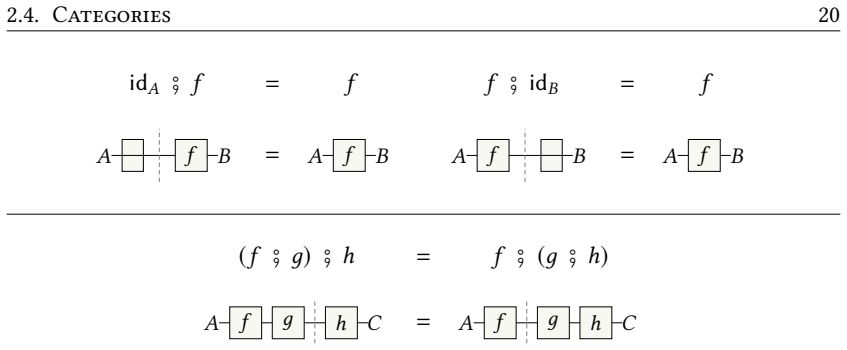
The central mechanism is a chain of traced PROPs. Circuits form the free symmetric traced monoidal category $\mathrm{SCirc}_{\Sigma}$, where the trace is feedback; monotone Mealy machines form a bridge category $\mathbf{Mealy}_I$; and stream functions form $\mathbf{Stream}_I$. The trace on $\mathbf{Stream}_I$ is computed as a least fixed point, supplied by the Kleene fixed-point theorem, and the unrolling rule for non-delay-guarded feedback uses the height of the value lattice as an iteration bound. For the Belnap four-valued logic (no signal, false, true, both), a functional-completeness argument lets every stream function be translated back into a circuit, completing the isomorphisms.
What would settle it
Take a finite value lattice and a gate set whose interpretations are all $\bot$-preserving and monotone but not functionally complete—for instance, monotone Boolean gates without a constant-true generator—and define the stream function that outputs true in every position regardless of input. If that constant stream behavior is not realizable by any circuit over the signature, the completeness half of the isomorphism fails for that interpretation.
Extended reading notes
Core claim
The load-bearing result is Corollary 4.100: the category $\mathrm{SCirc}_{\Sigma}$ of synchronous sequential circuits quotiented by denotational equivalence is isomorphic to the category $\mathbf{Stream}_I$ of causal, finitely specified, $\bot$-preserving monotone stream functions on the value lattice. The same quotient is isomorphic to the quotient by observational equivalence (circuits reduce to the same outputs for all inputs) and to the quotient by algebraic equivalence (circuits interderivable by the equations $E_I$). So, for a functionally complete interpretation, every circuit has a unique stream-function behavior, every such behavior is implemented by some circuit, and the operational and algebraic rules prove exactly the behavioral equalities.
Load-bearing premise
The interpretation of the gate set must be functionally complete: every $\bot$-preserving monotone function on the finite value lattice must be expressible as a circuit. The thesis proves this for the Belnap four-valued gates but not for arbitrary signatures, and without it the reverse direction of the isomorphism fails, leaving only soundness of the denotational semantics.
Editorial extensions
If this is right
- Two circuits can be swapped freely in any context once their stream functions agree, so a library of verified components can be reused without re-verification.
- The operational reduction strategy—global trace-delay form, Mealy form, then instant-feedback unrolling—gives a decision procedure for behavioral equivalence: reduce and compare output streams.
- The algebraic equations are complete, so proof search for circuit identities can be organized as rewriting to a pseudo-normal form.
- Every finitely specified causal monotone stream behavior is implementable and every implementation realizes exactly one such behavior, so specifications can be compiled to circuits without loss of behavior.
- Non-delay-guarded feedback is handled instead of excluded, which keeps useful cyclic combinational circuits inside the theory.
Reading between the lines
- A natural next question is to characterize, for arbitrary gate sets and value lattices, exactly when functional completeness holds; the gap between the Belnap case and a generic signature is where the full isomorphism either stands or falls.
- The unrolling bound suggests a concrete complexity promise: evaluating a feedback loop on an $m$-bit value lattice needs at most $\mathrm{height}(V^m)+1$ iterations, which a simulator could measure directly.
- The graph-rewriting machinery in the second half points toward an automatic proof assistant for circuits, where rewriting modulo traced comonoid structure implements the operational semantics as a hardware description language.
- The same three-way semantic construction could be attempted for asynchronous or handshake circuits; a failure there would show which parts of the result depend on synchrony and the lattice order rather than on the categorical skeleton.
Editorial analysis
A structured set of objections, weighed in public.
Referee Report
Summary. Starting from a syntax of synchronous sequential circuits as morphisms of a freely generated traced monoidal category SCircΣ, the thesis develops three semantics: a denotational semantics into a category StreamI of causal, finitely specified, bottom-preserving monotone stream functions; an operational semantics based on global transformations followed by local reductions; and an algebraic semantics via a set of equations. The central technical result is Corollary 4.100, an isomorphism SCircΣ/≈I ≅ StreamI for functionally complete interpretations, obtained by passing through monotone Mealy machines, encoding states into words of values, and realizing every transition/output function as a normalized circuit. The second half of the thesis adapts hypergraph rewriting to traced comonoid structure and applies it to circuit rewriting and to a hardware description language.
Significance. The monograph is careful and unusually complete in its technical development: it proves directly that the proposed stream-function category is closed under taking least fixed points (Theorem 4.47), verifies the trace axioms (Theorem 4.48), constructs both directions of the Mealy-machine bridge, and proves functional completeness of the Belnap signature (Theorem 4.113). If the main theorem is accepted under its stated hypothesis, this is a substantial contribution to compositional circuit semantics, and the graph-rewriting part extends existing hypergraph string-diagram rewriting to a structure class that includes feedback. The proofs are paper-and-pencil and do not appear to be accompanied by machine-checked artifacts; the reader must therefore rely on the usual mathematical checking of the written argument.
major comments (2)
- [§4.4, Cor. 4.100; §4.5] The central isomorphism SCircΣ/≈I ≅ StreamI is proved only under the functional-completeness hypothesis of Definition 4.87. For an interpretation whose gate set is not functionally complete, Corollary 4.98 fails and only the soundness direction survives. For example, take the Belnap value lattice with P = {AND} together with the structural generators and value generators: the Belnap negation is a bottom-preserving monotone function V → V, so the pointwise-negation stream function belongs to StreamI, but no circuit over this signature can realize it, since the available operations generate the lattice-polynomial clone, which omits ¬ on the Belnap diamond. Thus the advertised 'fully compositional theory' is not a theorem for arbitrary circuit signatures; the abstract and Chapter 1 should state the completeness claim as conditional on functional completeness, and the generalized-circuit extension in Section 4.6 should state that it inherits the same restriction.
- [§4.1.1, Def. 4.14] The definition of a monotone function as 'x ≤_A y if and only if f(x) ≤_B f(y)' is the definition of an order embedding, not the standard notion of monotonicity used elsewhere in the paper (e.g., Definitions 4.15–4.18, Lemma 4.33, Theorem 4.47, and Theorem 4.113). Under the stated 'iff' definition, FuncI excludes constant functions and every non-injective monotone map; Lemma 4.93, for instance, is not justified, because a monotone Mealy encoding may map two different states to the same encoded value on some input and therefore is not an order embedding. The intended definition is almost certainly the one-way implication. Because monotonicity is a load-bearing hypothesis throughout the completeness argument, this definitional error should be corrected and all subsequent monotonicity statements should be re-checked against the corrected definition.
minor comments (4)
- [§4.3.2, Thm. 4.97] In the proof, the sentence 'To show that !I(−) = J−K^S_I ◦ !I(−)' should read 'To show that !I(−) = J−K^S_I ◦ ||−||^≤_I'; as written the right-hand side duplicates the left side and omits the Mealy-to-circuit map.
- [§4.6, Def. 4.121] There is a typo in 'moprhisms', which should be 'morphisms'.
- [§3.3, Rem. 3.15] The phrase 'minimum obervable duration' contains a typo; it should be 'minimum observable duration'.
- [§5.1, Lem. 5.11] The soundness of the (Mealy) rule is dismissed as 'a simple exercise'; since this rule is a global transformation central to the operational semantics, a short explicit justification (or a reference to the matching equations in Section 6) would help the reader.
Circularity Check
No significant circularity: the completeness isomorphism is conditional on an explicit functional-completeness hypothesis, proved for Belnap logic, and no fitted parameter or self-citation is doing the work.
full rationale
The derivation is self-contained in the relevant sense. StreamI is defined independently of circuit syntax (Definition 4.34: causal, finitely specified, bottom-preserving monotone stream functions), and the denotational semantics is a PROP morphism from the freely generated SCircSigma, so the semantic category is not defined as whatever the syntax does. The completeness direction (Corollary 4.98, Corollary 4.100) is explicitly conditional: after translating a stream function to its minimal Mealy machine (Corollary 4.71) and encoding states, the final step requires every bottom-preserving monotone function to be realizable as a circuit. That is precisely the stated hypothesis of functional completeness (Definition 4.87), and Section 4.5 discharges it for the Belnap interpretation by a constructive DNF argument (Theorem 4.113) using standard Boolean functional completeness. The thesis itself flags the limitation: 'For an interpretation to admit a sound and complete denotational semantics it needs to be functionally complete.' For a non-complete gate set the isomorphism would fail, leaving only soundness; this is a scope caveat, not a circular step. No parameters are fitted: the unrolling bound c is the length of the longest chain in the finite lattice (Definition 5.18), not tuned to match outputs. The operational and algebraic semantics are checked for soundness against the denotational model and then proved complete, rather than being defined as denotational equivalence in disguise. Self-citations to [GKS24] and [GK23] are provenance and refinement remarks, not unverified load-bearing premises, and the standard coalgebra and fixed-point facts are cited externally to Rutten, Tarski, and others. I therefore find no step in which a prediction or first-principles result reduces to its own input by construction.
Assumptions & free parameters
assumptions (5)
- domain assumption Circuit values form a finite lattice with least element • and every primitive is interpreted as a ⊥-preserving monotone function (Definition 4.16)
- domain assumption The interpretation I is functionally complete (Definition 4.87)
- standard math Kleene fixed-point theorem for Scott-continuous functions on pointed directed-complete posets (Theorem 4.39)
- standard math Axioms of symmetric monoidal, traced monoidal, and Frobenius categories, plus the theory of PROPs and string diagrams
- standard math Double pushout rewriting theory for (coloured) hypergraphs, including adhesivity properties
invented entities (4)
-
Monotone Mealy machine
-
Category of partial monogamous cospans of hypergraphs (PMCsp_D(Hyp_Σ))
-
Traced boundary complement / traced left-boundary complement
-
Category of partial left-monogamous cospans (PLMCsp_D(Hyp_Σ))
Cite this review
Pith. "Pith review of Foundations of Digital Circuits: Denotation, Operational, and Algebraic Semantics." pith.science (2026). https://pith.science/paper/7XSIMEBT
@misc{pith2026250208497,
  author       = {Pith},
  title        = {Pith review of: Foundations of Digital Circuits: Denotation, Operational, and Algebraic Semantics},
  year         = {2026},
  howpublished = {\url{https://pith.science/paper/7XSIMEBT}},
  note         = {Machine review of arXiv:2502.08497}
}
read the original abstract
This thesis details a project to define a fully compositional theory of synchronous sequential circuits built from primitive components, motivated by applying techniques successfully used in programming languages to hardware. The first part of the thesis defines the syntactic foundations of sequential circuit morphisms, and then builds three different semantic theories: denotational, operational and algebraic. We characterise the denotational semantics of sequential circuits as certain causal stream functions, as well as providing a link to existing circuit methodologies by mapping between circuit morphisms, stream functions and Mealy machines. The operational semantics is defined as a strategy for applying some global transformations followed by local reductions to demonstrate how a circuit processes a value, leading to a notion of observational equivalence. The algebraic semantics consists of equations for bringing circuits into a pseudo-normal form, and then encoding between different state sets. This part of the thesis concludes with a discussion of some novel applications, such as those for using partial evaluation for digital circuits. While mathematically rigorous, the categorical string diagram formalism is not suited for reasoning computationally. The second part of this thesis details an extension of string diagram rewriting with hypergraphs so that it is compatible with the traced comonoid structure present in the category of digital circuits. We identify the properties that characterise cospans of hypergraphs corresponding to traced comonoid terms, and demonstrate how to identify rewriting contexts valid for rewriting modulo traced comonoid structure. We apply the graph rewriting framework to fixed point operators as well as the operational semantics from the first part, and present a new hardware description language based on these theoretical developments.
Figures


Figures from the paper (52 more)




Forward citations
Cited by 1 Pith paper
-
Layered Monoidal Theories I: Diagrammatic Algebra and Applications
Layered monoidal theories let different abstraction levels of a system live in one string diagram with formal translations between layers.
Reference graph
Works this paper leans on
-
[1]
Open Graphs and Computational Reasoning
In: Electronic Proceedings in Theoretical Computer Science 26 (June 9, 2010), pp. 169–180. issn: 2075-2180. doi: 10.4204/EPTCS.26.16. arXiv: 1007.3794 (cit. on pp. 145, 188). [DK13] Lucas Dixon and Aleks Kissinger. “Open-Graphs and Monoidal Theories”. In: Mathematical Structures in Computer Science 23.2 (Apr. 2013), pp. 308–359. issn: 0960-1295, 1469-8072...
work page Pith review arXiv 1945
-
[2]
A Structural and Nominal Syntax for Diagrams
In: Electronic Proceedings in Theoretical Computer Science 266 (Feb. 27, 2018), pp. 71–83. issn: 2075-2180. doi: 10.4204/EPTCS.266.4. arXiv: 1702.01695 (cit. on p. 1). [GLZ23] Ella Gale, Leo Lobski, and Fabio Zanasi. “A Categorical Approach to Synthetic Chemistry”. In: Theoretical Aspects of Computing – ICTAC 2023 . Ed. by Erika Ábrahám, Clemens Dubslaff,...
work page Pith review arXiv 2018
-
[12]
Categorical Semantics of Digital Circuits
176 pp. isbn: 978-1-4832-2516-6. Google Books: MCijBQAAQBAJ (cit. on pp. 6, 72). [GJ16] Dan R. Ghica and Achim Jung. “Categorical Semantics of Digital Circuits”. In: 2016 Formal Methods in Computer-Aided Design (FMCAD) . 2016 Formal Methods in Computer-Aided Design (FMCAD). Oct. 2016, pp. 41–48. doi: 10.1109/FMCAD.2016.7886659 (cit. on pp. 7–8, 114, 210, ...
arXiv 2016
-
[15]
A Structural and Nominal Syntax for Diagrams
doi: 10.48550/arXiv.2201.10456. arXiv: 2201.10456 [cs, math] . preprint (cit. on pp. 8, 47, 56, 68, 99, 114). [GL18] Dan R. Ghica and Aliaume Lopez. “A Structural and Nominal Syntax for Diagrams”. Version
-
[21]
issn: 1572-9095. doi: 10.1007/s10485-023-09717-0 (cit. on p. 182). [Fon15] Brendan Fong. “Decorated Cospans”. In: Theory and Applications of Categories 30.33 (Aug. 11, 2015), pp. 1096–1120. arXiv: 1502.00872 (cit. on p. 159). [Fox76] Thomas Fox. “Coalgebras and Cartesian Categories”. In: Communications in Algebra 4.7 (Jan. 1, 1976), pp. 665–667. issn: 009...
work page Pith review arXiv 2015
-
[26]
Feedback, Trace and Fixed-Point Semantics
url: http://essay.utwente.nl/59381/1/scriptie_M_Kooijman.pdf (cit. on p. 218). [KSW02] P. Katis, Nicoletta Sabadini, and Robert F. C. Walters. “Feedback, Trace and Fixed-Point Semantics”. In: RAIRO - Theoretical Informatics and Applications 36.2 (Apr. 2002), pp. 181–194. issn: 0988-3754, 1290-385X. doi: 10.1051/ita:2002009 (cit. on p. 101). [KSW97] P. Kat...
-
[28]
String Diagrams for Layered Explanations
doi: 10.48550/arXiv.2207.03929. arXiv: 2207.03929 [cs, math] (cit. on pp. 140, 228). [Mac63] Saunders MacLane. “Natural Associativity and Commutativity”. In: Rice Institute Pamphlet-Rice University Studies 49.4 (1963) (cit. on pp. 4, 14). [Mac65] Saunders MacLane. “Categorical Algebra”. In: Bulletin of the American Mathematical Society 71.1 (1965), pp. 40...
work page Pith review arXiv doi:10.48550/arxiv.2207.03929 1963
-
[31]
Rewriting for Symmetric Monoidal Categories with Commutative (Co)Monoid Structure
doi: 10.48550/arXiv.2204.04274. arXiv: 2204.04274 [cs, math] . preprint (cit. on pp. 146, 182). [MS09] John MacDonald and Laura Scull. “Amalgamations of Categories”. In: Canadian Mathematical Bulletin 52.2 (June 2009), pp. 273–284. issn: 0008-4395, 1496-4287. doi: 10.4153/CMB-2009-030-5 (cit. on pp. 172–173). [MS98] Nicholas McKay and Satnam Singh. “Dynam...
work page Pith review arXiv doi:10.48550/arxiv.2204.04274 2012
Show all 42 references
-
[34]
Call-by-Name, Call-by-Value and 𝜆-Calculus
816 pp. isbn: 978-0-471-24186-7 (cit. on p. 142). [Plo75] G. D. Plotkin. “Call-by-Name, Call-by-Value and 𝜆-Calculus”. In: Theoretical Computer Science 1.2 (Dec. 1, 1975), pp. 125–159. issn: 0304-3975. doi: 10.1016/0304-3975(75)90017-1 (cit. on p. 97). [Plo81] Gordon Plotkin. ...
1975 doi
-
[35]
The Synthesis of Cyclic Combinational Circuits
doi: 10.48550/arXiv.2211.16484. arXiv: 2211.16484 [cs]. preprint (cit. on p. 14). [RB03] Marc D. Riedel and Jehoshua Bruck. “The Synthesis of Cyclic Combinational Circuits”. In: Proceedings of the 40th Annual Design Automation Conference . DAC ’03. New York, NY, USA: Associati...
- [36]
-
[37]
The Necessity of Feedback in Minimal Monotone Combinational Circuits
112 pp. isbn: 9780496071005. url: https://www.proquest.com/ docview/305199547/abstract/B04FE380B2224E4DPQ/1 (cit. on p. 101). [Riv77] Rivest. “The Necessity of Feedback in Minimal Monotone Combinational Circuits”. In: IEEE Transactions on Computers C-26.6 (June 1977), pp. 606–...
2005
-
[38]
A Survey of Graphical Languages for Monoidal Categories
160 (Aug. 8, 2006), pp. 305–319.issn: 1571-0661. doi: 10.1016/j.entcs.2006.05.030 (cit. on pp. 6, 61–62, 70, 76). [Sco70] Dana Scott. Outline of a Mathematical Theory of Computation . PRG-2. Oxford: Oxford University Computing Laboratory, Programming Research Group, 1970 (cit....
2006
-
[39]
A Lattice-Theoretical Fixpoint Theorem and Its Applications
422 pp. isbn: 978-1-85233-195-5. doi: 10.1007/978-1-4471-0479-7 (cit. on p. 212). [Tar55] Alfred Tarski. “A Lattice-Theoretical Fixpoint Theorem and Its Applications”. In: Pacific Journal of Mathematics 5.2 (June 1, 1955), pp. 285–309. issn: 0030-8730, 0030-8730. doi: 10.2140/...
1955
-
[41]
Interacting Hopf Algebras: The Theory of Linear Systems
Leibniz International Proceedings in Informatics (LIPIcs). Dagstuhl, Germany: Schloss Dagstuhl – Leibniz-Zentrum für Informatik, 2023, 37:1–37:19. isbn: 978-3-95977-264-8. doi: 10.4230/LIPIcs.CSL.2023.37 (cit. on p. 53). [Zan15] Fabio Zanasi. “Interacting Hopf Algebras: The Th...
2023 doi
-
[42]
Rewriting in Free Hypergraph Categories
doi: 10.48550/arXiv.1805.03032.arXiv:1805.03032 (cit. on p. 14). [Zan17] Fabio Zanasi. “Rewriting in Free Hypergraph Categories”. In: Electronic Proceedings in Theoretical Computer Science 263 (Dec. 22, 2017), pp. 16–30. issn: 2075-2180. doi: 10.4204/EPTCS.263.2. arXiv: 1712.0...
-
[82]
Diagrammatic Semantics for Digital Circuits (Technical Report)
Leibniz International Proceedings in Informatics (LIPIcs). Dagstuhl, Germany: Schloss Dagstuhl–Leibniz-Zentrum für Informatik, 2017, 24:1–24:16. isbn: 978-3-95977-045-3. doi: 10.4230/LIPIcs.CSL.2017.24 (cit. on pp. 1, 7–9, 11, 114, 140, 225–226). Bibliography 240 [GJL17b] Dan ...
2017 arXiv
-
[85]
ClaSH: Structural Descriptions of Synchronous Hardware Using Haskell
Leibniz International Proceedings in Informatics (LIPIcs). Dagstuhl, Germany: Schloss Dagstuhl–Leibniz-Zentrum fuer Informatik, 2017, 24:1–24:16. isbn: 978-3-95977-048-4. doi: 10.4230/LIPIcs.CONCUR.2017.24 (cit. on p. 14). [BKK+10] Christiaan Baaij, Matthijs Kooijman, Jan Kupe...
2017 doi
-
[172]
Lambda-Calculus Models of Programming Languages
Kyoto, Japan: Electronic Proceedings in Theoretical Computer Science, 2014, pp. 262–269. doi: https://dx.doi.org/10.4204/EPTCS.172.18 (cit. on p. 159). Bibliography 246 [Mor69] James Hiram Morris. “Lambda-Calculus Models of Programming Languages.” Thesis. Massachusetts Institu...
2014 doi
-
[252]
Compositional Approach to Design of Digital Circuits
Leibniz International Proceedings in Informatics (LIPIcs). Dagstuhl, Germany: Schloss Dagstuhl – Leibniz-Zentrum für Informatik, 2023, 6:1–6:20. isbn: 978-3-95977-264-8. doi: 10.4230/LIPIcs.CSL.2023.6 (cit. on p. 14). [Ale14] Arseniy Alekseyev. “Compositional Approach to Desig...
2023 doi
-
[260]
Dagstuhl, Germany: Schloss Dagstuhl – Leibniz-Zentrum für Informatik, 2023, 14:1–14:21
Leibniz International Proceedings in Informatics (LIPIcs). Dagstuhl, Germany: Schloss Dagstuhl – Leibniz-Zentrum für Informatik, 2023, 14:1–14:21. isbn: 978-3-95977-277-8. doi: 10.4230/LIPIcs.FSCD.2023.14 (cit. on pp. 8, 146, 189). [GKS24] Dan R. Ghica, George Kaye, and David ...
2023 doi
-
[1973]
The Calculi of Lambda-Nu-Cs Conversion: A Syntactic Theory of Control and State in Imperative Higher-Order Programming Languages
Bibliography 238 14th Annual Symposium on Switching and Automata Theory (Swat 1973). Oct. 1973, pp. 167–180. doi: 10.1109/SWAT.1973.11 (cit. on p. 190). [Fel87] Matthias Felleisen. “The Calculi of Lambda-Nu-Cs Conversion: A Syntactic Theory of Control and State in Imperative H...
1973 doi
-
[1976]
String Diagrams for Non-Strict Monoidal Categories
isbn: 978-3-540-07592-9 978-3-642-95279-1. doi: 10.1007/978-3-642-95279-1 (cit. on p. 96). [WGZ23] Paul Wilson, Dan Ghica, and Fabio Zanasi. “String Diagrams for Non-Strict Monoidal Categories”. In: 31st EACSL Annual Conference on Computer Science Logic (CSL
-
[1978]
Analysis of Cyclic Combinational Circuits
isbn: 978-1-4419-3123-8 978-1-4757-4721-8. doi: 10.1007/978-1-4757-4721-8 (cit. on pp. 4, 27, 29). [Mal94] S. Malik. “Analysis of Cyclic Combinational Circuits”. In: IEEE Transactions on Computer-Aided Design of Integrated Circuits and Systems 13.7 (July 1994), pp. 950–956. is...
-
[1985]
Operational Equivalences for Untyped and Polymorphic Object Calculi
doi: 10.48456/tr-77 (cit. on p. 6). [Gor98] Andrew D. Gordon. “Operational Equivalences for Untyped and Polymorphic Object Calculi”. In: Higher Order Operational Techniques in Semantics . Publications of the Newton Institute. Cambridge University Press, Jan. 22, 1998, pp. 9–54...
-
[1987]
A Reduction Semantics for Imperative Higher-Order Languages
247 pp. isbn: 9798206205855. url: https://www.proquest.com/docview/ 303475687/abstract/255169B355CB43A2PQ/1 (cit. on p. 97). [FF87] Matthias Felleisen and Daniel P. Friedman. “A Reduction Semantics for Imperative Higher-Order Languages”. In: PARLE Parallel Architectures and La...
1987 doi
-
[1988]
url: https://standards.ieee.org/ieee/1076/1609/ (cit. on p. 218). [IEE96] IEEE Computer Society. IEEE Standard Hardware Description Language Based on the Verilog(R) Hardware Description Language . 1364-1996. Oct. 14,
1996
-
[1994]
Graphical Piecewise-Linear Algebra
isbn: 978-0-521-44178-0. doi: 10.1017/CBO9780511525858 (cit. on p. 173). [BP22] Guillaume Boisseau and Robin Piedeleu. “Graphical Piecewise-Linear Algebra”. In: Foundations of Software Science and Computation Structures: 25th International Conference, FOSSACS 2022, Held as Par...
-
[1996]
An Introduction to Partial Evaluation
url: https://standards.ieee.org/ieee/1364/2051/ (cit. on p. 218). [Jon96] Neil D. Jones. “An Introduction to Partial Evaluation”. In: ACM Computing Surveys 28.3 (Sept. 1, 1996), pp. 480–503. issn: 0360-0300. doi: 10.1145/243439.243447 (cit. on p. 134). [JS91] André Joyal and R...
1991
-
[1999]
Construction of Pushout Complements in the Category of Hypergraphs
isbn: 978-1-4471-1221-1 978-1-4471-0865-8. doi: 10.1007/978-1-4471-0865-8 (cit. on p. 213). Bibliography 242 [HJKS11] Marvin Heumüller, Salil Joshi, Barbara König, and Jan Stückrath. “Construction of Pushout Complements in the Category of Hypergraphs”. In: Electronic Communica...
-
[2000]
Modular Hardware Design with Timeline Types
444 pp. isbn: 978-0-471-31931-3. Google Books: UsJu9IDN2H4C (cit. on p. 142). [NAS23] Rachit Nigam, Pedro Henrique Azevedo de Amorim, and Adrian Sampson. “Modular Hardware Design with Timeline Types”. In: Proceedings of the ACM on Programming Languages 7 (PLDI June 6, 2023), 1...
2023 doi
-
[2004]
A Category-Theoretic Approach to the Semantics of Programming Languages
MEMOCODE ’04. June 2004, pp. 69–70. doi: 10.1109/MEMCOD.2004.1459818 (cit. on p. 218). [Ole82] Frank J. Oles. “A Category-Theoretic Approach to the Semantics of Programming Languages”. University of Syracuse, Aug
2004 arXiv
-
[2005]
Simple Word Problems in Universal Algebras
608 pp. isbn: 978-0-201-30857-0 (cit. on p. 1). [KB70] Donald E. Knuth and Peter B. Bendix. “Simple Word Problems in Universal Algebras”. In: Computational Problems in Abstract Algebra . Ed. by John Leech. Pergamon, Jan. 1, 1970, pp. 263–297. isbn: 978-0-08-012975-4. doi: 10.1...
1970 doi
-
[2009]
Coherence for Compact Closed Categories
630 pp. isbn: 978-1-139-48308-7. doi: 10.1017/CBO9780511816239 (cit. on pp. 9, 80). [KL80] G. M. Kelly and M. L. Laplaza. “Coherence for Compact Closed Categories”. In: Journal of Pure and Applied Algebra 19 (Dec. 1, 1980), pp. 193–213. issn: 0022-4049. doi: 10.1016/0022-4049(...
1980 doi
-
[2012]
Abstract Tensor Systems as Monoidal Categories
doi: 10.48550/arXiv.1203.0202. arXiv: 1203.0202 [quant-ph] (cit. on pp. 11, 145, 188, 196–197). [Kis14] Aleks Kissinger. “Abstract Tensor Systems as Monoidal Categories”. In: Categories and Types in Logic, Language, and Physics: Essays Dedicated to Jim Lambek on the Occasion o...
-
[2014]
Feedback and Generalized Logic
url: http://theses.ncl.ac.uk/jspui/handle/10443/2590 (cit. on p. 5). [Bai76] E. S. Bainbridge. “Feedback and Generalized Logic”. In: Information and Control 31.1 (May 1, 1976), pp. 75–96. issn: 0019-9958. doi: 10.1016/S0019-9958(76)90390-9 (cit. on p. 214). [BCR18] John C. Bae...
-
[2015]
arXiv: 1406.5942 (cit. on p. 159). [KJ09] Zvi Kohavi and Niraj K. Jha. Switching and Finite Automata Theory . Cambridge University Press, Oct. 22,
-
[2020]
Interacting Quantum Observables
doi: 10.4230/LIPIcs.CSL.2020.18 (cit. on p. 14). [CD08] Bob Coecke and Ross Duncan. “Interacting Quantum Observables”. In: Automata, Languages and Programming. Ed. by Luca Aceto, Ivan Damgård, Leslie Ann Goldberg, Magnús M. Halldórsson, Anna Ingólfsdóttir, and Igor Walukiewicz...
2020 doi
-
[2021]
Cartesian Bicategories I
New York, NY, USA: Association for Computing Machinery, June 18, 2021, pp. 175–189. isbn: 978-1-4503-8391-2. doi: 10.1145/3453483.3454037 (cit. on p. 5). [CW87] A. Carboni and R. F. C. Walters. “Cartesian Bicategories I”. In: Journal of Pure and Applied Algebra 49.1 (Nov. 1, 1...
2021
-
[2022]
5th International Conference on Applied Category Theory (ACT 2022). Vol
2022
-
[2023]
On Traced Monoidal Closed Categories
doi: 10.48550/arXiv.2305.18945. arXiv: 2305.18945 [cs, math] . preprint (cit. on p. 14). [Has09] Masahito Hasegawa. “On Traced Monoidal Closed Categories”. In: Mathematical Structures in Computer Science 19.2 (Apr. 2009), pp. 217–244. issn: 1469-8072, 0960-1295. doi: 10.1017/S...
-
[2024]
Categories in Control
doi: 10.48550/arXiv.2401.07055. arXiv: 2401.07055 [cs, math] . preprint (cit. on p. 14). [BE15] John C. Baez and Jason Erbele. “Categories in Control”. In: Theory and Applications of Categories 30.24 (May 20, 2015), pp. 836–881. doi: 10.48550/arXiv.1405.6881 (cit. on p. 14). [...
Reviewed August 8, 2026 · model on record in the stance chip above.
Discussion (0). Continue with ORCID to comment.