The Moving Drone: Negotiating Agency Between the Voice and the Virtual
Pith reviewed 2026-06-27 05:25 UTC · model grok-4.3
The pith
A virtual drone in Hindustani music gains agency by cycling real-time voice loops, applying pitch shifts, and using low-fidelity generative AI resynthesis that still requires human interpretation to complete.
A machine-rendered reading of the paper's core claim, the machinery that carries it, and where it could break.
Core claim
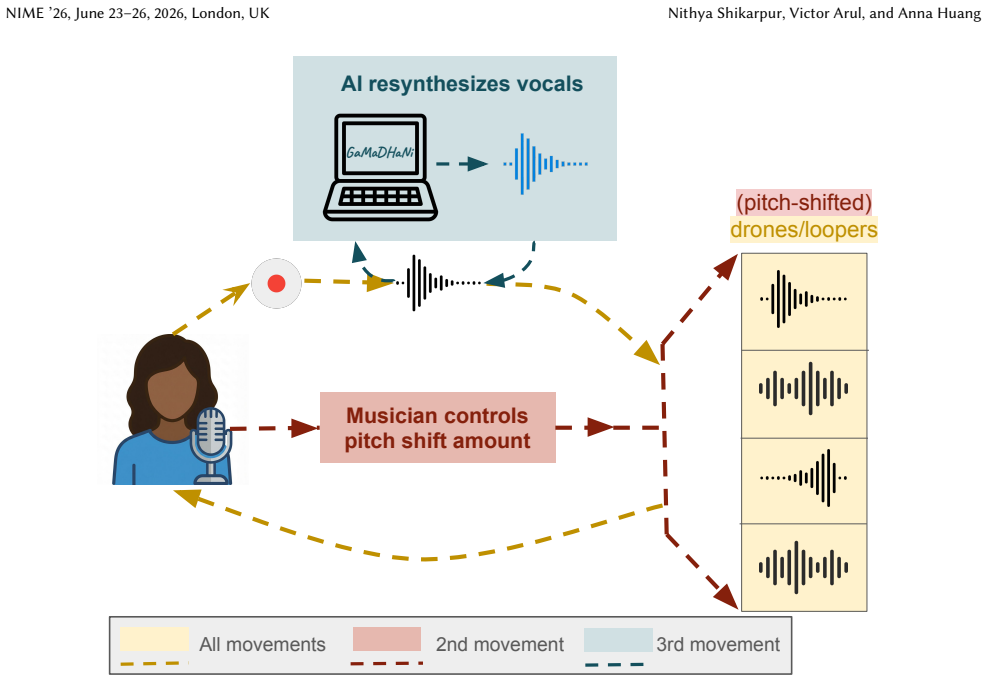
The work employs four independent loopers that populate in real time from the vocalist’s improvisation, creating an organic feedback loop; pitch shifting then introduces sudden melodic movement, and integration of a low-fidelity pitch-to-voice generative model changes timbre, together allowing the virtual drone to transition from reactive to more proactive roles and function as an active, responsive, and co-creative musical agent within established Hindustani practices.
What carries the argument
Four independent real-time loopers combined with pitch shifting and low-fidelity singer-conditioned AI resynthesis that together animate the static tanpura drone.
If this is right
- The virtual drone forms an evolving organic feedback loop with the live voice.
- Pitch shifting adds an explicit dimension of melodic movement to the drone.
- Low-fidelity generative outputs deliberately leave the material incomplete, requiring human situational context.
- Technology and generative AI are placed inside socio-cultural musical traditions rather than treated as replacements.
- The virtual drone operates as an active, responsive, and co-creative musical agent.
Where Pith is reading between the lines
- The same low-fidelity, context-dependent approach could be tested in other oral-tradition musics to keep AI from displacing human performers.
- Varying the timing or amount of pitch shift and resynthesis might allow controlled experiments on perceived agency levels.
- The system suggests a design principle where generative models are tuned for incompleteness so that collaboration remains necessary.
- Similar real-time looping plus controlled degradation could be applied to non-vocal instruments to explore agency in other ensembles.
Load-bearing premise
The specific combination of real-time looping, pitch shifting, and low-fidelity resynthesis actually produces a measurable shift from reactive to proactive agency and makes human interpretation necessary for musical completeness.
What would settle it
A recorded performance in which the virtual drone’s looped, shifted, and resynthesized output is played back without any live vocalist or external human adjustment and still forms a complete, stylistically coherent Hindustani piece.
Figures

read the original abstract
Melodic material in Hindustani music is presented in relation to a tonic, usually sustained by the tanpura, a four-stringed drone instrument. Rooted in Hindustani music, 'The Moving Drone' sets the traditionally static drone into motion that, throughout the performance, gains increasing agency transitioning from reactive to more proactive roles. The work employs four independent loopers in Max/MSP to function as 'virtual' drones. They are populated cyclically in real-time as the vocalist improvises, creating an organic and evolving feedback loop between the voice and the virtual drone. This relationship further evolves melodically by pitch shifting the loops, which introduces a dimension of sudden, explicit movement. Then it changes timbrally, via the integration of GaMaDHaNi, a singer conditioned pitch-to-voice generative AI model to resynthesize looped audio. While current music AI approaches prioritize high-fidelity and realism of generated content which has sparked anxiety over job replacement for the music community, this work intentionally utilizes low-fidelity generative outputs, further necessitating human interpretation and situational context in order to be complete. 'The Moving Drone' positions technology and generative AI within established socio-cultural musical practices, proposing a virtual drone as an active, responsive, and co-creative musical agent.
Editorial analysis
A structured set of objections, weighed in public.
Referee Report
Summary. The manuscript describes an artistic performance system called 'The Moving Drone' rooted in Hindustani music traditions. It uses four independent real-time loopers in Max/MSP populated cyclically from vocal improvisation, combined with pitch shifting for melodic movement and low-fidelity resynthesis via the GaMaDHaNi pitch-to-voice generative AI model, to animate the traditionally static tanpura drone. The system is presented as enabling a transition in the virtual drone from reactive to proactive agency, with low-fidelity outputs intentionally requiring human interpretation and situational context to be musically complete, thereby positioning generative AI as a co-creative agent within established socio-cultural practices.
Significance. If the described artistic intent is realized in performance, the work offers a distinctive contribution by integrating generative AI into traditional musical contexts in a manner that prioritizes co-creativity, human interpretation, and low-fidelity outputs over high-fidelity realism or replacement, providing a concrete example that could inform design principles for interactive and culturally situated music AI systems.
minor comments (1)
- The description of the Max/MSP implementation and GaMaDHaNi integration would benefit from additional technical specifics (e.g., loop lengths, pitch-shift ranges, or resynthesis parameters) to support clearer understanding and potential replication by other practitioners.
Simulated Author's Rebuttal
We thank the referee for their accurate summary of the manuscript, recognition of its significance in prioritizing co-creativity and low-fidelity generative outputs within Hindustani musical practices, and recommendation to accept.
Circularity Check
No significant circularity; artistic description only
full rationale
The paper is a descriptive account of an artistic installation using Max/MSP loopers, pitch shifting, and the GaMaDHaNi model. It advances no equations, fitted parameters, derivations, predictions, or uniqueness theorems. The central narrative—that the system transitions the drone from reactive to proactive agency—rests on artistic intent and design choices rather than any self-referential reduction or load-bearing self-citation. No step reduces to its own inputs by construction.
Axiom & Free-Parameter Ledger
Reference graph
Works this paper leans on
-
[1]
Cycling ’74. 1997. Max. https://cycling74.com/products/max. [Accessed 12-02-2026]
1997
-
[2]
1998.Nad
Sandeep Bagchee. 1998.Nad. BPI Publishing
1998
-
[3]
Sabyasachi (Rahul) Bhattacharya. 2014. Raga Bihag: An uplifting melody. https://sarod.com.au/raga-bihag-an-uplifting-melody/. [Accessed 12-02-2026]
2014
-
[4]
Giovanni Bindi, Nils Demerlé, Rodrigo Diaz, David Genova, Aliénor Golvet, Ben Hayes, Jiawen Huang, Lele Liu, Vincent Martos, Sarah Nabi, et al
- [5]
-
[6]
Jade Copet, Felix Kreuk, Itai Gat, Tal Remez, David Kant, Gabriel Synnaeve, Yossi Adi, and Alexandre Défossez. 2023. Simple and Controllable Music Generation. InThirty-seventh Conference on Neural Information Processing Systems
2023
-
[7]
Ashwini Bhide Deshpande. 2023. Raag Ki Tasveer - Bihag Family | Batiyan Daurawat | Dr. Ashwini Bhide Deshpande. https://www.youtube.com/ watch?v=BptPdYSxRGs&list=PLEfmeUsduoEadg1CroTkD1pghArNZ7HkT&index=2. Accessed 04-30-2026
2023
-
[8]
Eamonn Forde. 2025. Musicians are deeply concerned about AI. So why are the major labels embracing it? https://www.theguardian.com/music/ 2025/dec/16/musicians-are-deeply-concerned-about-ai-so-why-are-the-major-labels-embracing-it. [Accessed 12-02-2026]
2025
-
[9]
Kaustuv Kanti Ganguli and Preeti Rao. 2018. On the Distributional Representation of Ragas: Experiments with Allied Raga Pairs.Trans. Int. Soc. Music. Inf. Retr.1, 1 (2018), 79–95
2018
-
[10]
Daniel Griffin and Jae Lim. 1984. Signal estimation from modified short-time Fourier transform.IEEE Transactions on acoustics, speech, and signal processing32, 2 (1984), 236–243
1984
-
[11]
Sankalp Gulati, Joan Serra, Vignesh Ishwar, Sertan Sentürk, and Xavier Serra. 2016. Phrase-based r ¯aga recognition using vector space modeling. In 2016 IEEE International Conference on Acoustics, Speech and Signal Processing (ICASSP). IEEE, 66–70
2016
-
[12]
Sankalp Gulati, Joan Serrà Julià, Kaustuv Kanti Ganguli, Sertan Sentürk, and Xavier Serra. 2016. Time-delayed melody surfaces for r¯aga recognition. InISMIR
2016
-
[13]
Jonathan Herington, Raffaella Borasi, Benjamin J Guerrero, David E Miller, Blaire Koerner, Yu Jung Han, Zenon Borys, and Rachel Roberts. 2025. Musicians’ ethical concerns about AI: an interview study.AI & SOCIETY(2025), 1–14
2025
-
[14]
Kevin Kilgour, Mauricio Zuluaga, Dominik Roblek, and Matthew Sharifi. 2018. Fr\’echet audio distance: A metric for evaluating music enhancement algorithms.arXiv preprint arXiv:1812.08466(2018)
work page internal anchor Pith review Pith/arXiv arXiv 2018
-
[15]
Andrew McPherson, Fabio Morreale, and Jacob Harrison. 2019. Musical instruments for novices: Comparing NIME, HCI and crowdfunding approaches. InNew directions in music and human-computer interaction. Springer, 179–212
2019
-
[16]
Adam Neely. 2026. Suno, AI Music, and the Bad Future. https://www.youtube.com/watch?v=U8dcFhF0Dlk. [Accessed 12-02-2026]
2026
-
[17]
Michele Newman, Lidia Morris, and Jin Ha Lee. 2023. Human-AI Music Creation: Understanding the Perceptions and Experiences of Music Creators for Ethical and Productive Collaboration.. InISMIR. 80–88. NIME ’26, June 23–26, 2026, London, UK Nithya Shikarpur, Victor Arul, and Anna Huang
2023
-
[18]
Nithya Shikarpur, Krishna Maneesha Dendukuri, Yusong Wu, Antoine Caillon, and Cheng-Zhi Anna Huang. 2024. Hierarchical generative modeling of melodic vocal contours in hindustani classical music. InISMIR
2024
-
[19]
Nithya Shikarpur and Cheng-Zhi Anna Huang. 2024. Exploratory Study Of Human-AI Interaction For Hindustani Music.NeurIPS Creative AI Track (2024)
2024
- [20]
-
[21]
Ajay Srinivasamurthy, Sankalp Gulati, Rafael Caro Repetto, and Xavier Serra. 2021. Saraga: Open datasets for research on indian art music.Empirical Musicology Review 2021; 16 (1): 85-98.(2021)
2021
-
[22]
Notto JW Thelle and Philippe Pasquier. 2021. Spire muse: A virtual musical partner for creative brainstorming. InNIME 2021. PubPub
2021
discussion (0)
Sign in with ORCID, Apple, or X to comment. Anyone can read and Pith papers without signing in.