High-Order Regularity and a Fully Discrete Fourier Spectral Method for a Partially Dissipative Viscoelastic Timoshenko System with Memory
Pith reviewed 2026-06-27 15:53 UTC · model grok-4.3
The pith
The fully discrete Fourier spectral scheme for the viscoelastic Timoshenko system with memory converges at second order in time and arbitrary order in space.
A machine-rendered reading of the paper's core claim, the machinery that carries it, and where it could break.
Core claim
The fully discrete Fourier spectral scheme satisfies an error estimate of second-order convergence in time and q-th order convergence in space for any natural number q. This estimate is obtained from a discrete energy method that also establishes positivity of the discrete energy. The scheme employs sine and cosine Fourier expansions in space adapted to Dirichlet and Neumann conditions, central differencing for the second-order time derivatives, and the composite trapezoidal rule for the Volterra memory term.
What carries the argument
The discrete energy method applied to the fully discrete Fourier spectral scheme, which establishes both positivity of the numerical energy and the stated error bounds.
If this is right
- The scheme remains stable for any time step size because the discrete energy stays nonnegative.
- Arbitrary spatial accuracy follows by increasing the number of Fourier modes without changing the time-stepping order.
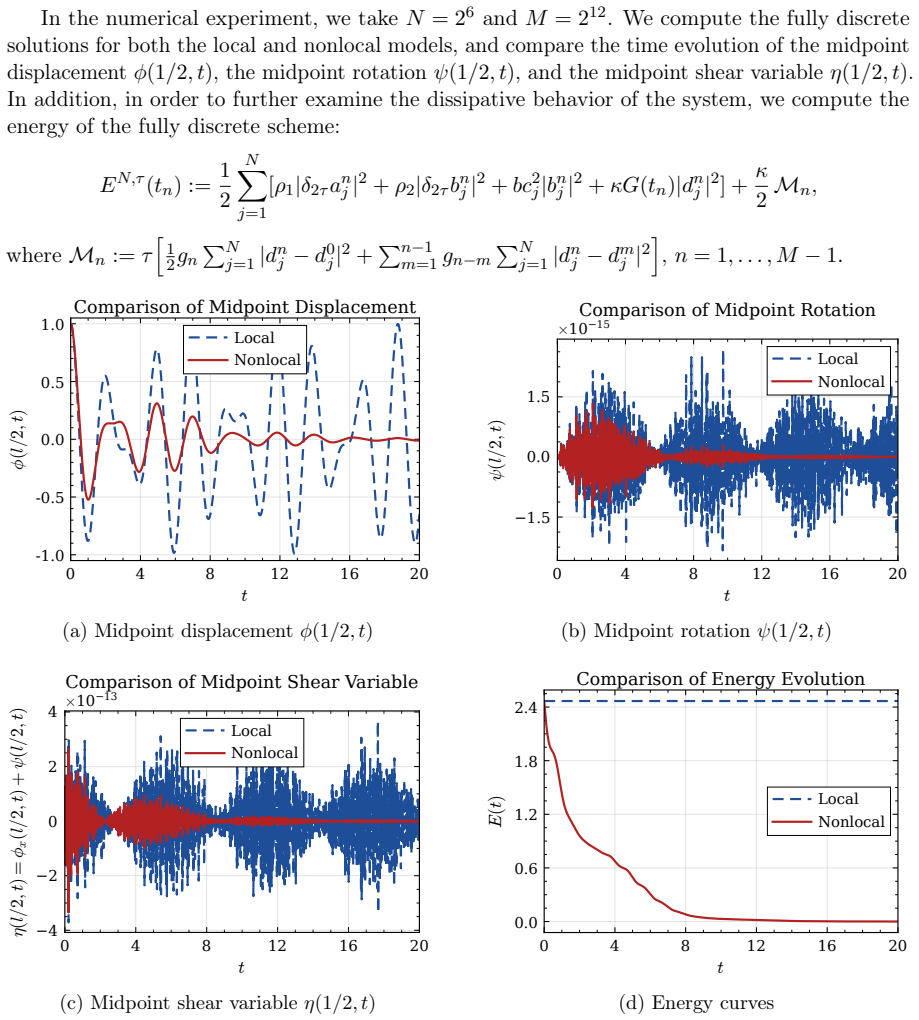
- Numerical comparisons confirm that the memory term produces stronger vibration attenuation than the corresponding local model.
- Higher-order regularity of solutions holds on finite intervals once initial data satisfy the compatibility conditions required by the mixed boundary conditions.
Where Pith is reading between the lines
- If the kernel decays more slowly than the assumed conditions, the long-time dissipation rate may drop and the scheme could require smaller time steps to maintain accuracy.
- The same Fourier basis construction and discrete energy argument could be applied to other one-dimensional viscoelastic systems with nonlocal dissipation terms.
- Running the scheme over successively longer time intervals would test whether positivity of the discrete energy persists globally or only up to the finite-time horizon treated in the analysis.
Load-bearing premise
The memory kernel satisfies positivity and decay conditions that allow the Volterra integral to function as a dissipative term in the energy balance.
What would settle it
A computation in which the discrete energy becomes negative for some time step and mode count, or in which the measured convergence rate in time falls below second order while the spatial order is held fixed.
Figures
read the original abstract
This paper investigates a class of partially dissipative viscoelastic Timoshenko systems with memory, where dissipation is induced by a Volterra-type memory term acting only on the shear variable. The well-posedness of weak and strong solutions is established on finite time intervals, including existence, uniqueness, stability, and higher-order regularity under compatibility conditions consistent with mixed boundary conditions. For the numerical approximation, a Fourier spectral fully discrete scheme is constructed: sine and cosine basis expansions are used in space for unknowns satisfying Dirichlet and Neumann boundary conditions, respectively; in time, a central difference scheme is applied to the second-order derivatives, and the composite trapezoidal rule is used to approximate the memory convolution term. Based on a discrete energy method, the positivity of the constructed discrete energy is proved, and the error estimate for the fully discrete scheme with second-order convergence in time and \(q\)-th order in space is established for any q \in \mathbb{N}. Numerical experiments are given to verify the theoretical convergence rates and to compare the dynamic responses of the local and nonlocal models, demonstrating that the memory term effectively captures energy dissipation and vibration attenuation behavior in viscoelastic materials.
Editorial analysis
A structured set of objections, weighed in public.
Referee Report
Summary. The paper proves well-posedness, uniqueness, stability, and higher-order regularity for a partially dissipative viscoelastic Timoshenko system with memory acting only on the shear variable. It then constructs a fully discrete Fourier spectral scheme (sine/cosine bases in space, central differences in time, composite trapezoidal quadrature for the Volterra memory term) and uses a discrete energy method to establish positivity of the discrete energy together with an error bound of second order in time and arbitrary order q in space. Numerical experiments confirm the rates and illustrate dissipation effects.
Significance. If the discrete-energy positivity argument holds under the stated kernel assumptions, the work supplies a rigorously justified high-order spectral method for a class of viscoelastic Timoshenko systems that is directly applicable to modeling energy dissipation in materials; the combination of arbitrary spatial order, proven stability, and explicit error estimates is a concrete contribution to the numerical analysis of memory-type PDEs.
major comments (2)
- [§4] §4 (discrete energy identity): the proof that the trapezoidal approximation of the memory convolution preserves non-negativity of the discrete energy appears to rely only on the standard positivity and monotonicity conditions used for the continuous problem. Under these conditions the discrete inner-product identity does not automatically yield a positive term; a completely monotone kernel or a discrete resolvent inequality is typically required. Without an explicit statement of the additional hypothesis or a direct verification of the discrete inequality, both the stability claim and the subsequent subtraction argument for the error estimate rest on an unverified step.
- [Theorem 5.1] Theorem 5.1 (error estimate): the O(τ² + h^q) bound is derived by subtracting the continuous and discrete energies. If the positivity identity in §4 fails for merely positive decreasing kernels, the Gronwall step that absorbs the memory error term loses its foundation; the estimate would then require a stronger kernel class that is not stated in the theorem hypotheses.
minor comments (2)
- [§2] The compatibility conditions for the higher-regularity result are stated only in the abstract; an explicit list in §2 would help readers verify that the mixed Dirichlet/Neumann boundary conditions are correctly incorporated into the Fourier basis choice.
- Notation for the memory kernel (e.g., g(t), its derivative, and the constants in the decay assumptions) should be collected in a single preliminary subsection to avoid repeated redefinition across the well-posedness and numerical sections.
Simulated Author's Rebuttal
We thank the referee for the detailed review and for identifying points that require clarification in the discrete analysis. We address each major comment below. Our responses maintain that the proofs in §§4–5 hold under the kernel assumptions stated in the manuscript (positive, decreasing, integrable kernels), but we agree that the discrete positivity step can be made more explicit to remove any ambiguity.
read point-by-point responses
-
Referee: [§4] §4 (discrete energy identity): the proof that the trapezoidal approximation of the memory convolution preserves non-negativity of the discrete energy appears to rely only on the standard positivity and monotonicity conditions used for the continuous problem. Under these conditions the discrete inner-product identity does not automatically yield a positive term; a completely monotone kernel or a discrete resolvent inequality is typically required. Without an explicit statement of the additional hypothesis or a direct verification of the discrete inequality, both the stability claim and the subsequent subtraction argument for the error estimate rest on an unverified step.
Authors: The discrete energy identity in §4 is obtained by taking the inner product of the fully discrete scheme with the discrete velocities and summing by parts. The memory term is handled by writing the trapezoidal quadrature explicitly and using the monotonicity of the kernel together with a discrete summation-by-parts identity that mirrors the continuous case. This produces a non-negative contribution without invoking complete monotonicity. We will revise the manuscript to insert the intermediate inequality that verifies non-negativity directly from the given kernel hypotheses, thereby making the argument self-contained. revision: partial
-
Referee: [Theorem 5.1] Theorem 5.1 (error estimate): the O(τ² + h^q) bound is derived by subtracting the continuous and discrete energies. If the positivity identity in §4 fails for merely positive decreasing kernels, the Gronwall step that absorbs the memory error term loses its foundation; the estimate would then require a stronger kernel class that is not stated in the theorem hypotheses.
Authors: Theorem 5.1 subtracts the continuous and discrete energy equalities and applies the positivity result of §4 to control the memory error. Because the positivity identity holds under the stated kernel assumptions (as clarified in the revised §4), the subsequent Gronwall estimate remains valid and yields the claimed O(τ² + h^q) bound. No stronger kernel class is required. We will add a short remark after Theorem 5.1 reiterating the precise kernel hypotheses used. revision: partial
Circularity Check
No circularity: standard discrete energy analysis with independent kernel assumptions
full rationale
The derivation proceeds from the continuous PDE under standard positivity/decay conditions on the memory kernel, through a Fourier spectral + central-difference + trapezoidal scheme, to a discrete energy identity whose positivity is asserted via direct inner-product manipulation and then used to bound the error. No parameter is fitted to data and then relabeled as a prediction; no uniqueness theorem is imported from the authors' prior work; the trapezoidal quadrature is analyzed directly rather than smuggled via self-citation; and the error bound is not definitionally identical to any input quantity. The central claims therefore remain self-contained against external benchmarks.
Axiom & Free-Parameter Ledger
axioms (2)
- domain assumption The memory kernel satisfies the usual positivity and integrability conditions that make the Volterra term dissipative.
- domain assumption Initial data satisfy compatibility conditions consistent with the mixed Dirichlet-Neumann boundary conditions.
Reference graph
Works this paper leans on
-
[1]
Alves, Eduardo H
Michele O. Alves, Eduardo H. Gomes Tavares, Marcio A. Jorge Silva, and José H. Rodrigues. On modeling and uniform stability of a partially dissipative viscoelastic Timoshenko system. SIAM J. Math. Anal., 51(6):4520–4543, 2019
2019
-
[2]
Muñoz Rivera, and Reinhard Racke
Fatiha Ammar-Khodja, Assia Benabdallah, Jaime E. Muñoz Rivera, and Reinhard Racke. Energy decay for Timoshenko systems of memory type.J. Differential Equations, 194(1):82– 115, 2003
2003
-
[3]
Atkinson.An introduction to numerical analysis
Kendall E. Atkinson.An introduction to numerical analysis. John Wiley & Sons, Inc., New York, second edition, 1989
1989
-
[4]
Hermann Brunner.Collocation Methods for Volterra Integral and Related Functional Dif- ferential Equations, volume 15 ofCambridge Monogr. Appl. Comput. Math.Cambridge University Press, Cambridge, 2004
2004
-
[5]
Canuto, M
C. Canuto, M. Y. Hussaini, A. Quarteroni, and T. A. Zang.Spectral methods. Scientific Computation. Springer-Verlag, Berlin, 2006. Fundamentals in single domains
2006
-
[6]
Christensen.Theory of Viscoelasticity
Richard M. Christensen.Theory of Viscoelasticity. Courier Corporation, Mineola, NY, 2013
2013
-
[7]
Compressing the memory variables in constant-Q viscoelastic wave propagation via an improved sum-of-exponentials approximation.J
Xu Guo, Shidong Jiang, Yunfeng Xiong, and Jiwei Zhang. Compressing the memory variables in constant-Q viscoelastic wave propagation via an improved sum-of-exponentials approximation.J. Comput. Phys., 518, 2024
2024
-
[8]
Han, Haym Benaroya, and Timothy Wei
Seon M. Han, Haym Benaroya, and Timothy Wei. Dynamics of transversely vibrating beams using four engineering theories.J. Sound Vib., 225(5):935–988, 1999
1999
-
[9]
A viscoelastic Timoshenko beam model: Regularity and numerical approximation.J
Yiqun Li, Hong Wang, and Xiangcheng Zheng. A viscoelastic Timoshenko beam model: Regularity and numerical approximation.J. Sci. Comput., 95(2), 2023. 23
2023
-
[10]
Messaoudi and Muhammad I
Salim A. Messaoudi and Muhammad I. Mustafa. On the internal and boundary stabilization of Timoshenko beams.Nonlinear Differential Equations Appl., 15(6):655–671, 2008
2008
-
[11]
Discontinuous Galerkin method for an evolution equation with a memory term of positive type.Math
Kassem Mustapha and William McLean. Discontinuous Galerkin method for an evolution equation with a memory term of positive type.Math. Comp., 78(268):1975–1995, 2009
1975
-
[12]
Raviart and J.-M
P.-A. Raviart and J.-M. Thomas.Introduction à l’Analyse Numérique des Équations aux Dérivées Partielles. Collection Mathématiques Appliquées pour la Maîtrise. Masson, Paris, 1983
1983
-
[13]
Gomes Tavares, Marcio A
Eduardo H. Gomes Tavares, Marcio A. Jorge Silva, To Fu Ma, and Higidio P. Oquendo. Shearing Viscoelasticity in Partially Dissipative Timoshenko–Boltzmann Systems.SIAM J. Math. Anal., 56(1):1149–1178, 2024
2024
-
[14]
Timoshenko
Stephen P. Timoshenko. On the correction for shear of the differential equation for transverse vibrations of prismatic bars.Philos. Mag., 41:744–746, 1921
1921
-
[15]
Decay properties for the numerical solutions of a partial differential equation with memory.J
Da Xu. Decay properties for the numerical solutions of a partial differential equation with memory.J. Sci. Comput., 62(1):146–178, 2015
2015
-
[16]
A viscoelastic Timoshenko beam: Model development, analysis, and investigation.J
Xiangcheng Zheng, Yiqun Li, and Hong Wang. A viscoelastic Timoshenko beam: Model development, analysis, and investigation.J. Math. Phys., 63(6), 2022. 24
2022
discussion (0)
Sign in with ORCID, Apple, or X to comment. Anyone can read and Pith papers without signing in.