Vacuum Fluctuation-Induced State Switching in Degenerate Optical Parametric Oscillators
Pith reviewed 2026-06-29 03:44 UTC · model grok-4.3
The pith
An external bias field controls vacuum fluctuation-driven switching between steady states in a degenerate optical parametric oscillator by reshaping its metapotential.
A machine-rendered reading of the paper's core claim, the machinery that carries it, and where it could break.
Core claim
In a biased degenerate OPO, vacuum fluctuations induce noise-activated switching between the two steady states; an external bias field modifies the shape of the steady-state metapotential, yielding closed-form expressions for the mean switching time that match numerical simulations of the intracavity field distribution and inter-state flow.
What carries the argument
The OPO steady-state metapotential, whose barrier height and asymmetry are tuned by the external bias to set the rate of vacuum-induced escapes between the two attractors.
If this is right
- Switching rate becomes a controllable function of the injected bias amplitude.
- Average transition time scales with pump gain and optical nonlinearity according to the explicit formulas.
- The bias-tuned metapotential supplies a mechanism for noise-assisted state selection in photonic circuits.
- The same framework supplies design rules for probabilistic gates that rely on vacuum-induced transitions.
Where Pith is reading between the lines
- Similar bias control of fluctuation-driven switching could be tested in other near-bifurcation nonlinear resonators such as Kerr microcavities.
- The derived switching-time expressions may serve as a starting point for engineering optical memory elements whose retention time is set by quantum noise rather than thermal activation.
- Integration with waveguide platforms would allow the bias field to be applied locally, opening routes to arrays of coupled OPOs with programmable noise-assisted dynamics.
Load-bearing premise
The operating point remains close enough to the bifurcation that the metapotential picture and semiclassical noise description continue to apply once the bias field is introduced.
What would settle it
Measured average switching times that depart systematically from the derived analytical expressions once the bias strength pushes the system appreciably away from the bifurcation point.
Figures
read the original abstract
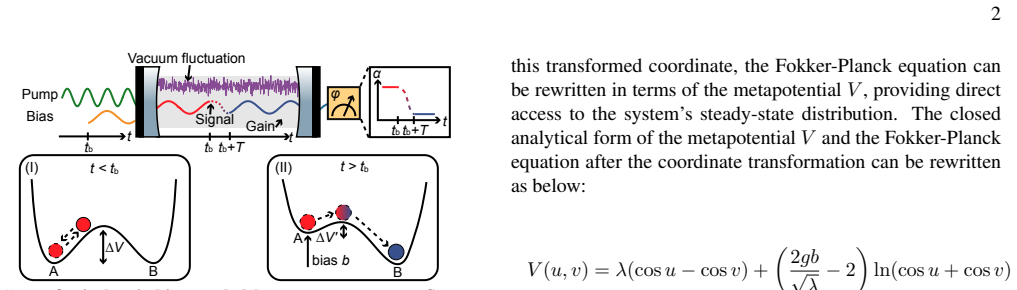
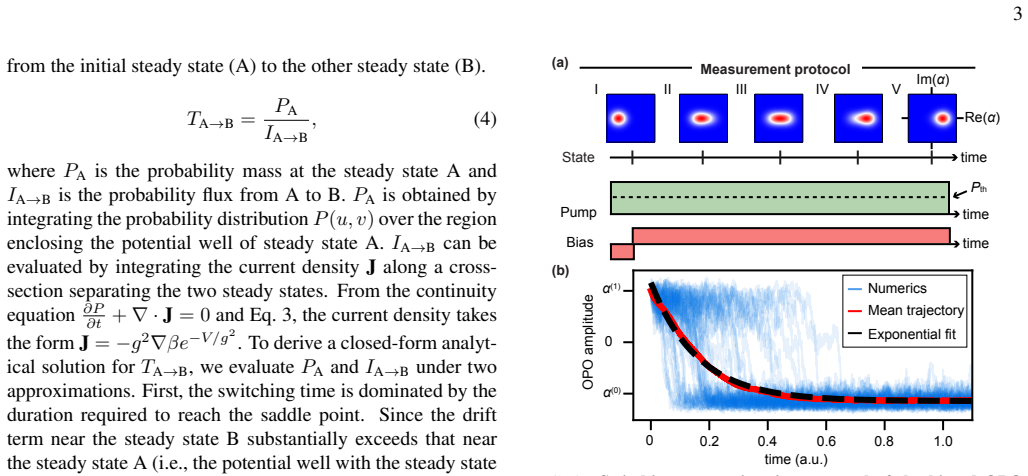
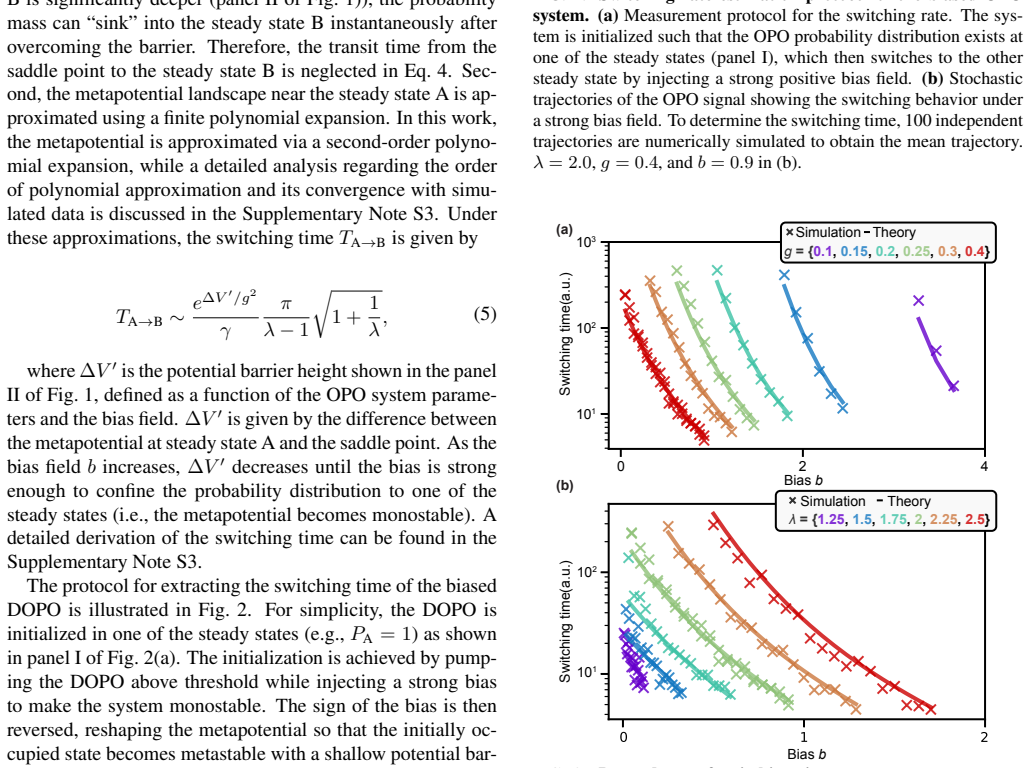
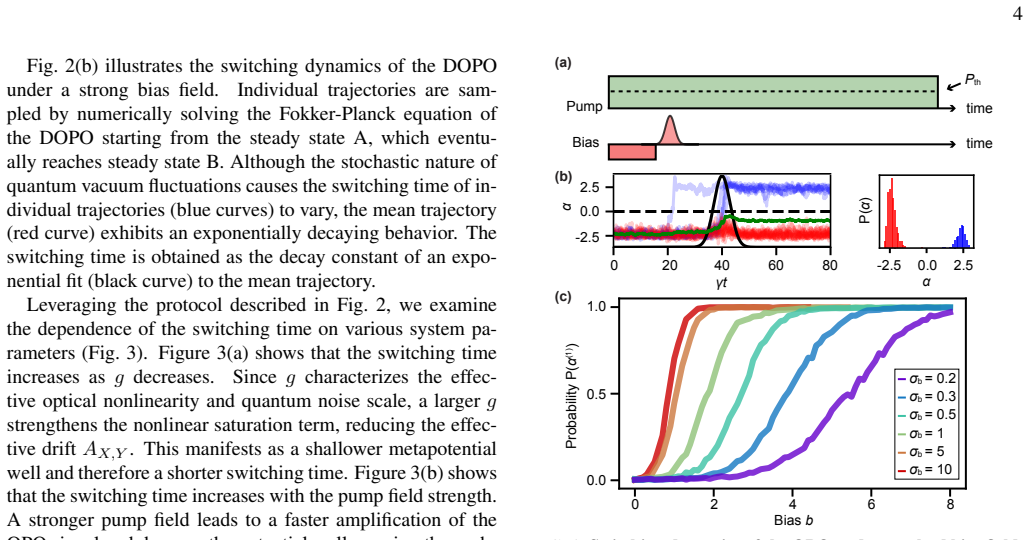
Bistable driven-dissipative systems near bifurcations can exhibit noise-activated switching between steady states. Here, we investigate how quantum vacuum fluctuations induce such switching in a biased optical parametric oscillator (OPO), a nonlinear system with intrinsic bistability. We show how microscopic quantum fluctuations driving macroscopic transitions can be controlled with an external bias field that reshapes the OPO steady-state metapotential. We derive analytical expressions for the average switching time and validate them through simulations of the OPO field distribution and inter-state probability flow under bias injection. We further examine how switching depends on bias strength, pump gain, and optical nonlinearity. Our findings clarify how quantum noise can shape macroscopic dynamics and provide a foundation for noise-assisted photonic machine learning and probabilistic quantum gates.
Editorial analysis
A structured set of objections, weighed in public.
Referee Report
Summary. The paper claims that quantum vacuum fluctuations induce noise-activated switching between bistable states in a biased degenerate optical parametric oscillator (OPO). An external bias field is shown to control these transitions by reshaping the steady-state metapotential; analytical expressions for the average switching time are derived from a semiclassical noise model and validated via simulations of the OPO field distribution and inter-state probability flow. Dependence on bias strength, pump gain, and nonlinearity is examined, with implications for photonic machine learning and probabilistic quantum gates.
Significance. If the metapotential-based derivations and their regime of validity hold, the work would provide a concrete link between microscopic quantum noise and controllable macroscopic switching in driven-dissipative systems, offering analytical tools rather than purely numerical results. The combination of closed-form switching-time expressions with simulation validation is a positive feature.
major comments (1)
- [Derivations and simulation setup (implicit throughout)] The derivation of analytical switching times and the simulation validation both rest on the assumption that the driven OPO remains sufficiently close to the pitchfork bifurcation for the metapotential description and semiclassical noise model to remain accurate under nonzero bias injection. No diagnostic (e.g., computed distance to bifurcation, comparison of noise correlators before/after bias, or explicit bounds on bias strength relative to the critical pump) is reported to confirm this regime for the parameter values examined. This assumption is load-bearing for the central claim.
Simulated Author's Rebuttal
We thank the referee for their thorough review and valuable feedback on our manuscript. We address the major comment regarding the validation of the metapotential approximation under bias injection below.
read point-by-point responses
-
Referee: [Derivations and simulation setup (implicit throughout)] The derivation of analytical switching times and the simulation validation both rest on the assumption that the driven OPO remains sufficiently close to the pitchfork bifurcation for the metapotential description and semiclassical noise model to remain accurate under nonzero bias injection. No diagnostic (e.g., computed distance to bifurcation, comparison of noise correlators before/after bias, or explicit bounds on bias strength relative to the critical pump) is reported to confirm this regime for the parameter values examined. This assumption is load-bearing for the central claim.
Authors: We agree that providing explicit diagnostics would better substantiate the regime of validity. Our parameter choices ensure the system operates near the bifurcation even with bias, as the bias is introduced as a small perturbation that reshapes the metapotential without driving the system far from the critical point; this is implicitly supported by the close agreement between our analytical predictions and numerical simulations across the examined ranges. Nevertheless, to fully address the concern, we will revise the manuscript to include: computed distances to the bifurcation point for biased cases, explicit bounds on allowable bias strength relative to the critical pump, and comparisons of noise correlators with and without bias. These additions will confirm the applicability of the semiclassical model. revision: yes
Circularity Check
No circularity; derivation chain self-contained
full rationale
The abstract states that analytical expressions for average switching time are derived from the bias-reshaped metapotential and validated by independent simulations of field distribution and probability flow. No self-citations, fitted parameters renamed as predictions, or self-definitional reductions are present in the provided text. The central claim rests on standard semiclassical noise modeling near bifurcations, which is externally falsifiable and does not reduce to its own inputs by construction. This matches the expected non-circular case for a first-principles quantum-optics derivation.
Axiom & Free-Parameter Ledger
Reference graph
Works this paper leans on
-
[1]
Brownian motion in a field of force and the diffusion model of chemical reactions.Physica, 7(4):284–304, 1940
Hendrik Anthony Kramers. Brownian motion in a field of force and the diffusion model of chemical reactions.Physica, 7(4):284–304, 1940
1940
-
[2]
Reaction- rate theory: fifty years after Kramers.Reviews of Modern Physics, 62(2):251, 1990
Peter H ¨anggi, Peter Talkner, and Michal Borkovec. Reaction- rate theory: fifty years after Kramers.Reviews of Modern Physics, 62(2):251, 1990
1990
-
[3]
Stochastic phase switch- ing of a parametrically driven electron in a penning trap.Phys- ical Review Letters, 83(5):899, 1999
LJ Lapidus, D Enzer, and G Gabrielse. Stochastic phase switch- ing of a parametrically driven electron in a penning trap.Phys- ical Review Letters, 83(5):899, 1999
1999
-
[4]
Activation barrier scaling and crossover for noise-induced switching in micromechanical parametric oscillators.Physical Review Letters, 99(6):060601, 2007
HB Chan and C Stambaugh. Activation barrier scaling and crossover for noise-induced switching in micromechanical parametric oscillators.Physical Review Letters, 99(6):060601, 2007. 6
2007
-
[5]
Implementing p-bits with embedded mtj.IEEE Electron Device Letters, 38(12):1767–1770, 2017
Kerem Yunus Camsari, Sayeef Salahuddin, and Supriyo Datta. Implementing p-bits with embedded mtj.IEEE Electron Device Letters, 38(12):1767–1770, 2017
2017
-
[6]
Neurobiological models of two-choice decision making can be reduced to a one- dimensional nonlinear diffusion equation.PLoS Computational Biology, 4(3):e1000046, 2008
Alex Roxin and Anders Ledberg. Neurobiological models of two-choice decision making can be reduced to a one- dimensional nonlinear diffusion equation.PLoS Computational Biology, 4(3):e1000046, 2008
2008
-
[7]
Balance between noise and adaptation in competi- tion models of perceptual bistability.Journal of Computational Neuroscience, 27(1):37–54, 2009
Asya Shpiro, Ruben Moreno-Bote, Nava Rubin, and John Rinzel. Balance between noise and adaptation in competi- tion models of perceptual bistability.Journal of Computational Neuroscience, 27(1):37–54, 2009
2009
-
[8]
Rf-driven josephson bifurcation amplifier for quantum measurement.Physical re- view letters, 93(20):207002, 2004
Irfan Siddiqi, R Vijay, F Pierre, CM Wilson, M Metcalfe, C Rigetti, L Frunzio, and MH Devoret. Rf-driven josephson bifurcation amplifier for quantum measurement.Physical re- view letters, 93(20):207002, 2004
2004
-
[9]
Integer factorization using stochastic magnetic tunnel junctions.Na- ture, 573(7774):390–393, 2019
William A Borders, Ahmed Z Pervaiz, Shunsuke Fukami, Kerem Y Camsari, Hideo Ohno, and Supriyo Datta. Integer factorization using stochastic magnetic tunnel junctions.Na- ture, 573(7774):390–393, 2019
2019
-
[10]
Hardware-aware in situ learning based on stochastic magnetic tunnel junctions
Jan Kaiser, William A Borders, Kerem Y Camsari, Shunsuke Fukami, Hideo Ohno, and Supriyo Datta. Hardware-aware in situ learning based on stochastic magnetic tunnel junctions. Physical Review Applied, 17(1):014016, 2022
2022
-
[11]
Fluctuational phase-flip transitions in parametrically driven oscillators.Physical Review E, 57(5):5202, 1998
MI Dykman, CM Maloney, VN Smelyanskiy, and M Silver- stein. Fluctuational phase-flip transitions in parametrically driven oscillators.Physical Review E, 57(5):5202, 1998
1998
-
[12]
Switching via quantum activa- tion: A parametrically modulated oscillator.Physical Review A, 73(4):042108, 2006
M Marthaler and MI Dykman. Switching via quantum activa- tion: A parametrically modulated oscillator.Physical Review A, 73(4):042108, 2006
2006
-
[13]
Resonant-force-induced symmetry breaking in a quantum para- metric oscillator.Physical Review Research, 6(3):033240, 2024
Daniel KJ Boneß, Wolfgang Belzig, and Mark I Dykman. Resonant-force-induced symmetry breaking in a quantum para- metric oscillator.Physical Review Research, 6(3):033240, 2024
2024
-
[14]
Unraveling the switching dynamics in a quan- tum double-well potential.Physical Review A, 112(4):042202, 2025
Qile Su, Rodrigo G Corti ˜nas, Jayameenakshi Venkatraman, and Shruti Puri. Unraveling the switching dynamics in a quan- tum double-well potential.Physical Review A, 112(4):042202, 2025
2025
-
[15]
Quantum versus classical switching dynamics of driven dissi- pative kerr resonators.Physical Review Applied, 13(4):044017, 2020
Christian Kraglund Andersen, Archana Kamal, Nicholas A Masluk, Ioan M Pop, Alexandre Blais, and Michel H Devoret. Quantum versus classical switching dynamics of driven dissi- pative kerr resonators.Physical Review Applied, 13(4):044017, 2020
2020
-
[16]
Asymmetry control in a parametric oscillator for the quantum simulation of chemical activation.PRX Quantum, 7(2):020309, 2026
Alejandro Cros Carrillo de Albornoz, Rodrigo G Corti ˜nas, Max Sch¨afer, Nicholas E Frattini, Brandon Allen, Delmar GA Cabral, Pablo E Videla, Pouya Khazaei, Eitan Geva, Victor S Batista, et al. Asymmetry control in a parametric oscillator for the quantum simulation of chemical activation.PRX Quantum, 7(2):020309, 2026
2026
-
[17]
Bi- asing the quantum vacuum to control macroscopic probability distributions.Science, 381(6654):205–209, 2023
Charles Roques-Carmes, Yannick Salamin, Jamison Sloan, Seou Choi, Gustavo Velez, Ethan Koskas, Nicholas Rivera, Steven E Kooi, John D Joannopoulos, and Marin Solja ˇci´c. Bi- asing the quantum vacuum to control macroscopic probability distributions.Science, 381(6654):205–209, 2023
2023
-
[18]
Springer Science & Business Media, 2007
Howard J Carmichael.Statistical methods in quantum optics 2: Non-classical fields. Springer Science & Business Media, 2007
2007
-
[19]
Probabilistic computing with p- bits.Applied Physics Letters, 119(15), 2021
Jan Kaiser and Supriyo Datta. Probabilistic computing with p- bits.Applied Physics Letters, 119(15), 2021
2021
-
[20]
P- bits for probabilistic spin logic.Applied Physics Reviews, 6(1), 2019
Kerem Y Camsari, Brian M Sutton, and Supriyo Datta. P- bits for probabilistic spin logic.Applied Physics Reviews, 6(1), 2019
2019
-
[21]
Collective and synchronous dynamics of photonic spiking neurons.Nature Communications, 12(1):2325, 2021
Takahiro Inagaki, Kensuke Inaba, Timoth ´ee Leleu, Toshimori Honjo, Takuya Ikuta, Koji Enbutsu, Takeshi Umeki, Ryoichi Kasahara, Kazuyuki Aihara, and Hiroki Takesue. Collective and synchronous dynamics of photonic spiking neurons.Nature Communications, 12(1):2325, 2021
2021
-
[22]
Photonic proba- bilistic machine learning using quantum vacuum noise.Nature Communications, 15(1):7760, 2024
Seou Choi, Yannick Salamin, Charles Roques-Carmes, Rumen Dangovski, Di Luo, Zhuo Chen, Michael Horodynski, Jamison Sloan, Shiekh Zia Uddin, and Marin Solja ˇci´c. Photonic proba- bilistic machine learning using quantum vacuum noise.Nature Communications, 15(1):7760, 2024
2024
-
[23]
Stochastic logic in biased coupled photonic proba- bilistic bits.Communications Physics, 8(1):31, 2025
Michael Horodynski, Charles Roques-Carmes, Yannick Salamin, Seou Choi, Jamison Sloan, Di Luo, and Marin Soljaˇci´c. Stochastic logic in biased coupled photonic proba- bilistic bits.Communications Physics, 8(1):31, 2025
2025
-
[24]
Pho- tonic integrated circuit optical parametric oscillators.Optica, 13(1):11–30, 2025
Xiyuan Lu, Robert M Gray, Jordan Stone, Selina Zhou, Nico- las Englebert, Alireza Marandi, and Kartik Srinivasan. Pho- tonic integrated circuit optical parametric oscillators.Optica, 13(1):11–30, 2025
2025
-
[25]
Quantum sensitivity of paramet- ric oscillators.Physical Review Research, 7(2):L022056, 2025
Alex Gu, Jamison Sloan, Charles Roques-Carmes, Seou Choi, Eric I Rosenthal, Michael Horodynski, Yannick Salamin, Jelena Vuˇckovi´c, and Marin Soljaˇci´c. Quantum sensitivity of paramet- ric oscillators.Physical Review Research, 7(2):L022056, 2025
2025
discussion (0)
Sign in with ORCID, Apple, or X to comment. Anyone can read and Pith papers without signing in.