REVIEW 5 major objections 5 minor 3 cited by
Towards Effective Code-Integrated Reasoning
T0 review · 5 major / 5 minor · reviewed 2026-08-07 · deepseek-v4-flash
Pith's one-line read Code-writing RL lifts a 7B math model’s average accuracy to 52.4 percent
desk verdict A useful code-integrated RL recipe with plausible headline numbers, but missing ablations, seed variance, and a decontamination report make the reported gains under-supported. read the letter →
The pith
A machine-rendered reading of the paper's core claim, the machinery that carries it, and where it could break.
The reading
What carries the argument
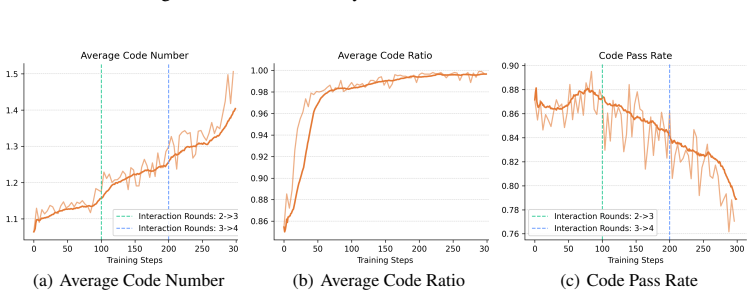
The load-bearing mechanism is the tool-augmented reinforcement-learning loop with a code interpreter: the model generates a code block, the interpreter executes it, the output is appended to the reasoning context, and the policy is updated from the full trajectory. Around that loop the paper wraps six training strategies—exact-match detection of complete Python code blocks, masking of interpreter feedback in the loss, entropy bonus disabled, a progressive interaction budget from two to four rounds, no KL term, and asymmetric clipping in the surrogate objective. These strategies do the work of keeping rollouts clean and preventing tool feedback from destabilizing the policy, while preserving enough exploration for the model to discover code use.
What would settle it
Run the identical pipeline on a base model with no code in its pretraining data: if exact-match detection rarely triggers or training collapses in the early steps, the reported gains depend on the assumption rather than on the six strategies. A second check is an ablation that replaces exact-match detection with stop-token detection under equal compute; if accuracy and training reward do not drop, the boundary-matching claim is not the active ingredient.
Extended reading notes
Core claim
The central claim is that code-integrated reasoning is not just an inference-time trick but a trainable capability, and that its RL training can be stabilized by deliberately balancing exploration against stability. On the paper's own account, the model learns when to invoke a code interpreter, generates code that participates in the reasoning, and incorporates execution results back into its context. The evidence is a consistent margin over baselines on math benchmarks, a steady training reward, and a sharp drop in response length as the model switches from verbose text reasoning to concise code-assisted reasoning. The paper further argues that code integration expands the model's capability boundary, measured by PASS@K, and that the benefits are uneven: algebra, number theory, and combinatorics gain most, while geometry gains little.
Load-bearing premise
The load-bearing premise is that the base model can already produce well-formed, executable Python code blocks from the start of training, so the exact-match boundary detector fires reliably and the interpreter feedback is useful rather than mostly syntax errors.
Editorial extensions
If this is right
- Code-integrated RL outperforms text-only RL and prior tool-augmented RL on all five benchmarks, with the largest gains on the hardest sets such as AIME and OlymMATH.
- Models trained this way produce much shorter responses than long-CoT reasoning while keeping comparable accuracy on the tested sets.
- RL-trained code-integrated models rely on the interpreter: removing execution at inference time causes a large accuracy drop.
- Non-executable code can still help by producing errors that push the model to revise, while executable but logically wrong code can mislead it into premature answers.
- Geometry problems benefit least from code integration, so the approach is not uniformly applicable across problem types.
Reading between the lines
- The paper leaves implicit that the six-strategy recipe should transfer to other base models only if those models can already emit well-formed code blocks; testing on a code-poor backbone would isolate that dependency.
- The same exploration-stability split could apply to other tool-augmented RL targets, such as search or calculator use, where boundary detection and feedback noise are analogous.
- The finding that plausible execution output can stop reasoning early suggests a concrete extension: reward the model for verifying execution results rather than accepting them, or penalize premature termination when the execution output does not match the intended plan.
- A testable extension is to make the interaction budget adaptive to the model's pass rate, rather than fixed at two to four, which would directly test whether the progressive schedule is the active ingredient.
Editorial analysis
A structured set of objections, weighed in public.
Referee Report
Summary. The paper proposes a set of reinforcement-learning training strategies for code-integrated reasoning, where a language model generates Python code during mathematical reasoning and receives execution feedback from an interpreter. The six proposed strategies are precise code-block boundary matching, masking of external-tool feedback in the loss, disabling the entropy bonus, progressively increasing the interaction budget from 2 to 4, removing the KL divergence term, and using an asymmetric clipping upper bound. The method is trained with REINFORCE++ on a 38k-sample subset of STILL-3, starting from Qwen2.5-Math-7B and Qwen3-8B, and evaluated on MATH500, AMC23, AIME2024, AIME2025, and OlymMATH. The central claim is that the full strategy set yields stable training and large accuracy gains over text-only and tool-augmented RL baselines, including 42.3% on AIME2024 and a 52.4% average across the five benchmarks. The paper also includes mechanistic analyses of capacity boundaries, response-length efficiency, non-executable code, and per-category gains.
Significance. If the reported gains are real and not artifacts of data contamination, the paper makes a useful contribution to tool-augmented RL, an area where training instability is a recognized problem. The release of data, code, and checkpoints is a concrete reproducibility asset, and the paper identifies several design choices that could transfer to other tool-augmented settings. However, the central quantitative claim currently rests on a single unablated training run, without decontamination evidence or uncertainty quantification. The mechanistic sections are thought-provoking but are largely correlational. The paper therefore has genuine potential, but its current evidence base is not yet sufficient to support the strength of the stated conclusions.
major comments (5)
- [§3.1, Table 1] No decontamination analysis is reported between the 38k STILL-3 training subset and the five evaluation benchmarks. This is load-bearing because AIME and AMC problems are widely present in public math corpora, and OlymMATH (Ref. [18]) and STILL-3 (Ref. [4]) come from the same research group. Without an exact and near-duplicate overlap analysis, the gains in Table 1 could reflect memorization rather than the proposed RL strategies. Please report the overlap statistics, the filtering procedure, and a fixed commit hash for the released data and code.
- [§2.3.2, §3.1] The six training strategies are presented as a joint recipe, but no ablation study isolates their individual contributions or justifies the necessity of each. The paper states that the model is trained with 'the strategies detailed in Section 2.3.2' but never shows a configuration without, say, feedback masking or without the progressive budget. Since the central claim is that 'with these improvements' the model achieves the reported numbers, an ablation table is required to attribute the gain to the proposed mechanism rather than to some other component of the training setup.
- [Table 1, Figures 2–3] No uncertainty estimates are provided for any evaluation result. AVG@16 is a sampling-based estimate, yet no bootstrap confidence intervals or standard deviations are reported; MATH500 is a single greedy run. The difference between CIR and TORL-7B on AIME25 is zero (29.2 vs. 29.2) and on average is only 1.9 points, so without sampling error bars the claim of 'consistent and superior performance' is not statistically supported. Similarly, the learning curves in Figures 2–4 come from a single run and need either multiple seeds or at least a statement of variance across runs.
- [§4.3, Table 4] The mechanistic conclusions about non-executable code are based on correlational statistics. The observation that 39.4% of correct responses contain non-executable code does not establish that such code 'contributes' to correctness, because correct responses may simply be longer and contain more code attempts. Likewise, the 36.0% of incorrect responses with fully executable code does not establish that executable-but-flawed code 'misleads' the model. A controlled comparison—for example, forcing or suppressing code revision, or matching on response length—is needed before these causal-sounding claims can be supported.
- [§4.1] The claim that 'removing the execution of the code interpreter results in a significant performance drop' conflates two different training conditions. The comparison is between RLcode (trained with tool-augmented RL and evaluated with code) and RLtext (trained with text-based RL), not between a single model with and without interpreter execution at inference time. The observed drop could be due to different training objectives or prompt distributions rather than to the model's dependence on execution. Please either directly ablate execution at inference time on the same trained model or soften the causal interpretation.
minor comments (5)
- [§3.2.2, Figure 3] The text says the trend is shown on 'AIME2025 and MATH500', but the figure caption and panel labels refer to AIME2024. Please correct the mismatch.
- [§2.3.2, §3.1] The precise hyperparameters of the proposed strategies are not specified: the schedule for the progressive interaction budget (when and how the budget changes from 2 to 3 to 4), the entropy coefficient setting, the clip-higher upper bound, and the KL divergence coefficient are not given. These details are necessary for reproduction and for interpreting the ablation-free results.
- [§4 opening] There is a typo: 'code ingetration' should be 'code integration'.
- [§3.1] The paper says training is conducted within the 'veRL framework [15]', but reference [15] is the HybridFlow paper. Please clarify the relationship or update the citation.
- [§3.2.2] The claim that the Qwen2.5-Math backbone adapts well 'because mainstream math models are typically exposed to significant amounts of code data' is presented without evidence. It is a reasonable hypothesis but should be labeled as such, or supported with a small experiment or citation.
Circularity Check
No significant circularity: the training claims are evaluated on held-out benchmarks, and no load-bearing derivation step reduces to its inputs by construction or self-citation chain.
full rationale
The paper's central claim is that a set of tool-augmented RL strategies improves code-integrated reasoning accuracy. The supporting evidence is Table 1, obtained by training on a fixed subset of STILL-3 and evaluating on MATH500, AMC23, AIME2024, AIME2025, and OlymMATH. No parameter is fitted to these benchmarks and then reported as a prediction: the training data and evaluation sets are distinct, and the reported AVG@16 numbers are measured, not derived from the training objective. The training data (STILL-3, Ref. [4]) and the OlymMATH benchmark (Ref. [18]) come from the same research group, but these citations are sources of data and evaluation material, not load-bearing mathematical results; they do not by themselves define the performance metric or force the outcome. The paper does not invoke a uniqueness theorem from prior self-authored work, does not smuggle in an ansatz via self-citation, and does not rename a known result as an organization. The mechanistic analyses (PASS@k, code pass rate, problem-type gains) are observations about the trained model, not components of the derivation. Accordingly, no equation reduces to another by construction, and no fitted input is relabeled as a prediction. The absence of a decontamination report raises evaluation-validity risk, which is a correctness concern, not circularity under the stated criteria.
Assumptions & free parameters
free parameters (4)
- Progressive interaction budget schedule =
2 -> 3 -> 4 rounds
- Entropy coefficient =
0
- Asymmetric clipping upper bound (clip-higher) =
not reported
- KL divergence coefficient =
removed (0)
assumptions (4)
- domain assumption Base Qwen2.5-Math-7B can generate well-formed Python code blocks early in training, so exact-match boundary detection yields reliable interpreter interactions.
- domain assumption A binary final-answer reward (+1 for correct, -1 otherwise) is a sufficient learning signal for acquiring code-integrated reasoning.
- domain assumption The STILL-3 38k sample subset provides a balanced difficulty distribution that transfers to all five evaluation benchmarks.
- standard math REINFORCE++ and the PPO-style surrogate objective are valid optimizers for autoregressive LLMs in this interactive setting.
Cite this review
Pith. "Pith review of Towards Effective Code-Integrated Reasoning." pith.science (2026). https://pith.science/paper/AKZMNMFY
@misc{pith2026250524480,
  author       = {Pith},
  title        = {Pith review of: Towards Effective Code-Integrated Reasoning},
  year         = {2026},
  howpublished = {\url{https://pith.science/paper/AKZMNMFY}},
  note         = {Machine review of arXiv:2505.24480}
}
read the original abstract
In this paper, we investigate code-integrated reasoning, where models generate code when necessary and integrate feedback by executing it through a code interpreter. To acquire this capability, models must learn when and how to use external code tools effectively, which is supported by tool-augmented reinforcement learning (RL) through interactive learning. Despite its benefits, tool-augmented RL can still suffer from potential instability in the learning dynamics. In light of this challenge, we present a systematic approach to improving the training effectiveness and stability of tool-augmented RL for code-integrated reasoning. Specifically, we develop enhanced training strategies that balance exploration and stability, progressively building tool-use capabilities while improving reasoning performance. Through extensive experiments on five mainstream mathematical reasoning benchmarks, our model demonstrates significant performance improvements over multiple competitive baselines. Furthermore, we conduct an in-depth analysis of the mechanism and effect of code-integrated reasoning, revealing several key insights, such as the extension of model's capability boundaries and the simultaneous improvement of reasoning efficiency through code integration. All data and code for reproducing this work are available at: https://github.com/RUCAIBox/CIR.
Figures


Figures from the paper (4 more)


Forward citations
Cited by 3 Pith papers
-
SimpleTIR: End-to-End Reinforcement Learning for Multi-Turn Tool-Integrated Reasoning
Filtering out trajectories with 'void turns' (no code, no answer) stabilizes multi-turn tool-integrated RL and substantially improves math reasoning benchmarks.
-
Chain-of-Agents: End-to-End Agent Foundation Models via Multi-Agent Distillation and Agentic RL
A single LLM is trained with multi-agent distilled trajectories plus agentic RL, and the resulting Chain-of-Agents models set state-of-the-art Pass@1 scores among tool-integrated reasoning methods on GAIA, BrowseComp,...
-
From Trial-and-Error to Improvement: A Systematic Analysis of LLM Exploration Mechanisms in RLVR
A systematic analysis of LLM exploration in RLVR, introducing capability-boundary metrics and examining entropy-performance exchange across training stages and token levels.
Reference graph
Works this paper leans on
-
[18]
Challenging the boundaries of reasoning: An olympiad-level math benchmark for large language models
Haoxiang Sun, Yingqian Min, Zhipeng Chen, Wayne Xin Zhao, Zheng Liu, Zhongyuan Wang, Lei Fang, and Ji-Rong Wen. Challenging the boundaries of reasoning: An olympiad-level math benchmark for large language models. arXiv preprint arXiv:2503.21380, 2025
arXiv 2025
-
[4]
An empirical study on eliciting and improving r1-like reasoning models
Zhipeng Chen, Yingqian Min, Beichen Zhang, Jie Chen, Jinhao Jiang, Daixuan Cheng, Wayne Xin Zhao, Zheng Liu, Xu Miao, Yang Lu, et al. An empirical study on eliciting and improving r1-like reasoning models. arXiv preprint arXiv:2503.04548, 2025. 13
arXiv 2025
-
[1]
DeepSeek-AI, Daya Guo, Dejian Yang, Haowei Zhang, Junxiao Song, Ruoyu Zhang, Runxin Xu, Qihao Zhu, Shirong Ma, Peiyi Wang, Xiao Bi, Xiaokang Zhang, Xingkai Yu, Yu Wu, Z. F. Wu, Zhibin Gou, Zhihong Shao, Zhuoshu Li, Ziyi Gao, Aixin Liu, Bing Xue, Bingxuan Wang, Bochao Wu, Bei Feng, Chengda Lu, Chenggang Zhao, Chengqi Deng, Chenyu Zhang, Chong Ruan, Damai D...
arXiv 2025
-
[2]
A survey of large language models
Wayne Xin Zhao, Kun Zhou, Junyi Li, Tianyi Tang, Xiaolei Wang, Yupeng Hou, Yingqian Min, Beichen Zhang, Junjie Zhang, Zican Dong, Yifan Du, Chen Yang, Yushuo Chen, Zhipeng Chen, Jinhao Jiang, Ruiyang Ren, Yifan Li, Xinyu Tang, Zikang Liu, Peiyu Liu, Jian-Yun Nie, and Ji-Rong Wen. A survey of large language models. CoRR, abs/2303.18223, 2023
arXiv 2023
-
[3]
Yang Yue, Zhiqi Chen, Rui Lu, Andrew Zhao, Zhaokai Wang, Shiji Song, and Gao Huang. Does reinforcement learning really incentivize reasoning capacity in llms beyond the base model? arXiv preprint arXiv:2504.13837, 2025
arXiv 2025
-
[5]
Torl: Scaling tool-integrated rl
Xuefeng Li, Haoyang Zou, and Pengfei Liu. Torl: Scaling tool-integrated rl. arXiv preprint arXiv:2503.23383, 2025
arXiv 2025
-
[6]
Retool: Reinforcement learning for strategic tool use in llms
Jiazhan Feng, Shijue Huang, Xingwei Qu, Ge Zhang, Yujia Qin, Baoquan Zhong, Chengquan Jiang, Jinxin Chi, and Wanjun Zhong. Retool: Reinforcement learning for strategic tool use in llms. arXiv preprint arXiv:2504.11536, 2025
arXiv 2025
-
[7]
Agent rl scaling law: Agent rl with spontaneous code execution for mathematical problem solving
Xinji Mai, Haotian Xu, Weinong Wang, Yingying Zhang, Wenqiang Zhang, et al. Agent rl scaling law: Agent rl with spontaneous code execution for mathematical problem solving. arXiv preprint arXiv:2505.07773, 2025
arXiv 2025
Show all 23 references
-
[8]
R1-searcher: Incentivizing the search capability in llms via reinforcement learning
Huatong Song, Jinhao Jiang, Yingqian Min, Jie Chen, Zhipeng Chen, Wayne Xin Zhao, Lei Fang, and Ji-Rong Wen. R1-searcher: Incentivizing the search capability in llms via reinforcement learning. arXiv preprint arXiv:2503.05592, 2025
2025 arXiv
-
[9]
Simpledeepsearcher: Deep information seeking via web-powered reasoning trajectory synthesis
Shuang Sun, Huatong Song, Yuhao Wang, Ruiyang Ren, Jinhao Jiang, Junjie Zhang, Fei Bai, Jia Deng, Wayne Xin Zhao, Zheng Liu, et al. Simpledeepsearcher: Deep information seeking via web-powered reasoning trajectory synthesis. arXiv preprint arXiv:2505.16834, 2025
2025
-
[10]
Ragen: Understanding self-evolution in llm agents via multi-turn reinforcement learning
Zihan Wang, Kangrui Wang, Qineng Wang, Pingyue Zhang, Linjie Li, Zhengyuan Yang, Kefan Yu, Minh Nhat Nguyen, Licheng Liu, Eli Gottlieb, et al. Ragen: Understanding self-evolution in llm agents via multi-turn reinforcement learning. arXiv preprint arXiv:2504.20073, 2025
2025 arXiv
-
[11]
R1-searcher++: Incentivizing the dynamic knowledge acquisition of llms via reinforcement learning
Huatong Song, Jinhao Jiang, Wenqing Tian, Zhipeng Chen, Yuhuan Wu, Jiahao Zhao, Yingqian Min, Wayne Xin Zhao, Lei Fang, and Ji-Rong Wen. R1-searcher++: Incentivizing the dynamic knowledge acquisition of llms via reinforcement learning. arXiv preprint arXiv:2505.17005, 2025
2025 arXiv
-
[12]
Dapo: An open-source llm reinforcement learning system at scale
Qiying Yu, Zheng Zhang, Ruofei Zhu, Yufeng Yuan, Xiaochen Zuo, Yu Yue, Tiantian Fan, Gaohong Liu, Lingjun Liu, Xin Liu, et al. Dapo: An open-source llm reinforcement learning system at scale. arXiv preprint arXiv:2503.14476, 2025
2025 arXiv
-
[13]
Qwen2.5-math technical report: Toward mathematical expert model via self-improvement
An Yang, Beichen Zhang, Binyuan Hui, Bofei Gao, Bowen Yu, Chengpeng Li, Dayiheng Liu, Jianhong Tu, Jingren Zhou, Junyang Lin, Keming Lu, Mingfeng Xue, Runji Lin, Tianyu Liu, Xingzhang Ren, and Zhenru Zhang. Qwen2.5-math technical report: Toward mathematical expert model via se...
2024 arXiv
-
[14]
Qwen3 technical report
An Yang, Anfeng Li, Baosong Yang, Beichen Zhang, Binyuan Hui, Bo Zheng, Bowen Yu, Chang Gao, Chengen Huang, Chenxu Lv, et al. Qwen3 technical report. arXiv preprint arXiv:2505.09388, 2025
2025 arXiv
-
[15]
Hybridflow: A flexible and efficient rlhf framework
Guangming Sheng, Chi Zhang, Zilingfeng Ye, Xibin Wu, Wang Zhang, Ru Zhang, Yanghua Peng, Haibin Lin, and Chuan Wu. Hybridflow: A flexible and efficient rlhf framework. arXiv preprint arXiv:2409.19256, 2024
2024 arXiv
-
[16]
Reinforce++: A simple and efficient approach for aligning large language models
Jian Hu. Reinforce++: A simple and efficient approach for aligning large language models. arXiv preprint arXiv:2501.03262, 2025
2025 arXiv
-
[17]
Measuring mathematical problem solving with the MATH dataset
Dan Hendrycks, Collin Burns, Saurav Kadavath, Akul Arora, Steven Basart, Eric Tang, Dawn Song, and Jacob Steinhardt. Measuring mathematical problem solving with the MATH dataset. In Joaquin Vanschoren and Sai-Kit Yeung, editors, Proceedings of the Neural Information Processing...
2021
-
[19]
Simplerl-zoo: Investigating and taming zero reinforcement learning for open base models in the wild
Weihao Zeng, Yuzhen Huang, Qian Liu, Wei Liu, Keqing He, Zejun Ma, and Junxian He. Simplerl-zoo: Investigating and taming zero reinforcement learning for open base models in the wild. arXiv preprint arXiv:2503.18892, 2025
2025 arXiv
-
[20]
Process reinforcement through implicit rewards
Ganqu Cui, Lifan Yuan, Zefan Wang, Hanbin Wang, Wendi Li, Bingxiang He, Yuchen Fan, Tianyu Yu, Qixin Xu, Weize Chen, et al. Process reinforcement through implicit rewards. arXiv preprint arXiv:2502.01456, 2025
2025 arXiv
-
[21]
Understanding r1-zero-like training: A critical perspective
Zichen Liu, Changyu Chen, Wenjun Li, Penghui Qi, Tianyu Pang, Chao Du, Wee Sun Lee, and Min Lin. Understanding r1-zero-like training: A critical perspective. arXiv preprint arXiv:2503.20783, 2025. 14
2025 arXiv
-
[22]
Cognitive behaviors that enable self-improving reasoners, or, four habits of highly effective stars
Kanishk Gandhi, Ayush Chakravarthy, Anikait Singh, Nathan Lile, and Noah D Goodman. Cognitive behaviors that enable self-improving reasoners, or, four habits of highly effective stars. arXiv preprint arXiv:2503.01307, 2025. 15 Problem Let ABCD be a tetrahedron such that AB = C...
2025 arXiv
-
[89]
This distance can be written in the form m√n p , where m, n, and p are positive integers, m and p are relatively prime, and n is not divisible by the square of any prime
There exists a point I inside the tetrahedron such that the distances from I to each of the faces of the tetrahedron are all equal. This distance can be written in the form m√n p , where m, n, and p are positive integers, m and p are relatively prime, and n is not divisible by...
Reviewed August 7, 2026 · model on record in the stance chip above.
Discussion (0). Sign in to comment.