The Allee Effect in Compressible Flows
Pith reviewed 2026-06-29 01:34 UTC · model grok-4.3
The pith
Compressible flows from turbulent advection in thin marine layers impose a maximum Allee strength that causes species extinction at small Damköhler number.
A machine-rendered reading of the paper's core claim, the machinery that carries it, and where it could break.
Core claim
Sinks and sources generated by the compressible flow have dramatic consequences for Allee populations; in the small-Damköhler-number limit a maximal Allee strength set by the statistics of the compressible flow leads to species extinction in fully developed turbulence.
What carries the argument
Sinks and sources produced by the effectively compressible flow, which interact with the Allee threshold to control net population growth.
If this is right
- Carrying capacity is an explicit function of Allee strength in both the small- and large-Damköhler limits.
- Numerical simulations connect the two analytic regimes across intermediate Damköhler values.
- Extinction occurs once Allee strength exceeds the value fixed by the compressible-flow statistics at small Damköhler number.
Where Pith is reading between the lines
- The same mechanism could limit persistence of other density-dependent populations advected in compressible media such as the atmosphere.
- Laboratory experiments that impose controlled compressibility on microbial cultures could test the predicted maximal Allee strength directly.
- Oceanographic models that ignore flow compressibility may overestimate survival of Allee-limited species in surface turbulence.
Load-bearing premise
Constrained advection in thin near-surface layers generates an effectively compressible flow that lets sinks and sources interact nontrivially with reproduction.
What would settle it
Direct measurement of sustained positive growth rates for an Allee population in fully developed turbulence whose strength exceeds the predicted flow-statistic maximum at small Damköhler number.
Figures

read the original abstract
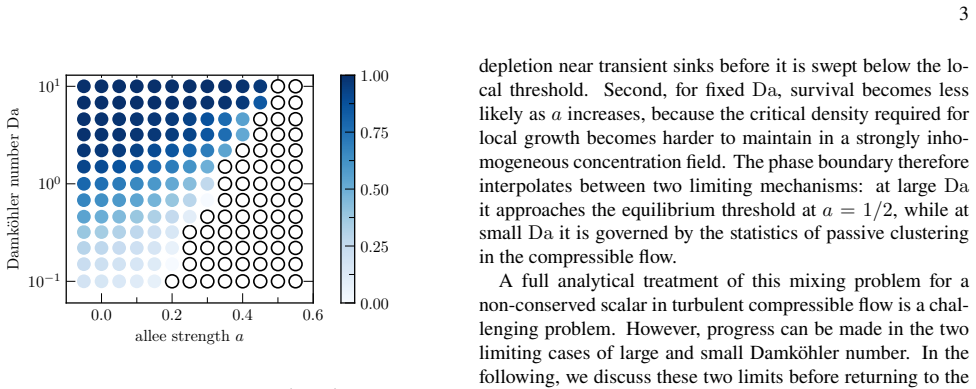
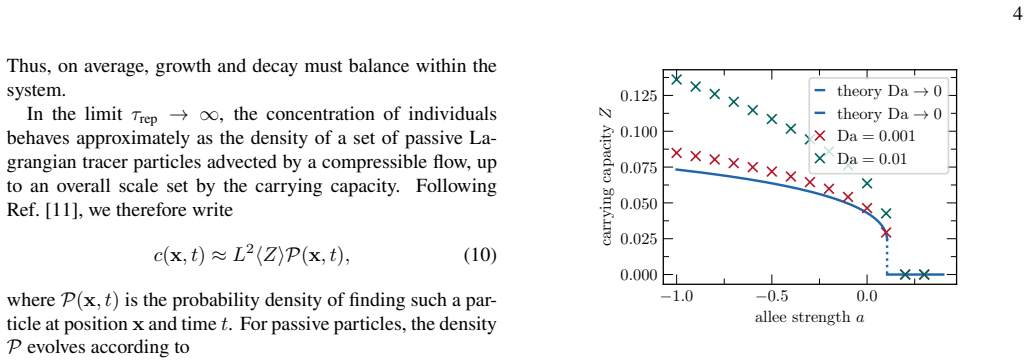
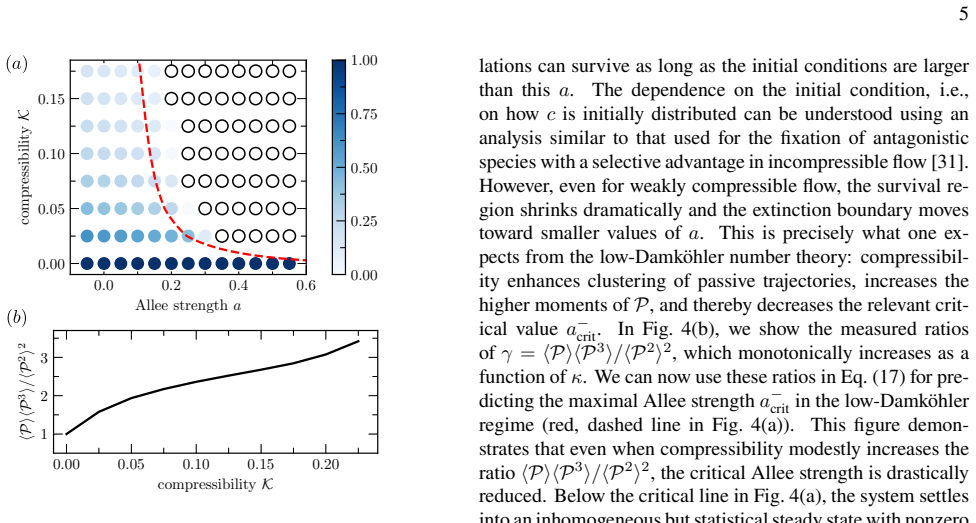
Microbes in marine environments are often confined to thin near-surface layers while being advected by turbulent flows. Because such constrained advection generates an effectively compressible flow, reproduction and transport interact in a nontrivial way. Here, we focus on populations whose growth is governed by an Allee effect and show that sinks and sources, generated by the compressible flow, have dramatic consequences for the survival of such species. We derive analytical expressions for the carrying capacity as a function of the Allee strength in the limit of small and large Damk\"ohler number, which measures the product of the large eddy turnover time and the organism growth rate. Numerical simulations reveal how these two limits connect. In the limit of small Damk\"ohler number, we find a maximal Allee strength, set by the statistics of the compressible flow, that leads to species extinction in fully developed turbulence.
Editorial analysis
A structured set of objections, weighed in public.
Referee Report
Summary. The manuscript examines microbial populations confined to thin near-surface layers and advected by turbulent flows that generate effectively compressible advection. It focuses on growth governed by an Allee effect and derives analytical expressions for carrying capacity versus Allee strength in the small- and large-Damköhler-number limits; numerical simulations connect the limits. The headline result is a maximal Allee strength, set by the compressible-flow statistics, that produces extinction in fully developed turbulence at small Damköhler number.
Significance. If the effective-compressibility mapping is rigorously justified and the analytical expressions are verified, the work would link flow statistics directly to population-extinction thresholds for Allee-affected species in marine turbulence. The provision of closed-form limits in both Damköhler regimes together with bridging simulations is a constructive feature. The significance remains conditional on addressing the physical derivation of the effective divergence from three-dimensional incompressible flow.
major comments (1)
- [Abstract] Abstract and introduction: the central claim that flow statistics set a maximal Allee strength leading to extinction at small Damköhler number rests on the premise that thin-layer confinement converts incompressible 3D turbulence into an effectively compressible 2D flow whose divergence produces persistent sinks. No derivation of the effective divergence operator from the 3D Navier-Stokes equations under a thin-layer constraint is supplied, nor is the scaling of compressibility measures (e.g., variance of ∇·u) with layer thickness or Reynolds number quantified. This step is load-bearing for the mapping from flow statistics to the extinction threshold.
Simulated Author's Rebuttal
We thank the referee for their careful and constructive review. The major comment raises an important point about the physical foundation of the effective compressibility used in the model. We address it directly below and will revise the manuscript accordingly.
read point-by-point responses
-
Referee: [Abstract] Abstract and introduction: the central claim that flow statistics set a maximal Allee strength leading to extinction at small Damköhler number rests on the premise that thin-layer confinement converts incompressible 3D turbulence into an effectively compressible 2D flow whose divergence produces persistent sinks. No derivation of the effective divergence operator from the 3D Navier-Stokes equations under a thin-layer constraint is supplied, nor is the scaling of compressibility measures (e.g., variance of ∇·u) with layer thickness or Reynolds number quantified. This step is load-bearing for the mapping from flow statistics to the extinction threshold.
Authors: We agree that the manuscript would benefit from an explicit outline of how the effective 2D divergence arises from 3D incompressible flow under thin-layer confinement. This mapping is standard in the literature on near-surface marine turbulence but is not re-derived in the present work, which instead takes the resulting compressible advection as its starting point and focuses on the population dynamics. In revision we will add a concise appendix that sketches the thin-layer projection leading to a nonzero divergence, together with the leading-order scaling of the divergence variance with layer thickness. The Reynolds-number dependence is more subtle and will be noted as a function of the specific turbulence statistics; it does not affect the analytic carrying-capacity expressions, which are written in terms of the measured flow divergence. These additions directly address the load-bearing character of the mapping while leaving the core results unchanged. revision: yes
Circularity Check
No circularity: derivations depend on external flow statistics and Damköhler number
full rationale
The paper derives analytical expressions for carrying capacity in limits of small/large Damköhler number and identifies a maximal Allee strength from compressible flow statistics leading to extinction. These steps use the assumed effective compressibility and external turbulence statistics as inputs without reducing predictions to fitted parameters by construction or relying on self-citation chains for the central claims. The thin-layer premise is an explicit modeling assumption rather than a derived result that loops back on itself. No self-definitional, fitted-input, or uniqueness-imported patterns appear in the provided abstract or described results.
Axiom & Free-Parameter Ledger
axioms (1)
- domain assumption Constrained advection in thin near-surface layers generates an effectively compressible flow
Reference graph
Works this paper leans on
-
[1]
S. A. Thorpe,The Turbulent Ocean(Cambridge University Press, 2005)
2005
-
[2]
G. K. Vallis,Atmospheric and Oceanic Fluid Dynamics: Fun- damentals and Large-Scale Circulation(Cambridge University Press, 2017)
2017
-
[3]
R. W. Eppley, Fishery Bulletin70, 1063 (1972)
1972
-
[4]
d’Ovidio, S
F. d’Ovidio, S. De Monte, S. Alvain, Y. Dandonneau, and M. Lévy, Proceedings of the National Academy of Sciences 107, 18366–18370 (2010)
2010
-
[5]
J.J.Cullen,CanadianJournalofFisheriesandAquaticSciences 39, 791–803 (1982)
1982
-
[6]
J. J. Cullen, Annual Review of Marine Science7, 207–239 (2015)
2015
-
[7]
B. Eckhardt and J. Schumacher, Physical Review E64, 10.1103/physreve.64.016314 (2001)
-
[8]
J.R.CressmanandW.I.Goldburg,JournalofStatisticalPhysics 113, 875–883 (2003)
2003
-
[9]
M.DePietro,M.A.T.vanHinsberg,L.Biferale,H.J.H.Clercx, P.Perlekar,andF.Toschi,PhysicalReviewE91,10.1103/phys- reve.91.053002 (2015)
-
[10]
Benzi and D
R. Benzi and D. R. Nelson, Physica D: Nonlinear Phenomena 238, 2003–2015 (2009)
2003
-
[11]
P. Perlekar, R. Benzi, D. R. Nelson, and F. Toschi, Physical Review Letters105, 10.1103/physrevlett.105.144501 (2010)
-
[12]
Benzi, D
R. Benzi, D. R. Nelson, S. Shankar, F. Toschi, and X. Zhu, Reports on Progress in Physics85, 096601 (2022)
2022
-
[13]
W. C. Allee, American Journal of Sociology37, 386–398 (1931)
1931
-
[14]
P. A. Stephens, W. J. Sutherland, and R. P. Freckleton, Oikos 87, 185 (1999)
1999
-
[15]
Courchamp, L
F. Courchamp, L. Berec, and J. Gascoigne,Allee Effects in Ecology and Conservation(Oxford University Press, London, England, 2009)
2009
-
[16]
J.Gore,H.Youk,andA.vanOudenaarden,Nature459,253–256 (2009)
2009
-
[17]
R.B.Kaul,A.M.Kramer,F.C.Dobbs,andJ.M.Drake,Biology Letters12, 20160070 (2016)
2016
-
[18]
M. Coolahan and K. E. Whalen, Communications Biology8, 10.1038/s42003-025-07608-9 (2025)
-
[19]
L.Prigent,J.Quéré,M.Plus,andM.LeGac,ISMECommuni- cations5, 10.1093/ismeco/ycae169 (2025)
-
[20]
P.C.HohenbergandB.I.Halperin,ReviewsofModernPhysics 49, 435–479 (1977)
1977
-
[21]
S. M. Allen and J. W. Cahn, Acta Metallurgica27, 1085–1095 (1979)
1979
-
[22]
L.C.Evans,H.M.Soner,andP.E.Souganidis,Communications on Pure and Applied Mathematics45, 1097–1123 (1992)
1992
-
[23]
Y. Qi, Y. Li, and F. Coletti, Journal of Fluid Mechanics1007, 10.1017/jfm.2025.139 (2025)
-
[24]
Mahoney, D
J. Mahoney, D. Bargteil, M. Kingsbury, K. Mitchell, and T. Solomon, EPL (Europhysics Letters)98, 44005 (2012)
2012
-
[25]
P.ClavinandG.Searby,CombustionWavesandFrontsinFlows: Flames,Shocks,Detonations,AblationFrontsandExplosionof Stars(Cambridge University Press, 2016)
2016
-
[26]
Balkovsky, G
E. Balkovsky, G. Falkovich, and A. Fouxon, Physical Review Letters86, 2790–2793 (2001)
2001
-
[27]
Falkovich, K
G. Falkovich, K. Gawedzki, and M. Vergassola, Reviews of Modern Physics73, 913–975 (2001)
2001
-
[28]
As can be seen using|⟨XY⟩|2 ≤ ⟨X 2⟩⟨Y 2⟩withX=P 1/2 andY=P 3/2, andP>0, everywhere
-
[29]
G. Boffetta, J. Davoudi, B. Eckhardt, and J. Schumacher, Phys- ical Review Letters93, 10.1103/physrevlett.93.134501 (2004)
-
[30]
Perlekar, R
P. Perlekar, R. Benzi, D. R. Nelson, and F. Toschi, Journal of Turbulence14, 161–169 (2013)
2013
-
[31]
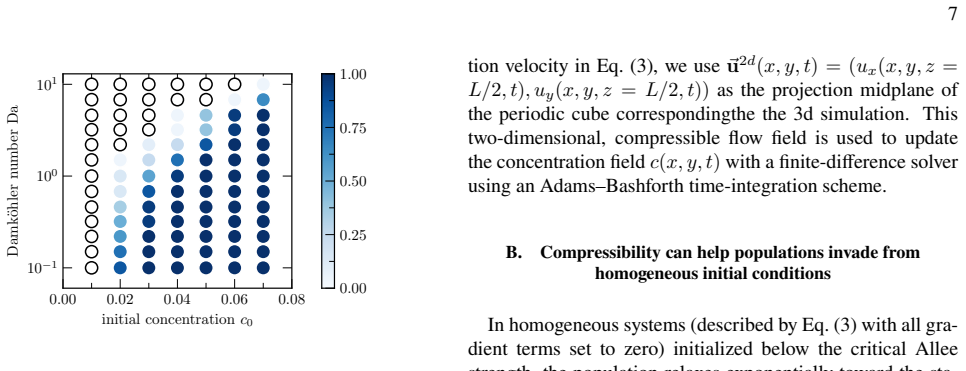
J. Bauermann, R. Benzi, D. R. Nelson, S. Shankar, and F. Toschi, Proceedings of the National Academy of Sciences 122, 10.1073/pnas.2417075122 (2025). 7 0.00 0.02 0.04 0.06 0.08 initial concentration c0 10−1 100 101 Damk¨ ohler number Da 0.00 0.25 0.50 0.75 1.00 Figure5.Invasionprobabilityforhomogeneousinitialconditions below the critical Allee strength, a...
discussion (0)
Sign in with ORCID, Apple, or X to comment. Anyone can read and Pith papers without signing in.