NullFlow: One-Step Generative Reconstruction
Pith reviewed 2026-06-26 10:34 UTC · model grok-4.3
The pith
NullFlow learns the average velocity of a flow confined to a measurement-consistent subspace to produce one-step posterior samples.
A machine-rendered reading of the paper's core claim, the machinery that carries it, and where it could break.
Core claim
By confining the generative flow to a measurement-consistent subspace, NullFlow ensures the flow never leaves this subspace and thus requires no separate data-fidelity corrections. Sampling is performed in a single network evaluation by learning the flow's average velocity. The paper proves that this yields a training objective whose global minimizer is a one-step posterior sampler and demonstrates that it matches state-of-the-art diffusion solvers on image inpainting.
What carries the argument
The measurement-consistent subspace confinement of the generative flow whose average velocity is learned to obtain the one-step sampler.
If this is right
- The flow stays within the subspace by construction so no data-fidelity corrections are needed.
- Sampling requires only one network evaluation rather than step-by-step integration.
- The learned model is the global minimizer of the objective and corresponds to the posterior sampler.
- Performance on image inpainting equals that of current diffusion methods but with far lower inference cost.
Where Pith is reading between the lines
- The method may apply to other inverse problems if an appropriate measurement-consistent subspace can be maintained.
- Real-time generative reconstruction becomes feasible if the one-step property holds across tasks.
- Training objectives based on average velocity could simplify other flow-matching approaches if the confinement idea generalizes.
Load-bearing premise
A measurement-consistent subspace can be defined and maintained throughout the flow such that the average velocity learned inside it recovers the true posterior sampler as its global minimizer.
What would settle it
Running NullFlow on a synthetic dataset where the true posterior distribution is analytically known and checking whether the one-step samples match that distribution in distribution distance.
Figures


read the original abstract
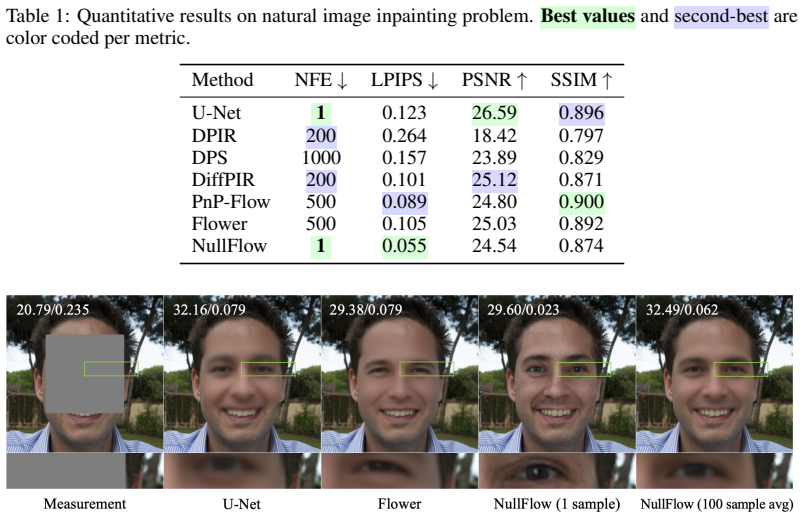
We propose NullFlow, a principled framework for one-step generative image reconstruction. Our key idea is to confine the generative flow to a measurement-consistent subspace. Because the flow never leaves this subspace, NullFlow needs no separate data-fidelity corrections, unlike existing solvers. NullFlow samples in a single network evaluation by learning the flow's average velocity, avoiding the step-by-step integration of traditional flow matching methods. We prove that the average velocity of this constrained flow yields a training objective whose global minimizer is a one-step posterior sampler. We show on image inpainting that NullFlow matches state-of-the-art diffusion solvers while cutting inference from hundreds of network evaluations to one.
Editorial analysis
A structured set of objections, weighed in public.
Referee Report
Summary. The manuscript proposes NullFlow, a framework for one-step generative image reconstruction by confining the generative flow to a measurement-consistent subspace. Because the flow never leaves this subspace, no separate data-fidelity corrections are required. Sampling occurs in a single network evaluation by learning the flow's average velocity. The authors prove that this yields a training objective whose global minimizer is a one-step posterior sampler. Experiments on image inpainting show performance matching state-of-the-art diffusion solvers while reducing inference from hundreds of evaluations to one.
Significance. If the central theoretical claim holds under the stated assumptions, the work offers a principled route to one-step generative reconstruction that avoids post-hoc corrections and dramatically lowers inference cost. This would be a meaningful contribution to efficient solvers for inverse problems in computer vision. The explicit proof of a global minimizer for the average-velocity objective is a strength if the derivation is complete and the subspace invariance transfers to the learned model.
major comments (2)
- [Abstract] Abstract, paragraph 3: The proof that the average velocity inside the constrained flow produces a training objective with the true one-step posterior sampler as global minimizer rests on the assumption that a measurement-consistent subspace can be defined and exactly maintained throughout the flow. The derivation appears to be carried out under the ideal continuous case; it is not shown whether the property survives neural-network approximation of the velocity field or discretization to a single step.
- [Theory / proof section] The manuscript states that 'the flow never leaves this subspace,' but any practical parameterization will only approximately preserve invariance. This gap is load-bearing for the global-minimizer claim and requires either an explicit error bound or a revised statement of what the learned discrete map actually minimizes.
minor comments (1)
- [Abstract] The abstract is concise but would benefit from one sentence clarifying the measurement model (e.g., inpainting mask) used to define the subspace.
Simulated Author's Rebuttal
We thank the referee for the constructive comments. We address each major comment below and propose targeted revisions to clarify the scope of the theoretical claims.
read point-by-point responses
-
Referee: [Abstract] Abstract, paragraph 3: The proof that the average velocity inside the constrained flow produces a training objective with the true one-step posterior sampler as global minimizer rests on the assumption that a measurement-consistent subspace can be defined and exactly maintained throughout the flow. The derivation appears to be carried out under the ideal continuous case; it is not shown whether the property survives neural-network approximation of the velocity field or discretization to a single step.
Authors: We agree that the global-minimizer result is derived under the idealized continuous-time setting with exact subspace invariance. The manuscript claims this property for the average-velocity objective when those assumptions hold. In the revision we will add an explicit statement of the assumptions in the abstract and theory section, together with a short discussion noting that neural-network approximation and single-step discretization introduce errors not bounded by the current analysis. This is presented as a clarification of scope rather than an alteration of the core continuous-time result. revision: partial
-
Referee: [Theory / proof section] The manuscript states that 'the flow never leaves this subspace,' but any practical parameterization will only approximately preserve invariance. This gap is load-bearing for the global-minimizer claim and requires either an explicit error bound or a revised statement of what the learned discrete map actually minimizes.
Authors: We acknowledge that any practical neural parameterization yields only approximate invariance. Deriving a rigorous error bound would require additional analysis outside the present scope. Instead, we will revise the relevant statements in the theory section to indicate that the learned discrete map approximately minimizes the average-velocity objective when subspace invariance holds only approximately. This revised wording is consistent with the empirical performance reported in the experiments. revision: yes
Circularity Check
No significant circularity; derivation is a self-contained proof under explicit assumptions
full rationale
The paper's strongest claim is a mathematical proof that the average velocity of the constrained flow (confined to a measurement-consistent subspace) produces a training objective whose global minimizer is a one-step posterior sampler. This follows directly from the definitions of the subspace and the flow's invariance property as stated in the abstract, without any reduction to a fitted parameter renamed as prediction, self-citation load-bearing the central result, or an ansatz smuggled in. The assumption that the flow never leaves the subspace is presented explicitly as part of the framework rather than derived from the result itself. No equations or steps in the provided text exhibit the specific reduction required to flag circularity under the enumerated patterns. The derivation therefore remains self-contained against external benchmarks.
Axiom & Free-Parameter Ledger
axioms (1)
- domain assumption A measurement-consistent subspace can be defined such that the generative flow remains inside it for the entire trajectory.
invented entities (1)
-
measurement-consistent subspace
no independent evidence
Reference graph
Works this paper leans on
-
[1]
Image super-resolution using deep convolutional networks,
Chao Dong, Chen Change Loy, Kaiming He, and Xiaoou Tang, “Image super-resolution using deep convolutional networks,”IEEE Trans. Pattern Anal. Mach. Intell., vol. 38, no. 2, pp. 295–307, 2016
2016
-
[2]
Beyond a Gaussian denoiser: Residual learning of deep CNN for image denoising,
Kai Zhang, Wangmeng Zuo, Yunjin Chen, Deyu Meng, and Lei Zhang, “Beyond a Gaussian denoiser: Residual learning of deep CNN for image denoising,”IEEE Trans. Image Proc., vol. 26, no. 7, pp. 3142–3155, 2017
2017
-
[3]
Deep convolutional neural network for inverse problems in imaging,
Kyong Hwan Jin, Michael T. McCann, Emmanuel Froustey, and Michael Unser, “Deep convolutional neural network for inverse problems in imaging,”IEEE Trans. Image Proc., vol. 26, no. 9, pp. 4509– 4522, 2017
2017
-
[4]
Deep null space learning for inverse problems: convergence analysis and rates,
Johannes Schwab, Stephan Antholzer, and Markus Haltmeier, “Deep null space learning for inverse problems: convergence analysis and rates,”Inverse Problems, vol. 35, no. 2, pp. 025008, 2019
2019
-
[5]
Deep decomposition learning for inverse imaging problems,
Dongdong Chen and Mike E. Davies, “Deep decomposition learning for inverse imaging problems,” in Proc. Eur. Conf. Comput. Vis. (ECCV), 2020, pp. 510–526
2020
-
[6]
Provable convergence of plug-and-play priors with MMSE denoisers,
X. Xu, Y . Sun, J. Liu, B. Wohlberg, and U. S. Kamilov, “Provable convergence of plug-and-play priors with MMSE denoisers,”IEEE Signal Process. Letters, vol. 27, pp. 1280–1284, 2020
2020
-
[7]
Plug-and-play image restoration with deep denoiser prior,
Kai Zhang, Yawei Li, Wangmeng Zuo, Lei Zhang, Luc Van Gool, and Radu Timofte, “Plug-and-play image restoration with deep denoiser prior,”Proc. CVPR, vol. 44, no. 10, pp. 6360–6376, 2021
2021
-
[8]
Plug-and-play image restoration with stochastic denoising regularization,
Marien Renaud, Jean Prost, Arthur Leclaire, and Nicolas Papadakis, “Plug-and-play image restoration with stochastic denoising regularization,” inProceedings of the 41st International Conference on Machine Learning, 2024
2024
-
[9]
Denoising diffusion probabilistic models,
Jonathan Ho, Ajay Jain, and Pieter Abbeel, “Denoising diffusion probabilistic models,”Proc. NeurIPS, vol. 33, pp. 6840–6851, 2020
2020
-
[10]
High- resolution image synthesis with latent diffusion models,
Robin Rombach, Andreas Blattmann, Dominik Lorenz, Patrick Esser, and Björn Ommer, “High- resolution image synthesis with latent diffusion models,” inProc. CVPR, 2022, pp. 10684–10695
2022
-
[11]
Flow matching for generative modeling,
Yaron Lipman, Ricky TQ Chen, Heli Ben-Hamu, Maximilian Nickel, and Matt Le, “Flow matching for generative modeling,”Proc. ICLR, 2023
2023
-
[12]
Flow straight and fast: Learning to generate and transfer data with rectified flow,
Xingchao Liu, Chengyue Gong, and Qiang Liu, “Flow straight and fast: Learning to generate and transfer data with rectified flow,”Proc. ICLR, 2023
2023
-
[13]
Building Normalizing Flows with Stochastic Interpolants,
Michael Albergo and Eric Vanden-Eijnden, “Building Normalizing Flows with Stochastic Interpolants,” inProc. ICLR, 2023
2023
-
[14]
Stochastic Interpolants: A Unifying Framework for Flows and Diffusions,
Michael Albergo, Nicholas M Boffi, and Eric Vanden-Eijnden, “Stochastic Interpolants: A Unifying Framework for Flows and Diffusions,”J. Mach. Learn. Res., vol. 26, no. 209, pp. 1–80, 2025
2025
-
[15]
Denoising diffusion restoration mod- els,
Bahjat Kawar, Michael Elad, Stefano Ermon, and Jiaming Song, “Denoising diffusion restoration mod- els,” inProc. Adv. Neural Inf. Process. Syst., 2022
2022
-
[16]
Diffusion posterior sampling for general noisy inverse problems,
Hyungjin Chung, Jeongsol Kim, Michael Thompson Mccann, Marc Louis Klasky, and Jong Chul Ye, “Diffusion posterior sampling for general noisy inverse problems,” inProc. ICLR, 2023
2023
-
[17]
DOLCE: A model-based probabilistic diffusion framework for limited-angle CT reconstruction,
Jiaming Liu, Rushil Anirudh, Jayaraman J Thiagarajan, Stewart He, K Aditya Mohan, Ulugbek S Kamilov, and Hyojin Kim, “DOLCE: A model-based probabilistic diffusion framework for limited-angle CT reconstruction,” inProc. ECCV, 2023, pp. 10498–10508. 6
2023
-
[18]
Stochastic Interpolants with Data-Dependent Couplings,
Michael Samuel Albergo, Mark Goldstein, Nicholas Matthew Boffi, Rajesh Ranganath, and Eric Vanden- Eijnden, “Stochastic Interpolants with Data-Dependent Couplings,” inProc. ICML, 2024
2024
-
[19]
Plug-and-play methods for integrating physical and learned models in computational imaging,
U. S. Kamilov, C. A. Bouman, G. T. Buzzard, and B. Wohlberg, “Plug-and-play methods for integrating physical and learned models in computational imaging,”IEEE Signal Process Mag., vol. 40, no. 1, pp. 85–97, Jan. 2023
2023
-
[20]
A Survey on Diffusion Models for Inverse Problems
Giannis Daras, Hyungjin Chung, Chieh-Hsin Lai, Yuki Mitsufuji, Jong Chul Ye, Peyman Milanfar, Alexandros G. Dimakis, and Mauricio Delbracio, “A survey on diffusion models for inverse problems,” arXiv:2410.00083, 2024
work page internal anchor Pith review Pith/arXiv arXiv 2024
-
[21]
Zero-shot image restoration using denoising diffusion null- space model,
Yinhuai Wang, Jiwen Yu, and Jian Zhang, “Zero-shot image restoration using denoising diffusion null- space model,”Proc. ICLR, 2023
2023
-
[22]
Flowdps : Flow-driven posterior sampling for inverse problems,
Jeongsol Kim, Bryan Sangwoo Kim, and Jong Chul Ye, “Flowdps : Flow-driven posterior sampling for inverse problems,” inProc. ICCV, October 2025, pp. 12328–12337
2025
-
[23]
Flower: A Flow-Matching Solver for Inverse Problems,
Mehrsa Pourya, Bassam El Rawas, and Michael Unser, “Flower: A Flow-Matching Solver for Inverse Problems,”Proc. ICLR, 2026
2026
-
[24]
Pnp-flow: Plug-and-play image restoration with flow matching,
Ségolène Tiffany Martin, Anne Gagneux, Paul Hagemann, and Gabriele Steidl, “Pnp-flow: Plug-and-play image restoration with flow matching,” inProc. ICLR, 2025
2025
-
[25]
Flow matching on general geometries,
Ricky TQ Chen and Yaron Lipman, “Flow matching on general geometries,” inProc. ICLR, 2024, vol. 2024, pp. 47922–47945
2024
-
[26]
D-flow: Differen- tiating through flows for controlled generation,
Heli Ben-Hamu, Omri Puny, Itai Gat, Brian Karrer, Uriel Singer, and Yaron Lipman, “D-flow: Differen- tiating through flows for controlled generation,” inProc. ICLR, 2024, pp. 3462–3483
2024
-
[27]
Flow priors for linear inverse problems via iterative corrupted trajectory matching,
Yasi Zhang, Peiyu Yu, Yaxuan Zhu, Yingshan Chang, Feng Gao, Ying N Wu, and Oscar Leong, “Flow priors for linear inverse problems via iterative corrupted trajectory matching,”Proc. NeurIPS, vol. 37, pp. 57389–57417, 2024
2024
-
[28]
Training-free linear image inverses via flows,
Ashwini Pokle, Matthew J Muckley, Ricky TQ Chen, and Brian Karrer, “Training-free linear image inverses via flows,”TMLR, 2024
2024
-
[29]
Mean flows for one- step generative modeling,
Zhengyang Geng, Mingyang Deng, Xingjian Bai, J Zico Kolter, and Kaiming He, “Mean flows for one- step generative modeling,” inProc. NeurIPS, 2026
2026
-
[30]
Improved Mean Flows: On the Challenges of Fastforward Generative Models
Zhengyang Geng, Yiyang Lu, Zongze Wu, Eli Shechtman, J Zico Kolter, and Kaiming He, “Improved mean flows: On the challenges of fastforward generative models,”arXiv:2512.02012, 2025
work page internal anchor Pith review Pith/arXiv arXiv 2025
-
[31]
One-step Latent-free Image Generation with Pixel Mean Flows
Yiyang Lu, Susie Lu, Qiao Sun, Hanhong Zhao, Zhicheng Jiang, Xianbang Wang, Tianhong Li, Zhengyang Geng, and Kaiming He, “One-step latent-free image generation with pixel mean flows,” arXiv:2601.22158, 2026
work page internal anchor Pith review Pith/arXiv arXiv 2026
-
[32]
The unreasonable effectiveness of deep features as a perceptual metric,
Richard Zhang, Phillip Isola, Alexei A Efros, Eli Shechtman, and Oliver Wang, “The unreasonable effectiveness of deep features as a perceptual metric,” inProc. CVPR, 2018, pp. 586–595
2018
-
[33]
Convnext v2: Co-designing and scaling convnets with masked autoencoders,
Sanghyun Woo, Shoubhik Debnath, Ronghang Hu, Xinlei Chen, Zhuang Liu, In So Kweon, and Saining Xie, “Convnext v2: Co-designing and scaling convnets with masked autoencoders,” inProc. CVPR, 2023, pp. 16133–16142
2023
-
[34]
Mean flows for one-step generative modeling,
Zhengyang Geng, Mingyang Deng, Xingjian Bai, Zico Kolter, and Kaiming He, “Mean flows for one-step generative modeling,”Proc. NeurIPS, vol. 38, pp. 75460–75482, 2026. 7 Appendix Lemmas 1, 2, and 3 extend Theorems 1,2, and 3, respectively, of [11] to measurement-conditional probability paths and vector fields onM y. Building on this affine-subspace flow, P...
2026
discussion (0)
Sign in with ORCID, Apple, or X to comment. Anyone can read and Pith papers without signing in.