REVIEW 4 major objections 5 minor 53 references
SVFR: A Unified Framework for Generalized Video Face Restoration
T0 review · 4 major / 5 minor · reviewed 2026-08-10 · deepseek-v4-flash
Pith's one-line read A single diffusion model jointly trained on video face restoration, colorization, and inpainting outperforms task-specific state-of-the-art methods on each task on the VFHQ-test benchmark.
desk verdict Genuinely new multi-task framework for video face restoration, but the all-task SOTA claim overreaches because colorization and inpainting baselines are not task-specific; still worth peer review. read the letter →
The pith
A machine-rendered reading of the paper's core claim, the machinery that carries it, and where it could break.
The reading
What carries the argument
The framework adapts Stable Video Diffusion (SVD), a pretrained latent video diffusion model with temporal convolution and attention layers, into a multi-task restorer. Task identification is handled by a learned Task Embedding that maps a binary vector (which of the three tasks are active) and is added to the time embedding. The Unified Latent Regularization (ULR) is a contrastive loss applied to features from the UNet's middle block: features from different degradations of the same source video are pulled together and pushed apart from other videos, aligning task-specific representations in one latent space. A facial prior learning objective trains a landmark predictor on those same features with a Wing loss against 68 ground-truth landmarks, injecting facial structure priors. Self-referred refinement injects a reference frame's latent and identity features into generation, with 50% dropout during training, and at inference uses a previously generated frame as the reference for subsequent clips to stabilize long videos.
What would settle it
Apply SVFR and the baselines to a set of naturally degraded face videos, such as old film scans, CCTV captures, or compressed video-conference recordings, and compare restoration quality and temporal stability; if the advantage over GPEN or CodeFormer shrinks or reverses on this out-of-distribution data, the generalized-restoration claim is falsified.
Extended reading notes
Core claim
On its own terms, the paper establishes that blind face restoration, colorization, and inpainting are not three unrelated video problems but one generalized video face restoration problem whose subtasks reinforce each other. The evidence is a pilot study showing that pretraining on one subtask improves FID on the others, and a full comparison in which the unified SVFR model beats GPEN, CodeFormer, PGDiff, PGTFormer, and KEEP on PSNR, SSIM, LPIPS, identity similarity, VIDD, and FVD across all three tasks. The paper interprets this as demonstrating that shared feature learning across tasks, enforced by its Unified Latent Regularization, yields higher fidelity and better temporal coherence than any single-task training.
Load-bearing premise
The comparison assumes that artificially damaged test videos are a fair common test, even though the proposed model was trained on those same kinds of damage and some rivals were not; no genuinely damaged real-world footage is used.
Editorial extensions
If this is right
- A single trained SVFR model replaces three separate deployment pipelines for video face restoration, colorization, and inpainting.
- Each subtask's supervision improves the others, so a user only needs to collect data for one of the tasks to strengthen all three.
- Video-level metrics (VIDD, FVD) improve along with frame-level ones, showing that temporal stability is not sacrificed for quality in this framework.
- Because task prompts are binary vectors, extending the framework to an additional video restoration task is a matter of adding an embedding rather than redesigning the backbone.
Reading between the lines
- The reported advantage is measured only on VFHQ-test degraded with synthetic pipelines that match SVFR's own training degradations; real archival or surveillance footage could behave differently, so the practical superiority claim has not yet been tested outside the benchmark.
- If ULR's contrastive alignment is the main carrier of the multi-task gain, the same alignment could be applied to broader multi-task video restoration settings such as deblurring, super-resolution, and deraining, a testable extension the paper does not run.
- The task-prompt design raises the possibility of composing new tasks at inference, such as colorizing and inpainting a low-quality video simultaneously, but the paper trains only on single-task prompts, so its behavior on combined prompts is an open question.
Editorial analysis
A structured set of objections, weighed in public.
Referee Report
Summary. The paper proposes SVFR, a unified diffusion-based framework for generalized video face restoration (GVFR) that jointly addresses blind face restoration (BFR), colorization, and inpainting in video. Built on Stable Video Diffusion, SVFR introduces a learnable task embedding, a unified latent regularization (ULR) contrastive loss, a facial prior learning objective based on landmarks, and a self-referred refinement (SRR) inference strategy for temporal consistency. Experiments on the VFHQ-test dataset report improvements over image-based and video-based BFR baselines for all three tasks, with ablations showing gains from multi-task training, ULR, and facial prior learning. The paper also releases code and a video demo.
Significance. If the results hold, SVFR would demonstrate that multi-task diffusion training on BFR, colorization, and inpainting improves both restoration quality and temporal stability compared to training each task separately, potentially establishing a new paradigm for video face restoration. The paper's strengths include the release of code and demo, the use of a broad set of image- and video-level metrics (PSNR, SSIM, LPIPS, IDS, VIDD, FVD), and ablations that decompose the contributions of each proposed component. However, the headline claim of outperforming task-specific state-of-the-art methods on all three tasks is not fully supported because the colorization and inpainting comparisons use only image-level face-restoration baselines, and all evaluation is on synthetic degradations that closely match the training distribution.
major comments (4)
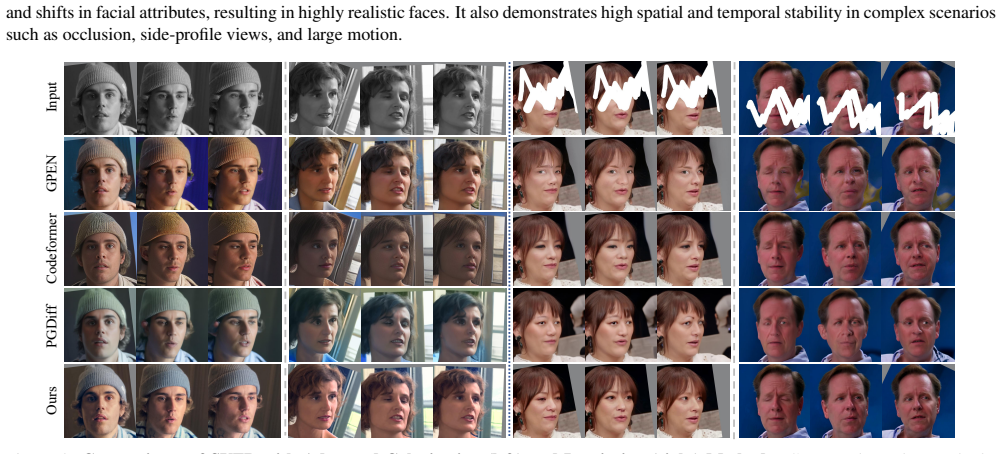
- [Sec. 5.2, Table 2] The central claim in the abstract and Sec. 5.2 that SVFR 'outperforms all methods on the GVFR tasks' is not established for colorization and inpainting. The only baselines reported for these two tasks are GPEN, CodeFormer, and PGDiff, which are image-level blind face restoration models not designed for grayscale or masked inputs. The paper notes that PGTFormer and KEEP lack trained models for colorization and inpainting but does not substitute any task-specific video colorization or video inpainting baselines. Without comparisons to dedicated methods (e.g., a video colorization model and a video inpainting model), the claim of state-of-the-art performance on these tasks overreaches the evidence. Please either add such baselines or narrow the scope of the claim to the BFR task.
- [Sec. 5.1, Sec. 5.2] All evaluation is conducted on the VFHQ-test dataset using synthetic degradations that match SVFR's training degradation pipeline: BFR uses random blur, noise, resizing, and compression; colorization uses grayscale conversion; inpainting uses brush-stroke masks. Because baselines are not trained on these exact degradation types, this protocol may advantage SVFR and limits the generality implied by 'generalized video face restoration.' The paper does not report results on real-world degraded videos, so it is unclear whether the measured gains transfer. Please add real-world evaluations or explicitly restrict the conclusions to the synthetic degradation setting.
- [Sec. 5.3, Table 3] All quantitative results in the paper are single-run with no error bars or statistical significance tests. Some of the reported improvements are numerically small (e.g., colorization LPIPS 0.274 vs 0.270; inpainting SSIM 0.898 vs 0.900), and without variance estimates it is not possible to judge whether the gains from multi-task training, ULR, or facial prior learning are reliable. Please report results over multiple seeds or with confidence intervals, at least for the main ablation table.
- [Sec. 3, Table 1] The pilot study that motivates the shared-representation hypothesis tests transfer learning (pretraining GPEN on one task and fine-tuning on another) rather than the joint multi-task training used in SVFR, and it reports only FID. This is weak evidence for the claim that the three tasks benefit each other within a single jointly trained framework. The ablation in Table 3 is more relevant, so the pilot study should either be strengthened (e.g., with joint training or additional metrics) or reframed as a preliminary observation.
minor comments (5)
- [Sec. 5.2] The subsection paragraph labels 'Qualitative analysis' and 'Quantitative analysis' appear to be reversed: the first paragraph discusses the numerical results in Table 2, while the second paragraph describes the visual comparisons in Figures 3 and 4.
- [Sec. 4.2, Eq. (3)] In the Wing loss definition, the constant C is said to ensure continuity but its value is not specified; please provide the explicit expression (e.g., C = w ln(1 + w/ε)) so that the loss is fully defined.
- [References] References [3] and [4] both cite the same Stable Video Diffusion paper, and references [7] and [8] both cite the same BasicVSR++ paper; please deduplicate or cross-reference these entries.
- [Sec. 4.1] The task-prompt example '[0, 1, 1]' indicates simultaneous colorization and inpainting, but the experiments appear to evaluate each task separately. If mixed degradation conditions are never used, please clarify whether multi-active task prompts occur during training and how the model behaves in that case.
- [Sec. 4.1, Eq. (2)] The notation in the contrastive loss denominator is ambiguous: it sums over all j, but standard InfoNCE separates the positive sample from the negatives. Please clarify the index ranges so that the positive and negative sets are explicitly defined.
Circularity Check
No significant circularity: the paper's claims are empirical benchmark results evaluated on external metrics, with no prediction that reduces by construction to a fitted input.
full rationale
The paper's central claims are that multi-task training on video BFR, colorization, and inpainting benefits each task, and that SVFR outperforms existing methods on VFHQ-test. These claims are supported by controlled ablations (Table 3) and comparisons against external baselines (Table 2), not by any equation in which the reported quantity is defined in terms of the result. The pilot study (Table 1) transfers pretrained GPEN weights between subtasks; this is an empirical probe, and the final framework's benefit is independently tested from a single-task SVFR baseline. The objective in Eq. (4) combines a standard noise-prediction loss, the ULR contrastive regularization, and a facial-landmark prior; none of these are fitted to the evaluation metrics. No load-bearing self-citation is used: references involving overlapping authors are contextual related work, and no uniqueness theorem or derivation is imported from the authors' prior papers. The main weakness is external validity and baseline selection for colorization/inpainting, where only image-based BFR models are compared; this is a correctness/fairness concern, not circularity. The claimed results are self-contained empirical findings that could be falsified by rerunning the benchmark.
Assumptions & free parameters
free parameters (2)
- lambda_1 (ULR weight) =
0.01
- lambda_2 (facial prior weight) =
0.1
assumptions (4)
- domain assumption Pretrained Stable Video Diffusion provides useful motion and spatial priors for video restoration.
- domain assumption The synthetic degradations used in training (blur, noise, resize, CRF compression, brush masks) are representative of the test degradations and of real-world video.
- ad hoc to paper The three tasks share a common intermediate representation in U-Net feature space, so the ULR contrastive alignment improves cross-task learning.
- domain assumption The pretrained landmark detector [16] gives reliable ground-truth landmarks for the facial prior loss.
Cite this review
Pith. "Pith review of SVFR: A Unified Framework for Generalized Video Face Restoration." pith.science (2026). https://pith.science/paper/AQQJ7HYS
@misc{pith2026250101235,
  author       = {Pith},
  title        = {Pith review of: SVFR: A Unified Framework for Generalized Video Face Restoration},
  year         = {2026},
  howpublished = {\url{https://pith.science/paper/AQQJ7HYS}},
  note         = {Machine review of arXiv:2501.01235}
}
read the original abstract
Face Restoration (FR) is a crucial area within image and video processing, focusing on reconstructing high-quality portraits from degraded inputs. Despite advancements in image FR, video FR remains relatively under-explored, primarily due to challenges related to temporal consistency, motion artifacts, and the limited availability of high-quality video data. Moreover, traditional face restoration typically prioritizes enhancing resolution and may not give as much consideration to related tasks such as facial colorization and inpainting. In this paper, we propose a novel approach for the Generalized Video Face Restoration (GVFR) task, which integrates video BFR, inpainting, and colorization tasks that we empirically show to benefit each other. We present a unified framework, termed as stable video face restoration (SVFR), which leverages the generative and motion priors of Stable Video Diffusion (SVD) and incorporates task-specific information through a unified face restoration framework. A learnable task embedding is introduced to enhance task identification. Meanwhile, a novel Unified Latent Regularization (ULR) is employed to encourage the shared feature representation learning among different subtasks. To further enhance the restoration quality and temporal stability, we introduce the facial prior learning and the self-referred refinement as auxiliary strategies used for both training and inference. The proposed framework effectively combines the complementary strengths of these tasks, enhancing temporal coherence and achieving superior restoration quality. This work advances the state-of-the-art in video FR and establishes a new paradigm for generalized video face restoration. Code and video demo are available at https://github.com/wangzhiyaoo/SVFR.git.
Figures


Figures from the paper (2 more)

Reference graph
Works this paper leans on
-
[43]
Human motion video genera- tion: A survey
Haiwei Xue, Xiangyang Luo, Zhanghao Hu, Xin Zhang, Xunzhi Xiang, Yuqin Dai, Jianzhuang Liu, Zhensong Zhang, Minglei Li, Jian Yang, et al. Human motion video genera- tion: A survey. Authorea Preprints, 2024. 1
work page 2024
-
[1]
Arniqa: Learning distortion mani- fold for image quality assessment
Lorenzo Agnolucci, Leonardo Galteri, Marco Bertini, and Alberto Del Bimbo. Arniqa: Learning distortion mani- fold for image quality assessment. In Proceedings of the IEEE/CVF Winter Conference on Applications of Computer Vision, 2024. 6
work page 2024
-
[2]
A morphable model for the synthesis of 3d faces
V olker Blanz and Thomas Vetter. A morphable model for the synthesis of 3d faces. In Proceedings of the 26th an- nual conference on Computer graphics and interactive tech- niques, 1999. 3
work page 1999
-
[4]
Stable video diffusion: Scaling latent video diffusion models to large datasets
Andreas Blattmann, Tim Dockhorn, Sumith Kulal, Daniel Mendelevitch, Maciej Kilian, Dominik Lorenz, Yam Levi, Zion English, Vikram V oleti, Adam Letts, et al. Stable video diffusion: Scaling latent video diffusion models to large datasets. arXiv preprint arXiv:2311.15127, 2023. 3
arXiv 2023
-
[5]
Align your latents: High-resolution video synthesis with la- tent diffusion models
Andreas Blattmann, Robin Rombach, Huan Ling, Tim Dock- horn, Seung Wook Kim, Sanja Fidler, and Karsten Kreis. Align your latents: High-resolution video synthesis with la- tent diffusion models. In Proceedings of the IEEE/CVF Con- ference on Computer Vision and Pattern Recognition, 2023. 2
work page 2023
-
[6]
GLEAN: Generative latent bank for large-factor image super-resolution
Kelvin CK Chan, Xintao Wang, Xiangyu Xu, Jinwei Gu, and Chen Change Loy. GLEAN: Generative latent bank for large-factor image super-resolution. In CVPR, 2021. 3
work page 2021
-
[7]
Basicvsr++: Improving video super- resolution with enhanced propagation and alignment
Kelvin CK Chan, Shangchen Zhou, Xiangyu Xu, and Chen Change Loy. Basicvsr++: Improving video super- resolution with enhanced propagation and alignment. InPro- ceedings of the IEEE/CVF conference on computer vision and pattern recognition, 2022. 1
work page 2022
-
[8]
Chan, Shangchen Zhou, Xiangyu Xu, and Chen Change Loy
Kelvin C.K. Chan, Shangchen Zhou, Xiangyu Xu, and Chen Change Loy. BasicVSR++: Improving video super- resolution with enhanced propagation and alignment. In IEEE Conference on Computer Vision and Pattern Recog- nition, 2022. 3
work page 2022
Show all 53 references
-
[9]
Videocrafter1: Open diffusion models for high-quality video generation
Haoxin Chen, Menghan Xia, Yingqing He, Yong Zhang, Xiaodong Cun, Shaoshu Yang, Jinbo Xing, Yaofang Liu, Qifeng Chen, Xintao Wang, et al. Videocrafter1: Open diffusion models for high-quality video generation. arXiv preprint arXiv:2310.19512, 2023. 2
-
[10]
Towards real-world video face restoration: A new benchmark
Ziyan Chen, Jingwen He, Xinqi Lin, Yu Qiao, and Chao Dong. Towards real-world video face restoration: A new benchmark. arXiv preprint arXiv:2404.19500, 2024. 6
2024 arXiv
-
[11]
V oxceleb2: Deep speaker recognition
Joon Son Chung, Arsha Nagrani, and Andrew Zisserman. V oxceleb2: Deep speaker recognition. arXiv preprint arXiv:1806.05622, 2018. 6
2018 arXiv
-
[12]
Kalman-inspired feature propagation for video face super- resolution
Ruicheng Feng, Chongyi Li, and Chen Change Loy. Kalman-inspired feature propagation for video face super- resolution. arXiv preprint arXiv:2408.05205, 2024. 3, 6
2024 arXiv
-
[13]
Wing loss for robust facial landmark localisation with convolutional neural networks
Zhen-Hua Feng, Josef Kittler, Muhammad Awais, Patrik Hu- ber, and Xiao-Jun Wu. Wing loss for robust facial landmark localisation with convolutional neural networks. InProceed- ings of the IEEE conference on computer vision and pattern recognition, 2018. 5
2018
-
[14]
Image processing using multi-code gan prior
Jinjin Gu, Yujun Shen, and Bolei Zhou. Image processing using multi-code gan prior. In CVPR, 2020. 3
2020
-
[15]
Vqfr: Blind face restoration with vector-quantized dictionary and paral- lel decoder
Yuchao Gu, Xintao Wang, Liangbin Xie, Chao Dong, Gen Li, Ying Shan, and Ming-Ming Cheng. Vqfr: Blind face restoration with vector-quantized dictionary and paral- lel decoder. In European Conference on Computer Vision . Springer, 2022. 3
2022
-
[16]
Stacked dense u-nets with dual transformers for robust face alignment
Jia Guo, Jiankang Deng, Niannan Xue, and Stefanos Zafeiriou. Stacked dense u-nets with dual transformers for robust face alignment. arXiv preprint arXiv:1812.01936 ,
-
[17]
Denoising dif- fusion probabilistic models
Jonathan Ho, Ajay Jain, and Pieter Abbeel. Denoising dif- fusion probabilistic models. Advances in neural information processing systems, 2020. 2
2020
-
[18]
Video dif- fusion models
Jonathan Ho, Tim Salimans, Alexey Gritsenko, William Chan, Mohammad Norouzi, and David J Fleet. Video dif- fusion models. Advances in Neural Information Processing Systems, 2022. 2
2022
-
[19]
Face super-resolution guided by 3d facial priors
Xiaobin Hu, Wenqi Ren, John LaMaster, Xiaochun Cao, Xi- aoming Li, Zechao Li, Bjoern Menze, and Wei Liu. Face super-resolution guided by 3d facial priors. In Computer Vision–ECCV 2020: 16th European Conference, Glasgow, UK, August 23–28, 2020, Proceedings, Part IV 16 , pages 7...
2020
-
[20]
Video interpolation with diffusion models
Siddhant Jain, Daniel Watson, Eric Tabellion, Ben Poole, Janne Kontkanen, et al. Video interpolation with diffusion models. In Proceedings of the IEEE/CVF Conference on Computer Vision and Pattern Recognition, 2024. 2
2024
-
[21]
A style-based generator architecture for generative adversarial networks
Tero Karras, Samuli Laine, and Timo Aila. A style-based generator architecture for generative adversarial networks. In CVPR, 2019. 3
2019
-
[22]
Analyzing and improving the image quality of stylegan
Tero Karras, Samuli Laine, Miika Aittala, Janne Hellsten, Jaakko Lehtinen, and Timo Aila. Analyzing and improving the image quality of stylegan. In CVPR, 2020. 3
2020
-
[23]
Faceformer: Scale-aware blind face restoration with transformers
Aijin Li, Gen Li, Lei Sun, and Xintao Wang. Faceformer: Scale-aware blind face restoration with transformers. arXiv preprint arXiv:2207.09790, 2022. 3
2022 arXiv
-
[24]
Blind face restora- tion via deep multi-scale component dictionaries
Xiaoming Li, Chaofeng Chen, Shangchen Zhou, Xianhui Lin, Wangmeng Zuo, and Lei Zhang. Blind face restora- tion via deep multi-scale component dictionaries. In ECCV,
-
[25]
Diff- bir: Towards blind image restoration with generative diffu- sion prior
Xinqi Lin, Jingwen He, Ziyan Chen, Zhaoyang Lyu, Bo Dai, Fanghua Yu, Wanli Ouyang, Yu Qiao, and Chao Dong. Diff- bir: Towards blind image restoration with generative diffu- sion prior. arXiv preprint arXiv:2308.15070, 2023. 3
2023 arXiv
-
[26]
Diffusion action segmenta- tion
Daochang Liu, Qiyue Li, Anh-Dung Dinh, Tingting Jiang, Mubarak Shah, and Chang Xu. Diffusion action segmenta- tion. In Proceedings of the IEEE/CVF International Confer- ence on Computer Vision, 2023. 3
2023
-
[27]
Pulse: Self-supervised photo upsam- pling via latent space exploration of generative models
Sachit Menon, Alexandru Damian, Shijia Hu, Nikhil Ravi, and Cynthia Rudin. Pulse: Self-supervised photo upsam- pling via latent space exploration of generative models. In CVPR, 2020. 3
2020
-
[28]
Exploiting deep genera- 9 tive prior for versatile image restoration and manipulation
Xingang Pan, Xiaohang Zhan, Bo Dai, Dahua Lin, Chen Change Loy, and Ping Luo. Exploiting deep genera- 9 tive prior for versatile image restoration and manipulation. TPAMI, 44(11):7474–7489, 2021. 3
2021
-
[29]
Learn- ing transferable visual models from natural language super- vision
Alec Radford, Jong Wook Kim, Chris Hallacy, Aditya Ramesh, Gabriel Goh, Sandhini Agarwal, Girish Sastry, Amanda Askell, Pamela Mishkin, Jack Clark, et al. Learn- ing transferable visual models from natural language super- vision. In International conference on machine learning...
2021
-
[30]
Unmasking your expression: Expression-conditioned gan for masked face inpainting
Sridhar Sola and Darshan Gera. Unmasking your expression: Expression-conditioned gan for masked face inpainting. In Proceedings of the IEEE/CVF conference on computer vi- sion and pattern recognition, pages 5908–5916, 2023. 2
2023
-
[31]
Fvd: A new metric for video generation
Thomas Unterthiner, Sjoerd van Steenkiste, Karol Kurach, Rapha¨el Marinier, Marcin Michalski, and Sylvain Gelly. Fvd: A new metric for video generation. 2019. 6
2019
-
[32]
EDVR: Video restoration with enhanced deformable convolutional networks
Xintao Wang, Kelvin CK Chan, Ke Yu, Chao Dong, and Chen Change Loy. EDVR: Video restoration with enhanced deformable convolutional networks. In CVPRW, 2019. 3
2019
-
[33]
To- wards real-world blind face restoration with generative facial prior
Xintao Wang, Yu Li, Honglun Zhang, and Ying Shan. To- wards real-world blind face restoration with generative facial prior. In CVPR, 2021. 2, 3
2021
-
[34]
Videocomposer: Compositional video synthesis with motion controllability
Xiang Wang, Hangjie Yuan, Shiwei Zhang, Dayou Chen, Ji- uniu Wang, Yingya Zhang, Yujun Shen, Deli Zhao, and Jin- gren Zhou. Videocomposer: Compositional video synthesis with motion controllability. Advances in Neural Information Processing Systems, 2024. 2
2024
-
[35]
Image quality assessment: from error visibility to structural similarity
Zhou Wang, Alan C Bovik, Hamid R Sheikh, and Eero P Si- moncelli. Image quality assessment: from error visibility to structural similarity. IEEE transactions on image processing,
-
[36]
Restoreformer: High-quality blind face restoration from undegraded key-value pairs
Zhouxia Wang, Jiawei Zhang, Runjian Chen, Wenping Wang, and Ping Luo. Restoreformer: High-quality blind face restoration from undegraded key-value pairs. In CVPR,
-
[37]
Dr2: Diffusion-based robust degradation remover for blind face restoration
Zhixin Wang, Ziying Zhang, Xiaoyun Zhang, Huangjie Zheng, Mingyuan Zhou, Ya Zhang, and Yanfeng Wang. Dr2: Diffusion-based robust degradation remover for blind face restoration. In Proceedings of the IEEE/CVF Conference on Computer Vision and Pattern Recognition , pages 1704– 1...
2023
-
[38]
Multi-task learning for natural language processing in the 2020s: Where are we go- ing? Pattern Recognition Letters, 136:120–126, 2020
Joseph Worsham and Jugal Kalita. Multi-task learning for natural language processing in the 2020s: Where are we go- ing? Pattern Recognition Letters, 136:120–126, 2020. 2
2020
-
[39]
Vfhq: A high-quality dataset and bench- mark for video face super-resolution
Liangbin Xie, Xintao Wang, Honglun Zhang, Chao Dong, and Ying Shan. Vfhq: A high-quality dataset and bench- mark for video face super-resolution. In Proceedings of the IEEE/CVF Conference on Computer Vision and Pattern Recognition, 2022. 6
2022
-
[40]
A denseunet generative adversarial network for near-infrared face image colorization
Jiangtao Xu, Kaige Lu, Xingping Shi, Shuzhen Qin, Han Wang, and Jianguo Ma. A denseunet generative adversarial network for near-infrared face image colorization. Signal Processing, 183:108007, 2021. 2
2021
-
[41]
Personalized face inpainting with dif- fusion models by parallel visual attention
Jianjin Xu, Saman Motamed, Praneetha Vaddamanu, Chen Henry Wu, Christian Haene, Jean-Charles Bazin, and Fernando De la Torre. Personalized face inpainting with dif- fusion models by parallel visual attention. In Proceedings of the IEEE/CVF Winter Conference on Applications of ...
2024
-
[42]
Beyond alignment: Blind video face restoration via parsing-guided temporal-coherent transformer
Kepeng Xu, Li Xu, Gang He, Wenxin Yu, and Yun- song Li. Beyond alignment: Blind video face restoration via parsing-guided temporal-coherent transformer. arXiv preprint arXiv:2404.13640, 2024. 3, 6
2024 arXiv
-
[44]
Pgdiff: Guiding diffusion models for versatile face restoration via partial guidance
Peiqing Yang, Shangchen Zhou, Qingyi Tao, and Chen Change Loy. Pgdiff: Guiding diffusion models for versatile face restoration via partial guidance. Advances in Neural Information Processing Systems, 2024. 6
2024
-
[45]
Gan prior embedded network for blind face restoration in the wild
Tao Yang, Peiran Ren, Xuansong Xie, and Lei Zhang. Gan prior embedded network for blind face restoration in the wild. In CVPR, 2021. 3, 6
2021
-
[46]
Diffir2vr- zero: Zero-shot video restoration with diffusion-based image restoration models
Chang-Han Yeh, Chin-Yang Lin, Zhixiang Wang, Chi-Wei Hsiao, Ting-Hsuan Chen, and Yu-Lun Liu. Diffir2vr- zero: Zero-shot video restoration with diffusion-based image restoration models. arXiv preprint arXiv:2407.01519, 2024. 2
2024
-
[47]
Celebv-text: A large-scale facial text-video dataset
Jianhui Yu, Hao Zhu, Liming Jiang, Chen Change Loy, Wei- dong Cai, and Wayne Wu. Celebv-text: A large-scale facial text-video dataset. In Proceedings of the IEEE/CVF Con- ference on Computer Vision and Pattern Recognition, 2023. 6
2023
-
[48]
Difface: Blind face restoration with diffused error contraction
Zongsheng Yue and Chen Change Loy. Difface: Blind face restoration with diffused error contraction. IEEE Transac- tions on Pattern Analysis and Machine Intelligence, 2024. 3
2024
-
[49]
The unreasonable effectiveness of deep features as a perceptual metric
Richard Zhang, Phillip Isola, Alexei A Efros, Eli Shecht- man, and Oliver Wang. The unreasonable effectiveness of deep features as a perceptual metric. In Proceedings of the IEEE conference on computer vision and pattern recogni- tion, 2018. 6
2018
-
[50]
Demesh- net: Blind face inpainting for deep meshface verification
Shu Zhang, Ran He, Zhenan Sun, and Tieniu Tan. Demesh- net: Blind face inpainting for deep meshface verification. IEEE Transactions on Information Forensics and Security , 13(3):637–647, 2017. 2
2017
-
[51]
I2vgen-xl: High-quality image-to-video synthesis via cascaded diffusion models
Shiwei Zhang, Jiayu Wang, Yingya Zhang, Kang Zhao, Hangjie Yuan, Zhiwu Qin, Xiang Wang, Deli Zhao, and Jingren Zhou. I2vgen-xl: High-quality image-to-video synthesis via cascaded diffusion models. arXiv preprint arXiv:2311.04145, 2023. 2
2023 arXiv
-
[52]
Towards robust blind face restora- tion with codebook lookup transformer
Shangchen Zhou, Kelvin Chan, Chongyi Li, and Chen Change Loy. Towards robust blind face restora- tion with codebook lookup transformer. Advances in Neural Information Processing Systems, 35:30599–30611, 2022. 2
2022
-
[53]
Chan, Chongyi Li, and Chen Change Loy
Shangchen Zhou, Kelvin C.K. Chan, Chongyi Li, and Chen Change Loy. Towards robust blind face restoration with codebook lookup transformer. In NeurIPS, 2022. 3, 6
2022
-
[54]
Blind face restora- tion via integrating face shape and generative priors
Feida Zhu, Junwei Zhu, Wenqing Chu, Xinyi Zhang, Xi- aozhong Ji, Chengjie Wang, and Ying Tai. Blind face restora- tion via integrating face shape and generative priors. In Pro- ceedings of the IEEE/CVF conference on computer vision and pattern recognition, 2022. 3 10
2022
Reviewed August 10, 2026 · model on record in the stance chip above.
Discussion (0). Continue with ORCID to comment.