Mid-infrared single-photon 3D imaging
Pith reviewed 2026-06-28 21:34 UTC · model grok-4.3
The pith
A mid-infrared time-of-flight system images 3D structure at single-photon sensitivity and femtosecond resolution.
A machine-rendered reading of the paper's core claim, the machinery that carries it, and where it could break.
Core claim
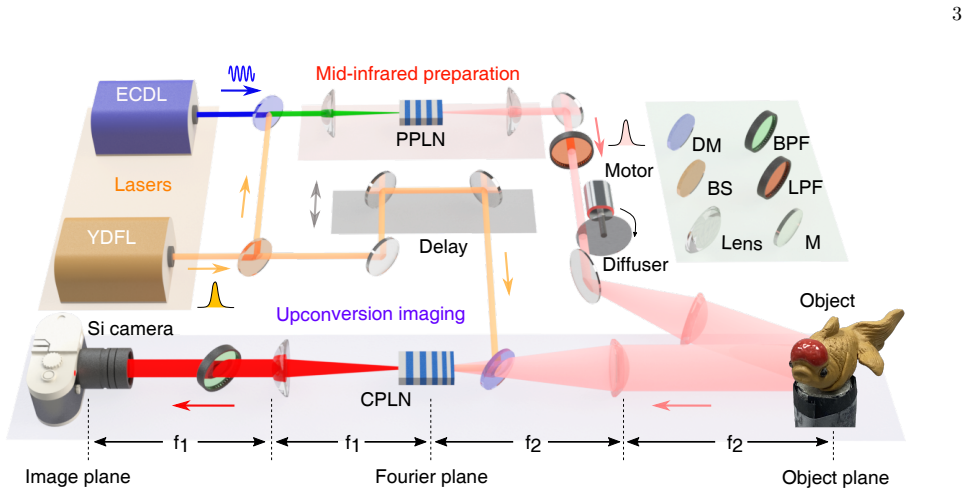
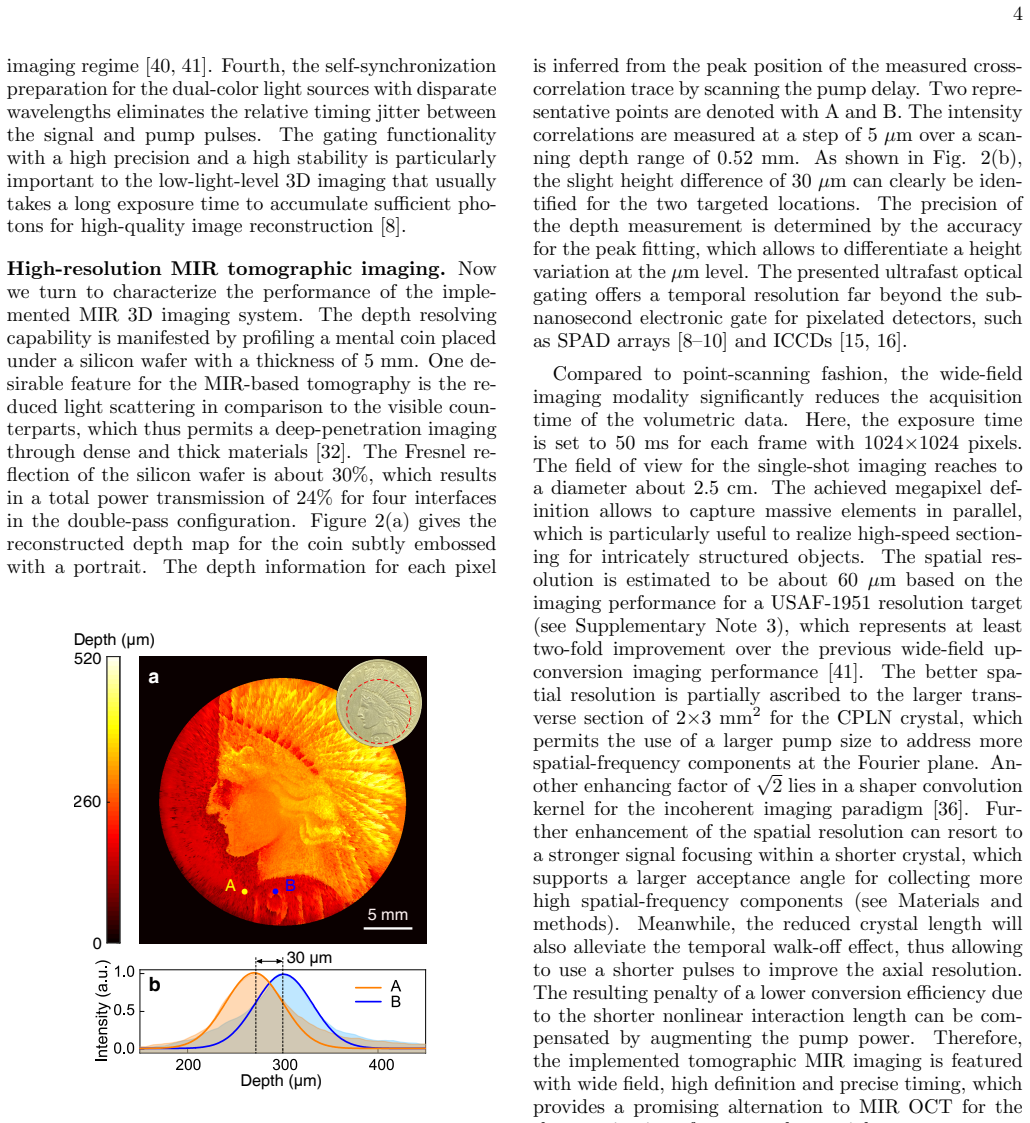
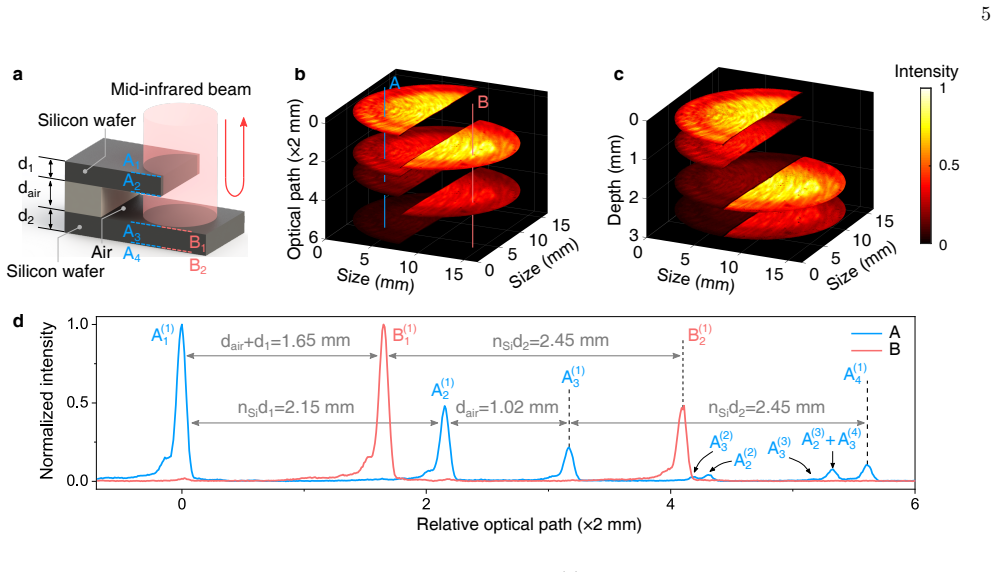
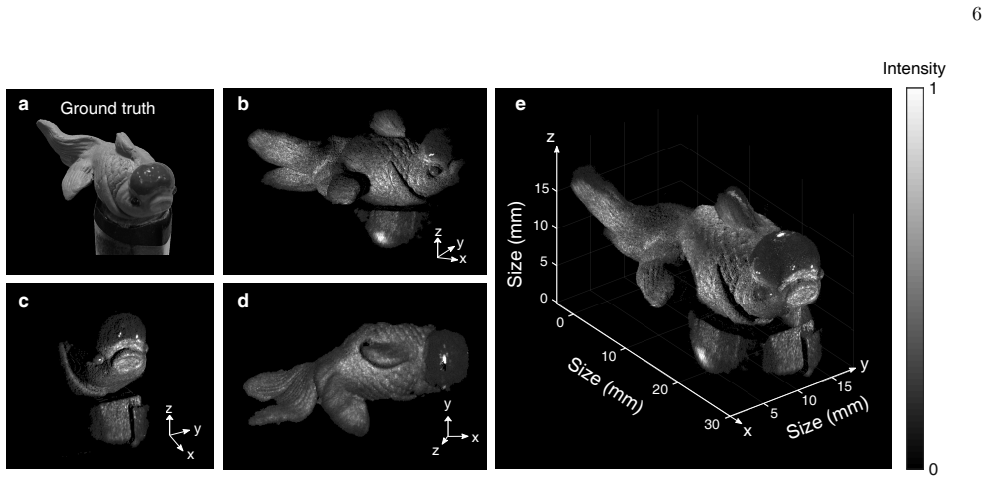
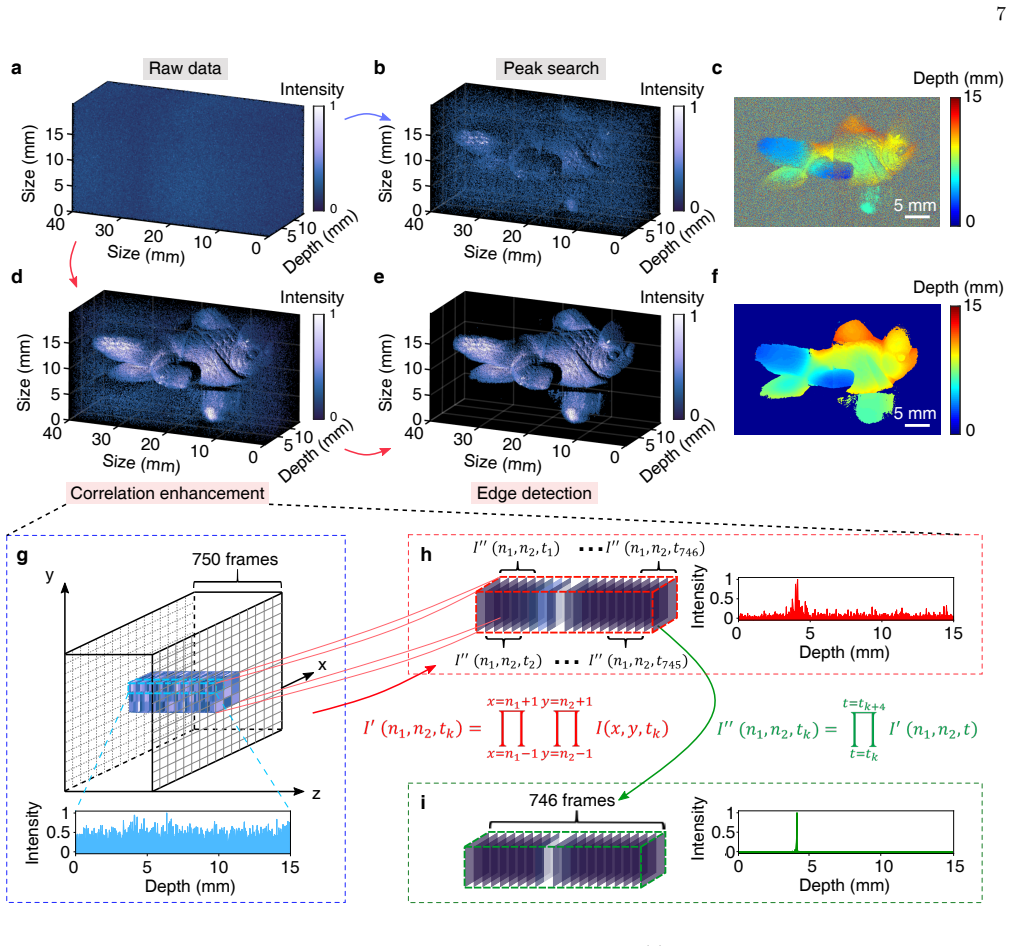
The authors implement a MIR time-of-flight imager in which delay-controlled ultrashort pump pulses perform nonlinear frequency upconversion on backscattered infrared photons, transferring both spatial and temporal information to a silicon camera; the resulting timestamped images, after numerical denoising based on spatiotemporal correlation, yield 3D reconstructions under photon-starving conditions.
What carries the argument
Nonlinear frequency upconversion gated by delay-controlled ultrashort pump pulses, which timestamps backscattered MIR photons and shifts them to a silicon camera.
If this is right
- The system retrieves both three-dimensional structure and reflectivity information in the mid-infrared at low light levels.
- It achieves high lateral and depth resolution while operating in a wide-field mode.
- A numerical denoiser based on spatiotemporal correlation recovers object profiles when detected flux falls below 0.05 photons per pixel per second.
- The approach provides single-photon sensitivity together with femtosecond timing resolution for MIR scenes.
Where Pith is reading between the lines
- The same upconversion-plus-camera architecture could be adapted for multi-wavelength operation by using multiple pump wavelengths in sequence.
- If the delay scanning were replaced by a single broadband pulse or compressive sensing, acquisition speed might increase enough for dynamic scenes.
- The correlation denoiser may transfer to other single-photon modalities such as near-infrared or visible time-of-flight imaging where sensor noise is the dominant limit.
- Integration with fiber delivery of the pump could allow endoscopic or remote MIR 3D sensing in confined environments.
Load-bearing premise
The upconversion step preserves the arrival time of each photon to femtosecond accuracy without adding jitter or loss that would prevent accurate 3D reconstruction.
What would settle it
Direct measurement of timing jitter larger than a few femtoseconds in the upconverted images, or failure to recover correct depth maps at the stated flux level of 0.05 photons per pixel per second, would falsify the central claim.
Figures
read the original abstract
Active mid-infrared (MIR) imagers capable of retrieving three-dimensional (3D) structure and reflectivity information are highly attractive in a wide range of biomedical and industrial applications. However, the infrared 3D imaging at low-light levels is still challenging due to the deficiency of sensitive and fast MIR sensors. Here we propose and implement a MIR time-of-flight imaging system that operates at single-photon sensitivity and femtosecond timing resolution. Specifically, back-scattered infrared photons from a scene are optically gated by delay-controlled ultrashort pump pulses through nonlinear frequency upconversion. The upconverted images with time stamps are then recorded by a silicon camera to facilitate the 3D reconstruction with high lateral and depth resolutions. Moreover, an effective numerical denoiser based on spatiotemporal correlation allows us to reveal the object profile and reflectivity under photon-starving conditions with a detected flux below 0.05 photons/pixel/second. The presented MIR 3D imager features with high detection sensitivity, precise timing resolution, and wide-field operation, which may open new possibilities in life and material sciences.
Editorial analysis
A structured set of objections, weighed in public.
Referee Report
Summary. The manuscript proposes and implements a mid-infrared time-of-flight 3D imaging system that uses nonlinear frequency upconversion with delay-controlled pump pulses to optically gate backscattered MIR photons, which are upconverted and recorded on a silicon camera. A spatiotemporal correlation-based denoiser is introduced to enable recovery of object profiles and reflectivity at detected fluxes below 0.05 photons/pixel/second, claiming single-photon sensitivity and femtosecond timing resolution for wide-field 3D reconstruction.
Significance. If the experimental validation holds with appropriate quantitative metrics, the work would provide a viable route to high-resolution MIR 3D imaging in photon-starved regimes by transferring the signal to silicon detectors via upconversion, addressing the longstanding shortage of sensitive fast MIR sensors. This could open applications in biomedical and industrial settings, with the wide-field operation and use of standard silicon cameras as practical strengths.
major comments (2)
- [Abstract] Abstract: the claim that the system 'operates at single-photon sensitivity and femtosecond timing resolution' is load-bearing for the central contribution, yet the text supplies no measured upconversion efficiency, no pump-signal overlap or temporal walk-off characterization, no jitter budget, and no ground-truth depth error on a calibrated target at the stated flux below 0.05 ph/pix/s.
- [Abstract] The description of the spatiotemporal denoiser: the assertion that it 'allows us to reveal the object profile and reflectivity under photon-starving conditions' lacks any reported validation metrics, error bars, exclusion criteria, or comparison against ground truth, so the reliability of the 3D reconstruction at the claimed flux cannot be assessed.
minor comments (1)
- [Abstract] Abstract: the sentence 'The presented MIR 3D imager features with high detection sensitivity...' contains awkward phrasing; 'features' should be replaced by 'is characterized by' or similar.
Simulated Author's Rebuttal
We thank the referee for their careful reading and constructive feedback. We address the two major comments point by point below. Where the comments correctly identify gaps in quantitative support, we agree to revise the manuscript.
read point-by-point responses
-
Referee: [Abstract] Abstract: the claim that the system 'operates at single-photon sensitivity and femtosecond timing resolution' is load-bearing for the central contribution, yet the text supplies no measured upconversion efficiency, no pump-signal overlap or temporal walk-off characterization, no jitter budget, and no ground-truth depth error on a calibrated target at the stated flux below 0.05 ph/pix/s.
Authors: We agree that the abstract would be strengthened by explicit quantitative backing for these claims. The current manuscript text does not supply the requested measured upconversion efficiency, overlap/walk-off data, jitter budget, or ground-truth depth error on a calibrated target at the stated flux. We will revise the manuscript to add these characterizations (from re-analysis of existing data where possible or additional measurements) and update the abstract to reference the key metrics and point to the relevant sections or figures. revision: yes
-
Referee: [Abstract] The description of the spatiotemporal denoiser: the assertion that it 'allows us to reveal the object profile and reflectivity under photon-starving conditions' lacks any reported validation metrics, error bars, exclusion criteria, or comparison against ground truth, so the reliability of the 3D reconstruction at the claimed flux cannot be assessed.
Authors: We agree that the denoiser description would benefit from quantitative validation. The manuscript illustrates the denoiser's effect via example reconstructions but does not report the requested metrics, error bars, exclusion criteria, or ground-truth comparisons. We will revise the manuscript to include these (e.g., PSNR/SSIM against higher-flux or known references, error bars on reflectivity, and any filtering criteria) and update the abstract accordingly. revision: yes
Circularity Check
No circularity: experimental hardware demonstration with no derivation chain
full rationale
The paper reports an experimental implementation of a MIR time-of-flight 3D imager using nonlinear frequency upconversion gated by delay-controlled pump pulses, followed by silicon-camera readout and a spatiotemporal denoiser. No equations, first-principles derivations, fitted parameters renamed as predictions, or self-citation load-bearing steps are present in the provided text. The result is grounded in physical hardware performance rather than any self-referential model or ansatz that reduces to its inputs by construction. This matches the default expectation for an experimental methods paper.
Axiom & Free-Parameter Ledger
Reference graph
Works this paper leans on
-
[1]
OCT systems based on single-photon nonlinear in- terferometry. Despite tremendous efforts, the presented imaging modality based on the OCT architecture faces the challenges that the total acquisition time is rather long due to the lateral raster scanning fashion. In this regard, wide-field operation based on a silicon camera is developed in the framework ...
1951
-
[2]
It is the megapixel and sensitive imaging capability that makes it possible to conduct a wide-field MIR tomographic analysis at the photon-starving regime
The resultant dark noise is measured to be about 8.7×10⁻⁴ electrons/pixel/second. It is the megapixel and sensitive imaging capability that makes it possible to conduct a wide-field MIR tomographic analysis at the photon-starving regime. As shown in Fig. 4(a), the test object is a ceramic goldfish with both geometric and re- flectivity complexity, which i...
-
[3]
Pears, N., Liu, Y. H. & Bunting, P.3D Imaging, Analysis and Applications.(London: Springer-Verlag, 2012)
2012
-
[4]
Li, Z.-P.et al.Single-photon computational 3D imaging at 45 km.Photonics Research8, 1532-1540 (2020)
2020
-
[5]
Sun, B.et al.3D computational imaging with single-pixel detectors.Science340, 844-847 (2013)
2013
-
[6]
Kirmani, A.et al.First-photon imaging.Science343, 58-61 (2014)
2014
-
[7]
S., Karpf, S
Jiang, Y. S., Karpf, S. & Jalali, B. Time-stretch LiDAR as a spectrally scanned time-of-flight ranging camera.Na- ture Photonics14, 14-18 (2020)
2020
-
[8]
Kim, G.et al.Metasurface-driven full-space structured light for three-dimensional imaging.Nature Communica- tions13, 5920 (2022)
2022
-
[9]
Siddiqui, M.et al.High-speed optical coherence tomogra- phy by circular interferometric ranging.Nature Photonics 12, 111-116 (2018)
2018
-
[10]
Gariepy, G.et al.Single-photon sensitive light-in-fight imaging.Nature Communications6, 6021 (2015)
2015
-
[11]
Shin, D.et al.Photon-efficient imaging with a single- photon camera.Nature Communications7, 12046 (2016)
2016
-
[12]
Morimoto, K.et al.Megapixel time-gated SPAD image sensor for 2D and 3D imaging applications.Optica7, 346-354 (2020)
2020
-
[13]
Zhao, Q.-Y.et al.Single-photon imager based on a su- perconducting nanowire delay line.Nature Photonics11, 247-251 (2017)
2017
-
[14]
Kong, L.et al.Noise-tolerant single-photon imaging with a superconducting nanowire camera.Optics Letters45, 6732-6735 (2020)
2020
-
[15]
Nature Communications3, 745 (2012)
Velten, A.et al.Recovering three-dimensional shape around a corner using ultrafast time-of-flight imaging. Nature Communications3, 745 (2012)
2012
-
[16]
Gao, L.et al.Single-shot compressed ultrafast photog- raphy at one hundred billion frames per second.Nature 516, 74-77 (2014)
2014
-
[17]
A.et al.Imaging with a small number of pho- tons
Morris, P. A.et al.Imaging with a small number of pho- tons. Imaging with a small number of photons.Nature Communications65913 (2015)
2015
-
[18]
& Wetzstein, G
Faccio, D., Velten, A. & Wetzstein, G. Non-line-of-sight imaging.Nature Reviews Physics2, 318-327 (2020)
2020
-
[19]
L.Laser-based Mid-infrared Sources and Applications.(Hoboken: John Wiley & Sons, Inc., 2020)
Vodopyanov, K. L.Laser-based Mid-infrared Sources and Applications.(Hoboken: John Wiley & Sons, Inc., 2020)
2020
-
[20]
J.et al.Laser-based mid-infrared reflectance imaging of biological tissues.Optics Express12, 208-219 (2004)
Guo, B. J.et al.Laser-based mid-infrared reflectance imaging of biological tissues.Optics Express12, 208-219 (2004)
2004
-
[21]
C.et al.3D spectral imaging with synchrotron Fourier transform infrared spectro- microtomography.Nature Methods10, 861-864 (2013)
Martin, M. C.et al.3D spectral imaging with synchrotron Fourier transform infrared spectro- microtomography.Nature Methods10, 861-864 (2013)
2013
-
[22]
S.et al.Mid-infrared optical coherence to- mography.Review of Scientific Instruments78, 123108 (2007)
Colley, C. S.et al.Mid-infrared optical coherence to- mography.Review of Scientific Instruments78, 123108 (2007). 10
2007
-
[23]
Su, R.et al.Perspectives of mid-infrared optical co- herence tomography for inspection and micrometrology of industrial ceramics.Optics Express22, 15804-15819 (2014)
2014
-
[24]
M.et al.Real-time high-resolution mid- infrared optical coherence tomography.Light: Science& Applications8, 11 (2019)
Israelsen, N. M.et al.Real-time high-resolution mid- infrared optical coherence tomography.Light: Science& Applications8, 11 (2019)
2019
-
[25]
Zorin, I.et al.Mid-infrared Fourier-domain optical coher- ence tomography with a pyroelectric linear array.Optics Express26, 33428-33439 (2018)
2018
-
[26]
& Nguyen, B
Razeghi, M. & Nguyen, B. M. Advances in mid-infrared detection and imaging: a key issues review.Reports on Progress in Physics77, 082401 (2014)
2014
-
[27]
Wang, P.et al.Sensing infrared photons at room temper- ature: from bulk materials to atomic layers.Small15, 1904396 (2019)
2019
-
[28]
Long, M.et al.Progress, challenges, and opportunities for 2D material based photodetectors.Advanced Func- tional Materials29, 1803807 (2019)
2019
-
[29]
Wu, J. B.et al. Nano Research14, 1863-1877 (2021)
2021
-
[30]
L.et al.Depth-resolved mid-infrared pho- tothermal imaging of living cells and organisms with submicrometer spatial resolution.Science Advances2, e1600521 (2016)
Zhang, D. L.et al.Depth-resolved mid-infrared pho- tothermal imaging of living cells and organisms with submicrometer spatial resolution.Science Advances2, e1600521 (2016)
2016
-
[31]
Tamamitsu, M.et al.Label-free biochemical quantita- tive phase imaging with mid-infrared photothermal ef- fect.Optica7, 359-366 (2020)
2020
-
[32]
R., Yin, J
Bai, Y. R., Yin, J. Z. & Cheng, J. X. Bond-selective imaging by optically sensing the mid-infrared photother- mal effect.Science Advances7, eabg1559 (2021)
2021
-
[33]
A.et al.Sensitive mid-infrared detection in wide-bandgap semiconductors using extreme non- degenerate two-photon absorption.Nature Photonics5, 561-565 (2011)
Fishman, D. A.et al.Sensitive mid-infrared detection in wide-bandgap semiconductors using extreme non- degenerate two-photon absorption.Nature Photonics5, 561-565 (2011)
2011
-
[34]
O.et al.Rapid chemically selective 3D imaging in the mid-infrared.Optica8, 995-1002 (2021)
Potma, E. O.et al.Rapid chemically selective 3D imaging in the mid-infrared.Optica8, 995-1002 (2021)
2021
-
[35]
O.et al.High-speed 2D and 3D mid-IR imag- ing with an InGaAs camera.APL Photonics6, 096108 (2021)
Potma, E. O.et al.High-speed 2D and 3D mid-IR imag- ing with an InGaAs camera.APL Photonics6, 096108 (2021)
2021
-
[36]
N.et al.Highly sensitive detection of infrared photons by nondegenerate two-photon absorption un- der midinfrared pumping.Physical Review Applied14, 064035 (2020)
Fang, J. N.et al.Highly sensitive detection of infrared photons by nondegenerate two-photon absorption un- der midinfrared pumping.Physical Review Applied14, 064035 (2020)
2020
-
[37]
Altmann, Y.et al.Quantum-inspired computational imaging.Science361, eaat2298 (2018)
2018
-
[38]
Barh, A.et al.Parametric upconversion imaging and its applications.Advances in Optics and Photonics11, 952- 1019 (2019)
2019
-
[39]
V.et al.Tunable optical coherence tomogra- phy in the infrared range using visible photons.Quantum Science and Technology3, 025008 (2018)
Paterova, A. V.et al.Tunable optical coherence tomogra- phy in the infrared range using visible photons.Quantum Science and Technology3, 025008 (2018)
2018
-
[40]
Vanselow, A.et al.Frequency-domain optical coherence tomography with undetected mid-infrared photons.Op- tica7, 1729-1736 (2020)
2020
-
[41]
Junaid, S.et al.Video-rate, mid-infrared hyperspectral upconversion imaging.Optica6, 702-708 (2019)
2019
-
[42]
Zhang, H.et al.Near-infrared 3D imaging with upconver- sion detection.Photonics Research10, 2760-2767 (2022)
2022
-
[43]
Huang, K.et al.Wide-field mid-infrared single-photon upconversion imaging.Nature Communications13, 1077 (2022)
2022
-
[44]
S., Tidemand-Lichtenberg, P
Dam, J. S., Tidemand-Lichtenberg, P. & Pedersen, C. Room-temperature mid-infrared single-photon spectral imaging.Nat. Photonics6, 788-793 (2012)
2012
-
[45]
Huang, K.et al.Mid-infrared photon counting and re- solving via efficient frequency upconversion.Photonics Research9, 259-265 (2021)
2021
-
[46]
S.et al.Mid-infrared upconversion imaging using femtosecond pulses.Photonics Research7, 783-791 (2019)
Ashik, A. S.et al.Mid-infrared upconversion imaging using femtosecond pulses.Photonics Research7, 783-791 (2019)
2019
-
[47]
Mrejen, M.et al.Multicolor time-resolved upconversion imaging by adiabatic sum frequency conversion.Laser& Photonics Reviews14, 2000040 (2020)
2020
-
[48]
Rehain, P.et al.Noise-tolerant single photon sensitive three-dimensional imager.Nature Communications11, 921 (2020)
2020
-
[49]
Wang, L.et al.Ballistic 2-D imaging through scattering walls using an ultrafast optical Kerr gate.Science253, 769-771 (1991)
1991
discussion (0)
Sign in with ORCID, Apple, or X to comment. Anyone can read and Pith papers without signing in.