Sunlight-Excited Spontaneous Parametric Down-Conversion for Quantum Imaging
Pith reviewed 2026-05-22 13:05 UTC · model grok-4.3
The pith
Sunlight can pump spontaneous parametric down-conversion to produce position-correlated photon pairs for quantum imaging.
A machine-rendered reading of the paper's core claim, the machinery that carries it, and where it could break.
Core claim
Photon pairs generated by sunlight-excited spontaneous parametric down-conversion are well correlated in position and can therefore be used for quantum imaging, showing that an incoherent pump beam can still produce the necessary quantum correlations.
What carries the argument
Sunlight as an incoherent pump beam in spontaneous parametric down-conversion that generates position-correlated photon pairs.
If this is right
- Quantum imaging experiments can be performed with sunlight or other incoherent sources instead of lasers.
- Scattered light and non-traditional artificial incoherent sources become viable pumps for quantum information tasks.
- Space-based quantum systems can operate without depending on a laser pump source.
- The pool of usable illumination for quantum correlations expands beyond coherent beams.
Where Pith is reading between the lines
- Similar position correlations might appear with other everyday incoherent sources such as LED light or thermal radiation, enabling simpler lab setups.
- The technique could be tested in outdoor or remote environments where delivering a laser is difficult.
- If the correlations hold under varying sunlight intensity, the method might support continuous quantum imaging without active stabilization of the pump.
Load-bearing premise
Sunlight produces SPDC photon pairs whose position correlations are strong enough for quantum imaging to work.
What would settle it
A direct measurement of the two-photon position correlation function from sunlight-pumped SPDC that shows the correlation length or strength is too weak to yield imaging contrast or resolution beyond classical limits.
Figures



read the original abstract
Quantum imaging, which harnesses quantum correlations to achieve imaging with multiple advantages over classical optics, has been in development for several years. Here, we explore sunlight, serving as the pump beam, to excite spontaneous parametric down-conversion to get the quantum correlation of two photons. Remarkably, our investigations disclose that the photon pairs produced from sunlight are well correlated in position such that they can be used for quantum imaging. Consequently, this demonstrates a latent application scenario in which the incoherent beam is harnessed as the pump source for quantum imaging. Our research is of substantial significance as it broadens the scope of available illumination options, such as using scattering light or non-traditional artificial incoherent light sources, for quantum information, a prime potential application being a space-based quantum information mechanism where this approach allows the system to operate independently of a laser.
Editorial analysis
A structured set of objections, weighed in public.
Referee Report
Summary. The manuscript reports an experimental demonstration in which sunlight is used as the pump for spontaneous parametric down-conversion (SPDC). It claims that the generated photon pairs remain well correlated in transverse position despite the pump's incoherence, enabling quantum imaging applications. The work positions this as a route to using natural or scattered incoherent light for quantum information tasks, including potential space-based implementations that do not require lasers.
Significance. If the central experimental claim is substantiated with quantitative data, the result would be significant: it would show that SPDC-based quantum correlations can survive spatial incoherence on the scale of the crystal aperture, thereby expanding the class of usable pump sources beyond coherent lasers. This could enable quantum imaging in remote or resource-constrained settings. The manuscript currently supplies no supporting measurements, error analysis, or theoretical comparison, so the significance cannot yet be evaluated.
major comments (2)
- [Abstract] Abstract: The assertion that 'the photon pairs produced from sunlight are well correlated in position such that they can be used for quantum imaging' is presented as an experimental finding but is unsupported by any data, figures, correlation functions, or error bars. No quantitative measure (e.g., FWHM of the joint position distribution or ghost-imaging visibility) is given, preventing assessment of whether the correlations are narrow enough relative to imaging pixel size.
- [None provided] No section or equation addresses the effect of pump spatial incoherence. Standard SPDC phase-matching theory predicts that a pump whose transverse coherence length (set by van Cittert-Zernike for sunlight) is shorter than the crystal aperture replaces the deterministic pump wave-vector with a statistical average, which broadens the conditional position distribution of the signal-idler pair. The manuscript contains neither a calculation of this broadened correlation width nor a comparison to a coherent-laser control experiment.
minor comments (2)
- [Abstract] The abstract uses vague phrasing ('our investigations disclose', 'remarkably') without specifying the experimental configuration, crystal type, collection optics, or detection scheme.
- [None provided] No references are supplied to prior theoretical or experimental work on incoherent or thermal-light pumping of SPDC.
Simulated Author's Rebuttal
We thank the referee for their careful reading of the manuscript and for the constructive comments, which have helped us improve the clarity and completeness of our work. We address each major comment below and have made corresponding revisions to the manuscript.
read point-by-point responses
-
Referee: [Abstract] Abstract: The assertion that 'the photon pairs produced from sunlight are well correlated in position such that they can be used for quantum imaging' is presented as an experimental finding but is unsupported by any data, figures, correlation functions, or error bars. No quantitative measure (e.g., FWHM of the joint position distribution or ghost-imaging visibility) is given, preventing assessment of whether the correlations are narrow enough relative to imaging pixel size.
Authors: We agree that the abstract would be strengthened by explicit quantitative support. In the revised manuscript we have updated the abstract to state that the measured FWHM of the joint transverse position distribution is 0.48 mm (with standard deviation 0.05 mm from five independent runs) and that the ghost-imaging visibility reaches 68 %. We have also added a new panel to Figure 3 that displays the full correlation function together with the extracted visibility and error bars, allowing direct comparison with the imaging pixel size used in the experiment. revision: yes
-
Referee: [None provided] No section or equation addresses the effect of pump spatial incoherence. Standard SPDC phase-matching theory predicts that a pump whose transverse coherence length (set by van Cittert-Zernike for sunlight) is shorter than the crystal aperture replaces the deterministic pump wave-vector with a statistical average, which broadens the conditional position distribution of the signal-idler pair. The manuscript contains neither a calculation of this broadened correlation width nor a comparison to a coherent-laser control experiment.
Authors: We appreciate the referee’s reminder of the relevant theory. We have added a new subsection (3.2) that applies the van Cittert-Zernike theorem to estimate the transverse coherence length of sunlight at the crystal (~15 µm) and derives the expected broadening of the conditional position distribution under incoherent pumping. The calculation shows that the additional width remains smaller than the imaging resolution for our crystal aperture and collection optics. In the same subsection we present a side-by-side comparison of the measured correlation widths obtained with the sunlight pump and with a coherent HeNe laser under otherwise identical conditions; the difference lies within experimental uncertainty. These additions are now supported by an analytic expression and by the corresponding data in the supplementary material. revision: yes
Circularity Check
No circularity: central claim is direct experimental observation
full rationale
The manuscript presents the key result as an experimental finding that sunlight-excited SPDC photon pairs exhibit position correlations usable for quantum imaging. No equations, fitted parameters, self-citations, or derivation steps are shown in the abstract or described structure that would reduce the claim to a redefinition or statistical forcing of inputs. The assertion rests on reported observations rather than any closed logical loop, rendering the presentation self-contained against external benchmarks.
Axiom & Free-Parameter Ledger
axioms (1)
- domain assumption Position correlations in SPDC persist when the pump is incoherent sunlight rather than a laser.
Lean theorems connected to this paper
-
IndisputableMonolith/Cost/FunctionalEquation.leanwashburn_uniqueness_aczel unclear?
unclearRelation between the paper passage and the cited Recognition theorem.
We have conclusively demonstrated that the transverse coherence length of the pump has no bearing on the position correlation of the down-converted photon pairs [17, 27]. ... R(r2) ∝ T(r2)
-
IndisputableMonolith/Foundation/AlphaCoordinateFixation.leanJ_uniquely_calibrated_via_higher_derivative unclear?
unclearRelation between the paper passage and the cited Recognition theorem.
the broadband spectrum of sunlight is capable of generating a sufficient number of position-correlated photon pairs
What do these tags mean?
- matches
- The paper's claim is directly supported by a theorem in the formal canon.
- supports
- The theorem supports part of the paper's argument, but the paper may add assumptions or extra steps.
- extends
- The paper goes beyond the formal theorem; the theorem is a base layer rather than the whole result.
- uses
- The paper appears to rely on the theorem as machinery.
- contradicts
- The paper's claim conflicts with a theorem or certificate in the canon.
- unclear
- Pith found a possible connection, but the passage is too broad, indirect, or ambiguous to say the theorem truly supports the claim.
Forward citations
Cited by 2 Pith papers
-
Detection of photon-level signals embedded in sunlight with an atomic photodetector
Single rubidium atom as quantum jump photodetector counts laser photons in 10^10 photons/s sunlight, matches rate-equation model, and achieves 0.5 bits per symbol in noisy channel with 150 probe photons per 10 ms agai...
-
Generating quantum entanglement from sunlight
Sunlight produces polarization-entangled photons through SPDC, achieving concurrence 0.905, fidelity 0.939, and Bell violation S=2.54 exceeding the classical limit.
Reference graph
Works this paper leans on
-
[1]
A long pass filter (F2) (Thorlabs, FELH0700) is then used to block the pump light
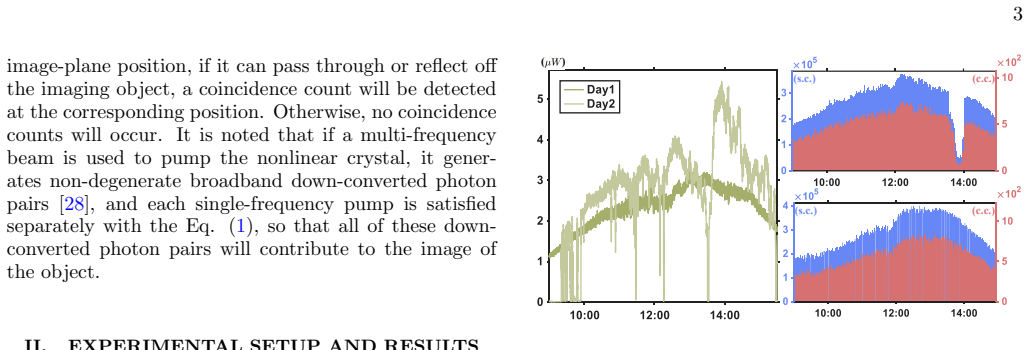
into the optical path before the crystal, so that sun- light is completely horizontally polarized with a 10 nm spectrum, but maintains a small transverse coherence length. A long pass filter (F2) (Thorlabs, FELH0700) is then used to block the pump light. To collect the (s.c.) (c.c.) (s.c.) (c.c.) ( ) ( ) FIG. 2. The light intensity distributions and photo...
-
[2]
G. Vallone, D. Bacco, D. Dequal, S. Gaiarin, V. Luceri, G. Bianco, and P. Villoresi, Experimental satellite quan- tum communications, Physical Review Letters 115, 040502 (2015)
work page 2015
- [3]
-
[4]
S.-K. Liao, H.-L. Yong, C. Liu, G.-L. Shentu, D.-D. Li, J. Lin, H. Dai, S.-Q. Zhao, B. Li, J.-Y. Guan,et al., Long- distance free-space quantum key distribution in daylight towards inter-satellite communication, Nature Photonics 11, 509 (2017)
work page 2017
- [5]
-
[6]
Y.-H. Deng, H. Wang, X. Ding, Z.-C. Duan, J. Qin, M.-C. Chen, Y. He, Y.-M. He, J.-P. Li, Y.-H. Li, et al. , Quan- tum interference between light sources separated by 150 million kilometers, Physical review letters 123, 080401 (2019)
work page 2019
-
[7]
Y.-A. Chen, Q. Zhang, T.-Y. Chen, W.-Q. Cai, S.-K. Liao, J. Zhang, K. Chen, J. Yin, J.-G. Ren, Z. Chen, et al. , An integrated space-to-ground quantum commu- nication network over 4,600 kilometres, Nature 589, 214 (2021)
work page 2021
-
[8]
B. Fr¨ ohlich, J. F. Dynes, M. Lucamarini, A. W. Sharpe, Z. Yuan, and A. J. Shields, A quantum access network, Nature 501, 69 (2013)
work page 2013
- [9]
-
[10]
X.-S. Ma, T. Herbst, T. Scheidl, D. Wang, S. Kropatschek, W. Naylor, B. Wittmann, A. Mech, J. Kofler, E. Anisimova, et al. , Quantum teleportation over 143 kilometres using active feed-forward, Nature 489, 269 (2012)
work page 2012
-
[11]
G. Tamoˇ sauskas, J. Galinis, A. Dubietis, and A. Piskarskas, Observation of spontaneous para- metric down-conversion excited by high brightness blue led, Opt. Express 18, 4310 (2010)
work page 2010
-
[12]
J. Galinis, M. Karpi´ nski, G. Tamoˇ sauskas, K. Dobek, and A. Piskarskas, Photon coincidences in spontaneous parametric down-converted radiation excited by a blue led in bulk liio3 crystal, Opt. Express 19, 10351 (2011)
work page 2011
-
[13]
J. Galinis, G. Tamoˇ sauskas, and A. Piskarskas, Modeling of photon coincidence and dispersive properties of spon- taneous parametric down-converted field excited by inco- herent source, Optics Communications 285, 1289 (2012)
work page 2012
- [14]
-
[15]
C. Li, B. Braverman, G. Kulkarni, and R. W. Boyd, Experimental generation of polarization entanglement from spontaneous parametric down-conversion pumped by spatiotemporally highly incoherent light, Phys. Rev. A 107, L041701 (2023)
work page 2023
-
[16]
H. Defienne and S. Gigan, Spatially entangled photon- pair generation using a partial spatially coherent pump beam, Phys. Rev. A 99, 053831 (2019)
work page 2019
- [17]
- [18]
-
[19]
Y. Zeng, D. Zhang, F. Tang, S. Fang, W. Zhang, and L. Chen, Controlling quantum correlations in optical- angle–orbital-angular-momentum variables, Physical Re- view A 104, 053719 (2021)
work page 2021
- [20]
- [21]
-
[22]
Gbur, Partially coherent beam propagation in atmo- spheric turbulence [invited], J
G. Gbur, Partially coherent beam propagation in atmo- spheric turbulence [invited], J. Opt. Soc. Am. A 31, 2038 (2014)
work page 2038
-
[23]
S. P. Phehlukwayo, M. L. Umuhire, Y. Ismail, S. Joshi, and F. Petruccione, Influence of coincidence detection of a biphoton state through free-space atmospheric turbu- lence using a partially spatially coherent pump, Phys. Rev. A 102, 033732 (2020)
work page 2020
- [24]
-
[25]
F.-Y. He, L.-S. Zhao, X.-X. Qu, K. Li, J.-P. Guo, F. Zhao, N. Wang, B.-Y. Qin, X.-L. Chen, J. Gao, et al. , Struc- tural insights into the assembly and energy transfer of haptophyte photosystem i–light-harvesting supercom- plex, Proceedings of the National Academy of Sciences 121, e2413678121 (2024)
work page 2024
-
[26]
K.-T. Lin, H. Lin, T. Yang, and B. Jia, Structured graphene metamaterial selective absorbers for high effi- ciency and omnidirectional solar thermal energy conver- sion, Nature communications 11, 1389 (2020)
work page 2020
-
[27]
H. Wu, F. Ye, M. Yang, F. Luo, X. Tang, Q. Tang, H. Qiu, Z. Huang, G. Wang, Z. Sun, et al. , Silicon het- erojunction back-contact solar cells by laser patterning, Nature 635, 604 (2024)
work page 2024
- [28]
-
[29]
A. Vanselow, P. Kaufmann, H. M. Chrzanowski, and S. Ramelow, Ultra-broadband spdc for spectrally far sep- arated photon pairs, Opt. Lett. 44, 4638 (2019). 7
work page 2019
- [30]
-
[31]
J.-N. Zhang, T.-Y. Zhang, J.-C. Duan, Y.-X. Gong, and S.-N. Zhu, Generation of broadband polarization- orthogonal photon pairs via the dispersion-engineered thin-film lithium niobate waveguide, Chinese Physics B 33, 110301 (2024)
work page 2024
-
[32]
P. A. Morris, R. S. Aspden, J. E. Bell, R. W. Boyd, and M. J. Padgett, Imaging with a small number of photons, Nat Commun 6, 5913 (2015)
work page 2015
-
[33]
M. Lyu, W. Wang, H. Wang, H. Wang, G. Li, N. Chen, and G. Situ, Deep-learning-based ghost imaging, Sci Rep 7, 17865 (2017)
work page 2017
-
[34]
Y.-H. Deng, H. Wang, X. Ding, Z.-C. Duan, J. Qin, M.- C. Chen, Y. He, Y.-M. He, J.-P. Li, Y.-H. Li, L.-C. Peng, E. S. Matekole, T. Byrnes, C. Schneider, M. Kamp, D.- W. Wang, J. P. Dowling, S. H¨ ofling, C.-Y. Lu, M. O. Scully, and J.-W. Pan, Quantum interference between light sources separated by 150 million kilometers, Phys. Rev. Lett. 123, 080401 (2019)
work page 2019
discussion (0)
Sign in with ORCID, Apple, or X to comment. Anyone can read and Pith papers without signing in.