Andha-Dhun: A First Look at Audio Descriptions in Hindi
Reviewed by Pith T0 review T1 audit T2 compute T3 formal T4 kernel 2026-07-08 05:04 UTCglm-5.2pith:AV5UB4LGrecord.jsonopen to challenge →
The pith
Direct Hindi generation beats translating English audio descriptions
A machine-rendered reading of the paper's core claim, the machinery that carries it, and where it could break.
Core claim
The central finding is that directly generating Hindi audio descriptions from English dense visual descriptions using a Hindi-capable LLM is more effective than translating predicted English ADs into Hindi, though both approaches remain substantially below human-authored quality. A second key discovery is that machine translation — whether of automatically generated or human-authored English ADs — systematically fails to adapt culture-specific items for Indian audiences, resolving only about 10% of them compared to 42.5% by human authors, while also reducing linguistic diversity. The paper frames this gap through Skopos theory, arguing that effective Hindi ADs require purpose-driven cultural
What carries the argument
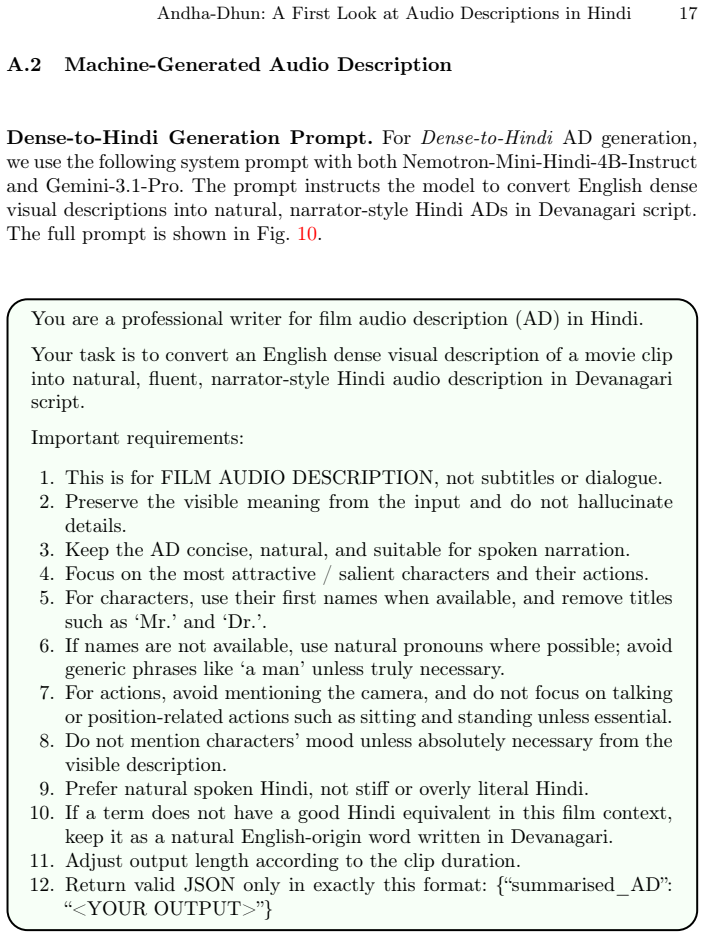
The paper's argument rests on three mechanisms: (1) AutoAD-Zero, a zero-shot framework that uses a multimodal LLM (Qwen-2-VL-7B) to produce dense English visual descriptions from video clips, which are then distilled into ADs by an LLM; (2) two Hindi generation pathways — Dense-to-Hindi, which feeds the full English dense description to a Hindi-capable LLM (Nemotron-4-Mini-Hindi-4B or Gemini-3.1-Pro) to produce a Hindi AD directly, versus AD-to-Hindi, which translates a compressed English AD using machine translation models (IndicTrans2, NLLB-600M, MADLAD, or Gemini); and (3) an evaluation pipeline combining LLM-AD-Eval (an LLM-as-judge scoring semantic match on a 0–5 scale) with perplexity,
If this is right
- The finding that Dense-to-Hindi outperforms AD-to-Hindi suggests that future automatic AD systems for non-English languages should preserve access to rich visual descriptions during the language-generation step rather than compressing first and translating second.
- The 10% vs. 42.5% CSI resolution gap between machine translation and human authors provides a concrete, measurable target for developing culturally-aware AD translation or generation systems.
- India's CBFC mandate that all released movies have ADs creates immediate practical pressure: the gap between current automatic methods and human quality identified here quantifies how much manual post-editing work remains.
- The Andha-Dhun dataset (5,870 AD sentences across 8 movies) provides the first benchmark for Hindi AD research, enabling future training-based approaches rather than only zero-shot methods.
Where Pith is reading between the lines
- If Dense-to-Hindi outperforms AD-to-Hindi because the Hindi LLM benefits from richer input, then an even stronger approach might use a multilingual or Hindi-native multimodal model to generate dense visual descriptions directly in Hindi, eliminating the English bottleneck entirely.
- The finding that human authors use omission as a legitimate strategy for difficult CSIs suggests that automatic AD systems may need to learn when not to describe something — a capability that current generation models, which are trained to maximize content coverage, are not designed for.
- The substantial disagreement between the two LLM judges (Gemini scoring 0.84–1.12 vs. Llama scoring 2.91–3.38) raises the question of whether LLM-as-judge is reliable enough for comparative quality claims in low-resource language settings, or whether human evaluation with BLV audiences is irreplaceable for this task.
- The paper's Skopos framing implies that the right evaluation metric for Hindi ADs is not semantic fidelity to an English source but comprehension by the target audience — a metric that none of the current automatic evaluation methods actually measure.
Load-bearing premise
The comparative quality claims between generation methods rest primarily on LLM-as-judge scores and perplexity, metrics that the authors themselves acknowledge capture surface-level semantic overlap but do not measure whether the output actually serves its purpose for blind and low-vision Hindi-speaking audiences.
What would settle it
The claim that Dense-to-Hindi outperforms AD-to-Hindi would be weakened if human evaluators — especially BLV Hindi speakers — rated the translated ADs as equally or more useful, since the LLM judges may be sensitive to fluency differences that do not affect actual comprehension. More broadly, if a culturally-aware translation system were developed that resolved CSIs at rates approaching human levels, the advantage of direct generation over translation might diminish or disappear.
Figures




read the original abstract
Audio Descriptions (ADs) narrate visual content for Blind and Low Vision (BLV) audiences during gaps in audiovisual media. There is growing momentum around ADs in movies and TV shows, and with mandates from India's Central Board of Film Certification (CBFC), there is a need to expand ADs beyond English. Yet, there is no work that generates ADs for any Indian language. To address this gap, we present the first systematic study of ADs in Hindi, contributing to aspects such as data, generation, and evaluation. We introduce Andha-Dhun, the first dataset of human-authored Hindi ADs collected from 8 full-length movies. We explore two approaches for generating ADs in Hindi: (i) directly from English dense video descriptions, and (ii) translating English ADs into Hindi. We evaluate these approaches using perplexity and LLM-as-a-judge metrics to assess fluency and quality respectively. We also analyze movies that have both English and Hindi human-authored ADs and find that naive translation introduces artifacts and narrows diversity compared to original Hindi ADs. Direct machine translation fails to adapt cultural references, while human-translated ADs do better but still fall short. Our findings emphasize that the purpose of Hindi ADs is accessibility for Indian BLV audiences, and that this requires adapting content for the audience more than strict fidelity to the source.
Editorial analysis
A structured set of objections, weighed in public.
Referee Report
Summary. This paper presents Andha-Dhun, the first dataset of human-authored Hindi audio descriptions (ADs) for movies, collected from 8 full-length films. The authors explore two approaches for generating Hindi ADs from English dense visual descriptions: (i) directly generating Hindi ADs using a Hindi-capable LLM (Dense-to-Hindi), and (ii) translating predicted English ADs into Hindi (AD-to-Hindi). They evaluate these approaches using perplexity and LLM-as-a-judge (LLM-AD-Eval) metrics. Additionally, they analyze dual-track movies with both English and Hindi human-authored ADs, examining how machine translation handles Culture-Specific Items (CSIs) compared to human authors, grounded in Skopos theory. The central finding is that Dense-to-Hindi generation outperforms AD-to-Hindi translation, though both remain far below human-authored quality, and that machine translation fails to adequately resolve cultural references for Indian BLV audiences.
Significance. This is a first-of-its-kind study for Hindi audio descriptions, addressing a genuine gap in the AD literature which has been predominantly English- and European-language focused. The dataset contribution (5,870 AD sentences across 8 movies, manually verified and time-aligned) is valuable for the community. The CSI analysis (Section 5.1) is the most informative part of the paper, providing concrete, manually verified evidence that machine translation retains cultural references while human authors adapt them — a finding with practical implications for AD accessibility. The code and data are stated to be publicly available, which strengthens reproducibility. The paper is well-positioned at the intersection of media accessibility and multimodal generation.
major comments (3)
- Table 2, LLM-AD-Eval scores: The central comparative claim that Dense-to-Hindi (Nemotron) outperforms AD-to-Hindi translation rests on scores from two LLM judges that disagree not only in absolute scale (Gemini: 0.84–1.12; Llama: 2.91–3.38) but also in relative ordering. The Llama judge ranks Nemotron (3.38) well above Gemini-w/ctxt (3.00), while the Gemini judge ranks them nearly tied (1.12 vs. 1.09). The claim that Nemotron is 'consistently best' is driven primarily by the Llama scores, which are themselves unvalidated. The authors should either (a) provide inter-judge agreement statistics (e.g., rank correlation between the two judges across all methods) to demonstrate that the ordering is reliable despite the scale difference, or (b) qualify the claim to acknowledge that the advantage is judge-dependent. As stated in Section 4.2, the claim is stronger than the evidence supports.
- Figure 4, Perplexity: Perplexity is computed using Llama-3.1-8B, an English-centric model, to score Hindi text. Lower perplexity for Nemotron generations could reflect more English-like or more templated Hindi output rather than higher fluency or quality. The paper does not discuss this confound. Since perplexity is used as a secondary metric supporting the Dense-to-Hindi advantage, the authors should either use a Hindi-capable language model for perplexity computation, or explicitly acknowledge this limitation and note that the perplexity comparison should be interpreted with caution. Without this, the perplexity evidence is ambiguous.
- Section 4.2 and Table 2: The Gemini judge scores for predicted ADs (0.84–1.12 on a 0–5 scale) are near-floor, meaning all methods score below 25% of the maximum. At this range, the discriminative power of the metric is questionable — a difference of 0.28 between the best and worst methods may not be meaningful. The authors should discuss whether differences at this near-floor range are statistically significant (e.g., via bootstrap confidence intervals or paired tests), or at minimum acknowledge that the Gemini judge's scores provide limited discriminative signal for the predicted-AD setting.
minor comments (8)
- Table 1: The 'AD Duration (s)' column header is ambiguous — it is unclear whether this refers to total AD duration per movie or average duration per AD. Clarifying the header would help.
- Section 3: The manual verification step is described briefly as 'manual verification ensures high quality transcription and temporal alignment.' A brief note on the verification procedure (e.g., number of annotators, criteria, inter-annotator agreement if applicable) would strengthen the dataset description.
- Figure 1: The Hindi text in the figure appears to have rendering issues (e.g., 'Nई िपया' and 'Nू ट रपर आती'). If these are romanization artifacts, this should be noted; if they are encoding errors, they should be fixed.
- Section 5.1: The CSI detection uses Gemini-3.1-Pro, and the footnote states it 'gave better results than 2.5-Pro for identifying cultural nuances.' A brief note on how this was determined (e.g., on a pilot set) would improve reproducibility.
- Table 3: The sample sizes (N=63, N=39, N=18) are small, particularly for the 'Different' category. A note acknowledging the limited statistical power of these comparisons would be appropriate.
- Section 5.2: The LLM-AD-Eval scores for human-authored ADs (Table 4, ~3–4.4) are much higher than for predicted ADs (Table 2, ~0.84–3.38). While the authors note this, a brief discussion of why the same metric yields such different score ranges across the two settings (beyond quality differences) would help readers calibrate expectations.
- References: Several arXiv preprints are cited (e.g., [16, 25, 50]). Where peer-reviewed versions exist, they should be preferred.
- Figure 14: The Hindi text in this figure has significant rendering/encoding issues that make it difficult to read. This should be corrected for the camera-ready version.
Simulated Author's Rebuttal
We thank the referee for their careful reading and constructive feedback. The referee raises three substantive points about the robustness of our evaluation metrics: (1) inter-judge agreement for LLM-AD-Eval, (2) the use of an English-centric model for Hindi perplexity, and (3) the near-floor discriminative power of the Gemini judge. All three points are valid concerns that we will address in the revision through additional analysis and appropriately qualified claims.
read point-by-point responses
-
Referee: Table 2, LLM-AD-Eval scores: The central comparative claim that Dense-to-Hindi (Nemotron) outperforms AD-to-Hindi translation rests on scores from two LLM judges that disagree not only in absolute scale but also in relative ordering. The claim that Nemotron is 'consistently best' is driven primarily by the Llama scores. The authors should either (a) provide inter-judge agreement statistics or (b) qualify the claim.
Authors: We agree that the current phrasing overstates the consistency of the judges' rankings. Upon re-examination, the two judges agree on the best method within the AD-to-Hindi group (IndicTrans2) and the worst overall (MADLAD), but they do not fully agree on the relative ranking of Nemotron versus Gemini-w/ctxt. We will compute rank correlation (Kendall's tau) across all six methods and report it in the revised Table 2. We will also revise the language in Section 4.2 from 'consistently identify Nemotron as the strongest' to a more precise statement: both judges rank Nemotron above all AD-to-Hindi translation methods, though they disagree on the margin between Nemotron and Gemini-w/ctxt. This makes the central claim — that direct generation outperforms translation — more precisely supported while acknowledging the judge-dependent ordering within the Dense-to-Hindi group. revision: partial
-
Referee: Figure 4, Perplexity: Perplexity is computed using Llama-3.1-8B, an English-centric model, to score Hindi text. Lower perplexity for Nemotron could reflect more English-like or templated Hindi. The authors should either use a Hindi-capable model or acknowledge this limitation.
Authors: This is a fair and important point. Llama-3.1-8B was not designed for Hindi and its tokenization may systematically favor certain styles of Hindi output. We will recompute perplexity using a Hindi-capable model (e.g., Nemotron-4-Mini-Hindi-4B or MuRIL) and report both sets of scores. If the relative ordering is preserved, this strengthens our claim; if not, we will report the discrepancy transparently. Regardless of the outcome, we will add an explicit discussion of this confound in Section 4.2, noting that perplexity computed with an English-centric model may reflect tokenization artifacts and should be interpreted as a secondary, approximate signal rather than a definitive fluency measure. revision: yes
-
Referee: Section 4.2 and Table 2: The Gemini judge scores for predicted ADs (0.84–1.12 on a 0–5 scale) are near-floor. The authors should discuss whether differences at this range are statistically significant or acknowledge limited discriminative signal.
Authors: We agree that the Gemini judge's scores for predicted ADs are near-floor and that the discriminative power at this range is questionable. We will add bootstrap confidence intervals for all LLM-AD-Eval scores in Table 2 and report whether the differences between methods are statistically significant under each judge. We will also add an explicit note in Section 4.2 acknowledging that the Gemini judge provides limited discriminative signal in the predicted-AD setting, and that the Llama judge offers more separation between methods. The overall narrative — that all automatic methods remain far below human quality — is supported by both judges and does not depend on the near-floor differences being individually significant. revision: yes
Circularity Check
No significant circularity; the paper is an empirical study with external data, models, and benchmarks.
full rationale
This is an empirical paper presenting a new dataset (Andha-Dhun) and comparing two approaches for generating Hindi audio descriptions. The dataset is collected from external sources (AudioVault, DVDs). The generation pipeline uses externally developed models (AutoAD-Zero, Qwen-2-VL, Llama-3, Nemotron, IndicTrans2, NLLB, MADLAD, Gemini). The evaluation metrics (LLM-AD-Eval, perplexity) are standard techniques applied to the collected data. The central comparative claim (Dense-to-Hindi outperforms AD-to-Hindi) is supported by Table 2 and Figure 4, which report scores from independent models applied to the paper's outputs. There is one self-citation to Kala et al. [26] for the finding that classical captioning metrics like CIDEr are unreliable, which motivates the choice of LLM-AD-Eval and perplexity instead. This self-citation is not load-bearing for the paper's central claims — it merely justifies a metric choice, and the paper would still hold if CIDEr were also reported. No step in the derivation chain reduces to its inputs by construction, no prediction is a renamed fit, and no ansatz is smuggled via self-citation. The paper's limitations (near-floor LLM judge scores, English-centric perplexity model) are correctness risks, not circularity.
Axiom & Free-Parameter Ledger
free parameters (2)
- Perplexity outlier threshold =
95th percentile
- LLM-AD-Eval judge model =
Gemini-3.1-Pro, LLaMA-3-8B-Instruct
axioms (3)
- domain assumption Skopos theory: translation should be guided by its purpose (helping Indian BLV audiences) rather than strict fidelity to source.
- domain assumption Perplexity measures linguistic diversity of ADs.
- domain assumption LLM-as-a-judge can reliably assess AD quality.
Reference graph
Works this paper leans on
-
[1]
Ananthakrishnan, R., Bhattacharyya, P., Sasikumar, M., Shah, R.M.: Some Issues in Automatic Evaluation of English-Hindi MT: More Blues for BLEU. Icon64 (2007)
work page 2007
-
[2]
Bain, M., Huh, J., Han, T., Zisserman, A.: WhisperX: Time-Accurate Speech Tran- scription of Long-Form Audio. In: Interspeech (2023)
work page 2023
-
[3]
Translation Studies in the New Millennium6, 14–30 (2008)
Braun, S.: Audio Description Research: State of the Art and Beyond. Translation Studies in the New Millennium6, 14–30 (2008)
work page 2008
-
[4]
Royal National Institute of Blind People (2025)
Braun, S., Qian, S., Zou, Y., Orasan, C.: Evaluation of AI-generated audio de- scription for factual TV/media genres. Royal National Institute of Blind People (2025)
work page 2025
-
[5]
International Journal of Translation 23(1), 07–26 (2011)
Chatterjee, N., Balyan, R.: Towards Development of a Suitable Evaluation Metric for English to Hindi Machine Translation. International Journal of Translation 23(1), 07–26 (2011)
work page 2011
-
[6]
LLM-AD: Large Language Model based Audio Description System
Chu, P., Wang, J., Abrantes, A.: LLM-AD: Large language Model based Audio Description System. arXiv preprint arXiv:2405.00983 (2024)
work page internal anchor Pith review Pith/arXiv arXiv 2024
-
[7]
The translation of culturally specific items
Dickins, J.: Language Studies: Stretching the Boundaries, chap. The translation of culturally specific items. Cambridge Scholars Publishing (2012)
work page 2012
-
[8]
Theory and Practice in Language Studies2(10) (2012)
Du, X.: A Brief Introduction of Skopos Theory. Theory and Practice in Language Studies2(10) (2012)
work page 2012
-
[9]
European Parliament and Council: Directive 2007/65/EC of the European Parlia- ment and of the Council of 11 December 2007. WIPO Lex (2007)
work page 2007
-
[10]
Fang, B., Wu, W., Wu, Q., Song, Y., Chan, A.B.: DistinctAD: Distinctive Audio Description Generation in Contexts. In: CVPR (2025)
work page 2025
-
[11]
SKASE Journal of translation and interpretation9(1), 64–87 (2016)
Fernández-Torné, A., Matamala, A.: Machine Translation in Audio Description? Comparing Creation, Translation and Post-Editing Efforts. SKASE Journal of translation and interpretation9(1), 64–87 (2016)
work page 2016
-
[12]
Fischer, L., Gao, Y., Lintner, A., Rios, A., Ebling, S.: SwissADT: An Audio De- scription Translation System for Swiss Languages. In: NAACL-HLT (2025) 14 R. Chakraborty, D. Kala et al
work page 2025
-
[13]
Gala, J., Chitale, P.A., Raghavan, A., Gumma, V., Doddapaneni, S., Kumar, A., et al.: IndicTrans2: Towards High-Quality and Accessible Machine Translation Models for all 22 Scheduled Indian Languages. arXiv preprint arXiv:2305.16307 (2023)
work page internal anchor Pith review Pith/arXiv arXiv 2023
-
[14]
Gao, Y., Fischer, L., Lintner, A., Ebling, S.: Audio Description Generation in the Era of LLMs and VLMs: A Review of Transferable Generative AI Technologies. In: NAACL Findings (2025)
work page 2025
-
[15]
Garbacea,C.,Carton,S.,Yan,S.,Mei,Q.:JudgetheJudges:ALarge-ScaleEvalua- tion Study of Neural Language Models for Online Review Generation. In: EMNLP- IJCNLP (2019)
work page 2019
-
[16]
Gemini: A Family of Highly Capable Multimodal Models
Gemini Team: Gemini: A Family of Highly Capable Multimodal Models. arXiv preprint arXiv:2312.11805 (2025)
work page internal anchor Pith review Pith/arXiv arXiv 2025
-
[17]
Grattafiori, A., Dubey, A., Jauhri, A., Team: The Llama 3 Herd of Models. arXiv preprint: arXiv 2407.21783 (2024)
work page internal anchor Pith review Pith/arXiv arXiv 2024
-
[18]
Computational Linguistics (2022)
Haddow, B., Bawden, R., Miceli Barone, A.V., Helcl, J., Birch, A.: Survey of Low- Resource Machine Translation. Computational Linguistics (2022)
work page 2022
-
[19]
Han, T., Bain, M., Nagrani, A., Varol, G., Xie, W., Zisserman, A.: AutoAD II: The Sequel-Who, When, and What in Movie Audio Description. In: CVPR (2023)
work page 2023
-
[20]
Han, T., Bain, M., Nagrani, A., Varol, G., Xie, W., Zisserman, A.: AutoAD: Movie Description in Context. In: CVPR (2023)
work page 2023
-
[21]
Han, T., Bain, M., Nagrani, A., Varol, G., Xie, W., Zisserman, A.: AutoAD III: The Prequel-Back to the Pixels. In: CVPR (2024)
work page 2024
-
[22]
Hashimoto, T.B., Zhang, H., Liang, P.: Unifying Human and Statistical Evaluation for Natural Language Generation. In: NAACL-HLT (2019)
work page 2019
-
[23]
Journal of Business, Com- munication & Technology3(1) (2024)
Homayouni, G., Khoshsaligheh, M.: Audio Description Technology: Enhancing Communication of Culture-Bound Elements in Films. Journal of Business, Com- munication & Technology3(1) (2024)
work page 2024
-
[24]
The Journal of the Acoustical Society of America62(S1), S63–S63 (1977)
Jelinek, F., Mercer, R.L., Bahl, L.R., Baker, J.K.: Perplexity—a Measure of the Difficulty of Speech Recognition Tasks. The Journal of the Acoustical Society of America62(S1), S63–S63 (1977)
work page 1977
-
[25]
Joshi, R., Singla, K., Kamath, A., Kalani, R., Paul, R., Vaidya, U., et al.: Adapting Multilingual LLMs to Low-Resource Languages using Continued Pre-training and Synthetic Corpus. In: Proceedings of the First Workshop on Natural Language Processing for Indo-Aryan and Dravidian Languages (2025)
work page 2025
-
[26]
Kala,D.,Khandelwal,E.,Tapaswi,M.:WhatYouSeeisWhatYouAsk:Evaluating Audio Descriptions. In: EMNLP (2025)
work page 2025
-
[27]
arXiv preprint: arXiv 2510.25440 (2025)
Khandelwal, E., Xie, J., Han, T., Bain, M., Nagrani, A., Zisserman, A., Varol, G., Tapaswi, M.: More than a Moment: Towards Coherent Sequences of Audio Descriptions. arXiv preprint: arXiv 2510.25440 (2025)
-
[28]
Kudugunta, S., Caswell, I., Zhang, B., Garcia, X., Xin, D., Kusupati, A., Stella, R., Bapna, A., Firat, O.: MADLAD-400: A Multilingual And Document-Level Large Audited Dataset. In: NeurIPS (2023)
work page 2023
-
[29]
Li, D., Jiang, B., Huang, L., Beigi, A., Zhao, C., Tan, Z., Bhattacharjee, A., Jiang, Y., Chen, C., Wu, T., et al.: From Generation to Judgment: Opportunities and Challenges of LLM-as-a-Judge. In: EMNLP (2025)
work page 2025
-
[30]
Lin, K.Q., Zhang, P., Gao, D., Xia, X., Chen, J., Gao, Z., et al.: Learning Video Context as Interleaved Multimodal Sequences. In: ECCV (2024)
work page 2024
-
[31]
Lüthi, N., Lintner, A., Fischer, L., Kappus, M., Ebling, S.: An Exploratory Anal- ysis of LLM-Based Machine-Translated Audio Description Scripts in the French- German Language Pair. Advanced Research Seminar on Audio Description (2025) Andha-Dhun: A First Look at Audio Descriptions in Hindi 15
work page 2025
-
[32]
Maszerowska, A., Mangiron, C.: Strategies for dealing with cultural references in audio description. In: Audio description, pp. 159–178. John Benjamins (2014)
work page 2014
-
[33]
TRANS: Revista de Traduc- tología (2016)
Matamala, A., Boix, C.O.: Accesibility and Multilingualism: An Exploratory Study on the Machine Translation of Audio Descriptions. TRANS: Revista de Traduc- tología (2016)
work page 2016
-
[34]
Journal of Audiovisual Translation3(2) (2020)
Mazur, I.: A Functional Approach to Audio Description. Journal of Audiovisual Translation3(2) (2020)
work page 2020
-
[35]
Universal Access in the Information Society23(2) (2024)
Mazur, I.: Same Film, Different Audio Descriptions: Describing Foreign Films from a Functional Perspective. Universal Access in the Information Society23(2) (2024)
work page 2024
-
[36]
Perspectives20(1), 5–23 (2012)
Mazur, I., Chmiel, A.: Towards Common European Audio Description Guidelines: Results of the Pear Tree Project. Perspectives20(1), 5–23 (2012)
work page 2012
-
[37]
No Language Left Behind: Scaling Human-Centered Machine Translation
NLLB Team: No Language Left Behind: Scaling Human-Centered Machine Trans- lation. arXiv preprint arXiv:2207.04672 (2022)
work page internal anchor Pith review Pith/arXiv arXiv 2022
-
[38]
Orero, P.: Sampling Audio Description in Europe. In: Media for all, pp. 109–125. Brill (2007)
work page 2007
-
[39]
Park, J., Ye, J., Lee, S., Ka, H.W., Han, D.: NarrAD: Automatic generation of audio descriptions for movies with rich narrative context. In: WACV (2025)
work page 2025
-
[40]
Pedersen, J.: Subtitling Norms for Television. John Benjamins Pub. Co. (2011)
work page 2011
-
[41]
Journal of Vision Impairment and Blindness90(1996)
Peli, E., Fine, E., Labianca, A.: Evaluating Visual Information Provided by Audio Description. Journal of Vision Impairment and Blindness90(1996)
work page 1996
-
[42]
British Journal of Visual Impairment14(1996)
Pettitt, B., Sharpe, K., Cooper, S.: AUDETEL: Enhancing Television for Visually Impaired People. British Journal of Visual Impairment14(1996)
work page 1996
-
[43]
Government of India, Press Information Bureau (Feb 2026), release ID: 2233786
Press Information Bureau: Central board of film certification (cbfc). Government of India, Press Information Bureau (Feb 2026), release ID: 2233786. Accessed: 2026-04-06
work page 2026
-
[44]
The Journal of Specialised Translation pp
Reviers, N.: Audio Description Services in Europe: an Update. The Journal of Specialised Translation pp. 232–247 (2016)
work page 2016
-
[45]
Soldan, M., Pardo, A., Alcázar, J.L., Caba, F., Zhao, C., Giancola, S., Ghanem, B.: MAD: A Scalable Dataset for Language Grounding in Videos from Movie Audio Descriptions. In: CVPR (2022)
work page 2022
-
[46]
Toury, G.: Descriptive Translation Studies and Beyond. John Benjamins (1995)
work page 1995
-
[47]
Tradumàtica tecnologies de la traducció (2021)
Vercauteren, G., Reviers, N., Steyaert, K.: Evaluating the Effectiveness of Machine Translation of Audio Description: the Results of two pilot studies in the English- Dutch Language Pair. Tradumàtica tecnologies de la traducció (2021)
work page 2021
-
[48]
Reihe Wissenschaft - TEXTconTEXT, Textcontext (1996)
Vermeer, H.: A Skopos Theory of Translation: (some Arguments for and Against). Reihe Wissenschaft - TEXTconTEXT, Textcontext (1996)
work page 1996
-
[49]
Wang, H., Tong, Z., Zheng, K., Shen, Y., Wang, L.: Contextual AD Narration with Interleaved Multimodal Sequence. In: CVPR (2025)
work page 2025
-
[50]
Wang, P., Bai, S., Tan, S., Wang, S., Fan, Z., Bai, J., et al.: Qwen2-VL: Enhanc- ing Vision-Language Model’s Perception of the World at Any Resolution. arXiv preprint: arXiv 2407.10671 (2024)
work page internal anchor Pith review Pith/arXiv arXiv 2024
-
[51]
Xie, J., Han, T., Bain, M., Nagrani, A., Khandelwal, E., Varol, G., Xie, W., Zis- serman, A.: Shot-by-Shot: Film-Grammar-Aware Training-Free Audio Description Generation. In: ICCV (2025)
work page 2025
-
[52]
Xie, J., Han, T., Bain, M., Nagrani, A., Varol, G., Xie, W., Zisserman, A.: AutoAD- Zero: A Training-Free Framework for Zero-Shot Audio Description. In: ACCV (2024)
work page 2024
-
[53]
Ye, X., Chen, J., Li, X., Xin, H., Li, C., Zhou, S., Bu, J.: MMAD: Multi-Modal Movie Audio Description. In: LREC-COLING (2024)
work page 2024
-
[54]
Zhang, C., Lin, K., Yang, Z., Wang, J., Li, L., Lin, C.C., et al.: MM-Narrator: Nar- rating long-form Videos with Multimodal In-Context Learning. In: CVPR (2024) 16 R. Chakraborty, D. Kala et al. A Supplementary Material We describe in detail the prompts for each generation/evaluation pipeline. A.1 Dataset Prompt for Andha-Dhun Transcriptions.We use Gemin...
work page 2024
- [55]
-
[56]
Maintain continuous timestamps from start to finish (timestamps should never reset)
-
[57]
Text must be the spoken line in Hindi, using Devanagari script
-
[58]
Do not include speaker names such as “Farhaan”, “Raaju”, etc. Just use “Narrator” or “Actor”
-
[59]
Ensure each annotation has accurate start and end times in the format minutes+seconds+milliseconds (e.g., 02:00.010 to 02:00.050)
-
[60]
The output should follow the style shown below:8 01:59.98 02:02.66 Narrator: Usse jhempte hue apni jeb se phone nikala, number dekha. 02:03.11 02:04.14 Actor: Hello? Do not include any extra commentary, metadata, character names, or for- matting other than what is asked above. Fig.9.Prompt used with Gemini-2.5-Flash for transcribing Hindi AD audio into ti...
-
[61]
This is for FILM AUDIO DESCRIPTION, not subtitles or dialogue
-
[62]
Preserve the visible meaning from the input and do not hallucinate details
-
[63]
Keep the AD concise, natural, and suitable for spoken narration
-
[64]
Focus on the most attractive / salient characters and their actions
-
[65]
For characters, use their first names when available, and remove titles such as ‘Mr.’ and ‘Dr.’
-
[66]
If names are not available, use natural pronouns where possible; avoid generic phrases like ‘a man’ unless truly necessary
-
[67]
For actions, avoid mentioning the camera, and do not focus on talking or position-related actions such as sitting and standing unless essential
-
[68]
Do not mention characters’ mood unless absolutely necessary from the visible description
-
[69]
Prefer natural spoken Hindi, not stiff or overly literal Hindi
-
[70]
If a term does not have a good Hindi equivalent in this film context, keep it as a natural English-origin word written in Devanagari
-
[71]
Adjust output length according to the clip duration
-
[72]
Return valid JSON only in exactly this format: {“summarised_AD”: “<YOUR OUTPUT>”} Fig.10.System prompt used forDense-to-HindiAD generation with Nemotron and Gemini. LLM-AD-Eval Prompt.We use the LLM-AD-Eval framework to evaluate the semantic match between predicted and ground-truth ADs. The system prompt, shown in Fig. 11, instructs the judge model to foc...
-
[73]
“ad_text”: The exact English AD text from the input
-
[74]
“is_csi”: “yes” if the AD contains a cultural element likely unfamiliar to the target audience, or “no” if it is culturally neutral or globally understood
-
[75]
Respond ONLY with a valid JSON array of objects
“reason”: A brief explanation of your decision. Respond ONLY with a valid JSON array of objects. Fig.13.Prompt for detecting Culture-Specific Items (CSIs) in English to Hindi AD translation. Andha-Dhun: A First Look at Audio Descriptions in Hindi 21 EN-HumanCSI ReasonHuman AD-to-HindiHI-HumanADResol.ADResol. They pass a steaming furnace on their left, the...
discussion (0)
Sign in with ORCID, Apple, or X to comment. Anyone can read and Pith papers without signing in.