The Body as Status: Muscularity, Engagement, and Body Image Risk on #GymTok
Pith reviewed 2026-06-30 04:37 UTC · model grok-4.3
The pith
TikTok's #GymTok videos with more muscular bodies and higher expert-rated harm to body image receive greater views, likes, shares, and comments.
A machine-rendered reading of the paper's core claim, the machinery that carries it, and where it could break.
Core claim
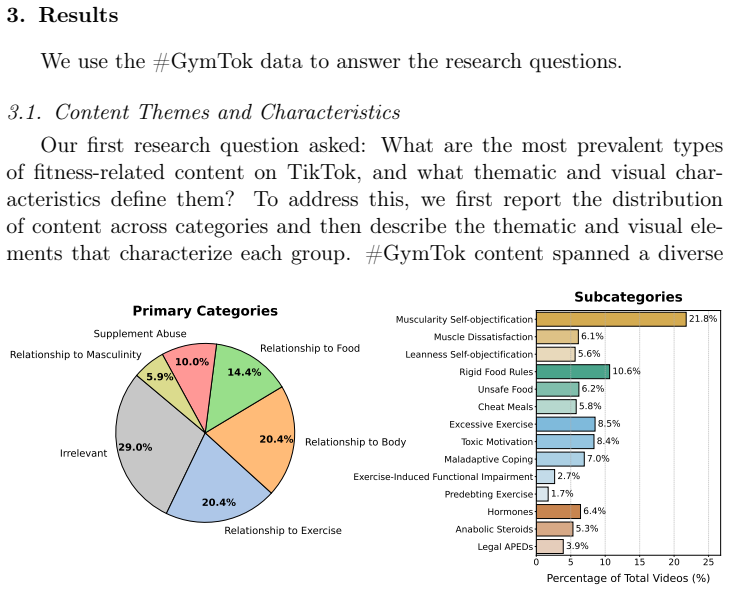
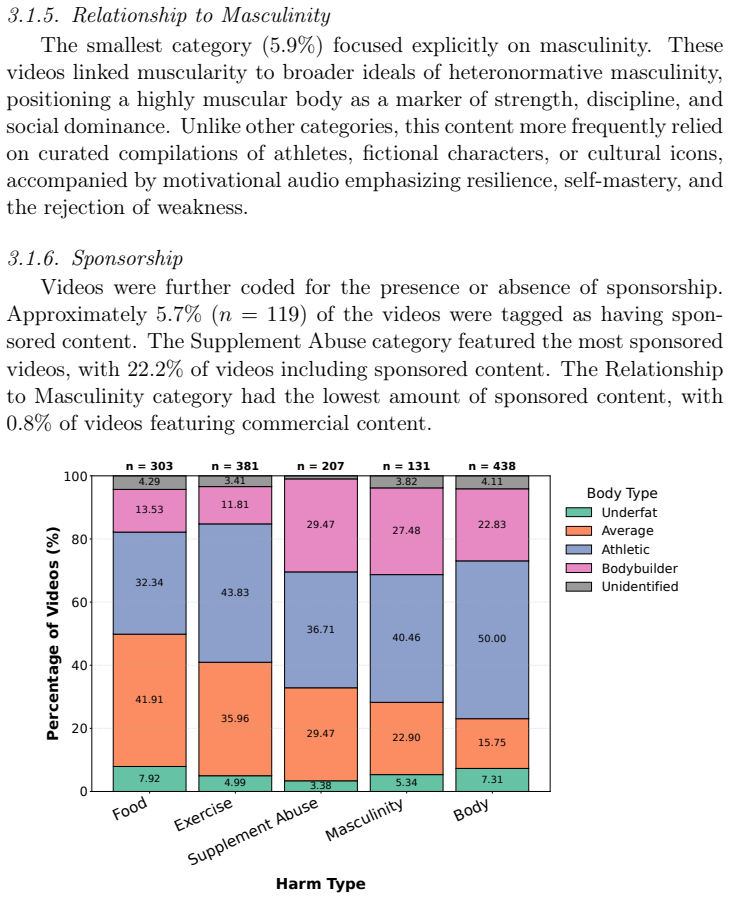
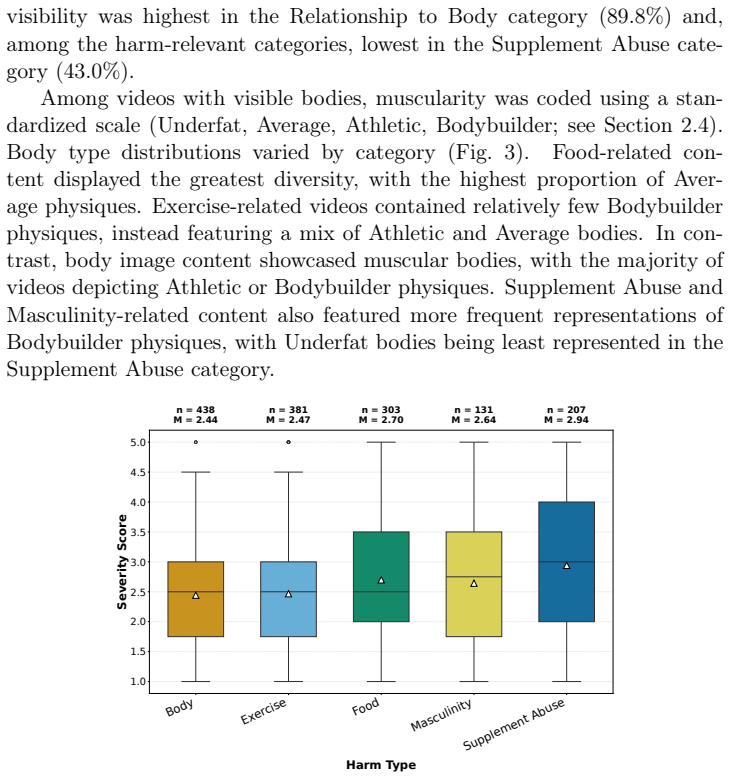
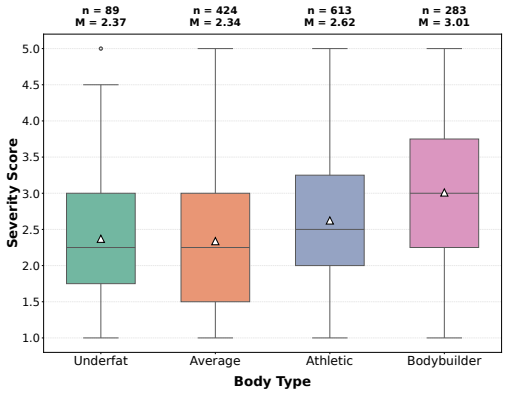
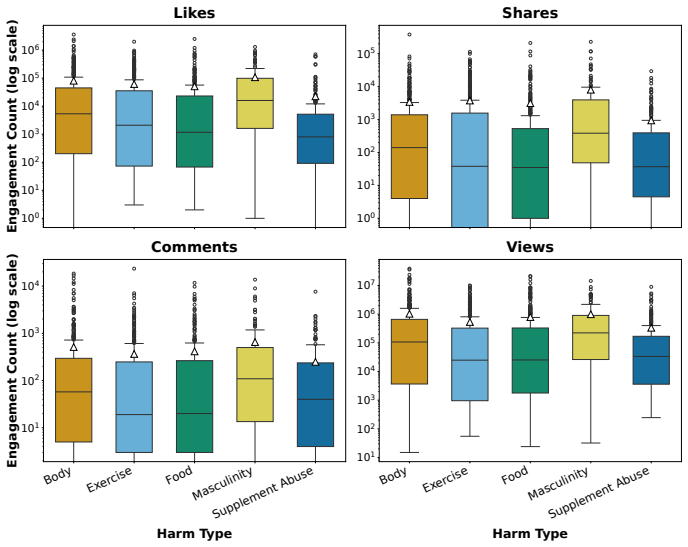
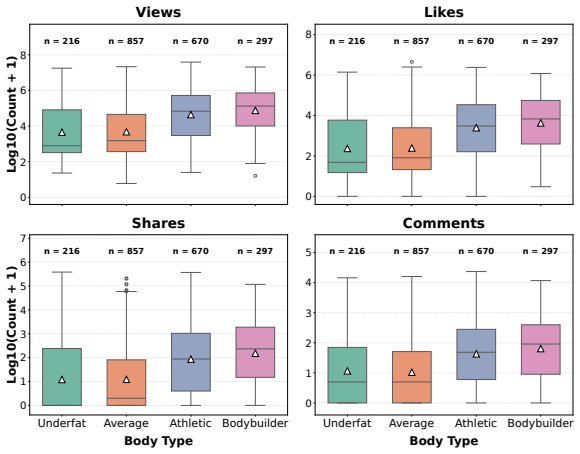
Content analysis of 2210 #GymTok videos shows that perceived harm to body image varies by theme, with supplement- and steroid-related videos rated highest, while engagement metrics including views, likes, shares, and comments increase with both higher muscularity of depicted bodies and higher harm ratings; masculinity-focused content produces the strongest engagement overall, implying that recommendation algorithms amplify exposure to muscular ideals and harmful practices.
What carries the argument
Expert-rated perceived harm to body image combined with coded muscularity level of depicted bodies, which together predict higher engagement across views, likes, shares, and comments.
If this is right
- Videos depicting more muscular bodies receive greater views, likes, shares, and comments.
- Supplement and steroid content is rated most harmful yet still drives engagement.
- Masculinity-focused content generates the highest engagement despite lower prevalence.
- Recommendation systems increase visibility of high-muscularity and high-harm videos, intensifying social comparison processes.
Where Pith is reading between the lines
- Reducing algorithmic promotion of high-harm fitness content could lower aggregate exposure to muscular ideals without changing user search behavior.
- The same engagement-harm correlation may appear on other short-video platforms that prioritize visual body displays.
- Viewer-level experiments measuring actual supplement uptake or body dissatisfaction after controlled exposure would test whether the observed amplification translates to measurable risk.
Load-bearing premise
Expert ratings of perceived harm to body image accurately predict real-world viewer risk and observed engagement differences stem from algorithmic amplification rather than unmeasured factors like video quality.
What would settle it
A longitudinal study that tracks changes in body image concerns or supplement use among users whose feeds are experimentally varied in the proportion of high-muscularity or high-harm #GymTok videos.
Figures


read the original abstract
Body image concerns among boys and young men are increasingly oriented toward muscularity, with social media serving as a central context for communicating and evaluating these ideals. While prior research has focused on the thin-ideal, less is known about how the muscular-ideal is represented and reinforced on visual social media platforms. This study examines (1) dominant content themes, (2) perceived harm to body image, and (3) engagement patterns across #GymTok, a muscularity-oriented fitness subculture on TikTok. We conducted a content analysis of 2,210 #GymTok videos annotated by clinical experts across themes like self-objectification, rigid dieting, excessive exercise, supplement and steroid use, and masculinity. Annotators also rated the perceived harm of videos to the viewers' body image, and depicted bodies were coded according to muscularity level. Perceived harm varied across content themes, with supplement- and steroid-related content rated as most harmful. Engagement was positively associated with both muscularity and perceived harm: videos depicting more muscular bodies and those rated as more harmful received greater views, likes, shares, and comments. Although less prevalent, masculinity-focused content generated the highest engagement. These findings suggest that TikTok may not only expose users to muscular ideals and potentially harmful behaviors, but also algorithmically amplify them. By increasing the visibility of highly muscular and harmful content, recommendation systems may intensify social comparison processes, while objectification elevates the muscular body into a marker of status, masculinity, and social worth. Together, these dynamics may contribute to body image risk among boys and young men.
Editorial analysis
A structured set of objections, weighed in public.
Referee Report
Summary. The paper reports a content analysis of 2,210 #GymTok videos on TikTok. Clinical experts annotated videos for themes (self-objectification, rigid dieting, excessive exercise, supplement/steroid use, masculinity), rated perceived harm to body image, and coded depicted muscularity. Perceived harm was highest for supplement/steroid content; engagement metrics (views, likes, shares, comments) were positively associated with higher muscularity and higher harm ratings, with masculinity-focused content showing highest engagement. The authors conclude that TikTok's algorithms may amplify exposure to muscular ideals and harmful content, intensifying body image risks among boys and young men.
Significance. If the associations survive proper controls and the sampling/measurement details are clarified, the work would add to the literature on muscular-ideal representations on visual platforms and provide platform-specific evidence on engagement patterns. The expert annotation of harm is a methodological strength relative to purely automated approaches, but the observational design limits stronger causal claims about algorithmic amplification.
major comments (4)
- [Abstract/Methods] Abstract and Methods: No sampling frame, selection criteria, or collection dates are described for the 2,210 videos. Without this information it is impossible to assess whether the sample is representative of #GymTok or biased toward high-engagement videos, directly affecting the validity of the engagement associations.
- [Methods] Methods: No inter-rater reliability statistics (e.g., Cohen's kappa or ICC) are reported for the expert annotations of themes or perceived-harm ratings. This omission undermines confidence in the harm-by-theme and harm-by-engagement findings.
- [Results] Results: The reported positive associations between muscularity/perceived harm and engagement metrics are presented without statistical controls for creator follower count, video length, posting time, or hashtag effects. These unmeasured factors could explain the correlations and prevent inference that the algorithm preferentially amplifies harmful content.
- [Discussion] Discussion: The claim that 'recommendation systems may intensify social comparison processes' and 'algorithmically amplify' harmful content is not supported by the cross-sectional data. Engagement differences are equally consistent with user-driven selection or production quality differences; temporal or A/B-test evidence would be required to support the causal language.
minor comments (2)
- [Abstract] Abstract: The phrase 'algorithmically amplify them' should be qualified as an interpretation rather than a direct finding, to avoid overstating the observational results.
- [Results] The manuscript would benefit from a table summarizing theme prevalence, mean harm ratings, and mean engagement by theme to make the patterns easier to evaluate.
Simulated Author's Rebuttal
Thank you for the opportunity to respond to the referee's comments on our manuscript. We appreciate the constructive feedback and address each major comment below, indicating where revisions will be incorporated.
read point-by-point responses
-
Referee: [Abstract/Methods] Abstract and Methods: No sampling frame, selection criteria, or collection dates are described for the 2,210 videos. Without this information it is impossible to assess whether the sample is representative of #GymTok or biased toward high-engagement videos, directly affecting the validity of the engagement associations.
Authors: We agree that these methodological details are necessary for evaluating sample representativeness. In the revised manuscript, we will add a dedicated subsection in Methods describing the sampling frame, including collection dates, the TikTok API or scraping procedure used, inclusion/exclusion criteria for #GymTok videos, and any stratification steps taken to mitigate high-engagement bias. revision: yes
-
Referee: [Methods] Methods: No inter-rater reliability statistics (e.g., Cohen's kappa or ICC) are reported for the expert annotations of themes or perceived-harm ratings. This omission undermines confidence in the harm-by-theme and harm-by-engagement findings.
Authors: We thank the referee for noting this omission. Inter-rater reliability was computed during annotation. We will report the statistics (Cohen's kappa for thematic codes and ICC for harm ratings) in the revised Methods section, along with details on how disagreements were resolved. revision: yes
-
Referee: [Results] Results: The reported positive associations between muscularity/perceived harm and engagement metrics are presented without statistical controls for creator follower count, video length, posting time, or hashtag effects. These unmeasured factors could explain the correlations and prevent inference that the algorithm preferentially amplifies harmful content.
Authors: We acknowledge that unmeasured variables could confound the observed associations. Our dataset contains partial metadata on video length and hashtags but lacks complete follower counts and posting times. In revision we will add regression models controlling for available variables and will expand the Discussion to explicitly address these limitations and their implications for causal inference. revision: partial
-
Referee: [Discussion] Discussion: The claim that 'recommendation systems may intensify social comparison processes' and 'algorithmically amplify' harmful content is not supported by the cross-sectional data. Engagement differences are equally consistent with user-driven selection or production quality differences; temporal or A/B-test evidence would be required to support the causal language.
Authors: We agree that the cross-sectional design precludes strong causal claims regarding algorithmic amplification. We will revise the language throughout the Abstract, Results, and Discussion to describe observed associations and plausible mechanisms while clearly stating the limitations of observational data and removing any definitive causal assertions about recommendation systems. revision: yes
Circularity Check
Empirical content analysis with no derivations or self-referential reductions
full rationale
The paper is a cross-sectional content analysis of 2,210 TikTok videos, with expert annotations for themes, muscularity levels, perceived harm ratings, and measured engagement metrics (views, likes, etc.). All reported findings are direct statistical associations from the coded data; the inference that recommendation systems 'algorithmically amplify' harmful content is an interpretive claim from those correlations, not a mathematical derivation, fitted parameter renamed as prediction, or reduction to self-citations. No equations, ansatzes, uniqueness theorems, or load-bearing prior-author citations appear in the text. The study is therefore self-contained against its own observational inputs without circularity.
Axiom & Free-Parameter Ledger
axioms (2)
- domain assumption Clinical experts can reliably rate the perceived harm of videos to viewers' body image
- domain assumption Differences in engagement metrics indicate algorithmic amplification of content
Reference graph
Works this paper leans on
-
[1]
angrish2024flex APACrefauthors Angrish, K. , Oshana, D. \ Gammage, K L. APACrefauthors \ 2024 . Flex Friday: A content analysis of men’s fitspiration on Instagram Flex friday: A content analysis of men’s fitspiration on instagram . Body image 48 101651 . APACrefURL https://doi.org/10.1016/j.bodyim.2023.101651 APACrefURL APACrefDOI doi:10.1016/j.bodyim.202...
-
[2]
APACrefauthors \ 2023
buzzfeednewsBrosEating APACrefauthors Arifi, F. APACrefauthors \ 2023 . Gym Bros Are Eating Dog Food For Protein And I’m Frightened --- buzzfeednews.com. Gym bros are eating dog food for protein and i’m frightened --- buzzfeednews.com. APACrefURL https://www.buzzfeednews.com/article/fjollaarifi/can-people-eat-dog-food APACrefURL Accessed 14-04-2026
2023
-
[3]
ashton2010status APACrefauthors Ashton, M C. , Lee, K. , Pozzebon, J A. , Visser, B A. \ Worth, N C. APACrefauthors \ 2010 . Status-driven risk taking and the major dimensions of personality Status-driven risk taking and the major dimensions of personality . Journal of Research in Personality 44 6 734--737 . APACrefURL https://doi.org/10.1016/j.jrp.2010.0...
-
[4]
barnes2023comparison APACrefauthors Barnes, K. , Newman, E. \ Keenan, G. APACrefauthors \ 2023 . A comparison of the impact of exposure to fit ideal and non-fit ideal body shapes in fitspiration imagery on women A comparison of the impact of exposure to fit ideal and non-fit ideal body shapes in fitspiration imagery on women . Computers in Human Behavior ...
-
[5]
bell2025active APACrefauthors Bell, C. , Cocks, A J. , Hills, L. \ Kerner, C. APACrefauthors \ 2025 . Active and passive social media use: Relationships with body image in physically active men Active and passive social media use: Relationships with body image in physically active men . New Media & Society 27 12 6453--6471 . APACrefURL https://doi.org/10....
-
[6]
beos2026impact APACrefauthors Beos, N. , Kemps, E. \ Prichard, I. APACrefauthors \ 2026 . The impact of fitness and supplement TikTok content on body, nutrition and fitness satisfaction, and intentions to use muscle-building substances in young men The impact of fitness and supplement tiktok content on body, nutrition and fitness satisfaction, and intenti...
-
[7]
brasil2024social APACrefauthors Brasil, K M. , Mims, C E. , Pritchard, M E. \ Mcdermott, R C. APACrefauthors \ 2024 . Social media and body image: Relationships between social media appearance preoccupation, self-objectification, and body image Social media and body image: Relationships between social media appearance preoccupation, self-objectification, ...
-
[8]
choukas2022perfect APACrefauthors Choukas-Bradley, S. , Roberts, S R. , Maheux, A J. \ Nesi, J. APACrefauthors \ 2022 . The perfect storm: A developmental--sociocultural framework for the role of social media in adolescent girls’ body image concerns and mental health The perfect storm: A developmental--sociocultural framework for the role of social media ...
-
[9]
chuBigTok APACrefauthors Chu, M D. , Pawar, K. , He, Z. , Sharifi, R. , Sonnenblick, R M. , Curry, M. Lerman, K. APACrefauthors \ 2026 03 . B ig T ok D etect: A Clinically-Informed Vision -- Language Modeling Framework for Detecting Pro-Bigorexia Videos on T ik T ok B ig T ok D etect: A clinically-informed vision -- language modeling framework for detecti...
-
[10]
cohen1960coefficient APACrefauthors Cohen, J. APACrefauthors \ 1960 . A coefficient of agreement for nominal scales A coefficient of agreement for nominal scales . Educational and Psychological Measurement 20 1 37--46 . APACrefURL https://doi.org/10.1177/001316446002000104 APACrefURL APACrefDOI doi:10.1177/001316446002000104 APACrefDOI
-
[11]
comanici2025gemini25pushingfrontier APACrefauthors Comanici, G. , Bieber, E. , Schaekermann, M. , Pasupat, I. , Sachdeva, N. , Dhillon, I. Helmholz, W. APACrefauthors \ 2025 . Gemini 2.5: Pushing the Frontier with Advanced Reasoning, Multimodality, Long Context, and Next Generation Agentic Capabilities. Gemini 2.5: Pushing the frontier with advanced reaso...
work page internal anchor Pith review Pith/arXiv arXiv doi:10.48550/arxiv.2507.06261 2025
-
[12]
, DeCook, J R
cotter2022fyp APACrefauthors Cotter, K. , DeCook, J R. , Kanthawala, S. \ Foyle, K. APACrefauthors \ 2022 . In FYP We Trust: The Divine Force of Algorithmic Conspirituality. In fyp we trust: The divine force of algorithmic conspirituality. International Journal of Communication 16 . APACrefURL https://ijoc.org/index.php/ijoc/article/view/19289 APACrefURL
2022
-
[13]
courtenay2000constructions APACrefauthors Courtenay, W H. APACrefauthors \ 2000 . Constructions of masculinity and their influence on men's well-being: a theory of gender and health Constructions of masculinity and their influence on men's well-being: a theory of gender and health . Social science & medicine 50 10 1385--1401 . APACrefURL https://doi.org/1...
-
[14]
cranswick2025s APACrefauthors Cranswick, I. , Richardson, D. , Littlewood, M. \ Tod, D. APACrefauthors \ 2025 . ‘It’s not just you come into the gym and do your weight training’: a narrative exploration of muscularity’s role as identity capital ‘it’s not just you come into the gym and do your weight training’: a narrative exploration of muscularity’s role...
-
[15]
dane2023social APACrefauthors Dane, A. \ Bhatia, K. APACrefauthors \ 2023 . The social media diet: A scoping review to investigate the association between social media, body image and eating disorders amongst young people The social media diet: A scoping review to investigate the association between social media, body image and eating disorders amongst yo...
-
[16]
daniel2014objectification APACrefauthors Daniel, S. \ Bridges, S K. APACrefauthors \ 2010 . The drive for muscularity in men: Media influences and objectification theory The drive for muscularity in men: Media influences and objectification theory . Body Image 7 1 32-38 . APACrefURL https://www.sciencedirect.com/science/article/pii/S1740144509000928 APACr...
-
[17]
de2025fittok APACrefauthors de Brabandere, M. , Hudders, L. \ Vanwesenbeeck, I. APACrefauthors \ 2025 . \# Fittok: how Fitfluencers' videos on Tiktok impact adolescents' body satisfaction, workout intention, and behavior \# fittok: how fitfluencers' videos on tiktok impact adolescents' body satisfaction, workout intention, and behavior . Psychology & Mark...
-
[18]
deighton2018objectifying APACrefauthors Deighton-Smith, N. \ Bell, B T. APACrefauthors \ 2018 . Objectifying fitness: A content and thematic analysis of\# fitspiration images on social media. Objectifying fitness: A content and thematic analysis of\# fitspiration images on social media. Psychology of Popular Media Culture 7 4 467 . APACrefURL https://doi....
-
[19]
drivas2024whatieatinaday APACrefauthors Drivas, M. , Reed, O S. \ Berndt-Goke, M. APACrefauthors \ 2024 . \# WhatIEatInADay: The effects of viewing food diary TikTok videos on young adults’ body image and intent to diet \# whatieatinaday: The effects of viewing food diary tiktok videos on young adults’ body image and intent to diet . Body Image 49 101712 ...
-
[20]
fatt2019effects APACrefauthors Fatt, S. , Fardouly, J. \ Rapee, R. APACrefauthors \ 2019 06 . \#malefitspo: Links between viewing fitspiration posts, muscular-ideal internalisation, appearance comparisons, body satisfaction, and exercise motivation in men \#malefitspo: Links between viewing fitspiration posts, muscular-ideal internalisation, appearance co...
-
[21]
festinger1954theory APACrefauthors Festinger, L. APACrefauthors \ 1954 . A theory of social comparison processes A theory of social comparison processes . Human relations 7 2 117--140 . APACrefURL https://doi.org/10.1177/001872675400700202 APACrefURL APACrefDOI doi:10.1177/001872675400700202 APACrefDOI
-
[22]
fioravanti2021fitspiration APACrefauthors Fioravanti, G. , Tonioni, C. \ Casale, S. APACrefauthors \ 2021 . \# Fitspiration on Instagram: The effects of fitness-related images on women’s self-perceived sexual attractiveness \# fitspiration on instagram: The effects of fitness-related images on women’s self-perceived sexual attractiveness . Scandinavian Jo...
-
[23]
flynn2020relationship APACrefauthors Flynn, M A. , Cotchett, E. \ Lin, L. APACrefauthors \ 2020 . The relationship between men’s peer and social media muscularity ideal discrepancies and body satisfaction The relationship between men’s peer and social media muscularity ideal discrepancies and body satisfaction . Journal of Social and Personal Relationship...
-
[24]
fredrickson1997objectification APACrefauthors Fredrickson, B L. \ Roberts, T A. APACrefauthors \ 1997 . Objectification theory: Toward understanding women's lived experiences and mental health risks Objectification theory: Toward understanding women's lived experiences and mental health risks . Psychology of women quarterly 21 2 173--206 . APACrefURL http...
-
[25]
ganson2025associations APACrefauthors Ganson, K T. , Testa, A. , Rodgers, R F. \ Nagata, J M. APACrefauthors \ 2025 . Associations between muscularity-oriented social media content and muscle dysmorphia among boys and men Associations between muscularity-oriented social media content and muscle dysmorphia among boys and men . Body Image 53 101903 . APACre...
-
[26]
GRIFFITHS2024101807 APACrefauthors Griffiths, S. , Harris, E A. , Whitehead, G. , Angelopoulos, F. , Stone, B. , Grey, W. \ Dennis, S. APACrefauthors \ 2024 . Does TikTok contribute to eating disorders? A comparison of the TikTok algorithms belonging to individuals with eating disorders versus healthy controls Does tiktok contribute to eating disorders? a...
-
[27]
gultzow2020male APACrefauthors G \"u ltzow, T. , Guidry, J P. , Schneider, F. \ Hoving, C. APACrefauthors \ 2020 . Male body image portrayals on instagram Male body image portrayals on instagram . Cyberpsychology, Behavior, and Social Networking 23 5 281--289 . APACrefURL https://doi.org/10.1089/cyber.2019.0368 APACrefURL APACrefDOI doi:10.1089/cyber.2019...
-
[28]
habib2022making APACrefauthors Habib, H. , Srinivasan, P. \ Nithyanand, R. APACrefauthors \ 2022 . Making a radical misogynist: How online social engagement with the manosphere influences traits of radicalization Making a radical misogynist: How online social engagement with the manosphere influences traits of radicalization . Proceedings of the ACM on hu...
-
[29]
halpin2025help APACrefauthors Halpin, M. , Gosse, M. , Yeo, K. , Handlovsky, I. \ Maguire, F. APACrefauthors \ 2025 . When help is harm: Health, lookism and self-improvement in the Manosphere When help is harm: Health, lookism and self-improvement in the manosphere . Sociology of Health & Illness 47 3 e70015 . APACrefURL https://doi.org/10.1111/1467-9566....
-
[30]
hilkens2021social APACrefauthors Hilkens, L. , Cruyff, M. , Woertman, L. , Benjamins, J. \ Evers, C. APACrefauthors \ 2021 . Social media, body image and resistance training: creating the perfect ‘me’with dietary supplements, anabolic steroids and SARM’s Social media, body image and resistance training: creating the perfect ‘me’with dietary supplements, a...
-
[31]
Strong beats skinny every time
holland2017strong APACrefauthors Holland, G. \ Tiggemann, M. APACrefauthors \ 2017 . “Strong beats skinny every time”: Disordered eating and compulsive exercise in women who post fitspiration on Instagram “strong beats skinny every time”: Disordered eating and compulsive exercise in women who post fitspiration on instagram . International Journal of Eatin...
-
[32]
huang2021media APACrefauthors Huang, Q. , Peng, W. \ Ahn, S. APACrefauthors \ 2021 . When media become the mirror: A meta-analysis on media and body image When media become the mirror: A meta-analysis on media and body image . Media psychology 24 4 437--489 . APACrefURL https://doi.org/10.1080/15213269.2020.1737545 APACrefURL APACrefDOI doi:10.1080/152132...
-
[33]
lepesheva2021fitness APACrefauthors Lepesheva, S O. \ Kholmogorova, A B. APACrefauthors \ 2021 . Fitness Blogging as a New Social Practice and Its Implications for Young Women’s Mental Health. Fitness blogging as a new social practice and its implications for young women’s mental health. Cultural-Historical Psychology 17 2 . APACrefURL https://doi.org/10....
-
[34]
mayoh2021young APACrefauthors Mayoh, J. \ Jones, I. APACrefauthors \ 2021 . Young people’s experiences of engaging with fitspiration on Instagram: Gendered perspective Young people’s experiences of engaging with fitspiration on instagram: Gendered perspective . Journal of Medical Internet Research 23 10 e17811 . APACrefURL https://doi.org/10.2196/17811 AP...
-
[35]
nourse2024masculine APACrefauthors Nourse, G. , Fraser, S. \ Moore, D. APACrefauthors \ 2024 . Masculine enhancement as health or pathology: Gender and optimisation discourses in health promotion materials on performance and image-enhancing drugs (PIEDs) Masculine enhancement as health or pathology: Gender and optimisation discourses in health promotion m...
-
[36]
nuhn2025understanding APACrefauthors Nuhn, W N. , Wick, M R. , Brown, M P. , Green, T J. \ Harriger, J A. APACrefauthors \ 2025 . Understanding fitness trends in the virtual age: A content analysis of TikTok workout videos Understanding fitness trends in the virtual age: A content analysis of tiktok workout videos . Health Communication 40 8 1546--1558 . ...
-
[37]
Poppin' bottles, getting wheysted
palmer2015a APACrefauthors Palmer, L. APACrefauthors \ 2015 . "Poppin' bottles, getting wheysted". Exploring young men's engagement with fitspiration content and its consequential influences on attitudes and behaviour. "poppin' bottles, getting wheysted". exploring young men's engagement with fitspiration content and its consequential influences on attitu...
2015
-
[38]
, Phillips, K A
pope2000adonis APACrefauthors Pope, H. , Phillips, K A. \ Olivardia, R. APACrefauthors \ 2000 . The Adonis complex: The secret crisis of male body obsession The adonis complex: The secret crisis of male body obsession . Simon and Schuster
2000
-
[39]
potts2023behind APACrefauthors Potts, C. \ Stebleton, M J. APACrefauthors \ 2023 . Behind the digital mask: Examining social media and masculinity Behind the digital mask: Examining social media and masculinity . About Campus 28 4 4--13 . APACrefURL https://doi.org/10.1177/10864822231195574 APACrefURL APACrefDOI doi:10.1177/10864822231195574 APACrefDOI
-
[40]
You started working out to get a flat stomach and a fat a\ \
pryde2024you APACrefauthors Pryde, S. , Kemps, E. \ Prichard, I. APACrefauthors \ 2024 . “You started working out to get a flat stomach and a fat a\ \ ”: A content analysis of fitspiration videos on TikTok “you started working out to get a flat stomach and a fat a\ \ ”: A content analysis of fitspiration videos on tiktok . Body image 51 101769 . APACrefUR...
-
[41]
pryde2022tiktok APACrefauthors Pryde, S. \ Prichard, I. APACrefauthors \ 2022 . TikTok on the clock but the\# fitspo don’t stop: The impact of TikTok fitspiration videos on women’s body image concerns Tiktok on the clock but the\# fitspo don’t stop: The impact of tiktok fitspiration videos on women’s body image concerns . Body image 43 244--252 . APACrefU...
-
[42]
ribeiro2021evolutionmanosphereweb APACrefauthors Ribeiro, M H. , Blackburn, J. , Bradlyn, B. , Cristofaro, E D. , Stringhini, G. , Long, S. Zannettou, S. APACrefauthors \ 2021 . The Evolution of the Manosphere Across the Web. The evolution of the manosphere across the web. APACrefURL https://arxiv.org/abs/2001.07600 APACrefURL
-
[43]
\ Mann, S
robb2025boys APACrefauthors Robb, M B. \ Mann, S. APACrefauthors \ 2025 . Boys in the digital wild: Online culture, identity, and well-being. Boys in the digital wild: Online culture, identity, and well-being. Common Sense Media . APACrefURL https://www.commonsensemedia.org/research/boys-in-the-digital-wild-online-culture-identity-and-well-being APACrefURL
2025
-
[44]
seekis2021social APACrefauthors Seekis, V. , Bradley, G L. \ Duffy, A L. APACrefauthors \ 2021 . Social networking sites and men’s drive for muscularity: Testing a revised objectification model. Social networking sites and men’s drive for muscularity: Testing a revised objectification model. Psychology of Men & Masculinities 22 1 189 . APACrefURL https://...
-
[45]
sousbois2025incels APACrefauthors Sousbois, O F. APACrefauthors \ 2025 . Incels, looksmaxxing, and the surgical design of the ‘Chad’-vertised body Incels, looksmaxxing, and the surgical design of the ‘chad’-vertised body . Body & Society 31 4 33--62 . APACrefURL https://doi.org/10.1177/1357034X251363787 APACrefURL APACrefDOI doi:10.1177/1357034X251363787 ...
-
[46]
talbot2019visual APACrefauthors Talbot, D. , Cass, J. \ Smith, E. APACrefauthors \ 2019 . Visual Body Scale for Men (VBSM): Validation of a new figural rating scale to measure perceived-desired body discrepancy in men Visual body scale for men (vbsm): Validation of a new figural rating scale to measure perceived-desired body discrepancy in men . Journal o...
-
[47]
tennfjord2025social APACrefauthors Tennfjord, M K. , Bell, A R. \ Eg, R. APACrefauthors \ 2025 . How social media influences the self-image and body image among female and male adolescents How social media influences the self-image and body image among female and male adolescents . PLoS One 20 11 e0334657 . APACrefURL https://doi.org/10.1371/journal.pone....
-
[48]
thompson1999theory APACrefauthors Thompson, J K. , Heinberg, L J. , Altabe, M. \ Tantleff-Dunn, S. APACrefauthors \ 1999 . Exacting beauty: Theory, assessment, and treatment of body image disturbance Exacting beauty: Theory, assessment, and treatment of body image disturbance . Washington, DC American Psychological Association . APACrefDOI doi:10.1037/103...
-
[49]
APACrefauthors \ 2025 December
statista_tiktok_2025 APACrefauthors Thuy, D. APACrefauthors \ 2025 December . Distribution of TikTok users worldwide as of October 2025, by age and gender. Distribution of TikTok users worldwide as of October 2025, by age and gender. https://www.statista.com/statistics/1299771/tiktok-global-user-age-distribution/ . Statista . Accessed: May 3, 2026
-
[50]
tiggemann2018strong APACrefauthors Tiggemann, M. \ Zaccardo, M. APACrefauthors \ 2018 . ‘Strong is the new skinny’: A content analysis of\# fitspiration images on Instagram ‘strong is the new skinny’: A content analysis of\# fitspiration images on instagram . Journal of health psychology 23 8 1003--1011 . APACrefURL https://doi.org/10.1177/135910531663943...
-
[51]
APACrefauthors \
tiktok_gymtok APACrefauthors TikTok . APACrefauthors \ . \#GymTok. \#gymtok. Hashtag page . APACrefURL https://www.tiktok.com/tag/GymTok APACrefURL Accessed: May 3, 2026
2026
-
[52]
APACrefauthors \ 2020
tiktok2020foryou APACrefauthors TikTok . APACrefauthors \ 2020 . How TikTok Recommends Videos \#ForYou. How tiktok recommends videos \#foryou. https://newsroom.tiktok.com/en-us/how-tiktok-recommends-videos-for-you . TikTok Newsroom. Retrieved May 26, 2026
2020
-
[53]
APACrefauthors \ 2024
tiktok2024_mental_behavioral_health APACrefauthors TikTok . APACrefauthors \ 2024 . Community Guidelines --- Mental and Behavioral Health. Community guidelines --- mental and behavioral health. https://www.tiktok.com/community-guidelines/en/mental-behavioral-health?cgversion=2024H1update\#2 . Retrieved February 2, 2026
2024
-
[54]
APACrefauthors \ 2026
tiktok2026researchapi APACrefauthors TikTok . APACrefauthors \ 2026 . TikTok Research API. Tiktok research api. APACrefURL https://developers.tiktok.com/products/research-api/ APACrefURL TikTok for Developers. Accessed January 15, 2026
2026
-
[55]
tsang2025role APACrefauthors Tsang, J H. , Poon, E T C. , Trexler, E T. , Wong, S H S. , Zheng, C. \ Sun, F. APACrefauthors \ 2025 . The role of cheat meals in dieting: A scoping review of physiological and psychological responses The role of cheat meals in dieting: A scoping review of physiological and psychological responses . Nutrition Reviews 83 11 22...
-
[56]
tylka2011refinement APACrefauthors Tylka, T L. APACrefauthors \ 2011 . Refinement of the tripartite influence model for men: Dual body image pathways to body change behaviors Refinement of the tripartite influence model for men: Dual body image pathways to body change behaviors . Body image 8 3 199--207 . APACrefURL https://doi.org/10.1016/j.bodyim.2011.0...
-
[57]
vandello2013hard APACrefauthors Vandello, J A. \ Bosson, J K. APACrefauthors \ 2013 . Hard won and easily lost: A review and synthesis of theory and research on precarious manhood. Hard won and easily lost: A review and synthesis of theory and research on precarious manhood. Psychology of men & masculinity 14 2 101 . APACrefURL https://doi.org/10.1037/a00...
-
[58]
wilson1985competitiveness APACrefauthors Wilson, M. \ Daly, M. APACrefauthors \ 1985 . Competitiveness, risk taking, and violence: The young male syndrome Competitiveness, risk taking, and violence: The young male syndrome . Ethology and sociobiology 6 1 59--73 . APACrefURL https://doi.org/10.1016/0162-3095(85)90041-X APACrefURL APACrefDOI doi:10.1016/016...
-
[59]
yan2025your APACrefauthors Yan, X. , Yan, J. , Tan, C. , Fu, Y. \ Wang, S. APACrefauthors \ 2025 . Your fitness-sharing is a reminder for my poor body: how fitness posts exposure on social media harms female body esteem Your fitness-sharing is a reminder for my poor body: how fitness posts exposure on social media harms female body esteem . Frontiers in P...
discussion (0)
Sign in with ORCID, Apple, or X to comment. Anyone can read and Pith papers without signing in.