A Meshtastic-based LoRa Mesh System for Smart Campus Applications: From Solar-Powered Sensing to Containerized Data Management
Pith reviewed 2026-05-21 07:27 UTC · model grok-4.3
The pith
An open-source LoRa mesh using Meshtastic and containerized services creates an autonomous monitoring system for smart campuses.
A machine-rendered reading of the paper's core claim, the machinery that carries it, and where it could break.
Core claim
The authors show that their Meshtastic-based LoRa mesh integrated with a Docker Compose microservices stack for data ingestion, time-series storage, and real-time dashboards delivers robust connectivity for smart campus applications, as demonstrated by consistent packet reception across campus sites including an extended link of approximately 2.47 km with mean RSSI of -110 dBm and mean SNR of +2.75 dB.
What carries the argument
The Meshtastic protocol running on LoRa hardware together with a containerized microservices architecture that manages ingestion, storage, and visualization.
If this is right
- Campus operators gain an independent way to collect environmental data without relying on commercial network providers.
- Mobile asset trackers integrate into the same data pipeline as fixed sensors.
- The containerized backend allows straightforward replication and scaling of the monitoring system at other sites.
- Heterogeneous hardware nodes can feed into one unified visualization layer.
Where Pith is reading between the lines
- The same mesh-plus-container pattern could support monitoring tasks beyond campuses, such as distributed environmental sensing in rural areas.
- Long-term archives in the time-series database open the possibility of analyzing trends in campus conditions over months or years.
- Adding more nodes would require checking whether mesh routing still holds under higher traffic loads.
Load-bearing premise
The assumption that signal conditions and obstacles at this one campus layout are representative enough for the results to apply to other smart campus environments.
What would settle it
A repeat deployment of the same nodes and software stack on a different campus that records frequent packet loss or broken mesh links over comparable distances would falsify the claim of reliable performance.
Figures



read the original abstract
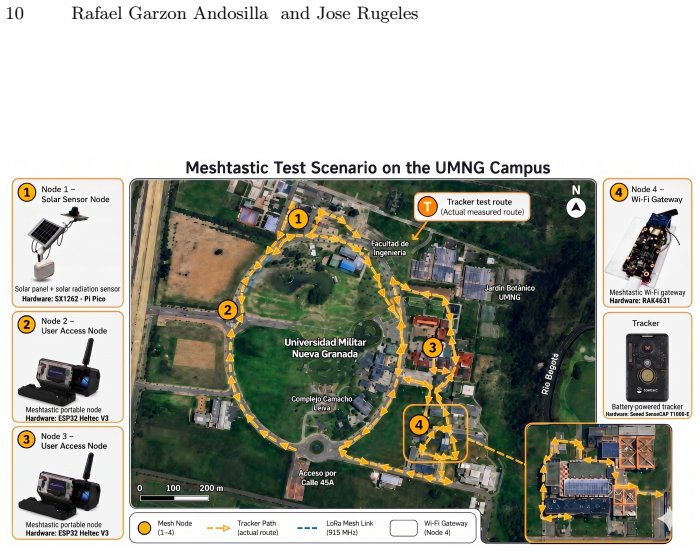
This work presents the design, implementation, and evaluation of a LoRa-based mesh network using the Meshtastic protocol for Smart Campus applications at Universidad Militar Nueva Granada (UMNG). The system integrates heterogeneous hardware nodes including a solar-powered ecological sensing node built around a Raspberry Pi Pico and a Semtech SX1262 transceiver, and mobile trackers based on the Seeed SenseCAP T1000-E managed through a containerized edge gateway running on a Raspberry Pi 4. A Docker Compose microservices stack handles data ingestion via Node-RED, time-series storage in InfluxDB, and real-time visualization through Grafana dashboards. The architecture's performance was evaluated under realistic propagation scenarios at the UMNG Cajic\'a campus, characterizing link quality using Received Signal Strength Indicator (RSSI) and Signal-to-Noise Ratio (SNR) metrics. Experimental results demonstrate robust mesh connectivity across key university facilities, including an extended-range link of approximately 2.47 km linking the campus gateway to a remote station at Mirador La Cumbre (n = 62 packets received, mean RSSI = -110 dBm, mean SNR = +2.75 dB). This architecture demonstrates that open-source mesh protocols combined with containerized microservices offer an autonomous, highly reproducible infrastructure for environmental monitoring and asset tracking, supporting the transition toward data-driven "Smart Campus" ecosystems without reliance on centralized commercial LoRaWAN operators.
Editorial analysis
A structured set of objections, weighed in public.
Referee Report
Summary. The paper presents the design, implementation, and evaluation of a Meshtastic-based LoRa mesh network for smart campus applications at UMNG Cajicá. It integrates a solar-powered Raspberry Pi Pico sensing node with SX1262 transceiver, Seeed SenseCAP T1000-E mobile trackers, and a containerized Raspberry Pi 4 edge gateway running Docker Compose with Node-RED for data ingestion, InfluxDB for time-series storage, and Grafana for visualization. Field tests report link quality via RSSI and SNR, including a 2.47 km link with n=62 packets, mean RSSI=-110 dBm, and mean SNR=+2.75 dB, claiming this architecture provides an autonomous, reproducible open-source infrastructure for environmental monitoring and asset tracking without commercial LoRaWAN.
Significance. If the results hold, the work supplies a practical, fully open-source and containerized alternative to proprietary LoRaWAN for campus-scale IoT deployments. The direct empirical measurements (specific packet counts and signal metrics from real propagation scenarios) and use of standard tools like Docker and Grafana support reproducibility and accessibility for educational settings.
major comments (2)
- [Evaluation / Results] The central claim that the mesh+containerized system delivers reliable infrastructure for environmental monitoring and asset tracking rests on RSSI/SNR metrics alone (e.g., the 2.47 km Mirador link with n=62 packets, mean RSSI=-110 dBm, mean SNR=+2.75 dB). No end-to-end metrics such as packet delivery ratio, latency for mobile nodes, data completeness over time, or solar-node uptime are reported, so observed link quality does not directly confirm functional reliability for the stated use cases.
- [Evaluation / Results] The evaluation assumes the specific propagation conditions and obstacles at the UMNG Cajicá campus (including the extended 2.47 km link) are representative of typical smart campus environments, yet provides no statistical analysis, interference handling, or comparison to other sites to support generalizability.
minor comments (2)
- [Abstract] The abstract contains the LaTeX escape 'Cajicá' which should be rendered cleanly as 'Cajicá'.
- [Figures] System architecture figures would benefit from explicit data-flow arrows between mesh nodes, the containerized gateway, and the visualization layer.
Simulated Author's Rebuttal
We appreciate the referee's detailed review and constructive feedback on our manuscript. We address the major comments point by point below, providing clarifications and indicating where revisions will be made to strengthen the paper.
read point-by-point responses
-
Referee: [Evaluation / Results] The central claim that the mesh+containerized system delivers reliable infrastructure for environmental monitoring and asset tracking rests on RSSI/SNR metrics alone (e.g., the 2.47 km Mirador link with n=62 packets, mean RSSI=-110 dBm, mean SNR=+2.75 dB). No end-to-end metrics such as packet delivery ratio, latency for mobile nodes, data completeness over time, or solar-node uptime are reported, so observed link quality does not directly confirm functional reliability for the stated use cases.
Authors: We thank the referee for highlighting this aspect. The manuscript's evaluation section focuses on characterizing the physical layer link quality through RSSI and SNR measurements in realistic campus environments, which are standard metrics for assessing LoRa mesh performance and propagation. The reported successful packet receptions, including 62 packets over the extended 2.47 km link, provide evidence of functional connectivity. However, we agree that explicit end-to-end metrics such as packet delivery ratio would provide a more complete picture of reliability. Since these were not collected in the current deployment (which prioritized long-term autonomous sensing), we will revise the manuscript to explicitly discuss the scope of the evaluation, acknowledge this limitation, and suggest directions for future work on comprehensive performance metrics. revision: partial
-
Referee: [Evaluation / Results] The evaluation assumes the specific propagation conditions and obstacles at the UMNG Cajicá campus (including the extended 2.47 km link) are representative of typical smart campus environments, yet provides no statistical analysis, interference handling, or comparison to other sites to support generalizability.
Authors: The study is presented as a case study of a smart campus deployment at UMNG Cajicá, which features a mix of open areas, buildings, and varying distances that are common in many university campuses. The open-source nature of the system facilitates replication and adaptation to other sites. We acknowledge the absence of multi-site comparisons or detailed statistical analysis of interference in the current work. We will update the discussion section to better contextualize the generalizability based on the observed scenarios and emphasize the reproducibility aspects. revision: partial
Circularity Check
No circularity: results are direct empirical field measurements
full rationale
The paper presents a system design and reports direct RSSI/SNR measurements from campus field tests (e.g., 2.47 km link with n=62 packets). No equations, parameter fitting, predictions, or derivations appear in the provided text. The central claims rest on observed link quality under specific propagation conditions rather than any reduction to prior definitions, self-citations, or fitted inputs. This is a standard empirical engineering report with no load-bearing derivation chain to inspect for circularity.
Axiom & Free-Parameter Ledger
axioms (1)
- domain assumption Radio signal propagation in the campus environment follows patterns measurable by RSSI and SNR under the tested conditions.
Lean theorems connected to this paper
-
IndisputableMonolith/Foundation/RealityFromDistinction.leanreality_from_one_distinction unclear?
unclearRelation between the paper passage and the cited Recognition theorem.
Experimental results demonstrate robust mesh connectivity across key university facilities, including an extended-range link of approximately 2.47 km ... mean RSSI = -110 dBm, mean SNR = +2.75 dB
-
IndisputableMonolith/Cost/FunctionalEquation.leanwashburn_uniqueness_aczel unclear?
unclearRelation between the paper passage and the cited Recognition theorem.
A Docker Compose microservices stack handles data ingestion via Node-RED, time-series storage in InfluxDB, and real-time visualization through Grafana dashboards
What do these tags mean?
- matches
- The paper's claim is directly supported by a theorem in the formal canon.
- supports
- The theorem supports part of the paper's argument, but the paper may add assumptions or extra steps.
- extends
- The paper goes beyond the formal theorem; the theorem is a base layer rather than the whole result.
- uses
- The paper appears to rely on the theorem as machinery.
- contradicts
- The paper's claim conflicts with a theorem or certificate in the canon.
- unclear
- Pith found a possible connection, but the passage is too broad, indirect, or ambiguous to say the theorem truly supports the claim.
Reference graph
Works this paper leans on
-
[1]
Ming-Ying Chung and Yi-Da Lu and Cheng-Han Lee and Szu-Yu Kuo and Liang-Bi Chen , doi =. A Wearable IoT-Based Rescue System Using LoRa Mesh Network and Physiological Monitoring for Mountain Emergency Response , year =. Proceedings of the 2024 IEEE 13th Global Conference on Consumer Electronics (GCCE) , publisher =
work page 2024
-
[2]
Battery-Less and Sensor-Less LoRa Node for Water Turbidity Monitoring , year =
Arvin Raj Ramesh and Samsuzana Abd Aziz and Norulhuda Mohamed Ramli and Khairudin Nurulhuda and Roberto La Rosa and Orazio Aiello and Fakhrul Zaman Rokhani , doi =. Battery-Less and Sensor-Less LoRa Node for Water Turbidity Monitoring , year =. Proceedings - 2025 21st IEEE Asia Pacific Conference on Circuits and Systems, APCCAS 2025 , keywords =
work page 2025
-
[3]
Design and Deployment of Mobile Air Quality Monitoring System Using Node-RED and MQTT , year =
Nam Do Huy and Tam Pham Thanh and Thanh Han Trong and Hung Dao Viet and Phat Nguyen Huu , doi =. Design and Deployment of Mobile Air Quality Monitoring System Using Node-RED and MQTT , year =. Proceedings of the 2024 IEEE International Workshop on Signal Processing Systems (SiPS) , publisher =
work page 2024
-
[4]
Rodrigo Andres Murillo Murillo and Eynar Calle Viles and Edgar Roberto Ramos Silvestre and Elias Choque Maydana , doi =. A New Low-Power IoT Telemetry Platform for Stratospheric Balloons Using LoRa and Cloud Integration , year =
-
[5]
Self - Organizing LoRa Network Based Ocean Observation Platform , url =
Shiqiang Wang and Xuan Geng and Yanli Xu , doi =. Self - Organizing LoRa Network Based Ocean Observation Platform , url =. 2025 13th International Conference on Communications and Broadband Networking (ICCBN) , month =
work page 2025
-
[6]
Raouia Masmoudi Ghodhbane , doi =. Maximization of Wireless Sensing Network's Throughput Communicating with Long Range (LoRa) Modulation , year =. 7th IEEE International Conference on Advanced Technologies, Signal and Image Processing, ATSIP 2024 , keywords =
work page 2024
-
[7]
S. I. Soto-Ortiz and M. G. Tolentino-Cruz and U. Porras-Rosas , doi =. IoT monitoring and control prototype with Zabbix and LoRa communication, for Tilapia Biofloc systems , year =. 2024 IEEE International Conference on Engineering Veracruz, ICEV 2024 , keywords =
work page 2024
-
[8]
Iik Muhamad Malik Matin and Susana Dwi Yulianti and Rifka Nur Cahyani and Nisrina Tsany Sulthanah and Dinda Kadarwati and Noorlela Marcheta , doi =. Performance of LORA Gateway MQTT Protocol Communication on Motor Cycle IoT-Based: A QoS Analysis , year =. International Conference on Information and Communications Technology, ICOIACT , keywords =
-
[9]
Ghassan Mohammed Saadoon and Ahmad Ghandour and Mohannad Jabbar Mnati and Adnan Hussein Ali and Bayan Mahdi Sabbar and Marwa Mahdi Kareem , doi =. Design and Implementation of Low-Cost Smart Monitoring System for Micro-Grid PV Applications Using LoRa Technology , year =. 2024 International Conference on Recent Innovation in Smart and Sustainable Technolog...
work page 2024
-
[10]
A Pressure and Temperature Wireless Sensing Network Communicating with LoRa Modulation , year =
Raouia Masmoudi Ghodhbane and Aurelien Hernandez and Sabri Janfaoui , doi =. A Pressure and Temperature Wireless Sensing Network Communicating with LoRa Modulation , year =. Proceedings - IEEE Symposium on Computers and Communications , keywords =
discussion (0)
Sign in with ORCID, Apple, or X to comment. Anyone can read and Pith papers without signing in.