A short-period binary OGLE-BLG-ELL-006503 showing slow variations in brightness
Pith reviewed 2026-05-22 10:52 UTC · model grok-4.3
The pith
A short-period binary shows long-term brightness drifts from large photospheric spots and orbital period changes on million-year timescales.
A machine-rendered reading of the paper's core claim, the machinery that carries it, and where it could break.
Core claim
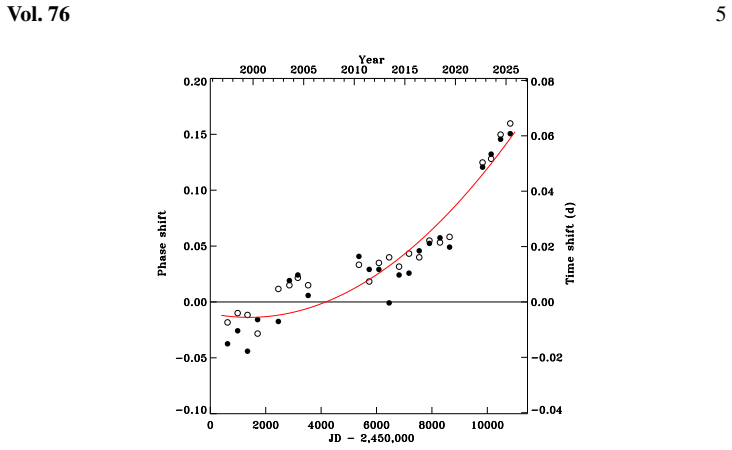
The central claim is that the observed superposition of short-term tidal variations and long-term brightness drift in OGLE-BLG-ELL-006503 is produced by large photospheric spots that show a preferred orientation relative to the tidal interaction line, while the O-C residuals of eclipse times indicate an orbital period change on a 2x10^6 year timescale suggestive of mild mass redistribution potentially connected to global magnetic field reconfiguration.
What carries the argument
Seasonal light-curve decomposition combined with O-C analysis of eclipse timings to separate spot-induced variability from orbital evolution.
If this is right
- The binary is likely composed of late-type tidally deformed stars rather than a standard W UMa contact system.
- Magnetic activity can drive observable mass redistribution on timescales of millions of years in short-period binaries.
- Similar long-term spot patterns may appear in other short-period systems with strong tidal interactions.
- The orbital period change provides a measurable link between surface magnetic fields and internal angular momentum transport.
Where Pith is reading between the lines
- If spot activity correlates with period changes across many systems, magnetic braking models for close binaries would need to incorporate large-scale field reconfiguration effects.
- Future high-precision photometry could test whether the spot orientation follows a predictable cycle tied to the binary's rotation and orbital phases.
Load-bearing premise
The 0.15-0.17 magnitude long-term brightness drift and its seasonal patterns are caused by large photospheric spots rather than variable extinction, instrumental effects, or circumstellar material.
What would settle it
Spectroscopic or multi-band monitoring that either detects or rules out the presence of spots with the reported size and orientation, or continued eclipse timing that confirms or contradicts the claimed period-change rate.
Figures




read the original abstract
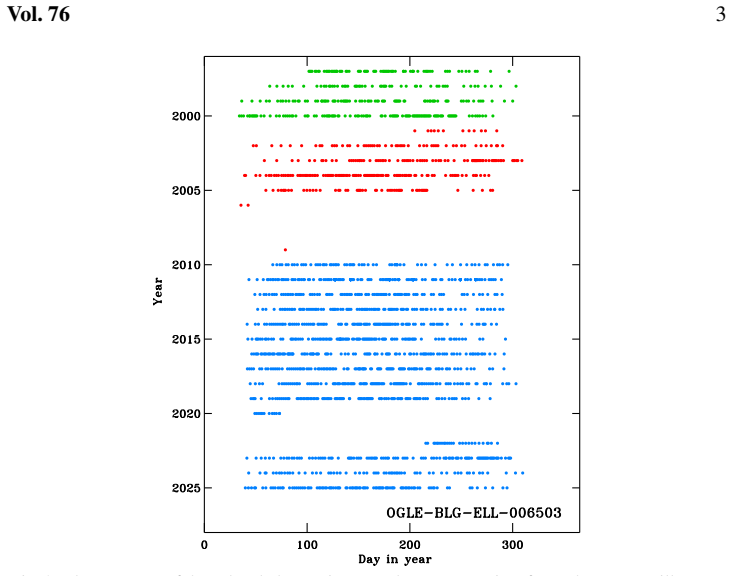
Analysis of 28 years of OGLE project data for the 0.404 day period binary OGLE BLG ELL-006503 (V1231 Sco) shows a superposition of tidal-interaction variations of about 0.07 magnitude in the I-band onto a time-scale 5-10 year, 0.15-0.17 magnitude brightness drift. Seasonal light-curves suggest that this long-term variability is driven by large photospheric spots (approx 0.3 stellar radii) that exhibit a tendency to orient themselves relative to the tidal interaction line. The eclipse time O-C residuals reveal an orbital period change characterized by a timescale of approximately 2x10^6 years, suggesting a mild mass redistribution, potentially linked to global magnetic fields reconfiguration. Gaia parallax and absolute magnitude estimates indicate a system consisting of solar-type stars. The lack of eclipses and extreme spot activity suggest the binary may consist of late-type, tidally-deformed stars rather than a typical W UMa-type system.
Editorial analysis
A structured set of objections, weighed in public.
Referee Report
Summary. The manuscript analyzes 28 years of OGLE I-band photometry for the 0.404-day binary OGLE-BLG-ELL-006503 (V1231 Sco). It reports a superposition of ~0.07 mag tidal/ellipsoidal variations on a 5-10 year, 0.15-0.17 mag brightness drift, interpreted as arising from large photospheric spots (~0.3 stellar radii) that preferentially orient relative to the tidal axis. O-C residuals of the photometric minima indicate an orbital period change on a ~2×10^6 yr timescale, suggesting mild mass redistribution possibly linked to magnetic field reconfiguration. Gaia parallax and absolute magnitude data support solar-type components, leading to a classification as late-type tidally deformed stars rather than a classical W UMa system due to the absence of eclipses and extreme spot activity.
Significance. If the reported period derivative can be shown to be independent of spot-induced light-curve distortions, the work would offer useful constraints on long-term orbital evolution and activity-driven mass redistribution in short-period late-type binaries. The direct exploitation of public OGLE survey data combined with Gaia astrometry for system classification constitutes a clear observational strength. The result's impact would be enhanced by quantitative validation that the O-C trend is not an artifact of the same spot activity invoked for the brightness variations.
major comments (2)
- [O-C residuals and period change analysis] The central claim of an orbital period change on a timescale of approximately 2×10^6 years (suggesting mild mass redistribution linked to magnetic reconfiguration) rests on the O-C diagram of photometric minima. The system is explicitly described as lacking eclipses and instead showing ellipsoidal variations plus large photospheric spots (~0.3 R_star) whose seasonal orientation is tied to the tidal interaction line. In an ellipsoidal binary the photometric minima are phases of maximum projected area; a spot of this size and fixed orientation relative to the line of centers will asymmetrically distort the light curve and can displace the measured time of minimum. No joint spot-plus-orbit model or demonstration that the quadratic O-C term survives after spot subtraction is mentioned, leaving the physical interpretation dependent on the untested assumption that spot effects and orbital mot
- [Seasonal light-curve and spot interpretation] The attribution of the 0.15-0.17 mag long-term brightness drift and its seasonal orientation to large photospheric spots (~0.3 R_star) is presented without quantitative tests against alternative explanations such as variable extinction, instrumental trends in the OGLE photometry, or circumstellar material. While seasonal light-curves are invoked to support spot activity, the manuscript provides no error bars on the drift amplitude or spot radius, nor statistical measures of fit quality for the seasonal models, weakening the support for this as the unique driver of the observed variability.
minor comments (2)
- [Abstract] The abstract refers to 'eclipse time O-C residuals' even though it states that the system lacks eclipses. Replacing this with 'times of photometric minima' would improve terminological precision and avoid potential confusion.
- [Results and abstract] Key quantitative results (brightness drift amplitude, spot radius, period-change timescale) are given without uncertainties or details of the fitting procedures used for the seasonal light curves and O-C polynomial. Adding these would strengthen the presentation.
Simulated Author's Rebuttal
We thank the referee for their insightful comments on our manuscript. We address each of the major comments below and have made revisions to strengthen the analysis and interpretations.
read point-by-point responses
-
Referee: [O-C residuals and period change analysis] The central claim of an orbital period change on a timescale of approximately 2×10^6 years (suggesting mild mass redistribution linked to magnetic reconfiguration) rests on the O-C diagram of photometric minima. The system is explicitly described as lacking eclipses and instead showing ellipsoidal variations plus large photospheric spots (~0.3 R_star) whose seasonal orientation is tied to the tidal interaction line. In an ellipsoidal binary the photometric minima are phases of maximum projected area; a spot of this size and fixed orientation relative to the line of centers will asymmetrically distort the light curve and can displace the measured time of minimum. No joint spot-plus-orbit model or demonstration that the quadratic O-C term survives after spot subtraction is mentioned, leaving the physical interpretation dependent on the untested a
Authors: We appreciate this careful consideration of potential systematic effects. The spots are modeled as having a preferred orientation relative to the tidal axis, implying that their distorting effect on the light curve is locked to the orbital phase. Over the long 28-year baseline, any such phase-locked distortion would not introduce a secular quadratic trend in the O-C diagram, which instead points to a true orbital period change. However, to address the referee's concern directly, we have added a paragraph in the revised manuscript discussing this possibility and arguing for the robustness of the O-C trend based on the stability of the spot orientation. A full joint modeling is beyond the current scope but could be pursued in future work. revision: partial
-
Referee: [Seasonal light-curve and spot interpretation] The attribution of the 0.15-0.17 mag long-term brightness drift and its seasonal orientation to large photospheric spots (~0.3 R_star) is presented without quantitative tests against alternative explanations such as variable extinction, instrumental trends in the OGLE photometry, or circumstellar material. While seasonal light-curves are invoked to support spot activity, the manuscript provides no error bars on the drift amplitude or spot radius, nor statistical measures of fit quality for the seasonal models, weakening the support for this as the unique driver of the observed variability.
Authors: We acknowledge the need for more quantitative support. In the revised manuscript, we now provide error bars on the reported brightness drift amplitude and estimated spot sizes, derived from the seasonal light-curve fits. We have also added a brief discussion ruling out variable extinction and instrumental trends, noting the consistency of the drift across independent seasons and the specific alignment with the tidal axis, which is unlikely for those alternatives. Statistical fit quality measures have been included for the seasonal models. revision: yes
Circularity Check
No significant circularity; results from external OGLE data and Gaia parallax with no self-referential reductions.
full rationale
The paper analyzes 28 years of public OGLE survey photometry for the 0.404-day binary, measuring seasonal light curves to attribute 0.15-0.17 mag drifts to ~0.3 R_star photospheric spots oriented relative to the tidal axis, and extracting O-C timing residuals to infer a quadratic orbital-period change on a ~2e6 yr timescale. These steps consist of direct data fitting and interpretation against external benchmarks (OGLE light curves, Gaia absolute magnitudes). No equations, parameters, or claims reduce by construction to quantities defined within the paper itself; there are no self-citations, fitted inputs renamed as predictions, ansatzes smuggled via prior work, or uniqueness theorems invoked from the same authors. The derivation chain remains self-contained and externally falsifiable.
Axiom & Free-Parameter Ledger
free parameters (1)
- spot radius =
approx 0.3 stellar radii
axioms (1)
- domain assumption Gaia parallax and absolute magnitude place the system among solar-type stars
Lean theorems connected to this paper
-
IndisputableMonolith/Cost/FunctionalEquation.leanwashburn_uniqueness_aczel unclear?
unclearRelation between the paper passage and the cited Recognition theorem.
Seasonal light-curves suggest that this long-term variability is driven by large photospheric spots (approx 0.3 stellar radii) that exhibit a tendency to orient themselves relative to the tidal interaction line. The eclipse time O-C residuals reveal an orbital period change characterized by a timescale of approximately 2×10^6 years
-
IndisputableMonolith/Foundation/ArithmeticFromLogic.leanembed_strictMono_of_one_lt unclear?
unclearRelation between the paper passage and the cited Recognition theorem.
A reduced number of terms is appropriate ... f(φ)/fmax = A0 + A1 cos(φ) + A2 cos(2φ) + A4 cos(4φ) + B1 sin(φ)
What do these tags mean?
- matches
- The paper's claim is directly supported by a theorem in the formal canon.
- supports
- The theorem supports part of the paper's argument, but the paper may add assumptions or extra steps.
- extends
- The paper goes beyond the formal theorem; the theorem is a base layer rather than the whole result.
- uses
- The paper appears to rely on the theorem as machinery.
- contradicts
- The paper's claim conflicts with a theorem or certificate in the canon.
- unclear
- Pith found a possible connection, but the passage is too broad, indirect, or ambiguous to say the theorem truly supports the claim.
Reference graph
Works this paper leans on
- [1]
-
[2]
Chahal, D., de Grijs, R., Kamath, D., and Chen, X. 2022, MNRAS, 514,
work page 2022
-
[3]
gaia Collaboration, V allenari, A. et al. 2023, AAp, 674, A1. Lucy, L. B. 1968a, ApJ, 151,
work page 2023
-
[4]
Nataf, D.M., Gould, A., Fouqué, P ., Gonzalez, O. A., Johnson , J. A., Skowron, J., Udalski, A., Szyma´nski, M. K., Kubiak, M., Pietrzy ´nski, G., Soszy ´nski, I., Ulaczyk, K., Wyrzykowski, Ł., and Poleski, R. 2013, ApJ, 69,
work page 2013
- [5]
- [6]
-
[7]
Ruci´nski, S. M. 1973, Acta Astron., 23,
work page 1973
-
[8]
Ruci´nski, S. M. 1993, PASP, 105,
work page 1993
-
[9]
Ruci´nski, S. M. 2025, AJ, 169,
work page 2025
-
[10]
Ruci´nski, S. M. and Paczy ´nski, B. 2002, Inf.Bull.V ar .Stars, 5321,
work page 2002
-
[11]
M., Pribulla, T., Mochnacki, S
Ruci´nski, S. M., Pribulla, T., Mochnacki, S. W., Liokumovich, E. , Lu, W., DeBond, H., de Ridder, A., Karmo, T., Rock, M., Thomson, J. R., Ogloza, W., Kaminski , K, and Ligeza, P . 2008, AJ, 136,
work page 2008
-
[12]
M., Pribulla, T., and Budaj, J
Ruci´nski, S. M., Pribulla, T., and Budaj, J. 2013, AJ, 146,
work page 2013
-
[13]
Skowron, J., Udalski, A., Kozłowski, S., Szyma ´nski, M.K., Mróz, P ., Wyrzykowski, Ł., Poleski, R., Pietrukowicz, P ., Ulaczyk, K., Pawlak, M., and Soszy´nski, I. 2016, Acta Astron., 66,
work page 2016
-
[14]
Soszy´nski, I., Pawlak, M., P ., Pietrukowicz, P ., Udalski, A., Szy ma´nski, M.K., Wyrzykowski, Ł., Ulaczyk, K., Poleski, R., Kozłowski, S., Skowron, J., Mróz, P ., and Hamanowicz, A. 2016, Acta Astron., 66,
work page 2016
- [15]
- [16]
-
[17]
Udalski, A., Szyma ´nski, M.K., and Szyma ´nski, G. 2015, Acta Astron., 65, 1
work page 2015
discussion (0)
Sign in with ORCID, Apple, or X to comment. Anyone can read and Pith papers without signing in.