REVIEW 4 major objections 4 minor 46 references
Hybrid Graphs for Table-and-Text based Question Answering using LLMs
T0 review · 4 major / 4 minor · reviewed 2026-08-10 · deepseek-v4-flash
Pith's one-line read The paper sets out to show that a question-conditioned Hybrid Graph, built from both a table and its linked passages, lets an LLM answer multi-hop Table-Text QA without any fine-tuning.
desk verdict A practical zero-shot recipe for table-text QA with real but modest gains over full-context baselines, undermined by overclaimed abstract numbers and an unanalyzed pruning failure mode. read the letter →
The pith
A machine-rendered reading of the paper's core claim, the machinery that carries it, and where it could break.
The reading
What carries the argument
The central object is the Hybrid Graph, which combines a sub-table of relevant columns with a bipartite entity-document graph whose named entities are linked to table cells and passages. The load-bearing mechanism is the question-conditioned Breadth-First Search: question entities are mapped to headers (or 'Others'), matched semantically to graph nodes with a 0.8 threshold, and used as starting points for a three-hop traversal; the visited paths are stored hop-wise and handed to the LLM incrementally so it can answer from the first hop that suffices or return 'None' to trigger expansion. This graph traversal is what filters noise, preserves cross-source connections, and keeps the context small.
What would settle it
On a random sample from the two dev sets, compute whether the gold answer appears among the nodes and linked passages of the 3-hop pruned subgraph that ODYSSEY would hand to the reader; if a substantial share of correctly answered questions has the answer outside that subgraph, or if the scores change sharply when the hop limit or matching threshold is moved on a fresh sample, the pruning assumption is falsified.
Extended reading notes
Core claim
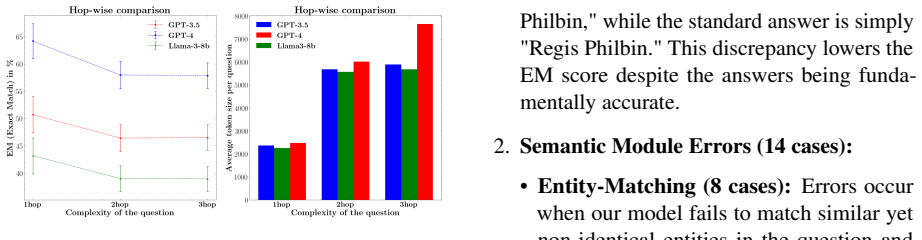
The authors' central claim is that ODYSSEY, a zero-shot pipeline, answers hybrid table-text questions by first constructing a Hybrid Graph from the retrieved sub-table and named entities in linked passages, then pruning this graph with a question-driven BFS up to three hops, and only then feeding the pruned context to an LLM reader hop by hop. The paper reports that this construction achieves the best zero-shot Exact Match on both datasets among the considered baselines, improving EM by up to 10% on Hybrid-QA and 5.4% on OTT-QA, and that it reduces reader token usage by up to 53% compared to the original table-and-text context. The argument is that most questions can be answered from a small subgraph, and the hop-wise 'None' protocol provides a fallback to full context in the roughly 8-10% of cases where pruning is insufficient.
Load-bearing premise
Everything depends on the answer being reachable within three hops from the single best semantically matched question entity; if that start entity is wrong or the answer lies farther out, the pruned context can miss it with no explicit signal.
Editorial extensions
If this is right
- If the central claim is right, zero-shot LLM systems can match or beat fine-tuned Table-Text QA models on Hybrid-QA and OTT-QA without needing human-curated training data.
- Because almost 90% of questions are answered within one or two hops, the context passed to the reader can be kept small, making the approach more affordable and more scalable to long passages.
- Token reductions of up to 53% compared with the full context directly lower API cost per query, which matters for real deployments.
- The method improves results across GPT-4, GPT-3.5, and Llama-3, so the benefit comes from graph pruning rather than from a single model's capacity.
Reading between the lines
- A direct test would be measuring subgraph recall: for a random sample, does the gold answer actually lie inside the 3-hop pruned subgraph, independent of the LLM's extraction? If not, the pruning step is the bottleneck, not the reader.
- The same question-conditioned graph pruning idea could be carried to other heterogeneous evidence, such as knowledge graphs plus text, or images with captions, wherever a small subgraph can be extracted before a multimodal LLM call.
- The reported 3-hop limit and 0.8 matching threshold were tuned on 50 dev samples, so an extension would be to test sensitivity on fresh samples and across different semantic matchers to see whether the gains are robust.
- A low-cost improvement could be trying multiple start entities or all entities above the threshold instead of only the best one, which might reduce the silent-failure cases where the true answer lies outside the pruned graph.
Editorial analysis
A structured set of objections, weighed in public.
Referee Report
Summary. The paper proposes ODYSSEY, a zero-shot, fine-tuning-free approach to table-and-text question answering. The method extracts entities from the question, constructs a hybrid graph that joins a retrieved sub-table with an entity-document graph built from linked passages, and then prunes the graph via semantic matching (instructor-xl, threshold 0.8) followed by a 3-hop BFS traversal. The pruned context is fed to a reader LLM hop-wise, with a fallback to the full table-text if the reader returns 'None'. The authors evaluate on 500-sample subsets of Hybrid-QA and OTT-QA using GPT-4, GPT-3.5, and Llama3-8B, comparing against full-context and summarization baselines, and also compare against fine-tuned and program-based methods. They report EM improvements of up to 10% on Hybrid-QA and 5.4% on OTT-QA, plus token reductions of up to 53%.
Significance. If the central empirical claim holds, the paper is a useful practical contribution: it shows that a relatively simple, training-free graph-pruning pipeline can match or exceed full-context prompting on hybrid table-text QA at lower token cost. The method is clearly described, the ablation of hop-wise versus one-shot retrieval is informative, and the authors are transparent about the fallback mechanism and the 50-sample hyperparameter tuning. The main weaknesses are statistical: the headline EM differences in Table 3 are small relative to the sample size, no significance tests are provided, and the comparison against fine-tuned systems on OTT-QA is not matched. The paper does not directly measure whether the pruning step retains the gold evidence, leaving the mechanism underlying the gains under-validated. Overall, the contribution is potentially valuable but the evidence as presented is not yet strong enough for a definitive acceptance.
major comments (4)
- [Section 5, Table 3] The central empirical claim rests on small EM differences that may be within sampling noise. For example, on Hybrid-QA with GPT-4 the full-context baseline scores 55.40 EM and ODYSSEY w/ hopwise scores 58.40, a difference of 3.0 points; on OTT-QA with GPT-4 the corresponding numbers are 58.86 and 62.02, a difference of 3.16 points. With 500 samples, the standard error of each of these differences is roughly 3 percentage points, so the observed gains are not clearly distinguishable from noise. The paper reports no confidence intervals, significance tests, or bootstrap estimates for Table 3. Please provide these, or explicitly present the results as exploratory; without them the abstract's claim of 'best zero-shot performance' is not statistically supported.
- [Sections 3.2.3 and 5.4] The paper never measures whether the gold evidence actually survives the pruning step. The single-start, 0.8-threshold BFS can exclude the gold answer while the reader LLM still outputs a confident non-None answer, and the reported ~10% (Hybrid-QA) and ~8% (OTT-QA) fallback rates do not account for this silent-failure channel. The error analysis in Section 5.4 classifies 41 GPT-4 errors into categories such as Expression Mismatch and Entity-Matching, but it does not distinguish 'answer absent from the pruned context' from 'answer present but misread'. Please report the recall of gold evidence in the pruned subgraph (e.g., the fraction of questions where the gold table cell or passage is within the 3-hop context) and add an explicit error category for pruning-induced absence. This is load-bearing because the method's claimed advantage is precisely that pruning preserves the relevant evidence, and without this measurement the EM gains could be driven by the full-context fallback or by the reader's parametric knowledge.
- [Tables 4 and 5] The comparison against fine-tuned state-of-the-art systems is not matched. Table 4 evaluates ODYSSEY and HPROPRO on the same 200 sampled Hybrid-QA dev cases using GPT-4-0613, which is reasonable. However, Table 5 compares ODYSSEY on 500 sampled OTT-QA dev cases using GPT-4-1106-preview against published full-dev-set numbers for fine-tuned systems such as COS and CORE. This introduces both subset-selection bias and a model-version mismatch. The claim of outperforming fine-tuned SoTA on OTT-QA is therefore not supported by the present evidence. Please either evaluate on the full dev set (or a common random subset) with the same model versions, or clearly label the comparison as approximate and non-matched.
- [Section 4.4 and Figure 4] The two free parameters of the method—the 0.8 semantic-matching threshold and the 3-hop BFS limit—were tuned on 50 dev samples and then evaluated on a different 500-sample dev subset. The paper states that the 50 samples are distinct from the experimental set, which mitigates direct overfitting, but no sensitivity analysis is provided. Since the method's behavior can change sharply with these parameters (e.g., a lower threshold would start traversal from more entities, a higher hop limit would include more context), please report results across a small grid of threshold values and hop limits, or at least show that the main conclusions in Table 3 are stable to reasonable variations. Without such an analysis, the reader cannot assess how robust the reported gains are to the chosen hyperparameters.
minor comments (4)
- [Abstract and Conclusion] The abstract's 'up to 10%' and '5.4%' EM improvements are relative improvements over the full-context baseline (e.g., Hybrid-QA GPT-3.5: (44.2-40.22)/40.22 ≈ 9.9%; OTT-QA GPT-4: (62.02-58.86)/58.86 ≈ 5.4%), but the text does not say 'relative'. The absolute EM differences in Table 3 are much smaller, and readers could misinterpret the percentages as absolute gains. Please clarify this in both the abstract and the results section.
- [Section 5.4] The error analysis is numbered '5.4' in the main text but is referenced elsewhere as 'Appendix 5.4'; please unify the cross-references. Also, the error categories are useful, but the sample size (100 cases, 41 errors) is small; consider reporting the error analysis on the full 500-sample evaluation set if feasible.
- [Global] There are several typographical and formatting issues: 'we presents' in Section 5, 'Positon 4' in Figure 3, and inconsistent use of 'ODYSSEY' versus 'Odyssey' in the conclusion. These do not affect the technical content but should be cleaned up.
- [Section 4.4 and Table 6] The token-cost comparison in Table 6 uses OpenAI pricing as of June 2024, which is reasonable, but the cost figures are reported without mentioning that they are based on the GPT-4 Turbo price per 1K tokens. Please state the assumed price explicitly in the table caption or text, and note that the 'Summarized' baseline's token counts may depend on the specific summarization prompt used.
Circularity Check
No significant circularity: the method is empirical, evaluated against external benchmarks, and the tuned hyperparameters are disclosed and not predictions.
full rationale
The paper makes no derivational claim that reduces to its own inputs. ODYSSEY is an empirical pipeline (question analysis, hybrid graph construction, traversal, reader LLM) evaluated on the Hybrid-QA and OTT-QA benchmarks. The only tuned quantities are the 0.8 semantic-matching threshold and the 3-hop traversal limit, selected on 50 dev samples as stated in Section 4.4: "We select the highest-ranked entity surpassing a 0.8 threshold... These values were determined by experimenting on 50 samples from the dev set." These are hyperparameters, not fitted predictions of the reported EM scores, and the evaluation is performed on a separately sampled 500-instance dev set. The reported EM/F1 comparisons in Tables 3-5 are against external baselines and fine-tuned models, and the token-efficiency claims in Table 6 are directly measured input sizes. There is no self-citation chain, no imported uniqueness theorem, no ansatz smuggled via citation, and no equation by which a result equals its input by construction. The abstract's 'up to 10%' improvement is not directly recoverable from Table 3 (the largest GPT-3.5 Hybrid-QA EM gap versus the full-context baseline in that table is 44.2 - 40.22 = 3.98), but this is an internal reporting inconsistency rather than circularity. Likewise, the skeptic's concern that a wrong start entity or a 3-hop limit could silently exclude gold evidence is a legitimate correctness or evaluation risk, not a circularity of the derivation chain.
Assumptions & free parameters
free parameters (2)
- Semantic matching threshold =
0.8
- BFS hop limit =
3
assumptions (4)
- domain assumption A 3-hop breadth-first traversal from the single best matched question entity contains the answer for the large majority of questions
- domain assumption GPT-3.5-turbo can reliably extract question entities, relevant table headers, and entity-header mappings
- domain assumption SpaCy transformer NER and instructor-xl embeddings provide accurate entity and semantic matches
- domain assumption The reader LLM's 'None' output is a trustworthy signal of insufficient context
Cite this review
Pith. "Pith review of Hybrid Graphs for Table-and-Text based Question Answering using LLMs." pith.science (2026). https://pith.science/paper/B6KSXQLP
@misc{pith2026250117767,
  author       = {Pith},
  title        = {Pith review of: Hybrid Graphs for Table-and-Text based Question Answering using LLMs},
  year         = {2026},
  howpublished = {\url{https://pith.science/paper/B6KSXQLP}},
  note         = {Machine review of arXiv:2501.17767}
}
read the original abstract
Answering questions that require reasoning and aggregation across both structured (tables) and unstructured (raw text) data sources presents significant challenges. Current methods rely on fine-tuning and high-quality, human-curated data, which is difficult to obtain. Recent advances in Large Language Models (LLMs) have shown promising results for multi-hop question answering (QA) over single-source text data in a zero-shot setting, yet exploration into multi-source Table-Text QA remains limited. In this paper, we present a novel Hybrid Graph-based approach for Table-Text QA that leverages LLMs without fine-tuning. Our method constructs a unified Hybrid Graph from textual and tabular data, pruning information based on the input question to provide the LLM with relevant context concisely. We evaluate our approach on the challenging Hybrid-QA and OTT-QA datasets using state-of-the-art LLMs, including GPT-3.5, GPT-4, and LLaMA-3. Our method achieves the best zero-shot performance on both datasets, improving Exact Match scores by up to 10% on Hybrid-QA and 5.4% on OTT-QA. Moreover, our approach reduces token usage by up to 53% compared to the original context.
Figures


Figures from the paper (1 more)
Reference graph
Works this paper leans on
-
[1]
Josh Achiam, Steven Adler, Sandhini Agarwal, Lama Ahmad, Ilge Akkaya, Florencia Leoni Aleman, Diogo Almeida, Janko Altenschmidt, Sam Altman, Shyamal Anadkat, et al. 2023. Gpt-4 technical report. arXiv preprint arXiv:2303.08774
arXiv 2023
-
[2]
Wenhu Chen, Ming-Wei Chang, Eva Schlinger, William Yang Wang, and William W Cohen. 2020 a . Open question answering over tables and text. In International Conference on Learning Representations
work page 2020
-
[3]
Wenhu Chen, Hanwen Zha, Zhiyu Chen, Wenhan Xiong, Hong Wang, and William Yang Wang. 2020 b . Hybridqa: A dataset of multi-hop question answering over tabular and textual data. In Findings of the Association for Computational Linguistics: EMNLP 2020, pages 1026--1036
work page 2020
-
[4]
Jacob Devlin, Ming-Wei Chang, Kenton Lee, and Kristina Toutanova. 2018. Bert: Pre-training of deep bidirectional transformers for language understanding. arXiv preprint arXiv:1810.04805
arXiv 2018
-
[5]
Julian Martin Eisenschlos, Maharshi Gor, Thomas M \"u ller, and William W Cohen. 2021. Mate: multi-view attention for table transformer efficiency. arXiv preprint arXiv:2109.04312
work page Pith review arXiv 2021
-
[6]
Dawei Gao, Haibin Wang, Yaliang Li, Xiuyu Sun, Yichen Qian, Bolin Ding, and Jingren Zhou. 2023. Text-to-sql empowered by large language models: A benchmark evaluation. arXiv preprint arXiv:2308.15363
arXiv 2023
-
[7]
Jonathan Herzig, Pawe Krzysztof Nowak, Thomas M \"u ller, Francesco Piccinno, and Julian Martin Eisenschlos. 2020. Tapas: Weakly supervised table parsing via pre-training. arXiv preprint arXiv:2004.02349
arXiv 2020
-
[8]
Minghao Hu, Yuxing Peng, Zhen Huang, Xipeng Qiu, Furu Wei, and Ming Zhou. 2018. Reinforced mnemonic reader for machine reading comprehension. In Proceedings of the 27th International Joint Conference on Artificial Intelligence, pages 4099--4106
work page 2018
Show all 46 references
-
[9]
Binyuan Hui, Ruiying Geng, Lihan Wang, Bowen Qin, Bowen Li, Jian Sun, and Yongbin Li. 2022. s ^ 2 SQL : Injecting syntax to question-schema interaction graph encoder for text-to- SQL parsers. arXiv preprint arXiv:2203.06958
2022 arXiv
-
[10]
Jinhao Jiang, Kun Zhou, Zican Dong, Keming Ye, Wayne Xin Zhao, and Ji-Rong Wen. 2023. Structgpt: A general framework for large language model to reason over structured data. In Proceedings of the 2023 Conference on Empirical Methods in Natural Language Processing, pages 9237--9251
2023
-
[11]
Hanlei Jin, Yang Zhang, Dan Meng, Jun Wang, and Jinghua Tan. 2024. A comprehensive survey on process-oriented automatic text summarization with exploration of llm-based methods. arXiv preprint arXiv:2403.02901
2024
-
[12]
Vladimir Karpukhin, Barlas Oguz, Sewon Min, Patrick Lewis, Ledell Wu, Sergey Edunov, Danqi Chen, and Wen-tau Yih. 2020. Dense passage retrieval for open-domain question answering. In Proceedings of the 2020 Conference on Empirical Methods in Natural Language Processing (EMNLP)...
2020
-
[13]
Omar Khattab and Matei Zaharia. 2020. Colbert: Efficient and effective passage search via contextualized late interaction over bert. In Proceedings of the 43rd International ACM SIGIR conference on research and development in Information Retrieval, pages 39--48
2020
-
[14]
Vishwajeet Kumar, Yash Gupta, Saneem Chemmengath, Jaydeep Sen, Soumen Chakrabarti, Samarth Bharadwaj, and Feifei Pan. 2023. Multi-row, multi-span distant supervision for table+ text question answering. In Proceedings of the 61st Annual Meeting of the Association for Computatio...
2023
-
[15]
Teven Le Scao, Angela Fan, Christopher Akiki, Ellie Pavlick, Suzana Ili \'c , Daniel Hesslow, Roman Castagn \'e , Alexandra Sasha Luccioni, Fran c ois Yvon, Matthias Gall \'e , et al. 2023. Bloom: A 176b-parameter open-access multilingual language model
2023
-
[16]
Sung-Min Lee, Eunhwan Park, Daeryong Seo, Donghyeon Jeon, Inho Kang, and Seung-Hoon Na. 2023. Mafid: Moving average equipped fusion-in-decoder for question answering over tabular and textual data. In Findings of the Association for Computational Linguistics: EACL 2023, pages 2...
2023
-
[17]
Fangyu Lei, Xiang Li, Yifan Wei, Shizhu He, Yiming Huang, Jun Zhao, and Kang Liu. 2023. S3hqa: A three-stage approach for multi-hop text-table hybrid question answering. In Proceedings of the 61st Annual Meeting of the Association for Computational Linguistics (Volume 2: Short...
2023
-
[18]
Haoyang Li, Jing Zhang, Cuiping Li, and Hong Chen. 2023 a . Resdsql: Decoupling schema linking and skeleton parsing for text-to-sql. In Proceedings of the AAAI Conference on Artificial Intelligence, volume 37, pages 13067--13075
2023
-
[19]
Jinyang Li, Binyuan Hui, Reynold Cheng, Bowen Qin, Chenhao Ma, Nan Huo, Fei Huang, Wenyu Du, Luo Si, and Yongbin Li. 2023 b . Graphix-t5: Mixing pre-trained transformers with graph-aware layers for text-to-sql parsing. In Proceedings of the AAAI Conference on Artificial Intell...
2023
-
[20]
Ruosen Li and Xinya Du. 2023. Leveraging structured information for explainable multi-hop question answering and reasoning. In Findings of the Association for Computational Linguistics: EMNLP 2023, pages 6779--6789
2023
-
[21]
Yinhan Liu, Myle Ott, Naman Goyal, Jingfei Du, Mandar Joshi, Danqi Chen, Omer Levy, Mike Lewis, Luke Zettlemoyer, and Veselin Stoyanov. 2019. Roberta: A robustly optimized bert pretraining approach. arXiv preprint arXiv:1907.11692
2019 arXiv
-
[22]
Kaixin Ma, Hao Cheng, Xiaodong Liu, Eric Nyberg, and Jianfeng Gao. 2022. Open-domain question answering via chain of reasoning over heterogeneous knowledge. In Findings of the Association for Computational Linguistics: EMNLP 2022, pages 5360--5374
2022
-
[23]
Kaixin Ma, Hao Cheng, Yu Zhang, Xiaodong Liu, Eric Nyberg, and Jianfeng Gao. 2023. Chain-of-skills: A configurable model for open-domain question answering. In Proceedings of the 61st Annual Meeting of the Association for Computational Linguistics (Volume 1: Long Papers), page...
2023
-
[24]
Will Orr and Kate Crawford. 2023. The social construction of datasets: On the practices, processes and challenges of dataset creation for machine learning
2023
-
[25]
Liangming Pan, Wenhu Chen, Wenhan Xiong, Min-Yen Kan, and William Yang Wang. 2021. Unsupervised multi-hop question answering by question generation. In Proceedings of the 2021 Conference of the North American Chapter of the Association for Computational Linguistics: Human Lang...
2021
-
[26]
Ethan Perez, Patrick Lewis, Wen-tau Yih, Kyunghyun Cho, and Douwe Kiela. 2020. Unsupervised question decomposition for question answering. In Proceedings of the 2020 Conference on Empirical Methods in Natural Language Processing (EMNLP), pages 8864--8880
2020
-
[27]
Bryan Perozzi, Bahare Fatemi, Dustin Zelle, Anton Tsitsulin, Mehran Kazemi, Rami Al-Rfou, and Jonathan Halcrow. 2024. Let your graph do the talking: Encoding structured data for llms. arXiv preprint arXiv:2402.05862
2024 arXiv
-
[28]
Colin Raffel, Noam Shazeer, Adam Roberts, Katherine Lee, Sharan Narang, Michael Matena, Yanqi Zhou, Wei Li, and Peter J Liu. 2020. Exploring the limits of transfer learning with a unified text-to-text transformer. Journal of machine learning research, 21(140):1--67
2020
-
[29]
Stephen Robertson, Hugo Zaragoza, et al. 2009. The probabilistic relevance framework: Bm25 and beyond. Foundations and Trends in Information Retrieval , 3(4):333--389
2009
-
[30]
Minjoon Seo, Aniruddha Kembhavi, Ali Farhadi, and Hannaneh Hajishirzi. 2016. Bidirectional attention flow for machine comprehension. arXiv preprint arXiv:1611.01603
2016 arXiv
-
[31]
Yeon Seonwoo, Ji-Hoon Kim, Jung-Woo Ha, and Alice Oh. 2020. Context-aware answer extraction in question answering. In Proceedings of the 2020 Conference on Empirical Methods in Natural Language Processing (EMNLP), pages 2418--2428
2020
-
[32]
Qi Shi, Han Cui, Haofeng Wang, Qingfu Zhu, Wanxiang Che, and Ting Liu. 2024. Exploring hybrid question answering via program-based prompting. arXiv preprint arXiv:2402.10812
2024 arXiv
-
[33]
Haitian Sun, William W Cohen, and Ruslan Salakhutdinov. 2021. Iterative hierarchical attention for answering complex questions over long documents. arXiv preprint arXiv:2106.00200
2021 arXiv
-
[34]
Xiaoyu Tan, Haoyu Wang, Xihe Qiu, Yuan Cheng, Yinghui Xu, Wei Chu, and Yuan Qi. 2024. Struct-x: Enhancing large language models reasoning with structured data. arXiv preprint arXiv:2407.12522
2024 arXiv
-
[35]
Gemini Team, Rohan Anil, Sebastian Borgeaud, Yonghui Wu, Jean-Baptiste Alayrac, Jiahui Yu, Radu Soricut, Johan Schalkwyk, Andrew M Dai, Anja Hauth, et al. 2023. Gemini: a family of highly capable multimodal models. arXiv preprint arXiv:2312.11805
2023 arXiv
-
[36]
Harsh Trivedi, Niranjan Balasubramanian, Tushar Khot, and Ashish Sabharwal. 2023. Interleaving retrieval with chain-of-thought reasoning for knowledge-intensive multi-step questions. In Proceedings of the 61st Annual Meeting of the Association for Computational Linguistics (Vo...
2023
-
[37]
Bailin Wang, Richard Shin, Xiaodong Liu, Oleksandr Polozov, and Matthew Richardson. 2020. Rat-sql: Relation-aware schema encoding and linking for text-to-sql parsers. In Proceedings of the 58th Annual Meeting of the Association for Computational Linguistics, pages 7567--7578
2020
-
[38]
Yingyao Wang, Junwei Bao, Chaoqun Duan, Youzheng Wu, Xiaodong He, and Tiejun Zhao. 2022. Muger2: Multi-granularity evidence retrieval and reasoning for hybrid question answering. In Findings of the Association for Computational Linguistics: EMNLP 2022, pages 6687--6697
2022
-
[39]
Zhiruo Wang, Haoyu Dong, Ran Jia, Jia Li, Zhiyi Fu, Shi Han, and Dongmei Zhang. 2021. Tuta: Tree-based transformers for generally structured table pre-training. In Proceedings of the 27th ACM SIGKDD Conference on Knowledge Discovery & Data Mining, pages 1780--1790
2021
-
[40]
Jason Wei, Xuezhi Wang, Dale Schuurmans, Maarten Bosma, Fei Xia, Ed Chi, Quoc V Le, Denny Zhou, et al. 2022. Chain-of-thought prompting elicits reasoning in large language models. Advances in neural information processing systems, 35:24824--24837
2022
-
[41]
Tianbao Xie, Chen Henry Wu, Peng Shi, Ruiqi Zhong, Torsten Scholak, Michihiro Yasunaga, Chien-Sheng Wu, Ming Zhong, Pengcheng Yin, Sida I Wang, et al. 2022. Unifiedskg: Unifying and multi-tasking structured knowledge grounding with text-to-text language models. In Proceedings ...
2022
-
[42]
Tianshu Zhang, Xiang Yue, Yifei Li, and Huan Sun. 2023. Tablellama: Towards open large generalist models for tables. arXiv preprint arXiv:2311.09206
2023 arXiv
-
[43]
Bertscore: Evaluating text generation with bert
Tianyi Zhang, Varsha Kishore, Felix Wu, Kilian Q Weinberger, and Yoav Artzi. Bertscore: Evaluating text generation with bert. In International Conference on Learning Representations
-
[44]
Wanjun Zhong, Junjie Huang, Qian Liu, Ming Zhou, Jiahai Wang, Jian Yin, and Nan Duan. 2022. Reasoning over hybrid chain for table-and-text open domain qa. arXiv preprint arXiv:2201.05880
2022 arXiv
-
[45]
online" 'onlinestring :=
ENTRY address archivePrefix author booktitle chapter edition editor eid eprint eprinttype howpublished institution journal key month note number organization pages publisher school series title type volume year doi pubmed url lastchecked label extra.label sort.label short.list...
-
[46]
write newline
" write newline "" before.all 'output.state := FUNCTION n.dashify 't := "" t empty not t #1 #1 substring "-" = t #1 #2 substring "--" = not "--" * t #2 global.max substring 't := t #1 #1 substring "-" = "-" * t #2 global.max substring 't := while if t #1 #1 substring * t #2 gl...
Reviewed August 10, 2026 · model on record in the stance chip above.
Discussion (0). Continue with ORCID to comment.